|
시장보고서
상품코드
1940563
유럽의 셀프 스토리지 : 시장 점유율 분석, 업계 동향과 통계, 성장 예측(2026-2031년)Europe Self-storage - Market Share Analysis, Industry Trends & Statistics, Growth Forecasts (2026 - 2031) |
||||||
 Mordor Intelligence
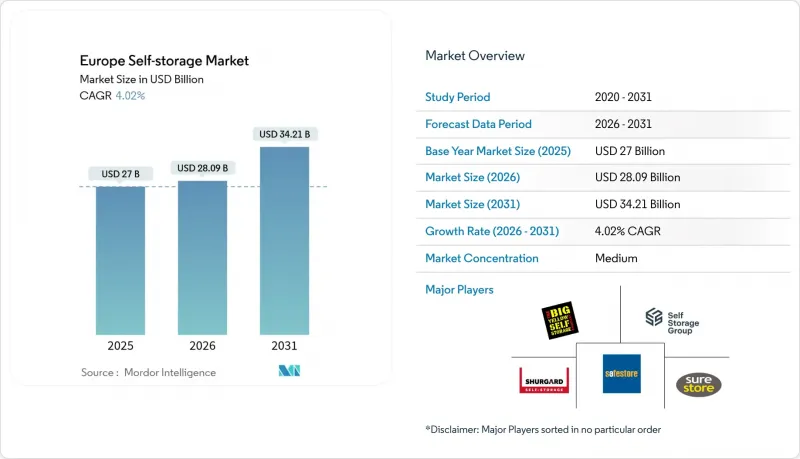
유럽의 셀프 스토리지 시장은 2025년에 270억 달러로 평가되며, 2026년 280억 9,000만 달러에서 2031년까지 342억 1,000만 달러에 달할 것으로 예측됩니다.
예측 기간(2026-2031년)의 CAGR은 4.02%로 예상됩니다.
이러한 확대는 지속적인 도시 인구 증가, 주거 이동성 증가, 그리고 보관 자산을 주변적인 부동산 투자가 아닌 인프라로 취급하는 기관 투자자들의 자금 유입에 힘입은 바 큽니다. 런던, 파리, 베를린 등 주요 도시의 도시 밀집화 및 고령화에 따른 주거 소형화 추세로 인해 경기순환을 넘어서서 가동률과 임대료 수준은 견고하게 유지되고 있습니다. 중소형 E-Commerce 기업의 마이크로 창고 전략 도입이 증가하는 한편, 학생 및 주재원들의 이동으로 예측 가능한 계절적 수요가 발생하고 있습니다. 기후정책에 따른 개보수는 비용이 많이 들지만, 에너지 효율을 향상시키고 규제 대응 시설의 이익률을 높이는 프리미엄 부문을 형성하고 있습니다.
유럽 셀프 스토리지 시장 동향과 인사이트
도시 밀집화와 마이크로 리빙
지가 상승으로 인해 도시 지역의 평균 거주 면적이 줄어들면서 주민들은 지역내 보관시설을 외부의 '방'으로 활용하게 되었습니다. 영국에서는 3년 동안 100개 이상의 신규 시설이 문을 열었고, 가구와 계절용품을 맡기는 이용자들로부터 연간 10억 파운드의 매출을 얻고 있습니다. 하이브리드형 임대 계약과 24시간 365일 디지털 접속을 통해 이 서비스는 도시 생활에 더욱 자리를 잡아가고 있습니다.
고령화에 따른 대규모 주택에서 축소
독일, 이탈리아, 영국의 고령 주택 소유자들이 소규모 주택으로 전환하면서 가보나 대형 가구의 임시 보관 수요가 발생하고 있습니다. OECD의 예측에 따르면 2050년까지 G7 도시 거주자의 25%가 65세 이상 연령층에 도달하여 지속적이고 니즈에 기반한 고객층이 형성될 것으로 예측됩니다.
엄격한 화재 안전 기준
북유럽 국가의 규정은 고급 소화 시스템과 검증된 위험 평가를 의무화하고 있으며, 이는 개보수 예산을 최대 25%까지 증가시켜 시장 진입을 지연시키는 요인으로 작용하고 있습니다.
부문 분석
2025년 기준, 유럽 셀프 스토리지 시장 매출의 69.35%를 개인 사용자가 차지했습니다. 가구의 이사, 마이크로 리빙, 은퇴 후 주거 축소로 인해 장기계약이 확보되어 거시경제 충격 시에도 가동률이 안정적으로 유지됩니다. 법인 부문은 규모는 작지만, 중소기업의 종량제 재고 공간 활용 확대에 따라 연 7.42% 성장하고 있습니다. 사업자는 현재 개인 고객에게는 라이프스타일을 강조한 메시지를, 기업 고객에게는 턴키 물류 기능을 제공하는 등 듀얼 브랜딩 전략을 구축하여 두 부문의 효과적인 수익화를 꾀하고 있습니다.
개인 임대와 관련된 유럽 셀프 스토리지 시장 규모는 단기 예약을 간소화하는 디지털 예약 플랫폼의 보급으로 2031년까지 지배적인 점유율을 유지할 것으로 예측됩니다. 한편, 지방 도시에서의 EC 침투가 심화됨에 따라 택배 집하, 랙 설치, 보험 등의 크로스셀링 서비스가 법인 고객사 당 평균 매출을 끌어올리고 있습니다.
2025년 기준, 비공조 유닛은 낮은 설비 비용으로 인해 유럽 셀프 스토리지 시장의 59.35%를 차지했습니다. 그러나 센서와 공조설비, 엄격한 출입관리로 표준 객실보다 25-40% 높은 요금을 책정할 수 있는 공조관리 유닛은 CAGR 8.82%로 확대되며 이익률 상승을 지원하고 있습니다.
규제 강화가 전환을 가속화하고 있습니다. 이미 클래스 E 기준을 충족하는 시설은 임대료 상승과 고객 이탈률 감소로 리노베이션 비용을 회수할 수 있습니다. 유럽의 공조 관리 장치 시장 규모는 2031년까지 142억 달러 이상에 달할 것으로 예상되며, 전자기기, 미술품, 공문서 전문 보험 상품에 대한 수요를 지원하고 있습니다.
기타 특전:
- 엑셀 형식 시장 예측(ME) 시트
- 애널리스트의 3개월 지원
자주 묻는 질문
목차
제1장 서론
제2장 조사 방법
제3장 개요
제4장 시장 구도
제5장 시장 규모와 성장 예측
제6장 경쟁 구도
제7장 시장 기회와 향후 전망
KSA 26.03.06The Europe self-storage market was valued at USD 27 billion in 2025 and estimated to grow from USD 28.09 billion in 2026 to reach USD 34.21 billion by 2031, at a CAGR of 4.02% during the forecast period (2026-2031).
Expansion rests on steady urban population growth, rising residential mobility, and institutional capital inflows that treat storage assets as infrastructure rather than peripheral real-estate plays. Urban compression in London, Paris, Berlin, and similar Tier-1 cities, coupled with ageing populations downsizing, keeps occupancy and rental levels resilient across economic cycles. Small and medium e-commerce businesses increasingly adopt micro-warehousing strategies, while student and expatriate mobility supplies predictable seasonal demand. Climate-policy-driven retrofits, although costly, improve energy efficiency and create a premium segment that lifts yields for compliant facilities
Europe Self-storage Market Trends and Insights
Urban compression and micro-living
Intensifying land prices have shrunk average city dwellings, prompting residents to treat local storage facilities as an external "room." Over 100 new complexes opened in the UK in three years, earning operators GBP 1 billion annually as renters off-load furniture and seasonal goods. Hybrid leases and 24/7 digital access further embed the service into day-to-day urban living.
Ageing population downsizing from larger homes
Older homeowners in Germany, Italy, and the UK are shifting to smaller dwellings, creating interim storage demand for heirlooms and bulky furniture. OECD projections show the 65+ cohort reaching 25% of G7 city dwellers by 2050, locking in a durable, needs-based customer base
Stringent fire-safety codes
Nordic rules require advanced suppression systems and verified risk assessments, adding up to 25% to conversion budgets and delaying market entry
Other drivers and restraints analyzed in the detailed report include:
- E-commerce SMB boom driving flexible micro-warehousing
- Student & expat mobility
- Heightened energy-efficiency mandates
For complete list of drivers and restraints, kindly check the Table Of Contents.
Segment Analysis
Personal users accounted for 69.35% of Europe self-storage market revenue in 2025. Household moves, micro-living, and retirement downsizing secure long-tenure contracts that stabilise occupancy during macro shocks. The business cohort, while smaller, is expanding at 7.42% annually as SMEs embrace pay-as-you-go inventory space. Operators now tailor dual-branding strategies-lifestyle messaging for individuals and turnkey logistics features for corporations-to monetise both streams effectively.
The Europe self-storage market size attached to personal tenancy is forecast to maintain a dominant share through 2031, helped by digital reservation platforms that simplify short-cycle booking. Meanwhile, cross-selling services such as courier pick-up, racking, and insurance lift average revenue per business customer as e-commerce penetration deepens in peripheral cities.
Non-climate units delivered 59.35% of Europe self-storage market share in 2025 thanks to lower fit-out costs. Yet climate-controlled stock, growing at 8.82% CAGR, underpins margin expansion because sensors, HVAC, and stricter access controls command fees 25-40% above standard rooms.
Regulatory upgrades accelerate the pivot: facilities that already meet class E standards recoup retrofit spending via higher rents and lower churn. The Europe self-storage market size for climate-controlled units is on track to surpass USD 14.2 billion by 2031, supporting specialised insurance offerings for electronics, art, and archival documents.
Europe Self Storage Market Report is Segmented by User Type (Personal and Business), Storage Type (Climate-Controlled, Non-Climate-Controlled), Space Size (Up To 90 Sq Ft, 91-150 Sq Ft, and More), Application (Household Goods, E-Commerce Micro-Fulfilment, and More), and Country. The Market Forecasts are Provided in Terms of Value (USD).
List of Companies Covered in this Report:
- Shurgard Self Storage SA
- Safestore Holdings PLC
- Big Yellow Group PLC
- Self Storage Group ASA
- Lok'nStore Group PLC
- SureStore Ltd
- Access Self Storage Ltd
- Lagerboks
- Nettolager
- Pelican Self Storage
- 24Storage AB
- Casaforte (SMC Self-Storage Management)
- W Wiedmer AG
- MyPlace SelfStorage GmbH
- BlueSpace Self-Storage S.L.
- Space Station Ltd
Additional Benefits:
- The market estimate (ME) sheet in Excel format
- 3 months of analyst support
TABLE OF CONTENTS
1 INTRODUCTION
- 1.1 Study Assumptions and Market Definition
- 1.2 Scope of the Study
2 RESEARCH METHODOLOGY
3 EXECUTIVE SUMMARY
4 MARKET LANDSCAPE
- 4.1 Market Overview
- 4.2 Market Drivers
- 4.2.1 Urban Compression and Micro-Living Trends in Tier-1 European Cities
- 4.2.2 Aging Population Downsizing from Larger Homes in Germany, Italy and UK'
- 4.2.3 E-commerce SMB Boom Driving Need for Flexible Micro-Warehousing
- 4.2.4 Surging Student & Expat Mobility Within the Schengen Region
- 4.2.5 Rise of Hybrid Work Creating Home Office Clutter
- 4.2.6 Institutional Investor Appetite for Alternative Real-Estate Yields
- 4.3 Market Restraints
- 4.3.1 Stringent Fire-Safety Codes Limiting Facility Conversions in Nordics
- 4.3.2 Scarcity of Suitable Zoned Industrial Stock in Historic City Centres
- 4.3.3 Inflation-Linked Rental Index Caps in France and Spain
- 4.3.4 Heightened Energy-Efficiency Mandates Increasing Retrofit Costs
- 4.4 Consumer Analysis
- 4.5 Regulatory Outlook
- 4.6 Porter's Five Forces Analysis
- 4.6.1 Bargaining Power of Suppliers
- 4.6.2 Bargaining Power of Buyers
- 4.6.3 Threat of New Entrants
- 4.6.4 Threat of Substitutes
- 4.6.5 Intensity of Competitive Rivalry
- 4.7 Investment Analysis
5 MARKET SIZE AND GROWTH FORECASTS (VALUE)
- 5.1 By User Type
- 5.1.1 Personal
- 5.1.2 Business
- 5.2 By Storage Type
- 5.2.1 Climate-Controlled
- 5.2.2 Non-Climate-Controlled
- 5.3 By Space Size
- 5.3.1 Up to 90 sq ft
- 5.3.2 91-150 sq ft
- 5.3.3 151-300 sq ft
- 5.3.4 Above 300 sq ft
- 5.4 By Application
- 5.4.1 Household Goods
- 5.4.2 E-commerce Micro-Fulfilment
- 5.4.3 Document & Archive Storage
- 5.4.4 Vehicle Storage
- 5.5 By Country
- 5.5.1 Germany
- 5.5.2 United Kingdom
- 5.5.3 France
- 5.5.4 Italy
- 5.5.5 Spain
- 5.5.6 Rest of Europe
6 COMPETITIVE LANDSCAPE
- 6.1 Market Concentration
- 6.2 Strategic Moves
- 6.3 Market Share Analysis
- 6.4 Company Profiles (includes Global level Overview, Market level overview, Core Segments, Financials as available, Strategic Information, Market Rank/Share for key companies, Products and Services, and Recent Developments)
- 6.4.1 Shurgard Self Storage SA
- 6.4.2 Safestore Holdings PLC
- 6.4.3 Big Yellow Group PLC
- 6.4.4 Self Storage Group ASA
- 6.4.5 Lok'nStore Group PLC
- 6.4.6 SureStore Ltd
- 6.4.7 Access Self Storage Ltd
- 6.4.8 Lagerboks
- 6.4.9 Nettolager
- 6.4.10 Pelican Self Storage
- 6.4.11 24Storage AB
- 6.4.12 Casaforte (SMC Self-Storage Management)
- 6.4.13 W Wiedmer AG
- 6.4.14 MyPlace SelfStorage GmbH
- 6.4.15 BlueSpace Self-Storage S.L.
- 6.4.16 Space Station Ltd
7 MARKET OPPORTUNITIES AND FUTURE OUTLOOK
- 7.1 White-space and Unmet-Need Assessment