
|
시장보고서
상품코드
1940600
특수 의료용 의자 : 시장 점유율 분석, 업계 동향과 통계, 성장 예측(2026-2031년)Specialty Medical Chairs - Market Share Analysis, Industry Trends & Statistics, Growth Forecasts (2026 - 2031) |
||||||
 Mordor Intelligence
특수 의료용 의자 시장은 2025년에 44억 2,000만 달러로 평가되었고, 2026년 47억 1,000만 달러에서 2031년까지 64억 6,000만 달러에 달할 것으로 예측됩니다.
예측 기간(2026-2031년)의 CAGR은 6.52%로 예상됩니다.
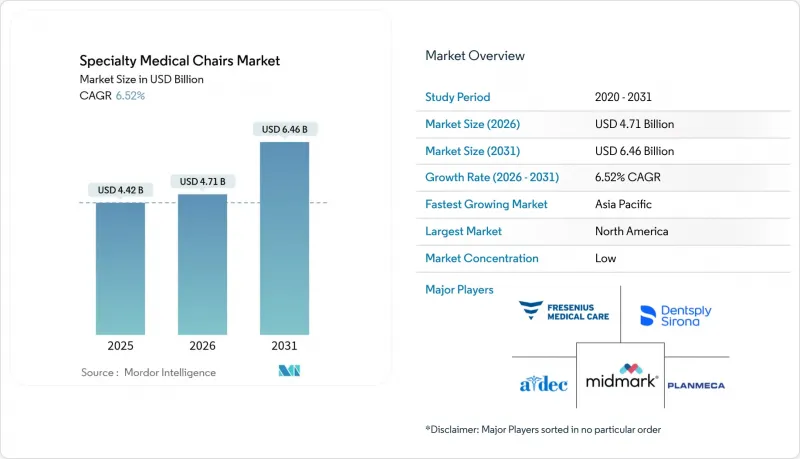
이러한 성장세는 고령화, 복합질환, 복잡한 시술의 외래 및 재택 전환 등의 요인이 겹치면서 인체공학적 기술 집약형 의자에 대한 수요가 증가하고 있음을 반영하고 있습니다. 의료기관은 보다 엄격한 욕창 예방 프로토콜을 준수하면서 처리 효율을 최적화하는 완전 전동식 및 IoT 지원 모델로 전환하고 있습니다. 팬데믹 기간 동안 동결되었던 자본 예산이 점차 완화되고 있지만, 갱신 결정은 여전히 입증 가능한 ROI, 규제 요건, 사이버 보안 조치의 구축 상황과 밀접하게 연관되어 있습니다. 동시에 유럽 의료기기 규정(MDR)과 화재안전기준으로 인해 특수 의료용 의자 시장은 비용적인 역풍을 맞고 있으며, 이는 실내장식 비용을 12-15% 상승시켜 기존 제조업체의 규모 우위를 더욱 강화시키고 있습니다.
세계 특수 의료용 의자 시장 동향 및 인사이트
고령화와 복합질환의 부담으로 투석-화학요법-비만치료용 의자 수요 가속화
85세 이상은 65-74세보다 3배 많은 의료자원을 이용하고 있으며, 미국의 100세 이상 인구는 2054년까지 4배 증가할 것으로 예측되고 있습니다. 이러한 인구통계학적 변화에 따라 투석, 종양, 비만 치료 부문에서는 장시간 치료, 고중량 제한, 정밀 포지셔닝에 대응하는 디자인의 의자 도입이 추진되고 있습니다. 메디케어 인증 ASC(Ambulatory Surgery Center)는 고령화에 따른 수술 수요에 대응하기 위해 수용 능력을 지속적으로 확대하고 있으며, 이에 따라 고급 의료용 의자에 대한 수요는 지속적으로 증가할 것으로 예측됩니다. 의료 시스템에서는 설계 측면에서 총소유비용 절감 효과도 고려하고 있으며, 구체적으로 환자 교체 시간 단축, 간병인의 부담 경감, 감염 방지 처리의 통합을 고려하고 있습니다.
기술 혁신 : 완전 전동식 및 IoT 지원 의자로 의료 서비스 제공업체의 투자 수익률 개선
커넥티드 체어는 사용 현황 및 유지보수 데이터를 병원 자산관리 플랫폼으로 직접 전송하여 예지보수를 통한 다운타임 감소를 실현합니다. 응급실에서는 IoT 통합을 통해 마운트 시나이 병원이 대기 시간을 50% 단축했습니다. 프리셋 설정으로 환자 간 셋업 시간을 단축하고, 특히 안과나 치과 진료실에서 표준화된 진료 경로를 지원합니다. 사이버 공격 위험이 증가하는 가운데, 암호화 펌웨어와 네트워크 분할 기능을 갖춘 완전 전동식 시스템은 필수적인 자본 구매품이 되었습니다.
Post COVID의 자본 예산 동결로 인해 갱신 주기가 연장되었습니다.
2024년에는 병원의 영업이익률이 1-2%로 압축되고, 의료기기의 수명주기가 기존 기준을 크게 초과하여 연장될 수 밖에 없는 상황입니다. 이익 풀은 2027년까지 연평균 복합 성장률(CAGR) 7%로 회복될 것으로 예상되지만, 의사결정권자들은 여전히 규제 의무 또는 측정 가능한 처리량 증가와 직결된 구매만 승인하고 있습니다. 대규모 의료 시스템은 자금 조달을 쉽게 확보할 수 있기 때문에 단독 지방 병원과의 기술 격차가 확대되고, 지방 병원은 의자 업그레이드를 다음 주기로 연기할 가능성이 있습니다.
부문 분석
치료용 의자가 혁신의 속도를 결정하고 있으며, 이 부문의 특수 의료용 의자 시장 규모는 2026-2031년 연평균 복합 성장률(CAGR) 7.05%를 나타낼 것으로 예측됩니다. 매출 성장은 치과, 이비인후과, 안과 클리닉에서 이미지 포트, AI 유도 포지셔닝, 항균성 장지 결합 모델을 채택하는 것에 기인합니다. 진단용 의자는 2025년 38.02%의 시장 점유율을 유지하며 심장병학, 투석과 같은 핵심 전문 분야를 뒷받침하고 있습니다. 광범위한 설치 기반이 교체 수요의 기반이 되고 있으며, 현재 치료용 의자는 프리미엄 마진을 견인하는 역할을 하고 있습니다.
시뮬레이션 연구에 따르면, 첨단 치과용 의자의 인체공학적 디자인은 임상의의 허리 부담을 42% 감소시키면서 환자의 시야를 넓혀 프리미엄 가격을 정당화할 수 있습니다. 각 제조업체들은 분만센터용으로도 횡위 분만 자세를 지원하고 응급상황 시 신속하게 수술 모드로 전환할 수 있는 디자인을 개발했습니다. 400파운드의 하중을 견딜 수 있는 휴대용 채혈 의자는 지역 검진 프로그램에 지속적으로 침투하고 있으며, 포트폴리오의 밸류엔드(Value End) 판매량을 강화하고 있습니다.
재활용 의자는 환자 리프트 기능의 통합, 단차 없는 좌석 높이, 강화된 프레임을 필요로 하는 고령자 및 비만 환자층을 위한 재활용 의자입니다. 2025년 전 세계 비만 성인 인구가 10억 명을 돌파할 것으로 예상되는 가운데, 비만 환자를 위한 모델은 두 자릿수 성장세를 보이고 있습니다. 투석용 리클라이너는 재택 치료의 확대로 수요가 증가하고 있으며, 일부 모델에는 블루투스 연결 혈압계 커프와 자동 팔걸이 회전 기능을 탑재해 바늘 삽입의 효율성을 높이고 있습니다.
세계 특수 의료용 의자 시장은 제품 유형(진료용 의자(심장용 의자, 분만용 의자 등), 치료용 의자, 재활용 의자), 기술(수동식, 반 전동식, 전동식), 최종 사용자(병원, 클리닉, 치과 등), 지역(북미, 유럽, 아시아태평양 등)으로 분류됩니다. 분류됩니다. 시장 예측은 금액 기준(USD)으로 제공됩니다.
지역별 분석
북미는 2025년 매출의 40.85%를 차지할 것으로 예상되며, 이는 외래 수술센터(ASC)의 확산, 적극적인 IoT 도입, 재택 투석에 대한 조기 상환을 반영하고 있습니다. 미국 의료 서비스 제공업체들은 ESKD 치료 옵션 인센티브와 VHA 욕창 예방 의무화(VHA pressure ulcer prevention mandate)의 혜택을 받고 있습니다. 캐나다에서는 주정부 계획에 따라 투석실을 현대화하고 있으며, 멕시코의 민간 병원 그룹은 의료관광 수요를 잡기 위해 수술실 시설을 개선하고 있습니다. 이러한 요인들이 결합되어 자본 예산은 고급형 완전 전기 모델에 집중되어 있으며, 연결성을 전제로 한 지속적인 소프트웨어 지원 계약을 촉진하고 있습니다.
아시아태평양은 가장 빠르게 성장하는 시장으로 2031년까지 연평균 복합 성장률(CAGR) 7.08%를 나타낼 것으로 예측됩니다. 중국, 인도, 인도네시아 정부는 병원 건설과 종양학 데이케어 센터에 사상 최대 규모의 자금을 투입하고 있으며, 이들 국가는 모두 링거 스탠드 일체형 및 체중 적응형 센서 매트가 장착된 종양학 리클라이너 의자를 필요로 하고 있습니다. 호주의 아이콘 그룹은 말레이시아에서 의자 수요를 창출하기 위해 국경을 초월한 합작투자를 활용했습니다. 한편, 일본에서는 하이브리드 치료 의자를 가정에 도입하는 원격 재활 프로그램이 가속화되고 있습니다. 현지 조달 전략과 기술이전 계약으로 납기가 단축되고 있지만, 3차 의료시설에서는 여전히 고급 수입품이 프리미엄 점유율을 차지하고 있습니다.
유럽에서는 엄격한 의료기기 규제(MDR)와 화재 안전 기준 준수가 요구되는 가운데, 견고하면서도 완만한 성장세를 유지하고 있습니다. 독일, 프랑스, 영국에서는 욕창 예방 대책과 종양학 데이케어 시설의 갱신에 자금을 투입하고, 미기후 관리 기능을 갖춘 스마트 리클라이너의 도입이 지속되고 있습니다. 인증기관의 역량 부족으로 인증 기간이 장기화되어 중소 공급업체의 진입을 가로막는 한편, 평균 단가를 상승시키고 있습니다. 브렉시트 이후 영국 제조업체는 이중 규제에 대응해야 하고, 서비스 제공 비용은 상승하지만 시장 접근성은 유지됩니다.
기타 특전:
- 엑셀 형식 시장 예측(ME) 시트
- 애널리스트의 3개월 지원
자주 묻는 질문
목차
제1장 서론
제2장 조사 방법
제3장 주요 요약
제4장 시장 구도
제5장 시장 규모와 성장 예측(금액-달러)
제6장 경쟁 구도
제7장 시장 기회와 향후 전망
LSH 26.03.10The specialty medical chairs market was valued at USD 4.42 billion in 2025 and estimated to grow from USD 4.71 billion in 2026 to reach USD 6.46 billion by 2031, at a CAGR of 6.52% during the forecast period (2026-2031).
This momentum reflects the collision of population aging, multimorbidity, and the shift of complex procedures into outpatient and home settings, all of which raise demand for ergonomic, technology-rich seating. Providers are gravitating toward fully-electric, IoT-enabled models that optimize throughput while complying with stricter pressure-injury prevention protocols. Capital budgets are gradually loosening after pandemic-era freezes, yet replacement decisions remain tightly linked to demonstrable ROI, regulatory mandates, and cybersecurity readiness. At the same time, the specialty medical chairs market faces cost headwinds from European MDR rules and fire-safety standards that add 12-15% to upholstery costs, reinforcing the advantage of scale for established manufacturers.
Global Specialty Medical Chairs Market Trends and Insights
Aging & Multimorbidity Burden Accelerates Demand for Dialysis, Chemo & Bariatric Chairs
People aged 85+ use triple the healthcare resources of the 65-74 cohort, and the U.S. centenarian population is projected to quadruple by 2054. This demographic surge pushes dialysis, oncology, and bariatric departments to install chairs engineered for lengthy therapies, higher weight limits, and precision positioning. Medicare-certified ASCs continue to expand capacity to handle age-linked procedures, ensuring sustained pull for premium seating. Health systems also factor in total-cost-of-ownership savings from designs that cut turnover time, lower caregiver strain, and integrate infection-control finishes.
Technology Shift to Fully-Powered, IoT-Enabled Chairs Improves ROI for Providers
Connected chairs feed utilization and maintenance data directly to hospital asset-management platforms, allowing predictive servicing that trims downtime. In emergency departments, IoT integration helped Mt. Sinai cut wait times by 50%. Preset configurations reduce setup time between patients and support standardized care pathways, especially in ophthalmology and dental suites. As cyberattack risks escalate, fully-electric systems equipped with encrypted firmware and network partitioning become essential capital purchases.
Capital-Budget Freezes Post-COVID Reduce Replacement Cycles
Hospital operating margins compressed to 1-2% in 2024, forcing equipment lifecycles to stretch well past prior benchmarks. Although profit pools are forecast to rebound at 7% CAGR by 2027, decision-makers still green-light only purchases tied to either regulatory obligation or measurable throughput gains. Larger health systems secure financing more easily, widening the technology gap with stand-alone rural hospitals that may postpone chair upgrades into the next cycle.
Other drivers and restraints analyzed in the detailed report include:
- Mandatory Pressure-Injury Prevention Protocols in OECD Hospitals
- Home-Based Kidney-Care Models Spur Residential Dialysis Recliners
- Fire-Retardancy & EU MDR Upholstery Compliance Adds 12-15% Cost
For complete list of drivers and restraints, kindly check the Table Of Contents.
Segment Analysis
Treatment chairs set the innovation tempo, and the specialty medical chairs market size for this segment is projected to climb at 7.05% CAGR between 2026-2031. Revenue growth stems from dental, ENT, and ophthalmic clinics adopting models that combine imaging ports, AI-guided positioning, and antimicrobial upholstery. Examination chairs retained 38.02% market share in 2025, serving core specialties such as cardiology and dialysis. Their broad installed base anchors replacement demand, yet treatment chairs now spearhead premium margins.
Simulation studies show advanced dental-chair ergonomics can cut lower-back stress on clinicians by 42% while expanding the patient visual field, justifying premium list prices. Manufacturers also target birthing centers with designs that support lateral delivery positions and quick emergency conversion to operating mode. Portable blood-drawing chairs with 400-lb capacities keep penetrating community-based screening programs, reinforcing volume at the value end of the portfolio.
Rehabilitation chairs cater to geriatric and bariatric populations that require patient-lift integration, zero-entry seat heights, and reinforced frames. With global obesity crossing 1 billion adults in 2025, bariatric variants achieve double-digit sub-segment growth. Dialysis recliners benefit from home-therapy expansion, and some models now include Bluetooth-linked blood-pressure cuffs and automated armrest rotation to streamline needle access.
Global Specialty Medical Chairs Market is Segmented by Product Type (Examination Chairs[Cardiac Chairs, Birthing Chairs, and More], Treatment Chairs, and Rehabilitation Chairs), Technology (Manual, Semi-Electric, and Fully-Electric), End-User (Hospitals, Clinics & Dental Practices, and More), and Geography (North America, Europe, Asia-Pacific, and More). The Market Forecasts are Provided in Terms of Value (USD).
Geography Analysis
North America generated 40.85% of 2025 revenue, reflecting widespread ASC penetration, aggressive IoT adoption, and early reimbursement for home dialysis. U.S. providers benefit from ESKD Treatment Choices incentives and from VHA pressure-injury mandates that require advanced seating. Canada's provincial plans modernize dialysis units, and Mexican private hospital groups upgrade operatories to capture inbound medical tourism. Collectively, these factors keep capital budgets oriented toward high-end, fully-electric models and fuel recurring software-support contracts tied to connectivity.
Asia-Pacific is the quickest-expanding territory, registering a 7.08% CAGR through 2031. Governments in China, India, and Indonesia are funneling record sums into hospital construction and oncology-day-care centers, each demanding oncology recliners with IV-pole integration and weight-adaptive sensor mats. Australia's Icon Group leveraged cross-border joint ventures to seed chair demand in Malaysia, while Japan accelerates tele-rehabilitation programs that deploy hybrid therapy chairs to homes. Local sourcing strategies and technology-transfer pacts shorten delivery cycles, yet top-tier imports still command premium share in tertiary facilities.
Europe maintains solid, though slower, growth amid stringent MDR and fire-safety compliance. Germany, France, and the United Kingdom channel funds into pressure-injury prevention initiatives and oncology-day-care upgrades, sustaining uptake of smart recliners with microclimate management. Shortage of notified-body capacity extends certification timelines, discouraging smaller suppliers and nudging average unit prices upward. Post-Brexit, UK manufacturers juggle dual regulatory tracks, raising cost-to-serve but preserving market access.
- Dentsply Sirona
- A-dec
- Planmeca
- Midmark
- ATMOS MedizinTechnik
- G. Heinemann Medizintechnik
- DentalEZ
- Hill Laboratories Company
- Topcon Medical Systems Inc.
- Forest Dental
- Fresenius
- Champion Manufacturing Inc.
- Invacare
- Stryker
- Danaher Corporation (Kavo Dental)
- Hill-Rom
- Digiterm Ltd.
- Drive DeVilbiss Healthcare
- Likamed GmbH
- Accora Ltd.
Additional Benefits:
- The market estimate (ME) sheet in Excel format
- 3 months of analyst support
TABLE OF CONTENTS
1 Introduction
- 1.1 Study Assumptions & Market Definition
- 1.2 Scope of the Study
2 Research Methodology
3 Executive Summary
4 Market Landscape
- 4.1 Market Overview
- 4.2 Market Drivers
- 4.2.1 Aging & Multimorbidity Burden Accelerates Demand for Dialysis, Chemo & Bariatric chairs
- 4.2.2 Technology Shift to Fully-powered, IoT-enabled Chairs Improves ROI for Providers
- 4.2.3 Mandatory Pressure-injury Prevention Protocols in OECD Hospitals
- 4.2.4 Home-based Kidney-care Models (ESKD Treatment Choices, US) Spur Residential Dialysis Recliners
- 4.2.5 Oncology-day-care Expansion in Tier-2 APAC Cities
- 4.2.6 Rising Dental & Ophthalmic Procedure Volumes Drive Specialty Chair Upgrades
- 4.3 Market Restraints
- 4.3.1 Capital-budget Freezes Post-COVID Reduce Replacement Cycles
- 4.3.2 Reimbursement Gaps for Examination Chairs Outside Hospitals
- 4.3.3 Fire-retardancy & MDR (EU) Upholstery Compliance Adds 12-15 % Cost
- 4.3.4 High Capital Cost of Specialty Chairs Limits Adoption by Small Practices
- 4.4 Value / Supply-Chain Analysis
- 4.5 Regulatory Landscape
- 4.6 Technological Outlook
- 4.7 Porter's Five Forces Analysis
- 4.7.1 Threat of New Entrants
- 4.7.2 Bargaining Power of Buyers
- 4.7.3 Bargaining Power of Suppliers
- 4.7.4 Threat of Substitutes
- 4.7.5 Competitive Rivalry
5 Market Size & Growth Forecasts (Value - USD)
- 5.1 By Product Type
- 5.1.1 Examination Chairs
- 5.1.1.1 Cardiac Chairs
- 5.1.1.2 Birthing Chairs
- 5.1.1.3 Blood Drawing Chairs
- 5.1.1.4 Dialysis Chairs
- 5.1.1.5 Others
- 5.1.2 Treatment Chairs
- 5.1.2.1 ENT Chairs
- 5.1.2.2 Ophthalmic Chairs
- 5.1.2.3 Dental Chairs
- 5.1.2.4 Other Treatment Chairs
- 5.1.3 Rehabilitation Chairs
- 5.1.3.1 Geriatric Chairs
- 5.1.3.2 Pediatric Chairs
- 5.1.3.3 Bariatric Chairs
- 5.1.3.4 Others
- 5.1.1 Examination Chairs
- 5.2 By Technology
- 5.2.1 Manual
- 5.2.2 Semi-Electric / Hydraulic
- 5.2.3 Fully-Electric / Programmable
- 5.3 By End User
- 5.3.1 Hospitals
- 5.3.2 Clinics & Dental Practices
- 5.3.3 Ambulatory Surgery Centers
- 5.3.4 Home-Care Settings & Long-Term Care
- 5.4 By Geography
- 5.4.1 North America
- 5.4.1.1 United States
- 5.4.1.2 Canada
- 5.4.1.3 Mexico
- 5.4.2 Europe
- 5.4.2.1 Germany
- 5.4.2.2 United Kingdom
- 5.4.2.3 France
- 5.4.2.4 Italy
- 5.4.2.5 Spain
- 5.4.2.6 Rest of Europe
- 5.4.3 Asia-Pacific
- 5.4.3.1 China
- 5.4.3.2 Japan
- 5.4.3.3 India
- 5.4.3.4 South Korea
- 5.4.3.5 Australia
- 5.4.3.6 Rest of Asia-Pacific
- 5.4.4 Middle East and Africa
- 5.4.4.1 GCC
- 5.4.4.2 South Africa
- 5.4.4.3 Rest of Middle East and Africa
- 5.4.5 South America
- 5.4.5.1 Brazil
- 5.4.5.2 Argentina
- 5.4.5.3 Rest of South America
- 5.4.1 North America
6 Competitive Landscape
- 6.1 Market Concentration
- 6.2 Market Share Analysis
- 6.3 Company Profiles
- 6.3.1 Dentsply Sirona
- 6.3.2 A-dec Inc.
- 6.3.3 PLANMECA OY
- 6.3.4 Midmark Corporation
- 6.3.5 ATMOS MedizinTechnik GmbH & Co. KG
- 6.3.6 G. Heinemann Medizintechnik GmbH
- 6.3.7 DentalEZ
- 6.3.8 Hill Laboratories Company
- 6.3.9 Topcon Medical Systems Inc.
- 6.3.10 Forest Dental
- 6.3.11 Fresenius Medical Care AG & Co. KGaA
- 6.3.12 Champion Manufacturing Inc.
- 6.3.13 Invacare Corporation
- 6.3.14 Stryker Corporation
- 6.3.15 Danaher Corporation (Kavo Dental)
- 6.3.16 Hill-Rom Holdings Inc.
- 6.3.17 Digiterm Ltd.
- 6.3.18 Drive DeVilbiss Healthcare
- 6.3.19 Likamed GmbH
- 6.3.20 Accora Ltd.
7 Market Opportunities & Future Outlook
- 7.1 White-space & Unmet-Need Assessment