

|
시장보고서
상품코드
1940626
기업용 직원 운송 서비스 : 시장 점유율 분석, 업계 동향과 통계, 성장 예측(2026-2031년)Corporate Employee Transportation Service - Market Share Analysis, Industry Trends & Statistics, Growth Forecasts (2026 - 2031) |
||||||
 Mordor Intelligence
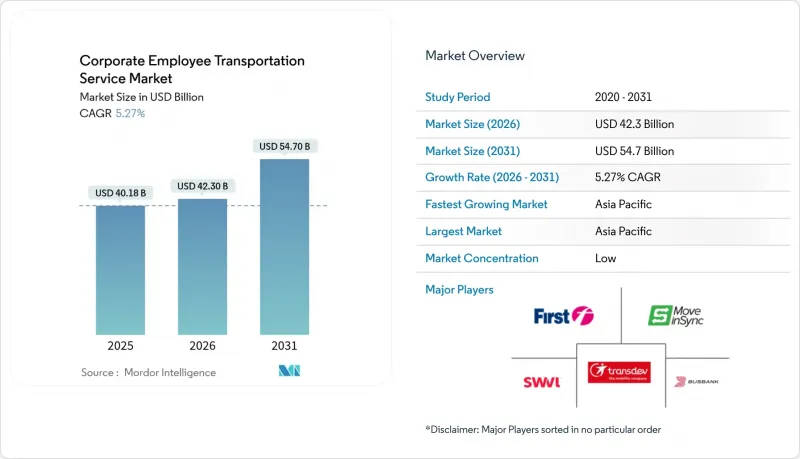
기업용 직원 운송 서비스 시장은 2025년 401억 8,000만 달러에서 2026년에는 423억 달러로 성장하여 2026년부터 2031년까지 CAGR 5.27%를 기록하며 2031년까지 547억 달러에 달할 것으로 예측됩니다.
성장의 기반은 인재 확보, Scope 3 배출 규제 대응, 경로 계획의 효율화를 위한 디지털 플랫폼 도입, 출퇴근 복리후생 프로그램의 공식적인 기업 도입에 있습니다. 자율주행 셔틀의 상용 서비스 개시, 무공해 차량에 대한 정부 지원 확대, 지방도시의 교통체증 심화 등이 복합적으로 작용하여 확대의 모멘텀을 촉진하고 있습니다. 경쟁의 격렬함은 중간 정도에 머물러 있습니다. 이는 분산된 지역 사업자군과 벤처 캐피털에 의한 플랫폼 사업자가 공존하는 한편, 운전자 부족과 보험료 상승에 따른 비용 압박으로 인해 기술 통합이 촉진되고 있기 때문입니다. 이와 함께 고용주들은 통근 지원책을 전략적 복리후생으로 간주하고, 교통 정책을 다양성, 공정성, 포용성(DEI) 목표와 일치시킴으로써 직원들의 정착률을 높이고 결근률을 낮추기 위해 노력하고 있습니다.
세계 기업용 직원 운송 서비스 시장 동향 및 인사이트
디지털 온디맨드 셔틀 플랫폼이 전 세계로 확대되고 있습니다.
정부는 교통 네트워크 기업(TNC)에 대한 보험, 라이선스, 접근성 규정을 법제화하여 앱 기반 셔틀의 기업 활용을 정당화하고 있습니다. 캘리포니아주는 승차당 보험 가입을 의무화하고, 뉴욕주는 면허료를 부과하는 등 자본력이 있는 기존 사업자에게 유리한 조치가 취해져 기업의 리스크 관리 담당자가 안심할 수 있도록 하고 있습니다. 시애틀의 단체교섭 조례는 운전기사의 임금을 높이고, 신뢰성을 향상시키며, 고용주의 서비스 수준을 향상시키는 데 기여하고 있습니다. 컴플라이언스가 명확해짐에 따라 기업용 직원 운송 서비스 시장에서는 디지털 경로 설정, 동적 가격 책정, 자동 비용 코드화가 정착되어 플랫폼의 정착도가 높아지고 있습니다.
아시아-아프리카 제2도시권의 급속한 도시 확산
인도의 스마트 시티 구상과 AMRUT 계획은 인프라 투자를 급성장하는 제2의 도시에 집중하고 있으며, 아시아개발은행이 예측하는 2050년까지 4억 명에 달하는 도시 인구 증가와도 잘 부합합니다. 사하라 이남 아프리카에서도 비슷한 추세가 확인되고 있으며, 세계은행 자료에 따르면 도시 인구는 15년 내에 두 배로 증가할 것으로 예상됩니다. OECD가 추진하는 민관 협력을 통해 지자체는 재정 계획을 수립하고, 기업 셔틀 사업자가 도시 수준의 MaaS(Mobility as a Service) 생태계에 통합될 수 있도록 지원합니다. 이러한 추세는 직원들의 출퇴근 수요를 증가시키고, 기업용 직원 운송 서비스 시장에서 경로 기반 기술을 활용하는 업체들에게 새로운 시장 기회를 열어줄 것입니다.
면허를 소지한 상업용 운전기사 부족
CDC의 모델 예측에 따르면, 은퇴자가 신규 진입자보다 많기 때문에 2030년까지 16만 명의 운전자가 부족할 것으로 예상됩니다. FMCSA의 '안전운전자 견습생 파일럿 프로그램'은 18-20세의 젊은 층을 대상으로 하고 있으며, 안전성을 검증하기 위해서는 3년간의 데이터가 필요합니다. 임금 상승에 따라 기업용 직원 운송 서비스 시장은 상업용 운전면허를 필요로 하지 않는 소형 차량과 사람에 대한 의존도를 낮추는 자율주행 시범사업 중심으로 이동하고 있습니다. 사업 기반 강화와 직원 만족도 향상을 위해 사업자는 매력적인 정착 보너스를 도입하고, 유연한 교대제 입찰 옵션을 제공하고 있습니다. 이러한 노력은 보다 안정적인 근무 환경을 조성할 뿐만 아니라, 주 간 CDL 상호인정 추진에 기여하여 후보군 확대와 다양한 기술을 가진 전문가 확보에 도움이 될 것입니다.
부문 분석
2025년 기준, 외주 운송 서비스는 기업용 직원 운송 서비스 시장의 45.05%를 차지하고 있으며, 차량 유지관리, 운전자 관리, 규제 준수 업무를 외주화하는 자산 경량화 전략으로 전환하는 기업의 움직임이 두드러집니다. 렌탈-리스는 소유 형태 중 가장 빠르게 성장하고 있으며, CAGR 7.08%를 기록하고 있습니다. 하이브리드 근무 스케줄에 대응할 수 있는 유연한 용량을 제공하며, 계절적 수요 급증 시 신속한 확장이 가능합니다. 보안 요구사항이 높은 업계에서는 자체 소유 운영이 계속되고 있지만, 자본 집약성과 다가오는 배출 규제가 확장 의지를 억제하고 있습니다.
기업용 직원 운송 서비스 시장이 성숙해짐에 따라 외주 업체는 예측 유지보수, 경로 분석, 모바일 예약 API를 통합한 턴키 솔루션을 제공하여 핵심 업무에 집중하고자 하는 인사 및 조달 부서에 매력적인 선택이 되고 있습니다. 연방정부 기관도 GSA 스케줄에 따른 제3자 차량 계약에서 유사한 추세를 보여, 공공부문에서 본 기법의 유효성을 확인하였습니다. 이를 통해 형성된 에코시스템은 다국적 사업 전개에 있어 일괄 조달, 효율화된 성과 평가 지표, 일관된 서비스 수준 계약을 촉진하고 있습니다.
버스 및 장거리 버스는 교외의 파크 앤 라이드 시설과 대규모 캠퍼스를 연결하는 고밀도 노선의 비용 효율성으로 인해 2025년 기준 기업용 직원 운송 서비스 시장 수익의 40.95%를 차지했습니다. 한편, 밴 및 MPV는 유연한 근무 형태 하에서 변동하는 일일 인원 수에 차량 용량을 맞추기 위해 8.21%의 CAGR로 빠르게 성장하고 있습니다. 기업 직원 수송 서비스 시장에서 밴의 점유율은 빠르게 확대될 것으로 예상됩니다. 이는 차량 전동화에 대한 인센티브가 총소유비용(TCO)을 개선할 수 있기 때문입니다. 독일 세제에서는 현재 9만 5,000유로(10만 달러)까지의 전기밴이 대상이며, 라이프사이클 경제성을 유리하게 이끌고 있습니다. 자율주행 파일럿 프로그램에서는 중형 포맷이 선호됩니다. 이는 차량 무게가 가볍고 차폭이 좁아 경로 인증이 간소화되기 때문입니다.
미니버스와 승용차는 틈새 역할을 유지합니다: 미니버스는 교외 순환 노선의 승객 밀도 격차를 메우고, 세단은 경영진과 의료적 배려가 필요한 승객을 위해 세단형 승용차를 운행합니다. 자동 긴급 제동부터 차선 유지 지원까지, 안전 장비의 보급으로 운영 비용 차이 축소. 고용주가 배출량 대시보드를 도입하는 가운데, 차량 유형 선택은 Scope 3 목표 달성을 위한 수단으로 배터리 구동 밴과 연료전지 버스의 모멘텀을 촉진할 수 있습니다.
지역별 분석
아시아태평양은 2025년 기업용 직원 운송 서비스 시장 규모의 39.05%를 차지했으며, 2031년까지 연평균 8.44%의 CAGR을 기록할 것으로 예상됩니다. 이는 인도의 스마트 시티 투자와 동남아시아 전역의 멀티모달 회랑 계획에 힘입은 것입니다. 중국의 도시 클러스터 전략은 메가 리저널 링 내 퍼스트 마일/라스트 마일 셔틀을 제도화하여 MaaS 통합을 위한 비옥한 토양을 제공하고 있습니다. OECD가 도입한 민관 컨세션 모델은 이용료를 통한 자본 회수 및 사업자의 진입 리스크 감소를 가능하게 합니다. 이 지역의 젊은 층 인구와 스마트폰 보급률은 모바일 예약의 우위를 더욱 강화시키고 있습니다.
북미에서는 성숙한 도입 곡선을 보이고 있으며, 연방 정부의 통근자 보조금(월 최대 325달러)이 프로그램 예산의 지속성을 뒷받침하고 있습니다. 8개 주에 걸쳐 20개 이상의 자율주행 시험 노선이 기술 리더십을 확고히 하고 있으며, 운전자 부족으로 인해 다교대 근무제 및 분할 근무표 실험이 활발히 진행되고 있습니다. 보험료 인플레이션은 지속적인 비용 압박으로 남아 소규모 사업자의 수익률을 압박하고 업계 구조조정을 촉진하고 있습니다.
유럽에서는 지속가능성과 프라이버시 관련 정책의 고도화가 두드러지게 나타나고 있습니다. 독일의 가속 상각 제도와 스페인의 MOVES III 보조금은 전기자동차 차량의 투자 회수 기간을 단축하고 빠른 갱신 주기를 촉진하고 있습니다. 네덜란드는 자전거 수당과 저세율의 회사 자전거 제도를 결합하여 능동적인 출퇴근 수단을 주류화하기 위해 노력하고 있습니다. GDPR(일반 데이터 보호 규정)과 노동위원회법은 엄격한 데이터 처리 프로토콜을 의무화하고 있으며, 벤더들이 프라이버시 중심의 솔루션을 구축하도록 장려하고 있습니다. 이러한 규제는 진입장벽을 높이는 동시에 서비스 품질을 향상시키고, 기업용 직원 운송 서비스 시장에서 유럽 업체들의 명성을 높이고 있습니다.
기타 특전:
- 엑셀 형식의 시장 예측(ME) 시트
- 애널리스트의 3개월간 지원
자주 묻는 질문
목차
제1장 소개
제2장 조사 방법
제3장 주요 요약
제4장 시장 구도
제5장 시장 규모와 성장 예측
제6장 경쟁 구도
제7장 시장 기회와 향후 전망
KSM 26.03.10The corporate employee transportation services market is expected to grow from USD 40.18 billion in 2025 to USD 42.3 billion in 2026 and is forecast to reach USD 54.7 billion by 2031 at 5.27% CAGR over 2026-2031.
Growth rests on corporations formalizing commuter-benefit programs to secure talent, comply with Scope-3 emission mandates, and adopt digital platforms that streamline route planning. Autonomous shuttle pilots entering commercial service, widening government incentives for zero-emission fleets, and rising urban congestion across Tier-2 cities collectively reinforce expansion momentum. Competitive intensity remains moderate because fragmented regional operators coexist with venture-backed platform players, while cost pressures tied to driver shortages and escalating insurance premiums encourage technology integration. In parallel, employers treat commuter offerings as a strategic benefit, aligning transportation policies with diversity, equity, and inclusion (DEI) objectives to boost retention and shrink absenteeism.
Global Corporate Employee Transportation Service Market Trends and Insights
Digital On-Demand Shuttle Platforms Are Scaling Globally
Governments have codified insurance, licensing, and accessibility rules for Transportation Network Companies, legitimizing corporate use of app-based shuttles. California mandates coverage per active ride while New York applies a licensing fee, moves that favor capitalized incumbents and reassure corporate risk managers. Seattle's collective-bargaining ordinance pushes driver wages up but lifts reliability, translating into higher employer service levels. As compliance clarity spreads, the corporate employee transportation services market embeds digital routing, dynamic pricing, and automated expense coding, deepening platform stickiness.
Rapid Urban Sprawl in Tier-2 Cities of Asia and Africa
India's Smart Cities Mission and AMRUT funnel infrastructure outlays toward rising Tier-2 hubs, dovetailing with Asian Development Bank projections of 400 million new urbanites by 2050 . Similar patterns occur in Sub-Saharan Africa where World Bank data track city populations that will double inside 15 years. Public-private partnerships championed by the OECD give municipalities financial blueprints, allowing corporate shuttle operators to integrate with city-level mobility-as-a-service ecosystems. These trends swell employee commuting demand and open white space for route-based, tech-enabled providers in the corporate employee transportation services market.
Labor Shortages in Licensed Commercial Drivers
CDC modeling foresees a 160,000-driver gap by 2030 as retirements outpace new entrants. FMCSA's Safe Driver Apprenticeship Pilot accepts 18- to 20-year-olds but needs three-year data to validate safety . With wages escalating, the corporate employee transportation services market pivots to smaller vehicles that do not require commercial driver's licenses and to autonomous pilots that reduce human dependency. To fortify their operations and enhance employee satisfaction, providers are rolling out enticing retention bonuses and offering flexible shift bidding options. These initiatives not only create a more stable work environment but also help them advocate for interstate CDL reciprocity, which would broaden their candidate pools and attract a diverse range of skilled professionals.
Other drivers and restraints analyzed in the detailed report include:
- Growing Employers' Focus on ESG and Scope-3 Emission Cuts
- Autonomous Shuttle Pilots Entering Commercial Phase
- Data-Privacy Backlash Against Employee Tracking Apps
For complete list of drivers and restraints, kindly check the Table Of Contents.
Segment Analysis
Outsourced transportation service held a 45.05% slice of the corporate employee transportation service market in 2025, underscoring a corporate pivot toward asset-light strategies that offload fleet upkeep, driver management, and regulatory compliance. Rental and leasing follow as the fastest-growing ownership mode with a 7.08% CAGR, offering flex capacity for hybrid work schedules and allowing rapid scaling during seasonal demand spikes. Company-owned operations persist in industries with elevated security needs, but capital intensity and looming emission regulations curb expansion appetite.
As the corporate employee transportation services market matures, outsourced vendors bundle predictive maintenance, route analytics, and mobile booking APIs, forming turnkey solutions attractive to HR and procurement teams focused on core-business concentration. Federal agencies mirror the trend by contracting third-party fleets under GSA schedules, signaling public-sector validation. The resulting ecosystem fosters consolidated purchasing, streamlined performance metrics, and consistent service-level agreements across multinational footprints.
Buses and coaches retained 40.95% of the corporate employee transportation service market revenue in 2025, thanks to cost-efficient high-density corridors linking suburban park-and-ride to mega campuses. Yet vans and MPVs are racing at an 8.21% CAGR, aligning vehicle capacity to volatile daily headcounts under flexible-work regimes. The corporate employee transportation services market size booked for vans will expand rapidly as fleet electrification incentives improve the total cost of ownership. Germany's tax rules now cover electric vans priced up to EUR 95,000 (USD 100,000), tilting lifecycle economics in their favor. Autonomous pilot programs favor mid-size formats because lower curb weights and narrower footprints simplify route certification.
Minibuses and passenger cars sustain niche roles: minibuses bridge passenger-density gaps on suburban circulators, while sedans cater to executives and medically sensitive riders. From automated emergency braking to lane-keeping assist, safety equipment migrates downmarket, narrowing operating-cost gaps. As employers adopt emissions dashboards, vehicle-type choice becomes a lever for meeting Scope-3 targets, reinforcing momentum for battery vans and fuel-cell buses.
The Corporate Employee Transportation Services Market Report is Segmented by Ownership (Company-Owned Transportation Service, and More), Vehicle Type (Passenger Cars, and More), Service Model (Mobility-As-A-Service, and More), Booking Platform (Mobile Application, and More), End-User Industry (IT and ITES, BFSI, and More), and Geography. The Market Forecasts are Provided in Terms of Value (USD).
Geography Analysis
Asia-Pacific exercised 39.05% control of the corporate employee transportation services market size in 2025 and is charting an 8.44% CAGR through 2031, propelled by Smart Cities investments in India and multimodal corridor plans across Southeast Asia. China's urban-cluster strategy institutionalizes first-mile/last-mile shuttles inside megaregional rings, providing fertile ground for MaaS integration. Public-private concession models seeded by the OECD permit capital recovery via availability payments and de-risking operator entry. The region's young demographic and smartphone penetration reinforce mobile-booking dominance.
North America reflects a mature adoption curve, with federal commuter subsidies of up to USD 325 monthly underpinning sustained program budgets. Over 20 autonomous pilot corridors across eight states cement technology leadership, while driver shortages spur experimentation with multi-shifts and split-duty rosters. Insurance inflation remains an ongoing cost headwind, compressing margins for small providers and nudging consolidation.
Europe showcases policy sophistication around sustainability and privacy. German accelerated depreciation and Spanish MOVES III grants compress payback on electric fleets, stimulating rapid replacement cycles. The Netherlands combines bicycle allowances with low-tax company-bike schemes to mainstream active commuting. GDPR and works council statutes impose strict data-handling protocols, prompting vendors to architect privacy-centric solutions. Such regulation simultaneously raises barriers to entry and elevates service quality, enhancing the reputation of European providers within the corporate employee transportation services market.
- Transdev Group
- FirstGroup plc
- Swvl Holdings Corp
- MoveInSync Technology Solutions Private Limited
- Shuttl (Chalo Mobility Chalo Mobility Private Limited)
- Busbank (Global Charter Services Inc.)
- Janani Tours and Resorts Pvt Ltd.
- Sun Telematics
- Via Transportation Inc.
- Lyft Inc.
- Uber Technologies Inc.
- Enterprise Holdings Inc.
- Addison Lee Limited
- Prairie Bus Lines Ltd.
- Eco Rent A Car
- Zum Services Inc.
- BusUp Technologies S.L.
- Ridecell Inc.
- Fleet Complete
Additional Benefits:
- The market estimate (ME) sheet in Excel format
- 3 months of analyst support
TABLE OF CONTENTS
1 Introduction
- 1.1 Study Assumptions & Market Definition
- 1.2 Scope of the Study
2 Research Methodology
3 Executive Summary
4 Market Landscape
- 4.1 Market Overview
- 4.2 Market Drivers
- 4.2.1 Digital On-Demand Shuttle Platforms are Scaling Globally
- 4.2.2 Growing Employers Focus on ESG And Scope-3 Emission Cuts
- 4.2.3 Corporate War for Talent, Boosting Commuter Benefits
- 4.2.4 Rapid Urban Sprawl in Tier-2 Cities of Asia and Africa
- 4.2.5 Autonomous Shuttle Pilots Entering Commercial Phase
- 4.2.6 Tax Incentives for Shared Mobility in Europe
- 4.3 Market Restraints
- 4.3.1 Labor Shortages in Licensed Commercial Drivers
- 4.3.2 Rising Insurance Premiums for Corporate Fleets
- 4.3.3 Legacy Union Opposition to Ride-Sharing Models
- 4.3.4 Data-Privacy Backlash Against Employee Tracking Apps
- 4.4 Value / Supply-Chain Analysis
- 4.5 Regulatory Landscape
- 4.6 Technological Outlook
- 4.7 Porter's Five Forces Analysis
- 4.7.1 Bargaining Power of Suppliers
- 4.7.2 Bargaining Power of Buyers/Employees
- 4.7.3 Threat of New Entrants
- 4.7.4 Threat of Substitutes
- 4.7.5 Intensity of Competitive Rivalry
5 Market Size & Growth Forecasts (Value, USD)
- 5.1 By Ownership
- 5.1.1 Company-owned Transportation Service
- 5.1.2 Outsourced Transportation Service
- 5.1.3 Rentals / Leasing
- 5.1.4 Pick & Drop (Scheduled Shuttle)
- 5.2 By Vehicle Type
- 5.2.1 Passenger Cars
- 5.2.2 Vans and MPVs
- 5.2.3 Minibuses
- 5.2.4 Buses & Coaches
- 5.3 By Service Model
- 5.3.1 Mobility-as-a-Service (MaaS)
- 5.3.2 Software-as-a-Service (SaaS) / Trip-Planning
- 5.3.3 Managed Transportation Services
- 5.3.4 Hybrid (MaaS + Managed Fleet)
- 5.4 By Booking Platform
- 5.4.1 Mobile Application
- 5.4.2 Web-based Portal
- 5.4.3 Call-center / Offline
- 5.5 By End-user Industry
- 5.5.1 IT and IT-enabled Services (ITES)
- 5.5.2 Banking, Financial Services and Insurance (BFSI)
- 5.5.3 Manufacturing and Industrial
- 5.5.4 Healthcare and Life Sciences
- 5.5.5 Energy and Utilities
- 5.5.6 Others (Education, Government, etc.)
- 5.6 By Geography
- 5.6.1 North America
- 5.6.1.1 United States
- 5.6.1.2 Canada
- 5.6.1.3 Rest of North America
- 5.6.2 South America
- 5.6.2.1 Brazil
- 5.6.2.2 Argentina
- 5.6.2.3 Rest of South America
- 5.6.3 Europe
- 5.6.3.1 Germany
- 5.6.3.2 United Kingdom
- 5.6.3.3 France
- 5.6.3.4 Spain
- 5.6.3.5 Italy
- 5.6.3.6 Netherlands
- 5.6.3.7 Poland
- 5.6.3.8 Russia
- 5.6.3.9 Rest of Europe
- 5.6.4 Asia-Pacific
- 5.6.4.1 India
- 5.6.4.2 China
- 5.6.4.3 Japan
- 5.6.4.4 South Korea
- 5.6.4.5 Australia
- 5.6.4.6 New Zealand
- 5.6.4.7 Thailand
- 5.6.4.8 Indonesia
- 5.6.4.9 Vietnam
- 5.6.4.10 Singapore
- 5.6.4.11 Rest of Asia-Pacific
- 5.6.5 Middle-East and Africa
- 5.6.5.1 United Arab Emirates
- 5.6.5.2 Saudi Arabia
- 5.6.5.3 Turkey
- 5.6.5.4 Egypt
- 5.6.5.5 South Africa
- 5.6.5.6 Rest of Middle-East and Africa
- 5.6.1 North America
6 Competitive Landscape
- 6.1 Market Concentration
- 6.2 Strategic Moves
- 6.3 Market Share Analysis
- 6.4 Company Profiles (Includes Global level Overview, Market level overview, Core Segments, Financials as available, Strategic Information, Market Rank/Share, Products & Services, Recent Developments)
- 6.4.1 Transdev Group
- 6.4.2 FirstGroup plc
- 6.4.3 Swvl Holdings Corp
- 6.4.4 MoveInSync Technology Solutions Private Limited
- 6.4.5 Shuttl (Chalo Mobility Chalo Mobility Private Limited)
- 6.4.6 Busbank (Global Charter Services Inc.)
- 6.4.7 Janani Tours and Resorts Pvt Ltd.
- 6.4.8 Sun Telematics
- 6.4.9 Via Transportation Inc.
- 6.4.10 Lyft Inc.
- 6.4.11 Uber Technologies Inc.
- 6.4.12 Enterprise Holdings Inc.
- 6.4.13 Addison Lee Limited
- 6.4.14 Prairie Bus Lines Ltd.
- 6.4.15 Eco Rent A Car
- 6.4.16 Zum Services Inc.
- 6.4.17 BusUp Technologies S.L.
- 6.4.18 Ridecell Inc.
- 6.4.19 Fleet Complete


