

|
시장보고서
상품코드
2097243
운송 업계 시험, 검사, 인증 : 시장 점유율 분석, 업계 동향과 통계, 성장 예측(2026-2031년)Testing, Inspection, and Certification for the Transportation Industry - Market Share Analysis, Industry Trends & Statistics, Growth Forecasts (2026 - 2031) |
||||||
 Mordor Intelligence
Mordor Intelligence에 의하면, 운송 업계 시험, 검사, 인증 시장 규모는 2025년에 58억 7,000만 달러로 평가되었고, 2026년 61억 2,000만 달러에서 2031년까지 75억 6,000만 달러에 이를 것으로 예측되며, 예측 기간(2026-2031년) CAGR은 4.33%를 나타낼 전망입니다.
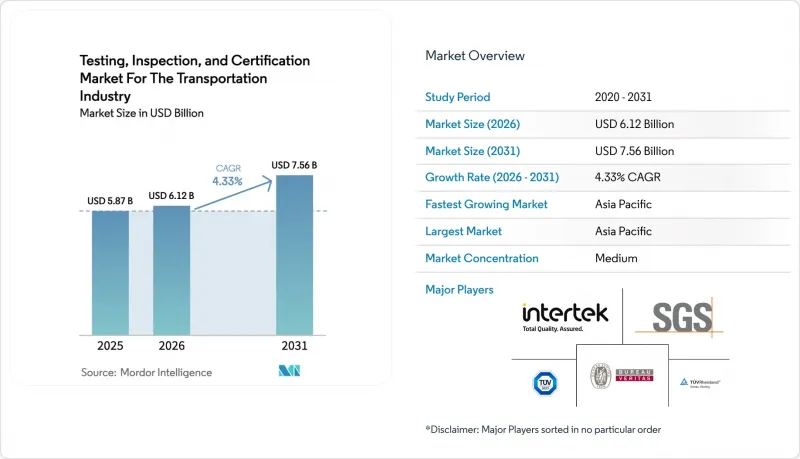
본 보고서는 서비스 유형별(시험 서비스, 검사 서비스, 인증 서비스), 조달 유형별(사내 수행 및 외부 위탁), 지역별(북미, 남미, 유럽, 아시아태평양, 중동 및 아프리카)로 분류되어 있습니다. 시장 예측은 금액(달러)으로 표시되어 있습니다.
운송 산업을 위한 시험, 검사, 인증의 세계 동향 및 인사이트
운송 안전성 및 배기가스 관련 규제의 강화
2024년에 전 세계 각국에서 채택된 배기가스 및 안전 규제로 인해 규정 준수 기준이 강화되었습니다. 특히 유로 7 실주행 배기가스 모니터링 제도와 중국의 타이어 규격 GB 9743-2024 및 GB 9744-2024를 들 수 있습니다. 유엔 유럽 경제 위원회(UNECE)의 WP.29 포럼은 제조업체가 단일 시험 세트를 통해 여러 관할 구역에서 인증을 획득할 수 있도록 규격 조화를 가속화했습니다. 현재는 성과 기반 지표가 주류를 이루고 있어, 시험소는 실제 사용 시의 작동 주기를 반영한 혁신적인 시험 절차를 설계할 수 있게 되었습니다. 자율주행을 위한 기능 안전 표준인 ISO 26262가 전 세계적으로 보급됨에 따라, 고도로 전문화된 검증에 대한 수요가 높아졌습니다. 책임 위험이 막대하기 때문에 이러한 검증에는 종종 높은 비용이 책정됩니다.
전기차(EV) 및 자율주행차의 급속한 보급에 따라 새로운 시험 프로토콜이 필요해지고 있습니다.
UL 2580의 개정을 통해 열 폭주 벤치마크가 추가되었으며, ISO 6469는 2027년 이후 출시 예정인 고체 전지까지 적용 범위를 확대했습니다. SAE J3018 및 ISO/TS 5083:2025에 기반한 자율주행 규격에서는 다층적인 센서, 알고리즘, 사이버 보안 시험이 의무화되어 있어, 이로 인해 검증 주기는 장기화되고 있지만 프로젝트당 수익은 증가하고 있습니다. 2024년에는 전력 회사로부터 양방향 안전성에 대한 증명이 요구됨에 따라, V2G(Vehicle-to-Grid) 인터페이스 시험이 독립된 서비스 라인으로 분리되었습니다.
중소기업의 높은 규정 준수 시험 비용
유럽연합 집행위원회의 조사에 따르면, 소규모 공급업체들은 현재 차량 시험에 연간 5만-10만 유로(5만 3,500-10만 7,000달러)를 지출하고 있으며, 이러한 지출이 운전자금을 압박하고 있습니다. 배터리 시험소 건설에는 200만-500만 달러의 비용이 소요되어 신규 진입 업체에게 진입 장벽이 되고 있습니다. 인증 취득까지의 기간이 길기 때문에 제품 출시 전에 자금이 묶이게 되어, 많은 중소기업은 공동 개발 모델이나 구독 모델의 도입을 선택할 수밖에 없습니다.
부문 분석
시험 서비스가 가장 큰 점유율을 차지하고 있으며, 이는 부품에서 완성차에 이르는 형식 인증에 이르기까지 다단계에 걸친 검증이 의무화되어 있음을 반영합니다. 운송 산업용 시험, 검사, 인증 시장 전체에서 2025년에는 배터리 극한 시험 및 ADAS(첨단 운전자 지원 시스템) 검증으로 인해 시험 서비스가 58.92%를 차지했습니다. 한편, 인증 분야는 성과 기반 규격에 따라 규제 당국이 원격으로 감사할 수 있는 디지털 인증서에 대한 수요가 증가하고 있어 연평균 성장률(CAGR) 4.88%로 확대될 것으로 전망됩니다. 이러한 변화는 ISO 26262 및 ISO 21434의 사이버 보안 승인에 고액의 수수료가 책정되어 있어, 이익률 향상으로도 이어질 것입니다.
검사는 안정적인 사업 분야이지만, 성장 속도는 비교적 완만합니다. 원격 모니터링 및 자동 카메라 시스템으로 인해 반복적인 물리적 점검이 줄어들었기 때문에 시험 및 인증에 비해 성장이 둔화되고 있습니다. 각 서비스 제공업체들은 알고리즘이 부적합 차량만을 식별하고 수동 재심사를 수행하는 ‘예외 기반’ 모델로 검사 포트폴리오를 재구성하여, 관련성을 유지하면서 비용을 절감하고 있습니다.
지역별 분석
2025년, 아시아태평양은 운송 산업용 시험, 검사, 인증 시장에서 매출의 39.12%를 차지하며 시장을 주도했습니다. 또한 2031년까지 연평균 성장률(CAGR) 5.18%라는 가장 높은 성장률을 나타낼 것으로 전망됩니다. 중국에서는 GB 38031-2020 배터리 안전 기준과 적극적인 신에너지차(NEV) 할당제 덕분에 시험소의 가동률이 안정적으로 유지되고 있습니다. 한편, 인도에서는 Bharat NCAP 2.0에 기반한 ADAS(첨단 운전자 지원 시스템) 시험으로의 전환이 진행되고 있어 해외 TIC 투자를 유치하고 있습니다. 일본과 한국에서는 전고체 배터리나 자율주행 셔틀과 관련된 고부가가치 수요가 추가되고 있지만, 차량 기반이 성숙기에 접어들었기 때문에 수량 증가세는 제한되고 있습니다.
북미는 이에 이어, 엄격한 연방 자동차 안전 기준(FMVSS)과 커넥티드카의 사이버 보안에 대한 중요성이 부각되면서 고단가 전문 시험 수요가 발생하고 있습니다. 2024년 FMCSA(연방자동차안전국)의 개정으로 상용차 감독이 강화됨에 따라, 미국의 차량 운영 사업자들은 외부에 위탁되는 검사량의 대부분을 차지하고 있습니다.
유럽은 계속해서 견조한 모습을 보이고 있으며, WP.29에 따른 규제 조화와 실제 주행 배기가스 검증이 필요한 유로 7 도입이 임박한 점이 호재로 작용하고 있습니다. 이 지역의 시험소는 국내 및 대서양을 가로지르는 제조업체 양측 모두를 지원하며, 휴대용 배기가스 측정 및 배터리 화재 억제 시험 분야에서 대규모 처리 능력을 강점으로 삼고 있습니다.
중동 및 아프리카 및 남미는 신흥 시장으로 부상하고 있습니다. 걸프협력회의(GCC) 회원국들은 규정을 유엔 규제에 부합하도록 조정하고 있는 반면, 브라질의 국내 생산 거점과 메르코수르(Mercosur) 무역 블록은 지역 공급업체의 사업 확장을 뒷받침하고 있습니다. 환율 변동과 인프라 부족으로 인해 단기적인 시장 침투에는 여전히 제약이 있지만, 기준의 수렴에 따라 장기적으로는 성장 여지가 있습니다.
기타 혜택:
- 엑셀 형식 시장 예측(ME) 시트
- 3개월간의 애널리스트 지원
자주 묻는 질문
목차
제1장 서론
제2장 조사 방법
제3장 주요 요약
제4장 시장 구도
제5장 시장 규모와 성장 예측
제6장 경쟁 구도
제7장 시장 기회와 향후 전망
KTH 26.08.06According to Mordor Intelligence, the testing, inspection, and certification market size for the transportation industry was valued at USD 5.87 billion in 2025 and estimated to grow from USD 6.12 billion in 2026 to reach USD 7.56 billion by 2031, at a CAGR of 4.33% during the forecast period (2026-2031).
This report is Segmented by Service Type (Testing Services, Inspection Services, and Certification Services), Sourcing Type (In-House and Outsourced), and Geography (North America, South America, Europe, Asia-Pacific, and the Middle East and Africa). The Market Forecasts are Provided in Terms of Value (USD).
Global Testing, Inspection, and Certification for the Transportation Industry Trends and Insights
Increasing Regulatory Stringency For Transportation Safety And Emissions
Worldwide emissions and safety rules adopted in 2024 tightened compliance thresholds, notably Euro 7's real-world emissions monitoring scheme and China's GB 9743-2024 and GB 9744-2024 tire standards. The UN Economic Commission for Europe's WP.29 forum accelerated harmonization so that manufacturers can certify across multiple jurisdictions via a single test suite. Outcome-based metrics now dominate, letting laboratories design innovative test procedures that capture real-life duty cycles. Global uptake of ISO 26262 functional safety for autonomous driving raised demand for highly specialized validation-often priced at a premium because liability risk is significant.
Rapid Adoption Of EV And Autonomous Vehicles Needing New Test Protocols
UL 2580 revisions added thermal-runaway benchmarks, and ISO 6469 broadened its scope to solid-state batteries planned for release after 2027. Autonomous standards under SAE J3018 and ISO/TS 5083:2025 mandate multi-layered sensor, algorithm, and cybersecurity tests, lengthening validation cycles but driving higher revenue per project. Vehicle-to-grid interface testing became a standalone service line in 2024 as utilities demanded proof of bidirectional safety.
High Compliance Testing Costs For SMEs
European Commission studies found that small suppliers now spend EUR 50,000-100,000 (USD 53,500-107,000) each year on vehicle testing, an outlay that strains working capital. Battery laboratories cost USD 2-5 million to build, raising entry barriers for new providers. Lengthy certification timelines lock up cash before product launch, forcing many SMEs to adopt collaborative or subscription models.
Other drivers and restraints analyzed in the detailed report include:
- Emergence Of Digital Twins Enabling Continuous Remote Inspection
- Rise Of Fleet-As-A-Service Models Outsourcing Compliance
- Shortage Of Qualified NDT Professionals
For complete list of drivers and restraints, kindly check the Table Of Contents.
Segment Analysis
Testing services generated the largest share, reflecting mandatory multi-stage validation from component to full-vehicle homologation. Within the Testing, Inspection, and Certification for the Transportation Industry size, testing captured 58.92% in 2025, thanks to battery abuse tests and ADAS verification. Certification, however, is set to accelerate at a 4.88% CAGR as outcome-based standards spur demand for digital certificates that regulators can audit remotely. The shift also boosts margins because ISO 26262 and ISO 21434 cybersecurity sign-offs command premium fees.
Inspection remains a steady but slower-growing line. Remote monitoring and automated camera systems cut repetitive physical checks, depressing growth relative to testing and certification. Providers are retooling inspection portfolios around exception-based models where algorithms flag only non-conforming vehicles for manual review, preserving relevance while controlling cost.
Complete Report Scope:
- By Service Type
- Testing Services
- Inspection Services
- Certification Services
- By Sourcing Type
- In-house
- Outsourced
- By Geography
- North America
- United States
- Canada
- Mexico
- South America
- Brazil
- Argentina
- Rest of South America
- Europe
- Germany
- United Kingdom
- France
- Italy
- Spain
- Russia
- Rest of Europe
- Asia-Pacific
- China
- Japan
- India
- South Korea
- South-East Asia
- Rest of Asia-Pacific
- Middle East and Africa
- Middle East
- Saudi Arabia
- United Arab Emirates
- Turkey
- Rest of Middle East
- Africa
- South Africa
- Nigeria
- Rest of Africa
- Middle East
- North America
Geography Analysis
Asia-Pacific dominated the Testing, Inspection, and Certification for the Transportation Industry in 2025, with 39.12% revenue, and is poised for the fastest 5.18% CAGR through 2031. China's GB 38031-2020 battery safety and aggressive NEV quotas generate steady lab utilization, while India's move toward advanced driver assistance system testing under Bharat NCAP 2.0 attracts foreign TIC investment. Japan and South Korea add high-value demand tied to solid-state batteries and autonomous shuttles, though their mature vehicle bases temper volume growth.
North America follows with stringent Federal Motor Vehicle Safety Standards and heightened emphasis on connected-car cybersecurity, creating specialty test demand at premium rates. U.S. fleet operators account for sizeable, outsourced inspection volumes after the 2024 FMCSA update tightened commercial vehicle oversight.
Europe remains robust, benefiting from WP.29 harmonization and the imminent Euro 7 rollout that necessitates real-world emissions verification. Laboratories there tout large capacity for portable emissions measurements and battery fire-containment tests that serve both domestic and trans-Atlantic manufacturers.
The Middle East and Africa, and South America are emerging theaters. Gulf Cooperation Council states are aligning rules with UN regulations, while Brazil's domestic production base and Mercosur trading bloc encourage regional providers to scale. Currency volatility and infrastructure gaps still limit near-term penetration but offer a long-run upside as standards converge.
- SGS SA
- Bureau Veritas SA
- Intertek Group plc
- DEKRA SE
- TUV SUD AG
- TUV Rheinland Group
- Applus Services SA
- DNV AS
- Lloyd's Register Group Ltd
- Element Materials Technology Group
- ALS Limited
- Eurofins Scientific SE
- UL LLC
- MISTRAS Group Inc.
- Kiwa N.V.
- CSA Group
- Control Union Certifications B.V.
- RINA S.p.A.
- NSF International
- BSI Group
- TUV NORD AG
- PONY Testing International Group
- ABS Group of Companies Inc.
- Vicom Ltd
- CCIC (China Certification and Inspection Group)
Additional Benefits:
- The market estimate (ME) sheet in Excel format
- 3 months of analyst support
TABLE OF CONTENTS
1 INTRODUCTION
- 1.1 Study Assumptions and Market Definition
- 1.2 Scope of the Study
2 RESEARCH METHODOLOGY
3 EXECUTIVE SUMMARY
4 MARKET LANDSCAPE
- 4.1 Market Overview
- 4.2 Market Drivers
- 4.2.1 Increasing regulatory stringency for transportation safety and emissions
- 4.2.2 Growth in global trade boosting vehicle inspection demand
- 4.2.3 Rapid adoption of EV and autonomous vehicles needing new test protocols
- 4.2.4 Aging transport infrastructure requiring regular inspection
- 4.2.5 Emergence of digital twins enabling continuous remote inspection
- 4.2.6 Rise of fleet-as-a-service models outsourcing compliance
- 4.3 Market Restraints
- 4.3.1 High compliance testing costs for SMEs
- 4.3.2 Fragmented regulatory frameworks across regions
- 4.3.3 AI-based self-diagnostics reducing third-party testing reliance
- 4.3.4 Shortage of qualified NDT professionals
- 4.4 Industry Value Chain Analysis
- 4.5 Impact of Macroeconomic Factors
- 4.6 Regulatory Landscape
- 4.7 Technological Outlook
- 4.8 Porter's Five Forces Analysis
- 4.8.1 Bargaining Power of Suppliers
- 4.8.2 Bargaining Power of Buyers
- 4.8.3 Threat of New Entrants
- 4.8.4 Threat of Substitutes
- 4.8.5 Competitive Rivalry
5 MARKET SIZE AND GROWTH FORECASTS (VALUE)
- 5.1 By Service Type
- 5.1.1 Testing Services
- 5.1.2 Inspection Services
- 5.1.3 Certification Services
- 5.2 By Sourcing Type
- 5.2.1 In-house
- 5.2.2 Outsourced
- 5.3 By Geography
- 5.3.1 North America
- 5.3.1.1 United States
- 5.3.1.2 Canada
- 5.3.1.3 Mexico
- 5.3.2 South America
- 5.3.2.1 Brazil
- 5.3.2.2 Argentina
- 5.3.2.3 Rest of South America
- 5.3.3 Europe
- 5.3.3.1 Germany
- 5.3.3.2 United Kingdom
- 5.3.3.3 France
- 5.3.3.4 Italy
- 5.3.3.5 Spain
- 5.3.3.6 Russia
- 5.3.3.7 Rest of Europe
- 5.3.4 Asia-Pacific
- 5.3.4.1 China
- 5.3.4.2 Japan
- 5.3.4.3 India
- 5.3.4.4 South Korea
- 5.3.4.5 South-East Asia
- 5.3.4.6 Rest of Asia-Pacific
- 5.3.5 Middle East and Africa
- 5.3.5.1 Middle East
- 5.3.5.1.1 Saudi Arabia
- 5.3.5.1.2 United Arab Emirates
- 5.3.5.1.3 Turkey
- 5.3.5.1.4 Rest of Middle East
- 5.3.5.2 Africa
- 5.3.5.2.1 South Africa
- 5.3.5.2.2 Nigeria
- 5.3.5.2.3 Rest of Africa
- 5.3.5.1 Middle East
- 5.3.1 North America
6 COMPETITIVE LANDSCAPE
- 6.1 Market Concentration
- 6.2 Strategic Moves
- 6.3 Market Share Analysis
- 6.4 Company Profiles (includes Global level Overview, Market level overview, Core Segments, Financials as available, Strategic Information, Market Rank/Share for key companies, Products and Services, and Recent Developments)
- 6.4.1 SGS SA
- 6.4.2 Bureau Veritas SA
- 6.4.3 Intertek Group plc
- 6.4.4 DEKRA SE
- 6.4.5 TUV SUD AG
- 6.4.6 TUV Rheinland Group
- 6.4.7 Applus Services SA
- 6.4.8 DNV AS
- 6.4.9 Lloyd's Register Group Ltd
- 6.4.10 Element Materials Technology Group
- 6.4.11 ALS Limited
- 6.4.12 Eurofins Scientific SE
- 6.4.13 UL LLC
- 6.4.14 MISTRAS Group Inc.
- 6.4.15 Kiwa N.V.
- 6.4.16 CSA Group
- 6.4.17 Control Union Certifications B.V.
- 6.4.18 RINA S.p.A.
- 6.4.19 NSF International
- 6.4.20 BSI Group
- 6.4.21 TUV NORD AG
- 6.4.22 PONY Testing International Group
- 6.4.23 ABS Group of Companies Inc.
- 6.4.24 Vicom Ltd
- 6.4.25 CCIC (China Certification and Inspection Group)
7 MARKET OPPORTUNITIES AND FUTURE OUTLOOK
- 7.1 White-space and Unmet-Need Assessment


