
|
시장보고서
상품코드
1940632
염소 알칼리 : 시장 점유율 분석, 업계 동향과 통계, 성장 예측(2026-2031년)Chlor-alkali - Market Share Analysis, Industry Trends & Statistics, Growth Forecasts (2026 - 2031) |
||||||
 Mordor Intelligence
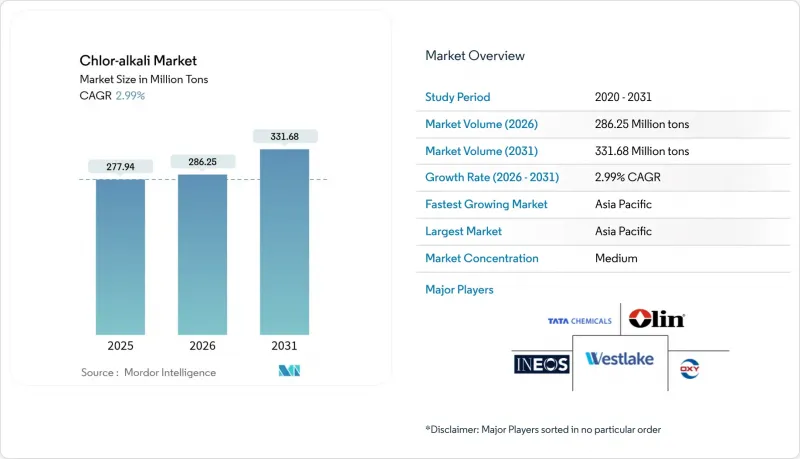
염소 알칼리 시장 규모는 2026년에는 2억 8,625만 톤으로 추정되며, 2025년 2억 7,794만 톤에서 성장이 전망됩니다.
2031년에는 3,316만 8,000톤에 달할 것으로 예상되며, 2026년부터 2031년까지 CAGR 2.99%로 성장할 것으로 전망됩니다.
이러한 성장세는 지속적인 PVC(폴리염화비닐(PVC) 설비 증설, 수처리 분야 적용 범위 확대, 전기자동차 배터리 소재용 알루미나 수요 증가에 기인합니다. 염소, 가성소다, 소다회라는 독특한 제품별 균형이 수요와 공급 관계를 긴밀하게 만들고, 생산자들은 가동률을 다운스트림 수요 추세에 맞춰야 합니다. 막전해에 대한 새로운 투자로 단위 전력 소비량이 감소하는 한편, 재생 전력 계약이 전력 비용의 변동성을 완화하고 있습니다. 동시에 수은 전해조 폐지와 탄소 배출량에 대한 규제 당국의 감시 강화로 인해 더 깨끗한 기술 플랫폼에 대한 지속적인 자본 투입이 요구되고 있습니다.
세계 염소-알칼리 시장 동향 및 인사이트
아시아 지역의 PVC 생산능력 급증
중국, 인도, 동남아시아의 PVC 생산량 증가는 부동산 시장의 침체가 단기적인 수요를 억제하는 가운데서도 미래 염소 수요를 뒷받침하고 있습니다. PCC그룹은 켐어스 미시시피 공장 내에 염소-알칼리 복합시설을 건설하기 위해 3억 4,000만 달러를 투자해 2028년까지 연간 34만 톤의 생산능력을 공급할 예정입니다. 인도의 수입 PVC에 대한 반덤핑 관세는 국내 생산을 촉진하고, 이는 염소 수요 증가로 직결되고 있습니다. 한편, 아세안 생산자들은 공급망 다변화를 통해 이익을 얻고 있습니다. 새로운 PVC 라인이 가동될 때마다 고정된 전기 화학적 염소 대 PVC 비율이 적용되기 때문에 체인 외부의 일반 염소 공급이 타이트해져 지역적 가격 프리미엄이 강화되고 있습니다. 이로 인해 국지적 공급과잉이 발생한 지역에서는 중국 연안 허브에서 아시아태평양 전체 염소-알칼리 시장을 향한 수출 파이프라인으로 물류 이동이 일어나고 있습니다.
EV용 알루미늄용 알루미나 생산량 증가
배터리용 알루미늄은 초저불순도 알루미나가 요구되며, 이를 위해서는 고순도 가성소다가 필수적입니다. 인도네시아의 알루미나 사업자들은 가성소다의 안정적인 공급을 확보하기 위해 노력하고 있으며, 염소알칼리 알루미나 일관 생산 회랑 구축이 전략적으로 필요함을 강조하고 있습니다. 보크사이트 광상, 정제거점, 전해설비 입지가 지역적으로 불일치하여 운송비용이 상승하고, 현지 염소알칼리 플랜트 연계가 촉진되고 있습니다. 이 차별화된 가성소다 시장에 공급하는 생산자는 순도 사양이 상품 수준을 상회하기 때문에 프리미엄 마진을 얻고 있습니다. 농축 가성소다의 장거리 운송은 취급상의 제약이 있기 때문에 인근의 막전해 설비가 내장되어 있어 비용 우위를 확보하고 있습니다.
높은 전기요금과 전력망 변동성
천연가스 가격 연동으로 인한 전기요금 급등은 유럽 염소-알칼리 산업의 수익률을 압박하고 있으며, 일부 가동 중단 및 생산기지 이전을 촉진하고 있습니다. 신흥시장에서는 전압 저하로 인해 고가의 무정전전원장치가 필수적이기 때문에 송전망 운영이 복잡해지고 있습니다. 피크 시간대에는 부하를 억제하고, 비피크 시간대에는 재생에너지 공급 시 생산량을 늘릴 수 있는 생산자는 중요한 비용 헷지 효과를 얻을 수 있습니다. 태국의 가스 고갈 사례는 업스트림 제약이 전력 부족으로 이어져 염소-알칼리 사업자의 운전자금 변동성을 증폭시키는 전형적인 사례입니다.
부문 분석
염소는 2025년 염소-알칼리 시장의 40.85%를 차지했으며, 2031년까지 연평균 3.35%의 CAGR로 제품별 성장률을 상회할 것으로 예상됩니다. 아시아 및 중동 지역의 폴리염화비닐(PVC) 중합 능력의 가속화는 생산되는 염소의 증분 톤당 확실한 판매 경로를 확보할 수 있습니다. 지자체 네트워크 전반에 걸쳐 수처리 시설의 고도화는 염소 유도체에 대한 추가 수요를 창출하여 통합 생산자에게 보다 안정적인 가동률을 보장합니다.
가성소다는 염소에 비해 점유율이 열세인 가성소다는 알루미나 정제업체와 펄프 가공업체로부터의 안정적인 수요 증가가 예상됩니다. 이들 기업은 가격 리스크 헤지를 위해 다년간의 오프테이크 계약을 체결하는 경우가 많으며, 그린 수소의 가치 향상 전략으로 인해 과거 배출되던 제품별 수소가 수익원으로 전환되고 있습니다. 특히 정책적 지원이 존재하는 지역에서는 이러한 경향이 두드러집니다. 다양한 최종 용도가 결합되어 염소알칼리 시장 전체의 수익 안정화 및 수익 변동성 완화에 기여하고 있습니다.
염소-알칼리 시장 보고서는 제품별(가성소다, 염소, 염소, 소다회), 제조 공정별(막전해조, 격막전해조, 기타공정), 용도별(펄프-제지, 유기화학, 무기화학, 비누-세제 등), 지역별(아시아태평양, 북미, 유럽, 남미, 중동 및 아프리카)로 분석하고 있습니다. 시장 예측은 수량(단위) 기준으로 제공됩니다.
지역별 분석
아시아태평양은 2025년 염소-알칼리 시장 규모의 62.15%를 차지하며 2031년까지 CAGR 3.12%로 확대될 것으로 예상됩니다. 중국의 PVC에서 전자제품에 이르는 제조업 기반은 염소 및 가성소다의 견조한 수요를 견인하고 있으며, 지역 부동산 시장의 냉각으로 당분간 PVC 수지 소비가 억제될 것으로 예상되지만, 이러한 추세는 지속되고 있습니다. 인도에서는 철도, 지하철, 위생 시설에 이르는 인프라의 급속한 확장으로 인해 PVC 파이프의 수요와 도시 상수도 처리 모두에 대한 수요가 촉진되어 다년간의 수요 전망을 보장하고 있습니다.
북미는 안정적인 점유율을 유지하고 있으며, 셰일 유래 에틸렌의 원가 우위로 인해 PVC의 경쟁력이 유지되고 있습니다. 지자체 상수도 사업자들은 수십 년 된 노후화된 처리시설을 지속적으로 갱신하고 있으며, 염소계 화합물 처리량이 증가하고 있습니다. 텍사스주와 앨버타주의 장기 재생에너지 전력구매계약(PPA)을 통해 멤브레인 설비 개보수 시 배출량 감축이 가능해져 지역 사업자들의 회복탄력성을 강화할 수 있습니다.
유럽에서는 전기요금 상승과 엄격한 탄소 규제로 인해 여러 구식 다이어프램 장비가 가동 중단을 강요당하고 있습니다. 그러나 특수 화학 분야, 엄격한 식수 기준, 고수익 의약품 전구체 수요로 인해 유럽은 여전히 주요 수입국으로서 존재감을 유지하고 있습니다.
남미의 성장은 브라질의 펄프 확대와 칠레-페루의 광업용 화학제품에 의해 뒷받침되고 있습니다. 한편, 중동 및 아프리카에서는 베퍼그룹의 5억 달러 규모의 이집트 복합단지 등 내수와 아프리카 수출 루트를 동시에 충족시키는 선택적 메가 프로젝트가 진행 중입니다.
기타 특전:
- 엑셀 형식의 시장 예측(ME) 시트
- 애널리스트의 3개월간 지원
자주 묻는 질문
목차
제1장 소개
제2장 조사 방법
제3장 주요 요약
제4장 시장 구도
제5장 시장 규모와 성장 예측
제6장 경쟁 구도
제7장 시장 기회와 향후 전망
KSM 26.03.10Chlor-alkali market size in 2026 is estimated at 286.25 Million tons, growing from 2025 value of 277.94 Million tons with 2031 projections showing 331.68 Million tons, growing at 2.99% CAGR over 2026-2031.
Momentum stems from persistent PVC build-outs, widening water-treatment coverage, and escalating alumina demand for electric-vehicle battery materials. Unique co-product balances between chlorine, caustic soda, and soda ash tighten supply-demand linkages, prompting producers to align operating rates with downstream pull signals. Renewed investment in membrane electrolysis is lowering unit power consumption, while renewable-electricity contracts cushion electricity cost volatility. At the same time, regulatory scrutiny over mercury cell retirements and carbon emissions compels sustained capital deployment into cleaner technology platforms.
Global Chlor-alkali Market Trends and Insights
Surging PVC Capacity Additions in Asia
PVC additions across China, India, and Southeast Asia underpin forward chlorine offtake, even as real-estate softness tempers near-term volumes. PCC Group is investing USD 340 million in a chlor-alkali complex inside Chemours' Mississippi site that will supply 340,000 tons of annual capacity by 2028. India's antidumping duties on imported PVC stimulate domestic builds that translate directly into incremental chlorine pull, while ASEAN producers gain from supply-chain diversification. Each new PVC line obliges fixed electrochemical chlorine-to-PVC ratios, so merchant chlorine availability outside the chain tightens, reinforcing regional price premiums. Localized oversupply pockets have therefore triggered logistics shifts toward export pipelines from coastal Chinese hubs into the wider Asia-Pacific chlor-alkali market.
Rising Alumina Output for EV-Grade Aluminium
Battery-grade aluminum calls for ultra-low impurity alumina, which in turn demands high-specification caustic soda. Indonesian alumina ventures are scrambling for secured caustic supply, underscoring the strategic need for integrated chlor-alkali-alumina corridors. Regional mismatch between bauxite deposits, refining basins, and co-located electrolysis capacity inflates freight outlays, incentivizing on-site chlor-alkali plant tie-ups. Producers serving this differentiated caustic pool earn premium margins because purity specs exceed commodity thresholds. Long-haul shipments of concentrated caustic soda face handling constraints, so nearby membrane assets secure an embedded cost edge.
High Power Tariffs and Grid Volatility
Electricity price spikes tied to natural-gas benchmarks have eroded European chlor-alkali margins, spurring partial shutdowns and capacity relocations. Emerging-market grids add operational complexity as voltage dips mandate expensive uninterruptible power systems. Producers able to curtail load during peak tariffs and ramp during off-peak renewables gain a crucial cost hedge. Thailand's gas depletion exemplifies how upstream constraints cascade into power scarcity, amplifying working-capital swings for chlor-alkali operators.
Other drivers and restraints analyzed in the detailed report include:
- Booming Water and Wastewater Treatment Projects
- Capacity-Linked Renewable-Energy Incentives
- Stringent Carbon-Footprint Regulations
For complete list of drivers and restraints, kindly check the Table Of Contents.
Segment Analysis
Chlorine held a 40.85% share of the chlor-alkali market in 2025 and will outpace co-products at a 3.35% CAGR to 2031. Accelerated PVC polymerization capacity in Asia and the Middle East locks in a dependable offtake corridor for every incremental ton of chlorine produced. Water-treatment upgrades across municipal grids layer on additional chlorine derivative demand, assuring more stable run-rates for integrated producers.
Caustic soda, while trailing chlorine in share, secures steady lift from alumina refiners and pulp processors that often engage in multi-year offtake contracts to hedge price risk. Meanwhile, green hydrogen valorization strategies turn the once-vented hydrogen co-product into a revenue contributor, especially where policy support exists. Collectively, diversified end-uses stabilize returns and moderate earnings cyclicality across the chlor-alkali market.
The Chlor-Alkali Report is Segmented by Product (Caustic Soda, Chlorine, and Soda Ash), Production Process (Membrane Cell, Diaphragm Cell, and Other Processes), Application (Pulp and Paper, Organic Chemicals, Inorganic Chemicals, Soaps and Detergents, and More), and Geography (Asia-Pacific, North America, Europe, South America, and Middle-East and Africa). The Market Forecasts are Provided in Terms of Volume (Units).
Geography Analysis
Asia-Pacific retained 62.15% of the chlor-alkali market size in 2025 and is projected to compound at a 3.12% CAGR through 2031. China's manufacturing backbone, from PVC to electronics, embeds robust chlorine and caustic soda pull, even as regional real-estate cooling tempers immediate PVC resin consumption. India's infrastructure binge, spanning rail, metro, and sanitation, stimulates both vinyl pipe uptake and municipal water treatment, locking in multiyear demand visibility.
North America holds a stable share, benefiting from shale-derived ethylene cost advantages that safeguard PVC competitiveness. Municipal water utilities continue renewing decades-old treatment plants, lifting chlorine derivative throughput. Long-term renewable PPAs in Texas and Alberta enable lower emissions footprints for membrane retrofits, enhancing regional operator resilience.
Europe grapples with elevated power tariffs and stringent carbon regimes that have pressured several older diaphragm units into mothballing. Yet specialty chemical niches, stringent potable-water standards, and high-margin pharmaceutical precursors sustain a baseline of local demand, ensuring Europe remains a sizable import destination.
South America's growth rests on Brazilian pulp expansion and mining chemicals in Chile and Peru, while Middle-East and Africa witness selective megaprojects such as Befar Group's USD 500 million Egyptian complex targeting both domestic uses and African export lanes.
- ANWIL SA
- BorsodChem (Wanhua)
- Ciner Group
- Covestro AG
- Dow
- Ercros SA
- Formosa Plastics Corporation
- Genesis Energy, L.P.
- Hanwha Group
- INEOS
- Kemira
- MicroBio
- Nirma
- Nobian (Reyez)
- Occidental Petroleum Corporation
- Olin Corporation
- PCC SE
- Shin-Etsu Chemical Co., Ltd
- Sisecam
- Solvay
- Spolchemie
- Tata Chemicals Ltd
- Tosoh Corporation
- Vynova Group
- Westlake Corporation
Additional Benefits:
- The market estimate (ME) sheet in Excel format
- 3 months of analyst support
TABLE OF CONTENTS
1 Introduction
- 1.1 Study Assumptions and Market Definition
- 1.2 Scope of the Study
2 Research Methodology
3 Executive Summary
4 Market Landscape
- 4.1 Market Overview
- 4.2 Market Drivers
- 4.2.1 Surging PVC Capacity Additions in Asia
- 4.2.2 Rising Alumina Output for EV-Grade Aluminium
- 4.2.3 Booming Water and Wastewater Treatment Projects
- 4.2.4 Capacity-Linked Renewable-Energy Incentives
- 4.2.5 Surging Demand in Chemical Manufacturing
- 4.3 Market Restraints
- 4.3.1 High Power Tariffs and Grid Volatility
- 4.3.2 Stringent Carbon-Footprint Regulations
- 4.3.3 Brine-Disposal Compliance Costs
- 4.4 Value Chain Analysis
- 4.5 Porter's Five Forces
- 4.5.1 Bargaining Power of Suppliers
- 4.5.2 Bargaining Power of Buyers
- 4.5.3 Threat of New Entrants
- 4.5.4 Threat of Substitutes
- 4.5.5 Degree of Competition
- 4.6 Import and Export Trends
5 Market Size and Growth Forecasts (Volume)
- 5.1 By Product
- 5.1.1 Caustic Soda
- 5.1.2 Chlorine
- 5.1.3 Soda Ash
- 5.2 By Production Process
- 5.2.1 Membrane Cell
- 5.2.2 Diaphragm Cell
- 5.2.3 Other Processes
- 5.3 By Application
- 5.3.1 Pulp and Paper
- 5.3.2 Organic Chemicals
- 5.3.3 Inorganic Chemicals
- 5.3.4 Soaps and Detergents
- 5.3.5 Alumina
- 5.3.6 Textiles
- 5.3.7 Other Applications
- 5.4 By Geography
- 5.4.1 Asia-Pacific
- 5.4.1.1 China
- 5.4.1.2 India
- 5.4.1.3 Japan
- 5.4.1.4 South Korea
- 5.4.1.5 Indonesia
- 5.4.1.6 Thailand
- 5.4.1.7 Malaysia
- 5.4.1.8 Vietnam
- 5.4.1.9 Rest of Asia-Pacific
- 5.4.2 North America
- 5.4.2.1 United States
- 5.4.2.2 Canada
- 5.4.2.3 Mexico
- 5.4.3 Europe
- 5.4.3.1 Germany
- 5.4.3.2 United Kingdom
- 5.4.3.3 France
- 5.4.3.4 Italy
- 5.4.3.5 Spain
- 5.4.3.6 Turkey
- 5.4.3.7 Russia
- 5.4.3.8 Nordic Countries
- 5.4.3.9 Rest of Europe
- 5.4.4 South America
- 5.4.4.1 Brazil
- 5.4.4.2 Argentina
- 5.4.4.3 Colombia
- 5.4.4.4 Rest of South America
- 5.4.5 Middle-East and Africa
- 5.4.5.1 Saudi Arabia
- 5.4.5.2 United Arab Emirates
- 5.4.5.3 Qatar
- 5.4.5.4 Egypt
- 5.4.5.5 South Africa
- 5.4.5.6 Nigeria
- 5.4.5.7 Rest of Middle-East and Africa
- 5.4.1 Asia-Pacific
6 Competitive Landscape
- 6.1 Market Concentration
- 6.2 Strategic Moves
- 6.3 Market Share (%)/Ranking Analysis
- 6.4 Company Profiles (includes Global level Overview, Market level overview, Core Segments, Financials as available, Strategic Information, Market Rank/Share, Products and Services, Recent Developments)
- 6.4.1 ANWIL SA
- 6.4.2 BorsodChem (Wanhua)
- 6.4.3 Ciner Group
- 6.4.4 Covestro AG
- 6.4.5 Dow
- 6.4.6 Ercros SA
- 6.4.7 Formosa Plastics Corporation
- 6.4.8 Genesis Energy, L.P.
- 6.4.9 Hanwha Group
- 6.4.10 INEOS
- 6.4.11 Kemira
- 6.4.12 MicroBio
- 6.4.13 Nirma
- 6.4.14 Nobian (Reyez)
- 6.4.15 Occidental Petroleum Corporation
- 6.4.16 Olin Corporation
- 6.4.17 PCC SE
- 6.4.18 Shin-Etsu Chemical Co., Ltd
- 6.4.19 Sisecam
- 6.4.20 Solvay
- 6.4.21 Spolchemie
- 6.4.22 Tata Chemicals Ltd
- 6.4.23 Tosoh Corporation
- 6.4.24 Vynova Group
- 6.4.25 Westlake Corporation
7 Market Opportunities and Future Outlook
- 7.1 White-space and Unmet-need Assessment