|
시장보고서
상품코드
1940663
시스템 통합사업자 : 시장 점유율 분석, 업계 동향과 통계, 성장 예측(2026-2031년)System Integrators - Market Share Analysis, Industry Trends & Statistics, Growth Forecasts (2026 - 2031) |
||||||
 Mordor Intelligence
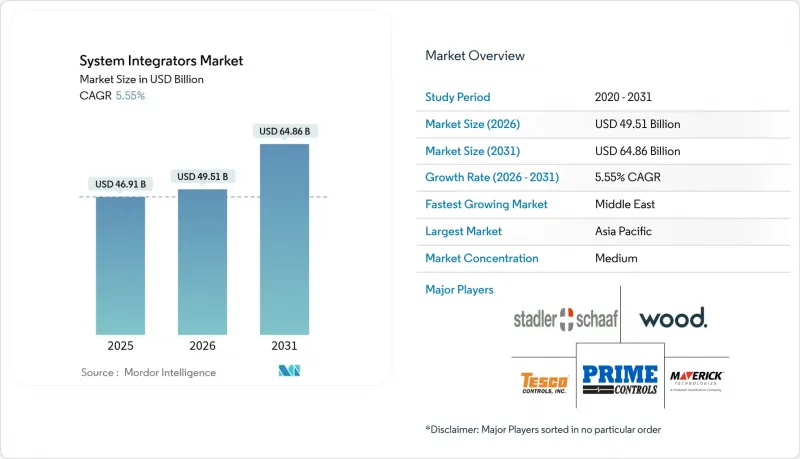
시스템 통합사업자 시장은 2025년에 469억 1,000만 달러로 평가되었으며, 2026년 495억 1,000만 달러에서 2031년까지 648억 6,000만 달러에 달할 것으로 예측됩니다.
예측 기간(2026-2031년) 동안 CAGR은 5.55%로 예상됩니다.
이러한 확대는 제조업체들이 단독 업그레이드에서 턴키 방식의 OT-IT 융합 프로젝트로 전환하고 있으며, 이를 통해 투자 회수 기간을 단축하는 동시에 생산 중단 시간을 최소화할 수 있기 때문입니다. 기존 플랜트(브라운필드)가 신규 수주에서 차지하는 비중이 확대되고 있으며, 프라이빗 5G를 기반으로 한 멀티 벤더의 엣지 구축이 고도화된 오케스트레이션 기술에 대한 새로운 수요를 창출하고 있습니다. 동시에 유럽과 아시아의 유틸리티 사업자들은 적극적인 청정에너지 목표를 달성하기 위해 재생에너지 자산의 디지털화를 추진하고 있습니다. 이러한 변화는 SCADA(감시 제어 및 데이터 수집) 시스템 업그레이드와 분산형 에너지 자원(DER) 관리에 정통한 통합업체에게 유리한 상황을 만들어내고 있습니다. 중동 지역에서 두드러진 중요 인프라에 대한 사이버 보안 규제로 인해 고수익 SCADA 리노베이션 프로젝트의 잠재적 시장이 확대되고 있습니다. 플랜트 현장의 인력 부족은 자체 개발 및 외부 조달에 대한 판단을 아웃소싱으로 기울이게 하고, 중견기업이 대형 자동화 벤더로부터 점유율을 빼앗아 갈 수 있도록 하고 있습니다.
세계 시스템 통합업체 시장 동향 및 인사이트
기존 제조 공장의 턴키 OT-IT 통합 프로젝트에 대한 수요 증가
턴키 방식의 OT-IT 통합 프로그램이 단계적 업그레이드를 대체하고 있습니다. 제조업체가 18개월 미만의 ROI 주기를 목표로 하고 있기 때문입니다. 수십 년 동안 사용되어 온 PLC를 현대적인 클라우드 아키텍처에 매핑하는 과제는 공존 관리, 사이버 보안, 분석을 단일 범위에서 관리할 수 있는 통합업체에 대한 지속적인 수요를 창출하고 있습니다. 공정 산업은 이러한 압력을 가장 크게 느끼고 있으며, 1시간의 계획되지 않은 가동 중단으로 인해 5만 달러 이상의 생산 손실이 발생할 수 있기 때문입니다.
유럽 및 아시아 재생에너지 자산의 디지털화 가속화
유럽 전력회사들은 2030년까지 약 900GW의 태양광발전 용량을 통합 운영해야 하며, 이 목표를 달성하기 위해서는 예측, 저장, 계통연계 애플리케이션의 긴밀한 연계가 필수적입니다. Yokogawa가 소유한 BaxEnergy 플랫폼은 이미 40개국에서 120GW의 재생에너지를 모니터링하고 있으며, 차세대 프로젝트의 규모와 복잡성을 보여주고 있습니다.
프로젝트 범위 확대 위험 증가로 인해 최종사용자의 총 소유 비용 증가 증가
통합 프로그램의 40% 이상이 당초 예산을 초과 달성했습니다. 이는 엔지니어가 프로젝트 도중 문서화되지 않은 인터페이스나 구식 펌웨어에 직면할 수 있기 때문입니다. 미국 감사원(GAO)의 조사에 따르면, 카테고리 1 기술 프로젝트가 여전히 연방 예산 초과액의 81%를 차지하고 있으며, 엄격한 거버넌스 하에서도 범위 이탈이 지속되고 있는 것으로 나타났습니다.
부문 분석
2025년 기준 소프트웨어 디지털 통합은 애널리틱스, MES, 클라우드 엣지 통합 제품군을 중심으로 시스템 통합업체 시장 규모의 47.35%를 차지했습니다. IIoT 및 엣지 중심의 통합은 기업들이 기계 수준에서 컨테이너화된 워크로드를 도입함에 따라 2031년까지 CAGR 8.75%를 기록할 것으로 예상됩니다. 기존 설비(브라운필드)에 대한 하드웨어 개조는 여전히 중요하지만, 제조업체들이 순수 처리 능력이 아닌 데이터 활용으로 수익을 창출하기 때문에 그 비중은 점차 감소하는 추세입니다. 컨설팅 및 교육 수요는 인력 부족으로 인해 기업들이 사내 직원들의 스킬을 향상시켜야 하는 상황에서 회복세를 보이고 있습니다. 한편, 애프터세일즈 지원은 주기적인 프로젝트 흐름을 완화하는 지속적인 수익원을 확보합니다. Litmus와 Edge-Azure IoT의 제휴는 OPC UA 및 MQTT와 같은 표준화된 커넥터로의 전환을 상징하며, 이를 통해 도입 기간을 단축할 수 있습니다.
두 번째 구조적 변화는 미들웨어, 사전 구축된 API, 디지털 트윈 라이브러리를 통합한 독자적인 통합 플랫폼의 등장입니다. 이러한 서비스를 통해 통합업체는 시간당 엔지니어링 비용을 넘어 지적재산권으로 수익을 창출할 수 있으며, 전환 비용을 절감할 수 있습니다. 성과 기반 계약을 선호하는 제조업체가 증가함에 따라 소프트웨어 비중이 높은 업무 범위는 2020년대 말까지 시스템 통합업체 시장의 55% 이상을 차지할 것으로 예상됩니다.
통합 프로세스 제어 솔루션(PLC, DCS, SCADA)은 2025년 시스템 통합업체 시장 점유율의 34.02%를 차지했으며, 이는 기반 제어 계층이 여전히 디지털 전환 로드맵의 핵심임을 보여줍니다. 그럼에도 불구하고 랜섬웨어가 IT 영역에서 OT 영역으로 이동하는 가운데, 산업용 사이버 보안 솔루션은 10.05%의 CAGR로 다른 모든 분야를 능가하는 성장세를 보이고 있습니다. 제조실행시스템(MES)은 경영진이 이익센터 회계를 수행하기 위해 생산 데이터와 업무 데이터의 통합을 필요로 하기 때문에 꾸준히 성장하고 있습니다. 로봇공학 및 머신비전 프로젝트는 인건비가 설비투자의 감가상각 곡선을 능가하는 분야로 성장하고 있습니다.
사이버 보안의 가속화는 로크웰이 Verve Industrial Protection을 인수한 것에서 잘 드러납니다. 벤더 중립적인 스택으로 자산 인벤토리, 리스크 스코어링, 침해 대응을 통합했습니다. 지멘스도 이러한 추세에 발맞춰 SIBERprotect 솔루션으로 밀리초 단위의 자동 응답을 실현하여 가동시간과 안전성을 동시에 확보할 수 있도록 하고 있습니다. 규제 강화에 따라 프로세스 제어 마이그레이션에 제로 트러스트 아키텍처를 통합하는 통합업체는 프리미엄 요금을 받을 것으로 예상됩니다.
지역별 분석
2025년 아시아태평양은 시스템 통합업체 시장에서 31.20%의 매출 점유율로 1위를 차지했습니다. 이는 중국의 가격 중심의 자동화 환경과 인도의 에탄올 열병합발전 기반 확대가 주도하고 있습니다. Ditap-V Automatio와 같은 현지 경쟁사들은 품질과 공격적인 가격 설정의 균형을 통해 입찰을 획득하여 기존 다국적 기업들에 대한 압력을 높이고 있습니다. 정부 주도의 스마트 제조 계획이 수요를 확대하는 한편, 지정학적 마찰과 운송 병목현상이 납기를 위협하고 있습니다.
중동 지역은 가장 빠르게 성장하는 지역으로 2031년까지 CAGR 8.46%로 성장할 것으로 예상됩니다. '비전 2030' 메가 프로젝트와 OT 사이버 보안 규제 확대로 인해 평균 프로젝트 가치가 상승하고 있습니다. 킹살만 에너지 파크에 건설된 에머슨의 14만 평방피트 규모의 생산기지는 세계 벤더가 국내 가치 기준을 충족하기 위해 가치사슬을 현지화하는 방법을 보여주고 있습니다. 한편, 인도-중동-유럽 경제 회랑은 가동 후 운송 비용을 30% 절감할 수 있으며, 국경 간 표준에 정통한 통합업체에 대한 수요를 더욱 자극할 것입니다.
북미와 유럽은 여전히 수익성이 높은 성숙한 시장입니다. 미국에서는 프라이빗 5G와 엣지 AI 시범사업이 눈에 띄게 성장하고 있지만, 만성적인 인력 부족으로 인해 인건비가 상승하고 있습니다. 유럽에서는 재생에너지 추진으로 인해 전력회사들은 그리드 규모의 축전지, 태양광 인버터, 수요 반응 소프트웨어를 통합 시스템에 통합해야 하는 과제를 안고 있으며, 이러한 통합 과제가 탄탄한 프로젝트 파이프라인을 뒷받침하고 있습니다. 두 지역 모두 엄격한 안전 기준으로 인해 승인 주기가 길어지고 있으며, 전문 지식이 풍부한 통합업체의 가치가 더욱 부각되고 있습니다.
기타 특전:
- 엑셀 형식의 시장 예측(ME) 시트
- 애널리스트 지원(3개월)
자주 묻는 질문
목차
제1장 소개
제2장 조사 방법
제3장 주요 요약
제4장 시장 구도
제5장 시장 규모와 성장 예측
제6장 경쟁 구도
제7장 시장 기회와 향후 전망
KSM 26.03.10The system integrators market was valued at USD 46.91 billion in 2025 and estimated to grow from USD 49.51 billion in 2026 to reach USD 64.86 billion by 2031, at a CAGR of 5.55% during the forecast period (2026-2031).
Expansion is underpinned by manufacturers shifting from isolated upgrades to turnkey OT-IT convergence projects that shorten payback periods while minimizing production downtime. Brownfield plants account for a rising share of new awards, and multi-vendor edge deployments anchored in private-5G are unlocking fresh demand for advanced orchestration skills. At the same time, utilities in Europe and Asia are digitizing renewable assets to comply with aggressive clean-energy targets, a change that favors integrators fluent in SCADA upgrades and DER management. Regulatory cybersecurity mandates for critical infrastructure, most visibly in the Middle East, are widening the addressable pool of high-margin SCADA retrofit projects. Talent shortages on the plant floor further tilt the build-versus-buy calculus toward outsourcing, enabling mid-tier firms to capture share from large automation vendors.
Global System Integrators Market Trends and Insights
Demand for Turn-Key OT-IT Convergence Projects in Brownfield Manufacturing Plants
Turn-key OT-IT programs are replacing incremental upgrades because manufacturers now target ROI cycles below 18 months. The challenge of mapping decades-old PLCs to modern cloud architectures creates enduring demand for integrators able to manage coexistence, cybersecurity and analytics in one scope. Process industries feel this pressure most acutely, since one hour of unplanned downtime can exceed USD 50,000 in lost output.
Acceleration of Renewable-Energy Asset Digitalization Across Europe and Asia
European utilities must orchestrate nearly 900 GW of solar capacity by 2030, a milestone that compels tighter coupling of forecasting, storage and grid-balancing applications. The BaxEnergy platform, now owned by Yokogawa, already monitors 120 GW of renewables across 40 countries, illustrating the scale and complexity of next-gen projects.
High Project Scope-Creep Risk Elevating Total Cost of Ownership for End-Users
More than 40% of integration programs overshoot original budgets as engineers confront undocumented interfaces and obsolete firmware mid-project. The U.S. Government Accountability Office found that Category 1 technology projects still account for 81% of federal overruns, underscoring how scope drift persists even under strict governance.
Other drivers and restraints analyzed in the detailed report include:
- 5G-Enabled Edge Computing Use-Cases Requiring Complex Multi-Vendor Integration in North America
- Regulatory Push for Cyber-Secure SCADA Retrofits in Critical Infrastructure (Middle East)
- Procurement Delays Caused by Semiconductor Supply Constraints
For complete list of drivers and restraints, kindly check the Table Of Contents.
Segment Analysis
Software and Digital Integration controlled 47.35% of system integrators market size in 2025 on the strength of analytics, MES and cloud-edge orchestration suites. IIoT and Edge-Focused Integration posts a 8.75% CAGR to 2031 as firms deploy containerized workloads at the machine level. Hardware retrofits remain vital for brownfield sites, but their share is gradually receding as manufacturers monetize data rather than pure throughput. Consulting and Training demand is reviving because talent gaps force companies to upskill in-house staff, while After-Sales Support secures recurring revenue that cushions cyclical project flow. The Litmus Edge-Azure IoT tie-up typifies the pivot toward standardized connectors like OPC UA and MQTT that cut roll-out times.
A second structural change is the rise of proprietary integration platforms that bundle middleware, pre-built APIs and digital-twin libraries. These services allow integrators to monetize intellectual property beyond hourly engineering fees, increasing switching costs. As more manufacturers favor outcome-based contracts, software-heavy scopes will likely surpass 55% share of the system integrators market by decade-end.
Integrated Process Control solutions-PLC, DCS and SCADA-accounted for 34.02% of system integrators market share in 2025, evidence that foundational control layers still anchor digital transformation roadmaps. Even so, Industrial Cyber-Security Solutions outpace every other cluster at a 10.05% CAGR as ransomware moves from IT to OT domains. Manufacturing Execution Systems keep growing steadily because executives need unified production and business data to run profit-center accounting. Robotics and Machine Vision projects gain traction where labor costs outstrip capex depreciation curves.
Cybersecurity's acceleration is visible in Rockwell's acquisition of Verve Industrial Protection, which unified asset inventory, risk scoring and breach response in a vendor-neutral stack. Siemens echoed this trend with its SIBERprotect solution that triggers automated responses within milliseconds, balancing uptime and safety. As regulations tighten, integrators that embed zero-trust architectures into process-control migrations are set to capture premium fees.
System Integrators Market Report is Segmented by Service Type (Hardware Integration, Software and Digital Integration, and More), Technology (Integrated Process Control, Manufacturing Execution Systems, and More), End-User Industry (Oil and Gas, Automotive and EV Manufacturing, and More), Enterprise Scale (SMEs, Large Enterprises), and Geography. The Market Forecasts are Provided in Terms of Value (USD).
Geography Analysis
Asia-Pacific led the system integrators market with 31.20% revenue in 2025, spurred by China's price-intensive automation landscape and India's expanding ethanol and co-gen base. Local competitors such as Ditap-V Automatio win bids by balancing quality and aggressive pricing, raising pressure on multinational incumbents. Government-sponsored smart-manufacturing schemes amplify demand, yet geopolitical frictions and shipping bottlenecks threaten delivery schedules.
The Middle East is the fastest-growing territory, forecast at 8.46% CAGR through 2031. Vision 2030 megaprojects and an expanding regulatory net for OT cybersecurity elevate average project values. Emerson's 140,000 ft2 manufacturing hub at King Salman Energy Park shows how global vendors localize supply chains to satisfy in-country value quotas. Meanwhile, the India-Middle East-Europe Economic Corridor could slash freight costs by 30% once operational, creating further pull for integrators versed in cross-border standards.
North America and Europe remain lucrative but mature. The U.S. sees outsized growth from private-5G and edge-AI pilots, yet chronic labor shortages inflate wage bills. Europe's renewable push forces utilities to blend grid-scale batteries, PV inverters and demand-response software in coherent stacks, an integration puzzle that sustains robust project pipelines. Both regions confront stringent safety codes that lengthen approval cycles, underscoring the value of domain-rich integrators.
- ABB Ltd.
- Siemens AG
- Rockwell Automation, Inc.
- Schneider Electric SE
- Honeywell International Inc.
- Emerson Electric Co.
- Yokogawa Electric Corporation
- John Wood Group PLC
- TESCO CONTROLS, Inc.
- STADLER + SCHAAF Mess- und Regeltechnik GmbH
- Prime Controls, LP
- MAVERICK Technologies, LLC
- Adsyst Automation Ltd.
- George T. Hall Company
- Avanceon Ltd.
- Wunderlich-Malec Engineering, Inc.
- Burrow Global, LLC
- ATS Corporation
- HCLTech (Industrial and Digital SI Practice)
- Accenture plc (Industry X)
Additional Benefits:
- The market estimate (ME) sheet in Excel format
- 3 months of analyst support
TABLE OF CONTENTS
1 INTRODUCTION
- 1.1 Study Assumptions and Market Definition
- 1.2 Scope of the Study
2 RESEARCH METHODOLOGY
3 EXECUTIVE SUMMARY
4 MARKET LANDSCAPE
- 4.1 Market Overview
- 4.2 Market Drivers
- 4.2.1 Demand for Turn-Key OT-IT Convergence Projects
- 4.2.2 Acceleration of Renewable-Energy Asset Digitalization
- 4.2.3 5G-Enabled Edge Computing Use-Cases
- 4.2.4 Regulatory Push for Cyber-Secure SCADA Retrofits
- 4.2.5 Rising Adoption of Modular Automation
- 4.2.6 Shortage of Plant-Floor Automation Talent
- 4.3 Market Restraints
- 4.3.1 High Project Scope-Creep Risk
- 4.3.2 Procurement Delays
- 4.3.3 Fragmented Vendor Ecosystem
- 4.3.4 Critical Liability Exposure
- 4.4 Value / Supply-Chain Analysis
- 4.5 Regulatory and Technological Outlook
- 4.6 Porter's Five Forces
- 4.6.1 Bargaining Power of Buyers
- 4.6.2 Bargaining Power of Suppliers
- 4.6.3 Threat of New Entrants
- 4.6.4 Threat of Substitutes
- 4.6.5 Intensity of Competitive Rivalry
5 MARKET SIZE AND GROWTH FORECASTS (VALUE)
- 5.1 By Service Type
- 5.1.1 Hardware Integration
- 5.1.2 Software and Digital Integration
- 5.1.3 Consulting and Training
- 5.1.4 After-Sales Support and Maintenance
- 5.2 By Technology
- 5.2.1 Integrated Process Control (PLC, DCS, SCADA)
- 5.2.2 Manufacturing Execution Systems (MES)
- 5.2.3 Robotics and Machine Vision
- 5.2.4 IIoT and Edge Platforms
- 5.2.5 Cyber-Security Solutions
- 5.3 By End-User Industry
- 5.3.1 Oil and Gas
- 5.3.2 Automotive and EV Manufacturing
- 5.3.3 Aerospace and Defense
- 5.3.4 Healthcare and Life Sciences
- 5.3.5 Energy and Power
- 5.3.6 Chemicals and Petrochemicals
- 5.3.7 Food and Beverage
- 5.3.8 Metals and Mining
- 5.3.9 Others (Water / Waste-Water, Pulp and Paper)
- 5.4 By Enterprise Scale
- 5.4.1 SMEs
- 5.4.2 Large Enterprises
- 5.5 By Geography
- 5.5.1 North America
- 5.5.1.1 United States
- 5.5.1.2 Canada
- 5.5.2 Latin America
- 5.5.2.1 Mexico
- 5.5.2.2 Brazil
- 5.5.2.3 Argentina
- 5.5.2.4 Rest of Latin America
- 5.5.3 Europe
- 5.5.3.1 Germany
- 5.5.3.2 United Kingdom
- 5.5.3.3 France
- 5.5.3.4 Italy
- 5.5.3.5 Spain
- 5.5.3.6 Rest of Europe
- 5.5.4 Middle East and Africa
- 5.5.5 Asia-Pacific
- 5.5.5.1 China
- 5.5.5.2 Japan
- 5.5.5.3 South Korea
- 5.5.5.4 India
- 5.5.5.5 Australia
- 5.5.5.6 Rest of Asia Pacific
- 5.5.1 North America
6 COMPETITIVE LANDSCAPE
- 6.1 Market Concentration
- 6.2 Strategic Moves
- 6.3 Market Share Analysis
- 6.4 Company Profiles (includes Global?level Overview, Market level Overview, Core Segments, Financials as available, Strategic Information, Market Rank/Share for key companies, Products and Services, Recent Developments)
- 6.4.1 ABB Ltd.
- 6.4.2 Siemens AG
- 6.4.3 Rockwell Automation, Inc.
- 6.4.4 Schneider Electric SE
- 6.4.5 Honeywell International Inc.
- 6.4.6 Emerson Electric Co.
- 6.4.7 Yokogawa Electric Corporation
- 6.4.8 John Wood Group PLC
- 6.4.9 TESCO CONTROLS, Inc.
- 6.4.10 STADLER + SCHAAF Mess- und Regeltechnik GmbH
- 6.4.11 Prime Controls, LP
- 6.4.12 MAVERICK Technologies, LLC
- 6.4.13 Adsyst Automation Ltd.
- 6.4.14 George T. Hall Company
- 6.4.15 Avanceon Ltd.
- 6.4.16 Wunderlich-Malec Engineering, Inc.
- 6.4.17 Burrow Global, LLC
- 6.4.18 ATS Corporation
- 6.4.19 HCLTech (Industrial and Digital SI Practice)
- 6.4.20 Accenture plc (Industry X)
7 MARKET OPPORTUNITIES AND FUTURE OUTLOOK
- 7.1 White-Space and Unmet-Need Assessment