|
시장보고서
상품코드
1940682
자동차 온보드 충전기 : 시장 점유율 분석, 업계 동향과 통계, 성장 예측(2026-2031년)Automotive On-board Charger - Market Share Analysis, Industry Trends & Statistics, Growth Forecasts (2026 - 2031) |
||||||
 Mordor Intelligence
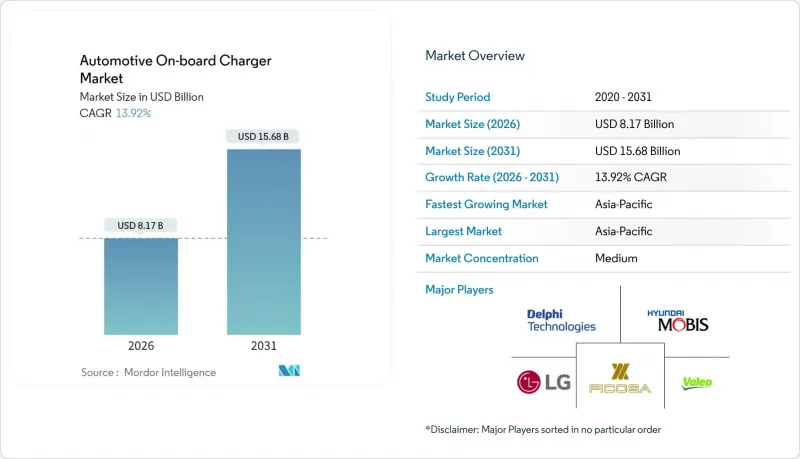
자동차 온보드 충전기 시장은 2025년 71억 7,000만 달러에서 2026년에는 81억 7,000만 달러로 성장하여 2026년부터 2031년까지 CAGR 13.92%를 기록하며 2031년까지 156억 8,000만 달러에 달할 것으로 예측됩니다.
주요 경제권의 전기자동차 도입 의무화, 800V 차량 플랫폼으로의 빠른 전환, 와이드 밴드갭 반도체의 안정적인 가격 하락은 전반적으로 사양 업그레이드 주기를 강화하여 고출력 충전 솔루션에 대한 전반적인 수요를 증가시키고 있습니다. 유럽과 일부 아시아 시장에서는 자동차 제조업체들이 삼상 주택용 그리드를 활용하여 11-22kW 단위의 표준화를 추진하고 있습니다. 북미 OEM 업체들은 비용에 대한 민감성과 연방 정부의 인센티브를 동시에 고려하면서 국내 충전기 생산과 ISO 15118 준수를 우선시하고 있습니다. 1티어 공급업체들이 기존 가치사슬을 우회하여 트랙션 통합형 아키텍처를 추구하는 반도체 전문 기업들과 점유율 경쟁을 벌이면서 경쟁의 기세는 더욱 거세지고 있습니다. 동시에 정책 입안자들은 알루미늄 하우징에 대한 안전 및 재활용성 규제를 강화하고 있으며, 이로 인해 설계 변경의 필요성이 증가하여 공급업체의 수익 기회가 확대되고 있습니다. 이러한 구조적 요인이 결합되어 향후 10년간 자동차 온보드 충전기 시장은 두 자릿수 성장을 유지할 것으로 예상됩니다.
세계 자동차 온보드 충전기 시장 동향 및 인사이트
적극적인 세계 전기자동차 보급 목표와 구매 인센티브
각국의 무공해 규제와 구매 보조금 도입으로 OEM 업체들이 경쟁력 있는 총소유비용(TCO) 제안을 실현하기 위해 경쟁하면서 차량용 충전기의 기본 사양이 향상되고 있습니다. 중국의 2025년 신에너지 자동차 판매 목표, 유럽연합(EU)의 2030년 전체 차량 CO2 배출량 절반 감축 요건, 캘리포니아주의 첨단 클린카 II 프로그램 등이 맞물려 11kW 또는 22kW AC 충전 기능을 표준으로 장착한 모델 출시가 가속화되고 있습니다. 한국이 2020년 말까지 전기자동차 보급률의 대폭적인 향상을 목표로 하고 있는 가운데, 현대모비스는 2020년 하반기부터 통합충전제어장치(ICCU) 생산 확대를 계획하고 있습니다. 이러한 움직임은 지역적 수요의 급격한 증가를 뒷받침하며, SiC 디바이스의 가격 하락에 기여하고 있습니다. 한편, 보조금 제도에서는 가정용 충전기 구매 보조권 제공이 증가하고 있습니다. 이 조치는 고출력 월박스에 대한 소비자의 투자 회수 기간을 단축시킬 뿐만 아니라, 양방향 전력 흐름 및 차량용 충전기용 ISO 15118 인증과 같은 고급 기능에 대한 자동차 제조업체의 투자를 정당화하는 역할을 합니다.
800V 차량용 시스템으로의 빠른 전환으로 11-22kW 차량용 충전기 실현
800V 전기 시스템으로의 전환은 구리의 질량이나 열 부하를 비례적으로 증가시키지 않고도 높은 전력 밀도를 실현함으로써 비용 대비 성능의 한계를 재정의합니다. 현대 자동차의 E-GMP와 GM의 Ultium은 급속 충전 시나리오를 실현하고, 22kW의 AC 충전 용량은 주거용 에너지 차익거래를 자연스럽게 보완할 수 있습니다. FORVIA HELLA와 같은 공급업체는 Infineon의 CoolSiC 모듈을 컴팩트한 인클로저에 통합하여 최대 효율을 달성하고 냉각판 면적을 3분의 1로 줄였습니다. 이를 통해 후드 아래 공간을 보조 전자기기를 위한 공간으로 확보했습니다. 조기 도입 기업은 충전 시간 단축을 무기로 가격 프리미엄을 획득하고, 인센티브 자격이 최소 충전 성능 기준과 연동되는 시장에서 귀중한 컴플라이언스 크레딧을 확보할 수 있습니다. 1차 공급업체가 800V 지원 설계를 사전 인증하는 가운데, 2차 도입 기업은 설계 기간 단축에 직면하여 턴키 레퍼런스 플랫폼에 대한 수요가 증가하고 있습니다. 이러한 시너지 효과로 기본 등급의 전력 등급이 향상되어 자동차 온보드 충전기 시장은 기존 3.3-7.4kW의 축을 넘어 규모가 확대되고 있습니다.
22kW 삼상 차량용 충전기에서 광대역 갭 기판의 지속적 고비용
파운드리의 기록적인 확장에도 불구하고 SiC 부울의 수율은 5분의 3 미만, GaN 에피웨이퍼의 리드타임은 30주 이상, 기판 비용은 여전히 높은 수준을 유지하고 있습니다. 자동차 등급 650V SiC MOSFET 다이의 경우, 평면 실리콘 IGBT에 비해 여전히 3-4배의 프리미엄 가격이 유지되고 있으며, 고출력 3상 설계는 프리미엄 브랜드 차량 및 상용차에 한정되어 있습니다. 방열판과 EMI 차폐는 시스템 재료 비용을 더욱 증가시켜 와이드 밴드 갭 채택에 따른 밀도 향상 효과를 일부 상쇄하고 있습니다. 비용에 민감한 C부문 크로스오버 차량의 경우, 0.02달러/W의 가격 차이는 대략 45달러의 부품 비용 증가에 해당하며, 가격 탄력성이 높은 시장에서는 소매 마진을 압박합니다. 이 때문에 OEM 업체들은 비용 곡선이 낮아질 때까지 유럽 이외의 지역에서는 22kW 옵션 코드 도입을 연기하고 있으며, 이로 인해 자동차 온보드 충전기 시장에서 차세대 충전기 보급률에 일시적인 상한선이 생기고 있습니다.
부문 분석
상용차는 2025년부터 2031년까지 14.05%의 가장 빠른 CAGR을 기록했지만, 2025년 기준 승용차가 자동차 온보드 충전기 시장 규모의 65.82%를 차지했습니다. 창고 중심의 가동 사이클에서는 대기시간의 최소화가 중요하기 때문에 물류 사업자는 야간 에너지 처리 능력의 극대화와 전력회사의 수요 반응 프로그램 참여를 목적으로 22kW 양방향 충전기를 지정하고 있습니다.
승용차는 더 큰 잠재적 번호판 기반으로 인해 절대적인 출하량을 계속 지원하지만, 플랫폼의 공통화로 인해 옵션 가격 책정 자유도가 제한되어 단가 기여도는 감소할 것입니다. 안전 규정, 사이버 보안 요건, 재활용성 규정의 통합으로 인해 차량 전용 솔루션에 대한 비반복적인 엔지니어링 비용이 증가하여 전문 공급업체에 마진 버퍼를 가져다 줍니다. 또한, 충전기 사용량 대시보드, 예방적 유지보수 알림과 같은 부가가치 분석을 통해 통합형 OBC 솔루션의 수익화를 차별화하고 있습니다. 그 결과, 차종별 동향은 서로 다른 성장 궤도를 형성하지만, 전체적으로 자동차 온보드 충전기 시장은 두 자릿수 매출 성장을 유지할 것입니다.
2025년 기준, 배터리 전기자동차(BEV)는 자동차 온보드 충전기 시장 점유율의 76.18%를 차지하며 2031년까지 연평균 14.02%의 CAGR로 선두를 유지할 것으로 예상됩니다. 순수 전기식 스케이트보드 구조는 후륜 축 상부 공간을 확보하여 OBC, 트랙션 인버터, DC-DC 스테이지가 표준 냉각 루프를 공유하는 중앙 집중식 파워 일렉트로닉스 베이를 설치할 수 있습니다. 바닥 아래 연료 탱크의 제약으로 인해, 이 패키징은 PHEV 레이아웃에서는 재현할 수 없는 비용 절감의 협업을 실현합니다.
플러그인 하이브리드 차량은 규제 대응과 지방 시장의 틈새 수요를 계속 충족시키고 있지만, 듀얼 연료의 복잡성으로 인해 비용과 무게 관리로 인해 OBC 등급은 7.4kW 전후에서 정점을 찍고 있습니다. 중국과 유럽의 규제 크레딧 제도에서 PHEV에 대한 보너스 배율이 단계적으로 낮아지고 있어, 프리미엄 충전 기능의 비즈니스 케이스는 축소되는 추세입니다. 공급업체는 BEV 차량에 대한 펌웨어 커스터마이징을 우선시하여 동적 위상 전환 및 고조파 감소를 실현하는 한편, PHEV 설계는 주로 파생 제품으로 유지합니다. 2029년까지 BEV가 서유럽 신차 등록대수의 절반을 차지할 것으로 예상되는 가운데, 공급업체들은 BEV 전용 OBC가 전체 매출의 85% 이상을 차지할 것으로 예상하고 있으며, 이는 자동차 온보드 충전기 시장의 장기적인 성장 전망을 확고히 하고 있습니다.
지역별 분석
아시아태평양은 2025년 자동차 자동차 온보드 충전기 시장 규모의 37.35%를 차지하며 1위를 차지했으며, 중국의 GB38031-2025 배터리 안전 표준과 기록적인 전기자동차 도입 촉진책에 힘입어 2031년까지 연평균 14.07%의 성장률을 기록하며 다른 지역보다 높은 성장세를 이어갈 것입니다. 2023년 말까지 중국 본토에는 수백만 개의 공공 및 민간 충전기가 설치되었습니다. 이 이정표는 충전 밀도 기준을 설정하고, 공유 삼상 라이저를 갖춘 고층 아파트의 가정용 충전 실현을 가능하게 했습니다. 중국 공업정보화부는 알루미늄 하우징의 재활용 할당량에 대응하기 위해 재료 대체 이니셔티브를 추진하고 있습니다.
유럽은 제2의 시장으로, 계속해서 강력한 성장세를 보이고 있습니다. 이러한 모멘텀은 주로 AFIR(유럽 자동차 인프라 규정)에 따른 ISO 15118 표준 호환성 의무화와 유럽 횡단 교통망 연선에서의 충전소 밀도 기준의 필요성에 의해 뒷받침되고 있습니다. 독일과 프랑스에서는 전력계통의 탄소강도 안정화를 위해 원자력과 재생에너지를 계통에 통합하고 있습니다. 이번 통합으로 전력회사는 중대형 충전기의 V2G(차량에서 계통으로 전력 공급) 기능을 활용하여 동적 요금제를 제공할 수 있게 되었습니다.
북미에서는 인플레이션 억제법에 따른 선진 제조 세액공제의 혜택을 받고 있습니다. 또한, NEVI 자금에 의한 회랑 개발은 지역 인프라 강화에 기여하고 있습니다. 그러나 고용량 충전기의 보급은 고급 브랜드 외에는 제한적이며, 그 주요 요인은 단상 주택용 서비스의 제약에 있습니다. 이에 대응하여 OEM 제조업체는 고출력 듀얼 충전기를 제공하고 있지만, 시장 침투율은 여전히 미미합니다.
기타 특전:
- 엑셀 형식의 시장 예측(ME) 시트
- 애널리스트 지원(3개월)
자주 묻는 질문
목차
제1장 소개
제2장 조사 방법
제3장 주요 요약
제4장 시장 구도
제5장 시장 규모와 성장 예측(금액(달러) 및 수량(대수))
제6장 경쟁 구도
제7장 시장 기회와 향후 전망
KSM 26.03.10The Automotive On-board Charger Market is expected to grow from USD 7.17 billion in 2025 to USD 8.17 billion in 2026 and is forecast to reach USD 15.68 billion by 2031 at 13.92% CAGR over 2026-2031.
Surging electric-vehicle adoption mandates across major economies, the rapid migration to 800 V vehicle platforms, and steady declines in wide-band-gap semiconductor pricing collectively reinforce a cycle of specification upgrades that lift overall demand for higher-power charging solutions. Automakers leverage three-phase residential grids in Europe and selected Asian markets to standardize 11-22 kW units. North American OEMs balance cost sensitivities against federal incentives, prioritizing domestic charger production and ISO 15118 compliance. Competitive momentum intensifies as tier-1 suppliers defend share against semiconductor specialists that bypass traditional value chains to pursue traction-combined architectures. At the same time, policymakers tighten safety and recyclability rules on aluminum housings, creating incremental redesign requirements that expand supplier addressable revenue. Together, these structural forces sustain double-digit growth for the Automotive on-board charger market through the decade.
Global Automotive On-board Charger Market Trends and Insights
Aggressive Global EV Adoption Targets & Purchase Incentives
National zero-emission mandates and purchase subsidies elevate the baseline specification of on-board chargers as OEMs race to deliver compelling total-cost-of-ownership propositions. China's new-energy vehicle sales goal for 2025, the European Union's half of fleet-wide CO2-reduction requirement for 2030, and California's Advanced Clean Cars II program together accelerate model launches that embed 11 kW or 22 kW AC capability as standard equipment . With South Korea aiming for a significant increase in EV adoption by the end of the decade, Hyundai Mobis is set to ramp up production of integrated charging control units (ICCU) starting in the latter half of the decade. This move underscores a regional demand surge, contributing to a price drop for SiC devices. Meanwhile, subsidy frameworks are increasingly offering home-charging vouchers. This tactic not only shortens the payback period for consumers investing in higher-power wallboxes but also validates OEMs' investments in advanced features like bi-directional energy flow and ISO 15118 authentication for on-board chargers.
Rapid Switch To 800 V Vehicle Architectures Enabling 11-22 kW OBCs
The migration toward 800 V electrical systems reshapes cost-performance frontiers by enabling higher power densities without proportional increases in copper mass or thermal overhead. Hyundai's E-GMP and GM's Ultium demonstrate quick charging scenarios, making 22 kW AC capability a natural complement for residential energy arbitrage . Suppliers such as FORVIA HELLA integrate Infineon CoolSiC modules into compact housings, achieving maximum efficiency and reducing cooling plate area by one-third, freeing under-hood volume for auxiliary electronics. Early adopters leverage reduced charge times to command pricing premiums and secure valuable compliance credits in markets that tie incentive eligibility to minimum charging performance thresholds. As tier-1s pre-qualify 800 V-ready designs, secondary adopters face compressed design windows, intensifying the demand for turnkey reference platforms. The net effect elevates base-grade power ratings and scales the Automotive on-board charger market beyond its historical 3.3-7.4 kW spine.
Persistently High Wide-Band-Gap Substrate Costs in 22 kW Three-Phase OBCs
Despite record foundry expansions, SiC boule yields under three-fifths and GaN epi-wafer lead times surpassing 30 weeks prolong elevated substrate economics. Automotive-grade 650 V SiC MOSFET die still commands a 3-4 times premium over planar silicon IGBTs, limiting high-power three-phase designs to premium badges and commercial fleets. Heat-spreading plates and EMI shielding further inflate system material costs, offsetting some of the density gains from wide-band-gap adoption. For value-oriented C-segment crossovers, each USD 0.02 / W price delta translates to roughly USD 45 in incremental BOM, pressuring retail margins in price-elastic markets. OEMs thus defer 22 kW option codes outside Europe until cost curves decline, creating a temporary ceiling on the penetration rate of next-gen chargers in the Automotive on-board charger market.
Other drivers and restraints analyzed in the detailed report include:
- Declining SiC/GaN Device Prices Lifting OBC Power Density
- Mandatory ISO 15118 / Plug-and-Charge & V2G Readiness Clauses
- OEM Hesitancy To Up-Spec AC Chargers As DC Ultra-Fast Networks Accelerate
For complete list of drivers and restraints, kindly check the Table Of Contents.
Segment Analysis
Commercial vehicles contributed the fastest 14.05% CAGR during 2025-2031, even though passenger cars controlled 65.82% of the Automotive on-board charger market size in 2025. Depot-centric duty cycles reward fleets that minimize dwell times; thus, logistics operators specify 22 kW bi-directional chargers to maximize overnight energy throughput and participate in utility demand-response.
Passenger cars will continue to anchor absolute shipments because of larger addressable license-plate bases, yet their unit-value contribution tapers as platform commonization curbs option-pricing latitude. The convergence of safety regulations, cybersecurity mandates, and recyclability rules amplifies non-recurring engineering outlays for fleet-specific solutions, giving specialized suppliers a margin buffer. Fleets also pioneer value-added analytics such as charger-utilization dashboards and preventive-maintenance alerts that monetarily differentiate integrated OBC offerings. Consequently, vehicle-type dynamics shape divergent growth trajectories but collectively keep the broader Automotive on-board charger market on a double-digit revenue track.
Battery electric vehicles captured 76.18% of the Automotive on-board charger market share in 2025 and maintain the lead with a 14.02% CAGR through 2031. Pure-electric skateboard architectures free volume above the rear axle, enabling centralized power-electronics bays where OBCs, traction inverters, and DC-DC stages share a standard coolant loop. Due to under-floor fuel-tank constraints, this packaging unlocks cost collaborations that PHEV layouts cannot replicate.
Plug-in hybrids continue to serve compliance and rural-market niches, but their dual-fuel complexity caps OBC ratings near 7.4 kW to manage cost and mass. Regulatory credit systems in China and Europe progressively lower bonus multipliers for PHEVs, tightening the business case for premium charging upgrades. Suppliers prioritize firmware customization for BEV fleets-enabling dynamic phase switching and harmonic mitigation-while keeping PHEV designs largely derivative. As BEVs cross half of new-car registrations in Western Europe by 2029, suppliers expect BEV-dedicated OBCs to represent more than 85% of total revenue, solidifying long-term growth prospects for the Automotive on-board charger market.
The Automotive On-Board Charger Market Report is Segmented by Vehicle Type (Passenger Cars and Commercial Vehicles), Powertrain Type (Battery Electric Vehicles and Plug-In Hybrid Electric Vehicles), Power Rating (Less Than 3. 3 KW, 3. 3-11 KW, and More Than 11 KW), Sales Channel (OEM-Installed and Aftermarket), and Geography. The Market Forecasts are Provided in Terms of Value (USD) and Volume (Units).
Geography Analysis
Asia-Pacific led with 37.35% share of the Automotive on-board charger market size in 2025 and continues to outpace peers at a 14.07% CAGR through 2031, buoyed by China's GB38031-2025 battery-safety mandate and record EV adoption incentives. By the close of 2023, mainland installations boasted millions of public and private charging units. This milestone set density thresholds, making home charging feasible for high-rise apartments with shared three-phase risers. In a move to address recycling quotas on aluminum housings, the Chinese Ministry of Industry and Information Technology spurred material-substitution initiatives.
Europe, holding the second spot, continues to witness vigorous growth. This momentum is primarily fueled by AFIR's mandates on ISO 15118 compatibility and the requisite density of charging stations along the Trans-European Transport Network. Germany and France are weaving nuclear and renewable energy into their grids to stabilize grid-carbon intensity. This integration empowers utilities to roll out dynamic tariff products, capitalizing on the vehicle-to-grid capabilities of mid-to-high capacity chargers.
North America is reaping the benefits of the Inflation Reduction Act's advanced-manufacturing tax credits. Additionally, NEVI-funded corridor developments are bolstering the region's infrastructure. However, the adoption of higher-capacity chargers remains limited outside luxury brands, primarily due to the constraints of single-phase residential services. In response, OEMs offer dual chargers with higher output capacities, though market penetration is still modest.
- BorgWarner Inc.
- Hyundai Mobis
- LG Electronics
- STMicroelectronics
- Ficosa International S.A.
- Valeo SE
- Delta Energy Systems AG
- Toyota Industries Corp.
- Brusa Elektronik AG
- VisIC Technologies
- Infineon Technologies AG
- Eaton Corp.
- DENSO Corp.
- Panasonic Industry
- TDK Corp.
- Onsemi
- Stercom Power Solutions
- Delta-Q Technologies
Additional Benefits:
- The market estimate (ME) sheet in Excel format
- 3 months of analyst support
TABLE OF CONTENTS
1 Introduction
- 1.1 Study Assumptions & Market Definition
- 1.2 Scope of the Study
2 Research Methodology
3 Executive Summary
4 Market Landscape
- 4.1 Market Overview
- 4.2 Market Drivers
- 4.2.1 Aggressive Global EV Adoption Targets & Purchase Incentives
- 4.2.2 Rapid Switch To 800 V Vehicle Architectures Enabling 11-22 kW OBCs
- 4.2.3 Declining SIC/GAN Device Prices Lifting OBC Power Density
- 4.2.4 Mandatory ISO 15118 / Plug-&-Charge & V2G Readiness Clauses In EU & US Funding Schemes
- 4.2.5 Tier-1/OEM Migration To Traction-Integrated & Bidirectional OBCs (3-In-1 E-Axle)
- 4.2.6 PV-Integrator Channel In Emerging Markets Bundling Rooftop Solar + OBC-Ready EV Packages
- 4.3 Market Restraints
- 4.3.1 Persistently High Wide-Band-Gap Substrate Costs In 22 Kw Three-Phase OBCs
- 4.3.2 OEM Hesitancy To Up-Spec AC Chargers As DC Ultra-Fast (>=350 Kw) Roll-Outs Accelerate
- 4.3.3 Grid-Connection Bottlenecks For Residential 11 Kw Upgrades In Dense Cities
- 4.3.4 Impending Scrap-Recycling Regulation In China Taxing Large OBC Aluminum Housings
- 4.4 Value / Supply-Chain Analysis
- 4.5 Regulatory Landscape
- 4.6 Technological Outlook
- 4.7 Porter's Five Forces
- 4.7.1 Threat of New Entrants
- 4.7.2 Bargaining Power of Buyers/Consumers
- 4.7.3 Bargaining Power of Suppliers
- 4.7.4 Threat of Substitute Products
- 4.7.5 Intensity of Competitive Rivalry
5 Market Size & Growth Forecasts (Value (USD) and Volume (Units))
- 5.1 By Vehicle Type
- 5.1.1 Passenger Cars
- 5.1.2 Commercial Vehicles
- 5.2 By Powertrain Type
- 5.2.1 Battery Electric Vehicles (BEVs)
- 5.2.2 Plug-in Hybrid Electric Vehicles (PHEVs)
- 5.3 By Power Rating
- 5.3.1 Less than 3.3 kW
- 5.3.2 3.3-11 kW
- 5.3.3 More than 11 kW
- 5.4 By Sales Channel
- 5.4.1 OEM-installed
- 5.4.2 Aftermarket
- 5.5 By Geography
- 5.5.1 North America
- 5.5.1.1 United States
- 5.5.1.2 Canada
- 5.5.1.3 Mexico
- 5.5.2 South America
- 5.5.2.1 Brazil
- 5.5.2.2 Argentina
- 5.5.2.3 Rest of South America
- 5.5.3 Europe
- 5.5.3.1 Germany
- 5.5.3.2 United Kingdom
- 5.5.3.3 France
- 5.5.3.4 Italy
- 5.5.3.5 Russia
- 5.5.3.6 Rest of Europe
- 5.5.4 Asia Pacific
- 5.5.4.1 China
- 5.5.4.2 Japan
- 5.5.4.3 India
- 5.5.4.4 South Korea
- 5.5.4.5 Rest of Asia Pacific
- 5.5.5 Middle East & Africa
- 5.5.5.1 Saudi Arabia
- 5.5.5.2 UAE
- 5.5.5.3 Turkey
- 5.5.5.4 South Africa
- 5.5.5.5 Egypt
- 5.5.5.6 Nigeria
- 5.5.5.7 Rest of Middle East and Africa
- 5.5.1 North America
6 Competitive Landscape
- 6.1 Market Concentration
- 6.2 Strategic Moves
- 6.3 Market Share Analysis
- 6.4 Company Profiles (includes Global Level Overview, Market Level Overview, Core Segments, Financials as Available, Strategic Information, Market Rank/Share for Key Companies, Products and Services, SWOT Analysis, and Recent Developments)
- 6.4.1 BorgWarner Inc.
- 6.4.2 Hyundai Mobis
- 6.4.3 LG Electronics
- 6.4.4 STMicroelectronics
- 6.4.5 Ficosa International S.A.
- 6.4.6 Valeo SE
- 6.4.7 Delta Energy Systems AG
- 6.4.8 Toyota Industries Corp.
- 6.4.9 Brusa Elektronik AG
- 6.4.10 VisIC Technologies
- 6.4.11 Infineon Technologies AG
- 6.4.12 Eaton Corp.
- 6.4.13 DENSO Corp.
- 6.4.14 Panasonic Industry
- 6.4.15 TDK Corp.
- 6.4.16 Onsemi
- 6.4.17 Stercom Power Solutions
- 6.4.18 Delta-Q Technologies
7 Market Opportunities & Future Outlook
- 7.1 White-space & unmet-need assessment