|
시장보고서
상품코드
1940730
미국의 인쇄 라벨 : 시장 점유율 분석, 업계 동향과 통계, 성장 예측(2026-2031년)United States Print Label - Market Share Analysis, Industry Trends & Statistics, Growth Forecasts (2026 - 2031) |
||||||
 Mordor Intelligence
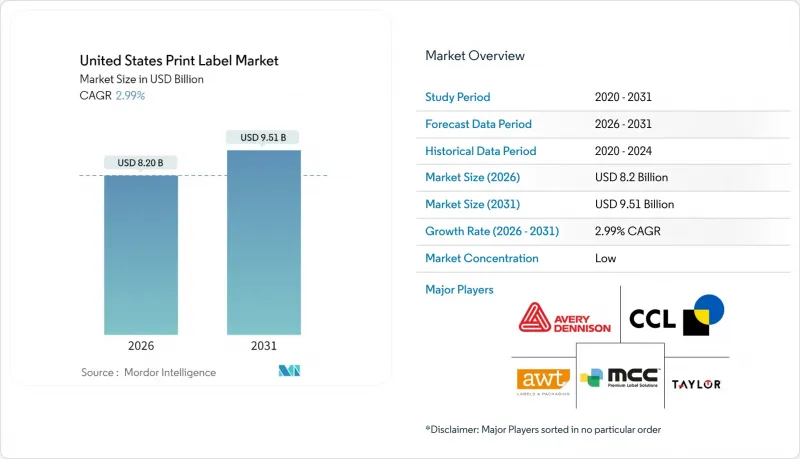
미국의 인쇄 라벨 시장은 2025년 79억 6,000만 달러에서 2026년에는 82억 달러에 이르고, 2026-2031년 CAGR 2.99%로 성장을 지속하여 2031년까지 95억 1,000만 달러에 달할 것으로 예측됩니다.
식품, 의료, 전자상거래 분야의 견고한 수요가 성장을 뒷받침하는 한편, 디지털 인쇄와 지속가능성에 대한 요구가 기술 선택, 재료, 비즈니스 모델을 재구성하고 있습니다. 플 렉소 인쇄는 여전히 큰 설치 기반을 유지하고 있지만, 가변 데이터 지원, 단납기 생산의 경제성, 직렬화 규제가 민첩한 인쇄기에 유리하기 때문에 디지털 워크플로우가 자리를 잡아가고 있습니다. 캘리포니아 주와 같은 주에서 확대된 생산자책임재활용(EPR) 법규로 인해 라이너리스, 재활용 가능, 바이오 구조가 가속화되고 있습니다. 숙련된 인력 부족을 보완하기 위한 자동화 투자가 진행되고 있으며, 원자재 비용의 변동성으로 인해 가치사슬 전반에서 재고 관리 및 조달 방식의 전환이 이루어지고 있습니다. 규모의 경제를 배경으로 주요 컨버터들이 공급 확보, 연구개발 자금 조달, 하이브리드 인쇄기 플랫폼 도입을 추진하면서 업계 재편은 계속되고 있습니다. 이를 통해 물류 경로 전반에서 증가하는 스마트 라벨 수요에 대응하고 있습니다.
미국의 인쇄 라벨 시장 동향 및 인사이트
디지털 인쇄 기술의 보급
가변 데이터에 대한 수요가 증가함에 따라, 컨버터는 설정 시간을 크게 단축하고 ERP 직접 PDF 워크플로우를 지원하는 디지털 인쇄기로의 전환을 촉진하고 있습니다. 2025년 1월에 출시된 도시바의 BX410T 시리즈는 듀얼 코어 프로세서와 리눅스 운영체제를 통합하여 드라이버가 필요 없는 운영과 클라우드 차량 관리를 실현함으로써 숙련된 인력 부족을 완화합니다. 제약 브랜드는 이러한 시스템을 개인 수준의 시리얼라이제이션에 활용하고, 화장품 라인은 주문형 컬러 유연성을 활용하여 계절별 한정판 제품을 생산하고 있습니다. 원격 펌웨어 업데이트와 예지보전을 통해 가동률을 높이고, 설비 투자 판단을 디지털 플랫폼으로 전환하고 있습니다. 초기 도입자들이 폐기물을 줄이고 캠페인 주기를 단축하여 ROI를 입증함에 따라 미국의 인쇄 라벨 시장은 하이브리드 또는 완전 디지털 대응 능력을 갖춘 컨버터에 점점 더 많은 관심을 기울이고 있습니다.
의료-화장품 라벨 채용 동향
2024년 1월, FDA는 환자용 의약품 정보 규칙을 최종 결정하고 단일 페이지 형식과 표준화된 서체를 의무화했습니다. 이로 인해 제네릭 의약품은 주기적으로 라벨을 재부착해야 하는 상황이 발생하고 있습니다. 한편, 화장품 브랜드는 소매점에서 차별화를 위해 변조 방지 기능과 고급스러운 마감재 채택을 가속화하고 있습니다. 이에 반해 브래디는 2024년 매출액의 5.1%를 R&D에 투자해 수용성 실험실 라벨과 RFID 기반 추적성 솔루션 확대에 집중하기로 했습니다. 의료 및 미용 분야 고객들은 규제 준수 기판, 초소형 글꼴 가독성, 특수 접착제에 정통한 컨버터를 높이 평가하고 있으며, 미국 전체 인쇄 라벨 시장에서 일반 식품 라벨에 비해 평균 수익률을 높이고 있습니다.
변동하는 종이 및 수지 원료 비용
펄프 가격 변동과 석유화학제품공급 차질은 특히 가격 급등 이전에 체결된 장기 계약의 경우 컨버터의 수익률을 압박합니다. 수직계열화 기업은 선물구매나 자체 필름 압출설비 활용으로 리스크 헤지를 도모하지만, 소규모 독립기업은 재고조정이나 계약기간 중 계약조건 재협상을 해야 하는 경우가 많습니다. 또한, 제지 공장이 외딴 곳에 위치한 경우, 종이 라이너의 재활용 제약으로 인해 운송 비용이 추가되는 것으로 Associated Labels and Packaging의 2024년 서해안 지역 파일럿 조사에서 밝혀졌습니다. 비용의 불확실성으로 인해 기판의 경량화 및 라이너리스화가 시도되고 있지만, 재료의 대체는 성능을 저하시킬 수 있으며, 품질 보증 팀은 엄격한 일정에 따라 모든 변경 사항을 검증해야 합니다.
부문 분석
플 렉소 인쇄는 2025년 기준 미국의 인쇄 라벨 시장의 37.02%를 차지할 것으로 예상되며, 고속 라인 속도와 식음료의 긴 길이 인쇄를 위한 비용 효율적인 폴리머 판이 이를 뒷받침할 것으로 보입니다. 그라비아 인쇄는 규모는 작지만 고급 와인, 화장품, 특수 화학제품 브랜드가 사진 품질과 금속성 마감을 요구함에 따라 2031년까지 연평균 복합 성장률(CAGR) 3.76%를 유지할 것으로 예측됩니다. 미국 내 디지털 전자 사진 인쇄 및 UV 잉크젯 인쇄 라벨 시장은 현재 규모가 작지만, 제약 및 크래프트 음료 구매자가 로트별 일련번호와 SKU별 아트웍을 필요로 하기 때문에 2024년에는 설치 대수가 두 자릿수 성장률을 나타낼 것으로 예측됩니다. 하이브리드 인쇄기를 제공하는 컨버터는 아날로그와 디지털 스테이션을 원활하게 전환하여 폐기물과 납기를 줄입니다.
전자상거래를 도입하는 브랜드 소유자는 플렉스 실린더를 가득 채우지 않는 소규모 캠페인을 전개합니다. 이를 통해 디지털 인쇄는 기존 플 렉소 인쇄량을 잠식하지 않고 매출 증대를 실현하고, 판재 투자를 유지하면서 동적 QR 코드 및 개인화 기능을 활용할 수 있습니다. 스크린 인쇄는 두꺼운 바니시 층이나 촉각 효과와 같은 틈새 분야에서 역할을 유지하고, 오프셋 인쇄는 고급 주류의 정밀한 컬러 매칭 작업을 담당합니다. 활판인쇄는 현재 고수익을 내는 선물 및 문구 제품을 제작하는 장인 스튜디오에서 주로 생존하고 있습니다. 공정의 다양성은 컨버터에게 설비 투자 협상력을 부여하고, 미국의 인쇄 라벨 시장에서 다국적 고객에게 풀라인 서비스를 제안할 수 있도록 지원합니다.
2025년 기준, 압착식 롤 라벨은 범용성과 자동 부착기와의 호환성으로 인해 미국의 인쇄 라벨 시장의 52.05%를 차지했습니다. 그러나 EPR(확대된 생산자 책임(EPR)에 따른 폐기물 감소 목표와 측정 가능한 생산성 향상(팔레트당 라벨 용량 40% 증가)을 배경으로 라이너리스 릴은 4.26%의 연평균 복합 성장률(CAGR)로 확대될 것으로 예측됩니다. 습식 접착 라벨은 기존 라인을 사용하는 주류 맥주 병입 업체에게 여전히 비용 효율적인 선택입니다. 한편, 크래프트 맥주 양조장에서는 특수한 병 모양이나 소량 생산에 대응할 수 있는 수축 슬리브와 감압 접착 라벨을 채택하고 있습니다. 다중 부품 세트는 특히 의료 진단 및 항공우주 부품 추적 관리와 같은 관리 체인 시나리오에서 활용되고 있습니다.
인몰드 옵션은 5년 이상의 제품 수명을 견딜 수 있는 내마모성이 요구되는 내구소비재 및 산업용 페일 용기에 채택되고 있습니다. 수축 슬리브와 스트레치 슬리브는 음료, 건강보조식품, 가정용 세제 분야에서 매장 내 소구력이 판매 촉진과 직결되는 '간판 그래픽'과 '변조 방지 표시'를 제공합니다. 소매업체들이 재활용 기준을 강화하는 가운데, 컨버터는 부유성 슬리브 필름과 PET 재생 시 분리되는 세척 가능한 잉크를 결합한 솔루션을 제공합니다. 따라서 재료 엔지니어는 R&D 팀에서 인쇄 사업자와 협력하여 미국의 인쇄 라벨 시장에서 접착력, 불투명도 및 지속가능성 목표를 달성하기 위해 노력하고 있습니다.
기타 특전:
- 엑셀 형식 시장 예측(ME) 시트
- 애널리스트의 3개월간 지원
자주 묻는 질문
목차
제1장 서론
제2장 조사 방법
제3장 주요 요약
제4장 시장 구도
제5장 시장 규모와 성장 예측
제6장 경쟁 구도
제7장 시장 기회와 향후 전망
LSH 26.03.10The United States print label market is expected to grow from USD 7.96 billion in 2025 to USD 8.2 billion in 2026 and is forecast to reach USD 9.51 billion by 2031 at 2.99% CAGR over 2026-2031.
Robust demand from food, healthcare, and e-commerce applications anchors growth, while digital printing and sustainability mandates reshape technology choices, materials, and business models. Flexography retains a sizeable installed base, yet digital workflows gain ground as variable-data, short-run economics, and serialization rules favor agile presses. Linerless, recyclable, and bio-based constructions accelerate through Extended Producer Responsibility (EPR) legislation in states such as California. Automation spending offsets skilled-labor shortages, and raw-material cost volatility triggers inventory and sourcing shifts across the value chain. Consolidation continues as scale helps leading converters secure supply, fund R&D, and deploy hybrid press platforms that address emerging smart-label needs across fulfillment corridors.
United States Print Label Market Trends and Insights
Digital Print Technology Penetration
Demand for variable data pushes converters toward digital presses that slash makeready times and support ERP-direct PDF workflows. Toshiba's BX410T series, launched in January 2025, integrates a dual-core processor and Linux operating system, enabling driver-free operation and cloud fleet management that mitigates skilled-labor gaps. Pharmaceutical brands leverage these systems for unit-level serialization, while cosmetics lines exploit on-demand color flexibility to run seasonal variants. Remote firmware updates and predictive maintenance improve uptime, tipping capex decisions toward digital platforms. As early adopters demonstrate ROI through reduced waste and quicker campaign cycles, the United States print label market increasingly favors converters with hybrid or fully digital capacity.
Healthcare and Cosmetics Label Uptake
In January 2024, the FDA finalized Patient Medication Information rules that enforce single-page formats and standardized typography, creating recurrent relabeling cycles for generic drugs. Cosmetics brands simultaneously escalate tamper-evident and premium finishes to stand out on retail shelves. Brady Corporation responded by expanding water-dissolvable laboratory labels and RFID-enabled traceability solutions, underpinned by a 5.1% R&D-sales ratio in 2024. Healthcare and beauty accounts thus reward converters skilled in compliant substrates, micro-font legibility, and specialty adhesives, lifting average margins compared with commodity food labels across the United States print label market.
Volatile Paper and Resin Input Costs
Pulp price swings and petrochemical disruptions squeeze converter margins, especially on long-term contracts signed before spike events. Vertically integrated players hedge exposure by forward-buying or leveraging in-house film extrusion, whereas small independents often ration inventory or renegotiate terms mid-cycle. Paper-liner recycling constraints add hauling fees when mills are distant, as documented in Associated Labels & Packaging's 2024 West Coast pilot study. Cost uncertainty encourages substrate light-weighting and linerless trials, but material substitutions can compromise performance, pressing QA teams to validate every change under tight timelines.
Other drivers and restraints analyzed in the detailed report include:
- E-Commerce and Logistics Label Volumes
- Smart/IoT Labels for Supply-Chain Traceability
- Skilled Narrow-Web Labor Shortages
For complete list of drivers and restraints, kindly check the Table Of Contents.
Segment Analysis
Flexography commanded 37.02% of the United States print label market share in 2025, supported by fast line speeds and cost-effective polymer plates for long food and beverage runs. Gravure, though smaller, is on track for a 3.76% CAGR through 2031 as luxury wine, cosmetic, and specialty-chemical brands demand photographic quality and metallic finishes. The United States print label market for digital electrophotography and UV inkjet remains modest currently, yet installs grew double-digit in 2024 because pharmaceutical and craft-beverage buyers need serialization or SKU-specific artwork on every lot. Converters offering hybrid presses switch seamlessly between analog and digital stations, cutting waste and turnaround times.
Brand owners embracing e-commerce launch micro-campaigns that rarely fill a flexo cylinder. Digital thus captures incremental revenue without cannibalizing base flexo volumes, preserving plate investments while unlocking dynamic QR code and personalization features. Screen printing retains niche roles for heavy varnish layers and tactile effects, whereas offset lithography serves precise color-match jobs in premium spirits. Letterpress now survives mainly in artisanal studios catering to high-margin gift and stationery products. Process diversity gives converters bargaining power on capex buys and supports full-line service pitches to multinational clients across the United States print label market.
Pressure-sensitive rolls occupied 52.05% of the United States print label market in 2025 due to universal applicability and automated applicator compatibility. However, linerless reels are forecast to log a 4.26% CAGR, spurred by EPR-driven waste targets and measurable throughput gains, sometimes fitting 40% more labels per pallet. Wet-glue remains cost-effective for mainstream beer bottlers using legacy lines, but craft brewers adopt shrink sleeves and PS because they accommodate unique bottle shapes and small batches. Multi-part sets flourish in chain-of-custody scenarios, particularly medical diagnostics and aerospace part tracking.
In-mold options appeal to durable goods and industrial pails that require scuff resistance for product life spans exceeding five years. Shrink and stretch sleeves provide billboard graphics and tamper indication for beverage, nutraceutical, and household cleaners, where shelf appeal directly drives sell-through. As retailers enforce recyclability standards, converters pair floatable sleeve films with washable inks that separate during PET reclamation. Material engineers, therefore, sit alongside press operators in R&D teams to ensure adhesion, opacity, and sustainability targets converge within the United States print label market.
The United States Print Label Market Report is Segmented by Print Process (Offset Lithography, Gravure, Flexography, Screen, and More), Label Format (Wet-Glue Labels, Pressure-Sensitive Labels, Linerless Labels, and More), End-User Industry (Food, Beverage, Healthcare, Cosmetics, Household, and More), Material Type (Paper, Plastic Films, and More). The Market Forecasts are Provided in Terms of Value (USD).
List of Companies Covered in this Report:
- Avery Dennison Corporation
- Multi-Color Corporation
- Fort Dearborn Company LLC
- AWT Labels & Packaging
- Brady Corporation
- RR Donnelley & Sons Company
- Taylor Corporation
- Weber Packaging Solutions
- Grand Rapids Label
- DRG Technologies Inc.
- CCL Industries Inc.
- Constantia Flexibles Group GmbH
- Label Masters LLC
- 3M Company
- Resource Label Group LLC
- Fortis Solutions Group LLC
- Brook & Whittle Holdings Corp.
- Inland Label & Marketing Services LLC
Additional Benefits:
- The market estimate (ME) sheet in Excel format
- 3 months of analyst support
TABLE OF CONTENTS
1 INTRODUCTION
- 1.1 Study Assumptions and Market Definition
- 1.2 Scope of the Study
2 RESEARCH METHODOLOGY
3 EXECUTIVE SUMMARY
4 MARKET LANDSCAPE
- 4.1 Market Overview
- 4.2 Market Drivers
- 4.2.1 Digital Print Technology Penetration
- 4.2.2 Healthcare and Cosmetics Label Uptake
- 4.2.3 E-Commerce and Logistics Label Volumes
- 4.2.4 EPR-Driven Shift to Linerless/Recyclable Labels
- 4.2.5 Smart/IoT Labels for Supply-Chain Traceability
- 4.2.6 Near-Shoring Driving Short-Run VDP Demand
- 4.3 Market Restraints
- 4.3.1 Durability Limits in Harsh Conditions
- 4.3.2 Volatile Paper and Resin Input Costs
- 4.3.3 Skilled Narrow-Web Labor Shortages
- 4.3.4 Recycling-Stream Fragmentation
- 4.4 Industry Value Chain Analysis
- 4.5 Regulatory Landscape
- 4.6 Technological Outlook
- 4.7 Porter's Five Forces Analysis
- 4.7.1 Threat of New Entrants
- 4.7.2 Bargaining Power of Buyers
- 4.7.3 Bargaining Power of Suppliers
- 4.7.4 Threat of Substitute Products
- 4.7.5 Intensity of Competitive Rivalry
- 4.8 Impact of Macroeconomic Factors on the Market
5 MARKET SIZE AND GROWTH FORECASTS (VALUE)
- 5.1 By Print Process
- 5.1.1 Offset Lithography
- 5.1.2 Gravure
- 5.1.3 Flexography
- 5.1.4 Screen
- 5.1.5 Letterpress
- 5.1.6 Electrophotography
- 5.1.7 Inkjet
- 5.2 By Label Format
- 5.2.1 Wet-Glue Labels
- 5.2.2 Pressure-Sensitive Labels
- 5.2.3 Linerless Labels
- 5.2.4 Multi-part Tracking Labels
- 5.2.5 In-Mold Labels
- 5.2.6 Shrink and Stretch Sleeves
- 5.3 By End-User Industry
- 5.3.1 Food
- 5.3.2 Beverage
- 5.3.3 Healthcare
- 5.3.4 Cosmetics
- 5.3.5 Household
- 5.3.6 Industrial (Automotive, Chemicals, Durables)
- 5.3.7 Logistics
- 5.3.8 Other End-User Industries
- 5.4 By Material Type
- 5.4.1 Paper
- 5.4.2 Plastic Films (PP, PET, PE)
- 5.4.3 Specialty and Sustainable Facestocks
- 5.4.4 Other Material Types
6 COMPETITIVE LANDSCAPE
- 6.1 Market Concentration
- 6.2 Strategic Moves
- 6.3 Market Share Analysis
- 6.4 Company Profiles {(includes Global level Overview, Market level overview, Core Segments, Financials as available, Strategic Information, Market Rank/Share for key companies, Products and Services, and Recent Developments)}
- 6.4.1 Avery Dennison Corporation
- 6.4.2 Multi-Color Corporation
- 6.4.3 Fort Dearborn Company LLC
- 6.4.4 AWT Labels & Packaging
- 6.4.5 Brady Corporation
- 6.4.6 RR Donnelley & Sons Company
- 6.4.7 Taylor Corporation
- 6.4.8 Weber Packaging Solutions
- 6.4.9 Grand Rapids Label
- 6.4.10 DRG Technologies Inc.
- 6.4.11 CCL Industries Inc.
- 6.4.12 Constantia Flexibles Group GmbH
- 6.4.13 Label Masters LLC
- 6.4.14 3M Company
- 6.4.15 Resource Label Group LLC
- 6.4.16 Fortis Solutions Group LLC
- 6.4.17 Brook & Whittle Holdings Corp.
- 6.4.18 Inland Label & Marketing Services LLC
7 MARKET OPPORTUNITIES AND FUTURE OUTLOOK
- 7.1 White-space and Unmet-Need Assessment