|
시장보고서
상품코드
1940801
소셜 미디어 리스닝 : 시장 점유율 분석, 업계 동향과 통계, 성장 예측(2026-2031년)Social Media Listening - Market Share Analysis, Industry Trends & Statistics, Growth Forecasts (2026 - 2031) |
||||||
 Mordor Intelligence
소셜 미디어 리스닝 시장은 2025년에 96억 2,000만 달러로 평가되었으며, 2026년 109억 1,000만 달러에서 2031년까지 205억 1,000만 달러에 달할 것으로 예측됩니다.
예측 기간(2026-2031년) 동안 CAGR은 13.45%로 예상됩니다.
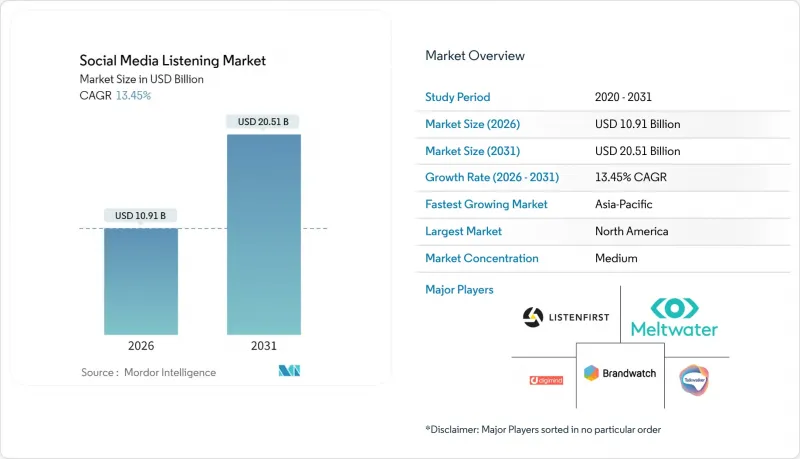
이러한 상승 추세는 기업들이 소셜 플랫폼에서 포착되는 초기 감정 신호에 의존하는 적극적인 참여로 전환하고 있기 때문입니다. 북미는 몇 가지 주목할 만한 위기 이후 브랜드 안전에 대한 우려가 높아지면서 선두를 유지하고 있습니다. 한편, 아시아태평양은 지역 특화형 플랫폼의 확대와 스마트폰 보급 가속화에 따라 가장 가파른 성장세를 보이고 있습니다. 소프트웨어는 여전히 핵심 투자 분야이지만, 기업이 맞춤형 워크플로우와 AI 모델 훈련이 필요하기 때문에 전문 서비스에 대한 수요가 증가하고 있습니다. 텍스트 분석이 여전히 주류를 이루고 있지만, 많은 네트워크에서 짧은 동영상이 텍스트를 능가하는 가운데 동영상 분석의 규모가 빠르게 확대되고 있습니다.
세계 소셜 미디어 리스닝 시장 동향 및 인사이트
인플루언서 주도의 위기에서 브랜드 리스크 감소
인플루언서들의 논쟁으로 인한 재정적 영향이 확대됨에 따라 기업의 리스크 관리 팀에게 실시간 소셜 인텔리전스는 필수적인 요소로 자리 잡았습니다. 성숙한 리스닝 시스템을 구축한 브랜드는 기존 모니터링에만 의존하는 타사 대비 4.3배 더 빠르게 문제 징후를 감지하고 대응할 수 있어 피해를 크게 줄일 수 있습니다. 상시 가동되는 알림은 기업의 리스크 관리 대시보드에 통합되어 홍보, 법무, 고객관리 부서가 신속하게 대응할 수 있도록 연계되어 있습니다. 소비재 업계에서는 단 한 번의 확산 게시물로 수개월에 걸친 브랜드 가치 구축이 망가질 수 있기 때문에 가장 시급한 문제입니다. 이러한 전략적 전환에 따라 주요 플랫폼 내 위기 대응 전용 모듈에 대한 예산 배분이 증가하고 있습니다. 예측적 점수화 및 자동화된 워크플로우를 통합한 벤더는 위험회피적인 구매 담당자들이 우선적으로 선택합니다.
생성형 AI를 통한 감정 분석으로 아시아태평양의 소매 ROI 개선
대규모 언어 모델(LLM)은 코드 스위칭과 속어가 기존의 자연어 처리(NLP)를 방해해 온 시장에서 감정 분석의 정확성을 재정의하고 있습니다. GPT-4는 이분법적 감정 분석 작업에서 93%의 정확도를 달성하여 다국어 지역에서 높은 정확도의 인사이트를 제공합니다. 아시아태평양의 소매업체들은 이러한 진보를 빠르게 활용하여 프로모션 및 상품 개선에 대한 미세 조정을 하고 있습니다. 특히, LLM은 별도의 애널리스트 팀 없이도 여러 아시아 언어를 처리할 수 있다는 점에서 크로스보더 판매사에게 큰 이점을 제공하고 있습니다. 호주의 건강보조식품 제조업체인 블랙모어스(Blackmores)는 위챗을 중심으로 한 모니터링을 활용하여 소비자의 우려를 감지하고 메시징을 재구성했습니다. 중국 시장 점유율 확대에 기여했습니다. 이 ROI 성공사례는 박리다매 상황을 의식한 EC 브랜드들 사이에서 도입이 가속화되고 있습니다.
분절된 데이터 프라이버시 규제
각기 다른 프라이버시 법규에 따라 벤더들은 지역마다 다른 옵트아웃, 삭제권, 데이터 거주의무에 대응해야 합니다. 캘리포니아주 소비자 프라이버시법(CCPA)은 세밀한 소비자 관리와 기밀정보에 대한 독자적인 워크플로우를 요구하는 등 운영상의 부담을 상징합니다. 중소 공급업체들은 지속적인 규제 업데이트에 대한 자금 조달에 어려움을 겪고 있으며, 컴플라이언스 비용의 증가로 인해 업계 구조조정이 가속화되고 있습니다. 기업 구매자들은 지역별 인스턴스를 개별적으로 도입하는 경우가 많아 세계 통합 대시보드의 가치를 희석시키고, ROI 기대치를 낮추고 있습니다.
부문 분석
2025년 기준 소셜 미디어 리스닝 시장에서 소프트웨어의 점유율은 67.20%를 차지하며 기업용 소셜 인텔리전스 기반의 핵심으로 확고히 자리매김하고 있습니다. 구매 담당자들은 리스닝, 인게이지먼트, 분석 기능을 통합하고 인사이트를 캠페인 관리 도구에 직접 연동하는 통합 제품군을 선호하고 있습니다. 이에 따라 벤더들은 고객 데이터 플랫폼 및 BI 웨어하우스와 연동되는 API 레이어를 통합하여 보다 광범위한 디지털 경험 전략을 지원하는 대응을 진행하고 있습니다. 이 번들링 트렌드는 기본적인 모니터링이 상품화되어도 라이선스 수익을 보호할 수 있습니다.
서비스 매출은 규모는 작지만 CAGR 16.02%로 성장하고 있습니다. 이는 기업들이 소셜 인텔리전스를 '플러그 앤 플레이 툴셋'이 아닌 '성과 중심의 기능'으로 인식하는 경향이 강해졌기 때문입니다. 현재 위기 시뮬레이션, 경쟁 정보 전술실, 산업별 전문 용어에 대한 LLM(대규모 언어 모델) 맞춤형 튜닝 등을 제공하고 있습니다. 매니지드 서비스는 24시간 커버리지가 부족한 중견기업이 선호하고, AI 튜닝 계약은 도메인 안전 모델을 필요로 하는 규제 산업에서 틈새시장을 개척하고 있습니다. 이러한 양대 축의 성장으로 소셜 미디어 리스닝 시장에서는 순수 전문 벤더와 하이브리드 벤더가 모두 존재감을 유지하고 있습니다.
대기업은 2025년 지출의 64.10%를 차지했습니다. 이는 청취 출력을 CRM, 제품, 컴플라이언스 시스템을 아우르는 데이터 레이크 아키텍처에 통합하고 있기 때문입니다. 여러 브랜드를 보유한 복합기업은 지역별 감정변동을 가시화하는 대시보드를 활용하여 반박 및 캠페인 확대를 조정하고 있습니다. 또한 CIO가 계약 간소화와 ISO 인증 보안 프레임워크를 제공하는 벤더를 중시하기 때문에 기업 구매 주기는 통합을 촉진하고 있습니다.
그러나 중소기업(SME)은 연평균 성장률(CAGR) 15.35%로 가장 빠르게 성장하는 계층입니다. 클라우드 가격대, 템플릿 기반 도입, 대화형 UI로 진입장벽을 낮추고 있습니다. OECD 조사에 따르면, 중소기업의 AI 도구 활용률은 2024년 26%에서 2025년 39%로 상승할 것으로 예상되며, 이는 디지털화의 가속화를 반영합니다. 소셜 미디어를 통한 '대화' 전략과 고객의 목소리를 결합한 소규모 수출기업들은 고객 확보 효과가 향상되었다고 보고하고 있어 투자 효과가 입증되고 있습니다. 벤더들은 이 부문을 타겟으로 분석의 심화 및 다중 사용자 접근이 필수적인 단계에서 유료 플랜으로 전환하는 번들형 프리미엄 제품을 제공하고 있습니다.
지역별 분석
북미는 2025년에도 41.20%의 매출 점유율을 유지했습니다. 이는 기술적 성숙도와 최근 몇 년간의 위기 이후 강화된 엄격한 브랜드 보호 태도에 힘입은 바 큽니다. 금융 서비스 및 의료 기업들은 캘리포니아 소비자 개인정보 보호법(CCPA) 등 소비자의 광범위한 데이터 권리를 인정하는 법규를 준수하기 위해 규제 대상 불만 처리 시스템에 소셜 데이터를 통합하고 있습니다. 지속적인 투자는 게시물이 확산되기 전에 브랜드 가치를 보호하는 고정밀 위험 감지 모듈에 집중되고 있습니다.
아시아태평양은 플랫폼 보급률의 급증과 모바일 커머스의 우위로 인해 2031년까지 CAGR 16.02%로 성장할 것으로 예상됩니다. 중국의 폐쇄형 네트워크 환경에서 벤더는 언어 모델과 API 커넥터를 미세 조정해야 합니다. WeChat의 Blackmores와 같이 이 복잡성을 파악한 브랜드는 빠른 점유율 확대를 실현하고 있습니다. 인도 시장에서는 스마트폰의 보급과 지역 언어 소셜 네트워크가 결합되어 다국어 대응이 필수적입니다. 동남아시아 시장은 높은 참여도를 보이지만, 방언 적응형 NLP가 필요하며, 서비스 파트너에 대한 수요가 증가하고 있습니다.
유럽에서는 GDPR 대응에 따른 무거운 부담과 기회가 맞물려 프라이버시 보호형 분석 기술의 혁신이 촉진되고 있습니다. 미디어 예산이 소셜 동영상으로 이동함에 따라 멀티모달 SOV(Share of Voice) 대시보드에 대한 수요가 증가하고 있습니다. 라틴아메리카, 중동 및 아프리카는 규모는 작지만 활기가 넘치고, 도시 중심지와 지역 정서를 측정할 수 있는 지표를 필요로 하는 다국적 기업을 중심으로 성장이 진행되고 있습니다. 걸프 지역 정부들은 서비스 품질에 대한 여론 추적을 위해 리스닝 도입에 박차를 가하고 있으며, 소셜 미디어 리스닝 시장에 대한 공공 부문의 수요를 확대하고 있습니다.
기타 특전:
- 엑셀 형식의 시장 예측(ME) 시트
- 애널리스트의 3개월간 지원
자주 묻는 질문
목차
제1장 소개
제2장 조사 방법
제3장 주요 요약
제4장 시장 구도
제5장 시장 규모와 성장 예측
제6장 경쟁 구도
제7장 시장 기회와 향후 전망
KSM 26.03.10The social media listening market was valued at USD 9.62 billion in 2025 and estimated to grow from USD 10.91 billion in 2026 to reach USD 20.51 billion by 2031, at a CAGR of 13.45% during the forecast period (2026-2031).
The uptrend stems from enterprises shifting toward proactive engagement that relies on early sentiment signals captured on social platforms. North America retains leadership, aided by heightened brand-safety concerns following several high-profile crises, while Asia-Pacific records the steepest growth as localized platforms expand and smartphone adoption accelerates. Software remains the core investment category, although demand for expert services is climbing because firms need tailored workflows and AI model training. Text analytics still dominates, but video analytics is scaling quickly as short-form video overtakes text on many networks.
Global Social Media Listening Market Trends and Insights
Brand-risk Mitigation Amid Influencer-led Crises
Escalating financial fallout from influencer controversies is making real-time social intelligence indispensable for corporate risk teams. Brands with mature listening setups now detect brewing issues and respond 4.3 times faster than peers relying only on traditional monitoring, sharply limiting damage. Always-on alerts are being plugged into enterprise risk dashboards so PR, legal, and customer-care units can coordinate rapid remediation. Consumer-facing sectors feel the greatest urgency because a single viral post can erase months of equity building. The strategic shift elevates budget allocation for crisis-specific modules inside leading platforms. Vendors that embed predictive scoring and automated workflows gain preference among risk-averse buyers.
Generative-AI Sentiment Classification Boosting APAC Retail ROI
Large language models are rewriting sentiment analysis accuracy in markets where code-switching and slang frustrated legacy NLP. GPT-4 attains 93% precision on binary sentiment tasks, unlocking high-fidelity insights for multilingual regions. Retailers in Asia-Pacific quickly exploit the advance to fine-tune promotions and product tweaks. Cross-border sellers gain particular leverage because LLMs handle multiple Asian languages without separate analyst teams. Australian supplement maker Blackmores used WeChat-centric monitoring to spot rising consumer concerns and recast messaging, contributing to share gains in China. The ROI narrative accelerates adoption among e-commerce brands mindful of razor-thin margins.
Fragmented Data-Privacy Regimes
Divergent privacy statutes force vendors to juggle opt-outs, deletion rights, and data-residency mandates that vary by region. The California Consumer Privacy Act exemplifies the operational burden, requiring granular consumer controls and unique workflows for sensitive information. Smaller suppliers struggle to fund continuous rule updates, accelerating consolidation as compliance costs escalate. Enterprise buyers often deploy separate regional instances, diluting the value of unified global dashboards and dampening ROI expectations.
Other drivers and restraints analyzed in the detailed report include:
- Shift of TV Ad Spend to Social Video in Europe Raises SOV Analytics Demand
- Regulatory Response-Time Mandates for BFSI Complaints
- Multilingual AI Accuracy Gaps for Low-Resource Languages
For complete list of drivers and restraints, kindly check the Table Of Contents.
Segment Analysis
Software accounted for a 67.20% share of the social media listening market in 2025, cementing its role as the backbone of enterprise social intelligence stacks. Buyers prefer integrated suites that merge listening, engagement, and analytics so that insights flow directly into campaign orchestration tools. Platform vendors respond by embedding API layers that connect to customer data platforms and BI warehouses, supporting broader digital-experience strategies. The bundling trend protects license revenue even as basic monitoring commoditizes.
Services revenue, though smaller, is advancing at 16.02% CAGR because firms increasingly view social intelligence as an outcome-driven function rather than a plug-and-play toolset. Providers now offer crisis simulations, competitive war-rooms, and bespoke LLM fine-tuning that map to sector-specific jargon. Managed services resonate with mid-market brands lacking 24/7 coverage, while AI-tuning engagements carve a niche among regulated sectors that need domain-safe models. The dual-track growth keeps both pure-play and hybrid vendors relevant in the social media listening market.
Large enterprises commanded 64.10% of 2025 spending because they integrate listening outputs into data-lake architectures that span CRM, product, and compliance systems. Multi-brand conglomerates rely on dashboards that surface sentiment spikes per region, enabling coordinated rebuttal or campaign amplification. Enterprise buying cycles also drive consolidation as CIOs favor vendors offering contractual simplicity and ISO-certified security frameworks.
SMEs, however, represent the fastest-growing cohort with a projected 15.35% CAGR. Cloud pricing tiers, template-based onboarding, and conversational UI lower entry barriers. OECD research shows that 39% of SMEs used AI tools in 2025, up from 26% in 2024, mirroring broader digital acceleration. Small exporters pairing listening with social "talking" tactics report sharper customer gains, validating investment. Vendors target this segment with bundled freemium offerings that graduate to paid tiers once analytic depth and multiseat access become essential.
The Social Media Listening Market Report is Segmented by Component (Software, and Services), Organization Size (Large Enterprises, Small and Medium-Sized Enterprises), Analytics Type (Text Analytics, Image Analytics, and More), Application (Brand Health Tracking, Crisis Management, and More), Industry Vertical (Retail and E-Commerce, BFSI, and More), and Geography. The Market Forecasts are Provided in Terms of Value (USD).
Geography Analysis
North America retained a 41.20% revenue lead in 2025, supported by technology maturity and stringent brand-protection postures following recent crises. Financial-services and healthcare firms integrate social data into regulated complaint systems to comply with statutes like the California Consumer Privacy Act, which grants consumers sweeping data rights. Ongoing investment focuses on high-precision risk detection modules that shield brand equity before posts trend.
Asia-Pacific is forecast to grow at 16.02% CAGR to 2031, propelled by soaring platform penetration and the dominance of mobile commerce. China's walled-garden networks oblige vendors to fine-tune language models and API connectors; brands that master this complexity, such as Blackmores on WeChat, unlock rapid share gains. India's rise combines smartphone affordability with regional-language social networks that demand multilingual coverage. Southeast Asian markets present high engagement but require dialect-adaptive NLP, keeping service partners busy.
Europe balances opportunity with heavy GDPR compliance overhead, spurring innovation in privacy-preserving analytics. The pivot of media budgets toward social video intensifies demand for multimodal share-of-voice dashboards. Latin America, the Middle East, and Africa are smaller yet dynamic, with growth centered in urban hubs and among multinationals that need regional sentiment gauges. Gulf governments increasingly adopt listening to track public opinion on service quality, expanding public-sector demand in the social media listening market.
- Meltwater
- Sprinklr
- Brandwatch (Cision LLC)
- NetBase Quid
- Talkwalker
- Digimind
- Khoros
- Clarabridge (Qualtrics)
- Mention
- Hootsuite Inc.
- Agorapulse
- Awario
- Zignal Labs
- ListenFirst
- Synthesio (Ipsos)
- Reputology
- Linkfluence
- Socialbakers (Astute)
- Keyhole Inc.
- Brand24
Additional Benefits:
- The market estimate (ME) sheet in Excel format
- 3 months of analyst support
TABLE OF CONTENTS
1 Introduction
- 1.1 Study Assumptions and Market Definition
- 1.2 Scope of the Study
2 Research Methodology
3 Executive Summary
4 Market Landscape
- 4.1 Market Overview
- 4.2 Market Drivers
- 4.2.1 Brand-risk mitigation amid influencer-led crises (North America)
- 4.2.2 Generative-AI sentiment classification boosting APAC retail ROI
- 4.2.3 Shift of TV ad spend to social video in Europe raises SOV analytics demand
- 4.2.4 Regulatory response-time mandates for BFSI complaints
- 4.2.5 Gaming and livestreaming surge generating rich video/audio data sets
- 4.2.6 Open-API martech ecosystems driving platform consolidation
- 4.3 Market Restraints
- 4.3.1 Fragmented data-privacy regimes (GDPR, CCPA, PDPA)
- 4.3.2 Multilingual AI accuracy gaps for low-resource languages
- 4.3.3 API access fee hikes from X (Twitter) and Meta
- 4.3.4 Overlap with in-house BI/CDP causing procurement fatigue
- 4.4 Technological Outlook
- 4.5 Regulatory Outlook
- 4.6 Porter's Five Forces Analysis
- 4.6.1 Bargaining Power of Suppliers
- 4.6.2 Bargaining Power of Consumers
- 4.6.3 Threat of New Entrants
- 4.6.4 Threat of Substitute Products
- 4.6.5 Intensity of Competitive Rivalry
- 4.7 Assessment of Macroeconomic Factors
5 Market Size and Growth Forecasts (Value)
- 5.1 By Component
- 5.1.1 Software
- 5.1.2 Services
- 5.2 By Organization Size
- 5.2.1 Large Enterprises
- 5.2.2 Small and Medium-sized Enterprises (SMEs)
- 5.3 By Analytics Type
- 5.3.1 Text Analytics
- 5.3.2 Image Analytics
- 5.3.3 Video Analytics
- 5.3.4 Voice/Audio Analytics
- 5.4 By Application
- 5.4.1 Brand Health Tracking
- 5.4.2 Customer Experience Management
- 5.4.3 Competitive Benchmarking
- 5.4.4 Lead Generation and Sales Monitoring
- 5.4.5 Campaign Management
- 5.4.6 Crisis Management
- 5.5 By Industry Vertical
- 5.5.1 Retail and E-commerce
- 5.5.2 BFSI
- 5.5.3 IT and Telecom
- 5.5.4 Media and Entertainment
- 5.5.5 Healthcare and Life Sciences
- 5.5.6 Travel and Hospitality
- 5.5.7 Education
- 5.5.8 Others (Government, NGOs)
- 5.6 By Geography
- 5.6.1 North America
- 5.6.1.1 United States
- 5.6.1.2 Canada
- 5.6.1.3 Mexico
- 5.6.2 Europe
- 5.6.2.1 United Kingdom
- 5.6.2.2 Germany
- 5.6.2.3 France
- 5.6.2.4 Italy
- 5.6.2.5 Spain
- 5.6.2.6 Nordics
- 5.6.2.7 Rest of Europe
- 5.6.3 Asia-Pacific
- 5.6.3.1 China
- 5.6.3.2 India
- 5.6.3.3 Japan
- 5.6.3.4 South Korea
- 5.6.3.5 Southeast Asia
- 5.6.3.6 Australia and New Zealand
- 5.6.3.7 Rest of Asia-Pacific
- 5.6.4 South America
- 5.6.4.1 Brazil
- 5.6.4.2 Argentina
- 5.6.4.3 Rest of South America
- 5.6.5 Middle East
- 5.6.5.1 GCC Countries
- 5.6.5.2 Turkey
- 5.6.5.3 Israel
- 5.6.5.4 Rest of Middle East
- 5.6.6 Africa
- 5.6.6.1 South Africa
- 5.6.6.2 Nigeria
- 5.6.6.3 Kenya
- 5.6.6.4 Rest of Africa
- 5.6.1 North America
6 Competitive Landscape
- 6.1 Market Concentration
- 6.2 Strategic Moves
- 6.3 Market Share Analysis
- 6.4 Company Profiles (includes Global-level Overview, Market-level Overview, Core Segments, Financials as available, Strategic Information, Market Rank/Share, Products and Services, Recent Developments)
- 6.4.1 Meltwater
- 6.4.2 Sprinklr
- 6.4.3 Brandwatch (Cision LLC)
- 6.4.4 NetBase Quid
- 6.4.5 Talkwalker
- 6.4.6 Digimind
- 6.4.7 Khoros
- 6.4.8 Clarabridge (Qualtrics)
- 6.4.9 Mention
- 6.4.10 Hootsuite Inc.
- 6.4.11 Agorapulse
- 6.4.12 Awario
- 6.4.13 Zignal Labs
- 6.4.14 ListenFirst
- 6.4.15 Synthesio (Ipsos)
- 6.4.16 Reputology
- 6.4.17 Linkfluence
- 6.4.18 Socialbakers (Astute)
- 6.4.19 Keyhole Inc.
- 6.4.20 Brand24
- 6.5 Vendor Positioning Matrix
7 Market Opportunities and Future Outlook
- 7.1 White-space and Unmet-need Assessment