|
시장보고서
상품코드
1940881
기후변화 컨설팅 : 시장 점유율 분석, 업계 동향과 통계, 성장 예측(2026-2031년)Climate Change Consulting - Market Share Analysis, Industry Trends & Statistics, Growth Forecasts (2026 - 2031) |
||||||
 Mordor Intelligence
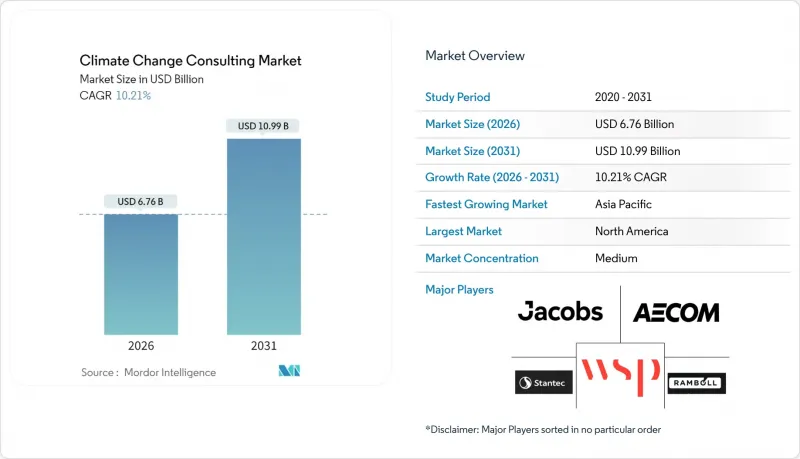
기후변화 컨설팅 시장은 2025년에 61억 3,000만 달러로 평가되며, 2026년 67억 6,000만 달러에서 2031년까지 109억 9,000만 달러에 달할 것으로 예측됩니다.
예측 기간(2026-2031년)의 CAGR은 10.21%로 예상됩니다.
이러한 성장 가속화는 공시 규정의 강화, 투자자들의 압박, 지속가능성 연계 금융에 대한 수요 증가, AI를 활용한 리스크 분석 기술의 급속한 발전을 반영하고 있습니다. 유럽연합(EU), 미국, 아시아태평양의 ESG 보고 의무화로 인해 수천 개의 기업이 외부 자문을 구하고 있으며, 사모펀드 소유주 및 자산운용사들은 포트폴리오 기업에 대한 대출을 하기 전에 상세한 탄소 그림자 감사를 요구하고 있습니다. 동시에 기후 리스크 모델링의 비약적인 발전으로 컨설턴트들은 이전과는 비교할 수 없을 정도로 정확하게 전환 리스크와 물리적 리스크를 정량화할 수 있게 되었고, 이에 따라 대응할 수 있는 고객 기반이 확대되고 있습니다. OEM(Original Equipment Manufacturer)공급망 탈탄소화 의무화는 중소기업(SME) 계층에 새로운 수입원을 창출하고, 디지털 제공 모델은 이동에 따른 환경적 부담 없이 지역적 범위를 확장하고 있습니다.
세계 기후 변화 컨설팅 시장 동향과 인사이트
전 세계에서 강화되는 ESG 공시 의무
유럽 기업지속가능경영보고지침(CSRD)과 같은 새로운 공시제도는 유럽의 약 5만개 기업을 대상으로 하고 있으며, 많은 기업이 이중 중요성 규칙의 해석을 위해 외부 자문기관에 의존하고 있습니다. 싱가포르, 홍콩, 말레이시아, 대만은 2025년부터 단계적으로 도입되는 국제지속가능경영기준위원회(ISSB)의 기준을 채택하여 컴플라이언스 대상 범위를 확대하고 있습니다. 미국에서는 증권거래위원회(SEC)의 규칙 제정이 보류 중임에도 불구하고 이미 시나리오 분석 및 배출량 보고 준비 작업이 진행되고 있습니다. 기업은 컴플라이언스를 비용 중심이 아닌 가치 창출의 수단으로 인식하고 있으며, 이는 자문 서비스에 대한 지속적인 지출을 지원하고 있습니다. 규제 해석과 기술 플랫폼을 결합한 컨설팅 회사가 다년간의 계약을 체결하고 있습니다.
투자자 주도형 탄소 그림자 감사
블랙록과 같은 자산운용사들은 자본배분 전에 Scope 1, 2, 3 배출량에 대한 세부적인 검증을 요구하고 있으며, 지속가능성 실사 작업의 엄격화를 촉진하고 있습니다. 사모펀드 투자자들은 탈탄소화 마일스톤을 주주 계약에 포함시킴으로써 진행 상황 추적을 중심으로 지속적인 자문 매출을 창출하고 있습니다. 전환 리스크가 두드러지는 에너지, 소재, 운송 분야의 포트폴리오에서 탄소 그림자 감사가 급증하고 있습니다. 감사 대응 데이터 프로토콜과 제3자 검증을 제공하는 컨설턴트는 기관 투자자들로부터 우선 공급업체로 선정되고 있습니다. 이러한 추세는 대출기관이 대출 계약에 배출량 관련 계약 조항을 포함시킴으로써 미들마켓 거래에도 영향을 미치고 있습니다.
검증 가능한 범위3 데이터 부족
밸류체인 배출량은 기업 전체 배출량의 최대 90%를 차지함에도 불구하고 데이터의 불균일성과 공급업체의 참여 부족으로 인해 정확한 측정이 이루어지지 않고 있습니다. 컨설턴트들은 종종 대리값에 의존하는 경우가 많으며, 이는 투자자와 규제 당국의 신뢰를 떨어뜨립니다. 신흥 국가 중소 공급업체는 모니터링 툴이 부족하여 공시의 신뢰성을 더욱 제한하고 있습니다. 검증이 지연되면 보증서 발급이 지연되어 자문 업무의 회전율을 제한하고 있습니다. 따라서 시장 진출기업은 규모 확장을 위해 상호 운용 가능한 데이터 표준과 제3자 검증 서비스를 요구하고 있습니다.
부문 분석
2025년 기후 변화 컨설팅 시장 점유율의 22.95%는 리스크 평가 및 시나리오 분석이 차지하며, 기후 관련 재무정보공개 태스크포스(TCFD) 요건을 충족하는 미래지향적 기후모델에 대한 기업의 높은 수요를 보여주었습니다. 이 부문의 성장은 은행, 보험사, 에너지 기업이 전환 위험과 물리적 위험에 대한 노출에 대한 정량적 지식을 원하는 은행, 보험사, 에너지 기업에 의해 주도되고 있습니다. 지속가능금융과 ESG 통합은 규모는 작지만, 대출 가격 책정 인센티브가 신뢰할 수 있는 목표 달성에 의존하는 가운데, 2031년까지 14.10%의 연평균 복합 성장률(CAGR)로 다른 모든 카테고리를 능가하는 성장률을 보이고 있습니다. 컨설턴트는 분석과 자문을 결합하여 시나리오 입력, KPI 설계, 외부 검증을 통합한 솔루션을 제공합니다.
온실가스(GHG) 회계 및 보고에 대한 수요는 다운스트림 전략의 데이터베이스을 제공한다는 점에서 안정적입니다. 기후 적응 및 복원력 계획은 홍수 및 열 스트레스와 같은 심각한 물리적 위협에 직면한 인프라 소유주들 사이에서 주목을 받고 있습니다. 탄소 상쇄 거래 자문은 자발적 시장의 가격 변동 및 품질 기준 관련 규제 명확화와 관련하여 일시적으로 수요가 급증하고 있습니다. 자연 기반 솔루션 자문 및 순환 경제 설계와 같은 신흥 분야는 포트폴리오를 보완하고, 프레임워크를 빠르게 확장할 수 있는 선구자적 옵션 가치를 구현합니다.
공공 부문은 경기부양책에 따른 탈탄소화 프로젝트와 국가 차원의 공시 의무로 인해 2025년 기후 변화 컨설팅 시장 규모의 18.75%를 차지할 것으로 예측됩니다. 그러나 금융 서비스 부문은 감독 당국이 기후 리스크를 자본 규제에 포함시키면서 연간 12.85%의 성장률로 뚜렷한 모멘텀을 보이고 있는 분야입니다. 은행은 포트폴리오 스트레스 테스트를 위해 첨단 시나리오 모델을 필요로 하고, 자산운용사는 투자 대상 기업과의 대화를 위한 스튜어드십 로드맵을 요구하고 있습니다.
에너지 및 전력 분야의 고객들은 넷제로 달성 로드맵이 복잡한 자산 폐기 및 재생에너지 통합 의사결정을 수반하므로 전환 계획에 대한 지출이 여전히 큰 상황입니다. 제조업은 OEM 계약을 유지하기 위해 Scope 3 탈탄소화 프로그램에 투자하고, 광업 및 금속 기업은 자금 조달을 확보하기 위해 자연 보호 전략을 추진하고 있습니다. ICT 업체들은 데이터센터 효율화와 하드웨어 순환 프로그램에 집중하고, 농업 및 식품 기업은 메탄 저감 및 재생 농업을 실천하는 데 주력하고 있습니다. 운송업체들은 비용, 주행거리, 인프라 리스크의 균형을 맞춘 차량 전동화 계획을 모색하고 있습니다.
지역별 분석
북미는 2025년 미국 증권거래위원회(SEC)의 규제안과 활발한 투자자 활동에 힘입어 기후 변화 컨설팅 시장 점유율 29.85%로 1위를 유지했습니다. 뉴욕, 토론토 등 주요 금융 중심지에는 4대 회계법인 거점과 전문 부티크 기업이 공존하며 첨단 인재 클러스터를 형성하고 있습니다. 또한 이 지역은 기업이 디지털 트윈을 통한 자산 복원력 검증을 추진하는 가운데, AI 기반 기후 리스크 분석 도입도 선도적인 위치에 있습니다.
유럽은 CSRD(기업지속가능경영보고지침), EU 택소노미, 탄소국경조정조치 등의 규제로 대상 기업이 약 5만 개로 확대되면서 여전히 강력한 시장으로 자리매김하고 있습니다. 독일, 영국, 프랑스가 거래의 흐름을 주도하고, 스페인과 이탈리아가 에너지 전환 부양책을 통해 추격하고 있습니다. 회원국마다 규정의 세부 사항이 다르기 때문에 유럽 전역을 커버하는 딜리버리 네트워크와 다국어 팀을 보유한 컨설턴트 회사가 유리한 위치에 있습니다.
아시아태평양은 2031년까지 연평균 복합 성장률(CAGR) 11.05%로 가장 빠른 성장을 기록할 것입니다. 중국의 2060년 넷제로 공약, 인도의 대규모 재생에너지 도입, 동남아시아의 ISSB 도입이 맞물려 전례 없는 자문 수요를 창출하고 있습니다. 일본과 한국은 EU 탄소 관세에 대한 수출 리스크 관리를 위해 첨단 시나리오 계획이 필요합니다. 호주는 인프라 계획에서 자연 기반 탄소 제거 및 적응 전략의 실행을 위한 컨설팅 지원을 중요시하고 있습니다.
남미와 중동 및 아프리카은 신흥 시장이지만 변동성이 큰 시장입니다. 브라질의 삼림 벌채 관련 공시 규정, 아르헨티나의 재생에너지 입찰, 콜롬비아의 그린본드 프로젝트가 초기 촉매제가 될 것입니다. 중동에서는 사우디아라비아와 아랍에미레이트가 탄화수소로부터의 다변화를 모색하고 있으며, 수소 로드맵 수립 및 그린 파이낸스 구축 프로젝트가 발생하고 있습니다. 아프리카 수요는 재정 능력과 데이터 부족으로 인해 제약이 있는 남아공의 탄소세 준수와 케냐의 기후 변화에 강한 농업 구상에 집중되어 있습니다. 세계 베스트 프랙티스를 현지에 맞게 조정하여 제공하는 컨설팅 기업은 프로젝트 이익률은 낮지만, 향후 확장을 위한 전략적 발판을 마련할 수 있습니다.
기타 특전:
- 엑셀 형식 시장 예측(ME) 시트
- 애널리스트의 3개월간 지원
자주 묻는 질문
목차
제1장 서론
제2장 조사 방법
제3장 개요
제4장 시장 구도
제5장 시장 규모와 성장 예측
제6장 경쟁 구도
제7장 시장 기회와 향후 전망
KSA 26.03.06The climate change consulting market was valued at USD 6.13 billion in 2025 and estimated to grow from USD 6.76 billion in 2026 to reach USD 10.99 billion by 2031, at a CAGR of 10.21% during the forecast period (2026-2031).
This acceleration reflects tighter disclosure rules, investor pressure, growing demand for sustainability-linked finance, and rapid advances in AI-enabled risk analytics. Mandatory ESG reporting across the European Union, the United States, and Asia-Pacific is forcing thousands of companies to seek external advice, while private-equity owners and asset managers expect detailed carbon-shadow audits before financing portfolio firms. At the same time, breakthroughs in climate-risk modeling allow consultants to quantify transition and physical hazards with unprecedented granularity, expanding the addressable client base. Supply-chain decarbonization mandates imposed by original equipment manufacturers (OEMs) are opening new revenue pools among small and medium enterprises (SMEs), and digital delivery models are widening geographic reach without heavy travel footprints.
Global Climate Change Consulting Market Trends and Insights
Mandatory ESG disclosures tightening worldwide
New disclosure regimes such as the Corporate Sustainability Reporting Directive (CSRD) cover roughly 50,000 European companies, and many are turning to external advisors to interpret double-materiality rules. Singapore, Hong Kong, Malaysia, and Taiwan have adopted International Sustainability Standards Board (ISSB) baselines that phase in from 2025, widening the compliance net. In the United States, pending Securities and Exchange Commission rules have already spurred preparatory scenario analysis and emissions reporting exercises. Enterprises view compliance as a value-creation lever rather than a cost center, which underpins sustained spending on advisory services. Consultants who combine regulatory interpretation with technology platforms are winning multiyear mandates.
Investor-led carbon-shadow audits
Asset managers such as BlackRock demand granular verification of Scope 1, 2, and 3 emissions before allocating capital, elevating the rigour of sustainability due diligence workstreams. Private-equity buyers now embed decarbonization milestones in shareholder agreements, creating recurring advisory revenue around progress tracking. Carbon-shadow audits have proliferated in energy, materials, and transport portfolios where transition risk is pronounced. Consultants offering audit-ready data protocols and third-party verification gain preferred-supplier status with institutional investors. This trend cascades into middle-market deals as lenders embed emissions covenants in credit facilities.
Scarcity of verifiable Scope 3 data
Supply-chain emissions account for as much as 90% of a corporation's footprint, yet data heterogeneity and lack of supplier engagement impede accurate measurement. Consultants often rely on proxy values, which erode confidence among investors and regulators. Smaller suppliers in emerging economies lack monitoring tools, further constraining disclosure reliability. Verification backlogs delay assurance statements, limiting advisory turnover. Market participants, therefore, demand interoperable data standards and third-party validation services to unlock scale.
Other drivers and restraints analyzed in the detailed report include:
- Sustainability-linked finance boom
- OEM-driven supply-chain decarbonization
- Talent shortage at climate-finance interface
For complete list of drivers and restraints, kindly check the Table Of Contents.
Segment Analysis
Risk Assessment and Scenario Analysis accounted for 22.95% of the climate change consulting market share in 2025, underscoring corporate appetite for forward-looking climate models that meet Task Force on Climate-related Financial Disclosures requirements. The segment's growth is propelled by banks, insurers, and energy companies seeking quantitative insights into transition and physical risk exposure. Sustainable Finance and ESG Integration, while smaller, is outpacing every other category with a 14.10% CAGR to 2031 as loan-pricing incentives hinge on credible targets. Consultants are packaging analytics with advisory to create integrated solutions that bundle scenario inputs, KPI design, and external verification.
Demand for GHG Accounting and Reporting remains steady because it provides the data foundation for downstream strategy. Climate Adaptation and Resilience Planning gains traction among infrastructure owners that face material physical threats such as flooding and heat stress. Carbon Offset and Trading Advisory sees episodic volume spikes linked to voluntary-market price swings and regulatory clarity on quality standards. Emerging niches such as nature-based solutions advisory and circular-economy design round out the portfolio, representing option value for early movers that can scale frameworks quickly.
The Public Sector commanded 18.75% of the climate change consulting market size in 2025, thanks to stimulus-funded decarbonization projects and sovereign-level disclosure obligations. Yet Financial Services is the clear momentum leader, expanding at 12.85% per year as prudential supervisors embed climate risk into capital frameworks. Banks require sophisticated scenario models to stress-test portfolios, while asset managers seek stewardship roadmaps to engage investee firms.
Energy and Power clients remain large spenders on transition planning because net-zero roadmaps involve complex asset-retirement and renewable-integration decisions. Manufacturing industries invest in Scope 3 decarbonization programs to keep OEM contracts, while Mining and Metals firms pursue nature-positive strategies to secure financing. ICT providers focus on data-center efficiency and circular-hardware programs, whereas Agriculture and Food players tackle methane reduction and regenerative practices. Transport companies look for fleet electrification blueprints that balance cost, range, and infrastructure risk.
The Climate Change Consulting Market Report is Segmented by Service Type (Risk Assessment and Scenario Analysis, and More), End-User Industry (Energy and Power, and More), Organization Size (Large Enterprises, and More), Consultancy Type (Multidisciplinary Engineering Firms, and More), Delivery Mode (On-Site Advisory, and More), and Geography (North America, and More). The Market Forecasts are Provided in Terms of Value (USD).
Geography Analysis
North America retained leadership with 29.85% climate change consulting market share in 2025 on the back of Securities and Exchange Commission draft rules and robust investor activism. Major financial centers such as New York and Toronto host both Big Four hubs and pure-play boutiques, creating dense talent clusters. The region also leads AI-based climate-risk analytics adoption as enterprises pilot digital twins to test asset resilience.
Europe remains a powerhouse thanks to the CSRD, EU taxonomy, and carbon-border adjustment rules that collectively expand the compliance universe to roughly 50,000 firms. Germany, the United Kingdom, and France drive deal flow, while Spain and Italy catch up via energy-transition stimulus. Consultants with pan-European delivery networks and multilingual teams enjoy an advantaged positioning because regulatory nuances differ among member states.
Asia-Pacific records the fastest growth at 11.05% CAGR through 2031 as China's 2060 net-zero pledge, India's massive renewable roll-out, and Southeast Asia's ISSB adoption converge to create unprecedented advisory demand. Japan and South Korea require advanced scenario planning to manage export exposure to EU carbon tariffs. Australia leans on consulting support to implement nature-based carbon removal and adaptation strategies in infrastructure planning.
South America and the Middle East & Africa represent emerging but volatile markets. Brazil's deforestation-related disclosure rules, Argentina's renewable auctions, and Colombia's green-bond pipeline are early catalysts. In the Middle East, Saudi Arabia and the United Arab Emirates seek diversification from hydrocarbons, generating mandates in hydrogen road-mapping and green-finance structuring. Africa's demand is concentrated in South Africa's carbon-tax compliance and Kenya's climate-resilient agriculture initiatives, albeit constrained by fiscal capacity and data gaps. Consultants that package global best practices with localized delivery endure lower project margins but gain strategic footholds for future expansion.
- Jacobs Solutions Inc.
- AECOM
- WSP Global Inc.
- Stantec Inc.
- Ramboll Group A/S
- Tetra Tech Inc.
- ERM International Group Ltd.
- Arup Group Ltd.
- GHD Group Pty Ltd.
- Sweco AB
- Deloitte Touche Tohmatsu Ltd.
- PricewaterhouseCoopers International Ltd.
- KPMG International Ltd.
- Ernst and Young Global Ltd.
- McKinsey and Company
- Boston Consulting Group Inc.
- ICF International Inc.
- South Pole Holding AG
- Carbon Trust Advisory Ltd.
- Sustainalytics
Additional Benefits:
- The market estimate (ME) sheet in Excel format
- 3 months of analyst support
TABLE OF CONTENTS
1 INTRODUCTION
- 1.1 Study Assumptions and Market Definition
- 1.2 Scope of the Study
2 RESEARCH METHODOLOGY
3 EXECUTIVE SUMMARY
4 MARKET LANDSCAPE
- 4.1 Market Overview
- 4.2 Market Drivers
- 4.2.1 Mandatory ESG disclosures tightening worldwide
- 4.2.2 Corporate carbon-shadow audits demanded by investors
- 4.2.3 Rapid scaling of sustainability-linked finance instruments
- 4.2.4 Supply-chain decarbonisation pressures from OEMs
- 4.2.5 Breakthroughs in AI-driven climate-risk analytics
- 4.2.6 Growing demand for nature-based carbon removal advisory
- 4.3 Market Restraints
- 4.3.1 Scarcity of verifiable Scope 3 emissions data
- 4.3.2 Talent shortage in climate science and finance interface
- 4.3.3 Inconsistent regional carbon-pricing mechanisms
- 4.3.4 Green-washing litigation risk discouraging advisory uptake
- 4.4 Industry Value Chain Analysis
- 4.5 Regulatory Landscape
- 4.6 Technological Outlook
- 4.7 Porter's Five Forces Analysis
- 4.7.1 Bargaining Power of Suppliers
- 4.7.2 Bargaining Power of Buyers
- 4.7.3 Threat of New Entrants
- 4.7.4 Threat of Substitutes
- 4.7.5 Competitive Rivalry
- 4.8 Service Trend Analysis
5 MARKET SIZE AND GROWTH FORECASTS (VALUE)
- 5.1 By Service Type
- 5.1.1 Risk Assessment and Scenario Analysis
- 5.1.2 GHG Accounting and Reporting
- 5.1.3 Decarbonisation Strategy and Road-mapping
- 5.1.4 Climate Adaptation and Resilience Planning
- 5.1.5 Carbon Offset and Trading Advisory
- 5.1.6 Sustainable Finance and ESG Integration
- 5.1.7 Other Services
- 5.2 By End-User Industry
- 5.2.1 Energy and Power
- 5.2.2 Mining and Metals
- 5.2.3 Public Sector
- 5.2.4 Manufacturing
- 5.2.5 Financial Services
- 5.2.6 ICT and Telecom
- 5.2.7 Agriculture and Food
- 5.2.8 Transportation and Logistics
- 5.2.9 Other Industries
- 5.3 By Organization Size
- 5.3.1 Large Enterprises
- 5.3.2 Small and Medium Enterprises
- 5.4 By Consultancy Type
- 5.4.1 Multidisciplinary Engineering Firms
- 5.4.2 Pure-play Sustainability Boutiques
- 5.4.3 Big Four Accounting Firms
- 5.4.4 Management Consulting Firms
- 5.4.5 Think Tanks and NGOs
- 5.5 By Delivery Mode
- 5.5.1 On-site Advisory
- 5.5.2 Remote / Virtual Advisory
- 5.5.3 Hybrid Engagements
- 5.6 By Geography
- 5.6.1 North America
- 5.6.1.1 United States
- 5.6.1.2 Canada
- 5.6.1.3 Mexico
- 5.6.2 Europe
- 5.6.2.1 Germany
- 5.6.2.2 United Kingdom
- 5.6.2.3 France
- 5.6.2.4 Spain
- 5.6.2.5 Italy
- 5.6.2.6 Rest of Europe
- 5.6.3 Asia-Pacific
- 5.6.3.1 China
- 5.6.3.2 Japan
- 5.6.3.3 India
- 5.6.3.4 South Korea
- 5.6.3.5 Rest of Asia-Pacific
- 5.6.4 South America
- 5.6.4.1 Brazil
- 5.6.4.2 Argentina
- 5.6.4.3 Rest of South America
- 5.6.5 Middle East and Africa
- 5.6.5.1 Middle East
- 5.6.5.1.1 Israel
- 5.6.5.1.2 Saudi Arabia
- 5.6.5.1.3 United Arab Emirates
- 5.6.5.1.4 Turkey
- 5.6.5.1.5 Rest of Middle East
- 5.6.5.2 Africa
- 5.6.5.2.1 South Africa
- 5.6.5.2.2 Egypt
- 5.6.5.2.3 Rest of Africa
- 5.6.5.1 Middle East
- 5.6.1 North America
6 COMPETITIVE LANDSCAPE
- 6.1 Market Concentration
- 6.2 Strategic Moves
- 6.3 Market Share Analysis
- 6.4 Company Profiles (includes Global level Overview, Market level overview, Core Segments, Financials as available, Strategic Information, Market Rank/Share for key companies, Products and Services, and Recent Developments)
- 6.4.1 Jacobs Solutions Inc.
- 6.4.2 AECOM
- 6.4.3 WSP Global Inc.
- 6.4.4 Stantec Inc.
- 6.4.5 Ramboll Group A/S
- 6.4.6 Tetra Tech Inc.
- 6.4.7 ERM International Group Ltd.
- 6.4.8 Arup Group Ltd.
- 6.4.9 GHD Group Pty Ltd.
- 6.4.10 Sweco AB
- 6.4.11 Deloitte Touche Tohmatsu Ltd.
- 6.4.12 PricewaterhouseCoopers International Ltd.
- 6.4.13 KPMG International Ltd.
- 6.4.14 Ernst and Young Global Ltd.
- 6.4.15 McKinsey and Company
- 6.4.16 Boston Consulting Group Inc.
- 6.4.17 ICF International Inc.
- 6.4.18 South Pole Holding AG
- 6.4.19 Carbon Trust Advisory Ltd.
- 6.4.20 Sustainalytics
7 MARKET OPPORTUNITIES AND FUTURE OUTLOOK
- 7.1 White-space and Unmet-need Assessment