|
시장보고서
상품코드
1940894
스페인의 의약품 물류 : 시장 점유율 분석, 업계 동향과 통계, 성장 예측(2026-2031년)Spain Pharmaceutical Logistics - Market Share Analysis, Industry Trends & Statistics, Growth Forecasts (2026 - 2031) |
||||||
 Mordor Intelligence
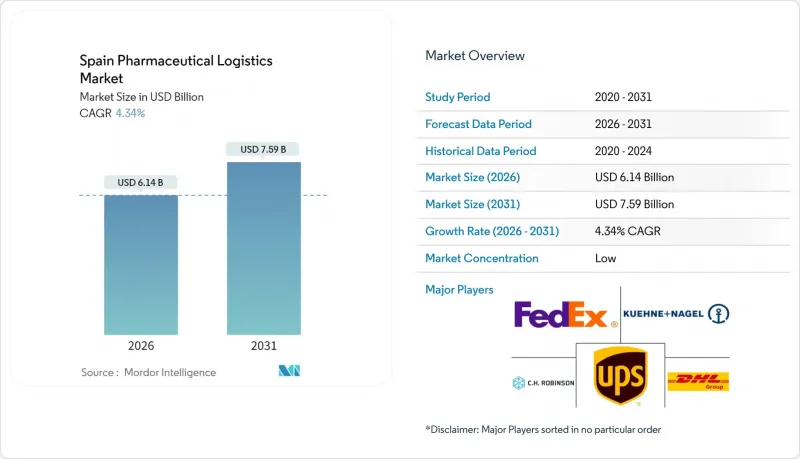
스페인의 의약품 물류 시장 규모는 2026년에 61억 4,000만 달러로 추정되고 있습니다.
2025년 58억 8,000만 달러에서 2031년에는 75억 9,000만 달러에 달할 것으로 예상되며, 2026년부터 2031년까지 연평균 4.34%의 성장률을 보일 것으로 전망됩니다.
탄탄한 고속도로, 항만, 공항 인프라를 갖춘 스페인은 남유럽의 관문으로 자리매김하고 있으며, 온도 관리가 필요한 의약품의 리드 타임을 단축하고 엔드 투 엔드 시각화 도구에 대한 수요가 증가하고 있습니다. 지중해와 대서양 회랑을 따라 집적된 물류단지는 프랑스와 이탈리아로 국경을 넘는 물류 흐름을 가속화하고 있으며, 유럽 의약품의 80%가 온도 관리를 필요로 하는 현 상황에서 매우 중요합니다. GDP 인증 관련 규제 개혁으로 품질 기준이 강화되고, 자동 모니터링 시스템을 도입한 사업자가 우대받게 됩니다. 세계 선도 기업들이 스페인의 물류 역량에 수십억 유로를 투자하고, 기술 도입을 가속화하며, 업계 재편을 촉진하면서 경쟁이 치열해지고 있습니다.
스페인의 의약품 물류 시장 동향 및 인사이트
국내 의약품 판매량 증가
국내 의약품 연간 매출액은 230억 유로(250억 달러)를 넘어섰고, 26만 명 이상의 고용을 지원하며 물류 성장 기반을 강화하고 있습니다. 1,340억 유로(1,430억 달러)에 달하는 공공 의료 지출은 스페인의 의약품 물류 시장 전체에 안정적인 수요를 창출하고 있습니다. 1인당 의약품 지출은 477유로(510달러)로 유럽 평균을 상회하며 판매량의 안정성을 강화하고 있습니다. 그러나 2024년에는 의약품 부족이 41% 급증하여 4,983개 품목이 영향을 받으면서 보충주기의 취약성을 드러냈습니다. 2024년 1월에는 947개 품목공급이 중단되어 의료 서비스 제공의 연쇄적인 혼란을 줄이기 위한 예측적 재고 관리 도구의 필요성이 부각되었습니다.
고령화와 만성질환 증가로 라스트마일 수요 증가 가속화
장기 인구추계에 따르면, 2074년까지 65세 이상 인구의 비율이 급격히 증가합니다. 만성질환이 증가함에 따라 처방전 조제 패턴이 환자 가정으로 정기 배송으로 전환되고 있으며, 이는 스페인의 의약품 물류 시장에서 라스트마일 배송의 복잡성을 증가시키고 있습니다. 디지털 헬스 플랫폼은 원격 의료와 약국 네트워크를 통합하여 심혈관 질환 및 당뇨병 치료제의 정시 배송을 필요로 합니다. Kern Pharma와 Teva가 주도하는 제네릭 의약품 보급은 저렴한 가격을 실현하는 한편, 배송 빈도를 증가시키고 있습니다. PharmaMar의 맞춤형 암 치료 요법은 병원 약국에서 재택치료 환경까지 확장되는 환자별 추적 가능한 콜드체인 운송을 요구합니다.
운전자 부족과 인건비 급등
콜드체인 사업자는 이베리아 반도 식품 GDP의 2.5%를 차지하고 있으며, 심각한 운전자 부족으로 인해 인건비가 팽창하고 있습니다. DHL은 인력 부족에 대응하기 위해 자동화를 우선시하는 20억 유로(20억 8,000만 달러) 규모의 헬스케어 물류 프로그램을 통해 대응했습니다. UPS는 2026년까지 의료 관련 매출을 200억 달러로 두 배로 늘리겠다는 목표를 세우고, 로봇 기술과 배송 경로 최적화 소프트웨어를 통한 생산성 향상에 집중하고 있습니다. 자본 투입에도 불구하고 독감 백신 수요가 급증할 때 즉각적인 운전자 부족으로 인해 운송 능력이 제한되어 스페인의 의약품 물류 시장 확장을 억제하고 있습니다.
부문 분석
2025년 기준, 운송 부문은 스페인의 의약품 물류 시장의 59.30%를 차지했습니다. 바르셀로나, 발렌시아, 알헤시라스 항구를 연결하는 총 15,825km의 고속도로망이 이를 견인하고 있습니다. 이 핵심 인프라를 통해 로지스타와 DHL이 관리하는 네트워크를 통해 유럽 20만 곳의 판매 거점으로 의약품이 배송되고 있습니다. 익일 배송이 가능하다는 점에서 도로 운송이 여전히 주요 수단이지만, 긴급한 생물학적 제제 수요에 대응하기 위해 지로나 공항과 사라고사 공항을 경유하는 항공 화물도 확대되고 있습니다. 배출량 감축 목표를 추구하는 화주들은 해상 및 철도 운송 회랑에 대한 관심이 높아지고 있으며, 세바에 따르면 냉장 해상 운송 경로의 경우 배출량이 70% 감소한다고 합니다. 부가가치 서비스 및 기타 분야는 GDP 문서화, 키트화, 후기 단계 커스터마이징이 표준 계약 항목이 되면서 2031년까지 연평균 복합 성장률(CAGR) 4.66% 성장할 것으로 예측됩니다. 페덱스는 2025년 CEIV Pharma 기업 인증을 획득하고 4억 달러 규모의 의료 계약을 체결했습니다. 컴플라이언스 우수성이 상업적 성과로 이어지는 좋은 예입니다.
스페인의 의약품 물류 시장에서 부가가치 서비스 및 기타 분야의 규모는 스페인 병원의 아웃소싱 확대에 따라 증가할 것으로 예측됩니다. 운송 모드의 구성은 IoT 센서가 내장된 온도 관리 컨테이너로 전환되고, 예측 항로 검증 서비스를 통해 수익화할 수 있는 데이터 스트림이 생성됩니다. UPS의 Frigo-Trans와 BPL의 통합으로 유럽 내 2-8℃ 환경의 서비스 네트워크가 확장되어 스페인의 의약품 수출업체들에게 육해공을 아우르는 단일 인보이스 솔루션을 제공합니다. 지속가능성도 촉진요인으로, CEVA의 FORPLANET 브랜드로 마드리드 시내 클리닉을 위한 전기 트럭이 운행되며, 2024년까지 2만 6,000톤의 배출량 감소가 예상됩니다.
기타 특전:
- 엑셀 형식 시장 예측(ME) 시트
- 애널리스트의 3개월 지원
자주 묻는 질문
목차
제1장 서론
제2장 조사 방법
제3장 주요 요약
제4장 시장 구도
제5장 시장 규모와 성장 예측
제6장 경쟁 구도
제7장 시장 기회와 향후 전망
LSH 26.03.11The Spain Pharmaceutical Logistics Market size in 2026 is estimated at USD 6.14 billion, growing from 2025 value of USD 5.88 billion with 2031 projections showing USD 7.59 billion, growing at 4.34% CAGR over 2026-2031.
Robust motorway, port, and airport capacity positions Spain as a Southern European gateway that reduces lead times for temperature-sensitive medicines and heightens demand for end-to-end visibility tools. Logistic parks clustered along the Mediterranean and Atlantic corridors speed cross-border flows into France and Italy, which is critical as 80% of European medicines now require temperature control. Regulatory reforms around GDP certification tighten quality thresholds and reward operators with automated monitoring systems. Competitive intensity is rising because global leaders are injecting billions into Spanish capacity, accelerating technology adoption, and sparking consolidation.
Spain Pharmaceutical Logistics Market Trends and Insights
Rising Domestic Pharmaceutical Sales Volume
Annual domestic drug revenue exceeds EUR 23 billion (USD 25 billion) and supports more than 260,000 jobs, which strengthens the baseline for logistics growth. Public health spending at EUR 134 billion (USD 143 billion) creates dependable demand across the Spanish pharmaceutical logistics market. Per-capita medicine outlays at EUR 477 (USD 510) surpass European averages, reinforcing volume stability. Yet drug shortages jumped 41% in 2024, with 4,983 items affected, exposing vulnerabilities in replenishment cycles. January 2024 recorded 947 unavailable products, underscoring the need for predictive inventory tools that reduce cascading care disruptions.
Ageing Population & Chronic Disease Burden Intensifying Last-Mile Demand
Long-term demographic projections show a sharply rising proportion of citizens older than 65 by 2074. Chronic illnesses shift dispensing patterns toward repeat prescriptions delivered to patients' homes, which magnifies last-mile complexity within Spain pharmaceutical logistics market. Digital health platforms integrate telemedicine with pharmacy networks and require timed deliveries of cardiovascular and diabetes drugs. Generic penetration led by Kern Pharma and Teva supports affordability but raises shipment frequency. Personalized oncology regimens from PharmaMar demand traceable, patient-specific cold-chain movements that extend beyond hospital pharmacies into home-care settings.
Driver Shortage & Escalating Labour Costs
Cold-chain operators represent 2.5% of Iberian food GDP and face acute driver shortages that inflate wage bills. DHL answered with a EUR 2 billion (USD 2.08 billion) health-logistics program that prioritizes automation to counter labor gaps. UPS seeks to double healthcare revenue to USD 20 billion by 2026, banking on robotics and routing software to lift productivity. Despite capital injections, immediate driver scarcity restricts capacity during influenza vaccine peaks, restraining Spain pharmaceutical logistics market expansion.
Other drivers and restraints analyzed in the detailed report include:
- Expansion of Biologics & Temperature-Sensitive Therapies
- EU Falsified Medicines Directive Serialization Deadline Enforcement
- Rising Energy Costs Impacting Refrigerated-Warehouse Margins
For complete list of drivers and restraints, kindly check the Table Of Contents.
Segment Analysis
Transportation captured 59.30% of Spain pharmaceutical logistics market share in 2025, propelled by 15,825 km of motorways connecting ports at Barcelona, Valencia, and Algeciras. This backbone delivers medicines to 200,000 European points of sale through networks managed by Logista and DHL. Road haulage remains the preferred mode for its overnight reach, but airfreight is scaling via Girona and Zaragoza airports to meet urgent biologic demand. Sea and rail corridors increasingly attract shippers pursuing carbon-reduction targets, with CEVA citing 70% lower emissions for refrigerated sea lanes. Value-added services & others are expected to post a 4.66% CAGR to 2031 as GDP documentation, kitting, and late-stage customization become standard contract inclusions. FedEx secured a CEIV Pharma Corporate Certificate in 2025 and won USD 400 million in healthcare contracts, illustrating the commercial payoff from compliance excellence.
Spain pharmaceutical logistics market size for value-added services & others is forecast to rise, aligned with expanding outsourcing by Spanish hospitals. The modal mix will tilt toward temperature-controlled containers that embed IoT sensors, creating data streams monetized through predictive lane validation services. UPS's integration of Frigo-Trans and BPL widens its European 2-8 °C footprint and offers Spanish pharma exporters a single invoice solution spanning road, sea and air. Sustainability is another driver, with electric trucks now servicing inner-city clinics in Madrid under CEVA's FORPLANET label, reducing emissions by 26,000 tons in 2024.
The Spain Pharmaceutical Logistics Market Report is Segmented by Service Type (Transportation, Warehousing & Storage, and Value-Added Services & Others), Mode of Operation (Cold-Chain Logistics and Non-Cold-Chain Logistics), Product Type (Prescription Drugs, OTC Drugs, Biologics & Biosimilars, Vaccines & Blood Products, Cell & Gene Therapies, Veterinary Medicine, and More). The Market Forecasts are Provided in Terms of Value (USD).
List of Companies Covered in this Report:
- DHL Supply Chain Spain
- FedEx Express
- Kuehne + Nagel S.A.
- United Parcel Service (UPS)
- C.H. Robinson
- CEVA Logistics
- DSV
- Movianto
- Eurotranspharma
- Primafrio
- Cencora
- Yusen Logistics (Part of NYK Line)
- Scan Global Logistics
- Rhenus Logistics
- Geodis
- TIBA
- Logista Pharma
- Noatum Logistics
- Ibercondor
- Logisber
Additional Benefits:
- The market estimate (ME) sheet in Excel format
- 3 months of analyst support
TABLE OF CONTENTS
1 Introduction
- 1.1 Study Assumptions & Market Definition
- 1.2 Scope of the Study
2 Research Methodology
3 Executive Summary
4 Market Landscape
- 4.1 Market Overview
- 4.2 Market Drivers
- 4.2.1 Rising domestic pharmaceutical sales volume
- 4.2.2 Ageing population & chronic disease burden intensifying last-mile demand
- 4.2.3 Expansion of biologics & temperature-sensitive therapies
- 4.2.4 EU Falsified Medicines Directive serialization deadline enforcement
- 4.2.5 RRF-backed cold-chain infrastructure investments
- 4.2.6 Hospital network shift toward outsourced supply models
- 4.3 Market Restraints
- 4.3.1 Driver shortage & escalating labour costs
- 4.3.2 Ensuring end-to-end temperature integrity amid climate extremes
- 4.3.3 Fragmented cold-storage real-estate ownership
- 4.3.4 Rising energy costs impacting refrigerated-warehouse margins
- 4.4 Value / Supply-Chain Analysis
- 4.5 Regulatory Landscape
- 4.6 Technological Outlook
- 4.7 Porter's Five Forces
- 4.7.1 Bargaining Power of Suppliers
- 4.7.2 Bargaining Power of Buyers
- 4.7.3 Threat of New Entrants
- 4.7.4 Threat of Substitutes
- 4.7.5 Intensity of Competitive Rivalry
- 4.8 Impact of Geopolitics & Pandemic on the Market
5 Market Size & Growth Forecasts (Value)
- 5.1 By Service Type
- 5.1.1 Transportation
- 5.1.1.1 Road Freight
- 5.1.1.2 Air Freight
- 5.1.1.3 Sea Freight
- 5.1.1.4 Rail Freight
- 5.1.2 Warehousing & Storage
- 5.1.3 Value-added Services and Others
- 5.1.1 Transportation
- 5.2 By Mode of Operation
- 5.2.1 Cold-Chain Logistics
- 5.2.2 Non-Cold-Chain Logistics
- 5.3 By Product Type
- 5.3.1 Prescription Drugs
- 5.3.2 OTC Drugs
- 5.3.3 Biologics & Biosimilars
- 5.3.4 Vaccines & Blood Products
- 5.3.5 Clinical Trail Materials
- 5.3.6 Cell & Gene Therapies
- 5.3.7 Medical Devices & Diagnostics
- 5.3.8 Veterinary Medicine
- 5.3.9 Others
6 Competitive Landscape
- 6.1 Market Concentration
- 6.2 Strategic Moves
- 6.3 Market Share Analysis
- 6.4 Company Profiles (includes Global level Overview, Market level overview, Core Segments, Financials as available, Strategic Information, Market Rank/Share for key companies, Products & Services, and Recent Developments)
- 6.4.1 DHL Supply Chain Spain
- 6.4.2 FedEx Express
- 6.4.3 Kuehne + Nagel S.A.
- 6.4.4 United Parcel Service (UPS)
- 6.4.5 C.H. Robinson
- 6.4.6 CEVA Logistics
- 6.4.7 DSV
- 6.4.8 Movianto
- 6.4.9 Eurotranspharma
- 6.4.10 Primafrio
- 6.4.11 Cencora
- 6.4.12 Yusen Logistics (Part of NYK Line)
- 6.4.13 Scan Global Logistics
- 6.4.14 Rhenus Logistics
- 6.4.15 Geodis
- 6.4.16 TIBA
- 6.4.17 Logista Pharma
- 6.4.18 Noatum Logistics
- 6.4.19 Ibercondor
- 6.4.20 Logisber
7 Market Opportunities & Future Outlook
- 7.1 White-space & Unmet-need Assessment