|
시장보고서
상품코드
2035057
통신 타워 시장 : 점유율 분석, 업계 동향 및 통계, 성장 예측(2026-2031년)Telecom Towers - Market Share Analysis, Industry Trends & Statistics, Growth Forecasts (2026 - 2031) |
||||||
 Mordor Intelligence
통신 타워 시장 규모는 2025년에 292억 9,000만 달러로 평가되었고 2026년 300억 7,000만 달러에서 2031년까지 343억 달러에 이를 것으로 예측되며, 예측 기간(2026-2031년) CAGR은 2.67%를 나타낼 전망입니다.
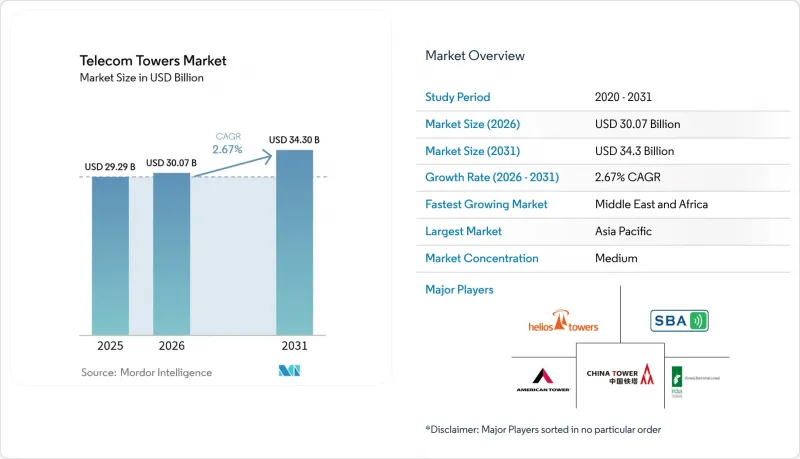
이러한 꾸준한 성장 궤적은 모바일 네트워크 사업자(MNO)가 자본 집약적인 환경에서 수익률을 보호하기 위해 급속한 신규 구축에서 인프라 공유 및 에너지 효율적 업그레이드로 전환하고 있음을 반영하고 있습니다. 5G의 지속적인 고밀도화, 정부 주도의 지방 커버리지 계획, 하이브리드 재생에너지 시스템 도입 가속화로 인해 수요는 견조하게 유지되고 있지만, 코로케이션 비율의 상승과 주파수 대역 비용이 사업자의 예산을 압박하고 있기 때문에 전반적인 속도는 완만하게 유지되고 있습니다. 지역별로는 중국 타워의 204만 사이트 규모의 포트폴리오와 인도의 161억 달러 규모의 지역 연결 계획으로 아시아태평양이 성장을 주도하고 있습니다. 한편, 북미와 유럽에서는 구역 설정에 대한 역풍 속에서 기존 자산의 최적화에 집중하고 있습니다. 거래 동향은 이 부문의 성숙도를 잘 보여주고 있습니다. 통신사들은 타워 포트폴리오를 현금화하여 그 수익을 주파수 대역과 핵심 네트워크 업그레이드에 재투자하고 있으며, 자산 경량화 운영 모델로의 전략적 전환이 강조되고 있습니다.
세계 통신 타워 시장 동향 및 인사이트
5G 네트워크 구축으로 인프라의 집적화 촉진
통신사업자는 5G의 저지연 목표를 달성하기 위해, 특히 고대역 mm파 스펙트럼에서 4G 대비 3배에서 5배까지 사이트 밀도를 높여야 합니다. 라틴아메리카에서만 2030년까지 5G 연결 수가 4억 2,500만 건에 달할 것으로 예상되며, 기존 매크로 타워와 더불어 지속적으로 증가하는 스몰셀의 도입이 필수적입니다. 규제 당국도 이에 대응하고 있습니다. 캐나다 방송통신위원회(CRTC)는 통신사업자가 장기간의 허가 절차 없이 기존 구조물에 5G 무선 장비를 추가할 수 있도록 설치 규정을 간소화했습니다. 이러한 정책 변화로 인해 도입 주기가 단축되고, 주요 대도시 지역에서 신규 및 업그레이드된 타워 부지에 대한 수요가 꾸준히 증가하고 있습니다.
모바일 데이터 사용량 증가로 네트워크 용량에 대한 압력 증가
2024년, 동영상 스트리밍, 클라우드 게임, 기업의 모바일화가 정착되면서 미국의 무선 데이터 소비량은 36% 증가했습니다. 이에 따라 크라운캐슬의 입주기업을 포함한 통신사업자들은 도시 지역의 설치 밀도를 높이고, 지방의 커버리지를 확대할 수밖에 없는 상황에 처했습니다. 신흥 시장에서도 저렴한 스마트폰이 보급되면서 비슷한 급증세를 보이고 있습니다. 캐리어 어그리게이션, 매시브 MIMO 등의 기술을 통해 주파수 대역의 효율적 활용이 가능하지만, 물리적 인프라가 여전히 병목현상으로 작용하고 있습니다. 그 결과, 통신 타워 시장은 완만하지만 지속적으로 확대되고 있으며, 통신 사업자들은 용량 부족 해소를 가속화하기 위해 타워 회사에 의존하고 있습니다.
타워 공유의 포화로 성숙 시장의 상승 여지가 제한됨
북미와 서유럽의 공용화율은 타워당 약 2.7개의 테넌트가 입주하고 있어 임대수익 증가 여력은 제한적입니다. 구조적 제약으로 인해 무게가 늘어난 5G 장비로의 업그레이드가 복잡해지고 있으며, 고가의 보강 공사가 필요해 수익에 압박을 주고 있습니다. 신흥국에서는 신규 테넌트 파이프라인이 여전히 견조한 반면, 성숙 지역에서는 포화상태가 성장을 억제하고 있으며, 세계 통신 타워 시장은 보다 균형 잡힌 확장 패턴으로 전환하고 있습니다.
부문 분석
2025년에는 매크로셀 사이트용 송전망 전력과 디젤 발전기를 주축으로 한 비재생 에너지원이 통신 타워 시장의 72.88%를 차지했으며 여전히 지배적인 지위를 유지합니다. 그러나 통신사업자들이 원격지 운영비용을 크게 절감할 수 있는 태양광-배터리 하이브리드 시스템으로 전환함에 따라, 재생에너지는 CAGR 5.22%로 가장 높은 성장률을 보이고 있습니다. 재생에너지의 도입은 전력 공급이 불안정하고 디젤 연료의 물류비용이 높은 지역에서 특히 두드러집니다. 텔레포니카 독일의 에너지 자급자족형 5G 타워는 온대 기후에서 실현 가능성을 입증하고 있습니다. 하이브리드 시스템은 이산화탄소 배출량도 억제하기 때문에 인프라 제공 업체는 점점 더 엄격해지는 ESG 요구 사항을 충족하고 통신 타워 시장에 녹색 금융 자본을 끌어들일 수 있습니다.
선진적인 타워 회사들은 현재 EaaS(Energy-as-a-Service) 계약을 패키지화하여 MNO(이동통신사)가 사이트 관리와 전력 관리를 모두 아웃소싱할 수 있도록 하고 있습니다. 스마트 컨트롤러와 AI를 활용한 배터리 분석으로 소비 곡선이 최적화됨에 따라 통신 타워 산업은 에너지 소비자에서 지역 밀착형 생산자로 전환하고 있습니다. 이러한 진화는 수익률 향상 기회를 확대하고, 수익원을 다양화하며, 지속 가능한 연결성에서 이 부문의 역할을 강화하고 있습니다.
격자형 타워는 삼각형으로 조립된 철골 구조가 경제적인 비용으로 무거운 멀티 밴드 장비를 지탱할 수 있기 때문에 2025년에도 55.62%의 점유율을 유지했습니다. 이들은 아시아태평양과 아프리카의 광활한 농촌 지역에서의 광범위한 커버리지의 기반이 되고 있습니다. 한편, 모노폴은 도시지역에서 CAGR 4.12%로 가장 높은 성장률을 보이고 있습니다. 단일 기둥 구조는 부지 확보의 부담을 줄이고 경관상의 우려를 피하기 위해 인허가 절차를 신속하게 처리할 수 있습니다. 2024년에 도입된 탄소섬유 모노폴은 강철의 12분의 1 무게에 12배의 인장강도를 발휘하여 운송비 및 기초공사비를 절감하는 동시에 자산의 수명을 연장합니다.
스텔스형과 지선형 제품이 제품 라인업을 보완하고 있습니다. 스텔스형 솔루션은 역사지구의 구역 규정을 충족하고, 지선형 타워는 토지가 풍부한 초고층 용도에 대응할 수 있습니다. 이러한 다양한 설계를 통해 통신 타워 시장은 경제성을 해치지 않으면서도 도시 밀집과 지방으로의 확장이라는 두 가지 목표를 모두 달성할 수 있게 됩니다.
지역별 분석
아시아태평양은 중국의 204만 사이트 기반과 2030년까지 수십만 개의 신규 테넌트를 추가하겠다는 인도의 적극적인 5G 목표에 힘입어 세계 성장의 원동력이 되고 있습니다. 정부 정책도 뒷받침하고 있으며, 주파수 경매에서 커버리지를 우선시하고, 지방에 대한 보조금을 통해 사업성 격차가 줄어들고 있습니다. 일본과 한국에서는 매크로망 위에 스몰셀을 겹겹이 쌓는 초 고밀도 아키텍처가 정교해지고 있으며, 동남아시아 시장에서는 구축 속도를 높이고 비용을 절감하기 위해 타워 공유 프레임워크를 추구하고 있습니다. 이러한 추세로 인해 아시아태평양은 통신 타워 시장에서 가장 크고 빠르게 성장하는 지역으로 확고히 자리매김하고 있습니다.
북미는 성숙하고, 기술적으로도 선진적인 상황입니다. 광범위한 공용화로 인해 신규 구축이 억제되고 있지만, 5G로의 업그레이드와 엣지 데이터센터의 노력은 임대 수요를 뒷받침하고 있습니다. 'Rural 5G Fund'와 같은 연방 프로그램은 인구 밀도가 낮은 지역의 경제적 문제를 해결하고, 서비스가 부족한 지역 사회로의 점진적인 성장을 가속하고 있습니다. 규제 측면의 역풍은 지방정부 차원에서 발생하고 있으며, 구역 지정의 관성이나 경관 반대 등으로 인해 프로젝트 공기가 길어질 수 있지만, 연방정부의 우선순위에 따라 지방정부가 거부권을 행사할 수 있는 여지는 점점 좁아지고 있습니다.
유럽에서는 양극화 경향을 볼 수 있습니다. 서유럽 시장은 포화상태에 이르렀고, 엄격한 환경 규제에 직면해 있으며, 타워 기업들은 재생에너지 활용 사이트, 스텔스 설계 등 환경 중심 규제를 충족하는 혁신이 요구되고 있습니다. 반면 동유럽과 발칸반도는 아직 5G 도입이 초기 단계에 머물러 있습니다. 주파수 경매와 EU의 연결성 기금은 그린필드 건설을 지원하고 있으며, 지역 전체에 활력을 불어넣고 있습니다. 한편, 중동에서는 STC의 TAWAL, Zain의 TASC와 같은 플랫폼을 배경으로 통합이 진행되고 있으며, 타워 회사의 점유율이 44%를 넘어서고 있습니다. 라틴아메리카는 아메리카 모바일의 브라질에 대한 77억 달러의 투자와 확대되는 5G 주파수 경매의 혜택을 누리고 있습니다. 한편, 아프리카의 장기적인 잠재력은 위성 백홀, 농촌 지역 보조금, 보편적 서비스 의무를 결합한 정부의 디지털화 계획에 달려있습니다.
기타 특전:
- 엑셀 형식 시장 예측(ME) 시트
- 3개월간 애널리스트 지원
자주 묻는 질문
목차
제1장 서론
제2장 조사 방법
제3장 주요 요약
제4장 시장 구도
제5장 시장 규모와 성장 예측
제6장 경쟁 구도
제7장 시장 기회와 향후 전망
JHS 26.05.20The Telecom Towers Market size was valued at USD 29.29 billion in 2025 and estimated to grow from USD 30.07 billion in 2026 to reach USD 34.3 billion by 2031, at a CAGR of 2.67% during the forecast period (2026-2031).
This steady trajectory reflects how mobile network operators (MNOs) are shifting from rapid green-field rollouts toward infrastructure sharing and energy-efficient upgrades that protect margins in a capital-intensive environment. Continued 5G densification, government-backed rural coverage programs, and accelerating adoption of hybrid renewable power systems keep demand resilient, yet the overall pace remains measured as co-location ratios climb, and spectrum costs weigh on operator budgets. Regionally, Asia-Pacific leads growth thanks to China Tower's 2.04 million-site portfolio and India's USD 16.1 billion rural connectivity plan, while North America and Europe focus on optimizing existing assets amid zoning headwinds. Transaction activity highlights the sector's maturation: operators are monetizing tower portfolios and redeploying proceeds into spectrum and core-network upgrades, underscoring a strategic pivot toward asset-light operating models.
Global Telecom Towers Market Trends and Insights
5G Network Rollouts Drive Infrastructure Densification
Operators must increase site density by three to five times compared with 4G to deliver 5G's low-latency targets, especially in high-band millimetre-wave spectrum. Latin America alone is expected to reach 425 million 5G connections by 2030, necessitating both traditional macro towers and growing layers of small cells. Regulatory bodies are responding: the Canadian Radio-television and Telecommunications Commission (CRTC) streamlined attachment rules so carriers can add 5G radios on existing structures without lengthy permissions. These policy shifts shorten deployment cycles and support consistent upward demand for new and upgraded tower sites across major urban corridors.
Rising Mobile Data Usage Pressures Network Capacity
U.S. wireless data consumption climbed 36% during 2024 as video streaming, cloud gaming, and enterprise mobility took hold, forcing carriers such as Crown Castle's tenants to densify urban footprints and expand rural coverage. Emerging markets mirror this surge as affordable smartphones proliferate. Techniques like carrier aggregation and massive-MIMO can stretch the spectrum, yet physical infrastructure remains the gating factor. As a result, the telecom towers market continues to exhibit incremental but durable expansion, with operators relying on tower companies to accelerate capacity meets.
Tower-Sharing Saturation Limits Mature-Market Upside
Co-location ratios in North America and Western Europe hover around 2.7 tenants per tower, leaving limited headroom for incremental leasing revenue. Structural limits complicate upgrades for heavier 5G equipment, prompting costly reinforcements that erode returns. While new tenancy pipelines remain healthy in emerging economies, saturation tempers growth in established regions, nudging the global telecom towers market toward a more balanced expansion profile.
Other drivers and restraints analyzed in the detailed report include:
- Rural Connectivity Programs Unlock New Market Opportunities
- MNO Tower-Asset Monetization Accelerates Industry Restructuring
- Environmental and Zoning Restrictions Complicate Deployment
For complete list of drivers and restraints, kindly check the Table Of Contents.
Segment Analysis
Non-renewable sources dominated with 72.88% telecom towers market share in 2025, anchored by grid electricity and diesel generators for macro-cell sites. However, renewables deliver the fastest growth at a 5.22% CAGR as operators pivot to solar-battery hybrids that slash operating expense in remote areas. Renewable adoption is most pronounced in regions with erratic grid supply and high diesel logistics costs; Telefonica Germany's energy self-sufficient 5G tower demonstrates viability in temperate climates. Hybrid systems also curb carbon output, aligning infrastructure providers with tightening ESG mandates and drawing green-finance capital toward the telecom towers market.
Progressive tower companies now bundle energy-as-a-service contracts, allowing MNOs to outsource both site and power management. As smart controllers and AI-driven battery analytics optimize consumption curves, the telecom towers industry is transitioning from energy consumer to localized producer. That evolution widens margin opportunity, diversifies revenue, and reinforces the sector's role in sustainable connectivity.
Lattice towers retained a 55.62% share in 2025 because their triangulated-steel design supports heavy multi-band payloads at economical cost. They remain the backbone for wide-area coverage across rural expanses of Asia-Pacific and Africa. Monopoles, though, exhibit the highest growth at 4.12% CAGR in urban corridors. Their single-column form factors reduce right-of-way and skirt aesthetic objections, enabling faster permitting cycles. Carbon-fiber monopoles introduced in 2024 weigh one-twelfth of steel yet deliver twelve times the tensile strength, curbing transport and foundation expense while extending asset life.
Stealth and guyed variants round out the portfolio: stealth solutions satisfy zoning mandates in heritage districts, while guyed towers address ultra-tall applications where land is abundant. Collectively, diversified designs help the telecom towers market serve both densification and rural outreach targets without compromising economics.
The Telecom Towers Market Report is Segmented by Fuel Type (Renewable, Non-Renewable), Type of Tower (Lattice Tower, Guyed Tower, Monopole Tower, Stealth Tower), Installation (Rooftop, Ground-Based), Ownership (Operator-Owned, Joint Venture, Private-Owned, MNO Captive), and Geography (North America, Europe, Asia-Pacific, Middle East, Africa, South America). The Market Forecasts are Provided in Terms of Value (USD).
Geography Analysis
Asia-Pacific remains the engine of global growth, backed by China's 2.04 million-site footprint and India's aggressive 5G targets that will add hundreds of thousands of new tenancies by 2030. Government policy is supportive: spectrum auctions prioritize coverage, and rural subsidies narrow viability gaps. Japan and South Korea refine ultra-dense architectures that layer small cells onto macro grids, while Southeast Asian markets pursue tower-sharing frameworks to accelerate rollout and contain costs. These dynamics solidify Asia-Pacific's status as both the largest and fastest-growing slice of the telecom towers market.
North America presents a mature but technologically advanced landscape. Extensive co-location has tempered new-build volumes, yet 5G upgrades and edge-data-center initiatives sustain leasing demand. Federal programs such as the Rural 5G Fund bridge the economics of sparsely populated territories, steering incremental growth toward underserved communities. Regulatory headwinds arise at the municipal level, where zoning inertia and aesthetic opposition can extend project timelines, but federal pre-emption measures are narrowing the window for local vetoes.
Europe shows a two-speed pattern. Western markets face saturation and stringent environmental scrutiny, prompting tower companies to innovate with renewable-powered sites and stealth designs that satisfy eco-centric regulations. Eastern Europe and the Balkans, in contrast, are earlier in the 5G curve; spectrum auctions and EU connectivity funds support green-field construction that lifts overall regional momentum. Meanwhile, the Middle East advances consolidation, with TowerCo share surpassing 44% on the back of STC's TAWAL and Zain's TASC platforms. Latin America benefits from America Movil's USD 7.7 billion Brazil commitment and expanding 5G auctions, while Africa's long-term potential rests on government digitization plans that combine satellite backhaul, rural subsidies, and universal-service mandates.
- American Tower Corporation
- Cellnex Telecom S.A.
- China Tower Corporation Limited
- SBA Communications Corporation
- Indus Towers Limited
- Helios Towers PLC
- IHS Holding Limited
- Vantage Towers AG
- Deutsche Funkturm GmbH
- TAWAL Company Ltd.
- Telxius Telecom S.A.
- Telesites S.A.B. de C.V.
- AT&T Inc.
- T-Mobile US, Inc.
- GTL Infrastructure Limited
- Orange S.A.
- Telenor ASA
- PT Dayamitra Telekomunikasi Tbk (Mitratel)
- Ooredoo Q.P.S.C.
- Zong Pakistan (CMPak Limited)
Additional Benefits:
- The market estimate (ME) sheet in Excel format
- 3 months of analyst support
TABLE OF CONTENTS
1 INTRODUCTION
- 1.1 Study Assumptions and Market Definition
- 1.2 Scope of the Study
2 RESEARCH METHODOLOGY
3 EXECUTIVE SUMMARY
4 MARKET LANDSCAPE
- 4.1 Market Overview
- 4.2 Market Drivers
- 4.2.1 5G network roll-outs
- 4.2.2 Rising mobile data and smartphone usage
- 4.2.3 Rural connectivity programmes
- 4.2.4 MNO tower-asset monetisation
- 4.2.5 Edge data-centre co-location demand
- 4.2.6 Hybrid renewable power systems adoption
- 4.3 Market Restraints
- 4.3.1 Tower-sharing saturation
- 4.3.2 Environmental and zoning restrictions
- 4.3.3 High-strength steel and composite supply constraints
- 4.3.4 LEO-satellite rural coverage substitution
- 4.4 Industry Value-Chain Analysis
- 4.5 Regulatory Landscape
- 4.6 Technological Outlook
- 4.7 Porter's Five Forces Analysis
- 4.7.1 Bargaining Power of Suppliers
- 4.7.2 Bargaining Power of Buyers
- 4.7.3 Threat of New Entrants
- 4.7.4 Threat of Substitutes
- 4.7.5 Intensity of Competitive Rivalry
5 MARKET SIZE AND GROWTH FORECASTS (VALUE)
- 5.1 By Fuel Type
- 5.1.1 Renewable
- 5.1.2 Non-Renewable
- 5.2 By Type of Tower
- 5.2.1 Lattice Tower
- 5.2.2 Guyed Tower
- 5.2.3 Monopole Tower
- 5.2.4 Stealth Tower
- 5.3 By Installation
- 5.3.1 Rooftop
- 5.3.2 Ground-based
- 5.4 By Ownership
- 5.4.1 Operator-owned
- 5.4.2 Joint Venture
- 5.4.3 Private-owned
- 5.4.4 MNO Captive
- 5.5 By Geography
- 5.5.1 North America
- 5.5.1.1 United States
- 5.5.1.2 Canada
- 5.5.1.3 Mexico
- 5.5.2 Europe
- 5.5.2.1 United Kingdom
- 5.5.2.2 Germany
- 5.5.2.3 France
- 5.5.2.4 Italy
- 5.5.2.5 Rest of Europe
- 5.5.3 Asia-Pacific
- 5.5.3.1 China
- 5.5.3.2 Japan
- 5.5.3.3 India
- 5.5.3.4 South Korea
- 5.5.3.5 Rest of Asia
- 5.5.4 Middle East
- 5.5.4.1 Israel
- 5.5.4.2 Saudi Arabia
- 5.5.4.3 United Arab Emirates
- 5.5.4.4 Turkey
- 5.5.4.5 Rest of Middle East
- 5.5.5 Africa
- 5.5.5.1 South Africa
- 5.5.5.2 Egypt
- 5.5.5.3 Rest of Africa
- 5.5.6 South America
- 5.5.6.1 Brazil
- 5.5.6.2 Argentina
- 5.5.6.3 Rest of South America
- 5.5.1 North America
6 COMPETITIVE LANDSCAPE
- 6.1 Market Concentration
- 6.2 Strategic Moves
- 6.3 Market Share Analysis
- 6.4 Company Profiles (includes Global level Overview, Market level overview, Core Segments, Financials as available, Strategic Information, Market Rank/Share for key companies, Products and Services, and Recent Developments)
- 6.4.1 American Tower Corporation
- 6.4.2 Cellnex Telecom S.A.
- 6.4.3 China Tower Corporation Limited
- 6.4.4 SBA Communications Corporation
- 6.4.5 Indus Towers Limited
- 6.4.6 Helios Towers PLC
- 6.4.7 IHS Holding Limited
- 6.4.8 Vantage Towers AG
- 6.4.9 Deutsche Funkturm GmbH
- 6.4.10 TAWAL Company Ltd.
- 6.4.11 Telxius Telecom S.A.
- 6.4.12 Telesites S.A.B. de C.V.
- 6.4.13 AT&T Inc.
- 6.4.14 T-Mobile US, Inc.
- 6.4.15 GTL Infrastructure Limited
- 6.4.16 Orange S.A.
- 6.4.17 Telenor ASA
- 6.4.18 PT Dayamitra Telekomunikasi Tbk (Mitratel)
- 6.4.19 Ooredoo Q.P.S.C.
- 6.4.20 Zong Pakistan (CMPak Limited)
7 MARKET OPPORTUNITIES AND FUTURE OUTLOOK
- 7.1 White-space and Unmet-Need Assessment