|
시장보고서
상품코드
2035144
반도체 본딩 장비 시장 : 점유율 분석, 업계 동향 및 통계, 성장 예측(2026-2031년)Semiconductor Bonding Equipment - Market Share Analysis, Industry Trends & Statistics, Growth Forecasts (2026 - 2031) |
||||||
 Mordor Intelligence
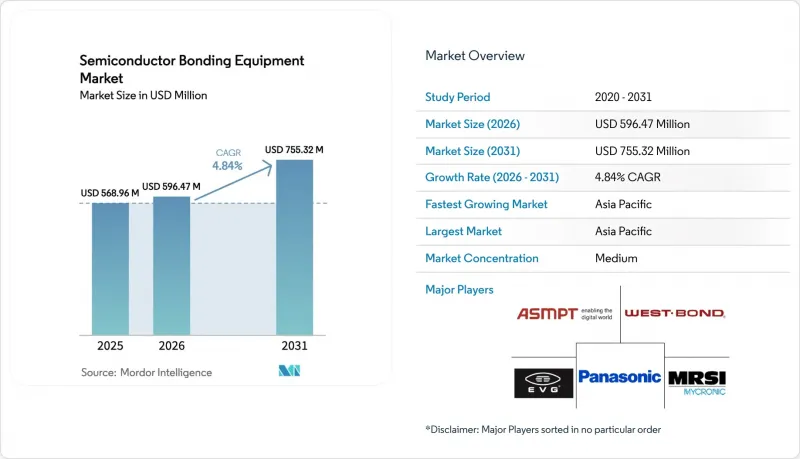
2026년 반도체 본딩 장비 시장 규모는 5억 9,647만 달러로 추정되고 있어 2025년 5억 6,896만 달러에서 확대해, 2031년에는 7억 5,532만 달러에 이를 것으로 예측됩니다.
2026년부터 2031년까지 연평균 복합 성장률(CAGR) 4.84%를 나타낼 것으로 예측됩니다.
이러한 수요 증가는 업계가 평면 미세화에서 수직 적층으로 이동하고 있으며, 이 분야에서는 이종 집적화 전략으로 인해 웨이퍼 간 및 다이와 웨이퍼 간의 정밀한 연결이 요구되고 있음을 반영합니다. 주요 칩 제조업체들은 AI 가속기 및 고성능 컴퓨팅 장치의 대역폭, 지연시간, 에너지 효율을 향상시키기 위해 첨단 패키징 라인에 대한 투자를 가속화하고 있습니다. 3nm 이하 노드가 위험 생산 단계로 넘어가면서 하이브리드 구리-구리 공정이 기존 와이어 본딩을 대체하고 있으며, 정렬 정확도에 대한 요구는 10µm 이하로 높아지고 있습니다. 동시에 자동차의 전동화와 IoT의 소형화로 응용 범위가 넓어지고, 영구형, 임시형, 하이브리드형 플랫폼의 수주 잔고가 증가하고 있습니다. 그러나 높은 총소유비용과 휘발성 유기화합물(VOC) 관련 환경 규제 강화로 인해 가동률을 70% 이상으로 유지해야 한다는 압박이 커지면서 구매자는 풀 서비스 계약 및 예측 유지보수 패키지를 협상하고 있습니다.
세계 반도체 본딩 장비 시장 동향 및 인사이트
IDM 및 파운드리의 설비 투자(CAPEX) 증가
세계 반도체 제조 장비 투자액은 2024년 1,100억 달러에 달했고, 2026년에는 1,300억 달러에 달할 것으로 예측됩니다. TSMC만 해도 2025년 설비 갱신에 380억-420억 달러를 투자하고, 그 중 대부분은 첨단 패키징 및 본딩 라인에 투자되었습니다. 삼성과 인텔의 유사한 확장은 고 대역폭 메모리와 칩렛 설계를 지원하는 웨이퍼 레벨 집적화에 대한 경쟁적 필요성을 강조하고 있습니다. 현재 자본배분 대상은 서브미크론급 광학 정렬 모듈, 진공 본딩 챔버, AI를 활용한 공정 제어 등의 항목입니다. 디바이스 제조업체들이 향후 설계 변경에 대비하는 가운데, 모듈식 업그레이드 경로를 제공하는 벤더가 우선 공급업체로 자리매김하고 있습니다. 이러한 투자 증가는 교체 주기 단축과 프론트엔드 및 백엔드 팹의 도입 기반 확대를 통해 반도체 본딩 장비 시장에 활력을 불어넣고 있습니다.
자동차 및 IoT 기기에 탑재되는 반도체 탑재량 급증
전기 파워트레인, 첨단운전자보조시스템(ADAS), 존 아키텍처의 보급으로 2024년 차량 1대당 평균 반도체 탑재액은 950달러에 달했습니다. 전기자동차 모델에는 고강도 및 고온에 대응하는 본딩 헤드와 강력한 플럭스 관리 시스템을 필요로 하는 실리콘 카바이드(SiC) 및 질화갈륨(GaN) 파워 디바이스가 채택되고 있습니다. 이와 함께, IoT 웨어러블 기기 및 스마트 홈 노드에서는 실적를 줄이고 배터리 수명을 연장하는 웨이퍼 레벨 칩 스케일 패키지가 요구되고 있습니다. 이러한 서로 다른 요구 사항은 장비 수준에서 수렴하고 있으며, 구성 가능한 본더는 고출력 압력 프로파일과 섬세한 MEMS 처리 사이에서 전환해야 합니다. 공급업체들은 적응형 클램프 설계, 척의 평탄도에 대한 실시간 피드백, 레시피 기반 압력 곡선 등을 통해 이 격차를 해소하기 위해 노력하고 있습니다. 이러한 추세는 반도체 본딩 장비 시장의 출하량 증가와 함께, 자동차 1차 협력업체와 민수용 OEM 업체로 수익원 다변화를 가져오고 있습니다.
높은 소유 비용과 TCO의 불확실성
최첨단 하이브리드 본더의 가격은 300만 달러가 넘지만, 예비 부품, 소모품, 교정을 포함한 연간 운영 비용으로 인해 평생 비용은 800만 달러에 달할 가능성이 있습니다. 소규모 OSAT(반도체 위탁생산업체)는 가동률이 70% 이하로 떨어지면 어려움을 겪게 됩니다. 특히 가전제품의 비수기에는 이러한 경향이 두드러집니다. 로드맵의 빠른 업데이트는 재무 모델링을 더욱 복잡하게 만들고 있습니다. 10µ&m 오버레이를 지원하는 공구라 할지라도, 단 두 번의 제품 사이클 후에 개조 키트가 필요할 수 있기 때문입니다. 리스 프로그램, 성과 연동형 서비스 계약, 위험분담형 가격 모델이 등장하고 있지만, CFO(최고재무책임자)들은 여전히 잔존가치의 불확실성을 반도체 본딩 장비 시장의 신규 발주의 걸림돌로 꼽고 있습니다.
부문 분석
CAGR 5.88%로 가장 빠르게 성장하고 있으며, 웨이퍼의 박형화 및 TSV(관통전극) 형성에 대응하고, 기계적 지원에 필요한 가역적 접착을 제공합니다. 하이브리드 시스템은 CAGR 5.88%로 가장 빠른 성장세를 보이고 있으며, 구리 대 구리의 직접 부착을 통해 저항과 전기 이동을 최소화하는 3nm 이하 집적화를 목표로 하고 있습니다. 이러한 성장에 힘입어 하이브리드 플랫폼용 반도체 본딩 장비 시장 규모는 현재 미미한 수준에서 10년 이내에 영구형 장비와 동등한 수준으로 확대될 것으로 예측됩니다. 각 제조업체들은 2단계 정렬 광학계, 액티브 레벨링 척, 클로즈드 루프 압력 제어 등의 기술로 차별화를 꾀하고 있으며, 이를 결합하여 배치 오차를 500nm 이하로 억제하고 있습니다. 구매자는 향후 레시피를 추가할 수 있는 멀티모드 유닛을 선호하며, 이를 통해 자본 리스크를 줄일 수 있습니다. 이러한 전환에 따라 박리 없이 반복적인 열 사이클을 견딜 수 있는 히트스프레더 소재와 컴플라이언트 언더필 화학 성분에 대한 연구개발이 활발히 진행되고 있습니다. 경쟁은 처리량에도 달려 있으며, 현재 주력 모델에서는 병렬 클램핑 암과 예측 서보 튜닝을 통해 사이클 타임을 20% 단축할 것을 약속하고 있습니다.
이러한 변화에 따라 장비의 업데이트 주기 또한 확대되고 있습니다. 라인 관리자가 구형 공융 본더를 점검한 결과, 유지보수 비용이 연간 12% 증가하는 것으로 나타났습니다. 하이브리드 본더로 전환하면 2번의 공정이 불필요해져 플로어 이용률이 향상됩니다. 그러나 이해관계자들은 새로운 장비가 다이의 일련번호 수준까지 추적성을 관리하는 MES 및 공장 자동화 계층과 원활하게 통합될 것을 요구하고 있습니다. 이에 대해 벤더들은 OPC-UA 게이트웨이와 엣지 분석 기능을 내장하고, 공정 데이터를 AI 기반 수율 대시보드에 통합하여 대응하고 있습니다. 이러한 에코시스템과의 호환성은 공장 전반에 걸친 도입을 가속화하여 반도체 본딩 장비 시장에서 하이브리드 부문의 기여도를 높이고 있습니다.
첨단 패키징은 2025년 매출의 35.42%를 차지했으며, 칩렛 프로세서, 고대역폭 메모리, 프리미엄 스마트폰 SoC 프로그램 등에 힘입어 핵심 부문으로 자리매김할 것으로 보입니다. 파워 IC 본딩은 그다지 주목받지 못하지만 엄격한 보이드 제어 프로토콜과 고압 열압축 헤드에 의존하여 안정적인 생산량을 보장합니다. 실리콘 포토닉스는 CAGR 5.73%로 빠르게 성장하는 틈새 시장입니다. 스위치 ASIC과 코패키지된 광학 엔진은 실리콘 캐리어 웨이퍼 위에 게르마늄 광검출기나 III-V족 레이저를 미크론 단위의 정밀도로 배치해야 하며, 250°C 이하로 온도 상승을 제어하는 특수한 본딩 공정이 요구됩니다. 이러한 견조한 수요의 흐름에 따라 실리콘 포토닉스 분야의 점유율은 반도체 본딩 장비 시장 전체에서 이미 한 자릿수에서 두 자릿수로 확대되고 있습니다.
MEMS 센서, 특히 자동차 LiDAR 및 산업 자동화용 센서의 경우, 1,000 사이클의 온도 변화를 견딜 수 있는 밀폐형 씰이 필요합니다. 이러한 응력 프로파일은 유리 프릿 본딩 및 애노드 본딩에 적합하며, 틈새 장비 벤더 시장 지위를 유지하고 있습니다. CMOS 이미지 센서는 광축의 정합성을 확보하기 위해 정렬 정밀도를 추구하고 있으며, 본딩 헤드에 내장된 첨단 오토포커스 광학장치에 대한 수주가 증가하고 있습니다. 한편, RF 디바이스는 고유한 임피던스를 가져오고 저손실 배선 금속을 필요로 하기 때문에 차세대 장비의 재료 공급 서브시스템에 영향을 미치고 있습니다. 이러한 광범위한 용도와 새로운 용도의 융합은 공급업체를 경기 변동으로부터 보호하고 반도체 본딩 장비 시장을 안정적인 성장 궤도에 올려놓았습니다.
지역별 분석
아시아태평양은 2025년 매출의 52.64%를 차지했으며, 그 배경에는 중국에서만 전년 대비 35% 증가한 496억 달러에 달하는 장비 투자가 있습니다. 한국이 205억 달러로 그 뒤를 이었고, 대만은 일시적인 재고 조정에도 불구하고 166억 달러를 기여했습니다. 각 지역의 정책 패키지에는 세액공제, 관세 면제, 인프라 보조금 등이 포함되어 있으며, 이는 하이브리드 본더의 실질적인 구매 가격을 낮추어 반도체 본딩 장비 시장에서 선도적인 지위를 유지하고 있습니다. TSMC와 삼성과 같은 현지의 주요 기업들이 3D 및 하이브리드 기술 채택을 주도하면서 지역 기술 수준을 높이고 정밀 척과 초평탄 캐리어 웨이퍼에 대한 공급망의 기대치를 재정의하고 있습니다.
북미에서는 2024년 매출액이 137억 달러를 기록했으며, 국내 생산능력 확대를 위한 CHIPS법 배분에 따라 14%의 성장세를 보였습니다. 인텔, 마이크론, 텍사스 기기는 애리조나, 오하이오, 텍사스에 기반을 둔 다년간의 패키징 프로젝트를 발표했습니다. 보조금을 통한 경기부양책이 수주를 가속화하고 있지만, 보조금이 단계적으로 축소된 이후 장기적인 원가 경쟁력에 대한 우려도 커지고 있습니다. 그러나 이 지역은 AI 워크로드를 위한 저지연 인터포저를 필요로 하는 하이퍼스케일 데이터센터 고객들과 가깝다는 장점이 있어, 반도체 본딩 장비 시장에서 고부가가치 하이브리드 본딩 장비에 대한 수요를 창출하고 있습니다. 유럽에서는 아날로그, 파워, EUV 장비 벤더가 집중되어 있는 독일과 네덜란드에 투자가 집중되어 있습니다. IPCEI-ME/CT와 같은 공동 프로그램은 특히 엄격한 신뢰성이 요구되는 자동차 파워 모듈을 위한 3D 집적화에 EU의 자금을 투입하고 있습니다. 중동 및 아프리카는 여전히 개발 중이지만, 사우디의 '비전 2030'과 UAE의 전략적 기술 기금은 화합물 반도체를 위한 파일럿 라인에 자금을 할당하고 있습니다. 이러한 초기 움직임은 기존의 APAC(아시아태평양) 지역을 넘어 반도체 본딩 장비 시장이 단계적으로 확대될 수 있는 보다 광범위한 지역적 다변화를 시사하고 있습니다.
기타 특전:
- 엑셀 형식 시장 예측(ME) 시트
- 3개월간 애널리스트 지원
자주 묻는 질문
목차
제1장 서론
제2장 조사 방법
제3장 주요 요약
제4장 시장 구도
제5장 시장 규모와 성장 예측
제6장 경쟁 구도
제7장 시장 기회와 향후 전망
JHS 26.05.20The semiconductor bonding equipment market size in 2026 is estimated at USD 596.47 million, growing from 2025 value of USD 568.96 million with 2031 projections showing USD 755.32 million, growing at 4.84% CAGR over 2026-2031.
Demand growth mirrors the industry shift from planar scaling to vertical stacking, where heterogeneous integration strategies require precise wafer-to-wafer and die-to-wafer connections. Leading chipmakers have accelerated capital spending on advanced packaging lines to improve bandwidth, latency, and energy efficiency for AI accelerators and high-performance computing devices. Hybrid copper-to-copper processes are eclipsing conventional wire bonding as sub-3 nm nodes move into risk production, raising alignment-accuracy demands below 10 µm. At the same time, automotive electrification and IoT miniaturization widen the application footprint, expanding order books for permanent, temporary, and hybrid platforms. However, the high total cost of ownership and tighter environmental rules on volatile organic compounds add pressure to sustain utilization levels above 70%, prompting buyers to negotiate full-service contracts and predictive-maintenance packages.
Global Semiconductor Bonding Equipment Market Trends and Insights
Increasing CAPEX by IDMs and Foundries
Global semiconductor equipment spending hit USD 110 billion in 2024 and is on track for USD 130 billion by 2026. TSMC alone earmarked USD 38-42 billion for 2025 facility upgrades, a substantial portion of which funds advanced packaging and bonding lines. Comparable expansions by Samsung and Intel emphasize the competitive need for wafer-level integration that supports high-bandwidth memory and chiplet designs. Capital allocation now targets line items such as sub-micrometer optical alignment modules, vacuum bond chambers, and AI-enabled process control. Vendors that provide modular upgrade paths are gaining preferred-supplier status as device makers hedge against future design pivots. The investment uptick stimulates the semiconductor bonding equipment market by shortening replacement cycles and broadening the installed base across both front-end and back-end fabs.
Surging Semiconductor Content in Automotive and IoT Devices
Average semiconductor value per vehicle climbed to USD 950 in 2024, driven by electrified powertrains, advanced driver-assistance systems, and zonal architectures. Electric models specify silicon-carbide and gallium-nitride power devices that need high-force, high-temperature bonding heads and robust flux-management systems. In parallel, IoT wearables and smart home nodes demand wafer-level chip-scale packages that shrink footprint and extend battery life. These divergent requirements converge at the equipment level, where configurable bonders must toggle between high-power pressure profiles and delicate MEMS handling. Suppliers are addressing the gap with adaptive clamp designs, real-time chuck-planarity feedback, and recipe-driven force curves. The trend raises unit shipments in the semiconductor bonding equipment market while diversifying revenue streams across automotive Tier-1s and consumer OEMs.
High Cost of Ownership and TCO Uncertainty
State-of-the-art hybrid bonders list above USD 3 million, while annual running costs including spares, consumables, and calibration can lift lifetime spend to USD 8 million. Smaller OSATs struggle when utilization drifts below 70%, especially in consumer-electronics off-seasons. Rapid roadmap updates further complicate financial modeling because a tool qualified for 10 µm overlay may need retrofit kits after only two product cycles. Leasing programs, outcome-based service contracts, and shared-risk pricing models are emerging, yet CFOs still cite uncertain residual value as a brake on new orders within the semiconductor bonding equipment market.
Other drivers and restraints analyzed in the detailed report include:
- Rapid Adoption of Advanced 2.5D/3D Packaging Platforms
- Government-Backed "CHIPS" Subsidies and Tax Incentives
- Process Complexity at Sub-10 µm Alignment Tolerances
For complete list of drivers and restraints, kindly check the Table Of Contents.
Segment Analysis
Permanent bonders accounted for 38.74% of 2025 revenue, underpinned by their proven reliability in legacy device packaging. Temporary bonding tools cater to wafer thinning and TSV creation, providing the reversible adhesion needed for mechanical support. Hybrid systems register the quickest climb at 5.88% CAGR, targeting sub-3 nm integration where copper-to-copper direct attach minimizes resistance and electromigration. That growth lifts the semiconductor bonding equipment market size for hybrid platforms from a modest base toward parity with permanent tools before the decade closes. Manufacturers differentiate through dual-stage alignment optics, active levelling chucks, and closed-loop pressure control that collectively push placement error below 500 nm. Buyers favor multi-modal units that accept future recipe add-ons, lowering capital risk. The pivot intensifies R&D around heat-spreader materials and compliant under-fill chemistries that withstand repeated thermal cycles without delamination. Competition also hinges on throughput, with flagship machines now promising 20% cycle-time reductions achieved via parallel clamp arms and predictive servo tuning.
A broader equipment refresh cycle accompanies the shift. Line managers audited older eutectic stations and discovered maintenance outlays rising 12% per year. Swapping to hybrid bonders eliminates dual-pass processes, improving floor utilization. Yet stakeholders insist that new gear integrate seamlessly with MES and factory automation layers that handle traceability down to die serial number. Vendors respond by embedding OPC-UA gateways and edge analytics that channel process data into AI-based yield dashboards. Such ecosystem compatibility accelerates factory-wide adoption, reinforcing the hybrid segment's contribution to the semiconductor bonding equipment market.
Advanced packaging maintained 35.42% of 2025 revenue and remains the anchor segment, buttressed by chiplet processors, high-bandwidth memory, and premium smartphone SoC programs. Power IC bonding, while less glamorous, delivers stable volumes that depend on rigorous void-control protocols and high-pressure thermocompression heads. Silicon photonics is the standout high-velocity niche at a 5.73% CAGR. Optical engines co-packaged with switch ASICs need micron-accurate placement of germanium photodetectors and III-V lasers onto silicon carrier wafers, driving specialized bond recipes with controlled temperature ramps under 250 °C. The strong demand trajectory has already lifted the silicon-photonics slice from single digits toward a double-digit share of the overall semiconductor bonding equipment market size.
MEMS sensors, notably for automotive lidar and industrial automation, require hermetic seals that endure 1,000-cycle temperature swings. These stress profiles favor glass-frit or anodic bonding, sustaining a market foothold for niche tool vendors. CMOS image sensors push alignment fidelity to safeguard optical axis integrity, stoking orders for advanced auto-focus optics built into bond heads. RF devices, meanwhile, introduce unique impedances that compel low-loss interconnect metallurgy, influencing material-delivery subsystems on next-gen machines. The blend of widespread and emerging uses buffers suppliers from cyclical swings and keeps the semiconductor bonding equipment market on a stable growth path.
The Semiconductor Bonding Equipment Market Report is Segmented by Equipment Type (Permanent, Temporary, and Hybrid), Application (Advanced Packaging, Power IC and Discrete, and More), Bonding Technology (Thermocompression, Eutectic/Solder, and More), Wafer Size (<=200mm, and More), End User (IDMs, Foundries, and OSAT), and Geography (North America, Europe, and More). The Market Forecasts are Provided in Terms of Value (USD).
Geography Analysis
Asia-Pacific held 52.64% of 2025 revenue, underlined by USD 49.6 billion in equipment spending from China alone, up 35% year over year. South Korea followed with USD 20.5 billion, and Taiwan contributed USD 16.6 billion despite temporary inventory corrections. Regional policy packages include tax deductions, duty exemptions, and infrastructure subsidies that lower effective purchase prices of hybrid bonders, sustaining leadership in the semiconductor bonding equipment market. Local champions such as TSMC and Samsung spearhead 3D and hybrid adoption, elevating regional technical standards and reshaping supply-chain expectations for precision chucks and ultra-flat carrier wafers.
North America posted USD 13.7 billion in 2024 sales, advancing 14% alongside CHIPS Act allocations targeting domestic capacity expansion. Intel, Micron, and Texas Instruments have announced multiyear packaging projects anchored in Arizona, Ohio, and Texas. The subsidy stimulus accelerates inbound orders but raises concerns over long-term cost competitiveness once grants taper. Yet the region benefits from proximity to hyperscale-data-center customers demanding low-latency interposers for AI workloads, a segment that outlets more value-added hybrid bonders into the semiconductor bonding equipment market. Europe concentrates spending in Germany and the Netherlands where analog, power, and EUV tool vendors cluster. Collaborative programs like IPCEI-ME/CT channel EUR funding into 3D integration, especially for automotive power modules that require stringent reliability. Middle East and Africa remain nascent, though Saudi Arabia's Vision 2030 and the UAE's strategic tech funds have earmarked pilot lines for compound semiconductors. These early moves hint at wider regional diversification that could incrementally enlarge the semiconductor bonding equipment market beyond its traditional APAC stronghold.,
- EV Group (EVG)
- ASMPT Semiconductor Solutions
- Mycronic AB (MRSI Systems)
- WestBond, Inc.
- Panasonic Holdings Corporation
- Palomar Technologies, Inc.
- Dr. Tresky AG
- BE Semiconductor Industries N.V.
- Fasford Technology Co., Ltd.
- Kulicke & Soffa Industries, Inc.
- DIAS Automation (HK) Ltd.
- Shibaura Mechatronics Corporation
- SUSS MicroTec SE
- Tokyo Electron Limited
- DISCO Corporation
- TOWA Corporation
- Hanmi Semiconductor Co., Ltd.
- Toray Engineering Co., Ltd.
- Hesse GmbH
- Finetech GmbH & Co. KG
Additional Benefits:
- The market estimate (ME) sheet in Excel format
- 3 months of analyst support
TABLE OF CONTENTS
1 INTRODUCTION
- 1.1 Study Assumptions and Market Definition
- 1.2 Scope of the Study
2 RESEARCH METHODOLOGY
3 EXECUTIVE SUMMARY
4 MARKET LANDSCAPE
- 4.1 Market Overview
- 4.2 Market Drivers
- 4.2.1 Increasing CAPEX by IDMs and foundries
- 4.2.2 Surging semiconductor content in automotive and IoT devices
- 4.2.3 Rapid adoption of advanced 2.5D/3D packaging platforms
- 4.2.4 Government-backed "CHIPS" subsidies and tax incentives
- 4.2.5 Commercial roll-out of hybrid wafer-to-wafer bonding in CIS and 3D-NAND
- 4.2.6 Silicon-photonic interposers for AI datacenters driving wafer bonding tools
- 4.3 Market Restraints
- 4.3.1 High cost of ownership and TCO uncertainty
- 4.3.2 Process complexity at sub-10 µm alignment tolerances
- 4.3.3 Supply-chain bottlenecks for ultra-flat carrier wafers
- 4.3.4 Stricter VOC / adhesive-chemistry environmental regulations
- 4.4 Industry Value Chain Analysis
- 4.5 Regulatory Landscape
- 4.6 Technological Outlook
- 4.7 Porter's Five Forces Analysis
- 4.7.1 Bargaining Power of Suppliers
- 4.7.2 Bargaining Power of Buyers
- 4.7.3 Threat of New Entrants
- 4.7.4 Threat of Substitutes
- 4.7.5 Intensity of Competitive Rivalry
- 4.8 Impact of Macroeconomic Factors on the Market
5 MARKET SIZE AND GROWTH FORECASTS (VALUE)
- 5.1 By Equipment Type
- 5.1.1 Permanent Bonding Equipment
- 5.1.2 Temporary Bonding Equipment
- 5.1.3 Hybrid Bonding Equipment
- 5.2 By Application
- 5.2.1 Advanced Packaging
- 5.2.2 Power IC and Discrete
- 5.2.3 Photonic Devices
- 5.2.4 MEMS Sensors and Actuators
- 5.2.5 Engineered Substrates
- 5.2.6 RF Devices
- 5.2.7 CMOS Image Sensors
- 5.3 By Bonding Technology
- 5.3.1 Thermocompression Bonding
- 5.3.2 Eutectic/Solder Bonding
- 5.3.3 Adhesive/Polymer Bonding
- 5.3.4 Ultrasonic / Thermosonic Bonding
- 5.3.5 Anodic / Fusion Bonding
- 5.4 By Wafer Size
- 5.4.1 Less than equal to 200 mm
- 5.4.2 200-300 mm
- 5.4.3 Greater than 300 mm
- 5.5 By End User
- 5.5.1 Integrated Device Manufacturers (IDMs)
- 5.5.2 Foundries
- 5.5.3 Outsourced Semiconductor Assembly and Test (OSAT)
- 5.6 Geography
- 5.6.1 North America
- 5.6.1.1 United States
- 5.6.1.2 Rest of North America
- 5.6.2 South America
- 5.6.3 Europe
- 5.6.3.1 Germany
- 5.6.3.2 France
- 5.6.3.3 Rest of Europe
- 5.6.4 Asia-Pacific
- 5.6.4.1 China
- 5.6.4.2 Japan
- 5.6.4.3 South Korea
- 5.6.4.4 India
- 5.6.4.5 Rest of Asia-Pacific
- 5.6.5 Middle East
- 5.6.6 Africa
- 5.6.1 North America
6 COMPETITIVE LANDSCAPE
- 6.1 Market Concentration
- 6.2 Strategic Moves
- 6.3 Market Share Analysis
- 6.4 Company Profiles (includes Global level Overview, Market level overview, Core Segments, Financials as available, Strategic Information, Market Rank/Share for key companies, Products and Services, and Recent Developments)
- 6.4.1 EV Group (EVG)
- 6.4.2 ASMPT Semiconductor Solutions
- 6.4.3 Mycronic AB (MRSI Systems)
- 6.4.4 WestBond, Inc.
- 6.4.5 Panasonic Holdings Corporation
- 6.4.6 Palomar Technologies, Inc.
- 6.4.7 Dr. Tresky AG
- 6.4.8 BE Semiconductor Industries N.V.
- 6.4.9 Fasford Technology Co., Ltd.
- 6.4.10 Kulicke & Soffa Industries, Inc.
- 6.4.11 DIAS Automation (HK) Ltd.
- 6.4.12 Shibaura Mechatronics Corporation
- 6.4.13 SUSS MicroTec SE
- 6.4.14 Tokyo Electron Limited
- 6.4.15 DISCO Corporation
- 6.4.16 TOWA Corporation
- 6.4.17 Hanmi Semiconductor Co., Ltd.
- 6.4.18 Toray Engineering Co., Ltd.
- 6.4.19 Hesse GmbH
- 6.4.20 Finetech GmbH & Co. KG
7 MARKET OPPORTUNITIES AND FUTURE OUTLOOK
- 7.1 White-space and Unmet-need Assessment