

|
시장보고서
상품코드
2043832
중동 및 아프리카의 자동차 유리섬유 복합재료 시장 : 점유율 분석, 업계 동향과 통계, 성장 예측(2026-2031년)Africa And Middle-East Automotive Glass Fiber Composites - Market Share Analysis, Industry Trends & Statistics, Growth Forecasts (2026 - 2031) |
||||||
 Mordor Intelligence
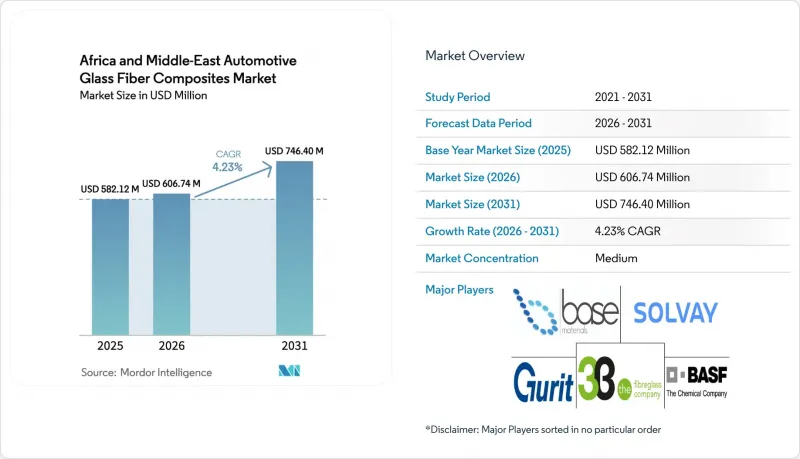
중동 및 아프리카의 자동차 유리섬유 복합재 시장 규모는 2025년에 5억 8,212만 달러, 2026년에 6억 674만 달러되어, 2031년까지 7억 4,640만 달러에 이를 것으로 예측되며, 2026년부터 2031년까지 CAGR 4.23%로 성장할 전망입니다.
걸프 국가들의 다운스트림 가공으로의 정책 전환과 더불어 아프리카 주요 조립 거점들의 국내 조달 의무화가 맞물리면서 기초 탄화수소 수출에서 고부가가치 복합재 성형으로 투자가 이동하고 있습니다. 2026년 2월 사우디아라비아가 공공투자기금에서 CEER 공급업체에 9억 8,700만 달러를 지원한 것은 이러한 전환을 보여주는 것으로, 이 프로그램은 유리섬유 도어 모듈과 배터리 트레이의 금형 제작을 지원하고 있습니다. GCC(걸프협력회의)의 경량화 규제와 UAE(아랍에미리트)의 세제 혜택으로 유럽 성형업체들의 진입장벽은 낮아지고 있지만, 홍해를 경유하는 물류 문제로 인해 수입 로빙의 비용은 계속 상승하고 있습니다. 아프리카의 CKD(완전조립키트) 공장에서는 현지화 요건을 충족하기 위해 프레스 강판에서 수작업 복합재로 전환이 진행되고 있지만, 남아공과 이집트에서는 기술자 부족으로 인해 ISO 527 인장 시험에서 품질 불합격이 발생하고 있습니다.
중동 및 아프리카의 자동차 유리섬유 복합재 시장 동향과 인사이트
연비 효율이 높은 경량화를 위한 규제 추진
사우디의 SASO 2864:2019 표준은 2028년까지 차량 연비를 5.8L/100km로 낮추도록 규정하고 있으며, 자동차 제조업체들은 소재 대체를 통해 차량 1대당 80-120kg의 경량화를 요구하고 있습니다. 유리섬유 패널은 연강 대비 25-30% 경량화를 실현하여 탄소섬유 대비 원가 경쟁력을 유지하고 있습니다. UAE는 2026년 1월에 EURO 6B를 도입하고 2030년까지 EURO 6D로 전환할 계획이며, OEM 업체들이 GCC 국가를 대상으로 한 생산 라인 전체에서 경량 부품의 비용을 회수하도록 압력을 가하고 있습니다. 이러한 규제로 인해 복합재료의 채택이 가속화되고 있지만, 열경화성 유리섬유는 재용해가 불가능하기 때문에 사용 후 제품의 재활용에 대한 과제는 여전히 남아 있으며, 2028년 이후에는 매립 처리 비용에 대한 추가 부담이 발생할 수 있습니다.
배터리 구동 파워트레인으로의 전환으로 EV용 인클로저에 대한 유리섬유 수요가 증가하고 있습니다.
SGL 카본이 BMW iX를 위해 개발한 유리섬유 배터리 인클로저는 알루미늄 하우징에 비해 무게를 15% 줄였습니다. CEER의 세단형 프로토타입 차량은 600kg의 배터리를 지탱하는 유리섬유 하부 트레이를 채택하고 있습니다. 수지 전사 성형(RTM)은 알루미늄 프레스 기계와 같은 대규모 설비 투자 없이도 복잡한 형상을 구현할 수 있어 예산이 한정된 아프리카 공장에 큰 이점이 있습니다. 이집트의 Dr. Greiche사는 2026년 4분기에 1,620만 달러를 투자한 인퓨전 성형라인을 개설하여 EV용 언더바디 쉴드를 공급할 예정입니다. 이는 전통적인 유리 가공 기업과 복합재료 부품 제조업체의 경계가 모호해지고 있음을 보여줍니다.
홍해 운임 급등으로 인한 유리섬유 수입 가격 변화
2024년 후시파의 공격으로 아시아에서 유럽으로 가는 화물의 28%가 희망봉을 통해 우회하여 운임이 150-200% 상승했습니다. 이로 인해 헤지 수단이 없는 이집트와 케냐의 성형업체들은 중국 및 인도산 로빙의 선적 비용이 12-18% 상승했습니다. 분쟁이 진정된 이후에도 보험사들은 보험료에 8-10%의 할증료를 추가하고 있으며, 이는 2027년까지 지속될 것으로 예측됩니다. 이는 중동 및 아프리카의 자동차 유리섬유 복합재 시장에 구조적 변동성을 내재화할 것으로 보입니다.
부문 분석
2025년에는 압축 성형이 매출의 34.28%를 차지하여 중동 및 아프리카의 자동차 유리섬유 복합재 시장에서 주요 생산 방식으로 남아있을 것입니다. Advanced Fibreform의 12대의 프레스기는 토요타와 이스즈 픽업트럭을 위해 주당 3,000개 이상의 부품을 생산하고 있습니다. 진공 사출 성형은 EV용 배터리 트레이 및 차체 하부 실드에서 복잡하고 기포가 없는 라미네이트에 대한 수요에 힘입어 2031년까지 연평균 복합 성장률(CAGR) 4.47%를 나타낼 것으로 예측됩니다. Johns Manville사가 5,500만 달러를 투자해 오하이오 주에 생산라인을 확장하는 것은 이러한 수요를 충족시키기 위한 것으로, 생산된 제품은 GCC(걸프협력회의) 회원국의 수입업체를 대상으로 공급될 예정입니다.
핸드 레이업은 생산량이 15,000대 미만인 CKD(Complete Knock Down) 생산에 지속적으로 활용되고 있으며, 알제리, 이집트, 케냐의 현지 조달 규정을 충족하기 위한 비용 효율적인 솔루션을 제공합니다. 수지 전사 성형은 섬유의 구조가 매우 중요한 시트 프레임과 같은 틈새 구조 부품에 사용됩니다. 사출 성형된 단섬유 컴파운드는 대량 생산되는 내장용 브래킷에 채택되고 있습니다.
기타 특전:
- 엑셀 형식 시장 예측(ME) 시트
- 3개월간 애널리스트 지원
자주 묻는 질문
목차
제1장 서론
제2장 조사 방법
제3장 주요 요약
제4장 시장 구도
제5장 시장 규모와 성장 예측
제6장 경쟁 구도
제7장 시장 기회와 향후 전망
JHS 26.06.11The Africa And Middle-East Automotive Glass Fiber Composites Market size is projected to be USD 582.12 million in 2025, USD 606.74 million in 2026, and reach USD 746.40 million by 2031, growing at a CAGR of 4.23% from 2026 to 2031. A shift in policy toward downstream processing in the Gulf, coupled with domestic-content mandates in key African assembly hubs, is driving investment away from basic hydrocarbon exports toward value-added composite molding. Saudi Arabia's allocation of USD 987 million from the Public Investment Fund to CEER suppliers in February 2026 highlights this transition, as the program supports tooling for glass-fiber door modules and battery trays. GCC lightweighting regulations and UAE tax incentives are reducing entry barriers for European molders, although logistical challenges through the Red Sea continue to increase the cost of imported roving. African CKD plants are replacing stamped steel with hand-laid composites to meet localization requirements, despite technician shortages in South Africa and Egypt leading to quality rejections under ISO 527 tensile tests.
Africa And Middle-East Automotive Glass Fiber Composites Market Trends and Insights
Regulatory Push for Fuel-Efficient Lightweighting
Saudi Arabia's SASO 2864:2019 standard lowers fleet consumption to 5.8 L/100 km by 2028, forcing automakers to remove 80-120 kg per vehicle through material substitution. Glass-fiber panels deliver 25-30% weight savings versus mild steel and remain cost-competitive against carbon fiber. The UAE starts EURO 6B in January 2026 and moves to EURO 6D by 2030, increasing pressure on OEMs to amortize lightweight components across GCC runs. While the rules accelerate composite uptake, end-of-life recycling gaps persist because thermoset glass fiber cannot be remelted, raising the prospect of landfill surcharges after 2028.
Shift to Battery-Electric Powertrains Raises Glass-Fiber Demand for EV Enclosures
SGL Carbon's glass-fiber battery enclosure for BMW's iX trims pack weight by 15% compared with aluminum housing. CEER's prototype sedan mirrors this approach with a glass-fiber lower tray that offsets its 600 kg battery. Resin-transfer molding offers complex geometries without the capital intensity of aluminum presses, a key benefit for African plants with tight budgets. Egypt's Dr. Greiche will open a USD 16.2 million infusion line in Q4 2026 to supply EV underbody shields, underscoring the cross-over between traditional glazing firms and composite components.
Volatile Glass-Fiber Import Prices Due to Red Sea Freight Premiums
Houthi attacks in 2024 caused 28% of Asia-to-Europe cargo to be rerouted via the Cape of Good Hope, leading to a 150-200% increase in freight rates. This raised the landed cost of Chinese and Indian rovings by 12-18% for Egyptian and Kenyan molders without hedging tools. Even after the conflict subsides, insurers have added an 8-10% surcharge to premiums, expected to remain through 2027, embedding structural volatility into the Africa and Middle-East automotive glass fiber composites market.
Other drivers and restraints analyzed in the detailed report include:
- Localisation Incentives in Saudi and UAE Tier-1 Supply Chains
- Surge in CKD/IKD Assembly Plants Across Africa Adopting Low-CAPEX Hand Lay-Up Parts
- Shortage of Certified Composite Technicians Causing OEM Quality Rejections
For complete list of drivers and restraints, kindly check the Table Of Contents.
Segment Analysis
Compression molding accounted for 34.28% of revenue in 2025, remaining a key production method in the Africa and Middle-East automotive glass fiber composites market. Advanced Fibreform's 12 presses produce over 3,000 parts weekly for Toyota and Isuzu pickups. Vacuum infusion processing is projected to grow at a 4.47% CAGR through 2031, driven by demand for complex, void-free laminates in EV battery trays and underbody shields. Johns Manville's USD 55 million Ohio line expansion aims to meet this demand, with output designated for GCC importers.
Hand lay-up continues to be utilized in CKD operations producing fewer than 15,000 units, offering a cost-effective solution to meet local-content regulations in Algeria, Egypt, and Kenya. Resin-transfer molding is used for niche structural components like seat frames, where fiber architecture is critical. Injection-molded short-fiber compounds are employed for high-volume interior brackets.
The Africa and Middle-East Automotive Glass Fiber Composites Market Report is Segmented by Production Type (Compression Molding, Hand Lay-Up, and More), Application Type (Exterior, Structural Assembly, Powertrain Components, Interior, and Other Application Types), and Geography (South Africa, Egypt, United Arab Emirates, Saudi Arabia, and Rest of Middle-East and Africa). The Market Forecasts are Provided in Terms of Value (USD).
List of Companies Covered in this Report:
- 3B - the fibreglass company
- Base Materials Ltd.
- BASF
- BorgWarner
- Chongqing Polycomp International Corporation (CPIC)
- Far-UK
- General Motors Company
- Gurit Holding AG
- Hexcel Corporation
- Johns Manville
- LyondellBasell
- Nippon Electric Glass
- Praana Group
- Saint-Gobain Vetrotex
- SGL Carbon
- Solvay
- Taishan Fiberglass
- Teijin Limited
Additional Benefits:
- The market estimate (ME) sheet in Excel format
- 3 months of analyst support
TABLE OF CONTENTS
1 Introduction
- 1.1 Study Assumptions and Market Definition
- 1.2 Scope of the Study
2 Research Methodology
3 Executive Summary
4 Market Landscape
- 4.1 Market Overview
- 4.2 Market Drivers
- 4.2.1 Regulatory push for fuel-efficient lightweighting
- 4.2.2 Shift to battery-electric powertrains raises glass-fiber demand for EV enclosures
- 4.2.3 Localisation incentives in Saudi and UAE Tier-1 supply chains
- 4.2.4 Growing demand for corrosion-resistant composites in desert climates (fleets/buses)
- 4.2.5 Surge in CKD/IKD assembly plants across Africa adopting low-CAPEX hand lay-up parts
- 4.3 Market Restraints
- 4.3.1 Volatile glass-fiber import prices due to Red Sea freight premiums
- 4.3.2 Limited regional Tier-2 resin formulators inflating composite costs
- 4.3.3 Shortage of certified composite technicians causing OEM quality rejections
- 4.4 Value Chain Analysis
- 4.5 Porter's Five Forces
- 4.5.1 Bargaining Power of Suppliers
- 4.5.2 Bargaining Power of Consumers
- 4.5.3 Threat of New Entrants
- 4.5.4 Threat of Substitutes
- 4.5.5 Degree of Competition
5 Market Size and Growth Forecasts (Value)
- 5.1 By Production Type
- 5.1.1 Compression Molding
- 5.1.2 Hand Lay-up
- 5.1.3 Resin Transfer Molding
- 5.1.4 Vacuum Infusion Processing
- 5.1.5 Injection Molding
- 5.2 By Application Type
- 5.2.1 Exterior
- 5.2.2 Structural Assembly
- 5.2.3 Powertrain Components
- 5.2.4 Interior
- 5.2.5 Other Application Types
- 5.3 By Geography
- 5.3.1 South Africa
- 5.3.2 Egypt
- 5.3.3 United Arab Emirates
- 5.3.4 Saudi Arabia
- 5.3.5 Rest of Middle-East and Africa
6 Competitive Landscape
- 6.1 Market Concentration
- 6.2 Strategic Moves
- 6.3 Market Share (%)/Ranking Analysis
- 6.4 Company Profiles (includes Global level Overview, Market level overview, Core Segments, Financials as available, Strategic Information, Products and Services, and Recent Developments)
- 6.4.1 3B - the fibreglass company
- 6.4.2 Base Materials Ltd.
- 6.4.3 BASF
- 6.4.4 BorgWarner
- 6.4.5 Chongqing Polycomp International Corporation (CPIC)
- 6.4.6 Far-UK
- 6.4.7 General Motors Company
- 6.4.8 Gurit Holding AG
- 6.4.9 Hexcel Corporation
- 6.4.10 Johns Manville
- 6.4.11 LyondellBasell
- 6.4.12 Nippon Electric Glass
- 6.4.13 Praana Group
- 6.4.14 Saint-Gobain Vetrotex
- 6.4.15 SGL Carbon
- 6.4.16 Solvay
- 6.4.17 Taishan Fiberglass
- 6.4.18 Teijin Limited
7 Market Opportunities and Future Outlook
- 7.1 White-space and Unmet-Need Assessment


