

|
시장보고서
상품코드
2043847
인도의 자동차용 어댑티브 라이팅 시스템 : 시장 점유율 분석, 업계 동향 및 통계, 성장 예측(2026-2031년)India Automotive Adaptive Lighting System - Market Share Analysis, Industry Trends & Statistics, Growth Forecasts (2026 - 2031) |
||||||
 Mordor Intelligence
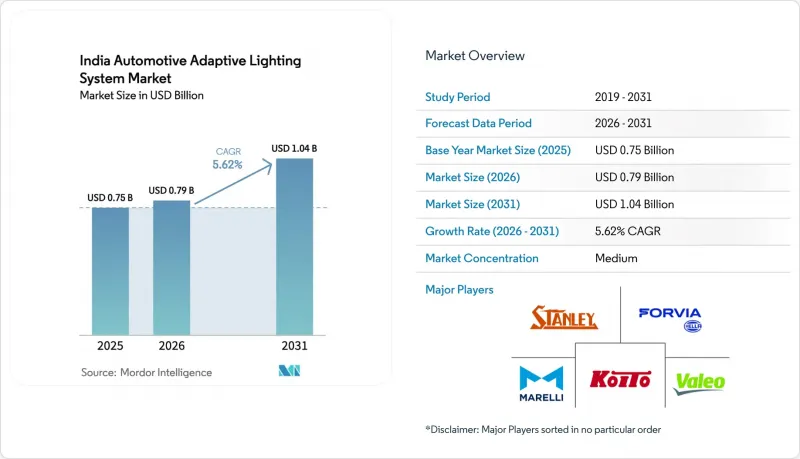
인도의 자동차용 어댑티브 라이팅 시스템 시장 규모는 2025년 7억 5,000만 달러로 평가되었습니다. 2026년 7억 9,000만 달러로 확대되어 2031년까지 10억 4,000만 달러에 이를 것으로 예상되며 2026년부터 2031년에 걸쳐 CAGR 5.62%를 나타낼 전망입니다.
최근 규제 제정, 특히 AIS-199 광도 측정 표준 초안은 자동차 제조업체(OEM)가 적응형 전방 조명을 단순한 고급 옵션이 아닌 컴플라이언스 요구 사항으로 취급하도록 촉구하고 있습니다. 한편, 지속적인 단가 압력으로 인해 전체 기능 시스템은 프리미엄 및 중상급으로 제한되어 있지만, LED 다이 비용의 하락으로 인해 가격 차이가 점차 줄어들고 있습니다. 각 협력사들은 생산연동형 인센티브(PLI) 적용 요건을 충족하기 위해 주요 센서 및 카메라 모듈의 현지 생산을 진행하고 있으며, 이를 통해 리드타임 단축 및 환리스크 감소를 도모하고 있습니다. 에너지 효율이 높은 조명은 실제 주행거리 극대화에 기여하고, 충전 인프라가 확대되는 가운데 구매자가 중시하는 요소이기 때문에 시장 성장 전망은 OEM의 전동화 로드맵에 따라 달라질 것으로 보입니다. 경쟁의 강도는 중간 정도이며, 5곳의 세계 Tier 1 공급업체가 기존 OEM과의 관계와 자체 개발한 소프트웨어 스택을 활용하여 점유율을 지키고 있습니다.
인도의 자동차용 어댑티브 라이팅 시스템 시장 동향 및 인사이트
LED 비용의 급격한 하락으로 중간 부문에 LED 도입 가능
다이 사이즈의 최적화로 수율이 향상됨에 따라 ED 헤드램프의 가격이 크게 낮아졌고, OEM 업체들은 가격 상한선을 넘지 않고도 차량에 적응형 기능을 탑재할 수 있게 되었습니다. 인도 자동차 연구협회(ARAI)의 검증을 거친 현지 개발 프로토타입은 현지에서 설계한 LED 어댑티브 모듈이 경쟁력 있는 비용으로 AIS-127 표준을 충족할 수 있다는 것을 입증했습니다. 미드 부문 등급의 추가 수요는 센서 및 액추에이터 공급업체의 규모의 경제를 향상시킬 수 있습니다. 인도 승용차 구매자에게 가격 민감도는 여전히 중요한 요소이기 때문에 비용이 조금이라도 절감될 때마다 더 넓은 고객층을 확보할 수 있습니다. 그 결과, 미드 부문 전동화 플랫폼에서 자동 하이빔을 표준으로 채택하는 경우가 늘고 있습니다.
AFS의 광도 기준을 의무화하는 AIS-199 규정(2024년 초안)
2024년 초안에서는 조명 기준이 통합되어 UN R-123을 참조하고 있습니다. 이에 따라 자동차 제조업체들은 2026년 이후 출시되는 새로운 플랫폼에 눈부심 제어 로직, 카메라 입력 및 적응형 광학 시스템을 탑재해야 합니다. 이미 유럽용 제품 인증을 획득한 Tier 1 공급업체는 이미 검증된 설계를 활용할 수 있어 형식승인을 쉽게 받을 수 있습니다. 이 규정은 모든 차종에 적용되며, 2020년대 말에는 상용차 부문에도 적용될 것으로 예측됩니다. 수출 지향적인 OEM 업체들은 단일 모듈로 여러 지역에 대응할 수 있고, 엔지니어링 부담을 줄일 수 있기 때문에 이러한 통합을 환영하고 있습니다. 단기적으로 AIS-199는 대부분의 신형 승용차 모델에서 적응형 조명을 사실상 의무화할 것으로 보입니다.
높은 단가가 양산차 보급을 가로막고 있습니다.
모든 기능을 갖춘 어댑티브 프론트 라이팅 어셈블리는 고가이며, 판매량의 대부분을 차지하는 저가형 차량에 큰 장벽이 되고 있습니다. 센서용 ASIC의 수입 의존으로 부품 원가가 고공행진을 하고 있으며, OEM은 환율 변동 위험에 노출되어 있습니다. Tier 1 공급업체들은 트림 레벨에 따라 기능을 확장하는 모듈식 접근 방식을 시험하고 있지만, 생산량이 세분화됨에 따라 비용 절감 효과는 줄어들고 있습니다. 컨트롤러와 카메라의 현지 생산으로 가격이 낮아지기 전까지는 어댑티브 라이팅은 주류 안전 기준이라기보다는 프리미엄 자동차의 상징으로 남을 것입니다.
부문 분석
2025년 인도의 자동차용 어댑티브 라이팅 시스템 시장에서 승용차가 55.67%의 점유율을 차지하며 CAGR 8.47%를 나타냈습니다. 이는 주로 개인 구매자들이 어댑티브 헤드램프가 제공하는 안전 기능과 스타일링의 매력을 중시하기 때문입니다. AIS-199 관련 규정의 시한으로 인해 OEM 업체들은 규정을 준수하는 승용차 플랫폼을 먼저 출시해야 하며, 트럭과 버스는 기존 사양을 그대로 유지해야 합니다. 저와트수 LED가 주행거리 연장에 기여하기 때문에 전동화 승용차는 그 도입을 더욱 촉진하고 있습니다.
따라서 공급업체의 로드맵에서 엔지니어링 리소스는 승용차 전용 빔 형성 알고리즘과 소형 센서 클러스터에 집중되어 있습니다. 상업용 차량은 차량 운영자가 투자 대비 효과를 더 엄격하게 조사하기 때문에 도입이 늦어지고 있습니다. 하지만 야간 운송 증가와 보험 기준의 강화로 인해 대형 트럭보다 먼저 일부 LCV(소형 상용차) 차량에 어댑티브 하이빔이 도입될 가능성이 있습니다. 향후 승용차 분야에서 달성한 규모의 경제로 인해 비용 장벽이 낮아지고, 화물차나 시외버스로의 단계적 파급이 예상됩니다.
인도의 자동차용 어댑티브 라이팅 시스템 시장에서 외장 조명이 대부분을 차지하고 있습니다. 이는 전조등이 안전 규정과 소비자의 가시성 요구의 교차점에 위치하기 때문입니다. 2025년에는 이 카테고리가 전체 시장의 72.87%를 차지했으며, 2031년까지 연평균 복합 성장률(CAGR) 9.77%로 가장 빠르게 성장할 것으로 예상되며, 적응형 전조등과 다이내믹 코너링 모듈이 하위 부문으로 확장됨에 따라 2031년까지 연평균 복합 성장률(CAGR) 9.77%를 나타낼 것으로 예측됩니다. 캐빈 앰비언트 조명과 같은 차량 내 용도는 주로 엄격한 안전 기준보다 개인화를 중시하는 프리미엄 차종에 주로 적용되고 있으며, 낮은 기반에서 성장하고 있습니다. 따라서 공급업체는 엔지니어링 예산의 대부분을 전면 조명용 광학, 센서 및 빔 포밍 소프트웨어에 투자하고 있습니다.
엑츄에이터, ECU, LED가 통합된 전체 헤드램프 어셈블리를 통해 차량 1대당 매출액이 높은 것도 외관에 대한 집중도가 반영된 결과입니다. 인테리어 모듈은 브랜드 차별화에 있어 여전히 중요하지만, 규제 측면의 후폭풍이 부족해 보급에 한계가 있습니다. 향후 차체 도메인 컨트롤러의 일원화가 진행되면 실내와 외부의 조명 시퀀싱 동기화가 수요를 더욱 확대할 수 있을 것으로 보입니다. 그러나 예측 기간 동안 적응형 조명 포트폴리오에서 외장형 헤드램프는 수량과 금액 면에서 여전히 뚜렷한 견인차 역할을 할 것으로 보입니다.
기타 혜택 :
- 엑셀 형식 시장 예측(ME) 시트
- 3개월간 애널리스트 지원
자주 묻는 질문
목차
제1장 서론
제2장 조사 방법
제3장 주요 요약
제4장 시장 구도
제5장 시장 규모와 성장 예측
제6장 경쟁 구도
제7장 시장 기회와 향후 전망
KTH 26.05.29The Indian automotive adaptive lighting system market size is expected to increase from USD 0.75 billion in 2025 to USD 0.79 billion in 2026, reaching USD 1.04 billion by 2031, growing at a CAGR of 5.62% over 2026-2031.
Recent rule-making, notably the draft AIS-199 photometric standard, is nudging original equipment manufacturers (OEMs) to treat adaptive front lighting as a compliance feature rather than a luxury add-on. Meanwhile, persistent unit-cost pressures confine full-feature systems to premium and upper-mid trims, even as LED die-cost declines slowly narrow the affordability gap. Suppliers are localizing critical sensors and camera modules to qualify for production-linked incentives (PLI) and thereby shorten lead times and mitigate currency exposure. Growth prospects remain tied to OEM electrification roadmaps because energy-efficient lighting helps maximize real-world range, an attribute buyers value as charging infrastructure scales. Competitive intensity is moderate, with five global tier-1 suppliers leveraging established OEM relationships and in-house software stacks to defend share.
India Automotive Adaptive Lighting System Market Trends and Insights
Rapid LED Cost Declines Enabling Mid-Segment Adoption
ED headlamp prices have come down sharply as die-size optimization improves yield, allowing OEMs to equip cars with adaptive functions without breaching price ceilings. Indigenous prototypes validated by the Automotive Research Association of India prove that locally engineered LED adaptive modules can meet AIS-127 benchmarks at competitive costs. Added volumes from mid-segment trims improve scale economics for sensor and actuator suppliers. As price sensitivity remains a defining feature of India's passenger-vehicle buyers, each incremental cost reduction unlocks a broader customer pool. Consequently, mid-segment electrified platforms increasingly specify automatic high-beam as standard.
AIS-199 Regulation Mandating AFS Photometric Standards (2024 Draft)
The 2024 draft standard consolidates illumination norms and references UN R-123, pushing carmakers to add glare-control logic, camera inputs, and adaptive optics to new platforms launched after 2026. Tier-1 suppliers that already certify products for Europe can repurpose validated designs, easing homologation. Because the rule applies across vehicle classes, compliance pressure trickles into commercial-vehicle segments by the decade's end. Export-oriented OEMs value this alignment because a single module can serve multiple regions, reducing engineering overhead. In the short term, AIS-199 effectively makes adaptive lighting mandatory for most new passenger models.
High Unit-Cost Limits Mass-Market Penetration
Full adaptive front-lighting assemblies cost well, forming a steep barrier for budget vehicles that dominate sales. Import dependence for sensor ASICs keeps bills of materials elevated, exposing OEMs to currency swings. Tier-1 suppliers are testing modular approaches that scale features with trim level, but fragmented volumes dilute cost savings. Until controller and camera prices drop through local fabrication, adaptive lighting remains a premium signifier rather than a mainstream safety norm.
Other drivers and restraints analyzed in the detailed report include:
- OEM Demand for ADAS Bundle-Features in Low-Budget Vehicles
- Growing EV Penetration Raising Demand for Energy-Efficient Lighting
- Semiconductor Supply-Chain Volatility
For complete list of drivers and restraints, kindly check the Table Of Contents.
Segment Analysis
Passenger cars dominated the Indian automotive adaptive lighting system market share in 2025, holding 55.67% and growing at an 8.47% CAGR, largely because private buyers value the safety features and styling cues that adaptive headlamps offer. Regulatory deadlines tied to AIS-199 spur OEMs to launch compliant passenger platforms first, leaving trucks and buses on legacy setups. Electrified passenger cars further reinforce uptake, as low-wattage LEDs help extend driving range.
Supplier roadmaps, therefore, concentrate engineering resources on car-specific beam-shaping algorithms and compact sensor clusters. Commercial vehicles trail because fleet operators scrutinize return on investment more tightly. Nonetheless, rising night-haul logistics and stricter insurance norms may pull adaptive high beam into select LCV fleets sooner than heavy trucks. Over time, economies of scale achieved in the passenger domain are expected to lower cost barriers, enabling a gradual spill-over into goods carriers and intercity buses.
Exterior lighting accounts for the majority of the Indian automotive adaptive lighting system market because headlamps sit at the intersection of safety regulations and consumer visibility needs. In 2025, the category accounted for 72.87% of total value and is set to post the fastest expansion, clocking a 9.77% CAGR through 2031 as adaptive front lighting and dynamic bending modules move down-segment. Interior applications such as ambient cabin lighting grow from a lower base, anchored mostly in premium vehicles where personalization outweighs strict safety calculus. Suppliers, therefore, direct most engineering budgets into forward-lighting optics, sensors, and beam-forming software.
The exterior focus also reflects higher per-unit revenue, as complete headlamp assemblies integrate actuators, ECUs, and LEDs. Interior modules remain important for brand differentiation, yet they lack regulatory tailwinds, limiting their penetration. Over time, synchronized cabin-exterior light sequences may spur incremental demand once centralized body-domain controllers become common. For the forecast period, however, exterior headlamps remain the clear volume and value driver within adaptive lighting portfolios.
The India Automotive Adaptive Lighting System Market Report is Segmented by Vehicle Type (Passenger Vehicles, Light Commercial Vehicles, and More), Application (Exterior Lighting and Interior Lighting), Component Type (Controllers, Sensors/Cameras, and More), Technology (LED and More), Sales Channel (OEM and Aftermarket), and Functionality (Automatic High Beam and More). The Market Forecasts are Provided in Terms of Value (USD).
List of Companies Covered in this Report:
- Koito Manufacturing Co. Ltd.
- Valeo SA
- HELLA GmbH & Co KGaA (FORVIA)
- Magneti Marelli SpA
- Stanley Electric Co. Ltd.
- Varroc Engineering Ltd.
- Lumax Industries Ltd.
- Hyundai Mobis Co. Ltd.
- OSRAM Continental GmbH
- Texas Instruments Inc.
- Philips Automotive Lighting
- Continental AG
- Denso Corporation
- Robert Bosch GmbH
- Uno Minda Ltd.
- Neolite ZKW Lighting Pvt. Ltd.
- LG Innotek Co. Ltd.
- ZKW Group GmbH
- SL Corporation
- Yazaki Corp.
Additional Benefits:
- The market estimate (ME) sheet in Excel format
- 3 months of analyst support
TABLE OF CONTENTS
1 Introduction
- 1.1 Study Assumptions and Market Definition
- 1.2 Scope of the Study
2 Research Methodology
3 Executive Summary
4 Market Landscape
- 4.1 Market Overview
- 4.2 Market Drivers
- 4.2.1 Rapid LED Cost Declines Enabling Mid-Segment Adoption
- 4.2.2 AIS-199 Regulation Mandating AFS Photometric Standards (2024 Draft)
- 4.2.3 OEM Demand for ADAS Bundle-Features in Low-Budget Vehicles
- 4.2.4 Growing EV Penetration Raising Demand for Energy-Efficient Lighting
- 4.2.5 Tier-1 Localisation Incentives Under PLI Auto Components Scheme
- 4.2.6 Integration of Micro-LED/Pixel ADB With Embedded Sensors for V2X
- 4.3 Market Restraints
- 4.3.1 High Unit-Cost Limits Mass-Market Penetration
- 4.3.2 Semiconductor Supply-Chain Volatility
- 4.3.3 Fragmented Aftermarket and Warranty-Void Risk for Retrofits
- 4.3.4 Low Awareness of Glare-Free Benefits Among Fleet Owners
- 4.4 Value / Supply-Chain Analysis
- 4.5 Regulatory Landscape
- 4.6 Technological Outlook
- 4.7 Porter's Five Forces
- 4.7.1 Competitive Rivalry
- 4.7.2 Threat of New Entrants
- 4.7.3 Bargaining Power of Suppliers
- 4.7.4 Bargaining Power of Buyers
- 4.7.5 Threat of Substitutes
5 Market Size and Growth Forecasts (Value)
- 5.1 By Vehicle Type
- 5.1.1 Passenger Vehicles
- 5.1.2 Light Commercial Vehicles (LCV)
- 5.1.3 Medium and Heavy Commercial Vehicles (MHCV)
- 5.2 By Application
- 5.2.1 Exterior Lighting
- 5.2.2 Interior Lighting
- 5.3 By Component Type
- 5.3.1 Controllers
- 5.3.2 Sensors / Cameras
- 5.3.3 Lamp Assemblies
- 5.3.4 Actuators
- 5.3.5 Others
- 5.4 By Technology
- 5.4.1 LED
- 5.4.2 Xenon / HID
- 5.4.3 Halogen
- 5.4.4 Laser Lighting
- 5.5 By Sales Channel
- 5.5.1 OEM
- 5.5.2 Aftermarket
- 5.6 By Functionality
- 5.6.1 Automatic High Beam
- 5.6.2 Dynamic Bending Light
- 5.6.3 Cornering Lights
- 5.6.4 Adaptive Front Lighting
6 Competitive Landscape
- 6.1 Market Concentration
- 6.2 Strategic Moves
- 6.3 Market Share Analysis
- 6.4 Company Profiles (Includes Global level Overview, Market level overview, Core Segments, Financials as available, Strategic Information, Market Rank/Share for key companies, Products and Services, and Recent Developments)
- 6.4.1 Koito Manufacturing Co. Ltd.
- 6.4.2 Valeo SA
- 6.4.3 HELLA GmbH & Co KGaA (FORVIA)
- 6.4.4 Magneti Marelli SpA
- 6.4.5 Stanley Electric Co. Ltd.
- 6.4.6 Varroc Engineering Ltd.
- 6.4.7 Lumax Industries Ltd.
- 6.4.8 Hyundai Mobis Co. Ltd.
- 6.4.9 OSRAM Continental GmbH
- 6.4.10 Texas Instruments Inc.
- 6.4.11 Philips Automotive Lighting
- 6.4.12 Continental AG
- 6.4.13 Denso Corporation
- 6.4.14 Robert Bosch GmbH
- 6.4.15 Uno Minda Ltd.
- 6.4.16 Neolite ZKW Lighting Pvt. Ltd.
- 6.4.17 LG Innotek Co. Ltd.
- 6.4.18 ZKW Group GmbH
- 6.4.19 SL Corporation
- 6.4.20 Yazaki Corp.
7 Market Opportunities and Future Outlook
- 7.1 White-space and Unmet-need Assessment


