

|
시장보고서
상품코드
2044138
자동차용 어댑티브 라이팅 시스템 시장 : 점유율 분석, 산업 동향 및 통계, 성장 예측(2026-2031년)Automotive Adaptive Lighting System - Market Share Analysis, Industry Trends & Statistics, Growth Forecasts (2026 - 2031) |
||||||
 Mordor Intelligence
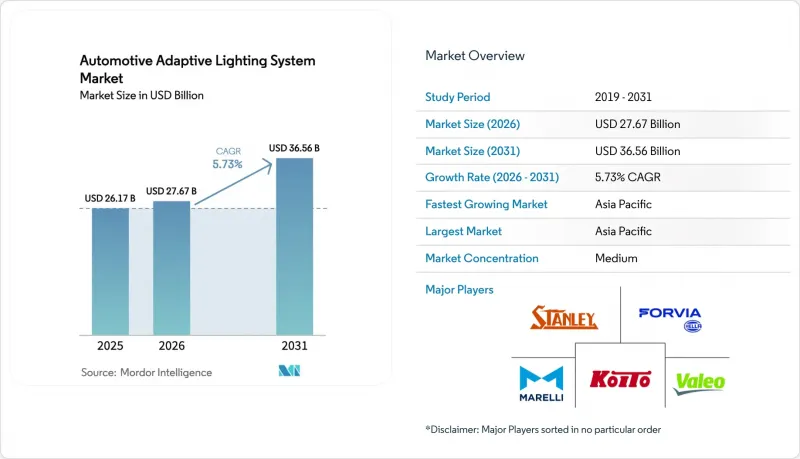
자동차용 어댑티브 라이팅 시스템 시장 규모는 2025년 261억 7,000만 달러에서 2026년에는 276억 7,000만 달러로 확대되어 2031년까지 365억 6,000만 달러에 이를 것으로 예상되고 있으며 2026-2031년까지 CAGR 5.73%로 성장할 전망입니다.
유럽과 북미의 규제 변경 시기가 거의 일치함에 따라, 과거 첨단 빔의 도입을 지연시켰던 분할 개발 비용이 해소되어 세계 플랫폼의 출시가 가속화되고 있습니다. 자동차 제조업체들은 고해상도 헤드램프에 무선 업데이트 기능을 결합하여 차량 구매 후 상당 기간이 지난 후에도 기능 업그레이드를 판매할 수 있도록 함으로써 새로운 지속적인 수익원을 확보할 수 있게 되었습니다. 각 협력사들은 환리스크와 운송 지연을 줄이기 위해 멕시코, 폴란드, 튀르키예, 태국에서 LED, 레이저, 마이크로 LED 모듈의 생산 현지화를 서둘러 진행하고 있습니다. 소프트웨어 정의형 조명은 고급차 브랜드용에서 일반 자동차의 안전장비로 전환되고 있으며, 내장된 센서와 AI 알고리즘이 교통 상황, 지형, 날씨에 따라 실시간으로 빔 형태를 지속적으로 조정하고 있습니다.
세계 자동차용 어댑티브 라이팅 시스템 시장 동향 및 인사이트
세계 조명 규제 강화(ADB, ECE R123)
미국은 2022년에 어댑티브 드라이빙 빔을 합법화하고 유럽의 ECE R123을 준수함으로써 수십년동안 지속되어 온 이 기능의 규제를 종식시켰습니다. 이러한 규제 정합성을 통해 자동차 제조업체는 하나의 하드웨어 스택으로 여러 지역에 대한 인증을 획득하고, 소프트웨어로 빔 패턴을 미세 조정하여 각 지역의 광도 규정을 충족할 수 있습니다. 중국 GB 4599-2024 및 관련 규정이 2025년에 시행되면서 도로 투영 기호가 명시적으로 승인되어 차선 유도 및 보행자 경보를 위한 길을 열었습니다. 인도는 유럽의 광학 설계를 반영한 국산 어댑티브 프론트 라이팅 설계를 인증하고, 2027년까지 트럭에 동 기능 탑재를 의무화하겠다는 의사를 밝혔습니다. 이러한 움직임은 공급업체의 잠재적 시장 규모를 확대하고 규모의 경제를 촉진하며 픽셀화 LED 및 레이저 온칩 어레이에 대한 투자를 가속화할 것입니다.
첨단 안전 시스템 및 ADAS에 대한 수요 증가
자동차 조명은 이제 단순한 조명이 아닌 외부용 센서로서의 역할을 하고 있습니다. 메르세데스-벤츠는 액티브 브레이크 어시스트에 어댑티브 빔을 탑재하여 레이더와 카메라가 위험을 감지하면 램프가 취약한 도로 이용자를 능동적으로 비추도록 했습니다. 보쉬는 대형 트럭의 헤드램프에 3세대(Gen3) 다목적 카메라를 결합하여 야간 사고율을 낮추기 위해 노력하고 있으며, 이는 차량 보험사에게 큰 이점이 될 수 있습니다. OEM들이 조명 시스템을 브레이크, 조향 및 인지 ECU와 긴밀하게 연계함에 따라, 구매자는 사실상 전체 스택을 보유한 Tier 1 공급업체에 종속될 수밖에 없습니다. 이러한 상황과 더불어 무선(OTA)을 통해 제공되는 구독형 조명 업그레이드의 전망으로 인해 어댑티브 라이팅은 향후 제품 계획에서 우선순위가 높은 항목이 되었습니다.
적응형 모듈과 고정식 램프의 초기 비용 차이
적응형 전조등은 여전히 고정형 LED의 2-4배의 비용이 들기 때문에 OEM 업체들은 보통 프리미엄급 또는 유료 소프트웨어 잠금 해제와 함께 판매합니다. 2026년형 BMW 3시리즈의 경우, 어댑티브 앰비언트 라이트 옵션이 차량 가격에 약 1,850유로(약 2,135.15달러)가 추가되기 때문에 가격에 민감한 시장에서의 보급은 제한적일 것으로 보입니다. 딜러에 의한 개조가 거의 이루어지지 않는 이유는 추가 하네스가 전기 시스템 보증을 무효화하기 때문에 신속한 애프터마켓으로 가는 길이 막혀 있기 때문입니다. 일부 공급업체들은 현재 고가의 MEMS 미러와 기본 자동 하이빔 로직을 분리하여 단계별 패키징을 제공하고 있으며, 이를 통해 엔트리 모델도 큰 가격 상승 없이 최소한 새로운 규정을 준수할 수 있게 되었습니다.
부문 분석
2025년 승용차는 자동차 어댑티브 라이팅 시장에서 73.76%로 가장 큰 점유율을 차지했습니다. 이는 매트릭스 LED와 픽셀 LED가 중형 크로스오버 차량에 기본 장착되는 등 매해 꾸준한 모델별 리뉴얼이 기여하고 있습니다. 자동차 제조업체들은 이러한 램프를 인포테인먼트 업그레이드와 함께 판매하기 때문에 구매자는 이 램프를 고가의 단독 옵션이 아닌 편안함과 안전성을 결합한 단일 패키지의 일부로 인식하고 있습니다. 또한, SUV의 높은 스타일링의 자유도는 디자이너에게 방열판과 센서를 위한 더 많은 공간을 제공하고 있으며, 이는 더욱 빠른 보급을 촉진하고 있습니다. 생산량이 증가함에 따라 Tier 1 공급업체는 규모의 경제 효과를 얻고, 모듈당 비용을 절감하고, 전자 플랫폼 공유를 통해 신뢰성을 향상시키고 있습니다.
중대형 상용차 시장은 장거리 운송용 트럭에서 어댑티브 빔과 충돌 완화 브레이크를 결합한 규제에 힘입어 2031년까지 연평균 복합 성장률(CAGR) 9.62%로 가장 높은 성장률을 보일 것으로 예측됩니다. 야간 시인성 향상으로 사고로 인한 가동 중단 시간과 보험료를 절감할 수 있기 때문에 차량 운영 사업자는 추가 비용을 감수하고 있습니다. 램프 제조업체들은 현재 기존 개구부에 슬라이드 방식으로 장착할 수 있는 모듈식 하우징을 제공하고 있으며, 트럭은 주변 패널을 다시 칠하지 않고도 정기적인 유지보수 시 업그레이드할 수 있도록 하고 있습니다. 이를 통해 실현되는 후방 개조 경로를 통해 도입이 가속화되고, 제조업체 보증이 만료된 후에도 공급업체에 제2의 수익 사이클을 가져다 줄 수 있습니다.
2025년에는 외장 시스템이 93.22%의 압도적인 점유율을 차지했습니다. 이는 모든 신차에 눈부심 방지 빔과 주간주행등 장착을 의무화하는 세계 각국의 법규를 반영한 것입니다. 자동차 제조업체들은 소프트웨어로 재조정된 단일 세계 램프 아키텍처로 전환하고 있으며, 지역별로 금형 변경을 최소화하고 있습니다. 이 전략은 개발 주기를 단축하고, 디자인 팀은 브랜드 정체성 확인을 강화하는 특징적인 디자인에 집중할 수 있습니다. 그 결과, 공급업체들은 기본적인 규정 준수보다는 열 관리 및 광학 효율 측면에서 경쟁하게 됩니다.
자동차용 어댑티브 라이팅은 CAGR 8.27%로 가장 빠르게 성장하고 있으며, 그 주요 원인은 전기차와 자율주행차가 엔진 소리를 대신해 색상과 밝기의 변화를 탑승자에게 피드백으로 활용하고 있기 때문입니다. 차내 중심의 시스템은 음성비서 및 생체 인식 센서와 연동하여 운전자의 기분과 주행 상황에 맞게 조명 장면을 조정합니다. 소프트웨어 업데이트를 통해 스마트폰 배경화면과 같은 새로운 테마를 추가할 수 있기 때문에 OEM은 지속적인 수익원을 창출할 수 있습니다. 차량 내 스크린이 늘어나는 가운데, 앰비언트 LED는 전체적인 밝기를 조절하여 눈의 피로를 줄여줍니다.
지역별 분석
아시아태평양은 2025년 자동차 어댑티브 라이팅 시장 매출의 45.55%를 차지하며 2031년까지 연평균 복합 성장률(CAGR) 8.91%를 나타낼 것으로 예측됩니다. 이는 도로 투사 기능을 허용하는 중국의 빠르게 진화하는 규제에 힘입은 것입니다. 국내 브랜드는 독일 고급 수입차와 정면으로 경쟁하는 전기자동차 모델에서 적응형 빔을 상태 상징으로 채택하고 있습니다. 코이토공업, 스탠리 등 일본 공급업체들은 세계 차량 플랫폼에 밀착하면서 환율 변동에 대한 헤지를 위해 아세안 및 라틴아메리카 전역에 공장을 확장하고 있습니다. 인도는 다음 전환점이 될 시장으로 떠오르고 있습니다. 유럽의 광학 표준을 반영한 독자적인 조명 규격이 마련됨에 따라 2027년 이후 트럭을 대상으로 한 의무화의 길이 열리게 되었습니다.
유럽은 기술 리더십을 유지하고 있으며, 2031년까지 연평균 복합 성장률(CAGR) 4.49%로 꾸준한 성장세를 이어갈 것으로 예측됩니다. ECE R123은 눈부심 방지 성능에 대한 높은 기준을 설정하고 있으며, 모든 새로운 플랫폼은 매트릭스 LED 및 레이저 조명을 위한 매트릭스 LED를 채택하고 있습니다. 독일 고급차 업체들은 4만 유로(약 4만 6,178.20달러) 이하의 모델에도 점차 고해상도 램프를 채택하고 있으며, 양산 브랜드는 비슷한 기술을 채택하거나 시장 점유율 하락을 초래할 위험을 감수해야할 것입니다. 공급업체들이 임금이 싼 폴란드, 헝가리, 모로코로 조립기지를 옮기면서 생산비용이 절감되고 있지만, 물류 측면에서는 여전히 EU 공장에 대한 납기 준수가 우선시되고 있습니다.
북미에서는 NHTSA가 어댑티브 빔을 승인하면서 그동안 쌓여있던 수요가 드디어 풀리고 있습니다. 2031년 CAGR 4.78%라는 수치는 낮게 보일 수 있지만, 수십 년간의 금지 조치 이후이기 때문에 그 기반은 작습니다. 테슬라가 주도하는 기존 차량에 무선(OTA)을 통한 기능 추가는 잠재적인 도입 기반이 이미 대기하고 있음을 증명하고 있습니다. 공급업체들은 미국-멕시코-캐나다 협정(USMCA)의 원산지 규정에 따른 특혜를 활용하여 운송 리드타임을 단축하기 위해 멕시코에서 마이크로 LED 생산라인의 현지화를 추진하고 있습니다. 남미와 중동도 이를 따르고 있습니다. 판매 증가는 구매자가 기능에 대한 프리미엄 가격을 수용하는 SUV 중심의 라인업에서 비롯된 것이지만, 엄격한 조명 규제가 없기 때문에 풀 매트릭스 방식의 전면적인 도입에는 여전히 제약이 있습니다.
기타 혜택
- 엑셀 형태 시장 예측(ME) 시트
- 3개월간 애널리스트 지원
자주 묻는 질문
목차
제1장 서론
제2장 조사 방법
제3장 주요 요약
제4장 시장 구도
제5장 시장 규모와 성장 예측(금액(달러)과 수량(받침대))
제6장 경쟁 구도
제7장 시장 기회와 향후 전망
JHS 26.06.02The automotive adaptive lighting market size is expected to increase from USD 26.17 billion in 2025 to USD 27.67 billion in 2026 and reach USD 36.56 billion by 2031, growing at a CAGR of 5.73% over 2026-2031.
Near-synchronous regulatory changes in Europe and North America are erasing the split-engineering costs that once slowed the rollout of advanced beams, enabling global platforms to scale faster. Automakers are pairing high-resolution headlamps with over-the-air functionality so that feature upgrades can be sold long after the initial vehicle purchase, supporting new recurring-revenue streams. Suppliers are racing to localize production of LED, laser, and micro-LED modules in Mexico, Poland, Turkiye, and Thailand to blunt currency risk and shipping delays. Software-defined lighting is moving from luxury branding to mainstream safety, with embedded sensors and AI algorithms constantly adjusting beam shape in real time based on traffic, terrain, and weather.
Global Automotive Adaptive Lighting System Market Trends and Insights
Stringent Global Lighting Regulations (ADB, ECE R123)
The United States legalized adaptive driving beams in 2022, aligning with Europe's ECE R123 and ending decades of suppression of the feature. This convergence lets automakers certify one hardware stack for multiple regions while fine-tuning beam patterns in software to satisfy each local photometric clause. China's GB 4599-2024 and companion rules came into force in 2025 with explicit approval for road-projection symbols, opening the door for lane guidance and pedestrian alerts. India validated a home-grown adaptive front lighting design that mirrors European optics, signaling an intent to mandate the feature on trucks by 2027. Together, these moves increase the addressable volume for suppliers, spur economies of scale, and accelerate investments in pixelated LEDs and laser-on-chip arrays.
Growing Demand for Advanced Safety Systems and ADAS
Automotive lighting now serves as an outward-facing sensor, not just illumination. Mercedes-Benz embedded adaptive beams into Active Brake Assist so the lamps actively highlight vulnerable road users when radar or camera flags a threat. Bosch pairs its Gen3 multi-purpose camera with headlamps on heavy trucks to shrink nighttime crash rates, a big win for fleet insurers. As OEMs deeply couple lighting with braking, steering, and perception ECUs, buyers are effectively locked into the tier-1 supplier that owns the entire stack. That establishment, and the prospect of subscription-based light upgrades delivered over-the-air, make adaptive lighting a priority line item on future product plans.
High Upfront Cost of Adaptive Modules vs. Fixed Lamps
Adaptive headlamps still cost 2-4 times as much as fixed LEDs, so OEMs usually bundle them with premium trim lines or paid software unlocks. On the 2026 BMW 3 Series, an adaptive ambient option adds nearly EUR 1,850 (~USD 2,135.15) to the sticker, limiting uptake in cost-sensitive markets. Dealership retrofits are scarce because extra harnesses void electrical warranties, cutting off a quick aftermarket path. Some suppliers now offer tiered packages that separate the expensive MEMS mirrors from basic auto-high-beam logic so that entry cars can at least comply with emerging regulations without big price jumps.
Other drivers and restraints analyzed in the detailed report include:
- Rising Premium and SUV Sales Lifting Feature-Take Rates
- Rapid LED Cost Reduction and Performance Gains
- Thermal Management Limits in High-Lumen LED/Laser Units
For complete list of drivers and restraints, kindly check the Table Of Contents.
Segment Analysis
Passenger vehicles retained the largest 73.76% share of the automotive adaptive lighting market in 2025, helped by steady model-year refreshes that make matrix and pixel LEDs standard on mid-trim crossovers. Carmakers bundle the lamps with infotainment upgrades so buyers view them as part of a single comfort-and-safety package rather than a costly stand-alone option. Styling freedom in SUVs also gives designers more space for heatsinks and sensors, which further encourages rapid rollout. As volume rises, tier-1 suppliers gain scale economies that lower per-module costs and improve reliability through shared electronics platforms.
Medium and heavy commercial vehicles are expected to post the fastest 9.62% CAGR through 2031, driven by regulations that pair adaptive beams with collision-mitigation braking on long-haul rigs. Fleet operators accept the added expense because better nighttime visibility cuts accident downtime and insurance premiums. Lamp makers now offer modular housings that slide into existing apertures, letting trucks upgrade during scheduled maintenance without repainting surrounding panels. The resulting retrofit path accelerates adoption and provides suppliers with a second revenue cycle once factory warranties expire.
Exterior systems held a commanding 93.22% share in 2025, reflecting global laws that require glare-free beams and daytime running lamps on every new vehicle. Automakers migrate to single global lamp architectures that can be recalibrated in software, limiting tooling changes across regions. That strategy shortens development cycles and lets design teams focus on signature graphics that reinforce brand identity. Suppliers, in turn, compete on thermal management and optical efficiency rather than on basic compliance.
Interior adaptive lighting is rising fastest at an 8.27% CAGR, largely because electric and autonomous models use color and intensity shifts to substitute for engine sound as feedback to occupants. Cabin-centric systems integrate with voice assistants and biometric sensors so light scenes match the driver's mood or route conditions. Software updates can add new themes just like smartphone wallpapers, giving OEMs an ongoing revenue stream. As screens proliferate inside vehicles, ambient LEDs also cut eye strain by balancing overall luminance.
The Automotive Adaptive Lighting Market Report is Segmented by Vehicle Type (Passenger Vehicles, Light Commercial Vehicles, and More), Application (Exterior Lighting and Interior Lighting), Component Type (Controllers and More), Technology (LED and More), Sales Channel (OEM and Aftermarket), Functionality (Automatic High Beam and More), and Geography. The Market Forecasts are Provided in Terms of Value (USD) and Volume (Units).
Geography Analysis
Asia-Pacific captured 45.55% of the automotive adaptive lighting market revenue in 2025 and is growing at an 8.91% CAGR through 2031, driven by China's rapidly evolving rules that allow road-projection features. Domestic brands deploy adaptive beams as a status symbol in electric models competing head-to-head with German luxury imports. Japanese suppliers such as Koito and Stanley are expanding factories across ASEAN and Latin America to hedge against currency shifts while staying close to global vehicle platforms. India is shaping up as the next inflection market; an indigenous lighting standard mirroring Europe's optics clears the path for a mandate covering trucks from 2027 onward.
Europe maintains technology leadership and will advance at a measured 4.49% CAGR to 2031. ECE R123 sets a high bar for glare-free performance, nudging all new platforms toward matrix LEDs or lasers. German premium OEMs continue to trickle down high-resolution lamps into sub-EUR 40,000 (~USD 46,178.20) models, forcing volume brands to adopt similar tech or risk market share erosion. Production costs are being squeezed as suppliers shift assembly to Poland, Hungary, and Morocco, where wages are lower, but logistics still favor on-time delivery to EU plants.
North America is finally unlocking pent-up demand now that the NHTSA green-lit adaptive beams. Growth of 4.78% CAGR through 2031 may seem modest, yet the base is small after decades of prohibition. Over-the-air activations on existing vehicles, led by Tesla, prove that a latent install base already waits in the driveway. Suppliers are localizing micro-LED lines in Mexico to capitalize on the United States-Mexico-Canada Agreement's rules-of-origin credits, all while trimming shipping lead times. South America and the Middle East follow in tandem; revenue lifts come from SUV-heavy lineups where buyers accept feature premiums, but the lack of stringent lighting rules still limits full matrix rollouts.
- Hella GmbH & Co. KGaA
- Valeo SA
- Koito Manufacturing Co., Ltd.
- Stanley Electric Co., Ltd.
- OSRAM Continental GmbH
- Marelli Automotive Lighting
- Lumileds Holding B.V.
- Hyundai Mobis Co., Ltd.
- Panasonic Automotive Systems
- ZKW Group
- J.W. Speaker Corporation
- Denso Corporation
- Varroc Lighting Systems
- Signify N.V. (Philips Automotive)
- Renesas Electronics Corporation
- Texas Instruments Incorporated
- Aptiv PLC
- Bosch Mobility
- Continental AG
- Lear Corporation
- Infineon Technologies AG
Additional Benefits:
- The market estimate (ME) sheet in Excel format
- 3 months of analyst support
TABLE OF CONTENTS
1 Introduction
- 1.1 Study Assumptions and Market Definition
- 1.2 Scope of the Study
2 Research Methodology
3 Executive Summary
4 Market Landscape
- 4.1 Market Overview
- 4.2 Market Drivers
- 4.2.1 Stringent Global Lighting Regulations (ADB, ECE R123)
- 4.2.2 Growing Demand for Advanced Safety Systems and ADAS
- 4.2.3 Rising Premium and SUV Sales Lifting Feature-Take Rates
- 4.2.4 Rapid LED Cost Reduction and Performance Gains
- 4.2.5 OTA-Enabled Beam-Pattern Upgrades Post-Sale
- 4.2.6 V2X-Triggered Pedestrian-Communication Lighting
- 4.3 Market Restraints
- 4.3.1 High Upfront Cost of Adaptive Modules Vs. Fixed Lamps
- 4.3.2 Thermal Management Limits in High-Lumen LED/Laser Units
- 4.3.3 ECU Cybersecurity Risks Via CAN-FD Gateways (Under-Radar)
- 4.3.4 GaN Substrate Supply Bottlenecks for Laser Diodes (Under-Radar)
- 4.4 Value / Supply-Chain Analysis
- 4.5 Regulatory Landscape
- 4.6 Technological Outlook
- 4.7 Porter's Five Forces
- 4.7.1 Bargaining Power of Suppliers
- 4.7.2 Bargaining Power of Buyers
- 4.7.3 Threat of New Entrants
- 4.7.4 Threat of Substitutes
- 4.7.5 Intensity of Competitive Rivalry
5 Market Size and Growth Forecasts (Value (USD) and Volume (Units))
- 5.1 By Vehicle Type
- 5.1.1 Passenger Vehicles
- 5.1.2 Light Commercial Vehicles (LCV)
- 5.1.3 Medium and Heavy Commercial Vehicles (MHCV)
- 5.2 By Application
- 5.2.1 Exterior Lighting
- 5.2.2 Interior Lighting
- 5.3 By Component Type
- 5.3.1 Controllers
- 5.3.2 Sensors / Cameras
- 5.3.3 Lamp Assemblies
- 5.3.4 Actuators
- 5.3.5 Others
- 5.4 By Technology
- 5.4.1 LED
- 5.4.2 Xenon / HID
- 5.4.3 Halogen
- 5.4.4 Laser Lighting
- 5.5 By Sales Channel
- 5.5.1 OEM
- 5.5.2 Aftermarket
- 5.6 By Functionality
- 5.6.1 Automatic High Beam
- 5.6.2 Dynamic Bending Light
- 5.6.3 Cornering Lights
- 5.6.4 Adaptive Front Lighting
- 5.7 By Geography
- 5.7.1 North America
- 5.7.1.1 United States
- 5.7.1.2 Canada
- 5.7.1.3 Rest of North America
- 5.7.2 South America
- 5.7.2.1 Brazil
- 5.7.2.2 Argentina
- 5.7.2.3 Rest of South America
- 5.7.3 Europe
- 5.7.3.1 Germany
- 5.7.3.2 United Kingdom
- 5.7.3.3 France
- 5.7.3.4 Italy
- 5.7.3.5 Spain
- 5.7.3.6 Rest of Europe
- 5.7.4 Asia-Pacific
- 5.7.4.1 China
- 5.7.4.2 India
- 5.7.4.3 Japan
- 5.7.4.4 South Korea
- 5.7.4.5 Rest of Asia-Pacific
- 5.7.5 Middle East and Africa
- 5.7.5.1 United Arab Emirates
- 5.7.5.2 Saudi Arabia
- 5.7.5.3 South Africa
- 5.7.5.4 Turkey
- 5.7.5.5 Rest of Middle East and Africa
- 5.7.1 North America
6 Competitive Landscape
- 6.1 Market Concentration
- 6.2 Strategic Moves
- 6.3 Market Share Analysis
- 6.4 Company Profiles {(Includes Global level Overview, Market level overview, Core Segments, Financials as available, Strategic Information, Market Rank/Share for key companies, Products and Services, and Recent Developments)}
- 6.4.1 Hella GmbH & Co. KGaA
- 6.4.2 Valeo SA
- 6.4.3 Koito Manufacturing Co., Ltd.
- 6.4.4 Stanley Electric Co., Ltd.
- 6.4.5 OSRAM Continental GmbH
- 6.4.6 Marelli Automotive Lighting
- 6.4.7 Lumileds Holding B.V.
- 6.4.8 Hyundai Mobis Co., Ltd.
- 6.4.9 Panasonic Automotive Systems
- 6.4.10 ZKW Group
- 6.4.11 J.W. Speaker Corporation
- 6.4.12 Denso Corporation
- 6.4.13 Varroc Lighting Systems
- 6.4.14 Signify N.V. (Philips Automotive)
- 6.4.15 Renesas Electronics Corporation
- 6.4.16 Texas Instruments Incorporated
- 6.4.17 Aptiv PLC
- 6.4.18 Bosch Mobility
- 6.4.19 Continental AG
- 6.4.20 Lear Corporation
- 6.4.21 Infineon Technologies AG
7 Market Opportunities and Future Outlook
- 7.1 White-space and Unmet-Need Assessment


