|
시장보고서
상품코드
2043849
사이버 보안 보험 : 시장 점유율 분석, 업계 동향 및 통계, 성장 예측(2026-2031년)Cybersecurity Insurance - Market Share Analysis, Industry Trends & Statistics, Growth Forecasts (2026 - 2031) |
||||||
 Mordor Intelligence
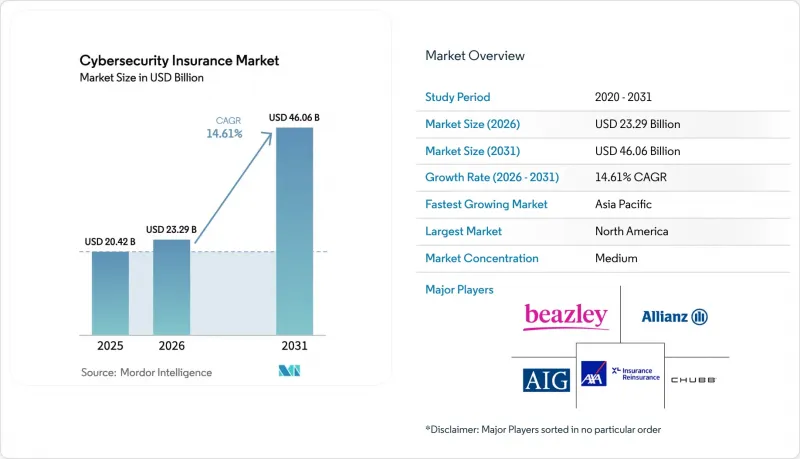
사이버 보안 보험 시장 규모는 2025년에 204억 2,000만 달러로 평가되었습니다. 2026년 232억 9,000만 달러에서 2031년까지 460억 6,000만 달러에 이를 것으로 예측되며, 2026년부터 2031년에 걸쳐 CAGR 14.61%를 나타낼 전망입니다.
보험료율 인하, 규제 범위 확대, 이사회 차원의 정량화된 사이버 리스크 이전 수요 증가가 수요 증가의 원동력이 되고 있습니다. 보험사들은 시스템적 익스포저가 집중된 부문에 대한 자본을 확보하기 위해 보험사의 인수 능력은 확대되고 있지만, 인수 기준은 여전히 엄격하게 유지되고 있습니다. 손해배상 전용 상품에서 통합형 InsurSec(InsurSec) 모델로의 전환으로, 내장된 관리 조치가 보험금 청구의 심각성을 감소시킴으로써 손해율이 감소하고 있습니다. 또한, 보험금 청구 주기를 단축하고, 서비스가 취약한 중소기업을 유치하는 파라메트릭 보험의 혁신도 성장 전망에 기여하고 있습니다. 특히 아시아태평양에서는 새로운 데이터 보호법에 따라 최소 보상 한도가 상향 조정됨에 따라 이러한 경향이 두드러지게 나타나고 있습니다.
세계의 사이버 보안 보험 시장 동향 및 인사이트
클라우드 퍼스트의 디지털화로 사이버 손실 위험 확대
멀티 테넌트형 클라우드 플랫폼으로의 빠른 전환으로 스토리지 설정 오류, 서비스 계정 침해, 테넌트 간 횡적 이동 등을 통한 침해 경로가 확대되고 있습니다. 2024년 2월 체인지 헬스케어(Change Healthcare)를 공격한 랜섬웨어 공격은 23억 달러의 직접적 피해와 비즈니스 중단 비용을 발생시켜, 단 한 번의 서비스 장애가 미국의 중요한 의료 워크플로우에 어떤 파급효과를 가져오는지 보여주었습니다. 보험사는 현재 보험 계약을 체결하기 전에 다단계 인증, 특권 액세스 제어 및 불변의 백업을 요구하고 있으며, 많은 보험사가 클라우드 서비스 제공업체의 서비스 중단에 대해 하위 제한을 적용하고 있습니다. 따라서 클라우드 서비스 중단은 몇 시간 내에 지리적으로 분산된 업무를 마비시킬 수 있기 때문에 1차 사업 중단 보상 확대에 대한 요구가 높아지고 있습니다. 이러한 기술적 전제조건으로 인해 시장 전체의 보험 인수 능력이 확대되고 있음에도 불구하고 인수 기준은 더욱 엄격해지고 있으며, 이를 통해 수익성을 유지하면서 클라우드를 많이 사용하는 기업의 보험 계약 획득을 유지하고 있습니다.
규제 요건 강화(GDPR(EU 개인정보보호규정), NY DFS, DORA, SEC 규정)
사이버 복원력 관련 법규가 통일되면서 사이버 보안 보험은 임의적 지출에서 컴플라이언스 준수 수단으로 변모하고 있습니다. 2025년 1월부터 시행되는 '디지털 운영 탄력성 법(Digital Operational Resilience Act)은 EU 역내 2만개 이상의 금융기관을 대상으로 연 1회 사이버 탄력성 테스트 실시와 엄격한 기한 내 사고 공개를 의무화하고 있습니다. 의무화하고 있습니다. 뉴욕주의 2023년 DFS 개정법은 주요 금융회사에 사이버 보안 프로그램 인증을 의무화하고, 위반 시 1일당 최대 1,000달러의 벌금을 부과했습니다. 이와 함께 미국 증권거래위원회(SEC)의 공시 규정은 상장기업에 대해 중요한 사건이 발생하면 4영업일 이내에 공표하고 이사회의 감독 체계를 설명할 것을 요구하고 있으며, 사이버 리스크 보고를 신탁자 책임에 포함시키고 있습니다. 이러한 법령이 맞물려 특히 제3자에 대한 벌금 및 법적 방어비용에 대한 기본 보상한도가 인상되어 총 보험료가 상승하고 있습니다.
계리 데이터 부족과 모델링의 불확실성
공격 벡터는 손해 데이터 축적 속도보다 빠르게 변화하기 때문에 기존 보험계리 방법론의 유효성이 훼손되고 있습니다. 2021년 Kaseya 랜섬웨어 공격은 매니지드 서비스 제공업체를 통해 확산되어 1,500개 이상의 다운스트림 고객에게 피해를 입혔습니다. 이는 제로데이 공격이 어떻게 하룻밤 사이에 상관관계 가정을 왜곡시킬 수 있는지를 보여줍니다. 보험사들은 이에 대응하기 위해 건당 보상 한도를 설정하고, 30일 이상 경과한 미해결 취약점 관련 사고는 제외하며, 방어되지 않은 원격 데스크톱 포트에 대해 고액의 추가 보험료를 부과하고 있습니다. 유럽과 북미 외 지역의 데이터 침해 보고법이 단편화되어 있어 정확한 발생 빈도 통계를 얻지 못하고, 모델링 오류에 대한 가격 책정에 대한 버퍼가 부풀려져 있으며, 투명한 통지 제도가 없는 관할권에서의 사업 확장을 지연시키고 있습니다.
부문 분석
일리노이주의 '생체정보 프라이버시법'과 같은 엄격한 법령에 따라 프라이버시 관련 벌금 및 집단 소송이 증가함에 따라 제3자 배상책임보험 수요는 2031년까지 연평균 복합 성장률(CAGR) 15.32%로 제1자 보험 수요를 능가할 것으로 예측됩니다. 2025년 사이버 보안 보험 시장 점유율의 42.66%를 차지한 1차 보호는 사고 대응, 사업 중단, 몸값 지불 자금 조달에 있어 여전히 기반이 되고 있지만, 북미와 유럽에서는 담보 한도가 계속 상승하고 있어 시장이 성숙기에 접어들었습니다. 의료 및 제조 산업에서 운영 기술에 대한 의존도가 높아짐에 따라 직접적인 손실이 발생하는 시나리오가 증가함에 따라 보험사들은 클라우드 장애 및 장비 재조정 비용에 대한 하위 한도를 추가하고 있으며, 보험료가 안정세를 보이고 있지만, 수요는 계속 증가하고 있습니다. 증가하고 있습니다.
EU의 GDPR(EU 개인정보보호규정)에 따라 전 세계 매출액의 최대 4%에 해당하는 제재를 허용하는 규제 당국의 벌금에 따른 소송 리스크는 특히 회원국 간 데이터를 처리하는 국제 플랫폼에서 방어 및 합의 비용 특약의 도입을 촉진하고 있습니다. 두 가지 손해 유형을 통일된 한도 내에서 통합하는 하이브리드 상품은 몸값 지불이 집단 소송 책임으로 발전할 경우 다국적 기업이 책임 배분 분쟁을 피할 수 있도록 도와줍니다. 이러한 하이브리드화는 발생 빈도가 높은 1차 손해와 손해액이 큰 배상책임 클레임 사이에서 보험료 수입의 균형을 유지함으로써 결합비율을 안정화시키고, 재보험사에게 매력적인 사이버 보안 보험 시장을 유지하고 있습니다.
2025년에는 단독계약이 전 세계 보험료의 53.17%를 차지했으며, 리스크 관리자들이 보다 명확한 조항을 확보하기 위해 사이버 위험을 손해보험의 보상범위에서 분리하려는 움직임에 따라 15.72%의 속도로 확대될 것으로 보입니다. 취리히가 몬델리즈의 1억 달러의 재산상 손해배상 청구를 거부한 후 발생한 NotPetya 분쟁은 '모든 위험' 형식의 모호함을 부각시키며, 전쟁 제외 조항을 무효화하는 맞춤형 조항에 대한 요구를 불러일으켰습니다. 현재 전용 보험 계약에는 다단계 인증 의무화, 30일간의 패치 적용 기간과 같은 세부적인 보증이 포함되어 있지만, 일반 배상책임 특약에는 거의 적용되지 않습니다.
가격에 대한 민감도가 보장 범위의 넓이보다 더 큰 영세 기업에서 패키지 특약의 중요성은 여전히 남아 있지만, 많은 보험사들이 이러한 특약에서 랜섬웨어, 소셜 엔지니어링 및 비즈니스 중단에 대한 보상을 삭제하고 있습니다. Coalition의 액티브 보험 모델과 같은 지속적 스캔형 서비스는 피보험자에게 외부 공격 대상 영역을 실시간으로 가시화하고, 고위험 취약점 발견 시 인수 담당자가 계약 기간 중 조건을 수정할 수 있도록 함으로써 단독형 보험에 대한 선호도를 높이고 있습니다. 이러한 추세는 사이버 보안 보험 시장에서 단독형 상품의 지속적인 성장을 뒷받침하고 있습니다.
지역별 분석
2025년 북미는 전 세계 보험료의 39.66%를 차지했습니다. 이는 광범위한 정보공개법과 제3자와의 합의금액을 부풀리는 소송사회가 배경에 있습니다. 상장기업에 대해 사고 발생 후 4영업일 이내에 보고를 의무화하는 SEC의 규정은 클레임 처리 타임라인을 표준화하고 모델의 정확성을 향상시키고 있습니다. 캐나다의 2024년 정보 유출 통지 관련 개정으로 국경 간 요건이 통일되어 지역별 프로그램 구축이 용이해졌습니다. 그러나 포춘지 선정 500대 기업 구매자층의 포화상태가 판매량 증가를 억제하고 있어 보험사들은 중견기업과 지방정부에 집중하고 있습니다.
아시아태평양은 2031년까지 16.12%의 가장 높은 성장률을 나타낼 것으로 예측됩니다. 이는 다국적 기업에 현지 인가 보험계약 체결을 의무화하는 중국의 '개인정보보호법'과 인도 CERT-In의 6시간 이내 사고 보고 지침에 힘입은 것입니다. 싱가포르와 홍콩의 규제 당국은 현재 은행의 운영 위험 자본 계획의 일환으로 사이버 보험을 권장하고 있습니다. 한편, 호주의 개정된 '중요 인프라 보안법'은 12시간 이내 서비스 중단 보고를 의무화하고 위반 시 무거운 벌칙을 부과함으로써 통신 및 에너지 분야에서의 도입을 촉진하고 있습니다. 과거 보험금 청구 데이터가 적다는 점이 여전히 보험 인수 능력을 제한하고 있지만, 보험사는 지역 재보험사와 제휴하여 누적된 위험을 분담하고 있습니다.
유럽의 동향은 DORA(Digital Operational Risk Act)에 의해 형성되고 있으며, 이 법은 금융기관에 대해 3년마다 복원력 테스트를 의무화하고, 사이버 모니터링에 대한 이사회의 책임성을 규정하고 있습니다. 독일 연방금융감독청(BaFin)은 현재 자본준비금을 측정된 익스포저와 연동하여 은행이 제3자에게 위험을 이전하도록 유도하고 있습니다. 2023년에 도입된 Lloyds의 전쟁 제외 조항 LMA5565는 국가가 지원하는 활동을 제외하는 조항으로, 유럽 바이어들은 커브백을 협상하고 정치적 위험에 대한 보완적 보상을 확보해야 합니다. 남미, 중동 및 아프리카에서는 아직 시장이 개발 단계에 있습니다. 아랍에미리트와 사우디아라비아는 국가 차원의 사이버 보안에 대한 의무 규정이 있지만, 현지의 인수 역량이 여전히 부족하여 시장 발전을 촉진하기 위해 파라메트릭, 프론트엔드 또는 재보험을 통한 솔루션 도입의 여지가 있습니다.
기타 혜택 :
- 엑셀 형식 시장 예측(ME) 시트
- 3개월간 애널리스트 지원
자주 묻는 질문
목차
제1장 서론
제2장 조사 방법
제3장 주요 요약
제4장 시장 구도
제5장 시장 규모와 성장 예측
제6장 경쟁 구도
제7장 시장 기회와 향후 전망
KTH 26.05.29The cybersecurity insurance market size is projected to be USD 20.42 billion in 2025, USD 23.29 billion in 2026, and reach USD 46.06 billion by 2031, growing at a CAGR of 14.61% from 2026 to 2031.
Premium rate moderation, wider regulatory coverage requirements, and growing board-level demand for quantified cyber-risk transfer are reinforcing demand momentum. Capacity is expanding, yet underwriting discipline remains tight as carriers reserve capital for sectors with concentrated systemic exposure. The shift from indemnity-only offerings toward integrated InsurSec models is compressing loss ratios because embedded controls lower claim severity. Growth prospects also benefit from parametric innovation that shortens claims cycles and attracts under-served small and medium enterprises, particularly in Asia-Pacific where new data-protection statutes are raising minimum coverage limits.
Global Cybersecurity Insurance Market Trends and Insights
Cloud-First Digitalization Upsizes Cyber-Loss Exposure
Rapid migration to multi-tenant cloud platforms has widened breach pathways through misconfigured storage, compromised service accounts, and lateral movement between tenants. The February 2024 ransomware strike on Change Healthcare, which generated USD 2.3 billion in direct and business-interruption costs, showed how a single service disruption can ripple through critical U.S. healthcare workflows. Insurers now demand multi-factor authentication, privileged-access controls, and immutable backups before binding coverage, and many apply sub-limits to cloud-service-provider outages. Demand for first-party business-interruption extensions is therefore rising because a cloud outage can paralyze geographically dispersed operations within hours. These technical prerequisites are tightening selection standards even as headline capacity grows, thereby preserving profitability while sustaining policy uptake among cloud-heavy enterprises.
Escalating Regulatory Mandates (GDPR, NY DFS, DORA, SEC Rules)
Harmonized resilience laws are transforming cybersecurity insurance from discretionary spending into a compliance instrument. The Digital Operational Resilience Act, effective January 2025, obliges more than 20,000 EU financial entities to test cyber-resilience annually and disclose incidents within strict timelines. New York's 2023 DFS amendment compels large financial firms to certify cybersecurity programs and imposes penalties of up to USD 1,000 per day for non-compliance. Parallel disclosure rules from the U.S. SEC require listed companies to announce material incidents within four business days and describe board oversight, embedding cyber-risk reporting in fiduciary duty. Together these statutes elevate baseline coverage limits, particularly for third-party fines and legal defense, thereby lifting overall premium volume.
Actuarial Data Scarcity and Modeling Uncertainty
Attack vectors mutate faster than loss data accumulates, undermining classical actuarial techniques. The 2021 Kaseya ransomware campaign spread through managed-service providers and harmed more than 1,500 downstream clients, showing how a zero-day exploit can distort correlation assumptions overnight. Carriers react by capping per-event aggregates, excluding incidents tied to unpatched vulnerabilities older than 30 days, and charging steep additional premiums for undefended remote-desktop ports. Fragmented breach-reporting laws outside Europe and North America suppress accurate frequency statistics, inflating pricing buffers against modeling error and delaying expansion in jurisdictions lacking transparent notification regimes.
Other drivers and restraints analyzed in the detailed report include:
- Board-Level Focus on Quantifying Cyber Risk
- SME-Focused Low-Cost Parametric Covers Emerging
- High Premium and Retention Levels Deter SMEs
For complete list of drivers and restraints, kindly check the Table Of Contents.
Segment Analysis
Third-party liability coverage is projected to outstrip first-party demand at a 15.32% CAGR through 2031 as privacy fines and class actions proliferate under stringent statutes such as Illinois's Biometric Information Privacy Act. First-party protection, which commanded 42.66% of cybersecurity insurance market share in 2025, remains foundational for funding incident response, business-interruption, and ransom outlays but is maturing in North America and Europe where attachment points keep rising. Growing reliance on operational technology in healthcare and manufacturing multiplies direct-loss scenarios, so insurers are adding sub-limits for cloud-outage or equipment-recalibration costs, sustaining incremental demand even as pricing moderates.
Litigation risk from regulatory fines under the EU GDPR, which allows sanctions up to 4% of global turnover, is propelling uptake of defense and settlement towers, especially among international platforms that process data across member states. Hybrid products that consolidate both loss types under unified limits help multinationals avoid allocation disputes when a ransom payment morphs into class-action liability. This hybridization stabilizes combined ratios by ensuring balanced premium inflows across frequency-prone first-party and severity-heavy liability claims, keeping the cybersecurity insurance market attractive for reinsurers.
Stand-alone contracts captured 53.17% of global premiums in 2025 and are accelerating at 15.72% as risk managers decouple cyber perils from property and casualty covers to secure clearer wording. The NotPetya disputes that followed Zurich's denial of Mondelez's USD 100 million property claim highlighted ambiguity in "all-risk" forms and spurred demand for bespoke language that overrides war exclusions. Dedicated policies now integrate granular warranties such as mandatory multifactor authentication and 30-day patching windows, which general-liability endorsements rarely enforce.
Packaged extensions retain relevance for micro-enterprises where price sensitivity trumps coverage breadth, yet many carriers have removed ransomware, social engineering, and business-interruption protections from these endorsements. Continuous-scanning offerings like Coalition's active-insurance model reinforce the stand-alone preference by giving insureds real-time visibility into external attack surfaces and allowing underwriters to amend terms mid-policy when high-risk vulnerabilities appear. This dynamic underpins sustainable growth in the cybersecurity insurance market size for stand-alone products.
The Cybersecurity Insurance Market Report is Segmented by Coverage Type (First-Party Coverage, Third-Party Liability, and Bundled/Hybrid), Insurance Type (Stand-Alone Cyber, and Packaged/Endorsement), Organization Size (SMEs, and Large Enterprises), End-User Industry (BFSI, Healthcare, Retail and E-Commerce, IT and Telecom, Manufacturing, and More), and Geography. The Market Forecasts are Provided in Terms of Value (USD).
Geography Analysis
North America generated 39.66% of global premiums in 2025, anchored by pervasive disclosure laws and a litigious environment that magnifies third-party settlement values. SEC rules obliging public issuers to report incidents within four business days standardize claims timelines and improve model accuracy. Canada's 2024 breach-notification amendments have harmonized cross-border requirements, making regional programs easier to structure. Yet saturation among Fortune 500 buyers is tempering volume growth, directing carrier focus toward middle-market firms and municipalities.
Asia-Pacific is expected to log the fastest expansion at 16.12% through 2031, propelled by China's Personal Information Protection Law and India's CERT-In six-hour incident-report directive, both of which compel multinational companies to arrange local-admitted policies. Singapore and Hong Kong regulators now encourage cyber insurance as part of operational-risk capital planning for banks, while Australia's revised Security of Critical Infrastructure Act imposes 12-hour outage reporting and heavy penalties for non-compliance, driving uptake in telecom and energy sectors. Low historical claims data still suppresses capacity, but carriers are partnering with regional reinsurers to share accumulation risk.
Europe's trajectory is shaped by DORA, which forces financial entities to test resilience triennially and hold boards accountable for cyber oversight. Germany's BaFin now links capital reserves to measured exposure, nudging banks toward third-party transfer. Lloyd's war-exclusion clause LMA5565, introduced in 2023, excludes state-sponsored operations and has driven European buyers to negotiate carve-backs or secure supplemental political-risk covers. South America, the Middle East and Africa remain nascent; while the United Arab Emirates and Saudi Arabia have national cyber-security mandates, local underwriting capacity remains thin, opening space for parametric, fronted, or reinsurance-backed solutions to seed market development.
- American International Group (AIG)
- Chubb Limited
- Zurich Insurance Group
- AXA XL
- Allianz Global Corporate and Specialty
- Fairfax Financial Holdings
- Beazley plc
- Munich Re Group
- Berkshire Hathaway Insurance Group
- Travelers Companies
- CNA Financial
- Hiscox Ltd.
- AXIS Capital Holdings
- Tokio Marine Holdings
- Sompo Holdings
- Aon plc
- Marsh McLennan
- Lockton Companies
- Coalition, Inc.
- Cowbell Cyber
- Swiss Reinsurance Company
- Lloyd's of London
- At-Bay
Additional Benefits:
- The market estimate (ME) sheet in Excel format
- 3 months of analyst support
TABLE OF CONTENTS
1 INTRODUCTION
- 1.1 Study Assumptions and Market Definition
- 1.2 Scope of the Study
2 RESEARCH METHODOLOGY
3 EXECUTIVE SUMMARY
4 MARKET LANDSCAPE
- 4.1 Market Overview
- 4.2 Market Drivers
- 4.2.1 Cloud-First Digitalization Upsizes Cyber-Loss Exposure
- 4.2.2 Escalating Regulatory Mandates (GDPR, NY DFS, DORA, SEC Rules)
- 4.2.3 Board-Level Focus on Quantifying Cyber Risk
- 4.2.4 SME-Focused Low-Cost Parametric Covers Emerging
- 4.2.5 InsurSec Models Bundling Security Services and Cover
- 4.2.6 Tokenized Cyber ILS Attracting New Capacity
- 4.3 Market Restraints
- 4.3.1 Actuarial Data Scarcity and Modeling Uncertainty
- 4.3.2 High Premium and Retention Levels Deter SMEs
- 4.3.3 Contractual War and Systemic-Risk Exclusions
- 4.3.4 Reinsurance Capacity Caps for Critical-Infrastructure Risks
- 4.4 Industry Supply-Chain Analysis
- 4.5 Regulatory Landscape and Industry Guidelines
- 4.6 Technological Outlook (AI Underwriting, CAT Models, Blockchain Parametrics)
- 4.7 Porter's Five Forces Analysis
- 4.7.1 Bargaining Power of Suppliers
- 4.7.2 Bargaining Power of Consumers
- 4.7.3 Threat of New Entrants
- 4.7.4 Threat of Substitutes
- 4.7.5 Intensity of Competitive Rivalry
- 4.8 Impact of Macroeconomic Factors on the Market
5 MARKET SIZE AND GROWTH FORECASTS (VALUE)
- 5.1 By Coverage Type
- 5.1.1 First-Party Coverage
- 5.1.2 Third-Party Liability
- 5.1.3 Bundled / Hybrid
- 5.2 By Insurance Type
- 5.2.1 Stand-Alone Cyber
- 5.2.2 Packaged / Endorsement
- 5.3 By Organisation Size
- 5.3.1 Small and Medium Enterprises (SMEs)
- 5.3.2 Large Enterprises
- 5.4 By End-User Industry
- 5.4.1 BFSI
- 5.4.2 Healthcare
- 5.4.3 Retail and E-Commerce
- 5.4.4 IT and Telecom
- 5.4.5 Manufacturing
- 5.4.6 Government and Public Sector
- 5.4.7 Other End-User Industries
- 5.5 By Geography
- 5.5.1 North America
- 5.5.1.1 United States
- 5.5.1.2 Canada
- 5.5.1.3 Mexico
- 5.5.2 South America
- 5.5.2.1 Brazil
- 5.5.2.2 Argentina
- 5.5.2.3 Rest of South America
- 5.5.3 Europe
- 5.5.3.1 United Kingdom
- 5.5.3.2 Germany
- 5.5.3.3 France
- 5.5.3.4 Sweden
- 5.5.3.5 Rest of Europe
- 5.5.4 Asia-Pacific
- 5.5.4.1 China
- 5.5.4.2 Japan
- 5.5.4.3 India
- 5.5.4.4 Australia
- 5.5.4.5 South Korea
- 5.5.4.6 Rest of Asia-Pacific
- 5.5.5 Middle East and Africa
- 5.5.5.1 Middle East
- 5.5.5.1.1 Saudi Arabia
- 5.5.5.1.2 United Arab Emirates
- 5.5.5.1.3 Turkey
- 5.5.5.1.4 Rest of Middle East
- 5.5.5.2 Africa
- 5.5.5.2.1 South Africa
- 5.5.5.2.2 Nigeria
- 5.5.5.2.3 Rest of Africa
- 5.5.5.1 Middle East
- 5.5.1 North America
6 COMPETITIVE LANDSCAPE
- 6.1 Market Concentration
- 6.2 Strategic Moves
- 6.3 Market Share Analysis
- 6.4 Company Profiles (includes Global Level Overview, Market Level Overview, Core Segments, Financials as available, Strategic Information, Market Rank/Share, Products and Services, Recent Developments)
- 6.4.1 American International Group (AIG)
- 6.4.2 Chubb Limited
- 6.4.3 Zurich Insurance Group
- 6.4.4 AXA XL
- 6.4.5 Allianz Global Corporate and Specialty
- 6.4.6 Fairfax Financial Holdings
- 6.4.7 Beazley plc
- 6.4.8 Munich Re Group
- 6.4.9 Berkshire Hathaway Insurance Group
- 6.4.10 Travelers Companies
- 6.4.11 CNA Financial
- 6.4.12 Hiscox Ltd.
- 6.4.13 AXIS Capital Holdings
- 6.4.14 Tokio Marine Holdings
- 6.4.15 Sompo Holdings
- 6.4.16 Aon plc
- 6.4.17 Marsh McLennan
- 6.4.18 Lockton Companies
- 6.4.19 Coalition, Inc.
- 6.4.20 Cowbell Cyber
- 6.4.21 Swiss Reinsurance Company
- 6.4.22 Lloyd's of London
- 6.4.23 At-Bay
7 MARKET OPPORTUNITIES AND FUTURE OUTLOOK
- 7.1 White-Space and Unmet-Need Assessment