|
시장보고서
상품코드
2043854
자동차 주변 조명 : 시장 점유율 분석, 업계 동향 및 통계, 성장 예측(2026-2031년)Automotive Perimeter Lighting - Market Share Analysis, Industry Trends & Statistics, Growth Forecasts (2026 - 2031) |
||||||
 Mordor Intelligence
자동차 주변 조명 시장 규모는 2025년에 358억 2,000만 달러로 평가되었습니다. 2026년 384억 8,000만 달러에서 2031년까지 550억 1,000만 달러에 이를 것으로 예상되며, 예측 기간(2026-2031년) CAGR은 7.41%를 나타낼 전망입니다.
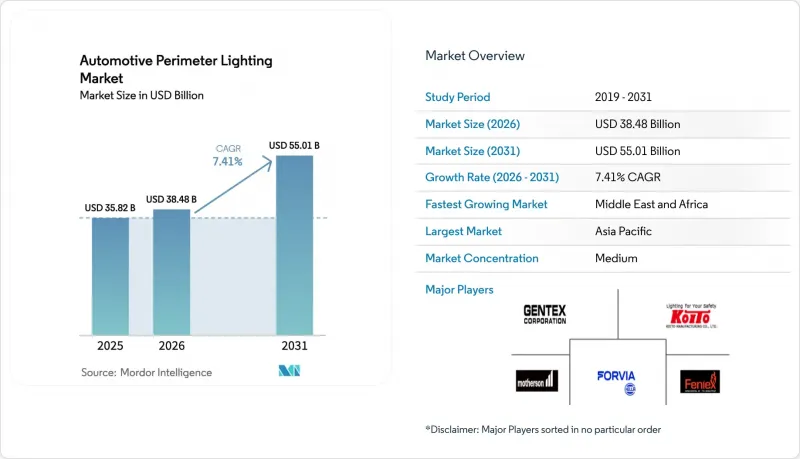
전동화의 진전과 세계 각국의 조명 규제 강화에 따라 조명은 단순한 안전 기능에서 역동적인 커뮤니케이션 도구로 진화하고 있습니다. Tier 1 공급업체는 광통신 기능을 갖춘 적응형 매트릭스 LED 어레이를 사용하여 헤드램프를 강화하고 있습니다. 이러한 발전으로 전조등은 도로에 경고 기호를 투사하거나 첨단운전자보조시스템(ADAS)와 동기화할 수 있게 됩니다. 한편, 배터리 전기자동차 플랫폼은 전력 제한이 엄격하기 때문에 OLED, 광섬유, 마이크로 LED와 같은 저전력 솔루션에 대한 수요가 급증하고 있습니다. 최근 몇 년 동안 아시아태평양은 전 세계 수익 창출에서 지배적인 위치를 유지하고 있습니다. 그러나 미래를 내다보면, 걸프협력회의(GCC)가 새로운 스마트 교통 회랑에 V2X 조명을 통합함에 따라 중동 및 아프리카가 가장 빠르게 성장하는 지역으로 부상할 것으로 예측됩니다.
세계의 자동차 주변 조명 시장 동향 및 인사이트
에너지 절약형 조명을 위한 LED의 급속한 보급
특정 임계치 이하의 접합부 온도에서 동작하는 LED 패키지는 높은 효율로 우수한 출력을 구현합니다. 이러한 효율성으로 인해 할로겐 조명에 비해 전력 소비가 크게 감소하고, 테슬라의 최근 기술 공개에서 강조한 바와 같이 차량 내 공조 제어를 위해 배터리용량을 확보할 수 있게 됩니다. 최근에는 중국 공장이 LED 모듈 가격을 매우 경쟁력 있는 수준으로 낮추면서 중요한 전환점을 맞이하여 오랫동안 할로겐 램프를 지켜온 경제적 우위를 잃게 되었습니다. 유럽 개조 시장은 도로 주행이 가능한 LED 교체용 조명이 규제 당국의 승인을 받음에 따라 탄력을 받고 있으며, 이는 이 지역의 방대한 차량 기반 전체에 큰 비즈니스 기회를 창출하고 있습니다. 이러한 발전에도 불구하고 LED 드라이버 칩은 여전히 장기적인 리드 타임에 직면하고 있으며, 이는 반도체 공급의 지속적인 문제를 반영하고 있습니다.
도로 안전 조명 강화를 위한 규제 요건
유엔 규정 48호 개정으로 2025년부터 유럽의 신형 승용차에는 적응형 주행 빔 장착이 의무화됩니다. 한편, 중국 GB 25991-2024에서는 1,800kg 이상의 차량에 대해 자동 하이빔 제어가 추가되었습니다. 자동차 제조업체들은 정적인 할로겐 램프에서 눈부심 영역을 차단하는 매트릭스 LED 어레이로 전환하고 있으며, 미국 도로교통안전국(NHTSA)도 2024년 마침내 어댑티브 빔 기술을 합법화함에 따라 북미 OEM 업체들의 잠재적 수요를 이끌어 낼 수 있는 계기가 되었습니다. 되었습니다. 도입 일정의 차이로 인해 전 세계 플랫폼은 '표준 장비 지역'과 '옵션 패키지 지역'으로 나뉘어져 단위당 비용이 증가하고 공급망이 세분화되어 있습니다. 또한, 일본의 새로운 눈부심 측정 프로토콜의 도입으로 인해 2025년에는 빔 강도를 재조정해야 하며, 여러 모델의 출시가 1-2분기 지연될 것으로 예측됩니다.
첨단 LED/OLED 및 적응형 시스템 비용 상승
매트릭스 LED 헤드램프는 고정식 유닛보다 훨씬 비싸고, OLED 테일램프도 LED 동급 제품에 비해 가격이 비싸기 때문에 주로 프리미엄 시장 부문에만 적용되고 있습니다. 인도, 브라질 등 시장에서는 저렴한 가격대의 차량에서는 여전히 할로겐 조명이 선호되고 있습니다. 이러한 추세로 인해 공급업체들은 두 개의 생산라인을 병렬로 운영해야 하는 상황에 처해 있습니다. 향후 Valeo는 생산량 확대로 OLED 모듈의 비용을 크게 절감할 수 있을 것으로 예측됩니다. 이러한 발전은 수주가 크게 증가하면 수년 내에 원가 경쟁력을 달성할 수 있음을 시사하고 있습니다.
부문 분석
LED는 2025년 63.17%의 점유율을 차지하며 자동차 주변 조명 시장에서 지배적인 위치를 계속 유지하고 있으며, 2031년까지 연평균 복합 성장률(CAGR) 7.43%를 기록하여 다른 모든 광원을 능가할 것으로 예측됩니다. 자동차 제조업체들은 부피가 큰 디퓨저를 없애고 부품 수를 거의 절반으로 줄이면서 입체감 있는 램프 표면을 구현할 수 있는 LED의 유연성을 높이 평가했습니다. 중국 및 EU의 규제 기한으로 인해 2028년까지 단계적으로 폐지되는 크세논 고휘도 방전(HID) 및 할로겐 기술은 현재 축소되고 있는 틈새 시장을 형성하고 있습니다. 각 공급업체들은 픽셀 밀도를 10배 향상시켜 고해상도 노면 투사 기술의 길을 여는 마이크로 LED 어레이를 개발하고 있습니다.
자동차 주변 조명 시장의 LED 부문 시장 규모는 예측 기간 동안 300억 달러를 상회할 것으로 예측됩니다. 하지만 고급차 모델에서 구역별 조광 기능이 채택됨에 따라 LED 매출은 소규모 기반에서 3배로 확대될 것으로 예측됩니다. 마이크로 LED 및 레이저 인광체 모듈은 2025년 출하량에서 차지하는 비중은 2% 미만이지만, Coito, Valeo, Hera가 열 관리 및 빔 스티어링 광학 관련 특허를 출원하고 있어 R&D 예산의 대부분을 차지할 것으로 예측됩니다.
2025년 기준, 폴리카보네이트 및 ABS와 같은 플라스틱은 잘 구축된 성형 공급망에 힘입어 자동차 주변 조명 시장의 57.71%를 차지했습니다. 그러나 OEM 업체들이 배터리 전기자동차(BEV)의 경량화를 추구하면서 섬유강화복합소재는 CAGR 7.51%로 성장하고 있습니다. 탄소섬유 강화 폴리카보네이트 렌즈는 내충격성과 광학적인 투명성을 유지하면서 경량화를 실현하여 고급 EV 프로그램의 관심을 받고 있습니다. 장기적인 내스크래치성이 최우선인 플래그십 모델에는 여전히 유리 렌즈가 사용되고 있지만, 폴리카보네이트의 하드코팅 처리가 유리의 내구성을 재현하면서 그 점유율이 감소하고 있습니다.
복합재료 시장 점유율이 확대됨에 따라 플라스틱이 차지하는 자동차 주변 조명 시장 점유율은 소폭 감소할 것으로 예측됩니다. 코베스트로(Covestro)와 같은 공급업체들은 현재 OEM의 Scope 3 배출량 목표에 부합하는 바이오 폴리카보네이트를 공급하고 있으며, 이는 수명주기 동안 탄소 배출량을 약간 감소시키는 것으로 알려져 있습니다. 광섬유식 라이트 가이드는 배선 거리를 더욱 단축하고 조립 시간을 20초 단축할 수 있지만, 높은 정렬 정확도가 필요하기 때문에 자동화 지그의 도입을 정당화할 수 있는 플랫폼에 한정되어 있습니다.
지역별 분석
2025년 아시아태평양은 자동차 주변 조명 시장 매출의 43.26%를 차지했습니다. 이는 중국의 강력한 LED 제조 능력, 일본의 첨단 OLED 연구 개발, 한국의 전자기기 통합 전문 지식에 힘입은 것입니다. 중국에서는 대형 차량에 적응형 주행 빔 장착을 의무화하는 규제가 도입될 것으로 예상되며, 이로 인해 중국 내 대부분의 플랫폼에 매트릭스 LED가 표준으로 장착되어 향후 몇 년 동안 꾸준한 성장이 예상됩니다. 한편, 세계 OEM 헤드램프 시장에서 큰 점유율을 차지하고 있는 일본의 코이토공업과 스탠리는 마이크로 LED의 파일럿 라인을 추진하고 있습니다. 또한, 현대모비스는 천안에 위치한 OLED 생산시설 확장을 위해 많은 투자를 약속하고 있습니다.
중동 및 아프리카는 2031년까지 연평균 복합 성장률(CAGR) 7.47%로 가장 빠르게 성장하는 지역이 될 것으로 예측됩니다. 두바이의 V2X 테스트베드 등 걸프 지역 국가들의 스마트시티 구상이 통신 기능이 있는 조명 솔루션에 대한 수요를 주도하고 있습니다. 또한, 튀르키예의 활발한 자동차 수출 활동으로 인해 현지 공급업체들은 LED 모듈 생산 능력 강화에 나서고 있습니다. 남아공은 BMW, 메르세데스-벤츠 등 주요 자동차 제조업체의 오른손잡이 자동차 조립 거점으로서 관세 관련 문제를 완화하기 위해 현지 렌즈 생산을 촉진하고 있습니다.
유럽과 북미는 성장률은 둔화되고 있지만 여전히 콘텐츠가 풍부한 시장입니다. 첨단운전자보조시스템(ADAS)와 눈부심 방지 조명을 연계하는 EU의 일반 안전 규정에 따라 사실상 모든 신차 모델에 어댑티브 매트릭스 LED 채택이 의무화되었습니다. 미국에서는 규제 변경으로 인해 적응형 빔과 LED 후장용 전구의 사용이 허용되어 상당한 업그레이드 시장 기회가 창출되고 있습니다. 남미에서는 성장 속도는 느리지만, 브라질의 차량 업데이트 프로그램이 할로겐 조명으로부터의 전환을 가속화하고 있으며, LED 기술로의 광범위한 전환을 위한 토대를 마련하고 있습니다.
기타 혜택 :
- 엑셀 형식 시장 예측(ME) 시트
- 3개월간 애널리스트 지원
자주 묻는 질문
목차
제1장 서론
제2장 조사 방법
제3장 주요 요약
제4장 시장 구도
제5장 시장 규모 및 성장 예측(금액(달러) 및 수량(단위))
제6장 경쟁 구도
제7장 시장 기회와 향후 전망
KTH 26.05.29The automotive perimeter lighting market size was valued at USD 35.82 billion in 2025 and is estimated to grow from USD 38.48 billion in 2026 to reach USD 55.01 billion by 2031, at a CAGR of 7.41% during the forecast period (2026-2031).
As electrification advances and global lighting regulations tighten, lighting is evolving from a mere safety feature into a dynamic communication tool. Tier 1 suppliers are enhancing headlamps with adaptive matrix LED arrays that possess optical communication capabilities. These advancements allow headlamps to project warning symbols onto the road and sync with advanced driver-assistance systems. Meanwhile, as battery-electric platforms enforce stringent power limits, there's a surging demand for low-power solutions like OLEDs, fiber optics, and micro-LEDs. In recent years, the Asia-Pacific region has maintained a dominant position in global revenue generation. However, looking ahead, the Middle East and Africa are poised to emerge as the fastest-growing regions, driven by the Gulf Cooperation Council's integration of V2X lighting into their new smart transport corridors.
Global Automotive Perimeter Lighting Market Trends and Insights
Rapid LED Penetration for Energy-Efficient Illumination
LED packages, operating at junction temperatures below a certain threshold, achieve an impressive output with high efficiency. This efficiency significantly reduces power consumption compared to halogen lights, freeing up battery capacity for cabin climate controls, as highlighted in Tesla's recent engineering disclosures . Recently, a significant milestone was reached as Chinese factories lowered LED module prices to a highly competitive level, erasing the economic advantage that had long protected halogen lamps. The European retrofit market gained momentum following regulatory endorsements of street-legal LED replacements, creating substantial opportunities across the region's extensive vehicle base. Despite these advancements, LED driver chips continued to face prolonged lead times, reflecting ongoing semiconductor supply challenges.
Regulatory Mandates for Enhanced Road-Safety Lighting
United Nations Regulation 48 amendments now oblige new European passenger cars to carry adaptive driving beams from 2025, while China's GB 25991-2024 adds automatic high-beam control for vehicles over 1,800 kg. Automakers have swapped static halogens for matrix LED arrays that blank out glare zones, and the U.S. National Highway Traffic Safety Administration finally legalized adaptive-beam technology in 2024, unleashing pent-up demand among North American OEMs . Divergent roll-out calendars split global platforms into mandatory-fit regions and option-package regions, raising per-unit costs and fragmenting supply chains. Japan's new glare-measurement protocol also forced recalibration of beam intensity in 2025, delaying several model releases by one to two quarters.
High Cost of Advanced LED/OLED & Adaptive Systems
Matrix LED headlamps are significantly more expensive than static units, while OLED tail-lamps also come at a noticeable premium over LED equivalents, restricting their adoption primarily to the premium market segment. In markets like India and Brazil, halogen lights remain the preferred choice for vehicles in the affordable price range. This preference necessitates suppliers to operate dual production lines. In the near future, Valeo is expected to achieve a notable reduction in OLED module costs by increasing production volumes. This development suggests a potential path toward cost parity within a few years, provided there is a substantial increase in orders.
Other drivers and restraints analyzed in the detailed report include:
- EV Adoption Driving Demand for Low-Power Lighting
- Software-Defined / V2X Communicative Lighting Platforms
- Semiconductor Supply-Chain Volatility for LED Drivers
For complete list of drivers and restraints, kindly check the Table Of Contents.
Segment Analysis
LED continued to dominate the automotive perimeter lighting market with a 63.17% share in 2025, and is projected to record a 7.43% CAGR to 2031, outpacing all other sources. Automakers value LED flexibility that removes bulky diffusers, trimming part count almost in half while enabling sculpted 3-D lamp surfaces. Xenon high-intensity discharge and halogen technologies now form a shrinking niche as regulatory deadlines in China and the EU phase them out by 2028. Suppliers are advancing micro-LED arrays, which deliver ten-fold pixel density improvements and pave the way for high-resolution road-surface projections.
The automotive perimeter lighting market size for LED segments is forecast to remain above USD 30 billion throughout the forecast period. Still, LED revenue will triple from a small base as luxury models adopt zone-specific dimming. Micro-LED and laser-phosphor modules, though accounting for under 2% of 2025 volume, absorb a disproportionate share of R&D budget as Koito, Valeo, and HELLA file patents on thermal management and beam-steering optics.
Plastics such as polycarbonate and ABS accounted for 57.71% of the automotive perimeter lighting market share in 2025, driven by well-established molding supply chains. Yet, fiber-reinforced composites are growing at a 7.51% CAGR as OEMs pursue mass savings in battery-electric vehicles. Carbon-fiber-reinforced polycarbonate lenses deliver weight reductions while maintaining impact resistance and optical clarity, attracting premium EV programs. Glass lenses persist on flagship nameplates where long-term scratch resistance is paramount, though shares slip as polycarbonate hard coats replicate glass durability.
The automotive perimeter lighting market share that plastics command is expected to contract marginally as composites gain market share. Suppliers such as Covestro now offer bio-attributed polycarbonate that reduces lifecycle carbon emissions by a minimal amount, aligning with OEM scope-3 emission targets. Fiber-optic light guides further reduce wiring runs and shave 20 seconds off assembly time, though high alignment precision keeps volume restricted to platforms that can justify automated fixtures.
The Automotive Perimeter Lighting Market Report is Segmented by Light Type (LED, Halogen, and More), Material (Plastic, Glass, and More), Application (Interior and Exterior), Vehicle Type (Passenger Cars and More), Sales Channel (OEM and Aftermarket), and Geography. The Market Forecasts are Provided in Terms of Value (USD) and Volume (Units).
Geography Analysis
Asia-Pacific accounted for 43.26% of the automotive perimeter lighting market revenue in 2025, driven by China's strong LED manufacturing capabilities, Japan's advanced OLED research and development, and South Korea's expertise in electronics integration. A regulatory mandate in China requiring adaptive driving beams for heavier vehicles is expected to make matrix LEDs standard equipment across most domestic platforms, ensuring consistent growth in the coming years. Meanwhile, Japan's Koito and Stanley, which hold a significant share of the global OEM headlamp market, are advancing their micro-LED pilot lines. Additionally, Hyundai Mobis has committed substantial investments to expand its OLED production facilities in Cheonan.
The Middle East and Africa will be the fastest-growing region, with a 7.47% CAGR through 2031. Gulf smart-city initiatives, such as Dubai's V2X testbeds, are driving the demand for communicative lighting solutions. Furthermore, Turkey's robust vehicle export activities are prompting local suppliers to enhance their LED module production capacities. In South Africa, the country's role as a right-hand-drive assembly hub for major automakers like BMW and Mercedes-Benz is fostering local lens production to mitigate tariff-related challenges.
Europe and North America remain content-rich markets, albeit with slower growth rates. The EU's General Safety Regulation, which links advanced driver-assistance systems (ADAS) to glare-free lighting, has effectively mandated adaptive matrix LEDs for all new vehicle models. In the United States, regulatory changes now allow adaptive beams and LED retrofit bulbs, creating a significant upgrade market opportunity. In South America, although growth is slower, Brazil's fleet-renewal program is accelerating the transition away from halogen lighting, laying the groundwork for a broader shift to LED technology.
- Koito Manufacturing Co., Ltd.
- Valeo SA
- HELLA GmbH & Co. KGaA (FORVIA)
- Gentex Corporation
- Magna International Inc.
- Stanley Electric Co., Ltd.
- OSRAM Continental GmbH
- ZKW Group GmbH
- Varroc Engineering Ltd.
- Marelli Holdings Co., Ltd.
- Samvardhana Motherson Group
- Hyundai Mobis Co., Ltd.
- DENSO Corporation
- TYC Brother Industrial Co., Ltd.
- Changzhou Xingyu Automotive Lighting Systems Co., Ltd.
- SL Corporation
- HASCO Vision Technology Co., Ltd.
- Lumax Industries Limited
- Depo Auto Parts Industrial Co., Ltd.
- Nichia Corporation
Additional Benefits:
- The market estimate (ME) sheet in Excel format
- 3 months of analyst support
TABLE OF CONTENTS
1 Introduction
- 1.1 Study Assumptions & Market Definition
- 1.2 Scope of the Study
2 Research Methodology
3 Executive Summary
4 Market Landscape
- 4.1 Market Overview
- 4.2 Market Drivers
- 4.2.1 Rapid LED Penetration for Energy-Efficient Illumination
- 4.2.2 Regulatory Mandates for Enhanced Road-Safety Lighting
- 4.2.3 EV Adoption Driving Demand for Low-Power Perimeter Lighting
- 4.2.4 OEM Shift to Modular Front-End Architectures Integrating Lighting
- 4.2.5 Software-Defined / V2X Communicative Lighting Platforms
- 4.2.6 Aftermarket Customization Culture Boosting Lighting Upgrades
- 4.3 Market Restraints
- 4.3.1 High Cost of Advanced Led/Oled & Adaptive Systems
- 4.3.2 Semiconductor Supply-Chain Volatility for Led Drivers
- 4.3.3 Cyber-Security & Functional-Safety Certification Hurdles
- 4.3.4 Light-Pollution Compliance Limiting Beam Patterns/Brightness
- 4.4 Value / Supply-Chain Analysis
- 4.5 Regulatory Landscape
- 4.6 Technological Outlook
- 4.7 Porter's Five Forces
- 4.7.1 Threat of New Entrants
- 4.7.2 Bargaining Power of Suppliers
- 4.7.3 Bargaining Power of Buyers
- 4.7.4 Threat of Substitutes
- 4.7.5 Competitive Rivalry
5 Market Size & Growth Forecasts (Value (USD) and Volume (Units))
- 5.1 By Light Type
- 5.1.1 LED Lights
- 5.1.2 Halogen
- 5.1.3 Xenon
- 5.1.4 Others
- 5.2 By Material
- 5.2.1 Plastic
- 5.2.2 Glass
- 5.2.3 Fiber
- 5.2.4 Others
- 5.3 By Application
- 5.3.1 Interior Perimeter Lighting
- 5.3.2 Exterior Perimeter Lighting
- 5.4 By Vehicle Type
- 5.4.1 Passenger Cars
- 5.4.2 Light Commercial Vehicles (LCV)
- 5.4.3 Medium and Heavy Commercial Vehicles (HCV)
- 5.5 By Sales Channel
- 5.5.1 OEM (Original Equipment Manufacturers)
- 5.5.2 Aftermarket
- 5.6 By Geography
- 5.6.1 North America
- 5.6.1.1 United States
- 5.6.1.2 Canada
- 5.6.1.3 Rest of North America
- 5.6.2 South America
- 5.6.2.1 Brazil
- 5.6.2.2 Argentina
- 5.6.2.3 Rest of South America
- 5.6.3 Europe
- 5.6.3.1 Germany
- 5.6.3.2 United Kingdom
- 5.6.3.3 France
- 5.6.3.4 Italy
- 5.6.3.5 Spain
- 5.6.3.6 Rest of Europe
- 5.6.4 Asia Pacific
- 5.6.4.1 China
- 5.6.4.2 India
- 5.6.4.3 Japan
- 5.6.4.4 South Korea
- 5.6.4.5 Rest of Asia Pacific
- 5.6.5 Middle East and Africa
- 5.6.5.1 United Arab Emirates
- 5.6.5.2 Saudi Arabia
- 5.6.5.3 South Africa
- 5.6.5.4 Turkey
- 5.6.5.5 Rest of Middle East and Africa
- 5.6.1 North America
6 Competitive Landscape
- 6.1 Market Concentration
- 6.2 Strategic Moves
- 6.3 Market Share Analysis
- 6.4 Company Profiles (Includes Global Level Overview, Market Level Overview, Core Segments, Financials as Available, Strategic Information, Market Rank/Share for Key Companies, Products and Services, SWOT Analysis, and Recent Developments)
- 6.4.1 Koito Manufacturing Co., Ltd.
- 6.4.2 Valeo SA
- 6.4.3 HELLA GmbH & Co. KGaA (FORVIA)
- 6.4.4 Gentex Corporation
- 6.4.5 Magna International Inc.
- 6.4.6 Stanley Electric Co., Ltd.
- 6.4.7 OSRAM Continental GmbH
- 6.4.8 ZKW Group GmbH
- 6.4.9 Varroc Engineering Ltd.
- 6.4.10 Marelli Holdings Co., Ltd.
- 6.4.11 Samvardhana Motherson Group
- 6.4.12 Hyundai Mobis Co., Ltd.
- 6.4.13 DENSO Corporation
- 6.4.14 TYC Brother Industrial Co., Ltd.
- 6.4.15 Changzhou Xingyu Automotive Lighting Systems Co., Ltd.
- 6.4.16 SL Corporation
- 6.4.17 HASCO Vision Technology Co., Ltd.
- 6.4.18 Lumax Industries Limited
- 6.4.19 Depo Auto Parts Industrial Co., Ltd.
- 6.4.20 Nichia Corporation
7 Market Opportunities & Future Outlook
- 7.1 White-space & unmet-need assessment