|
시장보고서
상품코드
2043900
미국의 자동차 엔진 오일 : 시장 점유율 분석, 업계 동향 및 통계, 성장 예측(2026-2031년)United States Automotive Engine Oils - Market Share Analysis, Industry Trends & Statistics, Growth Forecasts (2026 - 2031) |
||||||
 Mordor Intelligence
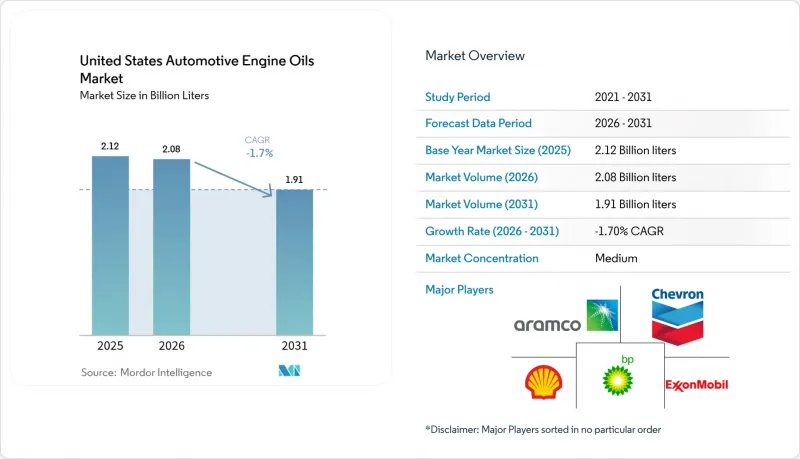
미국의 자동차 엔진 오일 시장 규모는 2025년에 21억 2,000만 리터로 평가되었습니다. 2026년에 20억 8,000만 리터가 되어, 2031년까지 19억 1,000만 리터로 축소할 것으로 예측됩니다.
2026년부터 2031년까지 연평균 복합 성장률(CAGR)이 마이너스 1.7%로 감소할 것으로 예측됩니다.
이러한 축소를 주도하는 것은 구조적 변화입니다. 차량 수명에 걸친 공장 충전 프로그램, 예측 유지보수 알고리즘 및 초저점도 사양의 도입으로 차량당 소비량은 감소하고 있지만 윤활유 품질은 향상되고 있습니다. 2025년 3월에 도입된 API SP 및 ILSAC GF-7 표준에 따라 이미 1,800개 이상의 배합이 허가되었으며, 이는 더 비싼 첨가제 화학 기술과 광범위한 동력계 시험에 의존하고 있습니다. 한편, 포드의 '지능형 오일 수명 모니터'를 통해 2025년 말까지 평균 교체 주기가 10,000마일로 2배 이상 연장될 것으로 예상되며, 발보린은 같은 해 커민스사로부터 10만 마일용 대형 차량용 오일에 대한 승인을 받았습니다. 이러한 발전은 제품 수익률을 높이는 한편, 서비스 대상 수요량을 감소시켜 미국 자동차 엔진 오일 시장의 장기적인 하락 추세를 고착화시키는 요인으로 작용하고 있습니다.
미국의 자동차 엔진 오일 시장 동향과 인사이트
API SP/ILSAC GF-7 표준 소개
2025년 3월에 도입된 API SP와 ILSAC GF-7은 이미 1,800개 이상의 블렌드가 승인되었지만, 북미에서 필요한 Sequence IX 및 Sequence X 테스트 장비를 보유한 연구소는 극소수에 불과해 6-9개월 분량의 인증 백로그가 남아있습니다. 각 시험 주기마다 5만-7만 달러의 비용이 소요되며, 최대 6주 동안 동력계를 점유해야 하기 때문에 자체 시설을 보유한 제조업체에게 유리한 상황입니다. 포드, 제너럴모터스, 도요타, 혼다, 스텔란티스는 2026년 공장 출하 시 GF-7을 의무화하여 인증을 받은 브랜드는 기존 API SN Plus 오일 대비 10-15%의 가격 프리미엄을 받을 수 있게 되었습니다. 중견 블렌더들이 시장에서 철수하거나 루브리졸과 인피니엄으로부터 첨가제 패키지 공동 라이선싱을 획득함에 따라 판매량은 감소하는 추세이지만 리터당 이익률은 확대되고 있으며, 이는 미국 자동차 엔진 오일 시장의 CAGR에 약 0.3% 포인트의 추가 효과를 가져옵니다. 3 포인트의 추가 효과를 가져왔습니다.
완전 합성유 및 0W-20 이하 등급으로의 빠른 전환
2024년에는 합성유 배합이 윤활유 시장 가치의 약 68%를 차지했으며, 신차 사용설명서의 42%가 0W-20으로 표기되었습니다. 2025년까지 모델 연도 사양의 70% 이상이 0W-20 또는 이보다 낮은 점도의 오일을 요구했으며, 일부 하이브리드 차량 라인은 2032년까지 강화되는 EPA의 차량 평균 CO2 배출량 상한선인 85g/마일을 충족하기 위해 0W-16으로 전환할 것으로 예측됩니다. 이에 대해 블렌딩 업체들은 그룹 III 및 PAO 원료에 대한 투자로 대응했습니다. 2025년 초에 가동을 시작한 엑손모빌의 싱가포르 리지드 업그레이드 시설은 연간 120만 톤의 고점도 지수 기유를 추가하여 세계 공급 체제를 갖추게 되었습니다. 리터당 수요는 계속 감소하고 있지만, 합성유 점유율은 빠르게 증가하여 미국 자동차 엔진 오일 시장 성장률에 0.4 포인트의 순 증가를 가져왔습니다.
기유 가격 및 공급 변동성
2024년부터 2025년까지 정유공장 정기보수 및 경질원유 공급구조의 변화로 인해 그룹 II와 그룹 III의 현물가격은 분기별로 15-20% 변동하여 독립 블렌더들은 마진 압박을 받게 되었습니다. 몰리브덴, 붕소 등 첨가제 가격이 12-18% 상승하여 비용을 더욱 압박했습니다. 에너지 전환의 압력으로 미국 내 정유시설 증설이 예상되지 않기 때문에 가격 변동은 계속될 것이며, 아시아의 신규 생산능력이 국내 부족분을 보충할 때까지 미국 자동차 엔진 오일 시장의 CAGR을 약 0.4% 낮추는 요인이 될 것입니다.
부문 분석
2025년 승용차 엔진 오일은 미국 자동차 엔진 오일 시장 규모의 63.45%를 차지했으며, 이는 미국 내 2억 9,000만 대에 달하는 차량 보유 대수를 반영합니다. 내연기관차가 여전히 차량의 주류를 차지하고 있지만, 전동화, 텔레매틱스 및 공장 충전 오일의 수명 연장으로 인해 정비 패턴이 변화함에 따라 승용차 엔진 오일 판매량은 감소할 것으로 예측됩니다. 대형 차량용 엔진 오일 판매량은 장거리 운송용 디젤 차량의 전동화가 여전히 어렵고, 보통 15-20년 동안 계속 운행되기 때문에 감소 속도는 완만합니다. 오토바이 엔진 오일은 크루저 및 투어링 바이크 라이더들이 기존의 오일 교환 주기를 유지하고 있고, 전동화 옵션도 제한적이기 때문에 가장 작은 감소폭(예측 기간(2026-2031년)의 CAGR은 -1.64%)을 기록할 것으로 예측됩니다.
제품 구성도 변화하고 있습니다. PCMO(승용차 엔진 오일)의 경우, 다공해 물질 규제와 관련된 OEM의 요구사항에 힘입어 0W-20 및 그보다 낮은 점도의 등급이 가장 빠르게 성장하고 있습니다. 기존 10W-30 및 10W-40 등급은 2015년 이전에 생산된 차량이라는 축소되는 시장에 한정되어 있습니다. HDMO 시장도 비슷한 추세를 보이고 있는데, 이는 함대(차량군)가 콜드스타트 효율을 높이기 위해 0W-30 또는 5W-30의 CK-4 오일을 채택하고 있기 때문입니다. 발보라인의 10만 마일 대응으로 커민스 인증을 받은 HDMO는 제품 가치가 상승하더라도 교체 주기의 연장이 리터당 판매량 감소를 더욱 심화시킬 수 있음을 보여주고 있습니다.
'미국의 자동차 엔진 오일 시장 보고서'는 수지 유형(승용차 엔진 오일, 대형차 엔진 오일, 이륜차 엔진 오일) 및 베이스 스톡(광유, 합성유, 반합성유, 바이오베이스)별로 분류되어 있습니다. 시장 예측은 판매량(리터) 기준으로 제공됩니다.
기타 혜택 :
- 엑셀 형식 시장 예측(ME) 시트
- 3개월간 애널리스트 지원
자주 묻는 질문
목차
제1장 서론
제2장 조사 방법
제3장 주요 요약
제4장 시장 구도
제5장 시장 규모와 성장 예측
제6장 경쟁 구도
제7장 시장 기회와 향후 전망
제8장 CEO을 위한 중요 전략적 과제
KTH 26.05.29The United States Automotive Engine Oils Market size is projected to be 2.12 billion liters in 2025, 2.08 billion liters in 2026, and decline to 1.91 billion liters by 2031, declining at a CAGR of -1.7% from 2026 to 2031.
A structural shift is driving this contraction: life-of-vehicle factory-fill programs, predictive-maintenance algorithms, and ultra-low-viscosity specifications raise lubricant quality even as per-vehicle consumption falls. API SP and ILSAC GF-7 standards, introduced in March 2025, have already licensed more than 1,800 formulations that rely on costlier additive chemistries and extensive dynamometer testing. Meanwhile, Ford's Intelligent Oil-Life Monitor more than doubled the average drain interval to 10,000 miles by late 2025, and Valvoline secured Cummins approval for a 100,000-mile heavy-duty oil the same year. Although these advances elevate product margins, they also shrink the serviceable volume pool, anchoring the long-term downtrend for the United States automotive engine oils market.
United States Automotive Engine Oils Market Trends and Insights
API SP/ILSAC GF-7 Specification Roll-Out
Launched in March 2025, API SP and ILSAC GF-7 have already licensed more than 1,800 blends, yet certification backlogs of 6-9 months persist because only a handful of North American labs own the requisite Sequence IX and Sequence X stands. Each test cycle costs USD 50,000-75,000 and ties up a dynamometer for up to six weeks, favoring producers with captive facilities. Ford, General Motors, Toyota, Honda, and Stellantis mandated GF-7 for 2026 factory fills, letting certified brands capture 10-15% price premiums over legacy API SN Plus oils. As mid-tier blenders exit or co-license additive packages from Lubrizol or Infineum, volume erosion continues, but margin per litre widens, adding roughly 0.3 percentage points to the United States automotive engine oils market CAGR.
Rapid Shift to Full-Synthetic and less than or equal to 0W-20 Grades
Synthetic formulas represented close to 68% of lubricant value in 2024, with 0W-20 appearing in 42% of new-vehicle owner manuals. By 2025, more than 70% of model-year specifications called for 0W-20 or thinner, and select hybrid lines moved to 0W-16 to meet tightening EPA fleet-average CO2 ceilings of 85 g/mile by 2032. Blenders responded by investing in Group III and PAO feedstock: ExxonMobil's Singapore Resid Upgrade, commissioned early 2025, added 1.2 million ton/year of high-viscosity-index base stocks for global allocation. Although litre demand keeps falling, the synthetic share grows fast enough to contribute a net 0.4 percentage-point lift to the United States automotive engine oils market trajectory.
Base-Oil Price and Supply Volatility
Group II and Group III spot prices swayed 15-20% quarter-to-quarter during 2024-2025 because of refinery turnarounds and lighter crude slates, leaving independent blenders exposed to margin compression. Additive elements such as molybdenum and boron climbed 12-18%, further squeezing costs. US refinery additions remain unlikely under energy-transition pressure, so volatility will persist and shave around 0.4 percentage points off the United States automotive engine oils market CAGR until new Asian capacity backfills domestic shortfalls.
Other drivers and restraints analyzed in the detailed report include:
- Aging Vehicle Parc more than 12 Years Sustaining Demand
- AI-Driven Predictive-Maintenance Programs Extending Drain Intervals
- Limited GF-7 Test-Stand Capacity Delaying Certifications
For complete list of drivers and restraints, kindly check the Table Of Contents.
Segment Analysis
Passenger car motor oil accounted for 63.45% of the United States Automotive Engine Oils market size in 2025, reflecting the nation's 290 million-unit vehicle parc. Although internal-combustion cars continue to dominate the fleet, PCMO volume is forecast to fall as electrification, telematics, and factory-fill longevity reshape service patterns. Heavy-duty motor oil volumes erode more slowly because long-haul diesels remain hard to electrify and typically stay in service 15-20 years. Motorcycle engine oil shows the smallest contraction (-1.64% CAGR during the forecast period (2026-2031)) because cruiser and touring riders maintain legacy drain intervals and have limited electric alternatives.
The internal mix is also changing. Within PCMO, 0W-20 and thinner grades expand fastest, driven by OEM mandates tied to multi-pollutant standards. Conventional 10W-30 and 10W-40 grades retreat to a shrinking pool of vehicles built before 2015. HDMO mirrors this trend as fleets adopt 0W-30 or 5W-30 CK-4 oils for cold-start efficiency. Valvoline's 100,000-mile Cummins-approved HDMO illustrates how extended drains deepen litre-volume shrinkage even when product value rises.
The United States Automotive Engine Oils Market Report is Segmented by Resin Type (Passenger Car Motor Oil, Heavy Duty Motor Oil, and Motorcycle Engine Oil) and Base Stock (Mineral, Synthetic, Semi-Synthetic, and Bio-Based). The Market Forecasts are Provided in Terms of Volume (Liters).
List of Companies Covered in this Report:
- AMSOIL INC.
- Blauparts LLC
- BP p.l.c.
- Chevron Corporation
- CITGO Petroleum
- ExxonMobil Corporation
- FUCHS
- Gulf Oil International Ltd
- Idemitsu Kosan Co., Ltd.
- Liqui Moly GmbH
- Lucas Oil Products, Inc.
- Motul
- Petro-Canada Lubricants Inc.,
- Phillips 66 Lubricants
- Quaker Houghton.
- Shell plc
- TotalEnergies
- Saudi Arabian Oil Co.
Additional Benefits:
- The market estimate (ME) sheet in Excel format
- 3 months of analyst support
TABLE OF CONTENTS
1 Introduction
- 1.1 Study Assumptions and Market Definition
- 1.2 Scope of the Study
2 Research Methodology
3 Executive Summary
4 Market Landscape
- 4.1 Market Overview
- 4.2 Market Drivers
- 4.2.1 API SP/ILSAC GF-7 specification roll-out
- 4.2.2 Rapid shift to full-synthetic and <=0W-20 grades
- 4.2.3 Aging US vehicle parc >12 yrs sustaining demand
- 4.2.4 AI-driven predictive-maintenance programs extending drain intervals
- 4.2.5 OEMs' carbon-credit strategies favouring ultra-low-viscosity factory-fill
- 4.3 Market Restraints
- 4.3.1 Base-oil price and supply volatility
- 4.3.2 Limited GF-7 test-stand capacity delaying certifications
- 4.3.3 OEM factory-fill life-of-vehicle oils curbing after-market volumes
- 4.4 Value Chain Analysis
- 4.5 Regulatory Landscape
- 4.6 Porter's Five Forces
- 4.6.1 Threat of New Entrants
- 4.6.2 Bargaining Power of Suppliers
- 4.6.3 Bargaining Power of Buyers
- 4.6.4 Threat of Substitutes
- 4.6.5 Industry Rivalry
5 Market Size and Growth Forecasts (Value)
- 5.1 By Resin Type
- 5.1.1 Passenger Car Motor Oil (PCMO)
- 5.1.1.1 0W-XX
- 5.1.1.2 5W-XX
- 5.1.1.3 10W-XX
- 5.1.1.4 15W-XX
- 5.1.1.5 Monogrades
- 5.1.1.6 Other Grades
- 5.1.2 Heavy Duty Motor Oil (HDMO)
- 5.1.2.1 0W-XX
- 5.1.2.2 5W-XX
- 5.1.2.3 10W-XX
- 5.1.2.4 15W-XX
- 5.1.2.5 Monogrades
- 5.1.2.6 Other Grades
- 5.1.3 Motorcycle Engine Oil (MCO)
- 5.1.3.1 0W-XX
- 5.1.3.2 5W-XX
- 5.1.3.3 10W-XX
- 5.1.3.4 15W-XX
- 5.1.3.5 Monogrades
- 5.1.3.6 Other Grades
- 5.1.1 Passenger Car Motor Oil (PCMO)
- 5.2 By Base Stock
- 5.2.1 Mineral
- 5.2.2 Synthetic
- 5.2.3 Semi-Synthetic
- 5.2.4 Bio-Based
6 Competitive Landscape
- 6.1 Market Concentration
- 6.2 Strategic Moves
- 6.3 Market Share(%)/Ranking Analysis
- 6.4 Company Profiles (includes Global level Overview, Market level overview, Core Segments, Financials as available, Strategic Information, Products and Services, Recent Developments)
- 6.4.1 AMSOIL INC.
- 6.4.2 Blauparts LLC
- 6.4.3 BP p.l.c.
- 6.4.4 Chevron Corporation
- 6.4.5 CITGO Petroleum
- 6.4.6 ExxonMobil Corporation
- 6.4.7 FUCHS
- 6.4.8 Gulf Oil International Ltd
- 6.4.9 Idemitsu Kosan Co., Ltd.
- 6.4.10 Liqui Moly GmbH
- 6.4.11 Lucas Oil Products, Inc.
- 6.4.12 Motul
- 6.4.13 Petro-Canada Lubricants Inc.,
- 6.4.14 Phillips 66 Lubricants
- 6.4.15 Quaker Houghton.
- 6.4.16 Shell plc
- 6.4.17 TotalEnergies
- 6.4.18 Saudi Arabian Oil Co.
7 Market Opportunities and Future Outlook
- 7.1 White-space and Unmet-Need Assessment