
|
시장보고서
상품코드
2043991
인도의 전사적 자원 계획(ERP) : 시장 점유율 분석, 업계 동향 및 통계, 성장 예측(2026-2031년)India Enterprise Resource Planning - Market Share Analysis, Industry Trends & Statistics, Growth Forecasts (2026 - 2031) |
||||||
 Mordor Intelligence
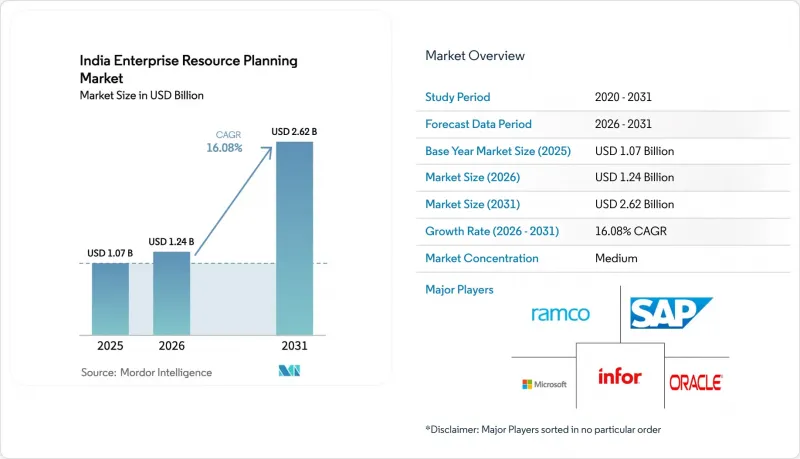
인도의 전사적 자원 계획(ERP) 시장 규모는 2025년 10억 7,000만 달러로 평가되었습니다. 2026년 12억 4,000만 달러로 확대되어 2026-2031년에 걸쳐 CAGR 16.08%를 나타내, 2031년까지 26억 2,000만 달러에 이를 것으로 예측됩니다.
상품 및 서비스세(GST) 규정 준수 기한 연장, 디지털 인디아 2.0 보조금, 중견 제조업의 적극적인 클라우드 전환으로 수요 곡선은 가파른 상승 곡선을 유지하고 있습니다. 5,000만 루피 이상의 거래에 대한 전자 청구서 규제 의무화와 인도 중앙은행(RBI)의 실시간 부정 모니터링 규정 도입으로 ERP는 법적 필수 요건이 되었습니다. 클라우드 하이퍼스케일러 업체들은 현재 하이데라바드, 푸네, 뭄바이에 가용성 존(Availability Zone)을 운영하고 있으며, 지연시간을 한 자릿수 밀리초 단위까지 줄여 On-Premise 시스템을 채택할 수 있는 마지막 기술적 근거를 없애고 있습니다. 구자라트, 타밀나두, 마하라슈트라의 2차 제조 벨트에서는 현장의 센서와 백오피스의 재무 모듈을 거의 실시간으로 동기화하는 '엣지 ERP'의 물결이 동시에 확산되고 있어 산업용 IoT가 더 이상 포춘 500대 기업의 전유물이 아님을 증명하고 있습니다. 증명하고 있습니다.
인도의 전사적 자원 계획(ERP) 시장 동향 및 인사이트
GST와 컴플라이언스를 이용한 정부 추진
단계적인 전자 송장 도입으로 인해 280만 개의 기업이 컴플라이언스 대응 ERP 제품군을 도입해야 하는 상황에 처해 있습니다. 기업부의 감사추적 의무화로 인해 스프레드시트로는 대응할 수 없는 타임스탬프와 해싱 요구사항이 추가되었습니다. 사전 인증된 GST 포장을 제공하는 공급업체는 2025년 상반기 중소기업 도입의 68%를 차지했습니다. 국경 간 서비스에 대한 리버스 차지(구매세액공제) 제도의 도입이 임박함에 따라 이미 조달 모듈의 업그레이드가 진행되고 있으며, 전자 운송 증명서(e-way bill)의 통합이 22% 증가한 것은 물류 워크플로우에도 영향을 미치고 있다는 것을 보여줍니다. 각 주마다 기존 부가가치세(VAT) 세칙이 다르기 때문에 지역에 맞는 설정 기능은 벤더 간 결정적인 차별화 요소로 작용하고 있습니다.
확대되는 디지털 전환 이니셔티브
'디지털 인디아 2.0'은 공공 부문 디지털화에 1,400억 루피를 할당하고, 2027년까지 50만 개의 MSME(중소영세기업)를 클라우드 플랫폼에 도입하는 것을 목표로 하고 있습니다. 공통 서비스 센터를 통해 제공되는 보조 대상 ERP 라이선스를 통해 대상 기업의 도입 비용을 최대 60%까지 절감할 수 있습니다. 1,200명의 CFO를 대상으로 한 민간 설문조사에 따르면, 71%가 이미 기간계 시스템 현대화를 추진하고 있으며, 투자 대상 1위로 클라우드 ERP를 꼽았습니다. 전자, 제약, 섬유 산업에서 생산 연동형 인센티브 제도에서는 실시간 생산 데이터를 명시적으로 요구하고 있으며, ERP 도입이 보조금 수령 요건으로서 ERP 도입이 깊숙이 포함되어 있습니다. 바라트 일렉트로닉스 등 국영기업은 통일된 ERP 입찰을 실시하고 있으며, 경쟁에 참여하고자 하는 중소 벤더에게 ISO 27001과 CERT-In 인증 취득을 장려하고 있습니다.
높은 도입 비용
중견기업을 위한 총소유비용은 15만-50만 달러에 달하고, 영세기업이 감당할 수 있는 범위를 훨씬 넘어선다. SIDBI의 조사에 따르면, 36개월의 클라우드 계약에도 불구하고 중소기업의 48%가 비용을 가장 큰 장벽으로 꼽았습니다. 비공식적인 신용 주기나 위탁 판매는 주문 제작 코드가 필요하기 때문에 커스터마이징으로 인해 예산이 40% 더 늘어날 수 있습니다. 디지털화 무담보 대출은 2026년 1월 기준 승인 건수가 1만 2,000건에 불과하며, 이는 대출자의 신중함과 대출자의 소극적인 태도를 모두 반영하고 있습니다. 각 벤더들은 사용자 1인당월499루피의 스타터 플랜을 시도하고 있지만, 기능이 축소되어 계약 중간에 업그레이드가 필요한 경우가 많아 해결하고자 했던 저렴한 가격이라는 장벽을 다시 만들어내고 있습니다.
부문 분석
2025년에는 클라우드 네이티브 제품군이 전체 도입의 53.77%를 차지했습니다. 벤더는 모듈을 분리하여 고객이 온디맨드 방식으로 마이크로 서비스를 이용하고, 다운타임 없이 기능을 업데이트할 수 있도록 하고 있습니다. 이 접근 방식은 거래 기반 가격 책정이 비용과 비즈니스 사이클을 일치시키기 때문에 2031년까지 연평균 복합 성장률(CAGR) 17.68%를 달성할 것으로 예측됩니다. 모바일 퍼스트형 ERP는 스마트폰으로 재고 및 주문 가시성을 필요로 하는 창고 직원이나 외근 영업 담당자들이 선호하고 있습니다. 대형 유통업체에서의 도입은 대규모 환경에서의 유용성을 입증하고 있습니다. 소셜 및 협업형 ERP는 트랜잭션 화면에 채팅 및 공동 편집 기능을 내장하고 있지만, 전문 서비스 기업들 사이에서는 여전히 틈새 시장에 머물러 있습니다. CAGR 18.7%로 확대가 예상되는 2계층형과 엣지 ERP는 세무 컴플라이언스를 위해 지역별로 장부를 슬림하게 유지하면서 전 세계로 집계하는 다국적 기업으로부터 지지를 받고 있습니다. 타타모터스가 2026년 1월 사난드와 푸네 공장에서 실시한 시범 프로젝트에서 고품질 이미지를 현지에서 처리하여 엣지 ERP의 낮은 지연시간의 이점을 입증했습니다. 인도 표준청(BIS)이 수립한 사이버 물리 시스템 표준안에서는 100밀리초 이하의 산업용 레이턴시를 달성하기 위해 엣지 컴퓨팅을 권장하고 있어, 이 아키텍처의 정당성을 더욱 뒷받침하고 있습니다.
2025년 기준, 재무 및 회계 부문은 기능별 점유율의 29.45%를 차지했습니다. 지속적인 감사추적 의무화 및 GST 전자계산서 적용기준에 따라 자동조회는 필수적인 요소로 자리 잡고 있습니다. ICICI 은행의 API는 ERP의 현금 잔액을 재무 부서와 연계하여 실시간 유동성 최적화를 실현하고 더 깊은 통합을 추진하고 있습니다. 공급망 및 운영 모듈은 알고리즘에 의한 보충을 통해 EC 창고의 재고를 유지하고, 인사 모듈의 업데이트를 통해 적립금 컴플라이언스를 추적합니다. 제조 실행 및 품질 관리는 PLI(생산 연동형 인센티브) 제도가 보조금을 검증된 디지털 성과와 연계하여 CAGR 17.1%로 가장 빠르게 성장하고 있습니다. 제약업체는 새로운 Schedule M 가이드라인을 충족하기 위해 전자 배치 기록을 도입하고, 고객 관계 관리 모듈을 통해 트랙터 구매자가 온라인으로 장비를 구성할 수 있도록 하여 기존 채널과 디지털 채널을 연결하고 있습니다. 사전 통합된 MES(제조 실행 시스템)와 ERP 제품군을 제공하는 벤더는 다음 업그레이드 주기에서 우위를 점할 수 있습니다.
기타 혜택
- 엑셀 형태 시장 예측(ME) 시트
- 3개월간 애널리스트 지원
자주 묻는 질문
목차
제1장 서론
제2장 조사 방법
제3장 주요 요약
제4장 시장 구도
제5장 시장 규모와 성장 예측
제6장 경쟁 구도
제7장 시장 기회와 향후 전망
KTH 26.05.29The India Enterprise Resource Planning Market size is expected to grow from USD 1.07 billion in 2025 to USD 1.24 billion in 2026 and is forecast to reach USD 2.62 billion by 2031 at 16.08% CAGR over 2026-2031.
Accelerated Goods and Services Tax compliance deadlines, Digital India 2.0 subsidies, and aggressive cloud migration among mid-market manufacturers keep the demand curve steep. Regulatory mandates for e-invoicing above INR 5 crore, coupled with the Reserve Bank of India's real-time fraud monitoring rules, make ERP a statutory necessity. Cloud hyperscalers now operate availability zones in Hyderabad, Pune, and Mumbai, reducing latency to single-digit milliseconds and eliminating the last technical argument for on-premise systems. Tier-II manufacturing belts in Gujarat, Tamil Nadu, and Maharashtra feed a parallel edge-ERP wave that synchronizes shop-floor sensors with back-office finance modules in near real time, proving that industrial IoT is no longer a privilege reserved for Fortune 500 companies.
India Enterprise Resource Planning Market Trends and Insights
Government Push for GST and Compliance
The phased e-invoice rollout forces 2.8 million enterprises to adopt compliant ERP suites. Ministry of Corporate Affairs audit-trail mandates add timestamp and hash requirements that spreadsheets cannot meet. Vendors with pre-certified GST packs captured 68% of SME installations in H1 2025. A looming reverse-charge mechanism for cross-border services is already driving upgrades to procurement modules, while the 22% jump in e-way bill integrations shows logistics workflows are equally exposed. States differ in legacy VAT nuances, so hyper-local configuration capability has become a decisive vendor differentiator.
Growing Digital Transformation Initiatives
Digital India 2.0 earmarks INR 14,000 crore for public-sector digitization and sets a target of onboarding 500,000 MSMEs onto cloud platforms by 2027. Subsidized ERP licenses offered via Common Services Centres drop acquisition costs by up to 60% for eligible firms. Private surveys of 1,200 CFOs show 71% already executing core-system modernization, with cloud ERP topping the investment list. Production-Linked Incentive schemes across electronics, pharma, and textiles explicitly require real-time production data, embedding ERP deep into subsidy compliance. State-owned enterprises such as Bharat Electronics issue unified ERP tenders, encouraging smaller vendors to obtain ISO 27001 and CERT-In certifications if they wish to compete.
High Implementation Costs
Total ownership for a mid-market roll-out spans USD 150,000-500,000, well above the comfort zone of micro-enterprises. A SIDBI survey shows 48% of SMEs cite cost as the top deterrent, even with 36-month cloud subscriptions. Customization inflates budgets by another 40% because informal credit cycles and consignment sales need bespoke code. Collateral-free loans for digitization posted only 12,000 approvals by January 2026, reflecting both lender caution and borrower reluctance. Vendors experiment with starter tiers priced at INR 499 per user per month, yet stripped-down features often trigger mid-contract upgrades, recreating the affordability barrier they aimed to solve.
Other drivers and restraints analyzed in the detailed report include:
- Increasing Adoption of Cloud-Based Solutions
- Rising Demand for Industry 4.0-Ready Edge ERP in Tier II Manufacturing Clusters
- Data Security and Privacy Concerns
For complete list of drivers and restraints, kindly check the Table Of Contents.
Segment Analysis
Cloud-native suites represented 53.77% of deployments in 2025. Vendors decouple modules, letting customers consume microservices on demand and update features without downtime. This approach delivers a 17.68% CAGR by 2031, as transaction-based pricing aligns costs with business cycles. Mobile-first ERP appeals to warehouse staff and field sales who need inventory and order visibility on smartphones; roll-outs at large retailers validate its utility at scale. Social and collaborative ERP weaves chat and co-editing into transactional screens but remains a niche preference among professional-services firms. Two-tier and edge ERP, forecast to expand at 18.7% CAGR, wins favor with multinationals that keep a lean regional ledger for tax compliance while aggregating globally. Tata Motors' January 2026 pilot at Sanand and Pune plants processes quality images locally, proving edge ERP's latency advantage. Draft cyber-physical standards from the Bureau of Indian Standards recommend edge computing for industrial latency under 100 milliseconds, further legitimizing the architecture.
Finance and accounting accounted for 29.45% of the functional share in 2025. Continuous audit-trail mandates and GST e-invoice thresholds make automated reconciliation non-negotiable. ICICI Bank APIs link ERP cash positions to treasury desks for real-time liquidity optimization, driving deeper integration. Supply-chain and operations modules keep e-commerce warehouses stocked through algorithmic replenishment, while HR updates track provident-fund compliance. Manufacturing execution and quality grow fastest, at a 17.1% CAGR, as PLI schemes tie subsidies to verified digital output. Pharma producers embed electronic batch records to meet new Schedule M guidelines, and customer relationship modules let tractor buyers configure equipment online, bridging traditional and digital channels. Vendors offering pre-integrated MES and ERP suites secure the inside track for the next upgrade cycle.
The India Enterprise Resource Planning Market Report is Segmented by Type (Cloud-Native Suite, Mobile-First ERP, and More), Business Function (Finance and Accounting, and More), Deployment Model (On-Premise, and Cloud), Organization Size (Large Enterprises, and Small and Medium Enterprises), and Industry Vertical (Manufacturing, BFSI, and More). The Market Forecasts are Provided in Terms of Value (USD).
List of Companies Covered in this Report:
- SAP SE
- Oracle Corporation
- Microsoft Corporation
- Infor Inc.
- Epicor Software Corporation
- The Sage Group plc
- Tally Solutions Pvt. Ltd.
- Zoho Corporation Pvt. Ltd.
- Focus Softnet Pvt. Ltd.
- Acumatica Inc.
- Deltek Inc.
- SYSPRO (Pty) Ltd
- Deskera Holdinigs Ltd.
- Unit4 N.V.
- Intuit Inc.
- Marg ERP Ltd.
- Busy Infotech Pvt. Ltd.
- Ramco Systems Limited
- Prismatic Technologies Pvt. Ltd.
- IFS AB
Additional Benefits:
- The market estimate (ME) sheet in Excel format
- 3 months of analyst support
TABLE OF CONTENTS
1 INTRODUCTION
- 1.1 Study Assumptions and Market Definition
- 1.2 Scope of the Study
2 RESEARCH METHODOLOGY
3 EXECUTIVE SUMMARY
4 MARKET LANDSCAPE
- 4.1 Market Overview
- 4.2 Market Drivers
- 4.2.1 Growing Digital Transformation Initiatives
- 4.2.2 Increasing Adoption of Cloud-Based Solutions
- 4.2.3 Government Push for GST and Compliance
- 4.2.4 Rising Demand for Industry 4.0-Ready Edge ERP in Tier II Manufacturing Clusters
- 4.2.5 Emergence of Unified Payments Interface-Integrated ERP for MSMEs
- 4.2.6 Surge in India-Specific AI Language Models Enabling Vernacular ERP Interfaces
- 4.3 Market Restraints
- 4.3.1 High Implementation Costs
- 4.3.2 Data Security and Privacy Concerns
- 4.3.3 Shortage of Domain-Skilled ERP Consultants in Non-Metro Cities
- 4.3.4 Resistance from Family-Owned SMEs to Process Standardization
- 4.4 Impact of Macroeconomic Factors on the Market
- 4.5 Industry Value Chain Analysis
- 4.6 Regulatory Landscape
- 4.7 Technological Outlook
- 4.8 Porter's Five Forces Analysis
- 4.8.1 Bargaining Power of Suppliers
- 4.8.2 Bargaining Power of Buyers
- 4.8.3 Threat of New Entrants
- 4.8.4 Threat of Substitutes
- 4.8.5 Degree of Competition
5 MARKET SIZE AND GROWTH FORECASTS (VALUE)
- 5.1 By Type
- 5.1.1 Cloud-Native Suite
- 5.1.2 Mobile-First ERP
- 5.1.3 Social / Collaborative ERP
- 5.1.4 Two-Tier / Edge ERP
- 5.2 By Business Function
- 5.2.1 Finance and Accounting
- 5.2.2 Supply-Chain and Operations
- 5.2.3 Human Capital Management
- 5.2.4 Customer Relationship and Commerce
- 5.2.5 Manufacturing Execution and Quality
- 5.3 By Deployment Model
- 5.3.1 On-Premise
- 5.3.2 Cloud
- 5.4 By Organization Size
- 5.4.1 Large Enterprises
- 5.4.2 Small and Medium Enterprises
- 5.5 By Industry Vertical
- 5.5.1 Manufacturing
- 5.5.2 Retail and E-commerce
- 5.5.3 BFSI
- 5.5.4 Government and Public Sector
- 5.5.5 IT and Telecom
- 5.5.6 Healthcare and Life Sciences
- 5.5.7 Others Industry Vertical
6 COMPETITIVE LANDSCAPE
- 6.1 Market Concentration
- 6.2 Strategic Moves
- 6.3 Market Share Analysis
- 6.4 Company Profiles (includes Global Level Overview, Market Level Overview, Core Segments, Financials as available, Strategic Information, Market Rank/Share, Products and Services, Recent Developments)
- 6.4.1 SAP SE
- 6.4.2 Oracle Corporation
- 6.4.3 Microsoft Corporation
- 6.4.4 Infor Inc.
- 6.4.5 Epicor Software Corporation
- 6.4.6 The Sage Group plc
- 6.4.7 Tally Solutions Pvt. Ltd.
- 6.4.8 Zoho Corporation Pvt. Ltd.
- 6.4.9 Focus Softnet Pvt. Ltd.
- 6.4.10 Acumatica Inc.
- 6.4.11 Deltek Inc.
- 6.4.12 SYSPRO (Pty) Ltd
- 6.4.13 Deskera Holdinigs Ltd.
- 6.4.14 Unit4 N.V.
- 6.4.15 Intuit Inc.
- 6.4.16 Marg ERP Ltd.
- 6.4.17 Busy Infotech Pvt. Ltd.
- 6.4.18 Ramco Systems Limited
- 6.4.19 Prismatic Technologies Pvt. Ltd.
- 6.4.20 IFS AB
7 MARKET OPPORTUNITIES AND FUTURE OUTLOOK
- 7.1 White-space and Unmet-Need Assessment