
|
시장보고서
상품코드
2044009
아시아태평양의 전사적 자원 계획(ERP) : 시장 점유율 분석, 산업 동향 및 통계 데이터, 성장 예측(2026-2031년)Asia-Pacific Enterprise Resource Planning - Market Share Analysis, Industry Trends & Statistics, Growth Forecasts (2026 - 2031) |
||||||
 Mordor Intelligence
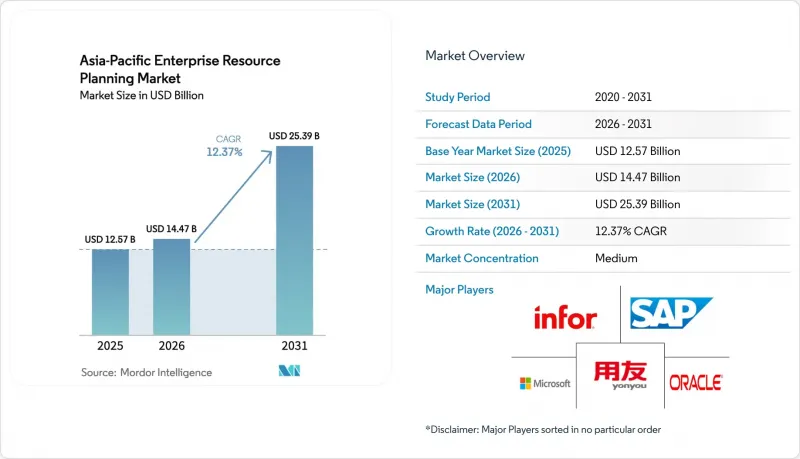
아시아태평양의 전사적 자원 계획(ERP) 시장 규모는 2025년 125억 7,000만 달러로 평가되었습니다. 2026년 144억 7,000만 달러로 확대되어 2026년부터 2031년에 걸쳐 CAGR 12.37%를 나타내, 2031년까지 253억 9,000만 달러에 이를 것으로 예측됩니다.
클라우드 네이티브 제품군의 급속한 확산, 공식적인 '클라우드 우선' 정책의 수립, 핵심 워크플로우에 인공지능(AI)의 통합으로 인해 시장 기반이 대형 제조업체에서 규제가 엄격한 공공 기관 및 소규모 소매업체로 확대되고 있습니다. 전자 청구서 의무화, 통합 데이터 레지스트리 및 소버린 클라우드 호스팅을 의무화하는 정부 프레임워크는 의사결정 주기를 단축하고 정보 기술(IT) 예산을 최신 기업 자원 계획(ERP) 플랫폼으로 전환하고 있습니다. 각 벤더들은 로컬 데이터센터 인증 획득, 국내 ID 월렛과의 사전 통합, 스타트업의 수직 확장을 가능하게 하는 애플리케이션 프로그래밍 인터페이스(API) 공개를 위해 경쟁하고 있으며, 경쟁 구도는 더욱 치열해지고 있습니다. 인구 통계학적 압력, 모바일 우선의 업무 스타일, 로우코드 설정 도구의 융합으로 인해 자원이 부족한 중소기업의 도입 장벽은 더욱 낮아지고 있습니다.
아시아태평양의 전사적 자원 계획(ERP) 시장 동향과 인사이트
아시아태평양 기업의 클라우드 네이티브 아키텍처 채택 확대
공공 부문의 의무화가 민간기업의 조달 사이클에도 파급되고 있습니다. 일본 정부의 클라우드 도입 시스템 수는 각 기관에 레거시 데이터센터 퇴출을 의무화하는 중앙집권적 기한 설정으로 2024년부터 2025년까지 671개 시스템에서 2,918개 시스템으로 335% 급증했습니다. 호주는 2026년 정부 차원의 클라우드 정책을 시행하여 각 기관이 새로운 디지털 투자에 클라우드 경제성을 포함하도록 의무화하고, 하이퍼스케일러와의 파트너 인증을 추진했습니다. 싱가포르는 41개 기관에 걸쳐 213개 시스템을 상용 클라우드로 이전했으며, 대상 워크로드의 80% 이상을 정부 프라이빗 클라우드에서 이전했습니다. 이러한 사례는 릴리스 주기와 운영 비용의 현저한 감소를 입증하고 있으며, 아시아태평양 전사적 자원 계획(ERP) 시장에서 금융기관과 소매업체들이 유사한 현대화 계획을 채택하도록 독려하고 있습니다.
아시아 신흥국 정부 주도의 디지털 전환 이니셔티브에 대한 자료입니다.
각국의 청사진은 현재 국내총생산(GDP) 목표를 디지털 경제의 생산량과 연결하고, 통합 데이터 백본과 인공지능(AI)을 지원하는 기업 자원 계획(ERP) 기반에 대한 지속적인 예산 배분을 보장하고 있습니다. 베이징의 '디지털 중국 2025 행동계획'은 주요 디지털 산업의 GDP 비중을 10% 이상으로 끌어올리고, 컴퓨팅 파워를 300 엑사플롭스 이상으로 확대하는 한편, 국내 호스팅 및 표준 기반 플랫폼에 대한 예측 가능한 수요를 창출하는 것을 목표로 하고 있습니다. 예측 가능한 수요를 창출하고 있습니다. 2025년에 체결된 '인도-일본 디지털 파트너십 2.0'은 디지털 공공 인프라의 상호운용성, AI 거버넌스, 반도체 가치사슬 협력을 규정하여 국경을 초월한 시스템 통합 프로젝트를 가속화하고 있습니다. 싱가포르의 '스마트 네이션 2.0'은 지난 5년간 디지털 경제가 연평균 11.2%의 성장률을 기록했으며, 2024년에는 기업 10곳 중 9곳이 최소 1개 이상의 디지털 툴을 도입할 것으로 예상하고 있습니다. 이러한 정책은 최신 제품군 도입 일정을 단축하고, 전자조달 플랫폼 및 디지털 ID 기반과 통합하면서 로컬 데이터 레지던시를 인증할 수 있는 벤더가 아시아태평양 전사적 자원 계획(ERP) 시장에서 우위를 점할 수 있도록 돕습니다.
아시아 지방 도시에 숙련된 ERP 도입 파트너 부족
컨설팅 인력은 여전히 대도시에 집중되어 있어 지방에 위치한 제조업체들은 긴 대기시간과 높은 출장비용을 감수해야 합니다. 베트남 중소기업 605개사를 대상으로 한 조사에 따르면, 사내에 추진자가 없는 경우 18개월 후 지속 이용률이 35%까지 급감하는 것으로 나타났습니다. 말레이시아의 '신산업 마스터플랜'도 스마트팩토리 구상의 장벽으로 유사한 기술 격차를 지적하고 있으며, 정부는 교육훈련을 위한 개입 자금을 확보하기에 이르렀습니다. 벤더들은 원격 설정 포털이나 템플릿화된 도입 방식을 제공하지만, 아시아태평양 전사적 자원 계획(ERP) 시장에서 이러한 방식은 세부적인 커스터마이징을 제한하는 경우가 많습니다.
부문 분석
2025년 기준, 클라우드 네이티브 제품군은 아시아태평양의 전사적 자원 계획(ERP) 시장 점유율의 46.1%를 차지했습니다. 모바일 퍼스트 아키텍처는 2031년까지 연평균 복합 성장률(CAGR) 12.7%를 나타낼 것으로 예측되며, 분산된 인력이 스마트폰에서 동등한 기능을 요구함에 따라 모바일 퍼스트 아키텍처는 2031년까지 연평균 복합 성장률(CAGR) 12.7%를 나타낼 것으로 예측됩니다. 공공기관이 지원 종료 전에 On-Premise SAP ECC와 Oracle E-Business Suite에서 전환함에 따라 클라우드 네이티브 모듈 시장이 확대되고 있습니다. 기업들은 리스크가 큰 일괄 전환을 피하고 단계적 전환을 가능하게 하는 마이크로 서비스를 중요시하고 있습니다. 모바일 우선 설계는 최종 사용자의 교육 부담을 줄이고, 승인 주기를 단축하며, 옴니채널 재고 조정을 위해 소매업체에게 큰 이점을 제공합니다.
벤더들의 전략도 이러한 변화를 여실히 보여주고 있습니다. 일본의 한 디지털 에이전시는 확장 가능한 애자일 프레임워크와 자동화된 품질 게이트를 도입하여 릴리스 주기를 6개월에서 48시간으로 단축했습니다. 마이크로소프트와 SAP는 임베디드 AI 코파일럿을 번들로 제공하는 ECC 마이그레이션 솔루션을 중견기업 4만개사를 대상으로 배포하고 있습니다. 워크데이가 2025년 12월 Sana와 Pipedream을 인수하면서 3,000개의 기성품 커넥터가 제공되어, 기업들은 별도의 커스텀 코드를 작성하지 않고도 대화형 에이전트를 통합할 수 있게 되었습니다.
2025년 아태지역 전사적 자원 계획(ERP) 시장에서 재무 및 회계 분야는 31.5%의 점유율을 유지한 반면, 인적자원관리(HCM) 분야는 연평균 12.9%의 성장률을 나타낼 것으로 예측됩니다. 전자 청구서 의무화와 실시간 납세 절차로 인해 재무 분야는 여전히 핵심적인 위치를 차지하고 있지만, 인구 통계학적 역풍으로 인해 워크포스 인텔리전스도 마찬가지로 전략적으로 중요한 위치를 차지하게 되었습니다. 아시아태평양의 급여 및 인사관리 모듈용 전사적 자원 계획(ERP) 시장은 일본의 마이넘버카드와 싱가포르의 Singpass API를 통해 시스템이 신원확인된 신원정보와 복리후생 데이터를 실시간으로 취득할 수 있게 됨에 따라 성장하고 있습니다.
정부의 도입 사례가 선례가 되고 있습니다. 싱가포르의 VISION 플랫폼은 10만 명의 공무원을 대상으로 채용부터 퇴직까지의 워크플로우를 자동화하여 처리 시간을 30% 단축했습니다. 인포시스(Infosys)는 워크데이 도입에 자사의 AI 조사 방법론인 'Topaz'를 적용하여 계약률과 고객 유지율에서 측정 가능한 성과를 내고 있다고 주장하고 있습니다. 이러한 사례들은 인재 분석과 예측 이직 모델이 이제 이사회 차원의 우선순위임을 입증하고 있습니다. 또한, AI의 인사이트를 ERP 시스템에 통합함으로써 조직은 보다 정보에 입각한 전략적 의사결정을 내릴 수 있게 됩니다.
기타 혜택 :
- 엑셀 형식 시장 예측(ME) 시트
- 3개월간 애널리스트 지원
자주 묻는 질문
목차
제1장 서론
제2장 분석 방법
제3장 주요 요약
제4장 시장 구도
제5장 시장 규모와 성장 예측
제6장 경쟁 구도
제7장 시장 기회와 향후 전망
KTHThe Asia-Pacific Enterprise Resource Planning Market size is expected to grow from USD 12.57 billion in 2025 to USD 14.47 billion in 2026 and is forecast to reach USD 25.39 billion by 2031 at a 12.37% CAGR over 2026-2031.
Rapid uptake of cloud-native suites, formal cloud-first policies, and the embedding of artificial intelligence into core workflows are widening the addressable base beyond large manufacturers into highly regulated public-sector agencies and small retailers. Government frameworks that mandate e-invoicing, unified data registries, and sovereign cloud hosting have shortened decision cycles and redirected information-technology budgets toward modern enterprise resource planning platforms. Vendors are racing to certify local data centers, pre-integrate with national identity wallets, and expose application programming interfaces that enable start-ups to build vertical extensions, intensifying the competitive landscape. The convergence of demographic pressures, mobile-first workstyles, and low-code configuration tools is further lowering adoption barriers for resource-constrained small and medium enterprises.
Asia-Pacific Enterprise Resource Planning Market Trends and Insights
Rising Adoption of Cloud-Native Architectures Among Asia-Pacific Enterprises
Public-sector mandates are cascading into private procurement cycles. Japan's government cloud portfolio expanded from 671 to 2,918 systems between 2024 and 2025, a 335% surge, after centralized deadlines required agencies to vacate legacy data centers. Australia activated a whole-of-government cloud policy in 2026 that compels agencies to embed cloud economics in every new digital investment, driving hyperscaler partner certifications. Singapore migrated 213 systems to commercial clouds across 41 agencies, pushing more than 80% of eligible workloads off the government's private cloud. These exemplars demonstrate measurable reductions in release cycles and operating costs, persuading financial institutions and retailers to follow similar modernization blueprints in the APAC enterprise resource planning market.
Government-Led Digital Transformation Initiatives Across Emerging Asian Economies
National blueprints now tie gross domestic product targets to digital economy output, ensuring sustained budget allocations for unified data backbones and artificial intelligence-ready enterprise resource planning foundations. Beijing's Digital China 2025 Action Plan aims for core digital industries to exceed 10% of GDP while expanding compute capacity beyond 300 exaflops, creating predictable demand for domestically hosted, standards-based platforms. The India-Japan Digital Partnership 2.0, signed in 2025, codifies collaboration on interoperability of digital public infrastructure, artificial intelligence governance, and semiconductor value chains, accelerating cross-border system integration projects. Singapore's Smart Nation 2.0 recorded a 11.2% compound annual growth rate over the past five years in its digital economy, with 9 in 10 firms adopting at least one digital tool in 2024. Such policies compress adoption timelines for modern suites and favor vendors able to certify local data residency while integrating with e-procurement platforms and digital-identity rails in the Asia-Pacific ERP market.
Shortage of Skilled ERP Implementation Partners in Tier-2 Asian Cities
Consultancy talent remains concentrated in metro hubs, leaving manufacturers in provincial clusters with long wait times and premium travel charges. A survey of 605 Vietnamese small and medium enterprises showed sustained usage plunged to 35% after 18 months without an internal champion. Malaysia's New Industrial Master Plan flags the same skills gap as a barrier to smart-factory ambitions, prompting the government to earmark intervention funds for training. Vendors offer remote configuration portals and templated rollouts, yet these often limit deep customization in the Asia-Pacific ERP market.
Other drivers and restraints analyzed in the detailed report include:
- Accelerated Post-Pandemic Push Toward Remote Work and Mobile-First Workflows
- AI-Driven Analytics Driving Demand for Modern ERP Suites
- Data Sovereignty Regulations Limiting Cross-Border Cloud Deployments
For complete list of drivers and restraints, kindly check the Table Of Contents.
Segment Analysis
Cloud-native suites owned 46.1% of the Asia-Pacific enterprise resource planning market share in 2025. Mobile-first architectures are forecast to post a 12.7% CAGR through 2031 as distributed workforces demand smartphone parity. The market for cloud-native modules is expanding as public agencies migrate from on-premises SAP ECC and Oracle E-Business Suite before their support sunsets. Enterprises value microservices that allow phased cutovers, avoiding risky big-bang switches. Mobile-first design reduces end-user training overhead and accelerates approval cycles, a boon for retailers reconciling omnichannel inventory.
Vendor strategies illustrate the shift. Japan's Digital Agency slashed release cycles from six months to 48 hours by adopting scaled agile frameworks and automated quality gates. Microsoft and SAP target 40,000 mid-market firms for ECC migrations that bundle built-in artificial intelligence co-pilots. Workday's December 2025 purchases of Sana and Pipedream deliver 3,000 pre-built connectors, enabling enterprises to embed conversational agents without heavy custom code.
Finance and accounting retained 31.5% of the Asia-Pacific enterprise resource planning market share in 2025, yet human capital management is on track for a 12.9% CAGR. Mandatory e-invoicing and real-time tax remittance keep finance at the core, but demographic headwinds make workforce intelligence equally strategic. The Asia-Pacific enterprise resource planning market for payroll and talent modules is growing as Japan's My Number Card and Singapore's Singpass APIs enable systems to pull verified identity and benefits data in real time.
Government deployments set precedents. Singapore's VISION platform, spanning 100,000 public officers, cut processing time by 30% after automating hire-to-retire workflows. Infosys applies its Topaz artificial intelligence methodology to Workday rollouts, claiming measurable gains in close rates and retention. These examples reinforce that talent analytics and predictive attrition models are now board-level priorities. Additionally, integrating AI-driven insights into ERP systems enables organizations to make more informed, strategic decisions.
The Asia-Pacific Enterprise Resource Planning Market Report is Segmented by Architecture (Cloud-Native Suite, Mobile-First ERP, and More), Business Function (Finance and Accounting, and More), Deployment Model (On-Premise, and Cloud), Organization Size (Large Enterprises, and Small and Medium Enterprises), Industry Vertical (Manufacturing, BFSI, and More), and Geography. The Market Forecasts are Provided in Terms of Value (USD).
List of Companies Covered in this Report:
- SAP SE
- Microsoft Corporation
- Oracle Corporation
- Unit4 N.V.
- IFS AB
- Infor Inc.
- Sage Group Plc
- Workday Inc.
- SYSPRO (Pty) Ltd.
- Yonyou Network Technology Co. Ltd.
- Ramco Systems Ltd.
- Kingdee International Software Group Company Limited
- Epicor Software Corporation
- Fujistu Limited
- NEC Corporation
- Zoho Corporation Pvt. Ltd.
- HashMicro Pte. Ltd.
- MYOB Group Pty. Ltd.
- Pronto Software Limited
- QAD Inc.
Additional Benefits:
- The market estimate (ME) sheet in Excel format
- 3 months of analyst support
TABLE OF CONTENTS
1 INTRODUCTION
- 1.1 Study Assumptions and Market Definition
- 1.2 Scope of the Study
2 RESEARCH METHODOLOGY
3 EXECUTIVE SUMMARY
4 MARKET LANDSCAPE
- 4.1 Market Overview
- 4.2 Market Drivers
- 4.2.1 Rising Adoption of Cloud-Native Architectures Among Asia-Pacific Enterprises
- 4.2.2 Government-led Digital Transformation Initiatives Across Emerging Asian Economies
- 4.2.3 Accelerated Post-pandemic Push Toward Remote Work and Mobile-first Workflows
- 4.2.4 Growing Ecosystem of Local ISV Extensions Enabling Industry-specific Customizations
- 4.2.5 Integration of AI-driven Analytics Driving Demand for Modern ERP Suites
- 4.2.6 Increasing Venture Capital Funding for Vertical SaaS Startups in Asia-Pacific
- 4.3 Market Restraints
- 4.3.1 Increasing Venture Capital Funding for Vertical SaaS Startups in Asia-Pacific
- 4.3.2 Shortage of Skilled ERP Implementation Partners in Tier-2 Asian Cities
- 4.3.3 Data Sovereignty Regulations Limiting Cross-border Cloud Deployments
- 4.3.4 Fragmented SME Market With Low IT Budgets Slowing Cloud ERP Adoption
- 4.4 Impact of Macroeconomic Factors on the Market
- 4.5 Industry Value Chain Analysis
- 4.6 Regulatory Landscape
- 4.7 Technological Outlook
- 4.8 Porter's Five Forces Analysis
- 4.8.1 Bargaining Power of Suppliers
- 4.8.2 Bargaining Power of Buyers
- 4.8.3 Threat of New Entrants
- 4.8.4 Threat of Substitutes
- 4.8.5 Intensity of Competitive Rivalry
5 MARKET SIZE AND GROWTH FORECASTS (VALUE)
- 5.1 By Architecture
- 5.1.1 Cloud-Native Suite
- 5.1.2 Mobile-First ERP
- 5.1.3 Social / Collaborative ERP
- 5.1.4 Two-Tier / Edge ERP
- 5.2 By Business Function
- 5.2.1 Finance and Accounting
- 5.2.2 Supply-Chain and Operations
- 5.2.3 Human Capital Management
- 5.2.4 Customer Relationship and Commerce
- 5.2.5 Manufacturing Execution and Quality
- 5.3 By Deployment Model
- 5.3.1 On-Premise
- 5.3.2 Cloud
- 5.4 By Organization Size
- 5.4.1 Large Enterprises
- 5.4.2 Small and Medium Enterprises
- 5.5 By Industry Vertical
- 5.5.1 Manufacturing
- 5.5.2 Retail and E-commerce
- 5.5.3 BFSI
- 5.5.4 Government and Public Sector
- 5.5.5 IT and Telecom
- 5.5.6 Healthcare and Life Sciences
- 5.5.7 Other Industry Verticals
- 5.6 By Geography
- 5.6.1 China
- 5.6.2 India
- 5.6.3 Japan
- 5.6.4 South Korea
- 5.6.5 Australia and New Zealand
- 5.6.6 Rest of Asia-Pacific
6 COMPETITIVE LANDSCAPE
- 6.1 Market Concentration
- 6.2 Strategic Moves
- 6.3 Market Share Analysis
- 6.4 Company Profiles (includes Global Level Overview, Market Level Overview, Core Segments, Financials as available, Strategic Information, Market Rank/Share, Products and Services, Recent Developments)
- 6.4.1 SAP SE
- 6.4.2 Microsoft Corporation
- 6.4.3 Oracle Corporation
- 6.4.4 Unit4 N.V.
- 6.4.5 IFS AB
- 6.4.6 Infor Inc.
- 6.4.7 Sage Group Plc
- 6.4.8 Workday Inc.
- 6.4.9 SYSPRO (Pty) Ltd.
- 6.4.10 Yonyou Network Technology Co. Ltd.
- 6.4.11 Ramco Systems Ltd.
- 6.4.12 Kingdee International Software Group Company Limited
- 6.4.13 Epicor Software Corporation
- 6.4.14 Fujistu Limited
- 6.4.15 NEC Corporation
- 6.4.16 Zoho Corporation Pvt. Ltd.
- 6.4.17 HashMicro Pte. Ltd.
- 6.4.18 MYOB Group Pty. Ltd.
- 6.4.19 Pronto Software Limited
- 6.4.20 QAD Inc.
7 MARKET OPPORTUNITIES AND FUTURE OUTLOOK
- 7.1 White-Space and Unmet-Need Assessment