

|
시장보고서
상품코드
2044024
중소기업용 클라우드 ERP : 시장 점유율 분석, 업계 동향 및 통계, 성장 예측(2026-2031년)SMBs Cloud ERP - Market Share Analysis, Industry Trends & Statistics, Growth Forecasts (2026 - 2031) |
||||||
 Mordor Intelligence
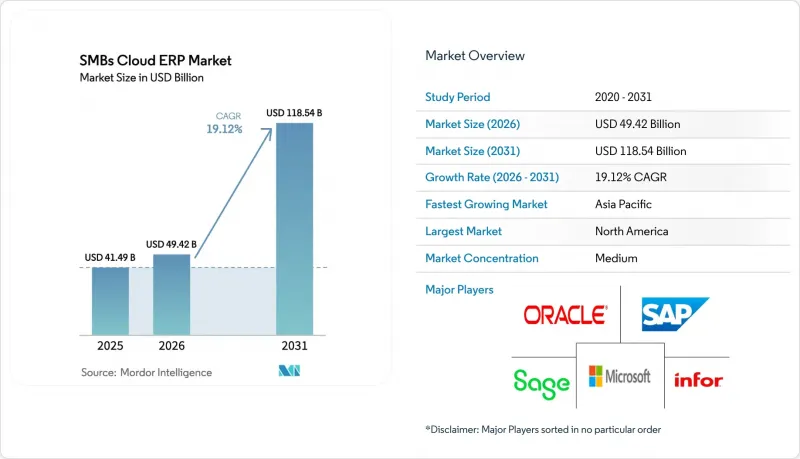
중소기업용 클라우드 ERP 시장 규모는 2025년에 414억 9,000만 달러로 평가되었습니다. 2026년 494억 2,000만 달러에서 2031년까지 1,185억 4,000만 달러에 이를 것으로 예상되며, 예측 기간(2026-2031년) CAGR은 19.12%를 나타낼 전망입니다.
구독형 가격 책정, 실시간 컴플라이언스 요구 사항, 임베디드 인공지능(AI)이 결합되어 중소기업의 도입을 지연시켰던 예산 및 기술 장벽이 사라지고 있습니다. 퍼블릭 클라우드 도입이 여전히 시장을 주도하고 있지만, 중국, 인도, 중동의 데이터 주권 규제로 인해 워크로드가 로컬 인프라로 이동하면서 하이브리드 도입이 가속화되고 있습니다. 의료, 제조, 소매용 수직 통합 모듈은 도입 기간을 단축하고 규제 대응 템플릿을 표준으로 제공하는 등 지속적으로 인기를 끌고 있습니다. AI 에이전트의 오케스트레이션과 로우코드 통합을 둘러싼 벤더 간 치열한 경쟁으로 가치 실현 시간을 더욱 단축하는 동시에 활용 확대와 연계된 새로운 수익화 경로가 생겨나고 있습니다.
세계의 중소기업용 클라우드 ERP 시장 동향 및 인사이트
중소기업의 퍼블릭 클라우드 도입이 급증합니다.
번거롭지 않은 프로비저닝과 사용량 증가에 따른 유연한 과금 체계로 인해 중견기업의 83%, 중소기업의 61%가 워크로드 대부분을 퍼블릭 클라우드로 전환하고 있습니다. 월별 릴리스 주기, 자동 패치 적용, 거의 즉각적인 스케일링으로 On-Premise ERP에서는 구현할 수 없는 운영상의 민첩성을 제공합니다. 하이퍼스케일러들은 데이터 거주 요건을 충족하는 새로운 지역 데이터센터 구축으로 이에 대응하고 있습니다. Oracle과 SAP는 2025년까지 아시아 데이터센터를 확장할 계획을 발표했으며, 중국, 인도, 중동의 소버린 클라우드 요구사항을 충족시켜 지연을 줄이고 컴플라이언스 마찰을 완화하는 것을 목표로 하고 있습니다. 가용성 영역이 확대됨에 따라 중소기업용 클라우드 ERP 시장은 현지 컴플라이언스에 대한 신뢰가 높아짐에 따라 더 많은 워크로드 전환이 가속화되는 선순환의 혜택을 누리고 있습니다. 현재 벤더들의 로드맵은 소버린 클라우드 청사진과 제로 트러스트 보안 기능에 초점을 맞추고 있으며, 퍼블릭 클라우드는 신규 도입의 기본 선택이 되고 있습니다.
코로나19 이후 디지털 전환의 가속화
락다운으로 인해 전자상거래 및 모바일 액세스를 위한 API가 없는 기존 회계 및 재고 관리 시스템의 취약점이 드러났습니다. 중소기업 경영자들은 디지털 워크플로우를 비상시 대응책이 아닌 표준 업무 절차로 인식하고 있습니다. 클라우드 ERP 벤더들은 전자상거래 커넥터, 내장형 분석 기능, 모바일 앱을 기본 플랜에 번들로 제공함으로써 과거 소규모 구매자를 주저하게 만들었던 통합 비용을 제거했습니다. 이전에는 추가 구매가 필요했던 CRM과 공급망 모듈이 이제는 표준으로 장착되어 견적부터 입금까지 엔드투엔드 가시성이 기대되는 것을 반영하고 있습니다. 이러한 변화로 인해, 팬데믹의 충격이 물러난 이후에도 시장에서는 견조한 성장세가 지속되고 있습니다.
중소기업의 IT 기술력 부족
많은 기술 책임자들이 클라우드 ERP 전문가 채용에 어려움을 겪고 있는 반면, 직원의 35%만이 AI 관련 스킬업 교육을 받은 것으로 나타났습니다. 지방과 지방 도시에서는 인력 부족이 가장 심각하며, 중소기업은 비용 증가와 커스터마이징의 자유도가 떨어지는 매니지드 서비스에 의존할 수밖에 없는 상황입니다. 각 벤더들은 설정 마법사나 노코드 확장 기능을 도입하고 있지만, 이러한 도구가 전문성을 완전히 대체할 수는 없습니다. 숙련된 인력의 부족은 기술 발전 속도가 훈련된 인력공급을 능가하는 빠른 속도로 인해 더욱 악화되고 있습니다. 이로 인해 발생하는 스킬 갭은 도입 지연과 ROI 저하로 이어져 중소기업용 클라우드 ERP 시장에 구조적인 걸림돌로 작용하고 있습니다.
부문 분석
2025년 퍼블릭 클라우드는 즉각적인 확장성과 최소한의 유지보수를 중요시하는 소규모 기업들로 인해 71.87%의 시장 점유율을 차지했습니다. 그러나 하이브리드 아키텍처는 2026년부터 2031년까지 연평균 복합 성장률(CAGR) 15.87%를 나타낼 것으로 예측되는데, 이는 퍼블릭 클라우드의 분석 유연성을 유지하면서 로컬 데이터 저장을 의무화하는 규제 압력에 따른 것으로 분석됩니다. 소버린 클라우드의 서비스와 통합 관리 콘솔을 통해 재무 및 인사 업무는 프라이빗 인스턴스에 남겨두고, AI를 활용한 예측 분석과 개발 및 테스트 환경은 필요에 따라 퍼블릭 인프라로 확장할 수 있습니다. SAP는 신젠타와 제휴하여 SAP Cloud ERP Private 솔루션을 제공합니다. 이러한 프라이빗 버전은 전용 테넌트 및 고객 관리 암호화 키를 보장할 뿐만 아니라 SAP의 광범위한 클라우드 생태계와도 원활하게 통합됩니다.
2세대 하이브리드 배포는 일관성 있고 안정적인 인터넷 연결이 여전히 과제로 남아있는 신흥 시장의 네트워크 불안정성에도 대비할 수 있습니다. 이러한 배포에서는 로컬 캐시를 활용하여 네트워크 장애 시에도 미션 크리티컬한 트랜잭션이 중단 없이 지속될 수 있도록 하고 있습니다. 연결이 복구되면, 시스템은 로컬에 캐시된 데이터와 클라우드 기반 원장을 대조하여 데이터의 무결성과 업무 연속성을 보장합니다. 이러한 수준의 내결함성으로 인해 중소기업을 위한 클라우드 ERP 시장은 그동안 신뢰할 수 없는 브로드밴드 인프라로 인해 제약이 있었던 지역으로 확대되고 있습니다.
지역별 분석
북미는 SaaS에 대한 성숙한 인식, 탄탄한 파트너 생태계, 대규모 공공 부문 프로젝트 등에 힘입어 2025년에도 매출 점유율 36.12%를 유지했습니다. Workday의 10억 캐나다 달러(약 7억 1,000만 달러) 규모의 확장 등 지속적인 투자로 급여 및 보안의 현지화는 더욱 가속화될 것으로 예상되지만, 보급률이 포화상태에 가까워짐에 따라 전반적인 성장은 둔화되고 있습니다. 현재 북미 중소기업용 클라우드 ERP 시장의 매출을 견인하고 있는 것은 신규 고객 확보보다는 AI 에이전트 모듈과 산업별 애드온을 중심으로 한 업셀링 기회입니다.
아시아태평양은 CAGR 15.19%로 가장 빠르게 성장하는 지역이 될 것으로 예측됩니다. '디지털 인디아'와 사우디아라비아의 '비전 2030'과 같은 국가적 디지털화 목표가 세제 혜택과 전자 청구서 의무화를 결합하여 성장을 견인하고 있으며, 이로 인해 기업들은 사실상 클라우드 지원 재무 시스템을 도입할 수밖에 없는 상황에 놓여 있습니다. 주요 클라우드 서비스 제공업체를 포함한 하이퍼스케일러들은 컴퓨팅 리전 현지화를 지속적으로 추진하고 있으며, 이를 통해 지연 시간을 줄이고, 데이터 주권 관련 법규를 준수하는 등 도입의 걸림돌로 작용했던 데이터 주권 관련 법규를 준수하고 있습니다. 조호(Zoho) 등 국내 벤더 및 세계 기존 업체들은 연구개발(R&&D) 거점을 설립하고, 현지어 대응 패키지를 도입하고 있습니다. 이러한 노력으로 지역 중소기업의 도입 기간을 대폭 단축하고, 시장 확대와 클라우드 ERP 솔루션의 보급을 촉진하고 있습니다.
유럽에서는 GDPR(EU 개인정보보호규정)을 준수하는 아키텍처와 중소기업의 도입 비용을 지원하기 위해 고안된 EU의 자금 지원 프로그램에 힘입어 꾸준한 성장세를 보이고 있습니다. 슬로베니아의 디지털화 기금이나 영국의 중소기업 디지털 도입 태스크포스(SME Digital Adoption Task Force)와 같은 이니셔티브는 중소기업의 디지털 전환을 촉진하기 위한 협력적 정책 추진의 좋은 예입니다. 한편, 중동 및 아프리카에서는 사우디아라비아의 ZATCA 2단계 실시간 청구서 발행과 걸프 지역 전체에서 도입되고 있는 유사한 규제와 같은 규제적 진전이 호재로 작용하고 있습니다. 이러한 추세에 따라 클라우드 ERP 시스템으로의 전환이 가속화되고 있습니다. 남미는 전체 시장 규모에서는 뒤쳐져 있지만, 브라질, 아르헨티나 등의 국가들이 부가가치세(VAT) 제도를 전면적으로 재검토하고 있는 가운데, 그 기세가 점점 더 커지고 있습니다. 이러한 변화는 클라우드 플랫폼으로 가능한 자동화된 세금 신고 프로세스를 촉진하고, 이 지역에서의 도입을 더욱 촉진하고 있습니다.
기타 혜택 :
- 엑셀 형식 시장 예측(ME) 시트
- 3개월간 애널리스트 지원
자주 묻는 질문
목차
제1장 서론
제2장 조사 방법
제3장 주요 요약
제4장 시장 구도
제5장 시장 규모와 성장 예측
제6장 경쟁 구도
제7장 시장 기회와 향후 전망
KTH 26.05.29The SMBs Cloud Enterprise Resource Planning market size was valued at USD 41.49 billion in 2025 and estimated to grow from USD 49.42 billion in 2026 to reach USD 118.54 billion by 2031, at a CAGR of 19.12% during the forecast period (2026-2031).
Subscription pricing, real-time compliance mandates, and embedded artificial intelligence are converging to remove historic budget and skills barriers that slowed adoption among smaller businesses. Public cloud deployments still dominate the market, yet hybrid deployments are accelerating as sovereign-data rules in China, India, and the Middle East push workloads toward localized infrastructure. Vertically tailored modules for healthcare, manufacturing, and retail continue to gain traction because they shorten implementation timelines and embed regulatory templates out of the box. Intense vendor competition around AI-agent orchestration and low-code integration is further compressing time-to-value while creating new monetization pathways tied to consumption expansion.
Global SMBs Cloud ERP Market Trends and Insights
Surge in Public Cloud Adoption Among SMBs
Low-touch provisioning and pay-as-you-grow elasticity have pushed 83% of mid-sized businesses and 61% of small businesses to migrate the majority of workloads to public cloud. Monthly release cycles, automated patching, and near-instant scaling deliver operational agility that on-premise ERP cannot match. Hyperscalers are responding with new regional data centers that satisfy data-residency mandates. Oracle and SAP announced plans to expand their data centers in Asia by 2025, aiming to meet sovereign-cloud requirements in China, India, and the Middle East, thereby reducing latency and easing compliance friction. As availability zones proliferate, the SMBs cloud enterprise resource planning market benefits from a feedback loop in which local compliance confidence accelerates additional workload migration. Vendor roadmaps now center on sovereign cloud blueprints and zero-trust security features, making the public cloud the default choice for new deployments.
Accelerating Digital Transformation Post-COVID-19
Lockdowns exposed the fragility of legacy accounting and inventory systems that lacked APIs for ecommerce and mobile access. SMB leaders continue to treat digital workflows as standard operating procedure rather than contingency planning. Cloud ERP vendors have bundled ecommerce connectors, embedded analytics, and mobile apps into base tiers, removing the integration cost that once deterred smaller buyers. CRM and supply-chain modules that previously required bolt-on purchases now ship standard, reflecting the expectation of end-to-end visibility from quote to cash. These shifts sustain premium growth in the market even as pandemic shocks recede.
Limited IT Skills Within Small Businesses
Many technology leaders struggle to recruit cloud-ERP specialists, while only 35% of employees receive AI-related upskilling. Rural and tier-2 cities face the steepest shortages, forcing SMBs to rely on managed services that add cost and dilute customization freedom. Vendors have introduced guided setup wizards and no-code extensions, yet these tools cannot fully replace domain expertise. This shortage of skilled professionals is further exacerbated by the rapid pace of technological advancements, which outpaces the availability of trained personnel. The resulting skills gap slows rollouts and dampens ROI, placing a structural drag on the SMBs' cloud enterprise resource planning market.
Other drivers and restraints analyzed in the detailed report include:
- Growing Affordability of Subscription Pricing Models
- Government Incentives for SME Digitization
- Data Security and Compliance Concerns
For complete list of drivers and restraints, kindly check the Table Of Contents.
Segment Analysis
Public cloud retained 71.87% of the market share in 2025 as smaller firms gravitated toward instant scalability and minimal maintenance. Hybrid architectures, however, are projected to deliver a 15.87% CAGR over 2026-2031, reflecting regulatory pressures that compel local data storage while preserving the analytic flexibility of the public cloud. Sovereign-cloud offerings and unified management consoles let finance and HR workloads remain on private instances, with AI-driven forecasting and dev-test environments burst to public infrastructure on demand. SAP has teamed up with Syngenta to roll out its SAP Cloud ERP Private solutions. These private editions not only ensure dedicated tenancy and customer-controlled encryption keys but also seamlessly integrate with SAP's expansive cloud ecosystem.
Second-generation hybrid deployments also hedge against network instability in emerging markets, where consistent and reliable internet connectivity remains a challenge. These deployments use local caching to ensure mission-critical transactions continue uninterrupted during network outages. Once connectivity is restored, the system reconciles the locally cached data with cloud-based ledgers, ensuring data integrity and operational continuity. This level of resilience is enabling the SMBs cloud enterprise resource planning market to expand into regions previously constrained by unreliable broadband infrastructure.
The SMBs Cloud Enterprise Resource Planning Market Report is Segmented by Deployment Model (Public Cloud, Private Cloud, and Hybrid Cloud), Module (Financial Management, Inventory and Order Management, Human Capital Management, Customer Relationship Management, and More), Industry Vertical (Manufacturing, Retail and E-Commerce, and More), and Geography. The Market Forecasts are Provided in Terms of Value (USD).
Geography Analysis
North America retained 36.12% revenue share in 2025, buoyed by mature SaaS mindsets, dense partner ecosystems, and large public-sector projects. Continued investments, such as Workday's CAD 1 billion (USD 0.71 billion approximately) expansion, will deepen payroll and security localization, but overall growth is moderating as penetration approaches saturation. Upsell opportunities around AI-agent modules and industry add-ons now outpace net-new logos in driving North American revenue for the SMBs cloud ERP market.
Asia-Pacific is projected to be the fastest-growing region, with a 15.19% CAGR. National digitization targets, such as Digital India and Saudi Arabia's Vision 2030, are driving growth by combining tax incentives with e-invoicing mandates that effectively require businesses to adopt cloud-ready finance systems. Hyperscalers, including major cloud service providers, are continuing to localize compute regions, which helps reduce latency and ensures compliance with data-sovereignty statutes that previously hindered adoption. Domestic vendors, such as Zoho, as well as global incumbents, are establishing R&D hubs and introducing local-language packs. These efforts are significantly compressing deployment timelines for regional SMBs, thereby fueling market expansion and adoption of cloud ERP solutions.
Europe is experiencing steady growth, supported by GDPR-compliant architectures and EU funding programs designed to offset the adoption costs for smaller firms. Initiatives such as Slovenia's digitization fund and the UK's SME Digital Adoption Taskforce exemplify a coordinated policy push to encourage digital transformation among SMBs. Meanwhile, the Middle East and Africa are benefiting from regulatory advancements, such as ZATCA Phase 2 real-time invoicing in Saudi Arabia, along with similar rules emerging across the Gulf region. These developments are prompting accelerated migrations to cloud ERP systems. South America, while trailing in total market value, is gaining momentum as countries like Brazil and Argentina implement overhauls to their VAT frameworks. These changes favor automated tax-filing processes enabled by cloud platforms, further driving adoption in the region.
- SAP SE
- Oracle Corporation
- Microsoft Corporation
- Sage Group Plc
- Infor Inc.
- Epicor Software Corporation
- Acumatica, Inc.
- Workday, Inc.
- Priority Software Ltd.
- Odoo SA
- Zoho Corporation Pvt. Ltd.
- Xero Limited
- Exact Holdin B.V.
- SYSPRO (Pty) Ltd.
- Intuit Inc.
- Deltek, Inc.
- Certinia Inc.
- Brrightpeearl Limited
- Abas Software GmbH
- IFS AB
- Unite4 N.V.
- MYOB Group Pty Ltd.
Additional Benefits:
- The market estimate (ME) sheet in Excel format
- 3 months of analyst support
TABLE OF CONTENTS
1 INTRODUCTION
- 1.1 Study Assumptions and Market Definition
- 1.2 Scope of the Study
2 RESEARCH METHODOLOGY
3 EXECUTIVE SUMMARY
4 MARKET LANDSCAPE
- 4.1 Market Overview
- 4.2 Market Drivers
- 4.2.1 Surge in Public Cloud Adoption Among SMBs
- 4.2.2 Accelerating Digital Transformation Post COVID-19
- 4.2.3 Growing Affordability of Subscription Pricing Models
- 4.2.4 Government Incentives for SME Digitization
- 4.2.5 Emergence of Vertical-Specific Cloud ERP Solutions
- 4.2.6 Integration Capabilities with Low-Code Platforms
- 4.3 Market Restraints
- 4.3.1 Limited IT Skills Within Small Businesses
- 4.3.2 Data Security and Compliance Concerns
- 4.3.3 Legacy System Integration Complexities
- 4.3.4 Rising Cloud Computing Cost Inflation
- 4.4 Impact of Macroeconomic Factors on the Market
- 4.5 Industry Value Chain Analysis
- 4.6 Regulatory Landscape
- 4.7 Technological Outlook
- 4.8 Porter's Five Forces Analysis
- 4.8.1 Bargaining Power of Suppliers
- 4.8.2 Bargaining Power of Buyers
- 4.8.3 Threat of New Entrants
- 4.8.4 Threat of Substitutes
- 4.8.5 Intensity of Comptitive Rivalry
5 MARKET SIZE AND GROWTH FORECASTS (VALUE)
- 5.1 By Deployment Model
- 5.1.1 Public Cloud
- 5.1.2 Private Cloud
- 5.1.3 Hybrid Cloud
- 5.2 By Module
- 5.2.1 Financial Management
- 5.2.2 Inventory and Order Management
- 5.2.3 Human Capital Management
- 5.2.4 Customer Relationship Management
- 5.2.5 Supply Chain Management
- 5.2.6 Other Modules
- 5.3 By Industry Vertical
- 5.3.1 Manufacturing
- 5.3.2 Retail and E-commerce
- 5.3.3 Professional Services
- 5.3.4 Healthcare
- 5.3.5 Construction
- 5.3.6 Other Industry Verticals
- 5.4 By Geography
- 5.4.1 North America
- 5.4.1.1 United States
- 5.4.1.2 Canada
- 5.4.1.3 Mexico
- 5.4.2 South America
- 5.4.2.1 Brazil
- 5.4.2.2 Argentina
- 5.4.2.3 Rest of South America
- 5.4.3 Europe
- 5.4.3.1 United Kingdom
- 5.4.3.2 Germany
- 5.4.3.3 France
- 5.4.3.4 Italy
- 5.4.3.5 Spain
- 5.4.3.6 Rest of Europe
- 5.4.4 Asia-Pacific
- 5.4.4.1 China
- 5.4.4.2 Japan
- 5.4.4.3 India
- 5.4.4.4 South Korea
- 5.4.4.5 Rest of Asia-Pacific
- 5.4.5 Middle East and Africa
- 5.4.5.1 Middle East
- 5.4.5.1.1 United Arab Emirates
- 5.4.5.1.2 Saudi Arabia
- 5.4.5.1.3 Rest of Middle East
- 5.4.5.2 Africa
- 5.4.5.2.1 South Africa
- 5.4.5.2.2 Egypt
- 5.4.5.2.3 Rest of Africa
- 5.4.5.1 Middle East
- 5.4.1 North America
6 COMPETITIVE LANDSCAPE
- 6.1 Market Concentration
- 6.2 Strategic Moves
- 6.3 Market Share Analysis
- 6.4 Company Profiles (includes Global Level Overview, Market Level Overview, Core Segments, Financials as available, Strategic Information, Market Rank/Share, Products and Services, Recent Developments)
- 6.4.1 SAP SE
- 6.4.2 Oracle Corporation
- 6.4.3 Microsoft Corporation
- 6.4.4 Sage Group Plc
- 6.4.5 Infor Inc.
- 6.4.6 Epicor Software Corporation
- 6.4.7 Acumatica, Inc.
- 6.4.8 Workday, Inc.
- 6.4.9 Priority Software Ltd.
- 6.4.10 Odoo SA
- 6.4.11 Zoho Corporation Pvt. Ltd.
- 6.4.12 Xero Limited
- 6.4.13 Exact Holdin B.V.
- 6.4.14 SYSPRO (Pty) Ltd.
- 6.4.15 Intuit Inc.
- 6.4.16 Deltek, Inc.
- 6.4.17 Certinia Inc.
- 6.4.18 Brrightpeearl Limited
- 6.4.19 Abas Software GmbH
- 6.4.20 IFS AB
- 6.4.21 Unite4 N.V.
- 6.4.22 MYOB Group Pty Ltd.
7 MARKET OPPORTUNITIES AND FUTURE OUTLOOK
- 7.1 White-Space and Unmet-Need Assessment


