
|
시장보고서
상품코드
2044027
통신 네트워크 디지털 트윈 : 시장 점유율 분석, 업계 동향 및 통계, 성장 예측(2026-2031년)Telecom Network Digital Twin - Market Share Analysis, Industry Trends & Statistics, Growth Forecasts (2026 - 2031) |
||||||
 Mordor Intelligence
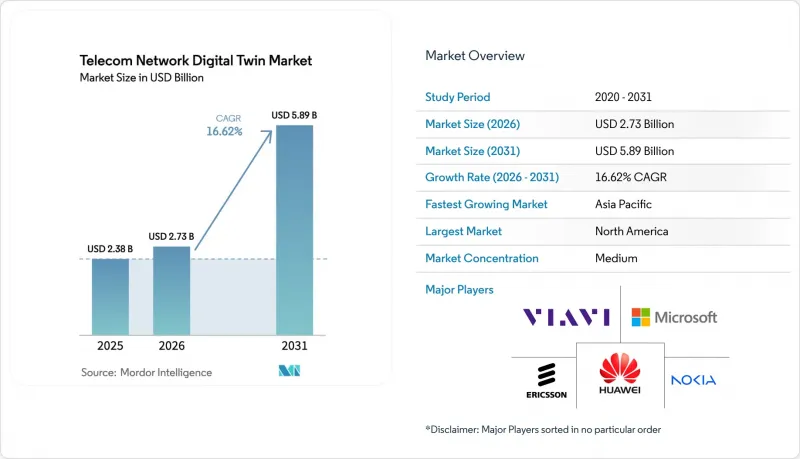
통신 네트워크 디지털 트윈 시장 규모는 2025년에 23억 8,000만 달러로 평가되었습니다. 2026년 27억 3,000만 달러에서 2031년까지 58억 9,000만 달러에 이를 것으로 예상되며, 예측 기간(2026-2031년) CAGR은 16.62%를 나타낼 전망입니다.
이러한 성장의 가속화는 통신 서비스 제공업체들이 실제 운영 환경에서 변경하기 전에 소프트웨어로 무선 액세스, 코어 및 에지 자산을 시뮬레이션하여 현장 출장을 줄이고 업그레이드 주기를 단축하고 있다는 점을 반영합니다. 소프트웨어 벤더들은 레이 트레이싱의 정확도와 AI 기반 최적화를 지속적으로 개선하고 있으며, 하이퍼스케일러는 통신 템플릿을 수평적 플랫폼에 통합하여 시간이 많이 소요되는 코드 커스터마이징을 없애고 있습니다. 클라우드를 도입하는 배경에는 종량제 가격체계로 인해 자본비용이 운영예산으로 전환되는 점이 있습니다. 이는 통신사업자들이 5G 및 6GHz 대역에 대한 투자를 수익 창출형 용도으로 전환하는 데 있어 매력적인 수단으로 작용하고 있습니다. 유럽의 에너지 가격 상승과 새로운 탄소 배출 규제로 인해 통신 사업자들은 서비스 품질 저하 없이 전기 요금을 절감하는 절전 모드 스케줄링에 트윈을 활용해야 하는 상황에 직면해 있습니다. 동시에 O-RAN의 개방형 인터페이스는 파트너 생태계를 확장하여 소규모 분석 기업이 통신사 마켓플레이스를 통해 전용으로 설계된 트윈 용도를 출시할 수 있도록 지원합니다.
세계의 통신 네트워크 디지털 트윈 시장 동향과 인사이트 : 5G RAN의 밀집화, 간섭을 고려한 계획 수립을 위해 실시간 가상 복제본이 필수적
도시 지역에서의 5G 구축에 따라 매크로셀과 스몰셀이 증가하고 있지만, 계획 담당자가 드라이브 테스트에만 의존할 경우 처리량이 20-30% 감소할 수 있습니다. 디지털 트윈은 지형, 장애물, 실시간 신호 데이터를 수집하여 동채널 간섭을 줄일 수 있는 전봇대 설치 위치의 순위를 매깁니다. Verizon은 디지털 트윈을 통해 중복 로브와 레인페이드가 발생하는 지역을 식별하고 제거한 결과, 뉴욕과 시카고에서 사이트 확보 비용을 18% 절감했습니다. AT&T는 노키아의 AVA 플랫폼을 활용하여 달라스에서 mm파 백홀 경로를 사전 조정하고 있습니다. 한편, 보더폰 독일은 에릭슨의 트윈 기술을 적용하여 2025년 옥토버페스트 기간 동안 셀엣지 처리량을 12% 향상시켰습니다. O-RAN의 2026년 레퍼런스 아키텍처에서는 가상 복제본이 RAN 지능형 컨트롤러와 연동되어 매개변수 제안을 통해 몇 밀리초 단위로 루프를 닫을 수 있게 됩니다.
CSP를 클라우드 네이티브 코어로 전환하려면 CI/CD 회귀 테스트를 위한 샌드박스 트윈이 필요합니다.
컨테이너화된 독립형 코어는 매주 소프트웨어 배포가 이루어지며, 단 한 번의 실수가 전국적인 서비스 중단으로 이어질 수 있습니다. 텔레포니카는 Azure 디지털 트윈을 자동화 게이트로 통합하고, Helm 차트를 푸시하기 전에 합성 피크 트래픽을 재생하여 2025년 인시던트 수를 34% 감소시켰습니다. 차이나모바일도 3GPP 워크숍에서 비슷한 성과를 보고했으며, 독일텔레콤은 기업 고객 온보딩 전에 화웨이의 ICNMaster 디지털 트윈으로 슬라이스 분리를 모델링하고 있습니다. TM Forum의 2026년판 자율 네트워크 가이드에서는 트윈을 활용한 테스트가 레벨 3 자가 최적화 운영의 필수 요건이라고 규정하고 있습니다.
고충실도 RF 레이트레이싱 트윈은 GPU 클러스터가 필요하며, CAPEX의 장벽이 있습니다.
밀리파의 정확도를 확보하기 위해서는 수십억 개의 광선이 필요하고, 엔비디아의 시온나 프레임워크는 최소 8개의 H100 가속기를 권장하고 있어, 단일 도시 트윈 구축 비용은 500만 달러가 넘습니다. Tier 2 캐리어는 도입을 주저하고 있으며, 에지 간섭을 생략한 저충실도 메시 모델을 선택하고 있습니다. AWS는 2026년 공유 GPU 풀을 임대하는 시뮬레이션별 과금 모델로 대응했지만, 통신사들은 주권이나 실시간 지연을 우려하고 있습니다. 키사이트의 하이브리드 접근 방식은 대략적인 계획과 주문형 고화질 버스트 프로세싱을 결합하여 브라질과 사우디아라비아의 초기 도입 기업에서 초기 비용을 40% 절감하는 효과를 가져왔습니다.
부문 분석
2025년 통신 네트워크 디지털 트윈 시장에서 소프트웨어가 67.49%를 차지했습니다. 이는 통신사가 구독 조건의 재협상 없이 사내 팀이 전파 모델을 조정할 수 있는 영구 라이선스를 선호했기 때문입니다. 통합, 교육, 관리형 분석에 이르는 서비스는 2031년까지 연평균 16.92%의 연평균 복합 성장률(CAGR)로 빠르게 성장할 것으로 예측됩니다. 이는 통신사에 TensorFlow와 Python에 능통한 RF 엔지니어가 부족하기 때문입니다. 노키아는 AVA에 기성품 3GPP 커넥터를 번들로 제공하지만, 대부분의 도입 사례는 여전히 6-12개월의 보정 지원이 필요합니다. 에릭슨의 매니지드 모델은 한 단계 더 나아가, 분석팀이 트윈의 산출물을 기반으로 매주 매개변수 조정을 제안합니다. 이는 엔지니어링 체제를 간소화하는 Tier 2 캐리어에게 매력적인 선택이 될 수 있습니다.
연간 유지보수 비용은 라이선스 가격의 평균 18%-22%이며, 주파수 대역의 확장에 따라 모델의 정확도를 유지하기 위한 업데이트와 새로운 AI 모델이 제공됩니다. 통신 네트워크의 디지털 트윈 시장 규모는 서비스와 연동되어 있기 때문에 소프트웨어가 매출을 주도하고 있음에도 불구하고 꾸준히 확대되고 있습니다. 보더폰은 네트워크 직원의 15% 미만이 트윈 알고리즘을 확장하는 데 필요한 코딩 지식을 가지고 있다고 밝혔기 때문에 외부 전문가에 대한 수요가 증가함에 따라 스킬업 프로그램은 계속되고 있습니다.
2025년에는 저지연 및 데이터 주권 정책으로 인해 프라이빗 데이터센터와의 근접성이 요구됨에 따라 On-Premise형 트윈이 매출의 45.32%를 차지했습니다. 그러나 하이퍼스케일러들이 범용 플랫폼에 통신 산업 특화 모듈을 통합함에 따라 클라우드 하위 부문은 2031년까지 연평균 복합 성장률(CAGR) 18.78%를 나타낼 것으로 예측됩니다. 마이크로소프트와 텔레포니카는 기밀성이 높은 가입자 데이터는 스페인의 데이터센터 내에 보관하고, 컴퓨팅 부하가 높은 시뮬레이션은 Azure가 호스팅하는 하이브리드 방식을 채택했습니다. AWS는 2026년 통신 산업에 최적화된 '트윈제조업체(TwinMaker)'를 출시했습니다. 이는 3GPP의 셀 구성을 자동으로 불러와 위성 이미지에서 커버리지 맵을 생성할 수 있기 때문에 Dish Network와 라쿠텐 모바일의 경우 도입 기간을 90일 이내로 단축할 수 있었습니다.
하이브리드 방식의 채택은 보안과 탄력적인 컴퓨팅의 균형을 맞추면서 통신 네트워크의 디지털 트윈 시장 규모를 보여주고 있습니다. 유럽은 GDPR(EU 개인정보보호규정) 준수를 위해 하이브리드 모델에 의존하는 반면, 차이나모바일은 300만 개의 기지국과 50밀리초마다 동기화되는 On-Premise 트윈을 고수하고 있습니다. 종량제를 통해 자본의 피크가 예측 가능한 운영 비용으로 전환되고, 이러한 회계적 이점이 CFO를 클라우드 도입으로 유도하고 있습니다.
지역별 분석
2025년 북미는 매출액의 29.87%를 차지했습니다. 이는 Verizon, AT&T, T-Mobile이 연방통신위원회(FCC)가 요구하는 6GHz 대역의 자동 주파수 조정을 효율화하기 위해 Open RAN 디지털 트윈에 투자했기 때문입니다. 디지털 트윈을 통해 드라이브 테스트를 줄이고, 도시 지역 구역 설정과 관련된 도입 지연을 피함으로써 통신 사업자는 예산 부담을 줄일 수 있습니다. 또한, 클라우드 도입도 계속 진행되고 있으며, AWS와 마이크로소프트의 데이터센터가 통신사업자에게 저지연 루프를 제공합니다.
아시아태평양은 2031년까지 연평균 복합 성장률(CAGR) 16.98%로 성장하고 있으며, 그 원동력은 중국 모바일 플랫폼인 차이나모바일(China Mobile)이 주도하고 있습니다. 이 플랫폼은 매일 500테라바이트의 텔레메트리 데이터를 수집하여 기지국 다운타임을 19% 절감하고 있습니다. NTT는 상용 서비스 개시 전에 엔드 투 엔드 지연을 모델링하기 위해 트윈스를 자사의 IOWN Photonic 프로그램에 통합하고 있으며, 산업용 사례로 소니와 도요타를 끌어들이고 있습니다. 인도 통신부는 농촌 지역 계획 수립을 위해 트윈스의 활용을 장려하고 있으며, 이로 인해 서비스가 제공되지 않는 마을에서 버티 에어텔과 릴라이언스 지오의 업그레이드가 가속화되고 있습니다.
유럽은 2025년 25% 내외의 점유율에 머물렀지만, 에너지 최적화 분야에서는 혁신의 주도권을 쥐고 있습니다. 오렌지, 보다폰, 도이치텔레콤은 유럽 그린딜의 탄소배출 목표에 부합하기 위해 슬립모드 스케줄링 트윈스를 적용하고 있습니다. ETSI는 2026년 초에 동기화 보안 가이드라인 초안을 발표하여 EU 사이버보안청이 지적한 사이버 위험에 대응했습니다. 이를 통해 강화된 인증 정보 관리를 갖춘 벤더는 컴플라이언스 측면에서 우위를 점하고 있습니다. 남미, 중동 및 아프리카 3개 지역을 합치면 2025년 매출의 약 5분의 1을 차지합니다. 브라질의 TIM과 사우디의 stc는 5G 계획에 에릭슨과 화웨이의 트윈 기술을 활용한 시범사업을 전개하고 있으며, 2027년 이후 지역 간 격차를 줄일 수 있는 가능성을 보여주고 있습니다.
기타 혜택 :
- 엑셀 형식 시장 예측(ME) 시트
- 3개월간 애널리스트 지원
자주 묻는 질문
목차
제1장 서론
제2장 조사 방법
제3장 주요 요약
제4장 시장 구도
제5장 시장 규모와 성장 예측
제6장 경쟁 구도
제7장 시장 기회와 향후 전망
KTH 26.05.29The Telecom Network Digital Twin Market size was valued at USD 2.38 billion in 2025 and is estimated to grow from USD 2.73 billion in 2026 to reach USD 5.89 billion by 2031, at a CAGR of 16.62% during the forecast period (2026-2031). Accelerated growth reflects how communication service providers now simulate radio-access, core, and edge assets in software before making live changes, trimming truck rolls, and shortening upgrade cycles. Software vendors continue to improve ray-tracing accuracy and AI-driven optimization, while hyperscalers bundle telecom templates into horizontal platforms that eliminate lengthy code customization. Cloud adoption is climbing because consumption-based pricing shifts capital costs into operating budgets, an attractive lever as operators steer 5G and 6 GHz outlays toward revenue-generating apps. Rising energy prices and new carbon caps in Europe add urgency, pushing carriers to use twins for sleep-mode scheduling that cuts electricity bills without harming quality of service. At the same time, O-RAN's open interfaces broaden the partner ecosystem, letting smaller analytics firms release purpose-built twin applications through operator marketplaces.
Global Telecom Network Digital Twin Market Trends and Insights 5G RAN Densification Mandates Real-Time Virtual Replicas for Interference-Aware Planning
Urban 5G rollouts add macro and small cells, which can cause 20%-30% throughput loss when planners rely solely on drive tests. Digital twins ingest terrain, clutter, and live signal data to rank pole locations that lower co-channel interference. Verizon trimmed site-acquisition costs by 18% in New York and Chicago, once its twin-flagged overlapping lobes and rain-fade pockets were removed. AT&T uses Nokia's AVA platform to pre-tune Dallas millimeter-wave backhaul paths, while Vodafone Germany applied Ericsson's twin to boost cell-edge throughput 12% during Oktoberfest 2025. O-RAN's 2026 reference architecture now ties virtual replicas to RAN Intelligent Controllers, enabling parameter proposals to close the loop in milliseconds.
CSP Shift to Cloud-Native Cores Requires Sandbox Twins for CI/CD Regression
Containerized standalone cores bring weekly software drops, and a single misstep can cascade into national outages. Telefonica integrated Azure Digital Twins as an automated gate that replays synthetic peak traffic before every Helm-chart push, cutting incident counts by 34% in 2025. China Mobile reported similar gains in a 3GPP workshop, and Deutsche Telekom models slice isolation in Huawei's ICNMaster twin before onboarding enterprise customers. The TM Forum's 2026 autonomous-network guide positions twin-driven testing as table stakes for Level 3 self-optimizing operations.
High-Fidelity RF Ray-Tracing Twins Demand GPU Clusters, CAPEX Barrier
Millimeter-wave accuracy needs billions of rays, and NVIDIA's Sionna framework recommends at least eight H100 accelerators, pushing a single-city twin above USD 5 million. Tier 2 carriers hesitate, opting for lower-fidelity meshes that skip edge interference. AWS responded in 2026 with per-simulation pricing that rents shared GPU pools, yet operators worry about sovereignty and real-time latency. Keysight's hybrid approach combines coarse planning with on-demand, high-detail bursts, reducing up-front spend by 40% for early adopters in Brazil and Saudi Arabia.
Other drivers and restraints analyzed in the detailed report include:
- Energy-Cost Inflation Pushes Operators to Twin-Based RAN Sleep-Mode Optimization
- O-RAN's Open Interfaces Accelerate Third-Party Twin Apps
- Multi-Vendor Model-Schema Fragmentation Delays Interoperability
For complete list of drivers and restraints, kindly check the Table Of Contents.
Segment Analysis
Software accounted for 67.49% of the telecom network digital twin market in 2025, as carriers favored perpetual licenses that let internal teams tweak propagation models without renegotiating subscription terms. Services spanning integration, training, and managed analytics are pacing ahead at a 16.92% CAGR through 2031 because operators lack sufficient RF engineers with TensorFlow and Python fluency. Nokia bundles ready-made 3GPP connectors with AVA, yet most deployments still require 6 to 12 months of calibration support. Ericsson's managed model goes further, with its analytics squad proposing weekly parameter adjustments based on twin output, an attractive option for Tier 2 carriers that run lean engineering benches.
Annual maintenance averages 18%-22% of license value, providing updates and new AI models that preserve model accuracy as frequency bands expand. The telecom network digital twin market size is tied to services, therefore rises steadily, even though software retains volume leadership. Upskilling programs continue as Vodafone disclosed that fewer than 15% of network staff have the coding knowledge needed to extend twin algorithms, reinforcing external-expert demand.
On-premise twins accounted for 45.32% of revenue in 2025 because low latency and data-sovereignty policies demand proximity to private data centers. The cloud sub-segment, however, grows at an 18.78% CAGR through 2031 as hyperscalers integrate telecom-specific modules into their generic platforms. Microsoft and Telefonica ran a hybrid scheme in which sensitive subscriber data remains within Spanish data centers while Azure hosts compute-intensive simulations. AWS launched a telecom-tuned TwinMaker in 2026 that can automatically load 3GPP cell configurations and generate coverage maps from satellite imagery, reducing deployment time to below 90 days for Dish Network and Rakuten Mobile.
Hybrid adoption shows the size of the telecom network digital twin market, balancing security with elastic compute. Europe leans on hybrid models to comply with GDPR, while China Mobile sticks to on-premises twins that sync every 50 milliseconds with 3 million base stations. Consumption pricing shifts capital peaks into predictable operating lines, and that accounting benefit is nudging CFOs toward cloud commitments.
The Telecom Network Digital Twin Market Report is Segmented by Component (Software and Services), Deployment Mode (Cloud-Based, On-Premise, and Hybrid), Network Domain (Radio Access Network (RAN), Core Network, and More), End-User (Communication Service Providers (CSPs), Tower Companies, and More), and Geography. The Market Forecasts are Provided in Terms of Value (USD).
Geography Analysis
North America contributed 29.87% of revenue in 2025 as Verizon, AT&T, and T-Mobile invested in Open RAN digital twins to streamline automated frequency coordination in the 6 GHz band required by the Federal Communications Commission. Carriers gain budget relief when twins cut drive tests and avert deployment delays linked to urban zoning. Cloud adoption also continues to advance, with AWS and Microsoft data centers providing operators with short latency loops.
Asia-Pacific climbs at a 16.98% CAGR toward 2031, fueled by China Mobile's platform that ingests 500 terabytes of telemetry daily to trim base-station downtime by 19%. NTT ties twins into its IOWN photonic program to model end-to-end latency before commercial launch, attracting Sony and Toyota for industrial cases. India's Department of Telecommunications encourages twins for rural planning, accelerating upgrades by Bharti Airtel and Reliance Jio across underserved villages.
Europe hovered near a 25% share in 2025, yet commands innovation leadership on energy optimization. Orange, Vodafone, and Deutsche Telekom apply sleep-mode scheduling twins to align with European Green Deal carbon targets. ETSI issued draft synchronization security guidelines in early 2026, addressing cyber risks flagged by the EU Agency for Cybersecurity, and vendors with hardened credential management now carry a compliance edge. South America and the Middle East and Africa together held roughly one-fifth of 2025 sales. Brazil's TIM and Saudi Arabia's stc run pilots that use Ericsson and Huawei twins for 5G planning, showcasing momentum that could narrow the regional gap post-2027.
List of Companies Covered in this Report:
- Nokia Corporation
- Telefonaktiebolaget LM Ericsson
- Huawei Technologies Co., Ltd.
- Microsoft Corporation
- VIAVI Solutions Inc.
- VMware, Inc.
- NEC Corporation
- Samsung Electronics Co., Ltd.
- Amazon Web Services, Inc.
- International Business Machines Corporation (IBM)
- Siemens AG
- Dassault Systemes SE
- PTC Inc.
- Oracle Corporation
- Keysight Technologies, Inc.
- Spirent Communications plc
- Hexagon AB
- Mavenir Systems, Inc.
- Ansys, Inc.
- Cohere Technologies Inc.
Additional Benefits:
- The market estimate (ME) sheet in Excel format
- 3 months of analyst support
TABLE OF CONTENTS
1 INTRODUCTION
- 1.1 Study Assumptions and Market Definition
- 1.2 Scope of the Study
2 RESEARCH METHODOLOGY
3 EXECUTIVE SUMMARY
4 MARKET LANDSCAPE
- 4.1 Market Overview
- 4.2 Market Drivers
- 4.2.1 5G RAN Densification Mandates Real-Time Virtual Replicas for Interference-Aware Planning
- 4.2.2 CSP Shift to Cloud-Native Cores Requires Sandbox Twins for CI/CD Regression
- 4.2.3 Energy-Cost Inflation Pushes Operators to Twin-Based RAN Sleep-Mode Optimization
- 4.2.4 O-RAN's Open Interfaces Accelerate Third-Party Twin Apps
- 4.2.5 AI-Curated Synthetic Traffic Datasets Unlock Under-Served Rural Planning
- 4.2.6 Digital-Twin-Enabled Spectrum-Sharing Marketplaces Emerge Post-6 GHz Auctions
- 4.3 Market Restraints
- 4.3.1 High-Fidelity RF Ray-Tracing Twins Demand GPU Clusters, CAPEX Barrier
- 4.3.2 Multi-Vendor Model-Schema Fragmentation Delays Interoperability
- 4.3.3 Twin-to-Live Synchronisation Cyber-Risks Drive Regulatory Caution
- 4.3.4 Scarcity of Domain-Trained ML Talent Lengthens Deployment Cycles
- 4.4 Industry Value Chain Analysis
- 4.5 Regulatory Landscape
- 4.6 Technological Outlook
- 4.7 Porter's Five Forces Analysis
- 4.7.1 Bargaining Power of Buyers
- 4.7.2 Bargaining Power of Suppliers
- 4.7.3 Threat of New Entrants
- 4.7.4 Threat of Substitutes
- 4.7.5 Competitive Rivalry
5 MARKET SIZE AND GROWTH FORECASTS (VALUE)
- 5.1 By Component
- 5.1.1 Software
- 5.1.2 Services
- 5.2 By Deployment Mode
- 5.2.1 Cloud-Based
- 5.2.2 On-Premise
- 5.2.3 Hybrid
- 5.3 By Network Domain
- 5.3.1 Radio Access Network (RAN)
- 5.3.2 Core Network
- 5.3.3 Transport/Backhaul
- 5.3.4 Edge/MEC
- 5.3.5 Other Network Domains (OSS/BSS)
- 5.4 By End-User
- 5.4.1 Communication Service Providers (CSPs)
- 5.4.2 Mobile Network Operators (MNOs)
- 5.4.3 Tower Companies
- 5.4.4 Internet Service Providers (ISPs)
- 5.4.5 Other End-users
- 5.5 By Geography
- 5.5.1 North America
- 5.5.1.1 United States
- 5.5.1.2 Canada
- 5.5.1.3 Mexico
- 5.5.2 South America
- 5.5.2.1 Brazil
- 5.5.2.2 Argentina
- 5.5.2.3 Rest of South America
- 5.5.3 Europe
- 5.5.3.1 Germany
- 5.5.3.2 United Kingdom
- 5.5.3.3 France
- 5.5.3.4 Italy
- 5.5.3.5 Spain
- 5.5.3.6 Russia
- 5.5.3.7 Rest of Europe
- 5.5.4 Asia-Pacific
- 5.5.4.1 China
- 5.5.4.2 Japan
- 5.5.4.3 South Korea
- 5.5.4.4 India
- 5.5.4.5 ASEAN
- 5.5.4.6 Rest of Asia-Pacific
- 5.5.5 Middle East and Africa
- 5.5.5.1 GCC
- 5.5.5.2 South Africa
- 5.5.5.3 Nigeria
- 5.5.5.4 Rest of Middle East and Africa
- 5.5.1 North America
6 COMPETITIVE LANDSCAPE
- 6.1 Market Concentration
- 6.2 Strategic Moves
- 6.3 Market Share Analysis
- 6.4 Company Profiles (includes Global level Overview, Market level overview, Core Segments, Financials as available, Strategic Information, Market Rank/Share, Products and Services, Recent Developments)
- 6.4.1 Nokia Corporation
- 6.4.2 Telefonaktiebolaget LM Ericsson
- 6.4.3 Huawei Technologies Co., Ltd.
- 6.4.4 Microsoft Corporation
- 6.4.5 VIAVI Solutions Inc.
- 6.4.6 VMware, Inc.
- 6.4.7 NEC Corporation
- 6.4.8 Samsung Electronics Co., Ltd.
- 6.4.9 Amazon Web Services, Inc.
- 6.4.10 International Business Machines Corporation (IBM)
- 6.4.11 Siemens AG
- 6.4.12 Dassault Systemes SE
- 6.4.13 PTC Inc.
- 6.4.14 Oracle Corporation
- 6.4.15 Keysight Technologies, Inc.
- 6.4.16 Spirent Communications plc
- 6.4.17 Hexagon AB
- 6.4.18 Mavenir Systems, Inc.
- 6.4.19 Ansys, Inc.
- 6.4.20 Cohere Technologies Inc.
7 MARKET OPPORTUNITIES AND FUTURE OUTLOOK
- 7.1 White-Space and Unmet-Need Assessment
- 7.2 Analyst Recommendations and Suggestions