
|
시장보고서
상품코드
2044046
통신 ID 및 인증 서비스 : 시장 점유율 분석, 업계 동향 및 통계, 성장 예측(2026-2031년)Telecom Identity And Authentication Services - Market Share Analysis, Industry Trends & Statistics, Growth Forecasts (2026 - 2031) |
||||||
 Mordor Intelligence
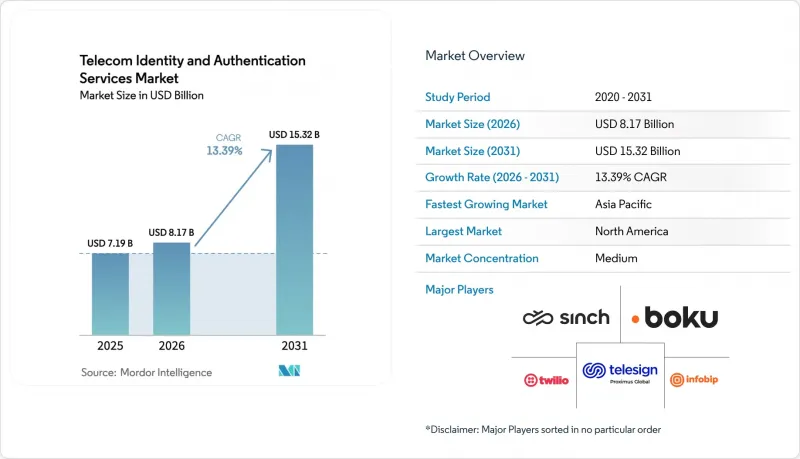
통신 ID 및 인증 서비스 시장 규모는 2025년에 71억 9,000만 달러로 평가되었습니다. 2026년 81억 7,000만 달러에서 2031년까지 153억 2,000만 달러에 이를 것으로 예측됩니다.
2026년부터 2031년까지 연평균 복합 성장률(CAGR) 13.39%를 나타낼 것으로 예상됩니다. 네트워크 수준의 검증에 대한 강력한 수요, SIM 스왑 사기의 급증, 이동통신사(MNO)에 대한 수익화 압력으로 인해, 프로그래밍 가능한 통신 인증 정보를 핵심 보안 조치로 취급하는 기업의 범위가 확대되고 있습니다. 2025년에는 솔루션이 매출의 대부분을 차지했지만, 은행, 소매업체, 핀테크 기업들이 규제 준수와 실시간 사기 감지 기능을 결합한 턴키 방식의 통합을 선호함에 따라 관리형 서비스의 확장 속도는 더욱 빨라질 것으로 예측됩니다. 결제 피크 시간대에는 인증 워크로드가 급증하고, 탄력적인 스케일링의 혜택을 누리기 위해 클라우드 도입이 대세가 되고 있습니다. 지역별로는 북미가 여전히 가장 큰 수익원이며, 아시아태평양은 통신사 API를 활용한 정부 주도의 디지털 ID 제도에 힘입어 가장 빠르게 성장하고 있는 지역입니다. 경쟁의 강도는 중간 정도입니다. Twilio, Sinch, Infobip 등의 메시징 애그리게이터들은 Prove, Trulioo 등의 전문 ID 플랫폼과 경쟁하고 있으며, Thales, IDEMIA 등의 하드웨어 보안 업체들은 보안 요소에 대한 전문지식을 활용하여 임베디드 인증 솔루션을 개발하고 있습니다.
세계의 통신 ID 및 인증 서비스 시장 동향 및 인사이트
MNO의 디지털 ID API 확장
MNO는 가입자 데이터를 프로그램 가능한 ID 프리미티브로 변환하고 있습니다. GSMA의 모바일 커넥트(Mobile Connect)는 2025년 말까지 31개국에서 47개의 도입 사례를 달성했으며, 기업들에게 SIM 스왑 체크, 디바이스 바인딩, 사일런트 검증을 하나의 계약으로 제공합니다. 2025년 2월에 출시된 보다폰의 트러스트허브는 99.99%의 가동률을 보장하는 SLA를 갖춘 RESTful API를 제공함으로써 실시간 사기 방지 대책을 충족해야 하는 은행의 통합 장벽을 낮추고 있습니다. 텔레포니카는 2025년 6월, 유사한 기능을 Azure Active Directory에 통합했습니다. 이는 통신사 인증이 고립된 통신 서비스가 아닌 클라우드 인프라의 기능이 되고 있음을 보여줍니다. 경쟁의 초점은 단순한 연결성이 아닌 지연, 불량 신호의 범위, 상업적 투명성 등으로 옮겨가고 있습니다. 2026년부터 2027년까지 더 많은 유럽과 라틴아메리카의 통신 사업자들이 API를 연동하고, 구현을 더욱 표준화하고, 지리적 커버리지를 확대할 것입니다.
SIM 스왑 및 계정 탈취 사기의 급격한 증가
2026년 3월에 발표된 FBI의 인터넷 범죄 보고서에 따르면, 2025년 SIM 스왑 사건은 48% 증가했고, 전 세계 피해액은 27억 달러가 넘었습니다. 공격자는 소매점의 소셜 엔지니어링 취약점을 악용하여 번호 이전, 일회용 코드 가로채기, 이중 인증 우회 등을 통해 이중 인증을 우회하고 있습니다. 이에 대해 미국 연방통신위원회(FCC)는 2025년 11월 통신사업자가 SIM 변경을 처리하기 전에 다단계 인증 적용을 의무화하는 규정을 제정했습니다. T-Mobile은 2026년 1월, SIM 변경 후 24시간 동안 인증을 자동으로 중지하여 부정사용을 방지하는 '계정 탈취 방지 기능'을 도입했습니다. 현재 사이버 보험사들은 보상 조건으로 통신사 수준의 인증을 요구하고 있으며, 이로 인해 기업들은 취약한 SMS OTP 플로우를 폐지하고 SIM 보유 기간, 기기 지문 및 최근 번호 이동성 이력을 확인하는 '사일런트 네트워크 검사'로 전환해야 합니다. 전환을 요구하고 있습니다.
중앙 집중식 가입자 데이터 리포지토리에 대한 프라이버시 우려 사항
유럽 데이터 보호 위원회는 2025년 3월, ID 서비스를 제공하는 통신사업자는 완전한 데이터 관리자로 판단하고, 데이터 보호 영향 평가 및 72시간 내 정보 유출 통지 등 GDPR(EU 개인정보보호규정)상의 의무를 부과했습니다. ETNO의 추산에 따르면, 컴플라이언스 대응 부담으로 인해 중소 통신사의 운영비용이 22% 증가하여 일부 사업자는 ID API 제공을 포기하는 사태가 벌어지고 있습니다. 옹호 단체들은 단 한 번의 침해 사고로 수백만 명의 가입자 기록이 유출될 수 있으며, 이는 대규모 감시와 사기를 가능하게 할 수 있다고 경고하고 있습니다. 그 결과, 규제 당국은 개인 식별자를 영구화하지 않고 SIM 카드의 소유권을 증명하는 토큰화 된 확인 방법을 추진하고 있으며, 이러한 설계 변경으로 인해 2027년까지 유럽 및 개인 정보 보호에 민감한 미국 주에서 플랫폼의 배포가 지연될 수 있습니다. 이 설계 변경으로 인해
부문 분석
2025년 기준, 솔루션은 통신 ID 및 인증 서비스 시장 매출의 63.40%를 차지했지만, 서비스 부문은 2031년까지 연평균 복합 성장률(CAGR) 15.40%로 성장하여 솔루션을 능가할 것으로 예측됩니다. 기업들은 설비 투자를 피하고, 수백 개의 통신 사업자를 통해 즉각적인 지리적 도달 범위를 확보하고, 규제 변경 관리를 외부에 위탁하기 위해 관리형 인증을 선택하고 있습니다. 2025년 Twilio가 Segment를 32억 달러에 인수한 것은 고객 데이터 오케스트레이션과 숫자 기반 인증을 결합하고, 행동 인사이트를 적응형 인증 과제로 전환하는 통합 스택에 중점을 두고 있음을 보여줍니다.
멀티 테넌트형 클라우드에 의존할 수 없는 규제가 엄격한 산업에서는 여전히 솔루션이 필수적입니다. 메인프레임 용도를 마이그레이션하는 은행이나 데이터 주권 관련 법령의 적용을 받는 병원에서는 SS7에 직접 접속하고 전용 하드웨어 보안 모듈을 갖춘 On-Premise형 엔진을 도입하고 있습니다. 이러한 분야에서도 구독형 개념이 부상하고 있습니다. 라이선스 계약에 지속적인 룰셋 업데이트와 24시간 365일 부정행위 감지 정보 제공이 포함되는 경우가 늘어나면서, 영구 라이선스형 소프트웨어와 매니지드 서비스의 경계가 모호해지고 있습니다. 그 결과, 각 벤더들은 기밀성이 높은 페이로드를 로컬에서 처리하면서 클라우드 분석 기능을 제공하는 하이브리드 모델을 정교화하여 확장성을 희생하지 않고도 컴플라이언스를 유지할 수 있도록 하고 있습니다.
2025년에는 클라우드 도입이 통신 ID 및 인증 서비스 시장 점유율의 68.81%를 차지했으며, 2031년까지 연평균 복합 성장률(CAGR) 15.11%의 두 자릿수 성장률을 유지할 것으로 전망됩니다. 이는 실시간 결제에서 지연시간, 탄력적인 확장성, 지리적 이중화가 필수적인 요건이기 때문입니다. Sinch는 AWS 리전 18곳을 추가하여 배포 범위를 확대한 후, 평균 API 응답 시간을 340밀리초에서 180밀리초로 단축하여 체크아웃 전환율을 눈에 띄게 향상시켰습니다.
On-Premise 도입은 매년 감소하는 추세이지만, 국경을 넘어선 데이터 전송을 규제하는 국내법이 존재하는 국가에서는 여전히 그 영향력이 강합니다. 독일, 아랍에미리트 등 시장에서 국방기관, 중요 인프라 사업자 및 소버린 클라우드 의무화로 인해 일부 수요가 유지되고 있습니다. 하이브리드 구성이 일반적입니다. 기업은 의사결정 엔진을 사내 방화벽 내부에서 운영하면서 SIM 스왑 확인을 위해 클라우드 엔드포인트를 호출하고 캐시된 결과를 활용함으로써 외부로의 데이터 전송을 최소화하면서 1초 미만의 사용자 경험을 유지하고 있습니다.
지역별 분석
2025년 북미는 통신 ID 및 인증 서비스 시장 매출의 36.22%를 차지했습니다. 이는 은행 및 의료 분야에서의 다단계 인증(MFA) 의무화 조기 도입과 미국 및 캐나다 전역에서 1초 미만의 API 호출을 가능하게 하는 캐리어 애그리게이션에 힘입은 바 큽니다. 5G의 광범위한 보급으로 무음 인증을 위한 신호 품질이 향상되는 한편, 사이버 보험의 요구 사항으로 인해 기업은 기존의 SMS OTP를 단계적으로 폐지할 수밖에 없습니다.
유럽의 성장은 더 안정적이지만, 엄격한 개인정보 보호법의 영향을 받고 있습니다. 이 지역은 PSD2 지침의 조화로운 시행으로 혜택을 받고 있지만, 시행 상황은 국가마다 다르며, 국경을 넘는 전자상거래의 복잡성을 가중시키고 있습니다. 2025년 10월에 발표된 Orange와 Deutsche Telekom의 'European Identity Platform'과 같은 합작 투자 사업은 eIDAS 2.0의 요구 사항을 충족하는 대륙 규모의 지갑 호환 서비스를 제공하는 것을 목표로 하고 있지만, 완전한 배포는 회원국들의 협조가 이루어져야만 완전한 전개가 가능합니다.
CAGR 16.72%로 성장하는 아태지역은 고가의 UPI 거래에 대한 인도의 SIM 바인딩 요건과 온보딩 시 통신사 확인을 통합한 인도네시아의 국가 디지털 ID에 힘입어 성장세를 보이고 있습니다. 중국 OEM 업체들의 휴대폰 시장 지배력은 eSIM의 보급을 가속화하고 있으며, 통신사들은 인증서 기반 검증을 위한 인증 로직을 재구축해야 하는 상황입니다. 한편, 동남아시아 신흥 시장에서는 종이 신분증을 통한 절차를 생략하고, 긱 이코노미 종사자의 KYC-lite 온보딩을 위해 통신사 API를 직접 활용하는 움직임이 빠르게 진행되고 있습니다.
기타 혜택 :
- 엑셀 형식 시장 예측(ME) 시트
- 3개월간 애널리스트 지원
자주 묻는 질문
목차
제1장 서론
제2장 조사 방법
제3장 주요 요약
제4장 시장 구도
제5장 시장 규모와 성장 예측
제6장 경쟁 구도
제7장 시장 기회와 향후 전망
KTH 26.05.29The Telecom Identity and Authentication Services Market size is projected to be USD 7.19 billion in 2025, USD 8.17 billion in 2026, and reach USD 15.32 billion by 2031, growing at a CAGR of 13.39% from 2026 to 2031. Strong demand for network-level verification, escalating SIM-swap fraud, and monetization pressure on mobile network operators (MNOs) are expanding the addressable base of enterprises that now treat programmable telecom credentials as a core security control. Solutions captured a significant share of revenue in 2025, though managed services are scaling faster because banks, retailers, and fintechs prefer turnkey integrations that bundle regulatory compliance and real-time fraud intelligence. Cloud deployments dominate because authentication workloads spike during peak payment windows and benefit from elastic scaling. Geographically, North America remains the largest revenue contributor, while Asia-Pacific is the fastest-growing region, driven by government digital-identity schemes that use carrier APIs. Competitive intensity is moderate: messaging aggregators such as Twilio, Sinch, and Infobip compete with specialist identity platforms such as Prove and Trulioo, while hardware security vendors, including Thales and IDEMIA, leverage secure-element expertise to launch embedded authentication offerings.
Global Telecom Identity And Authentication Services Market Trends and Insights
Expansion of MNO Digital-Identity APIs
MNOs are transforming subscriber data into programmable identity primitives. GSMA's Mobile Connect reached 47 deployments across 31 countries by the end of 2025, giving enterprises a single contract for SIM-swap checks, device binding, and silent verification. Vodafone's TrustHub, launched in February 2025, exposes RESTful APIs with 99.99% uptime SLAs, lowering integration friction for banks that must satisfy real-time fraud controls. Telefonica integrated the same capabilities into Azure Active Directory in June 2025, signaling that carrier authentication is becoming a cloud infrastructure feature rather than a siloed telecom service. Competition now centers on latency, fraud-signal breadth, and commercial transparency rather than mere connectivity. Over 2026-2027, additional European and Latin-American operators will federate APIs, further standardizing implementation and expanding geographic coverage.
Surge in SIM-Swap and Account-Takeover Fraud
SIM-swap incidents grew 48% in 2025, generating global losses above USD 2.7 billion, according to the FBI Internet Crime Report issued in March 2026. Attackers exploit social-engineering gaps at retail outlets to port numbers and intercept one-time codes, bypassing two-factor authentication. The U.S. FCC responded in November 2025 with rules that force carriers to apply multi-factor verification before processing SIM changes. T-Mobile rolled out Account Takeover Protection in January 2026, automatically pausing authentication for 24 hours after a SIM change to deter fraud. Cyber-insurers now require carrier-grade verification as a prerequisite for coverage, pushing enterprises to retire vulnerable SMS OTP flows in favor of silent network checks that validate SIM tenure, device fingerprinting, and recent porting events.
Privacy Concerns Over Centralized Subscriber Data Repositories
The European Data Protection Board ruled in March 2025 that operators offering identity services are full data controllers, triggering GDPR duties such as data-protection impact assessments and breach notification within 72 hours. ETNO estimates that compliance overhead lifted operating costs by 22% for small carriers, discouraging some from launching identity APIs. Advocacy groups warn that a single breach could expose millions of subscriber records, enabling mass surveillance or fraud. Consequently, regulators push for tokenized confirmations that prove SIM possession without persisting personal identifiers, a design shift likely to slow platform rollouts in Europe and privacy-sensitive U.S. states through 2027.
Other drivers and restraints analyzed in the detailed report include:
- Regulatory Mandates for Strong Customer Authentication
- Rise of eSIM and IoT Device Authentication
- Complex Revenue-Sharing Models Between MNOs and Identity Aggregators
For complete list of drivers and restraints, kindly check the Table Of Contents.
Segment Analysis
Solutions accounted for only 63.40% of the Telecom identity and authentication services market revenue in 2025, yet the services segment is forecast to grow at a 15.40% CAGR and surpass Solutions by 2031. Enterprises choose managed authentication to avoid capital expenditure, obtain instant geographic reach across hundreds of operators, and outsource regulatory change management. Twilio's USD 3.2 billion acquisition of Segment in 2025 bundled customer-data orchestration with number-based verification, illustrating the premium placed on integrated stacks that convert behavioral insights into adaptive authentication challenges.
Solutions remain essential for highly regulated verticals that cannot rely on multi-tenant clouds. Banks migrating mainframe applications or hospitals subject to data-sovereignty statutes deploy on-premises engines with direct SS7 access and dedicated hardware security modules. Even here, a subscription mindset is emerging: license agreements increasingly include continuous rule-set updates and 24/7 fraud-intelligence feeds, blurring the line between perpetual software and managed service. Consequently, vendors are refining hybrid models that deliver cloud analytics while processing sensitive payloads locally, preserving compliance without conceding scalability.
Cloud deployments commanded 68.81% of the Telecom identity and authentication services market share in 2025 and will sustain double-digit growth at a 15.11% CAGR by 2031, as latency, elastic scaling, and geographic redundancy are non-negotiable for real-time payments. Sinch trimmed the average API response time from 340 ms to 180 ms after expanding its footprint to 18 additional AWS regions, delivering a measurable uplift in checkout conversion rates.
On-premise adoption shrinks each year but resists extinction in countries where national rules restrict cross-border data transfers. Defense agencies, critical-infrastructure operators, and sovereign cloud mandates in markets such as Germany and the United Arab Emirates keep a rump demand alive. Hybrid postures are popular: enterprises run decision engines behind corporate firewalls yet call cloud endpoints for SIM-swap checks, leveraging cached results to minimize external data transfer while sustaining sub-second user experiences.
The Telecom Identity and Authentication Services Market Report is Segmented by Component (Solutions and Services), Deployment Mode (On-Premise and Cloud), Authentication Type (SMS-Based OTP, Mobile Biometrics, and More), End-User (Mobile Network Operators, and More), Industry Vertical (Financial Services, Ecommerce and Retail, and More), and Geography. The Market Forecasts are Provided in Terms of Value (USD).
Geography Analysis
North America contributed 36.22% of the Telecom identity and authentication services market revenue in 2025, anchored by early adoption of MFA mandates in banking and healthcare and supported by direct carrier aggregation that enables sub-second API calls across the United States and Canada. Widespread 5G rollout improves signal quality for silent verification, while cyber-insurance prerequisites compel enterprises to sunset legacy SMS OTP.
Europe's growth is steadier but shaped by stringent privacy laws. The region benefits from harmonized PSD2 directives, yet implementation varies by country, adding complexity for cross-border ecommerce. Joint ventures such as the Orange and Deutsche Telekom European Identity Platform, announced in October 2025, aim to deliver a continent-wide wallet-compatible service that meets eIDAS 2.0 requirements, but the full rollout depends on member-state alignment.
Asia-Pacific, expanding at 16.72% CAGR, is propelled by India's SIM binding requirement for high-value UPI transactions and Indonesia's national digital ID that embeds telecom checks at onboarding. Chinese OEM dominance in the handset market is accelerating eSIM adoption, compelling carriers to rewrite their authentication logic for certificate-based validation. Meanwhile, emerging markets in Southeast Asia leapfrog straight to carrier APIs for KYC-lite onboarding of gig-economy workers, bypassing paper ID processes.
List of Companies Covered in this Report:
- Boku Inc.
- Infobip D.O.O.
- Telesign Corporation
- Sinch AB
- Twilio Inc.
- Mobileum Inc.
- Prove Identity Inc.
- Callsign Limited
- 1Kosmos Inc.
- Trulioo Information Services Inc.
- Authlete, Inc.
- Tru.ID Limited
- IDEMIA Group S.A.S.
- Giesecke+Devrient GmbH
- Thales S.A.
- Amdocs Limited
- Tyntec GmbH
- Mitek Systems Inc.
- Aeris Communications Inc.
- Nexmo Inc. (Vonage)
Additional Benefits:
- The market estimate (ME) sheet in Excel format
- 3 months of analyst support
TABLE OF CONTENTS
1 INTRODUCTION
- 1.1 Study Assumptions and Market Definition
- 1.2 Scope of the Study
2 RESEARCH METHODOLOGY
3 EXECUTIVE SUMMARY
4 MARKET LANDSCAPE
- 4.1 Market Overview
- 4.2 Market Drivers
- 4.2.1 Expansion of Mobile Network Operator Digital Identity APIs
- 4.2.2 Surge in SIM Swap and Account Takeover Fraud
- 4.2.3 Regulatory Mandates for Strong Customer Authentication
- 4.2.4 Rise of eSIM and IoT Device Authentication
- 4.2.5 Telco Adoption of Decentralized Identifier Frameworks
- 4.2.6 Monetization Pressure Leading to Identity-As-A-Service Offerings
- 4.3 Market Restraints
- 4.3.1 Privacy Concerns Over Centralized Subscriber Data Repositories
- 4.3.2 Limited Awareness Among MVNOs and SMEs
- 4.3.3 Complex Revenue-Sharing Models Between MNOs and Identity Aggregators
- 4.3.4 Fragmented International KYC Standards
- 4.4 Industry Value Chain Analysis
- 4.5 Regulatory Landscape
- 4.6 Technological Outlook
- 4.7 Impact of Macroeconomic Factors
- 4.8 Porter's Five Forces Analysis
- 4.8.1 Threat of New Entrants
- 4.8.2 Bargaining Power of Suppliers
- 4.8.3 Bargaining Power of Buyers
- 4.8.4 Threat of Substitutes
- 4.8.5 Industry Rivalry
5 MARKET SIZE AND GROWTH FORECASTS (VALUE)
- 5.1 By Component
- 5.1.1 Solutions
- 5.1.2 Services
- 5.2 By Deployment Mode
- 5.2.1 On-Premise
- 5.2.2 Cloud
- 5.3 By Authentication Type
- 5.3.1 SMS-Based OTP
- 5.3.2 Mobile Biometrics
- 5.3.3 Multi-Factor Authentication Token
- 5.3.4 Digital Identity Verification API
- 5.4 By End-User
- 5.4.1 Mobile Network Operators
- 5.4.2 Mobile Virtual Network Operators
- 5.4.3 Over-The-Top Service Providers
- 5.4.4 Enterprises
- 5.5 By Industry Vertical
- 5.5.1 Financial Services
- 5.5.2 Ecommerce and Retail
- 5.5.3 Government and Public Sector
- 5.5.4 Healthcare
- 5.5.5 Media and Entertainment
- 5.6 By Geography
- 5.6.1 North America
- 5.6.1.1 United States
- 5.6.1.2 Canada
- 5.6.1.3 Mexico
- 5.6.2 South America
- 5.6.2.1 Brazil
- 5.6.2.2 Argentina
- 5.6.2.3 Rest of South America
- 5.6.3 Europe
- 5.6.3.1 Germany
- 5.6.3.2 United Kingdom
- 5.6.3.3 France
- 5.6.3.4 Russia
- 5.6.3.5 Rest of Europe
- 5.6.4 Asia-Pacific
- 5.6.4.1 China
- 5.6.4.2 Japan
- 5.6.4.3 India
- 5.6.4.4 South Korea
- 5.6.4.5 Rest of Asia-Pacific
- 5.6.5 Middle East and Africa
- 5.6.5.1 Middle East
- 5.6.5.1.1 Saudi Arabia
- 5.6.5.1.2 United Arab Emirates
- 5.6.5.1.3 Rest of the Middle East
- 5.6.5.2 Africa
- 5.6.5.2.1 South Africa
- 5.6.5.2.2 Nigeria
- 5.6.5.2.3 Rest of Africa
- 5.6.5.1 Middle East
- 5.6.1 North America
6 COMPETITIVE LANDSCAPE
- 6.1 Market Concentration
- 6.2 Strategic Moves
- 6.3 Market Share Analysis
- 6.4 Company Profiles (Includes Global Level Overview, Market Level Overview, Core Segments, Financials as Available, Strategic Information, Market Rank/Share For Key Companies, Products and Services, and Recent Developments)
- 6.4.1 Boku Inc.
- 6.4.2 Infobip D.O.O.
- 6.4.3 Telesign Corporation
- 6.4.4 Sinch AB
- 6.4.5 Twilio Inc.
- 6.4.6 Mobileum Inc.
- 6.4.7 Prove Identity Inc.
- 6.4.8 Callsign Limited
- 6.4.9 1Kosmos Inc.
- 6.4.10 Trulioo Information Services Inc.
- 6.4.11 Authlete, Inc.
- 6.4.12 Tru.ID Limited
- 6.4.13 IDEMIA Group S.A.S.
- 6.4.14 Giesecke+Devrient GmbH
- 6.4.15 Thales S.A.
- 6.4.16 Amdocs Limited
- 6.4.17 Tyntec GmbH
- 6.4.18 Mitek Systems Inc.
- 6.4.19 Aeris Communications Inc.
- 6.4.20 Nexmo Inc. (Vonage)
7 MARKET OPPORTUNITIES AND FUTURE OUTLOOK
- 7.1 White-Space and Unmet-Need Assessment
- 7.2 Analyst Recommendations and Suggestions