|
시장보고서
상품코드
2044070
고철 재활용 시장 : 점유율 분석, 산업 동향 및 통계, 성장 예측(2026-2031년)Scrap Metal Recycling - Market Share Analysis, Industry Trends & Statistics, Growth Forecasts (2026 - 2031) |
||||||
 Mordor Intelligence
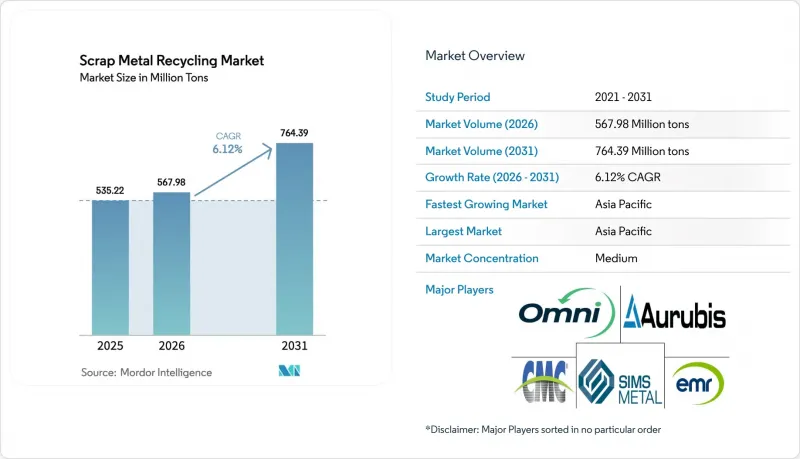
고철 재활용 시장 규모는 2025년 5억 3,522만 톤, 2026년 5억 6,798만 톤으로부터, 2031년까지 7억 6,439만 톤으로 확대될 것으로 예측되고 있으며 2026년부터 2031년까지 연평균 복합 성장률(CAGR)은 6.12%를 나타낼 전망입니다.
단기적인 성장을 견인하는 것은 세 가지 구조적 요인입니다. 첫째, 인도, 중동, 동남아시아의 새로운 전기 아크로(EAF)의 도입으로 국내 스크랩 소비량이 증가하고 수출량이 감소하고 있습니다. 둘째, 자동차 및 전자제품 OEM(주문자상표부착생산(OEM)이 낮은 잔여계약량을 확보하여 현물시장에서공급량을 제한하고 있습니다. 셋째, OECD의 스크랩 무역 자유화 추진으로 규제 당국은 통일된 품질 기준의 채택을 촉구하고 있지만, 각국의 수출 세제로 인해 지역별로 수급 균형이 여전히 타이트한 상황입니다. 이러한 추세는 구리 함량을 0.15% 미만으로 유지할 수 있는 가공업체들의 수익성을 향상시키는 반면, 여전히 수작업 선별 방식에 의존하는 시설들은 불리한 입장에 놓이게 됩니다.
세계 고철 재활용 시장 동향과 인사이트
인도, 중동 및 북아프리카(MENA), 동남아시아의 전기로(EAF) 설비의 급속한 증설
2024년 이후 시작된 전기로(EAF) 프로젝트는 아시아 지역 내 스크랩의 흐름을 바꾸어 놓았습니다. 타타스틸의 펀자브 공장에서만 가동 첫 해에 현지 수요를 75만 톤 증가시켰습니다. 한편, 에미레이트 스틸 알칸의 아부다비 공장(연간 350만 톤 생산)은 이전에는 튀르키예로 향하던 걸프 지역 화물을 전환했습니다. 2024년부터 2025년까지 인도네시아, 베트남, 말레이시아에서 280만 톤의 새로운 전기로(EAF) 생산능력이 추가되어 중국으로 흘러가던 일본산 스크랩을 흡수했습니다. 이러한 용광로가 본격 가동됨에 따라 스크랩 재활용 시장은 단거리 트럭 운송 능력의 한계와 제철소 게이트에서 300km 이내에서 즉시 납품되는 자재에 대한 프리미엄 가격 상승과 같은 문제에 직면하고 있습니다. 현지 수요 증가로 인해 그동안 체계적인 스크랩 유통망이 미발달한 지방도시에서 회수율이 향상될 것으로 예측됩니다.
자체용 스크랩 확보를 위한 수직계열화 제철소 M&A
2024년 초 선철 가격이 45% 급등하면서 제강 부문의 수익률이 압박을 받자 제강사들은 공급을 확보하기 위해 고철소 인수에 박차를 가하고 있습니다. 아르셀롤 미탈이 신일철주금의 북미 가공 네트워크의 절반을 인수함으로써, 신일철주금은 2백만 톤의 인증된 원료에 대한 접근성을 확보하는 동시에 거래 비용을 톤당 최소 12달러 이상 절감할 수 있게 되었습니다. 미국에서는 누콜 산하 데이비드 J. 조셉(David J. Joseph)이 2025년 중서부 지역에 12개의 스크랩 야드를 인수하여 처리 능력을 800만 톤으로 확대하면서, 이미 집중화되어 있던 지역의 스크랩 공급원이 더욱 타이트해졌습니다. 이러한 통합의 물결로 인해 대규모 구매자에게는 고철 재활용 시장이 호황을 누리고 있지만, 소규모 독립 사업자에게는 현물 시장공급 감소와 운전 자금의 변동성 위험 증가라는 문제에 직면하게 될 것입니다.
잔류 구리 오염 증가로 EAF 원료의 품질을 제한합니다.
2025년, 폐기물의 평균 구리 함량은 0.35%로 상승하여 많은 장제품용 전기 아크로(EAF)가 색 결함을 일으키지 않고도 허용되는 임계치인 0.2%를 초과했습니다. 티센크루프는 뒤스부르크 공장에 탈동 장비를 도입한 후 용해 공정 비용이 톤당 15유로 증가했다고 보고했습니다. 전기자동차의 배선 밀도가 높아지고 인쇄 회로 기판이 대중화됨에 따라 가공 업체는 로봇 선별 기술에 투자하거나 철근과 같은 저부가가치 제품으로의 다운사이징을 받아들여야 하는 선택을 강요받고 있습니다. 일본 경제산업성은 2028년까지 구리 잔류량 20% 감축을 목표로 자동 구리 추출 기술에 대한 설비투자 보조금 제도를 도입했습니다.
부문 분석
철계 금속이 2025년 처리량의 70.82%를 차지해, 이는 철근, 형강, 자동차 강판 수요에 힘입은 것입니다. 비철금속은 데이터센터 케이블, 전기자동차 인클로저, 북미와 유럽에서 거의 100%에 가까운 배터리 회수율에 힘입어 2031년까지 연평균 6.22%의 성장률을 보일 것으로 예측됩니다. 2025년 2,250만 톤의 광산 공급 부족과 강력한 전기화 수요가 결합하여 구리 스크랩 가격이 18% 상승하여 고철 재활용 시장의 고부가가치 부문을 촉진했습니다. 식수 캔 회수법에 따라 알루미늄의 회수가 순조롭게 진행되고 있지만, 래커에 의한 오염으로 인해 이차 합금의 수율은 버진 잉곳 수준의 85%에 불과합니다. 미국에서는 납축전지의 회수율이 99%에 달하고, 효율성의 기준을 확립한 반면, 티타늄은 여전히 틈새 시장인 항공우주 분야에서 고수익을 창출하고 있습니다.
등급 프리미엄이 시장의 트렌드를 형성하고 있습니다. 인증된 저구리 함유 철 스크랩은 톤당 최대 50달러까지 높은 가격에 거래되고 있으며, 이로 인해 대형 고철 야적장에서는 센서를 이용한 선별 설비에 대한 투자가 진행되고 있습니다. 비철금속 가공업체에서도 비슷한 추세를 볼 수 있습니다. 밀 등급 알루미늄은 혼합 절삭재보다 톤당 150달러 높은 가격에 거래되고 있으며, 구리 No.1 등급은 공급 부족이 최고조에 달했을 때 No.2 등급 대비 4%의 현물 프리미엄이 붙었습니다. AI 감지 기술의 보급이 진행됨에 따라 이러한 가격 차이는 줄어들 것으로 예측됩니다. 하지만, 초기 도입 기업들은 이미 고철 재활용 시장에서 가장 수익성이 높은 기회를 활용하기 시작했습니다.
"고철 재활용 시장 보고서"는 금속 유형(철(철 및 철강), 비철(구리, 알루미늄, 납, 기타 금속)), 최종 이용 산업(건설, 자동차, 전기/전자, 제조/산업, 기타), 지역(아시아태평양, 북미, 유럽, 남미, 중동/아프리카) 별로 분류되어 있습니다. 분류되어 있습니다. 시장 예측은 수량(톤) 기준으로 제공됩니다.
지역별 분석
아시아태평양은 2025년 시장 규모의 52.22%를 차지해 2031년까지 연평균 6.73% 성장할 것으로 예측됩니다. 중국의 국내 수출 금지 조치로 인해 800만 톤의 스크랩이 연안 전기 아크로(EAF)로 전환되어 일본과 한국에서공급이 타이트해졌습니다. 그럼에도 불구하고 일본은 620만 톤을 수출했지만, 이 수치는 2023년 기준치보다 15% 감소했습니다. AI 선별기를 갖춘 한국 포스코(POSCO)의 새로운 200만 톤 규모의 용광로로 인해 자동차 스크랩 수요가 증가하고 있습니다. 베트남, 인도네시아, 말레이시아도 비슷한 추세를 보이고 있으며, 생산 능력의 확대로 장거리 운송 경로에서 발생하는 잉여 스크랩을 흡수하여 현지 고철 재활용 시장의 성장에 기여하고 있습니다.
북미에서는 미국이 2025년 7,000만 톤을 처리했습니다. 이는 자동차 회수에 대한 엄격한 규제와 노후화된 인프라의 해체 공사가 뒷받침된 결과입니다. 커머셜 메탈즈 컴퍼니는 미국과 멕시코에 40개의 야드를 운영하고 있습니다. 캐나다는 주로 미국 바이어에게 스크랩을 수출했지만, 멕시코에서는 USMCA(미국-멕시코-캐나다 협정)의 규정에 따라 테르늄(Ternium)의 몬테레이 복합단지로 200만 톤의 수송이 촉진되었습니다. Nucor의 미국 중서부 지역 확장은 이 지역의 유통을 더욱 압박하고, 고철 재활용 시장에서 가격 안정화에 있어 통합 네트워크의 역할을 부각시켰습니다.
유럽에서는 '순환형 경제 행동계획'에 따라 2030년까지 해체 폐기물의 70%를 회수하도록 의무화하여 장척 제품 및 판재류 제품 제조업체에 안정적인 스크랩 공급을 보장하고 있습니다. 아르셀롤 미탈과 신일철주금의 제휴로 1,200만 톤의 독점 원료를 확보하고 있습니다. 튀르키예에서는 라이선스 규제로 인해 해외 판매가 반토막 나면서 수입 수요가 감소함에 따라 북유럽 미니밀은 지역 내 스크랩에 대한 의존도를 높이고 있습니다. 러시아에 대한 제재로 인해 유럽 고철 재활용 시장에 영향을 미치는 지역 간 불균형이 더욱 심화되고 있습니다.
기타 특전:
- 엑셀 형식 시장 예측(ME) 시트
- 3개월간 애널리스트 지원
자주 묻는 질문
목차
제1장 서론
제2장 조사 방법
제3장 주요 요약
제4장 시장 구도
제5장 시장 규모와 성장 예측
제6장 경쟁 구도
제7장 시장 기회와 향후 전망
JHS 26.06.02The Scrap Metal Recycling Market size is projected to expand from 535.22 Million tons in 2025 and 567.98 Million tons in 2026 to 764.39 Million tons by 2031, registering a CAGR of 6.12% between 2026 to 2031.
Three structural factors are driving the near-term growth. First, the introduction of new electric arc furnaces (EAFs) in India, the Middle-East, and Southeast Asia is increasing domestic scrap consumption and reducing export volumes. Second, automotive and electronics original equipment manufacturers (OEMs) are securing low-residual contracts, which limit spot market availability. Third, the OECD's advocacy for open scrap trade is encouraging regulators to adopt uniform quality standards, although national export levies continue to create tight regional balances. These dynamics enhance the profitability of processors capable of maintaining copper content below 0.15% while disadvantaging facilities that still depend on manual sorting methods.
Global Scrap Metal Recycling Market Trends and Insights
Rapid EAF Capacity Additions in India, MENA, and Southeast Asia
EAF projects launched since 2024 have reshaped intra-Asian scrap flows. Tata Steel's Punjab furnace alone increased local demand by 0.75 million tons in its first operational year, while Emirates Steel Arkan's 3.5 million-ton Abu Dhabi plant redirected Gulf cargoes that previously went to Turkey. Between 2024 and 2025, Indonesia, Vietnam, and Malaysia added 2.8 million tons of new EAF capacity, absorbing Japanese scrap that previously moved to China. As these furnaces reach full capacity, the Scrap Metal Recycling Market faces challenges such as limited short-haul trucking capacity and higher premiums for prompt material within 300 kilometers of mill gates. Increased local demand is expected to boost collection rates in secondary cities where organized scrap chains were previously underdeveloped.
Vertically Integrated Mill M&A to Secure Captive Scrap
Steelmakers have accelerated acquisitions of scrap yards to secure supply following a 45% spike in pig-iron prices in early 2024, which compressed melt-shop margins. ArcelorMittal's acquisition of half of Nippon Steel's continental processing network ensures access to 2 million tons of certified feed while reducing transaction costs by at least USD 12 per ton. In the United States, Nucor's David J. Joseph subsidiary acquired 12 Midwest yards in 2025, increasing throughput to 8 million tons and tightening the already-concentrated regional scrap pool. This wave of consolidation keeps the Scrap Metal Recycling Market dynamic for large buyers but leaves smaller independent players facing reduced spot availability and greater working-capital volatility.
Rising Residual Copper Contamination Limits EAF Feed Quality
The average copper content in obsolete scrap rose to 0.35% in 2025, exceeding the 0.2% threshold that most long-product EAFs can tolerate without causing color defects. ThyssenKrupp reported an additional EUR 15 per ton in melt-shop costs after installing decopperization units at its Duisburg facility. As electric vehicle wiring density increases and printed circuit boards become more prevalent, processors must either invest in robotic separation technologies or accept downgrades into lower-value products like rebar. Japan's trade ministry has introduced capital grants for automated copper extraction, aiming to reduce residual copper levels by 20% by 2028.
Other drivers and restraints analyzed in the detailed report include:
- AI-Guided LIBS and Hyperspectral Sorting Lifting Recovery Yield Above 98%
- OEM Closed-Loop Contracts for Certified Low-Residual Scrap
- Wave of National Export Restriction Laws Shrinking Tradable Pool
For complete list of drivers and restraints, kindly check the Table Of Contents.
Segment Analysis
Ferrous metals contributed 70.82% of the 2025 throughput, driven by demand for rebar, beams, and automotive sheet. Non-ferrous metals are anticipated to grow at a CAGR of 6.22% through 2031, supported by applications such as data-center cabling, electric vehicle enclosures, and near-total battery collection in North America and Europe. Copper scrap prices rose by 18% in 2025 due to a 2.5 million-ton mine shortfall combined with strong electrification demand, boosting the premium segment of the scrap metal recycling market. Aluminum collection remains robust under beverage-can take-back laws, though lacquer contamination limits secondary alloy yields to 85% of virgin ingot levels. Lead batteries set the efficiency standard with a 99% collection rate in the United States, while titanium continues to serve niche, high-margin aerospace applications.
Grade premiums are shaping market trends. Certified low-copper ferrous scrap fetches up to USD 50 per ton more, enabling sensor-based sorting investments among top-tier yards. Non-ferrous processors observe similar trends: mill-grade aluminum trades USD 150 per ton higher than mixed turnings, and No. 1 copper achieves a 4% spot premium over No. 2 copper during peak deficit periods. As AI detection technology becomes more widespread, these price gaps are expected to narrow. However, early adopters are already capitalizing on the most lucrative opportunities within the scrap metal recycling market.
The Scrap Metal Recycling Market Report is Segmented by Metal Type (Ferrous (Iron, and Steel) Non-Ferrous (Copper, Aluminum, Lead, and Other Metal Types)), End-Use Industry (Construction, Automotive, Electrical and Electronics, Manufacturing and Industrial, and More), and Geography (Asia-Pacific, North America, Europe, South America, and Middle-East and Africa). The Market Forecasts are Provided in Terms of Volume (Tons).
Geography Analysis
Asia-Pacific accounted for 52.22% of the 2025 market volume and is expected to grow at a CAGR of 6.73% through 2031. China's domestic export ban redirected 8 million tons of scrap to coastal electric arc furnaces (EAFs), tightening supply in Japan and South Korea. Despite this, Japan exported 6.2 million tons, though this figure was 15% lower than its 2023 baseline. South Korea's new 2 million-ton POSCO furnace, equipped with AI sorters, has increased demand for auto-grade feed. Vietnam, Indonesia, and Malaysia are following similar trajectories, with capacity expansions absorbing surplus feeds from long-haul routes and contributing to the growth of the local scrap metal recycling market.
In North America, the United States processed 70 million tons in 2025, supported by stringent automotive take-back regulations and aging infrastructure demolitions. Commercial Metals Company operates 40 yards across the United States and Mexico. Canada primarily exported scrap to U.S. buyers, while Mexico's USMCA rules facilitated the movement of 2 million tons to Ternium's Monterrey complex. Nucor's expansion in the U.S. Midwest further tightened regional flows, highlighting the role of integrated networks in stabilizing prices within the scrap metal recycling market.
In Europe, the Circular Economy Action Plan mandates 70% demolition-waste recovery by 2030, ensuring a consistent scrap supply for long-product and flat-product mills. ArcelorMittal's partnership with Nippon Steel secures 2 million tons of captive feed. Turkey's import demand declined after licensing restrictions halved overseas sales, prompting Nordic mini-mills to rely more on regional scrap. Russia, under payment sanctions, continues to reinforce regional imbalances that impact the European scrap metal recycling market.
- AIM Recycling
- ArcelorMittal
- Aurubis AG
- Baosteel Group Corporation
- CMR Green Technologies Ltd
- COHEN
- Commercial Metals Company (CMC)
- Dowa Holdings Co. Ltd
- European Metal Recycling Ltd.
- Gerdau S/A
- Greenwave Technology Solutions Inc.
- Norton Aluminium
- OmniSource, LLC
- Remondis SE & CO. KG
- Sims Limited
- SL Recycling
- Tata Steel Limited
- The David J. Joseph Company (Nucor Corporation)
- TKC Metal Recycling Inc.
- Tom Martin Company Ltd
- Total Metal Recycling, Inc.
Additional Benefits:
- The market estimate (ME) sheet in Excel format
- 3 months of analyst support
TABLE OF CONTENTS
1 Introduction
- 1.1 Study Assumptions and Market Definition
- 1.2 Scope of the Study
2 Research Methodology
3 Executive Summary
4 Market Landscape
- 4.1 Market Overview
- 4.2 Market Drivers
- 4.2.1 Rapid EAF capacity additions in India, MENA, and Southeast Asia
- 4.2.2 Vertically-integrated mill M&A to secure captive scrap
- 4.2.3 AI-guided LIBS and hyperspectral sorting lifting recovery yield more than 98%
- 4.2.4 OEM closed-loop contracts for certified low-residual scrap
- 4.2.5 OECD push for open scrap trade to hit 2050 net-zero steel targets
- 4.3 Market Restraints
- 4.3.1 Rising residual-copper contamination limits EAF feed quality
- 4.3.2 Wave of national export-restriction laws shrinking tradable pool
- 4.3.3 Scrap price volatility widening hedge costs for SMEs
- 4.4 Value Chain Analysis
- 4.5 Porter's Five Forces
- 4.5.1 Bargaining Power of Suppliers
- 4.5.2 Bargaining Power of Buyers
- 4.5.3 Threat of New Entrants
- 4.5.4 Threat of Substitutes
- 4.5.5 Degree of Competition
5 Market Size and Growth Forecasts (Volume)
- 5.1 By Metal Type
- 5.1.1 Ferrous
- 5.1.1.1 Iron
- 5.1.1.2 Steel
- 5.1.2 Non-Ferrous
- 5.1.2.1 Copper
- 5.1.2.2 Aluminum
- 5.1.2.3 Lead
- 5.1.2.4 Other Metal Types
- 5.1.1 Ferrous
- 5.2 By End-use Industry
- 5.2.1 Construction
- 5.2.2 Automotive
- 5.2.3 Electrical and Electronics
- 5.2.4 Manufacturing and Industrial
- 5.2.5 Consumer Appliances
- 5.2.6 Aerospace and Defense
- 5.2.7 Other End-use Industries
- 5.3 By Geography
- 5.3.1 Asia-Pacific
- 5.3.1.1 China
- 5.3.1.2 India
- 5.3.1.3 Japan
- 5.3.1.4 South Korea
- 5.3.1.5 Malaysia
- 5.3.1.6 Thailand
- 5.3.1.7 Indonesia
- 5.3.1.8 Vietnam
- 5.3.1.9 Rest of Asia-Pacific
- 5.3.2 North America
- 5.3.2.1 United States
- 5.3.2.2 Canada
- 5.3.2.3 Mexico
- 5.3.3 Europe
- 5.3.3.1 Germany
- 5.3.3.2 United Kingdom
- 5.3.3.3 France
- 5.3.3.4 Italy
- 5.3.3.5 Spain
- 5.3.3.6 Turkey
- 5.3.3.7 NORDIC Countries
- 5.3.3.8 Russia
- 5.3.3.9 Rest of Europe
- 5.3.4 South America
- 5.3.4.1 Brazil
- 5.3.4.2 Argentina
- 5.3.4.3 Rest of South America
- 5.3.5 Middle-East and Africa
- 5.3.5.1 Saudi Arabia
- 5.3.5.2 Qatar
- 5.3.5.3 United Arab Emirates
- 5.3.5.4 Egypt
- 5.3.5.5 South Africa
- 5.3.5.6 Rest of Middle-East and Africa
- 5.3.1 Asia-Pacific
6 Competitive Landscape
- 6.1 Market Concentration
- 6.2 Strategic Moves
- 6.3 Market Share (%)/ Ranking Analysis
- 6.4 Company Profiles (includes Global level Overview, Market level overview, Core Segments, Financials as available, Strategic Information, Products and Services, and Recent Developments)
- 6.4.1 AIM Recycling
- 6.4.2 ArcelorMittal
- 6.4.3 Aurubis AG
- 6.4.4 Baosteel Group Corporation
- 6.4.5 CMR Green Technologies Ltd
- 6.4.6 COHEN
- 6.4.7 Commercial Metals Company (CMC)
- 6.4.8 Dowa Holdings Co. Ltd
- 6.4.9 European Metal Recycling Ltd.
- 6.4.10 Gerdau S/A
- 6.4.11 Greenwave Technology Solutions Inc.
- 6.4.12 Norton Aluminium
- 6.4.13 OmniSource, LLC
- 6.4.14 Remondis SE & CO. KG
- 6.4.15 Sims Limited
- 6.4.16 SL Recycling
- 6.4.17 Tata Steel Limited
- 6.4.18 The David J. Joseph Company (Nucor Corporation)
- 6.4.19 TKC Metal Recycling Inc.
- 6.4.20 Tom Martin Company Ltd
- 6.4.21 Total Metal Recycling, Inc.
7 Market Opportunities and Future Outlook
- 7.1 White-space and Unmet-Need Assessment