

|
시장보고서
상품코드
2063231
배터리 스크랩 : 시장 점유율 분석, 업계 동향 및 통계, 성장 예측(2026-2031년)Battery Scrap - Market Share Analysis, Industry Trends & Statistics, Growth Forecasts (2026 - 2031) |
||||||
 Mordor Intelligence
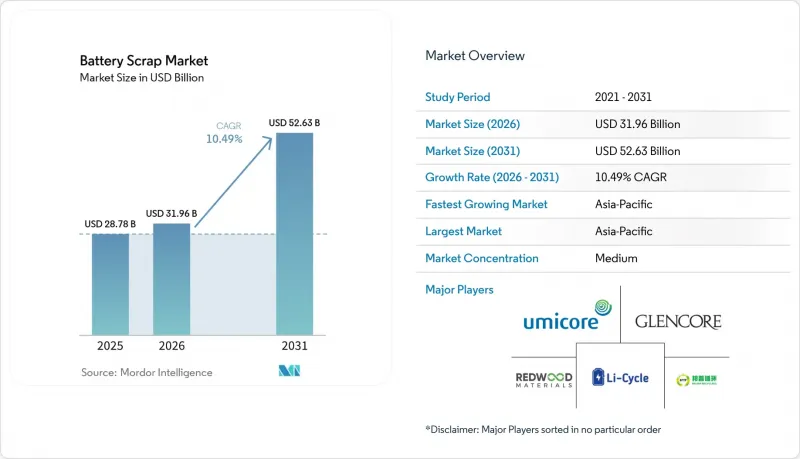
Mordor Intelligence에 의하면, 배터리 스크랩 시장 규모는 2025년 287억 8,000만 달러로 평가되었습니다. 2026년 319억 6,000만 달러에서 2031년까지 526억 3,000만 달러로 확대되고 2026-2031년 CAGR은 10.49%를 나타낼 것으로 예측됩니다.
본 보고서는 유형(납축전지, 리튬이온전지, 니켈계 전지, 기타 화학계), 용도(자동차, 산업용 동력, 소비자용 전자기기 등), 최종 사용자(전용 재활용 시설, OEM을 통한 회수, 유틸리티 등), 지역(북미, 유럽, 아시아태평양, 남미, 중동 및 아프리카)별로 분류되어 있습니다. 시장 전망은 금액(달러) 기준으로 제시되어 있습니다.
세계의 배터리 스크랩 시장 동향 및 인사이트
전기차 관련 리튬 이온 배터리 폐기량이 급증
2015년부터 2020년 사이에 탑재된 최초의 양산형 전기차용 배터리가 폐기되기 시작하면서 리튬 이온 배터리 폐기물이 급속히 증가했습니다. 전 세계 전기차용 배터리 수요는 2024년에 1TWh에 육박했고, 2030년까지 3TWh를 넘어설 것으로 예상되지만, 2023년 전 세계 재활용 처리 능력은 고작 300GWh에 그쳐 구조적인 공급 부족이 두드러졌습니다. 중국은 2024년에 50만 톤 이상의 사용 후 리튬 이온 배터리를 처리했으며, GEM의 새로운 징먼(Jingmen) 생산 라인을 통해 2026년까지 연간 처리량 30만 톤을 목표로 하고 있습니다. 광둥 브룸프 리사이클은 2024년에 니켈, 코발트, 망간의 회수율 99.6%, 리튬의 회수율 96.5%를 달성하여, 광산산 제품에 비해 원자재 비용을 15-20% 낮게 유지했습니다. 배터리 폐기량은 2025년 약 200GWh에서 2030년에는 1TWh 이상으로 증가할 것으로 예상되며, 폐배터리는 양극재 제조업체에게 주요 공급원으로 자리매김하게 될 것입니다. 지역별 원자재 부족으로 인해 자동차 제조업체, 배터리 제조업체, 전력 회사와 조기에 수거 계약을 체결한 재활용 기업에는 큰 이점이 있을 것으로 보입니다.
EU, 중국, 인도에서의 생산자 책임법 의무화
확대 생산자 책임(EPR) 체계에 따라 제조업체는 회수 및 재활용 비용을 부담해야 할 의무가 있으며, 이에 따라 공식적인 역물류 시스템 구축이 가속화되고 있습니다. EU의 배터리 규정에 따르면, 2027년까지 63%의 회수율과 코발트, 구리, 니켈에 대해 90%의 재활용 효율을 달성해야 하며, 2031년부터는 코발트 16%, 납 85%, 리튬 및 니켈 6%라는 재활용 함유율 하한선이 적용됩니다. 중국 공업정보화부는 전기차 제조업체들에게 회수 경로 구축과 추적성 데이터 기록을 의무화하고 있으며, 자동차 제조업체와 GEM, Brunp 등 대형 재활용 업체간의 제휴를 촉진하고 있습니다. 2025년까지 개정된 인도의 ‘배터리 폐기물 관리 규정’에 따르면, 회수 목표가 2026년부터 2027년까지 90%로 상향 조정되었으며, 2030년부터 2031년까지 재활용 비율 20% 달성이 의무화되었습니다. 이러한 정책에 따라 비공식 수거업자들은 시장에서 퇴출되었고, 수거된 양은 ISO 14001 인증을 취득한 시설로 유도되면서, 배터리 스크랩 시장은 산업 규모의 사업으로 전환되고 있습니다.
사용 후 배터리 팩의 비효율적인 세계 역물류
사용 후 배터리 팩의 회수 및 운송은 여전히 산발적이며 비용이 많이 듭니다. UN 3480 및 ADR 분류에 따라 특수한 포장 및 표시가 요구되며, 비위험물에 비해 단위당 물류 비용이 40-60% 더 높습니다. 설계상의 불균일성으로 인해 재활용 업체들은 맞춤형 분해 공구에 투자하거나, 파쇄 전용 라인을 사용함으로써 회수율 저하를 감수할 수밖에 없는 실정입니다. 2024년 인도의 흑연 수출 규제는 국내 정제 능력을 갖추지 못한 소규모 회수 업체들에게 병목 현상이 되었습니다. 한편, 인도네시아에서는 규제 감독을 받지 않는 상태에서 납축전지 스크랩의 약 30-40%가 여전히 비공식 부문에서 처리되고 있습니다. EU에서는 종합적인 배터리 패스포트 제도가 2027년 2월까지 도입되지 않을 예정이므로, 추적성 데이터는 여전히 단절된 상태로 남게 됩니다. 역물류의 기준이 통일될 때까지는 원료 집약 비용이 배터리 스크랩 시장의 성장을 저해할 것으로 보입니다.
부문별 분석
2025년 유통량의 61.2%를 납축전지가 차지했으며, 북미 및 유럽에서 99% 이상의 회수율을 바탕으로 배터리 스크랩 시장 규모를 지탱하고 있습니다. 그러나 전기차 폐차량이 증가함에 따라, 리튬 이온 배터리의 유통량은 2031년까지 연평균 성장률(CAGR) 22.3%로 급증할 것으로 예측됩니다. 습식 제련 업체들은 90-95%의 금속 회수율을 달성하고 있지만, 각 상업 거점마다 2억-5억 달러의 투자가 필요합니다. 한편, 건식 제련 업체는 자본 집약도가 낮은 대신 회수율이 80-85%에 그치고 있습니다. 하이브리드 차량이 리튬 이온 배터리로 전환됨에 따라 니켈수소 배터리의 폐배터리 시장 점유율은 줄어들고 있지만, 항공우주 및 방위 분야에서는 니켈카드뮴 재활용에 대한 틈새 수요가 유지되고 있습니다.
직접 카소드 리제네레이션(직접 음극 재생)은 소재의 완전한 분해를 필요로 하지 않고 비용을 30-40% 절감함으로써 리튬 이온 배터리 처리 공정에 혁신을 가져오고 있습니다. 조지아주에 위치한 Ascend Elements사의 ‘Hydro-to-Cathode’ 라인은 91%의 회수율을 달성했으며, 몇 주 이내에 재료를 셀 공장으로 재투입함으로써 운전 자금의 회수 주기를 단축하고 있습니다. ReCell Center의 시범 시험 결과, NMC 622 스크랩에서 NMC 811을 재생할 수 있음이 입증되었으나, LFP 및 니켈·코발트·알루미늄 계열 제품에 대해서는 여전히 별도의 처리 공정이 필요합니다. LFP 채택이 확대되는 가운데, 2031년까지 어떤 기업이 배터리 스크랩 시장 점유율을 유지할 수 있을지는 유연한 다중 화학 성분 대응 공장의 유무에 따라 결정될 것입니다.
지역별 분석
아시아태평양은 2025년 배터리 스크랩 시장 규모의 49.3%를 차지하며 시장을 주도했으며, 2031년까지 연평균 성장률(CAGR) 13.3%를 나타낼 것으로 전망됩니다. 중국 alone이 전 세계 재활용 능력의 80%를 차지하고 있으며, GEM의 새로운 5만 톤 규모 생산라인을 통해 총 생산 능력은 30만 톤에 달하며, 계약에 따라 CATL 및 BYD에 공급하고 있습니다. 인도의 개정된 ‘배터리 폐기물 관리 규정’에서는 2026-2027년까지 회수율을 90%로 높이는 목표를 제시하고 있지만, 시행 현황의 편차와 블랙매스(흑색 잔류물) 수출 금지 조치가 소규모 회수 업체들에게 과제로 대두되고 있습니다. 일본과 한국은 계속해서 기술 분야의 선두주자로 자리매김하고 있으며, 성일하이테크의 서해만에 위치한 600톤 규모의 코발트 공장은 해당 지역의 습식 제련 기술의 기반이 되고 있고, 스미토모 상사는 닛산과 제휴하여 리프의 배터리 팩 재활용에 힘쓰고 있습니다.
유럽은 엄격한 규제 덕분에 시장 규모 면에서 2위를 차지하고 있습니다. 노스볼트의 ‘레볼트’ 공장은 2025년에 처리 능력 5만 톤에 도달했으며, 2030년까지 12만 5,000톤을 목표로 하고 있습니다. 2027년 2월부터 의무화되는 EU 배터리 패스포트에는 QR 코드를 통한 추적 가능성과 재활용 함량 공개 조항이 포함되어 있어, 수직 통합형 기업에 경쟁 우위를 제공합니다. 북미는 인플레이션 억제법(IRA)의 인센티브에 힘입어 추격세를 보이고 있습니다. 레드우드와 어센드 엘리먼츠는 모두 2025년에 상업 생산 라인을 확대했으나, 글렌코어는 앨라배마주 사업장에 2억 달러를 투자했음에도 불구하고 비용 초과로 인해 로체스터 사업장의 가동을 일시 중단했습니다.
남미와 중동 및 아프리카는 여전히 개발도상국입니다. 브라질의 플렉스 연료 차량(FFV) 보유 대수는 안정적인 납축전지 공급원이 되고 있지만, 전기차 보급률이 낮아 리튬이온전지에 대한 투자는 미뤄지고 있습니다. 사우디아라비아와 아랍에미리트(UAE)는 다각화 전략의 일환으로 재활용을 검토하고 있지만, 원료는 여전히 부족한 실정입니다. 이집트에서는 국내 납축전지 처리량의 절반 이상을 비공식 사업자가 담당하고 있지만, 2024년 규정안에 따라 공식적인 회수 제도가 추진될 전망입니다. 지역 간 격차로 인해, 국내 거점이 규모를 확대하기 전까지는 블랙마스(Black Mass)의 국경 간 거래가 증가할 것으로 예측됩니다.
기타 혜택 :
- 엑셀 형식 시장 예측(ME) 시트
- 3개월간의 애널리스트 지원
자주 묻는 질문
목차
제1장 서론
제2장 조사 방법
제3장 주요 요약
제4장 시장 구도
제5장 시장 규모 및 성장 예측
제6장 경쟁 구도
제7장 시장 기회 및 향후 전망
KTH 26.06.22According to Mordor Intelligence, the battery scrap market size is projected to expand from USD 28.78 billion in 2025 and USD 31.96 billion in 2026 to USD 52.63 billion by 2031, registering a CAGR of 10.49% between 2026 and 2031.
This report is Segmented by Type (Lead-Acid, Lithium-Ion, Nickel-Based, Other Chemistries), Application (Automotive, Industrial Motive-Power, Consumer Electronics, and More), End-User (Dedicated Recycling Facilities, OEM Take-Back, Utilities, and More), and Geography (North America, Europe, Asia-Pacific, South America, and Middle East and Africa). The Market Forecasts are Provided in Terms of Value (USD).
Global Battery Scrap Market Trends and Insights
Soaring EV-Linked Li-ion Volumes Hitting End-of-Life
The first mass-market EV batteries installed between 2015 and 2020 have begun retiring, creating a rapid upswing in lithium-ion scrap. Global EV battery demand stood near 1 TWh in 2024 and is forecast to exceed 3 TWh by 2030, yet worldwide recycling capacity totaled only 300 GWh in 2023, underscoring a structural supply imbalance . China processed more than 500,000 tons of spent Li-ion cells in 2024 and targets 300,000 tons of annual throughput by 2026 through GEM's new Jingmen line. Guangdong Brunp Recycling reported 99.6% recovery of nickel, cobalt, and manganese and 96.5% of lithium in 2024, keeping material costs 15-20% below mined equivalents. Battery retirements are forecast to climb from roughly 200 GWh in 2025 to more than 1 TWh in 2030, transforming scrap into a front-line supply source for cathode producers. Regional feedstock tightness is set to reward recyclers who lock in offtake early with automakers, cell makers, and utilities.
Mandatory Producer-Responsibility Laws in EU, China, India
Extended producer responsibility (EPR) frameworks now obligate manufacturers to fund collection and recycling, accelerating formal reverse-logistics build-outs. The EU Battery Regulation mandates 63% collection by 2027 and 90% recycling efficiency for cobalt, copper, and nickel by 2027, with recycled-content floors of 16% cobalt, 85% lead, and 6% lithium and nickel taking effect from 2031 . China's Ministry of Industry and Information Technology requires EV producers to establish take-back channels and log traceability data, stimulating partnerships between automakers and large recyclers such as GEM and Brunp. India's Battery Waste Management Rules, amended through 2025, lift recovery targets to 90% by 2026-2027 and introduce recycled-content mandates rising to 20% by 2030-2031. These policies marginalize informal collectors and channel volumes toward ISO 14001-certified facilities, pushing the battery scrap market toward industrial-scale operations.
Inefficient Global Reverse-Logistics for End-of-Life Packs
Collection and transport of spent packs remain fragmented and costly. UN 3480 and ADR classifications demand specialized packaging and labeling, inflating per-unit logistics costs by 40-60% over non-hazardous goods. Design heterogeneity forces recyclers to invest in bespoke disassembly tooling or accept lower yields from shredding-only lines. India's 2024 black-mass export restriction created bottlenecks for small collectors who lack domestic refining, while Indonesia's informal sector still handles around 30-40% of lead-acid scrap outside regulatory oversight. A comprehensive battery passport system will not arrive in the EU until February 2027, keeping traceability data siloed. Until reverse-logistics standards converge, feedstock aggregation costs will temper the growth of the battery scrap market.
Other drivers and restraints analyzed in the detailed report include:
- Growing Black-Mass Spot Prices Improving Recycler Margins
- OEM "Closed-Loop" Offtake Contracts
- Volatile Cobalt & Nickel Prices Eroding Re-Seller Profits
For complete list of drivers and restraints, kindly check the Table Of Contents.
Segment Analysis
Lead-acid batteries supplied 61.2% of 2025 flows, anchoring the battery scrap market size with recovery rates above 99% in North America and Europe. Lithium-ion volumes, however, are projected to surge at a 22.3% CAGR to 2031 as EV retirements accelerate. Hydrometallurgical refiners deliver 90-95% metal recovery but need USD 200-500 million per commercial hub, whereas pyrometallurgical operators accept 80-85% yields for lower capital intensity. The battery scrap market share for nickel-metal-hydride cells is shrinking as hybrid vehicles transition to Li-ion, yet aerospace and defense preserve a niche demand for nickel-cadmium recycling.
Direct-cathode-regeneration is disrupting lithium-ion processing by eliminating full material breakdown and cutting costs by 30-40%. Ascend Elements' Hydro-to-Cathode line in Georgia achieves 91% recovery and reintroduces material into cell plants within weeks, shrinking working-capital cycles. ReCell Center pilots show NMC 622 scrap can regenerate NMC 811, though LFP and nickel-cobalt-aluminum variants still require separate flows. As LFP adoption rises, flexible multi-chemistry plants will determine which players retain battery scrap market share through 2031.
Geography Analysis
Asia-Pacific dominated the battery scrap market size with 49.3% of 2025 volumes and is forecast to have a 13.3% CAGR through 2031. China alone controls 80% of global recycling capacity; GEM's new 50,000-ton line pushes its total to 300,000 tons and supplies CATL and BYD under contract. India's amended Battery Waste Management Rules raise recovery targets to 90% by 2026-2027, but uneven enforcement and black-mass export bans challenge small collectors. Japan and South Korea remain technology leaders: SungEel HiTech's 600-ton cobalt plant in Saemangeum anchors regional hydrometallurgical expertise, and Sumitomo partners with Nissan on Leaf pack recycling.
Europe ranks second by value thanks to stringent regulation. Northvolt's Revolt plant reached 50,000 tons throughput in 2025 and aims for 125,000 tons by 2030. The EU Battery Passport, mandatory from February 2027, embeds QR-code traceability and recycled-content disclosure, tilting competitive advantage toward vertically integrated players. North America is catching up under the Inflation Reduction Act incentives: Redwood and Ascend Elements both scaled commercial lines in 2025, while Li-Cycle paused its Rochester hub amid cost overruns despite Glencore's USD 200 million investment in an Alabama spoke.
South America and the Middle East & Africa remain nascent. Brazil's flex-fuel car parc creates steady lead-acid flows, yet low EV penetration defers lithium-ion investment. Saudi Arabia and the UAE are evaluating recycling as part of diversification agendas, but feedstock remains scarce. Egypt's informal operators handle over half of national lead-acid volumes, with 2024 draft rules set to push formal take-back schemes. Regional disparity suggests cross-border trade in black mass will rise until domestic hubs reach scale.
- Umicore
- Li-Cycle
- Redwood Materials
- Glencore
- GEM Co., Ltd.
- Guangdong Brunp Recycling
- TES (Sims Lifecycle Services)
- Retriev Technologies
- Fortum Battery Solutions
- Ganfeng Lithium
- Stena Recycling
- Duesenfeld
- SungEel HiTech
- American Battery Technology Co.
- RecycLiCo Battery Materials
- Accurec Recycling
- Envirostream Australia
- Battery Solutions LLC
- Raw Materials Co.
- Highpower Technology
- Inobat Recycling
- EcoGraf
- Tenova
Additional Benefits:
- The market estimate (ME) sheet in Excel format
- 3 months of analyst support
TABLE OF CONTENTS
1 Introduction
- 1.1 Study Assumptions & Market Definition
- 1.2 Scope of the Study
2 Research Methodology
3 Executive Summary
4 Market Landscape
- 4.1 Market Overview
- 4.2 Market Drivers
- 4.2.1 Soaring EV-linked Li-ion volumes hitting end-of-life
- 4.2.2 Mandatory producer-responsibility laws in EU, China, India
- 4.2.3 Growing black-mass spot prices improving recycler margins
- 4.2.4 OEM "closed-loop" offtake contracts (e.g., Tesla-Redwood)
- 4.2.5 AI-enabled scrap-stream triage boosting recovery yields
- 4.2.6 Stationary-storage repurposing delaying recycle flows
- 4.3 Market Restraints
- 4.3.1 Inefficient global reverse-logistics for end-of-life packs
- 4.3.2 Volatile cobalt & nickel prices eroding re-seller profits
- 4.3.3 Technology-lock risk from rapid cell-chemistry shifts
- 4.3.4 Fire-safety liabilities inflating insurance premiums
- 4.4 Supply-Chain Analysis
- 4.5 Regulatory Landscape
- 4.6 Technological Outlook
- 4.7 Porter's Five Forces Analysis
- 4.7.1 Threat of New Entrants
- 4.7.2 Bargaining Power of Buyers
- 4.7.3 Bargaining Power of Suppliers
- 4.7.4 Threat of Substitutes
- 4.7.5 Competitive Rivalry
5 Market Size & Growth Forecasts
- 5.1 By Type
- 5.1.1 Lead-Acid Battery Scrap
- 5.1.2 Lithium-ion Battery Scrap
- 5.1.3 Nickel-based Battery Scrap
- 5.1.4 Other Chemistries (NiCd, Zn-air, Solid-state pre-commercial)
- 5.2 By Application
- 5.2.1 Automotive
- 5.2.2 Industrial Motive-Power
- 5.2.3 Consumer Electronics
- 5.2.4 Stationary Energy-Storage Systems
- 5.2.5 Aerospace and Defense
- 5.2.6 Other Niche Uses (medical, maritime, mining)
- 5.3 By End-User
- 5.3.1 Dedicated Recycling Facilities
- 5.3.2 Original Equipment Manufacturers (OEM Take-Back)
- 5.3.3 Utilities and Power Producers
- 5.3.4 Third-party Waste-Management Firms
- 5.3.5 Informal/Small-scale Collectors
- 5.4 By Geography
- 5.4.1 North America
- 5.4.1.1 United States
- 5.4.1.2 Canada
- 5.4.1.3 Mexico
- 5.4.2 Europe
- 5.4.2.1 Germany
- 5.4.2.2 United Kingdom
- 5.4.2.3 France
- 5.4.2.4 Italy
- 5.4.2.5 NORDIC Countries
- 5.4.2.6 Russia
- 5.4.2.7 Rest of Europe
- 5.4.3 Asia-Pacific
- 5.4.3.1 China
- 5.4.3.2 India
- 5.4.3.3 Japan
- 5.4.3.4 South Korea
- 5.4.3.5 ASEAN Countries
- 5.4.3.6 Rest of Asia-Pacific
- 5.4.4 South America
- 5.4.4.1 Brazil
- 5.4.4.2 Argentina
- 5.4.4.3 Rest of South America
- 5.4.5 Middle East and Africa
- 5.4.5.1 Saudi Arabia
- 5.4.5.2 United Arab Emirates
- 5.4.5.3 South Africa
- 5.4.5.4 Egypt
- 5.4.5.5 Rest of Middle East and Africa
- 5.4.1 North America
6 Competitive Landscape
- 6.1 Market Concentration
- 6.2 Strategic Moves (M&A, Partnerships, PPAs)
- 6.3 Market Share Analysis (Market Rank/Share for key companies)
- 6.4 Company Profiles (includes Global level Overview, Market level overview, Core Segments, Financials as available, Strategic Information, Products & Services, and Recent Developments)
- 6.4.1 Umicore
- 6.4.2 Li-Cycle
- 6.4.3 Redwood Materials
- 6.4.4 Glencore
- 6.4.5 GEM Co., Ltd.
- 6.4.6 Guangdong Brunp Recycling
- 6.4.7 TES (Sims Lifecycle Services)
- 6.4.8 Retriev Technologies
- 6.4.9 Fortum Battery Solutions
- 6.4.10 Ganfeng Lithium
- 6.4.11 Stena Recycling
- 6.4.12 Duesenfeld
- 6.4.13 SungEel HiTech
- 6.4.14 American Battery Technology Co.
- 6.4.15 RecycLiCo Battery Materials
- 6.4.16 Accurec Recycling
- 6.4.17 Envirostream Australia
- 6.4.18 Battery Solutions LLC
- 6.4.19 Raw Materials Co.
- 6.4.20 Highpower Technology
- 6.4.21 Inobat Recycling
- 6.4.22 EcoGraf
- 6.4.23 Tenova
7 Market Opportunities & Future Outlook
- 7.1 White-space & Unmet-Need Assessment


