
|
시장보고서
상품코드
2044080
플라스틱 폐기물 관리 시장 : 점유율 분석, 산업 동향 및 통계, 성장 예측(2026-2031년)Plastic Waste Management - Market Share Analysis, Industry Trends & Statistics, Growth Forecasts (2026 - 2031) |
||||||
 Mordor Intelligence
플라스틱 폐기물 관리 시장 규모는 2025년 481억 달러에서 2026년에는 498억 1,000만 달러로 확대되어 2026년부터 2031년까지 CAGR 3.55%로 성장을 지속하여, 2031년에는 593억 1,000만 달러에 이를 것으로 예측됩니다.
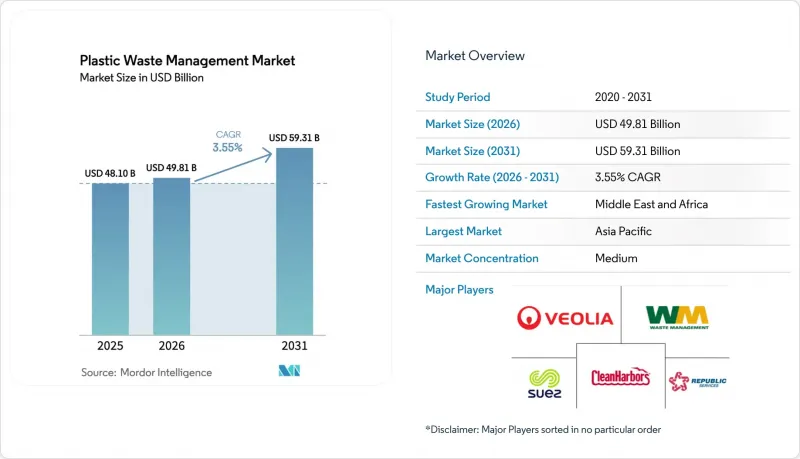
25개 이상의 관할권에서 시행되고 있는 생산자책임재활용제도(EPR)를 비롯한 규제 강화로 인해 이해관계자들은 포장재 재설계 및 재활용률 의무화 요건을 충족하는 회수 시스템에 투자해야 하는 상황에 처해 있습니다. 아시아태평양은 지역별로 가장 높은 수요를 유지하고 있으며, 가장 큰 재활용 설비 기반을 보유하고 있지만, 중동 및 아프리카는 각국 정부의 야심찬 매립 폐기물 감축 목표에 따라 다른 지역보다 높은 성장세를 보이고 있습니다. 민간의 '순환 경제' 펀드와 신규 설비의 리스크를 줄여주는 기업의 인수 계약에 힘입어, 투자 모멘텀은 전통적인 폐기물 처리에서 첨단 화학적 재활용으로 옮겨가고 있습니다. 현장에 도입된 AI 기반 광학 선별기는 MRF(Material Recovery Facility) 운영 비용을 최대 25% 절감하고, 원료의 품질을 향상시켜 버진 폴리머 가격 하락 시에도 재활용 소재의 수익률을 높이고 있습니다.
세계 플라스틱 폐기물 관리 시장 동향과 인사이트
확대된 생산자책임재활용(EPR) 규정으로 EU와 캐나다에서 유료 회수가 가속화되고 있습니다.
EPR 제도는 회수 및 처리 비용을 생산자에게 전가함으로써 경제구조를 변화시키고, 재료 중량 감소와 재생재 함량 향상을 위한 직접적인 인센티브를 창출하고 있습니다. 2025년 2월부터 시행되는 EU 규정은 2030년까지 식품 포장에 재생 PET를 30%까지 사용하도록 요구하고 있습니다. 한편, 브리티시컬럼비아주를 비롯한 캐나다 각 주에서는 이미 성숙한 제도를 통해 79.6%의 회수율을 기록하고 있습니다. 캘리포니아, 미네소타 등 미국 주정부 프로그램도 이러한 접근 방식을 따르고 있어 북미 전역의 통일이 진행되고 있음을 시사하고 있습니다. 생산자들은 현재 원자재 구매 비용 외에 컴플라이언스 비용도 예산에 반영하고 있으며, 재활용을 고려한 설계와 폐쇄형 조달(순환형 조달)이 비용 관리와 브랜드 평가의 핵심이 되고 있습니다.
중국의 저품질 스크랩 수입 금지 조치로 아시아 지역 내 국내 재활용 수익률 증가
2017년 중국이 대부분의 플라스틱 스크랩 수입을 금지함에 따라 수출업체는 베일의 순도를 높이거나 출하처를 변경해야만 했고, 동시에 라이선스를 받은 재활용업체들의 국내 이익률이 확대되었습니다. 국무원 순환경제계획은 2025년까지 연간 45억 톤의 자원 재활용을 목표로 하고 있으며, PET 음료 용기는 이미 96.48%의 회수율을 달성했습니다. 광둥성과 저장성의 지역 허브에서 플레이크는 국내 포장 시장과 수출 시장 모두에 판매되고 있으며, 현지 원자재 가격 상승과 세계 차익 거래 기회가 공존할 수 있음을 보여줍니다. 인근 아세안 회원국들은 저품질 폐기물의 수용소가 되지 않기 위해 품질 기준을 도입하여 대응하고 있으며, 이는 역내 처리 능력 확충을 촉진하고 있습니다.
플라스틱의 과잉 생산과 과잉 소비는 폐기물 관리에 부담을 주고, 재활용과 순환 경제에 대한 노력을 저해하고 있습니다.
세계 폴리머 생산량은 2022년 4억 3천만 톤에 달하고, 2035년까지 두 배로 증가할 가능성이 있습니다. 이로 인해 기존 회수 네트워크가 압도되고, 공급이 최종 시장 수요를 초과할 경우 재생재 가격이 하락할 수 있습니다. 전 세계 플라스틱 폐기물의 재활용률은 9%에 불과하며, 해양 유출의 65%가 발생하는 아프리카에서는 22%가 부적절하게 처리되고 있습니다. 또한, 생산능력의 과잉은 버진 폴리머의 가격을 하락시키고, 정책적인 인수 의무가 없는 한, 재활용 재료 사용의 경제성을 떨어뜨릴 수 있습니다.
부문 분석
2025년 기준 폴리에틸렌은 플라스틱 폐기물 관리 시장의 32.28%를 차지해, 이는 연질 및 경질 포장 분야에서 폴리에틸렌의 우위를 반영합니다. 철저한 문전수거 프로그램과 광범위한 기계식 재활용 인프라가 안정적인 처리량을 뒷받침하고 있습니다. 그러나 PET는 가장 빠르게 성장하고 있는 폴리머 분야로, 2030년까지 30% 재활용 소재 사용을 의무화하는 EU 규제 등 병 대 병(bottle to bottle) 의무화를 배경으로 CAGR 5.82%로 확대되고 있습니다. 중국의 폐쇄형 루프 시스템에서는 이미 음료용 PET병의 96.48%가 회수되어 국내 가공업체를 위한 고품질 플레이크가 생산되고 있습니다. 식품 등급의 탈중합 공장이 더 많이 가동됨에 따라, PET는 고사양의 재활용 응용 분야에서 최적의 소재로 자리매김하고 있습니다.
수요의 흐름은 규제 프레임워크을 넘어서고 있습니다. PET의 화학적 구조는 수지를 단량체 수준의 순도로 되돌릴 수 있는 용매 기반 탈중합을 가능하게 하여 물성 저하 없이 무한한 재사용을 가능하게 합니다. 폴리프로필렌과 폴리스티렌은 오염과 최종 시장의 한계로 인해 뒤쳐져 있지만, PVC 재활용은 AI를 활용한 사전 선별 시스템과 고효율 슈레더의 도입으로 탄력을 받고 있습니다. 기술 개발자들은 현재 정제소 원료 및 수소 제품별 생산 혼합 폴리머의 열분해를 목표로 하고 있습니다. 이러한 다양화로 인해 PE의 우위는 약화될 수 있지만, 그 규모와 저비용 회수 체계로 인해 플라스틱 폐기물 관리 시장에서 PE의 중요성은 계속 유지될 것입니다.
2025년에는 산업 부문이 전체 플라스틱 폐기물의 51.74%를 차지해, 균일한 재료 흐름과 낮은 혼입률의 혜택을 누릴 수 있습니다. 제조 공정의 단재, 유통용 필름 및 소비 전 스크랩은 전문 공장에 공급되어 더 높은 회수율을 달성하고 예측 가능한 원재료 가격을 누릴 수 있습니다. 주거용 폐기물 흐름은 지자체의 표준화된 수거 용기 도입, 오염 방지 교육, 스마트 카메라 도입이 진행됨에 따라 2031년까지 연평균 6.08%의 가장 빠른 성장률을 보일 것으로 예측됩니다. 킹 카운티의 시범사업에서는 오염률을 중요한 임계치인 12% 미만으로 낮추어 베일의 가치를 향상시켰습니다.
주택 폐기물 확대는 주택 폐기물 수거 체계의 정비 자금이 되는 EPR(확대 생산자 책임) 수수료 수입에 의해 뒷받침되고 있습니다. 로드아일랜드 주에서 스마트 센서를 시범 도입한 결과, 폐기물 처리 거부량이 감소하여 납세자의 운반 비용을 수백만 달러 절약할 수 있었습니다. 산업 폐기물은 그 규모의 크기로 인해 물류가 단순화되어 여전히 고단가 계약이 유지될 것으로 예상되지만, 디지털을 통한 수거 경로의 최적화로 가구당 수거 비용이 절감되어 폐기물 처리량의 가장 큰 증가는 가정에서 발생할 것으로 예측됩니다. 따라서 플라스틱 폐기물 관리 시장은 소량 수거와 재료의 순도 기준을 동시에 충족하는 솔루션으로 전환하고 있습니다.
"플라스틱 폐기물 관리 시장 보고서는 폴리에틸렌(PE), 폴리프로필렌(PP) 등 폴리머 유형별, 발생원별(산업, 주거 등), 서비스별(처리 및 처리 등), 최종 이용 산업별(포장, 자동차 등), 지역별(아시아태평양, 북미, 유럽 등)로 분류되어 있습니다. 분류되어 있습니다. 본 보고서에서는 위의 모든 부문에 대해 시장 규모와 예측(금액: USD)을 제시합니다.
지역별 분석
아시아태평양은 2025년 전 세계 매출의 40.21%를 차지해, 플라스틱 폐기물 관리 시장의 중심이 될 것입니다. 중국의 순환경제 정책은 2025년까지 연간 45억 톤의 자원 재활용을 목표로 하고 있으며, 인도는 2025년 7월부터 바코드 의무화를 통해 생산자의 책임을 강화하고 있습니다. 일본은 플라스틱 폐기물을 11% 줄였지만, 2030년 목표를 달성하기 위해서는 더 엄격한 집행이 필요합니다. 인도네시아는 58%에 달하는 미수거율을 해결하기 위해 지역사회의 '폐기물 은행'과 민간 수거업체에 의존하고 있습니다. 한편, 베트남의 순환형 도시 시범 프로그램에서는 수집과 처리의 통합된 프로세스를 보여주고 있습니다. 높은 베일 가격이 인프라 리스크를 상쇄하는 지역 허브에 외국인 직접투자가 유입되고 있으며, 컴플라이언스 비용 상승에도 불구하고 아시아의 선도적 지위를 유지하고 있습니다.
플라스틱 폐기물 관리 시장에서 중동 및 아프리카는 2031년까지 연평균 복합 성장률(CAGR) 6.09%로 가장 빠른 성장세를 보일 것으로 예측됩니다. 사우디의 '비전 2030'은 840개 이상의 처리 센터와 폐기물 관리를 25개 지역 클러스터로 나누는 계획을 바탕으로 매립지 전환율 94%를 목표로 하고 있습니다. 이집트는 2025년 3월 비닐봉투에 대한 생산자책임재활용제도(EPR)를 공식 법제화하여 민간부문의 분리배출 및 펠릿화 프로젝트를 촉진하고 있습니다. UAE에서는 2025년 1월부터 시행되는 일회용 플라스틱 금지 조치로 인해 비닐봉지에 관세가 부과되고, 데이터 보고 의무가 부과됩니다. 아프리카 전체의 플라스틱 재활용률은 9%에 불과하지만, 기부금 지원 프로젝트와 도시 폐기물 처리 비용의 상승으로 중기적으로 기술 이전을 위한 성장의 여지가 생기고 있습니다.
유럽은 '포장 및 포장 폐기물 규제'를 통해 규제 측면에서 주도권을 유지하고 있습니다. 이 규정은 2030년까지 모든 포장재를 재활용할 수 있도록 하고, rPET(재생 PET)의 비율을 30%로 규정했습니다. 회원국 간 통일된 EPR(확대생산자책임부담금)은 행정적 부담을 줄이고, 국경을 초월한 폐기물 추적시스템의 재원이 되고 있습니다. 캐나다에서는 생산자 전액 부담으로 79.6%의 회수율을 달성한 브리티시컬럼비아주의 성공 사례를 따라 앨버타주의 프레임워크가 2025년 4월부터 시행될 예정입니다. 미국에서는 EPA(환경보호청)의 '플라스틱 오염방지 국가전략'을 통해 자발적인 노력을 추진하는 한편, 주정부 차원의 EPR 도입도 장려하고 있습니다. 중국의 수입금지 조치에 따라 수출업체들이 고품질 압축 포장재의 판로를 모색하면서 국경을 넘는 자재 흐름이 변화하고 있으며, 플라스틱 폐기물 관리 시장이 지역 밀착형 순환 고리로 전환되고 있음을 보여주고 있습니다.
기타 특전:
- 엑셀 형식 시장 예측(ME) 시트
- 3개월간 애널리스트 지원
자주 묻는 질문
목차
제1장 서론
제2장 조사 방법
제3장 주요 요약
제4장 시장 동향과 시장 역학
제5장 시장 규모 및 성장 예측(금액, 10억 달러)
제6장 경쟁 구도
제7장 시장 기회와 향후 전망
JHS 26.06.02The Plastic Waste Management Market size is expected to grow from USD 48.10 billion in 2025 to USD 49.81 billion in 2026 and is forecast to reach USD 59.31 billion by 2031 at 3.55% CAGR over 2026-2031.
Tightening regulations, notably Extended Producer Responsibility (EPR) schemes across more than 25 jurisdictions, are pushing stakeholders to redesign packaging and invest in recovery systems that meet recycled-content mandates. Asia-Pacific retains the highest regional demand as well as the largest installed recycling base, while the Middle East and Africa outpace other regions as governments adopt ambitious landfill-diversion targets. Investment momentum is shifting from traditional disposal toward advanced chemical recycling, supported by private "circularity" funds and corporate off-take agreements that de-risk new capacity. On-site AI-powered optical sorters are cutting Material Recovery Facility operating costs by up to 25%, improving feedstock quality and bolstering recyclate margins even when virgin polymer prices soften.
Global Plastic Waste Management Market Trends and Insights
Extended Producer-Responsibility (EPR) Mandates Accelerating Fee-based Collection in EU & Canada
EPR systems are reshaping economics by shifting collection and processing costs onto producers, creating direct incentives to reduce material weight and increase recycled content. The EU regulation, effective February 2025, sets a 30% recycled-PET requirement for food packaging by 2030, while Canadian provinces such as British Columbia already record 79.6% recovery rates under mature schemes. Emerging US state programs in California, Minnesota, and others mirror this approach, signalling continent-wide convergence. Producers now budget for compliance fees alongside raw-material purchasing, making design-for-recycling and closed-loop sourcing central to cost control and brand reputation.
China's Ban on Low-grade Scrap Imports Boosting Domestic Recycling Margins in Asia
China's 2017 prohibition on most plastic scrap imports forced exporters to improve bale purity or divert shipments elsewhere, simultaneously widening domestic profit margins for licensed recyclers. The State Council's circular-economy plan targets 4.5 billion tons of annual resource recycling by 2025, and PET beverage containers already achieve 96.48% recovery. Regional hubs in Guangdong and Zhejiang sell flakes into both domestic packaging and export markets, demonstrating that higher local feedstock prices can coexist with global arbitrage opportunities. Neighboring ASEAN members have responded with quality standards to avoid becoming low-grade dumps, reinforcing regional capacity build-out.
Plastic Overproduction and Overconsumption Strain Waste Management, Hindering Recycling and Circular-economy Efforts
Global polymer output hit 400.3 million tons in 2022 and could double by 2035, overwhelming existing collection networks and depressing recyclate prices when supply outpaces end-market demand. Only 9% of plastic waste is recycled worldwide, with 22% mismanaged in Africa, where 65% of marine leakage originates. Overcapacity also lowers virgin-polymer prices, undermining recycled-content economics absent policy-mandated offtake.
Other drivers and restraints analyzed in the detailed report include:
- Rapid Scale-up of Advanced (Pyrolysis & Solvolysis) Recycling Facilities in U.S. Gulf Coast
- Corporate-backed Circularity Funds De-risking Infrastructure Projects
- Negative Netbacks for Recycled PE & PP When Brent Less Than USD 55/barrel
For complete list of drivers and restraints, kindly check the Table Of Contents.
Segment Analysis
Polyethylene held 32.28% of plastic waste management market share in 2025, reflecting its dominance in flexible and rigid packaging streams. Robust curbside programs and widespread mechanical-recycling infrastructure support steady volumes. Yet PET is the fastest-growing polymer segment, expanding at a 5.82% CAGR on the back of bottle-to-bottle mandates such as the EU's 30% recycled-content rule by 2030. China's closed-loop system already recovers 96.48% of PET beverage bottles, creating high-quality flake for domestic converters. As more food-grade depolymerization plants come on stream, PET positions itself as the preferred material for high-specification recycling applications.
Demand dynamics go beyond regulation. PET's chemical structure allows solvent-based depolymerization that returns resin to monomer purity, facilitating infinite reuse without property loss. Polypropylene and polystyrene lag because of contamination and limited end-markets, while PVC recycling gains traction through AI-assisted pre-sorting systems and high-efficiency shredders. Technology developers now target mixed-polymer pyrolysis that yields hydrocarbons for refinery feedstocks or hydrogen co-products. Such diversification may temper PE's lead, but its scale and low-cost collection ensure continued relevance in the plastic waste management market.
Industrial generators contributed 51.74% of total plastic waste volumes in 2025, benefiting from homogenous material flows and lower contamination. Manufacturing off-cuts, distribution film, and pre-consumer scrap feed specialized plants that achieve higher recovery yields and enjoy predictable input pricing. Residential waste streams are projected to grow fastest at 6.08% CAGR through 2031, as municipalities roll out standardized bins, anti-contamination education, and smart cameras. King County's pilot reduced contamination below the critical 12% threshold, unlocking higher bale values.
Residential expansion is underpinned by EPR fee revenue that finances household collection upgrades. Smart-sensor trials in Rhode Island cut rejected tonnage, saving taxpayers millions in hauling charges. Industrial streams will still command premium contracts because scale simplifies logistics, yet the broadest tonnage uplift will come from homes as digital route optimization reduces the per-household cost of collection. The plastic waste management market, therefore, pivots toward solutions that reconcile small-lot pick-ups with material purity standards.
The Plastic Waste Management Market Report is Segmented by Polymer Type (Polyethylene (PE), Polypropylene (PP), and More), by Source (Industrial, Residential, and More), by Service Type (Disposal/Treatment, and More), by End-Use Industry (Packaging, Automotive, and More), and by Geography (Asia-Pacific, North America, Europe, and More). The Report Offers Market Size and Forecasts in Value (USD) for all the Above Segments.
Geography Analysis
Asia-Pacific generated 40.21% of global revenue in 2025 and remains the anchor of the plastic waste management market. China's circular-economy policies aim for 4.5 billion tons of annual resource recycling by 2025, and India's July 2025 barcode mandate improves producer accountability. Japan posts an 11% reduction in plastic waste but still needs stricter enforcement to hit 2030 benchmarks. Indonesia relies on community "waste banks" and private haulers to tackle its 58% uncollected rate, while Vietnam's pilot circular-city programs showcase integrated collection and treatment paths. Foreign direct investment flows into regional hubs where high bale prices offset infrastructure risk, maintaining Asia's leadership despite rising compliance costs.
The Middle East and Africa segment in the plastic waste management market holds the fastest growth trajectory at 6.09% CAGR to 2031. Saudi Arabia's Vision 2030 targets 94% landfill diversion, supported by more than 840 treatment centers and a plan to divide waste management into 25 regional clusters. Egypt formally enacted EPR on shopping bags in March 2025, spurring private-sector sorting and pelletizing projects. The UAE's single-use plastic ban, effective January 2025, adds tariffs on carrier bags and imposes data-reporting duties. Africa overall recycles only 9% of its plastic, but donor-funded projects and rising urban-waste tipping fees create a medium-term runway for technology transfer.
Europe sustains regulatory leadership through the Packaging and Packaging Waste Regulation that demands all packaging be recyclable by 2030 and sets a 30% rPET threshold. Harmonized EPR fees across member states cut administrative burdens and fund trans-frontier waste-tracking systems. Canada mirrors success with British Columbia's 79.6% recovery under full producer funding, and Alberta's framework goes live in April 2025. In the United States, the EPA's National Strategy to Prevent Plastic Pollution presses voluntary action but also encourages state-level EPR adoption. Cross-border material flows adjust as exporters seek high-quality bale outlets after China's import ban, underscoring the plastic waste management market's shift toward localized circular loops.
- Veolia Environnement SA
- SUEZ SA
- Waste Management Inc.
- Republic Services Inc.
- Clean Harbors Inc.
- Remondis SE & Co. KG
- Biffa PLC
- Stericycle Inc.
- Covanta Holding Corp.
- TOMRA Systems ASA
- Plastic Energy Ltd.
- Brightmark LLC
- Agilyx Corporation
- TerraCycle Inc.
- Waste Connections Inc.
- DS Smith PLC
- Borealis AG
- LyondellBasell Industries NV
- Marius Pedersen A/S
Additional Benefits:
- The market estimate (ME) sheet in Excel format
- 3 months of analyst support
TABLE OF CONTENTS
1 Introduction
- 1.1 Study Assumptions & Market Definition
- 1.2 Scope of the Study
2 Research Methodology
3 Executive Summary
4 Market Insights and Dynamics
- 4.1 Market Overview
- 4.2 Market Drivers
- 4.2.1 Extended Producer-Responsibility (EPR) Mandates Accelerating Fee-Based Collection in EU & Canada
- 4.2.2 China's Ban on Low-Grade Scrap Imports Boosting Domestic Recycling Margins in Asia
- 4.2.3 Rapid Scale-up of Advanced (Pyrolysis & Solvolysis) Recycling Facilities in U.S. Gulf Coast
- 4.2.4 Corporate-Backed Circularity Funds (e.g., Closed Loop Partners) De-Risking Infrastructure Projects
- 4.2.5 AI-Driven Optical Sorting Lines Cutting OPEX by 18-25 % in MRFs
- 4.2.6 FMCG Re-design toward Mono-Material Flexible Packaging Lifting Recoverable Volumes
- 4.3 Market Restraints
- 4.3.1 Plastic overproduction and overconsumption strain waste management, hindering recycling and circular economy efforts
- 4.3.2 Negative Netbacks for Recycled PE & PP When Brent < US$55/bbl
- 4.3.3 High Contamination (>12 %) in Curb-Side Streams Limiting Mechanical Recyclate Quality
- 4.3.4 Carbon-Tax Exemptions for Incineration Undercutting Recycling Economics in Nordics
- 4.4 Value / Supply-Chain Analysis
- 4.5 Regulatory Outlook
- 4.6 Technological Outlook
- 4.7 Industry Attractiveness - Porter's Five Forces
- 4.7.1 Bargaining Power of Suppliers
- 4.7.2 Bargaining Power of Buyers
- 4.7.3 Threat of New Entrants
- 4.7.4 Threat of Substitutes
- 4.7.5 Intensity of Rivalry
- 4.8 Investment & Capacity Expansion Analysis
5 Market Size & Growth Forecasts (Value, In USD Billion)
- 5.1 By Polymer Type
- 5.1.1 Polyethylene (PE)
- 5.1.2 Polypropylene (PP)
- 5.1.3 Polyethylene Terephthalate (PET)
- 5.1.4 Polystyrene (PS)
- 5.1.5 Polyvinyl Chloride (PVC)
- 5.1.6 Other Polymers (ABS, PA, etc.)
- 5.2 By Source
- 5.2.1 Industrial
- 5.2.2 Commercial (Retail & Office)
- 5.2.3 Residential
- 5.2.4 Construction & Demolition
- 5.2.5 Others(Institutional, Healthcare, Curb-side waste, etc.)
- 5.3 By Service Type
- 5.3.1 Collection, Transportation & Sorting
- 5.3.2 Disposal/ Treatment
- 5.3.2.1 Mechanical Recycling
- 5.3.2.2 Chemical / Advanced Recycling
- 5.3.2.3 Incineration with Energy Recovery
- 5.3.2.4 Controlled Landfilling
- 5.3.3 Others (Consulting, Audit & Training, etc.)
- 5.4 By End-Use Industry
- 5.4.1 Packaging
- 5.4.2 Construction
- 5.4.3 Automotive & E-Mobility
- 5.4.4 Electrical & Electronics
- 5.4.5 Textiles & Fashion
- 5.4.6 Healthcare
- 5.4.7 Others (Agriculture, Consumer Goods, etc.)
- 5.5 By Geography
- 5.5.1 North America
- 5.5.1.1 United States
- 5.5.1.2 Canada
- 5.5.1.3 Mexico
- 5.5.2 South America
- 5.5.2.1 Brazil
- 5.5.2.2 Argentina
- 5.5.2.3 Peru
- 5.5.2.4 Rest of South America
- 5.5.3 Europe
- 5.5.3.1 United Kingdom
- 5.5.3.2 Germany
- 5.5.3.3 France
- 5.5.3.4 Italy
- 5.5.3.5 Spain
- 5.5.3.6 BENELUX (Belgium, Netherlands, and Luxembourg)
- 5.5.3.7 NORDICS (Denmark, Finland, Iceland, Norway, and Sweden)
- 5.5.3.8 Rest of Europe
- 5.5.4 Asia-Pacific
- 5.5.4.1 China
- 5.5.4.2 India
- 5.5.4.3 Japan
- 5.5.4.4 Australia
- 5.5.4.5 South Korea
- 5.5.4.6 ASEAN (Indonesia, Thailand, Philippines, Malaysia, Vietnam)
- 5.5.4.7 Rest of Asia-Pacific
- 5.5.5 Middle East and Africa
- 5.5.5.1 Saudi Arabia
- 5.5.5.2 United Arab Emirates
- 5.5.5.3 Qatar
- 5.5.5.4 Kuwait
- 5.5.5.5 Turkey
- 5.5.5.6 Egypt
- 5.5.5.7 South Africa
- 5.5.5.8 Nigeria
- 5.5.5.9 Rest of Middle East and Africa
- 5.5.1 North America
6 Competitive Landscape
- 6.1 Market Concentration
- 6.2 Strategic Moves
- 6.3 Market Share Analysis
- 6.4 Company Profiles {(includes Global level Overview, Market level overview, Core Segments, Financials as available, Strategic Information, Products & Services, and Recent Developments)}
- 6.4.1 Veolia Environnement SA
- 6.4.2 SUEZ SA
- 6.4.3 Waste Management Inc.
- 6.4.4 Republic Services Inc.
- 6.4.5 Clean Harbors Inc.
- 6.4.6 Remondis SE & Co. KG
- 6.4.7 Biffa PLC
- 6.4.8 Stericycle Inc.
- 6.4.9 Covanta Holding Corp.
- 6.4.10 TOMRA Systems ASA
- 6.4.11 Plastic Energy Ltd.
- 6.4.12 Brightmark LLC
- 6.4.13 Agilyx Corporation
- 6.4.14 TerraCycle Inc.
- 6.4.15 Waste Connections Inc.
- 6.4.16 DS Smith PLC
- 6.4.17 Borealis AG
- 6.4.18 LyondellBasell Industries NV
- 6.4.19 Marius Pedersen A/S
7 Market Opportunities & Future Outlook
- 7.1 White-space & Unmet-Need Assessment