

|
시장보고서
상품코드
2044102
라이파이(Li-Fi) : 시장 점유율 분석, 업계 동향 및 통계, 성장 예측(2026-2031년)Light Fidelity (Li-Fi) - Market Share Analysis, Industry Trends & Statistics, Growth Forecasts (2026 - 2031) |
||||||
 Mordor Intelligence
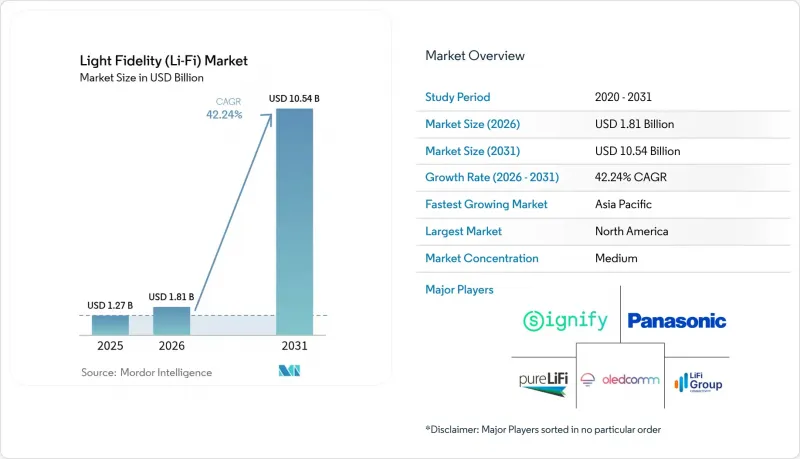
라이파이(Li-Fi) 시장 규모는 2025년 12억 7,000만 달러로 평가되었습니다. 2026년 18억 1,000만 달러로 확대되어 2031년까지 105억 4,000만 달러에 이를 것으로 예상되며 2026년부터 2031년에 걸쳐 CAGR 42.24%를 나타낼 전망입니다.
IEEE 802.11bb 상호운용성 표준으로 벤더 종속 위험이 해소되면서 상업적 추진력이 가속화되었습니다. 또한, 미 육군의 대규모 도입으로 실제 환경에서의 견고성을 입증했습니다. 현재 기업들은 특히 주파수 대역 혼잡, 전자기 간섭 또는 스파이 활동의 위협이 무선 솔루션을 손상시킬 수 있는 환경에서 광무선 기술을 Wi-Fi를 보완하는 안전한 오버레이로 인식하고 있습니다. 의료, 항공, 산업 자동화 분야의 초기 도입 기업들은 네트워크 장애 감소, 지연 감소, 데이터 보안에 대한 신뢰성 향상 등을 보고하고 있으며, 기존 조명 교체 주기를 넘어 동종업계 주도적인 수요를 창출하고 있습니다. 그 결과, 시범사업이 활성화되면서 2026년부터 2028년 사이에 시작될 예정인 개보수 및 신규 프로젝트 파이프라인이 탄탄하게 유지되고 있습니다.
세계의 라이파이(Li-Fi) 시장 동향과 인사이트
LED 조명 리노베이션의 물결
2020년부터 2025년까지 형광등 설비를 LED로 교체한 조직은 현재 Li-Fi를 신규 건설이 아닌 단계적 업그레이드로 인식하고 있습니다. Wieland Electric은 2025년 기존 조명기구에 광변조기를 내장하여 이 모델을 시연했습니다. 이를 통해 새로운 케이블 설치를 피하고 단 며칠 만에 250Mbps의 통신 링크를 가동할 수 있었습니다. 시설 관리자는 조명과 네트워크 예산을 통합하여 에너지 절감 효과와 연결성 향상과 함께 개별 무선 도입에 비해 투자 회수 기간을 단축할 수 있습니다. 더 많은 조명 공급업체가 "Li-Fi 지원" 조명기구를 공급함에 따라, 조달팀은 사전에 해당 기능을 사양으로 명시하여 미래 수요를 확보합니다. 따라서 이러한 개조 추세는 일상적인 유지보수 주기를 광무선의 대규모 유망한 시장으로 전환할 수 있는 계기가 될 것입니다.
IEEE 802.11bb 상호 운용성 표준
2023년 IEEE 802.11bb의 공식 승인과 그에 따른 정부 조달 고시에 따라 호환 하드웨어를 의무화하는 정부 조달 고시가 발표됨에 따라, 과거 파일럿 도입에 걸림돌이 되었던 멀티 벤더 리스크가 사라졌습니다. 기업들은 현재 Li-Fi 액세스 포인트를 기존 IP 보안 및 QoS(서비스 품질) 프레임워크에 통합하고 있으며, 병렬 IT 스택이 필요 없게 되었습니다. 칩셋 제조업체는 양산을 지원하고 Wi-Fi와의 비용 격차를 줄이기 위해 명확한 설계 규칙을 수립하고 있습니다. 표준의 통일로 인해 전 세계 인증이 용이해져 제조업체는 단일 제품군을 전 세계로 배송할 수 있게 되었습니다. 그 결과, 신뢰성이 높아지고, 판매 주기가 단축되었으며, 단기 출하 예측이 상향 조정되었습니다.
Wi-Fi에 비해 높은 기기 비용
와이파이 액세스 포인트와 USB 수신기는 여전히 동급 와이파이 장비의 3배에서 5배에 달하는 비용이 소요되고 있으며, 이러한 가격 차이는 학교, 스타트업, 일반 가정의 도입을 가로막고 있습니다. Oledcomm의 LiFiMAX Compact 키트는 도입 장벽을 낮추었지만, 가격은 여전히 대중 보급보다는 보안을 중시하는 시설을 대상으로 하고 있습니다. 램프와 클라이언트 장치 모두 트랜시버라는 이중 하드웨어가 필요하기 때문에 부품 원가가 두 배로 증가합니다. 통합 칩셋이 주류 노트북과 태블릿에 탑재되기 전까지는 사용자 1인당 동글 비용은 계속 높아질 것이고, 총소유비용(TCO)도 높아질 것입니다. 각 벤더들은 임대 및 구독 모델을 도입하려고 시도하고 있지만, 단기적인 보급은 여전히 보안 및 간섭 회피의 필요성이 추가 비용을 정당화할 수 있는 용도에 의존하고 있습니다.
부문 분석
2025년 Light Fidelity(Li-Fi) 시장 점유율 중 실내 네트워크 및 기업용 도입이 39.21%를 차지했으며, 보안이 강화된 회의실, 임원실, 트레이딩 플로어가 현재 가장 큰 수익원임을 입증하고 있습니다. 병원, 공장, 공항에서의 꾸준한 시범 도입이 진행되면서 Li-Fi가 실험실 밖에서도 안정적으로 작동할 수 있다는 확신이 커지고 있습니다. 수중 및 해양 분야는 현재 규모는 작지만, 해군 및 해양 사업자들이 감쇠하기 쉬운 무선 링크를 청록색 레이저 시스템으로 대체함에 따라 2031년까지 연평균 복합 성장률(CAGR) 43.66%로 확대될 것으로 예측됩니다. 의료시설에서의 도입은 광 신호가 생명 유지 장치를 방해하지 않기 때문에 환자 치료 영역을 신뢰할 수 있는 고 대역폭 영역으로 전환할 수 있어 지속적으로 인기를 끌고 있습니다. 전반적으로, 미션 크리티컬 환경에서의 초기 단계의 탄탄한 실적은 Li-Fi가 보다 광범위한 기업 구축에 효과적이라는 것을 입증하고 있습니다.
국방 분야에서의 지지는 파급효과를 일으켜 민간 산업에서의 조달을 가속화하고 있습니다. 군사 분야 현장 테스트에서 광링크가 간섭에 강하고 감지 가능한 전파를 방출하지 않는다는 것이 입증되었습니다. 이 결과는 스파이 활동을 우려하는 금융 서비스 및 중요 인프라 운영자들에게 공감을 불러일으키고 있습니다. 항공 분야 테스트에서 승객이 아비오닉스에 RF 노이즈를 추가하지 않고도 기가비트급 콘텐츠를 수신할 수 있는 것으로 나타나 이 기술의 매력은 더욱 확대되고 있습니다. 스마트홈에 대한 관심은 여전히 틈새 시장에 머물러 있지만, 게이머와 재택근무자들은 이미 저지연 광링크에 대해 비싼 요금을 지불하고 있으며, 이는 소비자들에게 단계적으로 보급될 것임을 시사하고 있습니다. 이를 종합하면, 다양한 도입 경로가 리스크를 분산시키고, 다양한 용도과 연계된 Light Fidelity(Li-Fi) 시장 규모에 대한 견조한 전망을 뒷받침하고 있습니다.
2025년 부품 매출 중 LED가 47.38%를 차지했습니다. 이는 많은 조직들이 독립적인 발광소자에 대한 투자보다는 기존 조명기구의 개보수를 진행하고 있기 때문입니다. 이러한 장점은 이미 사무실과 공장에 천장 조명이 널리 보급되어 있고, 데이터 변조 기능을 추가하는 데 필요한 추가 하드웨어를 최소화할 수 있다는 현실을 반영합니다. 한편, 광검출기는 아발란체 포토다이오드 및 실리콘 광전자 증배관이 통신 거리를 연장하고 멀티 기가비트 처리량을 실현함에 따라 2026년부터 2031년까지 연평균 43.26%의 가장 빠른 성장이 예상됩니다. 광 필터와 정밀 렌즈는 빔의 초점을 선명하게 하고 주변 빛을 차단하여 새로운 수신기를 보완합니다. 이는 햇빛이 들어오는 아트리움이나 유리로 된 공장에서 필수적인 기능입니다. 또한, 기업들이 Li-Fi와 Wi-Fi 간의 로밍을 조정하는 대시보드가 필요하기 때문에 소프트웨어 및 서비스 수익도 동시에 증가하고 있습니다.
특히, 확정적인 지연이 요구되는 제조 환경에서는 레이저 방식의 수직 공진기 표면 발광(VCSO) 송신기로의 전환이 진행되고 있습니다. 레이저는 Li-Fi(Light Fidelity) 시장에서 여전히 작은 점유율을 차지하고 있지만, 10Gbps에 도달할 수 있는 능력은 실시간 머신비전과 로봇을 지원하고 고급 검출기에 대한 새로운 수요를 창출하고 있습니다. 조명 조건의 변화에도 적응형 코딩을 통해 통신 링크를 안정화하기 위해 마이크로컨트롤러와 변조기는 더욱 복잡해지고 있으며, 그 결과 조명기구 하나당 반도체 부품 사용량이 증가하고 있습니다. 각 업체들이 단순한 밝기가 아닌 눈 안전 기준의 한계치 달성을 추구함에 따라, 수신 감도 향상이 커버리지 확대의 주요 수단이 되고 있습니다. 이러한 변화로 인해 범용 LED에서 수익성이 높은 포토닉스 및 신호 처리 부품으로 가치가 이동하고 있습니다.
지역별 분석
북미는 2025년 매출의 38.42%를 차지하며 라이트 유틸리티 시장 점유율 순위에서 1위를 차지했습니다. 연방 정부의 사이버 보안 규제와 지속적인 국방 예산으로 인해 정부 및 금융 서비스 분야 수요는 계속 강세를 보이고 있습니다. 또한, 벤더들은 LED의 광범위한 보급의 혜택을 누리고 있으며, 이로 인해 기업 캠퍼스 전체에 Li-Fi 도입이 가속화되고 있습니다. 현지 제조 투자로 인해 공급망이 단축되고 국내 조달 요건이 충족되어 구매자의 신뢰가 더욱 높아졌습니다. 이 지역의 성장 전망은 여전히 견조하지만, 예상 성장률은 아시아태평양에 미치지 못할 것으로 예측됩니다.
아시아태평양은 2031년까지 연평균 복합 성장률(CAGR) 43.29%를 나타낼 것으로 예측되며, 이는 Li-Fi 시장에서 기록된 지역별 성장률 중 가장 높은 수치입니다. 중국, 인도, 일본, 한국 등 정부 주도의 시범사업에서 스마트팩토리 및 스마트시티 회랑에 대한 보조금이 투입되어 국내 공급업체들에게 초기 핵심 수주를 창출하고 있습니다. 각국 국방부는 혼잡한 무선 대역을 피하는 안전한 함대 통신에 자금을 지원하고 있으며, 교육 기관은 지적 재산을 보호하기 위해 연구실에 Li-Fi를 도입하고 있습니다. VCSEL 어레이와 광검출기를 중심으로 형성되고 있는 부품 생태계는 비용 절감과 대규모 상용화를 가능하게 할 것으로 기대됩니다. 표준의 일관성이 향상됨에 따라, 국경을 초월한 전개로 아시아 벤더들은 턴키 솔루션을 수출할 수 있게 될 것입니다.
유럽도 그 뒤를 잇고 있습니다. 그 배경에는 엄격한 전자파 적합성(EMC) 표준과 빛 차단을 권장하는 프라이버시 규제가 있습니다. 항공사는 기내에 Li-Fi 조명 시스템을 후방으로 도입하고, 오피스 빌딩 소유주는 우량 테넌트를 유치하기 위해 보안 회의실을 설치합니다. 중동 및 아프리카 각국 정부는 주요 인프라 시설에서 이 기술을 시험 운용하고 있으며, 라틴아메리카의 물류 사업자들은 전파 반사로 인해 Wi-Fi의 신뢰성이 떨어지는 고천장 창고에서 테스트를 진행하고 있습니다. 이들 지역은 현재 시장 점유율은 작지만, 성공적인 시범 운영이 이루어지면 잠재적인 수요를 불러일으켜 예측 기간 동안 세계 Li-Fi 시장 규모에 추가적인 성장을 가져올 수 있습니다.
기타 혜택 :
- 엑셀 형식 시장 예측(ME) 시트
- 3개월간 애널리스트 지원
자주 묻는 질문
목차
제1장 서론
제2장 조사 방법
제3장 주요 요약
제4장 시장 구도
제5장 시장 규모와 성장 예측
제6장 경쟁 구도
제7장 시장 기회와 향후 전망
KTH 26.05.29The Light Fidelity (Li-Fi) market size is expected to increase from USD 1.27 billion in 2025 to USD 1.81 billion in 2026 and reach USD 10.54 billion by 2031, growing at a CAGR of 42.24% over 2026-2031.
Commercial momentum accelerated after the IEEE 802.11bb interoperability standard removed vendor-lock risk, while large-scale U.S. Army deployments validated field resilience. Enterprises now view optical wireless as a secure overlay that complements Wi-Fi, especially in environments where spectrum congestion, electromagnetic interference, or espionage threats undermine radio solutions. Early adopters in healthcare, aviation, and industrial automation report fewer network outages, lower latency, and greater confidence in data security, creating peer-driven demand that extends beyond traditional lighting refurbishment cycles. The resulting uptick in pilot activity supports a robust pipeline of retrofit and green-field projects scheduled to start during 2026-2028.
Global Light Fidelity (Li-Fi) Market Trends and Insights
LED-Lighting Retrofit Wave
Organizations that replaced fluorescent fixtures with LEDs during 2020-2025 now view Li-Fi as an incremental upgrade rather than a green-field build. Wieland Electric demonstrated the model in 2025 by embedding optical modulators into existing luminaires, avoiding new cable pulls and bringing 250 Mbps links online in days. Facility managers merge lighting and networking budgets, so the combined energy savings and connectivity gains shorten payback periods compared with separate wireless rollouts. As more lighting vendors ship "Li-Fi-ready" fixtures, procurement teams specify the capability up front, locking in future demand. The retrofit dynamic, therefore, converts a routine maintenance cycle into a large, addressable funnel for optical wireless.
IEEE 802.11bb Interoperability Standard
Formal ratification of IEEE 802.11bb in 2023, followed by government procurement notices that require compliant hardware, removed the multi-vendor risk that once stalled pilots. Enterprises now integrate Li-Fi access points into existing IP security and quality-of-service frameworks, eliminating the need for parallel IT stacks. Chipset makers have clear design rules that support volume production and narrow the cost gap with Wi-Fi. Standards alignment also eases global certification, enabling manufacturers to ship a single product family worldwide. The resulting confidence compresses sales cycles and lifts near-term shipment forecasts.
High Device Cost Versus Wi-Fi
Li-Fi access points and USB receivers still cost three to five times as much as comparable Wi-Fi gear, a premium that deters schools, start-ups, and homeowners. Oledcomm's LiFiMAX Compact kit reduces installation friction but remains priced for security-sensitive sites rather than mass adoption. The dual-hardware requirement transceivers in both lamps and client devices double the bill of materials. Until integrated chipsets appear in mainstream laptops and tablets, per-user dongle costs will keep total ownership high. Vendors are experimenting with leasing and subscription models, yet near-term uptake still hinges on applications where security or interference avoidance justifies the added spend.
Other drivers and restraints analyzed in the detailed report include:
- Secure RF-Free Links for Defense and Healthcare
- In-Flight Cabin Connectivity Adoption
- Line-of-Sight Blockage and Short Range
For complete list of drivers and restraints, kindly check the Table Of Contents.
Segment Analysis
Indoor networking and enterprise deployments accounted for 39.21% of the Light Fidelity (Li-Fi) market share in 2025, confirming that secure conference rooms, executive suites, and trading floors form the largest current revenue pool. Hospitals, factories, and airports added steady pilot volume, boosting confidence that Li-Fi performs reliably outside laboratories. The underwater and maritime niche, although small today, is projected to expand at a 43.66% CAGR through 2031 as navies and offshore operators replace attenuated radio links with blue-green laser systems. Healthcare installations continue to gain favor because optical signals do not interfere with life-support equipment, enabling patient-care areas to become reliable, high-bandwidth zones. Overall, strong early performance in mission-critical settings validates Li-Fi for broader enterprise rollouts.
Defense endorsements create a ripple effect that speeds procurement in civilian industries. Military field tests demonstrated that optical links remain jam-resistant and free of detectable emissions, a finding that resonates with financial services and critical infrastructure operators who fear espionage. Aviation trials show passengers can receive gigabit content without adding RF noise to avionics, further widening the technology's appeal. Smart home interest remains niche, yet gamers and home-office users already pay premiums for low-latency optical links, hinting at a gradual trickle-down to consumers. Taken together, diverse adoption paths diversify risk and underpin a strong outlook for the Light Fidelity (Li-Fi) market size tied to application breadth.
LEDs accounted for 47.38% of 2025 component revenue, as most organizations retrofit existing fixtures rather than invest in stand-alone emitters. Their dominance reflects the practical reality that ceiling lights already blanket offices and factories, so adding data modulation demands minimal extra hardware. Photodetectors, however, are on track to deliver the fastest growth, with a 43.26% CAGR from 2026 to 2031, as avalanche photodiodes and silicon photomultipliers extend range and unlock multi-gigabit throughput. Optical filters and precision lenses complement the new receivers by sharpening beam focus and blocking ambient light, essential for sunlit atria and glass-walled factories. Software and services revenue rises in tandem as enterprises need dashboards that orchestrate roaming between Li-Fi and Wi-Fi.
A transition toward laser-based vertical-cavity surface-emitting transmitters is underway, particularly in manufacturing environments that demand deterministic latency. While lasers still account for only a small share of the Light Fidelity (Li-Fi) market, their ability to reach 10 Gbps supports real-time machine vision and robotics, creating new demand for advanced detectors. Micro-controllers and modulators become more complex because adaptive coding keeps links stable during lighting variations, thereby increasing semiconductor content per fixture. As vendors chase eye-safety limits rather than raw brightness, receiver sensitivity improvements become the primary lever for coverage gains. This shift redirects value from commodity LEDs toward higher-margin photonics and signal-processing components.
The Light Fidelity Market Report is Segmented by Application (Underwater and Maritime, Aerospace and Defense, and More), Component (LEDs, Photodetectors, and More), Form Factor (Li-Fi Lamps/Luminaires, Li-Fi Dongles and Access Keys, Li-Fi Modules/Chipsets, Integrated Li-Fi Fixtures), End-User (Enterprises, Residential, Industrial Manufacturing, and More), and Geography. The Market Forecasts are Provided in Terms of Value (USD).
Geography Analysis
North America commanded 38.42% of 2025 revenue, placing the region at the top of the light fidelity market share leaderboard. Federal cybersecurity mandates and sustained defense funding continue to anchor demand in government and financial services. Vendors also benefit from wide LED penetration, which speeds Li-Fi retrofits across corporate campuses. Local manufacturing investments shorten supply chains and satisfy domestic-content rules, further reinforcing buyer confidence. The region's growth outlook remains solid even though its forecast expansion trails that of the Asia-Pacific.
Asia-Pacific is projected to grow at a 43.29% CAGR through 2031, the highest regional growth rate recorded for the light fidelity market. Government-backed pilots in China, India, Japan, and South Korea channel grants into smart factories and smart city corridors, creating early anchor orders for domestic suppliers. Defense ministries fund secure fleet communications that avoid congested radio bands, and educational institutions install Li-Fi in research labs to protect intellectual property. Component ecosystems emerging around VCSEL arrays and photodetectors are expected to bring down costs and enable large-scale commercial launches. As standards alignment improves, cross-border deployments will allow Asian vendors to export turnkey solutions.
Europe follows closely behind, driven by stringent electromagnetic-compatibility codes and privacy regulations that favor optical confinement. Airlines retrofit cabins with Li-Fi lighting harnesses, while office landlords install secure meeting rooms to attract blue-chip tenants. Middle East and African governments pilot the technology at critical infrastructure sites, and Latin American logistics operators test it in high-bay warehouses where radio reflections degrade Wi-Fi reliability. Although these regions currently hold modest shares, successful trials could unlock pent-up demand, adding incremental volume to the global light fidelity market size during the forecast window.
- Signify N.V.
- pureLiFi Ltd
- Oledcomm SAS
- LiFi Group
- Panasonic Holdings Corp
- Lucibel SA
- Zero1 Pte Ltd
- LumEfficient LLC
- KYOCERA SLD Laser Inc
- Acuity Brands Lighting Inc
- Qualcomm Technologies Inc
- Broadcom Inc
- Lite-On Technology Corp
- Renesas Electronics Corp
- Velmenni OU
- Getac Technology Corp
- Honeywell International Inc
- PureLifi France SAS
- Firefly LiFi Ltd
- Fraunhofer HHI
Additional Benefits:
- The market estimate (ME) sheet in Excel format
- 3 months of analyst support
TABLE OF CONTENTS
1 INTRODUCTION
- 1.1 Study Assumptions and Market Definition
- 1.2 Scope of the Study
2 RESEARCH METHODOLOGY
3 EXECUTIVE SUMMARY
4 MARKET LANDSCAPE
- 4.1 Market Overview
- 4.2 Market Drivers
- 4.2.1 LED-Lighting Retrofit Wave
- 4.2.2 Secure RF-Free Links for Defense and Healthcare
- 4.2.3 IEEE 802.11bb Interoperability Standard
- 4.2.4 In-Flight Cabin Connectivity Adoption
- 4.2.5 VCSEL-Based Above 10 Gbps Industrial Links
- 4.2.6 RF-Restricted Clean-Room Mandates
- 4.3 Market Restraints
- 4.3.1 High Device Cost versus Wi-Fi
- 4.3.2 Line-of-Sight Blockage and Short Range
- 4.3.3 Fragmented Optical-Spectrum Rules
- 4.3.4 Hybrid Li-Fi/Wi-Fi Security Gaps
- 4.4 Industry Value Chain Analysis
- 4.5 Regulatory Landscape
- 4.6 Technological Outlook
- 4.7 Impact of Macroeconomic Factors
- 4.8 Porter's Five Forces Analysis
- 4.8.1 Threat of New Entrants
- 4.8.2 Bargaining Power of Buyers
- 4.8.3 Bargaining Power of Suppliers
- 4.8.4 Threat of Substitutes
- 4.8.5 Competitive Rivalry
5 MARKET SIZE AND GROWTH FORECASTS (VALUE)
- 5.1 By Application
- 5.1.1 Indoor Networking and Enterprise
- 5.1.2 Healthcare and Medical Devices
- 5.1.3 Vehicle and Transportation
- 5.1.4 Underwater and Maritime
- 5.1.5 Aerospace and Defense
- 5.1.6 Smart Home and Consumer Electronics
- 5.1.7 Industrial Automation and Warehouse
- 5.2 By Component
- 5.2.1 LEDs
- 5.2.2 Photodetectors
- 5.2.3 Micro-Controllers and Modulators
- 5.2.4 Optical Filters and Lenses
- 5.2.5 Software and Services
- 5.3 By Form Factor
- 5.3.1 Li-Fi Lamps/Luminaires
- 5.3.2 Li-Fi Dongles and Access Keys
- 5.3.3 Li-Fi Modules/Chipsets
- 5.3.4 Integrated Li-Fi Fixtures
- 5.4 By End-User
- 5.4.1 Enterprises
- 5.4.2 Government and Defense
- 5.4.3 Residential
- 5.4.4 Transportation and Logistics
- 5.4.5 Industrial Manufacturing
- 5.5 By Geography
- 5.5.1 North America
- 5.5.1.1 United States
- 5.5.1.2 Canada
- 5.5.1.3 Mexico
- 5.5.2 South America
- 5.5.2.1 Brazil
- 5.5.2.2 Argentina
- 5.5.2.3 Rest of South America
- 5.5.3 Europe
- 5.5.3.1 United Kingdom
- 5.5.3.2 Germany
- 5.5.3.3 France
- 5.5.3.4 Italy
- 5.5.3.5 Rest of Europe
- 5.5.4 Asia-Pacific
- 5.5.4.1 China
- 5.5.4.2 Japan
- 5.5.4.3 India
- 5.5.4.4 South Korea
- 5.5.4.5 Rest of Asia-Pacific
- 5.5.5 Middle East and Africa
- 5.5.5.1 Middle East
- 5.5.5.1.1 United Arab Emirates
- 5.5.5.1.2 Saudi Arabia
- 5.5.5.1.3 Rest of Middle East
- 5.5.5.2 Africa
- 5.5.5.2.1 South Africa
- 5.5.5.2.2 Egypt
- 5.5.5.2.3 Rest of Africa
- 5.5.5.1 Middle East
- 5.5.1 North America
6 COMPETITIVE LANDSCAPE
- 6.1 Market Concentration
- 6.2 Strategic Moves
- 6.3 Market Share Analysis
- 6.4 Company Profiles (includes Global Level Overview, Market Level Overview, Core Segments, Financials as available, Strategic Information, Market Rank/Share, Products and Services, Recent Developments)
- 6.4.1 Signify N.V.
- 6.4.2 pureLiFi Ltd
- 6.4.3 Oledcomm SAS
- 6.4.4 LiFi Group
- 6.4.5 Panasonic Holdings Corp
- 6.4.6 Lucibel SA
- 6.4.7 Zero1 Pte Ltd
- 6.4.8 LumEfficient LLC
- 6.4.9 KYOCERA SLD Laser Inc
- 6.4.10 Acuity Brands Lighting Inc
- 6.4.11 Qualcomm Technologies Inc
- 6.4.12 Broadcom Inc
- 6.4.13 Lite-On Technology Corp
- 6.4.14 Renesas Electronics Corp
- 6.4.15 Velmenni OU
- 6.4.16 Getac Technology Corp
- 6.4.17 Honeywell International Inc
- 6.4.18 PureLifi France SAS
- 6.4.19 Firefly LiFi Ltd
- 6.4.20 Fraunhofer HHI
7 MARKET OPPORTUNITIES AND FUTURE OUTLOOK
- 7.1 White-Space and Unmet-Need Assessment


