|
시장보고서
상품코드
2044115
셀프 서비스 : 시장 점유율 분석, 업계 동향 및 통계, 성장 예측(2026-2031년)Self-Service - Market Share Analysis, Industry Trends & Statistics, Growth Forecasts (2026 - 2031) |
||||||
 Mordor Intelligence
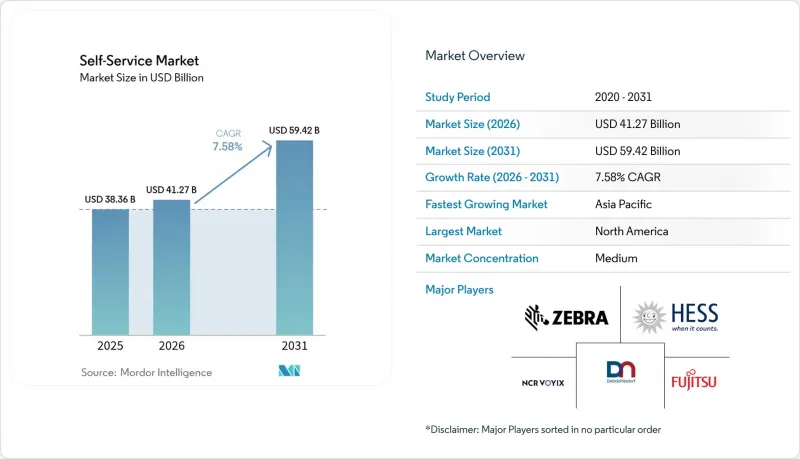
셀프 서비스 시장 규모는 2025년 383억 6,000만 달러로 평가되었습니다. 2026년 412억 7,000만 달러에서 2031년까지 594억 2,000만 달러로 확대되며 2026년부터 2031년까지 연평균 복합 성장률(CAGR)은 7.58%를 나타낼 전망입니다.
이러한 성장은 팬데믹 이후 가속화된 비대면 서비스로의 전환, 기업의 디지털화에 대한 보다 엄격한 정책, 그리고 디지털 지갑에 대한 대중의 광범위한 인식과 직접적으로 연관되어 있습니다. 하드웨어 및 소프트웨어 공급업체들은 AI, 컴퓨터 비전, 생체 인식 모듈을 통합하여 대기 시간을 줄이고, 보안을 강화하며, 은행, 소매, 의료, 공공시설 등 다양한 분야에서 새로운 이용 사례를 창출함으로써 이러한 수요에 부응하고 있습니다. QR 코드와 NFC를 기반으로 한 결제 생태계는 현재 많은 도시 지역에서 주류로 자리 잡고 있으며, 사용자가 원하는 모든 인증 수단을 지원하는 셀프 서비스 단말기에 대한 꾸준한 수요를 뒷받침하고 있습니다. 벤더들은 또한 서비스 계약과 플랫폼 사용료를 중시하고 있으며, 과거 단발성 하드웨어 판매에 그쳤던 것을 현금 흐름을 안정화시키는 지속적인 수익원으로 전환하고 있습니다. 그러나 기물파손, 실외의 혹독한 기상 조건, 그리고 전자상거래에 의한 대체에 대한 내성은 수익성 있는 확장을 위한 전제조건으로 남아있습니다.
세계의 셀프 서비스 시장 동향 및 인사이트
포스트 코로나 시대의 비접촉식 결제의 대중화
세계 디지털 결제 이용률은 2014년 44%에서 2022년 성인의 3분의 2로 급증하여 현금 없는 행동으로의 영구적인 전환이 확인되었습니다. 유럽에서의 조사에 따르면, 위생에 대한 우려로 현금을 피하려는 경향이 지속되고 있으며, 마이크로 마켓 운영 사업자들은 현금 없는 모듈을 도입한 후 매출이 증가했다고 보고하고 있습니다. 지난 10년간 현금 사용량이 절반으로 줄어든 스웨덴과 같은 국가들은 정책, 가맹점, 소비자가 얼마나 빠르게 디지털화라는 공통의 궤도에 올라섰는지를 잘 보여줍니다. 이러한 추세는 생체 인증과 음성 안내로 확대되고 있으며, 셀프 서비스 시장의 모든 분야에서 비접촉식 인증 지원이 추진되고 있습니다.
스마트 리테일 포맷의 급속한 확산
RFID 게이트, 컴퓨터 비전, 스마트 선반을 활용한 자율형 매장은 앞으로 크게 증가할 것으로 예측됩니다. 독일에서는 최근 5,000개 이상의 셀프 계산대 매장이 생겨났고, 소매업체들은 더 많은 확장을 계획하고 있습니다. 미국에서는 샘스클럽과 같은 도매 체인이 AI가 탑재된 기기를 도입하여 몇 초 만에 카트를 스캔하여 대기열을 단축하고 직원을 재배치하는 등 변화를 꾀하고 있습니다. 마이크로 풀필먼트 허브는 통합에 따른 어려움은 있지만, 인구 밀집 지역에 당일 상품 보충을 가능하게 하고, 24시간 상품 수령 및 반납이 가능한 사물함 및 하이브리드 키오스크에 대한 수요를 창출하고 있습니다.
고질적인 기물 파손과 현금 취급의 보안 리스크
영국 텔레콤의 데이터에 따르면, 강력한 잠금 장치와 경보 장치로 사건이 억제되기 전까지 공중전화는 매년 수만 건의 공격을 당했습니다. 고도의 잭팟팅 및 스키밍 수법으로 인해 물리적 및 사이버 보안 시장은 2032년까지 324억 달러에 달할 것으로 예측됩니다. 사업자들은 부정사용 방지책으로 지문인증, 얼굴인증, 다단계 인증 등을 도입하고 있지만, 새로운 모듈이 추가될 때마다 단가가 상승하고 인증 주기가 길어지고 있습니다. 경찰과의 합동 순찰이나 AI를 활용한 감시를 통해 손실을 줄일 수 있지만, 완전히 없앨 수는 없습니다.
부문 분석
키오스크는 2025년 셀프 서비스 시장의 35.74%를 차지했으며, 체크인, 발권, 청구서 결제 등 다양한 분야에서 유연성이 돋보입니다. 키오스크 관련 셀프 서비스 시장 규모는 언어 팩, AI 아바타, 결제 옵션을 추가하는 지속적인 소프트웨어 업데이트로 혜택을 받고 있습니다. 식료품점 및 종합 소매업체들이 인건비를 절감하고 계산대 대기 시간을 단축함에 따라 셀프 계산대는 CAGR 8.01%로 성장하고 있습니다. ATM은 여전히 현금 생태계의 핵심이지만, 소액 송금 수요의 상당 부분이 모바일 송금으로 채워지면서 연간 설치 대수는 감소하고 있습니다. 자판기는 스낵류에 그치지 않고 시판 의약품, 개인보호장비(PPE), 시간적 제약이 있는 백신으로 확대되며 그 사회적 영향력을 넓혀가고 있습니다. 스마트락커는 라스트마일 비용 절감과 영업시간 외 물품 수령을 필요로 하는 물류기업으로부터 활발한 수주를 기록했습니다. 2025년 8억 6,000만 달러에서 2029년까지 19억 2,000만 달러로 성장할 것으로 예상되는 의료용 키오스크는 진단, 원격 진료, 처방전 업데이트가 좁은 공간에서 어떻게 융합될 수 있는지를 보여줍니다. 소매업체는 컴퓨터 비전을 도입하여 카메라가 자동으로 농산물의 무게를 측정함으로써 오차와 고객 불만을 최소화하고 있습니다. 제품 라인업에서는 내구성과 실시간 인사이트 및 원격 서비스를 실현하는 클라우드 연동 기능을 결합한 벤더가 앞으로도 우위를 점할 것으로 보입니다.
키오스크 공급업체들은 접근성 규제에 앞서기 위해 항균 표면, 촉각 피드백, 휠체어 대응 레이아웃에 투자하고 있습니다. 셀프 체크아웃 기기 제조업체는 결제 보안 기준을 준수하면서 '지금 구매, 후불' 기능을 도입하기 위해 핀테크 게이트웨이와 제휴하고 있습니다. ATM 벤더들은 존재의 의미를 유지하기 위해 비디오 텔러 머신과 암호화폐 모듈로 사업 전환을 시도하고 있습니다. 자판기 전문 기업들은 판매량이 많은 상품을 우선적으로 진열하는 동적 냉장 기술과 AI 플래노그램을 시범 도입하여 평방인치당 매출 향상을 꾀하고 있습니다. 로커 제공업체는 식료품 및 의약품 분야를 위해 온도 관리 기능을 추가하고 있습니다. 따라서 다양한 제품 포트폴리오는 셀프 서비스 시장의 소비자 트렌드와 사업자의 경제 상황 변화에 대한 헤지 역할을 하고 있습니다.
2025년에는 하드웨어가 매출의 53.52%를 차지했지만, 소프트웨어는 매년 8.66%씩 성장하며 평생 수익 창출의 핵심이 되고 있습니다. 각 벤더들은 현장 방문 없이도 안전한 업데이트가 가능한 컨테이너형 운영체제를 도입하여 새로운 기능 시장 출시까지 걸리는 평균 시간을 단축하고 있습니다. 클라우드 대시보드를 통해 이용량 급증에 대한 가시성을 확보하고, 소매업체는 고객 수요가 있을 때만 직원을 배치할 수 있게 됩니다. 디벨트 닉스도르프의 DN Vynamic 제품군은 23만 개 이상의 엔드포인트를 연결하여 예기치 않은 다운타임을 줄여주는 예지보전 경고를 전송합니다. 엣지에 배치된 AI 엔진은 몇 밀리초 내에 의심스러운 인출 패턴을 감지하고 즉각적인 잠금 기능을 지원합니다. 로열티 플랫폼과의 연계를 통해 화면에서 직접 업셀링 기회를 창출할 수도 있습니다.
서비스 범위는 설치, 제거, 소프트웨어 패치, 컴플라이언스 감사, 컴포넌트 전략 보완에 이르기까지 다양합니다. 정기 계약이 확대됨에 따라 서비스 수익률은 하드웨어 출하 수익률을 능가할 수 있습니다. 접근성 컨설턴트는 연방 관보에 명시된 촉각, 음성, 시각 관련 기준을 준수하도록 보장합니다. ERP 및 POS 데이터와 키오스크의 텔레메트리 데이터를 결합하는 기업은 SKU, 교대근무, 위치별 매출 향상을 보여주는 폐쇄형 루프 분석을 실현할 수 있습니다. 이러한 가시성은 셀프 서비스 시장에서 제한된 설비 투자 주기로 전 세계에 키오스크를 배치하는 대형 체인의 조달 결정에 있어 매우 중요합니다.
"셀프 서비스 시장 보고서는 제품 유형(키오스크, ATM 등), 구성 요소(하드웨어, 소프트웨어, 서비스), 최종 사용자 산업(은행, 금융서비스 및 보험(BFSI), 소매 및 퀵서비스 레스토랑 등), 기술(생체 인식, NFC/비접촉식, AI 기반 및 컴퓨터 비전 등), 설치 장소(실내 및 실외), 지역별로 분류됩니다. 등), 설치 장소(실내/실외), 지역별로 분류되어 있습니다.
지역별 분석
북미는 2025년 매출의 39.02%를 차지했으며, 이는 수년간의 ATM 기술 보급, 소매 분야에서의 광범위한 도입, 그리고 프라이버시 보호에 대한 규제를 반영합니다. 결제카드 보급률이 거의 100%에 가깝고, 디지털 지갑도 주류가 되면서 가맹점은 칩, 탭, 모바일 인증이 가능한 단말기를 선호하고 있습니다. 연방 정부 기관은 광대역 및 디지털 정부 포털에 경제 대책 예산을 투자하여 공공 서비스 키오스크에서 일관된 사용자 경험을 촉진하고 있습니다. AI, 클라우드, 사이버 보안에 대한 기업의 관심은 예산 주기마다 증가하고 있으며, 기존 하드웨어 위에 구축되는 소프트웨어 중심의 업그레이드에 대한 수요를 촉진하고 있습니다.
유럽에서는 지속가능성과 포용성의 균형을 맞추고 있습니다. 유럽연합 집행위원회는 친환경 디자인과 투명한 공급망을 권장하고 있으며, 제조업체들에게 기기의 수명을 연장하고 탄소 발자국을 공개할 것을 요구하고 있습니다. 접근성법에 따라 점자 키패드, 음성 안내, 글꼴 크기 조정 기능이 의무화되어 있으며, 이는 부품표(BOM)와 펌웨어 설계에 영향을 미치고 있습니다. 독일의 EHI 이니셔티브는 수천 개의 셀프 체크아웃 레인을 계산하여 높은 상업적 수요를 보여주고 있으며, 이 지역에서는 키오스크 및 ATM과 원활하게 연동할 수 있는 디지털 유로의 최적 형태에 대한 논의가 진행되고 있습니다. 사업자들은 기후 목표에 부합하는 방식으로 서비스 차량의 주행거리를 줄이기 위해 원격 텔레메트리를 사후에 도입하고 있습니다.
CAGR 8.17%로 성장하는 아시아태평양은 디지털화 추진 정책과 스마트폰 연동형 QR코드 결제의 폭발적인 보급의 수혜를 받고 있습니다. 인도에서는 매월 수십억 건의 UPI 송금이 이루어지고 있으며, 지방의 키오스크에서도 QR코드 결제가 일상화되어 있습니다. 중국에서는 대중교통과 자판기 네트워크에 통합될 것으로 예상되는 중앙은행 디지털화폐(CBDC)의 시범운영이 진행되고 있으며, 사업자들은 빠른 펌웨어 업데이트가 요구되고 있습니다. 아세안 각국 정부는 우체국 내 전자정부 창구를 설치하기 위해 자금을 지원하고 있으며, 이를 통해 관료적 절차를 간소화하는 동시에 원격지 주민들에게도 동등한 서비스가 제공될 수 있도록 보장하고 있습니다. 남미와 중동은 뒤쳐져 있지만, 통신 사업자들이 모바일 머니를 추진하고 관광업의 회복과 함께 다국어 지원 티켓 판매기에 대한 관심이 높아지면서 그 속도가 빨라지고 있습니다.
기타 혜택 :
- 엑셀 형식 시장 예측(ME) 시트
- 3개월간 애널리스트 지원
자주 묻는 질문
목차
제1장 서론
제2장 조사 방법
제3장 주요 요약
제4장 시장 구도
제5장 시장 규모와 성장 예측
제6장 경쟁 구도
제7장 시장 기회와 향후 전망
KTH 26.05.29The Self-Service Market size is projected to expand from USD 38.36 billion in 2025 and USD 41.27 billion in 2026 to USD 59.42 billion by 2031, registering a CAGR of 7.58% between 2026 to 2031.
This growth links directly to the shift toward contactless engagement that gathered pace after the pandemic, tighter corporate mandates for digitization, and broad public familiarity with digital wallets. Hardware and software suppliers are responding by embedding AI, computer vision, and biometric modules that cut wait times, strengthen security, and open new use-cases across banking, retail, healthcare, and public venues. Payment ecosystems built on QR and NFC are now mainstream in many urban centers, and they underpin steady demand for self-service terminals able to accept any credential the user prefers. Vendors also highlight service contracts and platform fees, turning what was once a one-off hardware sale into a recurring revenue stream that smooths cash flow. However, resilience against vandalism, outdoor weather extremes, and e-commerce substitution remains a prerequisite for profitable roll-outs.
Global Self-Service Market Trends and Insights
Ubiquity of Contact-Free Transactions Post-COVID
Global digital payment participation jumped from 44% in 2014 to two-thirds of adults in 2022, confirming a permanent tilt toward cashless behaviors. European research shows sustained intentions to avoid cash because of hygiene concerns, and operators of micro-markets report higher revenues after installing cashless modules. Countries like Sweden, where cash use halved in the past decade, underscore how rapidly policy, merchants, and consumers converge on digital rails. This preference extends to biometric taps and voice prompts, driving every corner of the self-service market to support no-touch authentication.
Rapid Rollout of Smart Retail Formats
Autonomous stores relying on RFID gates, computer vision, and smart shelving are projected to grow significantly. Germany counted more than 5,000 self-checkout outlets recently, and retailers plan further acceleration. In the United States, wholesale chains such as Sam's Club deployed AI-enhanced devices that scan carts in seconds, shrinking queues and redeploying staff. Micro-fulfilment hubs, despite integration headaches, promise same-hour replenishment for densely populated districts, creating a pull for lockers and hybrid kiosks able to dispense and accept goods around the clock.
Persistent Vandalism and Cash-Handling Security Risks
Data from British Telecom revealed tens of thousands of attacks on pay-phones each year until ruggedized locks and alarms curbed incidents. Sophisticated jackpotting and skimming drives a physical and cyber security market forecast to reach USD 32.4 billion by 2032. Operators add fingerprint, facial recognition and multi-factor prompts to counter fraud, yet every new module raises cost per unit and elongates certification cycles. Collaborative patrols with police and AI-driven surveillance mitigate losses but cannot erase them entirely.
Other drivers and restraints analyzed in the detailed report include:
- Omni-Channel Banking Automation Wave
- Government Push for Cash-Lite Societies
- High TCO for Outdoor Deployments in Harsh Climates
For complete list of drivers and restraints, kindly check the Table Of Contents.
Segment Analysis
Kiosks controlled 35.74% self-service market share in 2025, highlighting their flexibility across check-in, ticketing, and bill payment. The self-service market size tied to kiosks benefits from continuous software refreshes that add language packs, AI avatars, and payment choices. Self-checkout lanes are growing at an 8.01% CAGR as grocers and general merchandisers curb labor expenses and speed the line. ATMs still anchor cash ecosystems, yet annual installations are plateauing because mobile transfers now satisfy many low-value needs. Vending machines move beyond snacks into OTC medicines, PPE, and time-sensitive vaccines, which widens their social footprint. Smart lockers registered brisk orders from logistics firms under pressure to cut last-mile costs and allow after-hours parcel pick-up. Healthcare kiosks, projected to ramp from USD 0.86 billion in 2025 to USD 1.92 billion by 2029, illustrate how diagnosis, telehealth, and prescription renewal can converge in compact footprints. Retailers adopt computer vision so cameras automatically weigh produce, minimizing errors and shopper frustration. The product mix will continue to reward vendors who merge durability with cloud hooks that unlock real-time insights and remote service.
Kiosk suppliers invest in antimicrobial surfaces, haptic feedback, and wheelchair-friendly layouts to stay ahead of accessibility rules. Self-checkout makers partner with fintech gateways to switch on buy-now-pay-later while still conforming to payment security standards. ATM vendors pivot toward Video Teller Machines and cryptocurrency modules to preserve relevance. Vending specialists test dynamic refrigeration and AI planograms to display fast-moving inventory first, which uplifts sales per square inch. Locker providers add temperature control for the grocery and pharmaceutical segments. Portfolio breadth, therefore, remains a hedge against shifts in consumer flow and merchant economics within the self-service market.
Hardware was responsible for 53.52% of revenue in 2025, yet software is advancing 8.66% each year and is the key to lifetime monetization. Vendors deploy containerized operating systems that permit secure updates without field visits, shortening mean-time-to-market for new features. Cloud dashboards spotlight usage spikes, allowing retailers to preload staff only when traffic demands. Diebold Nixdorf's DN Vynamic suite connects more than 230,000 endpoints and pushes predictive maintenance alerts that reduce unscheduled downtime. AI engines sit at the edge, flagging suspicious withdrawal patterns within milliseconds and supporting instant lockouts. Integrations with loyalty platforms also open upsell moments right on the screen.
Services round out the component play, spanning installation, decommissioning, software patching, and compliance audits. As recurring contracts expand, service margins may eclipse those of hardware shipments. Accessibility consultants ensure adherence to tactile, speech, and visual standards laid out in the Federal Register. Firms that couple ERP and point-of-sale data with kiosk telemetry enable closed-loop analytics showing sales uplift by SKU, shift, and location. This visibility is central to procurement decisions at large chains that roll kiosks worldwide on thin capex cycles within the self-service market.
The Self-Service Market Report is Segmented by Product Type (Kiosk, ATM, and More), Component (Hardware, Software, and Services), End-User Industry (BFSI, Retail and Quick-Service Restaurant, and More), Technology (Biometric-Enabled, NFC / Contactless, AI-Driven and Computer-Vision, and More), Deployment Location (Indoor and Outdoor), and Geography.
Geography Analysis
North America held 39.02% of revenue in 2025, reflecting long-standing adoption of automated teller technology, wide retail deployment, and supportive privacy regulations. Payment card penetration is nearly universal, and digital wallets are mainstream, so merchants prioritize terminals that handle chip, tap, and mobile credentials. Federal agencies devote stimulus budgets to broadband and digital government portals, fostering a consistent user experience in public service kiosks. Corporate appetite for AI, cloud, and cybersecurity rises each budget cycle, reinforcing demand for software-centric upgrades that sit atop existing hardware.
Europe balances sustainability and inclusion. The European Commission urges eco-design and transparent supply chains, pushing manufacturers to lengthen device lifespans and publish carbon footprints. Accessibility law compels tactile keypads, audio prompts, and adjustable font sizes, which influence BOM and firmware design. Germany's EHI initiative demonstrates commercial appetite by counting thousands of self-checkout lanes, while the region debates best formats for a digital euro that could seamlessly link to kiosks and ATMs. Operators retrofit remote telemetry to trim service van miles, aligning with climate targets.
Asia-Pacific, advancing at an 8.17% CAGR, benefits from pro-digitization edicts and an explosion of smartphone-linked QR payments. India stages billions of UPI transfers each month, normalizing QR taps even in rural kiosks. China pilots a central bank digital currency that will likely integrate into transit and vending networks, placing pressure on operators to update firmware fast. Governments in ASEAN fund e-government lobbies inside post offices, reducing red tape while ensuring remote citizens receive equal service. South America and the Middle East trail but accelerate as telcos push mobile money and as tourism revives interest in multi-language ticketing stations.
- NCR Corporation
- Diebold Nixdorf
- Crane Payment Innovations
- Fujitsu Ltd.
- Glory Global Solutions
- Zebra Technologies
- Advantech Co. Ltd.
- Frank Mayer and Associates Inc.
- HESS Cash Systems GmbH
- Azkoyen Group
- Embross
- SEDCO
- IER Group
- Maas International B.V.
- RedyRef Interactive
- Olea Kiosks Inc.
- Posiflex Technology Inc.
- SlabbKiosks
- KIOSK Information Systems
Additional Benefits:
- The market estimate (ME) sheet in Excel format
- 3 months of analyst support
TABLE OF CONTENTS
1 INTRODUCTION
- 1.1 Study Assumptions and Market Definition
- 1.2 Scope of the Study
2 RESEARCH METHODOLOGY
3 EXECUTIVE SUMMARY
4 MARKET LANDSCAPE
- 4.1 Market Overview
- 4.2 Market Drivers
- 4.2.1 Ubiquity of contact-free transactions post-COVID
- 4.2.2 Rapid rollout of smart retail formats
- 4.2.3 Omni-channel banking automation wave
- 4.2.4 Government push for cash-lite societies
- 4.2.5 AI-powered adaptive user interfaces
- 4.2.6 Micro-fulfilment and 24/7 unmanned concepts
- 4.3 Market Restraints
- 4.3.1 Persistent vandalism and cash-handling security risks
- 4.3.2 High TCO for outdoor deployments in harsh climates
- 4.3.3 Limited accessibility standards harmonisation
- 4.3.4 Rising e-commerce bypassing vending channels
- 4.4 Value Chain Analysis
- 4.5 Technological Outlook
- 4.6 Porter's Five Forces Analysis
- 4.6.1 Bargaining Power of Suppliers
- 4.6.2 Bargaining Power of Buyers
- 4.6.3 Threat of New Entrants
- 4.6.4 Threat of Substitutes
- 4.6.5 Competitive Rivalry
- 4.7 Major Technological Developments
- 4.7.1 Evolution of Self-Service Kiosks
- 4.7.2 Barrier-Free Kiosk Standards and Working Groups
- 4.7.3 Leading Case Studies and User-Surveys
5 MARKET SIZE AND GROWTH FORECASTS (VALUE)
- 5.1 By Product Type
- 5.1.1 Kiosk
- 5.1.2 ATM
- 5.1.3 Vending Machine
- 5.1.4 Self-Checkout System
- 5.1.5 Smart Locker / Parcel Station
- 5.2 By Component
- 5.2.1 Hardware
- 5.2.2 Software
- 5.2.3 Services
- 5.3 By End-user Industry
- 5.3.1 BFSI
- 5.3.2 Retail and Quick-Service Restaurant
- 5.3.3 Hospitality
- 5.3.4 Healthcare
- 5.3.5 Transportation and Travel Hubs
- 5.3.6 Government and Public Sector
- 5.4 By Technology
- 5.4.1 Biometric-Enabled
- 5.4.2 NFC / Contactless
- 5.4.3 AI-Driven and Computer-Vision
- 5.4.4 Cloud-Connected
- 5.5 By Deployment Location
- 5.5.1 Indoor
- 5.5.2 Outdoor
- 5.6 By Geography
- 5.6.1 North America
- 5.6.1.1 United States
- 5.6.1.2 Canada
- 5.6.1.3 Mexico
- 5.6.2 Europe
- 5.6.2.1 Germany
- 5.6.2.2 United Kingdom
- 5.6.2.3 France
- 5.6.2.4 Italy
- 5.6.2.5 Spain
- 5.6.2.6 Russia
- 5.6.2.7 Rest of Europe
- 5.6.3 Asia-Pacific
- 5.6.3.1 China
- 5.6.3.2 Japan
- 5.6.3.3 India
- 5.6.3.4 South Korea
- 5.6.3.5 ASEAN
- 5.6.3.6 Australia and New Zealand
- 5.6.3.7 Rest of Asia-Pacific
- 5.6.4 South America
- 5.6.4.1 Brazil
- 5.6.4.2 Argentina
- 5.6.4.3 Rest of South America
- 5.6.5 Middle East and Africa
- 5.6.5.1 Middle East
- 5.6.5.1.1 Saudi Arabia
- 5.6.5.1.2 UAE
- 5.6.5.1.3 Turkey
- 5.6.5.1.4 Rest of Middle East
- 5.6.5.2 Africa
- 5.6.5.2.1 South Africa
- 5.6.5.2.2 Nigeria
- 5.6.5.2.3 Rest of Africa
- 5.6.5.1 Middle East
- 5.6.1 North America
6 COMPETITIVE LANDSCAPE
- 6.1 Market Concentration
- 6.2 Strategic Moves
- 6.3 Market Share Analysis
- 6.4 Company Profiles (includes Global level Overview, Market level overview, Core Segments, Financials as available, Strategic Information, Market Rank/Share for key companies, Products and Services, and Recent Developments)
- 6.4.1 NCR Corporation
- 6.4.2 Diebold Nixdorf
- 6.4.3 Crane Payment Innovations
- 6.4.4 Fujitsu Ltd.
- 6.4.5 Glory Global Solutions
- 6.4.6 Zebra Technologies
- 6.4.7 Advantech Co. Ltd.
- 6.4.8 Frank Mayer and Associates Inc.
- 6.4.9 HESS Cash Systems GmbH
- 6.4.10 Azkoyen Group
- 6.4.11 Embross
- 6.4.12 SEDCO
- 6.4.13 IER Group
- 6.4.14 Maas International B.V.
- 6.4.15 RedyRef Interactive
- 6.4.16 Olea Kiosks Inc.
- 6.4.17 Posiflex Technology Inc.
- 6.4.18 SlabbKiosks
- 6.4.19 KIOSK Information Systems
7 MARKET OPPORTUNITIES AND FUTURE OUTLOOK
- 7.1 White-Space and Unmet-Need Assessment