

|
시장보고서
상품코드
2044116
톨루엔 : 시장 점유율 분석, 업계 동향 및 통계, 성장 예측(2026-2031년)Toluene - Market Share Analysis, Industry Trends & Statistics, Growth Forecasts (2026 - 2031) |
||||||
 Mordor Intelligence
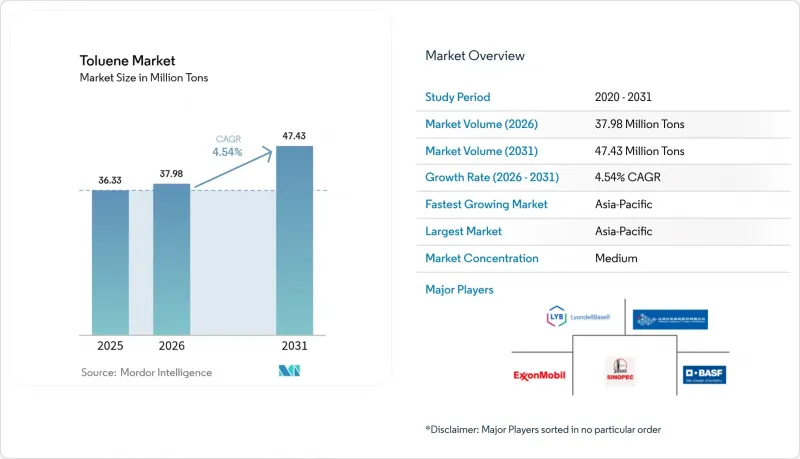
톨루엔 시장 규모는 2025년 3,633만 톤으로 평가되었습니다. 2026년에는 3,798만 톤으로 확대되어 2026년부터 2031년에 걸쳐 CAGR 4.54%를 나타내, 2031년에는 4,743만 톤에 이를 것으로 예측됩니다.
수요 증가는 벤젠, 자일렌, 톨루엔디이소시아네이트(TDI) 등의 다운스트림 제품에 사용되는 방향족 탄화수소로서 본 화학물질의 범용성을 반영하고 있으며, 이들은 건설에서 전자제품에 이르기까지 다양한 분야에 공급되고 있습니다. 배출량 감축을 위한 규제 조치로 인해 에너지 효율을 높이고 휘발성 유기화합물(VOC) 배출을 줄이기 위한 공정 개선이 가속화되고 있으며, 이는 장기적인 경쟁력을 뒷받침하고 있습니다. 이러한 추세는 비용 리더십과 청정 공정에 대한 기술 투자의 균형을 맞출 수 있는 생산자에게 유리한 통합적이고 지속가능성을 중시하는 공급망으로의 전환을 강조하고 있습니다.
세계의 톨루엔 시장 동향 및 인사이트
아세안 지역에서 폴리우레탄 폼의 견조한 확장으로 TDI 소비 증가
가구, 침구, 자동차 시트용 연질폼 생산이 급증하면서 말레이시아, 베트남, 태국에서 TDI 수요 증가를 견인하고 있습니다. 페트로나스의 RAPID 콤플렉스 등 톨루엔 시장에 대한 지역 투자로 톨루엔계 중간체에 대한 현지 접근성이 확대되어 수입 의존도가 낮아지고 있습니다. 생산자들은 방향족 화합물 생산을 확대하기 위해 원유에서 화학제품으로의 수율을 높이고 있으며, 톨루엔은 지역 폴리우레탄 공급의 핵심으로 자리 잡고 있습니다.
인도와 중국의 옥탄가 향상 규제로 인해 리포메이트 유래 톨루엔 수요 증가
인도의 'Bharat Stage VI'와 중국의 'China 6' 연료 기준은 더 높은 노크 방지 성분을 요구하고 있으며, 이에 따라 정유사들은 톨루엔이 풍부한 리포멧의 생산량을 늘리고 있습니다. 누마리갈 정유공장의 연간 900만 톤 생산량 증가로 현지 공급이 강화되는 한편, 중국의 통합형 복합시설에서는 더 많은 방향족 화합물이 가솔린 블렌딩 풀에 공급되고 있습니다. 이러한 움직임으로 인해 공급 과잉에 빠질 수 있었던 추가 톨루엔 공급이 흡수되어 정유사의 마진에 여유가 생겼고, 아시아태평양의 톨루엔 시장 전체에서 용매용 등급의 가격이 상승했습니다.
방향족 화합물에 대한 EU의 REACH VOC 규제 강화
유럽연합(EU)은 휘발성 유기화합물(VOC) 기준치를 높여 페인트, 코팅제, 접착제 제조업체들이 방향족 용매를 사용하지 않도록 배합을 재검토할 것을 촉구하고 있습니다. 배출 저감 설비 투자 및 고가의 저 VOC 캐리어로 대체하면서 컴플라이언스 비용이 증가하고 있습니다. 다국적 배합 제조업체들이 EU 및 영국 규제에 대응하기 위해 제품 라인을 간소화하면서 톨루엔 시장이 세분화되어 소비자 응용 분야에서 지역 내 톨루엔 수요를 둔화시키고 있습니다.
부문 분석
2025년 기준 벤젠과 자일렌은 유도체 소비량의 37.70%를 차지하여 폴리에스테르, 나일론 및 특수 화학제품 공급망에서 확고한 위치를 차지했습니다. 이러한 선도적 지위는 마진 변동에도 불구하고 개질업체와 방향족 화합물 추출업체에게 안정적인 처리량을 보장하고 있습니다. 한편, TDI 관련 톨루엔 시장 규모는 2026년부터 2031년까지 연평균 5.37% 성장할 것으로 예상되며, 이는 신흥 경제권의 가구 및 침구류에 대한 견조한 수요를 반영합니다.
벤즈알데히드, 벤조산, TNT 및 틈새 유도체는 각각 특수한 용도를 개척하고 있지만, 전체 톨루엔 시장 거래량에서 차지하는 비중은 크지 않습니다. 통합형 제조업체는 이 포트폴리오의 균형을 맞추고 규모의 경제를 활용하여 범용 제품과 특수 제품 모두를 고객에게 공급하고 있습니다.
이 톨루엔 시장 보고서는 파생 제품(벤젠 및 자일렌, 가솔린 첨가제, 톨루엔디이소시아네이트(TDI), 기타), 용도(페인트 및 코팅, 접착제 및 잉크, 화학 산업, 기타), 최종 사용자 산업(자동차, 건설, 석유 및 가스, 기타), 지역(아시아태평양, 북미, 유럽, 중동 및 아프리카, 기타)에 따라 산업을 분류하였습니다. 가스, 기타), 지역(아시아태평양, 북미, 유럽, 기타)으로 산업을 분류하고 있습니다. 시장 예측은 수량(톤) 기준으로 제공됩니다.
지역별 분석
2025년 기준 아시아태평양은 전 세계 총량의 54.70%를 차지했으며, 이 지역의 CAGR 5.48%는 톨루엔 시장의 주요 성장 동력으로 자리매김할 것으로 예측됩니다. 도시화, 건설 붐, 자동차 보급률 증가는 아세안 및 남아시아 전역의 파생 제품에 대한 수요를 뒷받침하고 있습니다.
북미는 성숙하면서도 혁신적인 시장이며, 이 지역의 규제 결정은 전 세계에 영향을 미칩니다. 미국은 고독성 용매의 단계적 폐지를 주도하고 있으며, 그 결과 특정 제품 배합에서 톨루엔이 선호되는 경향이 있습니다. 유럽은 가장 엄격한 VOC 규제에 직면하고 있으며, 용매 수요는 감소하고 있지만 저배출 공정 화학을 위한 연구개발이 촉진되고 있습니다.
중동에서는 사우디와 아랍에미리트에 세계 최대 규모의 혼합 자일렌 생산시설이 신설되어 이 지역이 아시아를 위한 조정 공급처로 자리매김하고 있습니다. 남미의 점유율은 작지만, 브라질의 산업 회복으로 지역 전체 수요가 증가하고 있으며, 특히 주요 이벤트와 연계된 건설 수요 및 인프라 구축이 톨루엔 산업의 성장을 견인하고 있습니다.
기타 혜택 :
- 엑셀 형식 시장 예측(ME) 시트
- 3개월간 애널리스트 지원
자주 묻는 질문
목차
제1장 서론
제2장 조사 방법
제3장 주요 요약
제4장 시장 구도
제5장 시장 규모와 성장 예측
제6장 경쟁 구도
제7장 시장 기회와 향후 전망
KTH 26.05.29The Toluene Market size is expected to grow from 36.33 Million Tons in 2025 to 37.98 Million Tons in 2026 and is forecast to reach 47.43 Million Tons by 2031 at 4.54% CAGR over 2026-2031.
Demand growth reflects the chemical's versatility as an aromatic hydrocarbon used in downstream products such as benzene, xylene, and toluene diisocyanate (TDI), which feed diverse sectors from construction to electronics. Regulatory initiatives to reduce emissions accelerate process upgrades that improve energy efficiency and cut volatile organic compound (VOC) releases, supporting long-term competitiveness. Together, these trends underscore a shift toward integrated, sustainability-oriented supply chains that favor producers able to balance cost leadership with technology investments in cleaner processes.
Global Toluene Market Trends and Insights
Robust Polyurethane Foam Build-out in ASEAN Elevates TDI Consumption
Surging output of flexible foam for furniture, bedding, and vehicle seats is driving incremental TDI demand in Malaysia, Vietnam, and Thailand. Toluene market regional investments, such as Petronas' RAPID complex, increase local access to toluene-based intermediates, limiting import reliance. Producers are elevating crude-to-chemicals yields to expand aromatics output, placing toluene at the heart of regional polyurethane supply.
Octane-Boost Mandates in India and China Boost Reformate Toluene Intake
India's Bharat Stage VI and China 6 fuel norms demand higher anti-knock components, prompting refiners to raise reformate volumes enriched with toluene. Numaligarh Refinery's upgrade to 9 MTPA consolidates local supply, while Chinese integrated complexes channel more aromatics into gasoline blending pools. These moves absorb incremental toluene streams that might otherwise face oversupply, creating a cushion for refinery margins and lifting solvent-grade prices across the toluene market in Asia Pacific.
Tightening EU REACH VOC Restrictions on Aromatics
The European Union has intensified VOC thresholds, prompting paint, coating, and adhesive producers to reformulate away from aromatic solvents[2]. Compliance costs rise through investment in abatement equipment and substitution with higher-priced low-VOC carriers. Toluene market fragmentation emerges as multinational formulators rationalize product lines to accommodate EU and the United Kingdom limits, dampening regional toluene demand in consumer-facing applications.
Other drivers and restraints analyzed in the detailed report include:
- Electronics-Grade Solvents Demand in Taiwan and South Korea
- Substitution of Methylene Chloride by Toluene in US Adhesives
- Volatility in Naphtha and Crude Spreads Compressing Margins
For complete list of drivers and restraints, kindly check the Table Of Contents.
Segment Analysis
Benzene and xylene retained a 37.70% share of derivative consumption in 2025, underscoring their entrenched role in polyester, nylon, and specialty chemical chains. That leadership secures steady throughput for reformers and aromatics extractors even as margins fluctuate. Meanwhile, the toluene market size tied to TDI is projected to expand at a 5.37% CAGR from 2026-2031, reflecting robust furniture and bedding demand across emerging economies.
Benzaldehyde, benzoic acid, TNT, and niche derivatives carve specialized outlets, but collectively they account for a modest share of the toluene market volumes. Integrated producers balance this portfolio, leveraging economies of scale to supply both commodity and specialty customers.
The Toluene Market Report Segments the Industry by Derivative (Benzene and Xylene, Gasoline Additives, Toluene Diisocyanates (TDI), and Others), Application (Paints and Coatings, Adhesives and Inks, Chemical Industry, and Others), End-User Industry (Automotive, Construction, Oil and Gas, and More), and Geography (Asia-Pacific, North America, Europe, and More). The Market Forecasts are Provided in Terms of Volume (Tons)
Geography Analysis
Asia Pacific controlled 54.70% of global volumes in 2025, and the region's 5.48% CAGR cements its status as the primary growth engine for the toluene market. Urbanization, construction booms, and rising vehicle penetration sustain derivative demand throughout ASEAN and South Asia.
North America is a mature yet innovative arena where regulatory decisions ripple globally. The United States is spearheading the phaseout of high-toxicity solvents, inadvertently favoring toluene in specific reformulations. Europe grapples with the strictest VOC rules, trimming solvent demand but stimulating research and development toward low-emission process chemistry.
The Middle East adds new barrels through world-scale mixed-xylene facilities in Saudi Arabia and the United Arab Emirates, positioning the region as a swing supplier for Asia. South America accounts for a smaller slice, yet Brazil's industrial recovery lifts regional appetite, especially for construction windows tied to major events and infrastructure drives growth in toluene industry.
- BASF
- Braskem
- Chevron Phillips Chemical Company LLC
- China Petrochemical Corporation
- CNPC
- CPC Corporation
- Exxon Mobil Corporation
- Formosa Chemicals & Fibre Corp
- Indian Oil Corporation Ltd
- INEOS
- LyondellBasell Industries Holdings B.V.
- Mangalore Refinery and Petrochemicals Limited
- Mitsubishi Chemical Group Corporation
- Mitsui Chemicals, Inc.
- Reliance Industries Limited
- SABIC
- Shell plc
- SK innovation Co., Ltd
- TotalEnergies
- Valero
Additional Benefits:
- The market estimate (ME) sheet in Excel format
- 3 months of analyst support
TABLE OF CONTENTS
1 Introduction
- 1.1 Study Assumptions and Market Definition
- 1.2 Scope of the Study
2 Research Methodology
3 Executive Summary
4 Market Landscape
- 4.1 Market Overview
- 4.2 Market Drivers
- 4.2.1 Robust Polyurethane Foam Build-out in ASEAN Elevates TDI Consumption
- 4.2.2 Octane-Boost Mandates in India and China Boost Reformate Toluene Intake
- 4.2.3 Electronics?Grade Solvents Demand in Taiwan and South Korea
- 4.2.4 Substitution of Methylene Chloride by Toluene in US Adhesives
- 4.2.5 Rapid Capacity Addition of Aromatics Units in GCC Region
- 4.3 Market Restraints
- 4.3.1 Tightening EU REACH VOC Restrictions on Aromatics
- 4.3.2 Volatility in Naphtha and Crude Spreads Compressing Margins
- 4.3.3 Growing Bio-Based Solvent Adoption in North America
- 4.4 Value Chain Analysis
- 4.5 Feedstock Analysis
- 4.6 Technological Snapshot
- 4.7 Regulatory Analysis
- 4.8 Trade Analysis
- 4.9 Porter's Five Forces
- 4.9.1 Bargaining Power of Suppliers
- 4.9.2 Bargaining Power of Buyers
- 4.9.3 Threat of New Entrants
- 4.9.4 Threat of Substitutes
- 4.9.5 Degree of Competition
- 4.10 Price Index
5 Market Size and Growth Forecasts (Volume)
- 5.1 By Derivative
- 5.1.1 Benzene and Xylene
- 5.1.2 Gasoline Additives
- 5.1.3 Toluene Diisocyanates (TDI)
- 5.1.4 Other Derivatives (Benzoic Acid, Trinitrotoluene (TNT), Benzaldehyde)
- 5.2 By Application
- 5.2.1 Paints and Coatings
- 5.2.2 Adhesives and Inks
- 5.2.3 Chemical Industry
- 5.2.4 Explosives
- 5.2.5 Other Applications (Pharmaceuticals, Solvents and Degreasers, Dyes and Pigments)
- 5.3 By End-user Industry
- 5.3.1 Automotive
- 5.3.2 Construction
- 5.3.3 Oil and Gas
- 5.3.4 Military and Defense
- 5.3.5 Other End-user Industries (Electronics, Consumer Products)
- 5.4 By Geography
- 5.4.1 Asia-Pacific
- 5.4.1.1 China
- 5.4.1.2 India
- 5.4.1.3 Japan
- 5.4.1.4 South Korea
- 5.4.1.5 Rest of Asia-Pacific
- 5.4.2 North America
- 5.4.2.1 United States
- 5.4.2.2 Canada
- 5.4.2.3 Mexico
- 5.4.3 Europe
- 5.4.3.1 Germany
- 5.4.3.2 United Kingdom
- 5.4.3.3 France
- 5.4.3.4 Italy
- 5.4.3.5 Rest of Europe
- 5.4.4 South America
- 5.4.4.1 Brazil
- 5.4.4.2 Argentina
- 5.4.4.3 Rest of South America
- 5.4.5 Middle East and Africa
- 5.4.5.1 Saudi Arabia
- 5.4.5.2 South Africa
- 5.4.5.3 Rest of Middle East and Africa
- 5.4.1 Asia-Pacific
6 Competitive Landscape
- 6.1 Market Concentration
- 6.2 Strategic Moves
- 6.3 Market Share Analysis
- 6.4 Company Profiles (includes Global level Overview, Market level overview, Core Segments, Financials as available, Strategic Information, Market Rank/Share for key companies, Products and Services, and Recent Developments)
- 6.4.1 BASF
- 6.4.2 Braskem
- 6.4.3 Chevron Phillips Chemical Company LLC
- 6.4.4 China Petrochemical Corporation
- 6.4.5 CNPC
- 6.4.6 CPC Corporation
- 6.4.7 Exxon Mobil Corporation
- 6.4.8 Formosa Chemicals & Fibre Corp
- 6.4.9 Indian Oil Corporation Ltd
- 6.4.10 INEOS
- 6.4.11 LyondellBasell Industries Holdings B.V.
- 6.4.12 Mangalore Refinery and Petrochemicals Limited
- 6.4.13 Mitsubishi Chemical Group Corporation
- 6.4.14 Mitsui Chemicals, Inc.
- 6.4.15 Reliance Industries Limited
- 6.4.16 SABIC
- 6.4.17 Shell plc
- 6.4.18 SK innovation Co., Ltd
- 6.4.19 TotalEnergies
- 6.4.20 Valero
7 Market Opportunities and Future Outlook
- 7.1 White-space and Unmet-Need Assessment


