

|
시장보고서
상품코드
2044118
반려동물 헬스케어 시장 : 점유율 분석, 산업 동향 및 통계, 성장 예측(2026-2031년)Companion Animal Healthcare - Market Share Analysis, Industry Trends & Statistics, Growth Forecasts (2026 - 2031) |
||||||
 Mordor Intelligence
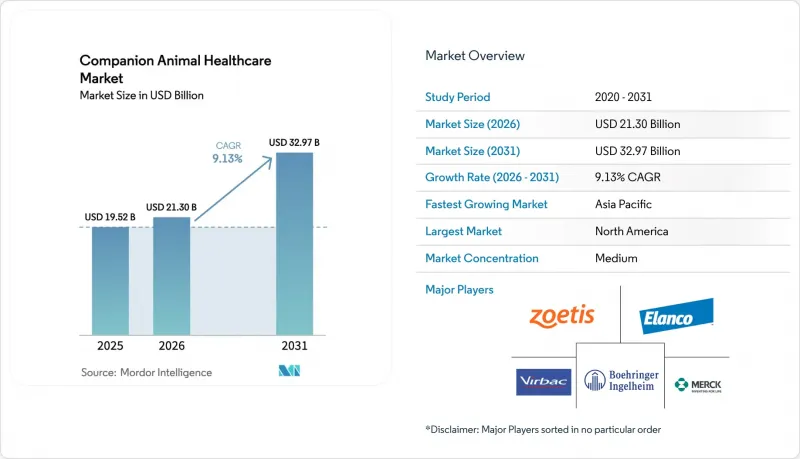
반려동물 헬스케어 시장 규모는 2025년에 195억 2,000만 달러로 평가되었고 2026년 213억 달러에서 2031년까지 329억 7,000만 달러에 이를 것으로 예측되며, 예측 기간(2026-2031년) CAGR은 9.13%를 나타낼 전망입니다.
반려동물 보험의 보장범위 확대, 현장진단(POC)의 급속한 보급, 바이오 의약품의 수용성 확대가 결합되어 반려동물 헬스케어 시장 전체의 수익구조를 재편하고 있습니다. 도시 가구의 가처분 소득 증가와 반려동물의 '인간화'가 결합하여 종양학 프로토콜에서 정형외과 수술에 이르기까지 고급 치료법에 대한 수요를 촉진하고 있습니다. 10분 이내에 결과를 얻을 수 있는 진단 기술은 임상적 판단을 향상시키고, 증상 발현부터 치료 시작까지의 시간을 단축시켜 다운스트림 치료제 판매를 촉진하고 있습니다. 동시에 전자상거래 플랫폼은 원격 의료 상담과 정기 배송 서비스를 결합하여 전통적인 조제 모델을 혁신하고, 진료 관리 소프트웨어는 진단, 청구, 재고 관리를 단일 워크 플로우로 통합합니다. 경쟁적 차별화는 블록버스터 의약품에서 데이터 기반 서비스, 동물병원을 반려동물 보호자의 일상 생활에 더 깊숙이 통합하는 클라우드 커넥티드 디바이스로 옮겨가고 있습니다.
세계 반려동물 헬스케어 시장 동향과 인사이트
반려동물 양육률 증가와 동물의 '인간화'
2024년 미국 가구의 반려동물 보유율은 66%에 달해, 반려동물 1마리당 연간 평균 지출액은 1,480달러로 인간의 웰빙 예산과 비슷한 수준까지 올라갔습니다. 반려동물 보호자들은 과거 인간에게만 국한되었던 장기이식, 화학요법, 맞춤형 정형외과용 임플란트 등의 시술을 선택하게 되었고, 이로 인해 환자 1인당 평균 수익이 향상되고 있습니다. 밀레니얼 세대와 Z세대의 반려동물 보험 가입률이 가장 높으며, 이들 세대가 고소득층으로 성숙해짐에 따라 프리미엄 치료법이 지속적으로 수용될 수 있는 기반이 마련되었습니다. 심박수, 수면, 활동을 추적하는 웨어러블 모니터는 질병을 조기에 발견할 수 있는 종단적 데이터 세트를 생성하여 수의사와의 잦은 교류를 정당화할 수 있습니다. 의료기기의 승인은 FDA(미국 식품의약국) 수의학 센터의 안전 가이드라인을 준수해야 합니다. 이로 인해 상품화까지의 기간은 길어지지만, 소비자의 신뢰는 높아집니다. 이러한 시너지 효과로 인해 데이터에 기반한 지식이 더 높은 수준의 케어를 뒷받침하고, 반려동물 헬스케어 시장 전체의 성장을 가속하는 선순환이 일어나고 있습니다.
반려동물 보험의 보급 확대
미국의 반려동물 보험료 수입은 2023년 39억 달러에서 2024년 47억 달러로 증가하여 620만 마리의 동물을 보장하며 전년 대비 21.4% 성장했습니다. 보험의 보급으로 골관절염이나 종양 치료를 위한 고가의 단일클론항체 주사(1만 5,000달러 이상)가 가능해졌습니다. 이는 70%-90%의 보험 환급률로 인해 보호자의 본인 부담금이 줄어들기 때문입니다. 외과 전문 분야는 보험 확대에 발맞추어 2023년부터 2024년까지 정형외과 수술 건수가 18% 증가하며 큰 수혜를 입었습니다. 보험사들은 현재 예방적 진단(연례 혈액검사, 유전자 검사 등)을 보험 적용 대상에 추가하고 있으며, 사후 대응형에서 예방형 케어 모델로 수익을 전환하고 있습니다. 영국과 스웨덴은 이미 25% 이상의 보급률을 달성했으며, 일본의 2024년 세제 혜택은 이 지역의 성장을 가속하고 있습니다. 보험 적용 범위의 확대는 예측 가능한 수요를 창출하고, 반려동물 헬스케어 시장 전체의 현금흐름을 안정화시키고 있습니다.
치솟는 수의학 서비스 및 약품 비용
미국의 수의학 서비스 가격은 2023년부터 2024년까지 10.2% 상승하여 일반 물가상승률 3.4%를 크게 웃돌았으며, 정기 건강검진 비용은 52달러에서 58달러로 상승했습니다. 대도시 지역의 응급 진료비는 현재 1,500달러를 넘어섰으며, 이는 예산이 부족한 보호자들이 적절한 시기에 치료를 받는 것을 주저하게 만드는 요인으로 작용하고 있습니다. 의약품 가격도 비슷한 추세를 보이고 있으며, 인도와 중국의 원료의약품(API) 공급 제약으로 인해 2024년 'Simparica Trio'의 도매가격이 8% 상승했습니다. 미국 반려동물의 94%가 보험에 가입되어 있지 않기 때문에 많은 보호자들이 선택적 치료를 미루거나 저렴한 제네릭 의약품으로 대체하고 있으며, 이는 반려동물 헬스케어 시장의 단기적 성장을 저해하는 요인으로 작용하고 있습니다. 라틴아메리카와 동남아시아의 가격 민감도가 높은 지역에서는 1인당 연간 50달러 미만의 수의학 비용이 발생하기 때문에 이 영향을 가장 심각하게 받고 있습니다.
부문 분석
진단 의약품은 가장 빠르게 성장하는 카테고리로 2031년까지 연평균 복합 성장률(CAGR) 12.25%로 확대될 것으로 예측됩니다. 한편, 치료제는 2025년 기준 반려동물 헬스케어 시장에서 37.56%의 점유율을 유지하고 있습니다. 백신, 구충제, NSAIDs는 안정적인 기반을 제공하지만, 선진국의 예방접종률이 정점을 찍고 있어 성장 여지가 제한적입니다. '심파리카 트리오'와 같은 복합 기생충 치료제는 1회 투여의 편리함을 원하는 보호자들의 지지를 받고 있지만, 제네릭 의약품의 경쟁 압력으로 인해 수익률이 압박을 받고 있습니다. 만성통증 및 신흥 종양학 적응증에 대한 단일클론항체들이 성장세를 보이고 있으며, 프리미엄 가격을 유지하면서 반려동물 헬스케어 시장에서의 수익 회복력을 뒷받침하고 있습니다.
진단 분야의 급격한 성장은 POC(현장검사) 기기, 면역측정법, 분자 패널에 의해 견인되고 있으며, 이는 검사 결과 보고 시간을 단축하고 내원 당일 진료를 가능하게 하고 있습니다. 과거에는 전문적인 검사였던 표준 SDMA 신장 기능 검사도 이제는 건강검진에서 일상적인 검사로 자리 잡았습니다. IDEXX는 연간 2억 건 이상의 검사를 처리하고 있으며, 이를 통해 동물병원을 시약 정기 구매에 묶어두는 '면도칼과 칼날' 모델을 강화하고 있습니다. 클라우드 통합을 통해 검사 데이터가 진료 관리 소프트웨어에 통합되고, 이상 징후를 실시간으로 감지하는 AI 알림이 지원됩니다. 미국 식품의약국(FDA)의 수의학 센터의 규제 감독을 통해 95% 이상의 정확도를 보장하고 있으며, 이 기준은 수준 이하의 진입자를 배제하는 동시에 제품 출시 주기를 연장하고 있습니다. 디지털 헬스 서비스(원격의료, 웨어러블 분석, 진료관리 플랫폼)는 아직 규모는 작지만, 진료소가 업무 효율화를 추구함에 따라 가속화되고 있습니다.
2025년에는 광견병 백신 의무화 및 풍토병 기생충 퇴치에 힘입어 감염성 질환 분야가 반려동물 헬스케어 시장 규모의 31.53%를 차지하며 수익의 대부분을 차지했습니다. 그러나 경쟁과 백신 접종의 포화상태가 앞으로의 확장을 억제하고 있습니다. 반면, 종양학 분야는 CAGR 11.85%로 확대될 것으로 예상되며, 기존 화학요법에 따른 부작용 없이 생존율을 향상시키는 Tanovea-CA1, Stelfonta와 같은 획기적인 치료법의 등장으로 인해 성장세를 보이고 있습니다.
반려동물의 암 발병률은 인간과 비슷한 수준이며, 이는 표적 생물학적 제제에 대한 투자를 촉진하고 있습니다. Tanovea-CA1은 반려견 림프종에서 79%의 반응률을 달성하여 병원 내 진단시설을 갖춘 동물병원에서 조기에 도입하도록 독려하고 있습니다. Stelfonta는 비만세포종에 대한 비수술적 치료법을 제공하여 마취의 위험과 회복 기간을 단축시킵니다. 아포켈, 사이트포인트와 같은 피부과 및 알레르기 치료제는 지속적인 수요가 있으며, 내분비질환 치료제는 인슐린 및 호르몬 대체요법의 매출이 안정적으로 발생하고 있습니다. 이러한 추세와 함께 만성질환 관리로 수익이 이동하고 있으며, 반려동물 헬스케어 시장에 예측 가능한 현금흐름을 가져다주고 있습니다.
지역별 분석
2025년에는 북미가 36.53%의 점유율로 1위를 차지해, 광범위한 전문 병원 네트워크와 성숙한 보험 보급률의 혜택을 누릴 수 있습니다. Mars Veterinary Health와 같은 기업 통합자는 여러 주에 걸친 클리닉 네트워크와 중앙 검사실을 운영하여 당일 진단을 가능하게 합니다. 유럽이 약 28%를 차지하고 있으며, 유럽의약품청(EMA)의 승인 동기화가 단일클론항체 시장 진입을 가속화하고 있습니다. 영국은 보험 가입률이 25%를 넘어 고가의 치료법을 뒷받침하고 있지만, 동유럽에서는 반려동물 한 마리당 지출이 낮은 수준에 머물러 있습니다.
아시아태평양은 반려동물 사육두수 증가, 보험 가입률 증가, 정부 혜택에 힘입어 CAGR 10.21%를 나타낼 것으로 예측됩니다. 중국 도시 지역의 반려동물 사육두수는 2024년 1억 2,000만 마리를 넘어, 보험 가입 건수는 2025년 81% 증가한 3억 8,000만 건에 달했으며, 예방 의료 및 만성 질환 치료비 부담에 대한 의지가 높아질 것으로 보입니다. 일본에서는 보험에 대한 세제혜택을 배경으로 2023년부터 2025년까지 동물병원 수가 8% 증가했습니다. 인도는 아직 개발도상국이지만, 주요 도시에서는 반려동물 사육 수가 연 15%의 성장세를 보이고 있습니다. 중동 및 아프리카는 매출의 5%, 남미는 6%를 차지하고 있으며, 거시경제의 변동성 속에서도 브라질은 장기적인 성장에 대한 기대감을 불러일으키고 있습니다.
기타 특전:
- 엑셀 형식 시장 예측(ME) 시트
- 3개월간 애널리스트 지원
자주 묻는 질문
목차
제1장 서론
제2장 조사 방법
제3장 주요 요약
제4장 시장 구도
제5장 시장 규모와 성장 예측
제6장 경쟁 구도
제7장 시장 기회와 향후 전망
JHS 26.06.02The Companion Animal Healthcare Market size was valued at USD 19.52 billion in 2025 and is estimated to grow from USD 21.30 billion in 2026 to reach USD 32.97 billion by 2031, at a CAGR of 9.13% during the forecast period (2026-2031).
Expanding pet insurance coverage, rapid uptake of point-of-care (POC) diagnostics, and the growing acceptance of biologics are collectively reshaping revenue flows across the companion animal healthcare market. Higher disposable incomes among urban households, coupled with the humanization of pets, propel demand for sophisticated interventions ranging from oncology protocols to orthopedic surgeries. Diagnostics that deliver sub-10-minute turnaround times improve clinical decision-making and shorten the gap between symptom onset and therapy initiation, boosting downstream therapeutic sales. At the same time, e-commerce platforms disrupt legacy dispensing models by pairing telehealth consultations with auto-ship subscriptions, while practice-management software integrates diagnostics, billing, and inventory management in a single workflow. Competitive differentiation is shifting from blockbuster drugs toward data-driven services and cloud-connected devices that embed clinics more deeply in the daily routines of pet owners.
Global Companion Animal Healthcare Market Trends and Insights
Increase in Pet Adoption & Humanization of Animals
Pet ownership rose to 66% of U.S. households in 2024, with average annual outlays of USD 1,480 per pet, mirroring human wellness budgets. Owners now opt for procedures once limited to people-organ transplants, chemotherapy, and custom orthopedic implants-thereby elevating average revenue per patient. Millennials and Gen Z show the highest propensity to acquire pet insurance, positioning premium therapies for sustained uptake as these cohorts mature into higher income brackets. Wearable monitors that track heart rate, sleep, and activity create longitudinal datasets that surface conditions earlier, justifying frequent veterinary engagement. Device approvals must align with FDA Center for Veterinary Medicine safety guidelines, which prolong commercialization timelines but fortify consumer confidence. The combined effect is a virtuous cycle where data-driven insights validate higher standards of care and reinforce growth across the companion animal healthcare market.
Expanding Penetration of Pet Insurance
United States pet insurance premiums climbed from USD 3.9 billion in 2023 to USD 4.7 billion in 2024, covering 6.2 million animals and delivering 21.4% year-over-year growth. Insurance uptake enables costly monoclonal antibody injections for osteoarthritis or oncology regimens topping USD 15,000, because 70%-90% reimbursement rates lower owner out-of-pocket exposure. Surgical specialties benefit markedly; orthopedic procedures rose 18% between 2023 and 2024 in lockstep with insurance expansion. Carriers now add preventive diagnostics-annual blood panels and genetic screens-to their formularies, migrating revenue from reactive to proactive care models. The United Kingdom and Sweden already exceed 25% penetration, while Japan's 2024 tax incentive program is catalyzing regional growth. Increased coverage drives predictable demand, which stabilizes cash flows across the companion animal healthcare market.
Escalating Veterinary Service & Drug Costs
U.S. veterinary service prices rose 10.2% from 2023 to 2024, dwarfing 3.4% general inflation and lifting routine wellness exams from USD 52 to USD 58. Emergency visits in metro areas now exceed USD 1,500, discouraging timely care among budget-constrained owners. Drug prices mirror this trend: Simparica Trio wholesale cost climbed 8% in 2024 amid API constraints in India and China. Because 94% of U.S. pets remain uninsured, many owners defer elective procedures or pivot to lower-cost generics, tempering near-term growth across the companion animal healthcare market. Price-sensitive regions in Latin America and Southeast Asia feel the strain most acutely, as per-capita veterinary spending stays below USD 50 annually.
Other drivers and restraints analyzed in the detailed report include:
- Rapid Uptake of Advanced In-Clinic & POC Diagnostics
- Boom in Chronic-Care Monoclonal Antibodies
- Global Shortage of Skilled Veterinary Talent
For complete list of drivers and restraints, kindly check the Table Of Contents.
Segment Analysis
Diagnostics represented the fastest-growing category, expanding at 12.25% CAGR through 2031, while therapeutics retained a 37.56% share of the companion animal healthcare market in 2025. Vaccines, parasiticides, and NSAIDs supply a stable base, but their incremental upside is modest as immunization rates plateau in developed economies. Multimodal parasiticides such as Simparica Trio captured owners' preference for single-dose convenience, yet competitive pressure from generics compresses margins. Monoclonal antibodies for chronic pain and emerging oncology indications are gaining traction, commanding premium pricing and anchoring revenue resilience inside the companion animal healthcare market.
The diagnostics surge is powered by POC devices, immunoassays, and molecular panels that compress turnaround times and facilitate same-visit care. Standard SDMA kidney screenings, once specialty procedures, are now routine during wellness exams. IDEXX alone processes over 200 million tests annually, reinforcing a razor-and-blade model that locks clinics into reagent subscriptions. Cloud integration funnels lab data into practice-management software, supporting AI alerts that flag anomalies in real time. Regulatory oversight by FDA's Center for Veterinary Medicine ensures >=95% accuracy, a bar that filters substandard entrants yet lengthens release cycles. Digital health services-telemedicine, wearable analytics, and practice-management platforms-remain smaller but accelerate as clinics seek operational efficiencies.
Infectious diseases dominated revenue with a 31.53% slice of the companion animal healthcare market size in 2025, fueled by mandated rabies vaccines and endemic parasite control. However, price competition and vaccination saturation restrain future expansion. Oncology, by contrast, is forecast to compound at 11.85% CAGR, riding breakthroughs such as Tanovea-CA1 and Stelfonta that improve survival without the adverse events associated with traditional chemotherapy.
Companion animals exhibit cancer rates comparable to humans, spurring investment in targeted biologics. Tanovea-CA1 achieved a 79% response rate in canine lymphoma, prompting earlier adoption by clinics equipped with in-house diagnostics. Stelfonta offers a non-surgical solution for mast cell tumors, reducing anesthesia risk and recovery time. Dermatology and allergy therapies like Apoquel and Cytopoint enjoy recurring demand, while endocrine disorders deliver predictable insulin and hormone-replacement sales. Together, these dynamics pivot revenue toward chronic disease management, layering predictable cash flows onto the companion animal healthcare market.
The Companion Animal Healthcare Market Report is Segmented by Product Type (Therapeutics [Vaccines, and More], Diagnostics [Immunodiagnostic Tests, and More], and Digital Health & Services), Therapeutic Area (Infectious Diseases, and More), Animal Type (Dogs, and More), Distribution Channel (Veterinary Hospitals & Clinics, and More), Geography (North America, and More). The Market Forecasts are Provided in Terms of Value (USD).
Geography Analysis
North America led with 36.53% share in 2025, benefiting from extensive specialty hospitals and mature insurance penetration. Corporate consolidators such as Mars Veterinary Health operate multi-state clinic networks and central labs that enable same-day diagnostics. Europe contributed roughly 28%, with synchronized EMA approvals expediting monoclonal antibody launches. The United Kingdom's insurance penetration above 25% sustains high-ticket therapies, whereas Eastern Europe lags on per-pet spending.
Asia-Pacific is poised for 10.21% CAGR, buoyed by rising pet ownership, insurance uptake, and government incentives. China's urban pet population topped 120 million in 2024, and policies rose 81% to 3.8 million in 2025, signaling willingness to fund preventive and chronic care. Japan's clinic count rose 8% between 2023 and 2025, underpinned by tax incentives for insurance. India remains nascent but exhibits 15% annual growth in pet adoption across major cities. The Middle East and Africa account for 5% of revenue, and South America represents 6%, with Brazil holding long-term promise despite macro volatility.
- bioMerieux
- Boehringer Ingelheim
- Ceva
- Covetrus
- Dechra Pharmaceuticals plc
- Elanco
- Heska
- Hipra
- IDEXX
- KRKA d.d.
- Mars Veterinary Health
- Merck
- Neogen Corp.
- Norbrook Laboratories
- PetIQ Inc.
- Phibro Animal Health
- Thermo Fisher Scientific
- Vetoquinol
- Virbac
- Zoetis
- Zomedica Corp.
Additional Benefits:
- The market estimate (ME) sheet in Excel format
- 3 months of analyst support
TABLE OF CONTENTS
1 Introduction
- 1.1 Study Assumptions & Market Definition
- 1.2 Scope of the Study
2 Research Methodology
3 Executive Summary
4 Market Landscape
- 4.1 Market Overview
- 4.2 Market Drivers
- 4.2.1 Increase in Pet Adoption & Humanization of Animals
- 4.2.2 Expanding Penetration of Pet Insurance
- 4.2.3 Rapid Uptake of Advanced In-Clinic & POC Diagnostics
- 4.2.4 Boom in Chronic-Care Monoclonal Antibodies
- 4.2.5 AI-Powered Predictive Analytics for Preventive Care
- 4.2.6 Subscription Models Monetising Wearable Biometrics
- 4.3 Market Restraints
- 4.3.1 Escalating Veterinary Service & Drug Costs
- 4.3.2 Global Shortage of Skilled Veterinary Talent
- 4.3.3 Regulatory Lag for Gene-Editing & Cell Therapies
- 4.3.4 Cyber-Security Risks to Connected Vet Devices
- 4.4 Supply-Chain Analysis
- 4.5 Regulatory Landscape
- 4.6 Technological Outlook
- 4.7 Porter's Five Forces
- 4.7.1 Threat of New Entrants
- 4.7.2 Bargaining Power of Buyers
- 4.7.3 Bargaining Power of Suppliers
- 4.7.4 Threat of Substitutes
- 4.7.5 Intensity of Competitive Rivalry
5 Market Size & Growth Forecasts (Value, USD)
- 5.1 By Product Type
- 5.1.1 Therapeutics
- 5.1.1.1 Vaccines
- 5.1.1.2 Parasiticides
- 5.1.1.3 Anti-Infectives
- 5.1.1.4 NSAIDs & Pain Management
- 5.1.1.5 Monoclonal Antibodies
- 5.1.1.6 Medical Feed Additives
- 5.1.1.7 Other Therapeutics
- 5.1.2 Diagnostics
- 5.1.2.1 Immunodiagnostic Tests
- 5.1.2.2 Molecular Diagnostics
- 5.1.2.3 Diagnostic Imaging
- 5.1.2.4 Point-of-Care Devices
- 5.1.2.5 Other Diagnostics
- 5.1.3 Digital Health & Services
- 5.1.3.1 Tele-medicine Platforms
- 5.1.3.2 Practice-Management Software
- 5.1.3.3 Wearable Monitoring Devices
- 5.1.1 Therapeutics
- 5.2 By Therapeutic Area
- 5.2.1 Infectious Diseases
- 5.2.2 Dermatology/Allergy
- 5.2.3 Pain & Inflammation
- 5.2.4 Endocrine & Metabolic Disorders
- 5.2.5 Oncology
- 5.2.6 Cardiology
- 5.3 By Animal Type
- 5.3.1 Dogs
- 5.3.2 Cats
- 5.3.3 Other Companion Animals
- 5.4 By Distribution Channel
- 5.4.1 Veterinary Hospitals & Clinics
- 5.4.2 Retail Pharmacies
- 5.4.3 Online /E-commerce Platforms
- 5.5 Geography
- 5.5.1 North America
- 5.5.1.1 United States
- 5.5.1.2 Canada
- 5.5.1.3 Mexico
- 5.5.2 Europe
- 5.5.2.1 Germany
- 5.5.2.2 United Kingdom
- 5.5.2.3 France
- 5.5.2.4 Italy
- 5.5.2.5 Spain
- 5.5.2.6 Rest of Europe
- 5.5.3 Asia-Pacific
- 5.5.3.1 China
- 5.5.3.2 Japan
- 5.5.3.3 India
- 5.5.3.4 South Korea
- 5.5.3.5 Australia
- 5.5.3.6 Rest of Asia-Pacific
- 5.5.4 Middle East and Africa
- 5.5.4.1 GCC
- 5.5.4.2 South Africa
- 5.5.4.3 Rest of Middle East and Africa
- 5.5.5 South America
- 5.5.5.1 Brazil
- 5.5.5.2 Argentina
- 5.5.5.3 Rest of South America
- 5.5.1 North America
6 Competitive Landscape
- 6.1 Market Concentration
- 6.2 Market Share Analysis
- 6.3 Company Profiles (includes Global-level Overview, Market-level Overview, Core Segments, Financials, Strategic Information, Market Rank/Share, Products & Services, Recent Developments)
- 6.3.1 bioMerieux SA
- 6.3.2 Boehringer Ingelheim Animal Health
- 6.3.3 Ceva Sante Animale
- 6.3.4 Covetrus Inc.
- 6.3.5 Dechra Pharmaceuticals plc
- 6.3.6 Elanco Animal Health
- 6.3.7 Heska Corp.
- 6.3.8 HIPRA
- 6.3.9 IDEXX Laboratories Inc.
- 6.3.10 KRKA d.d.
- 6.3.11 Mars Veterinary Health
- 6.3.12 Merck Animal Health
- 6.3.13 Neogen Corp.
- 6.3.14 Norbrook Laboratories
- 6.3.15 PetIQ Inc.
- 6.3.16 Phibro Animal Health Corp.
- 6.3.17 Thermo Fisher Scientific
- 6.3.18 Vetoquinol SA
- 6.3.19 Virbac
- 6.3.20 Zoetis Inc.
- 6.3.21 Zomedica Corp.
7 Market Opportunities & Future Outlook
- 7.1 White-space & Unmet-Need Assessment


