|
시장보고서
상품코드
2044169
마우스 모델 시장 : 점유율 분석, 업계 동향과 통계, 성장 예측(2026-2031년)Mice Model - Market Share Analysis, Industry Trends & Statistics, Growth Forecasts (2026 - 2031) |
||||||
 Mordor Intelligence
2026년 마우스 모델 시장 규모는 17억 1,000만 달러로 추정되고 있어 2025년 16억 달러에서 성장하여 2031년에는 23억 7,000만 달러에 이를 것으로 예측됩니다.
2026년부터 2031년까지 연평균 복합 성장률(CAGR) 6.78%를 나타낼 것으로 예측됩니다.
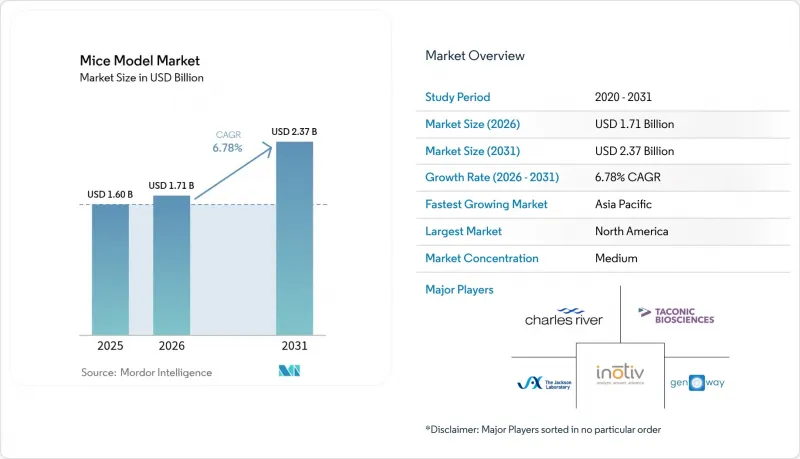
이러한 꾸준한 수요는 높은 번역적 유용성(임상 적용 가능성)을 가진 유전자 변형 계통에 의존하는 종양학, 면역학 및 희귀질환 파이프라인에 기인합니다. CRISPR/Cas9은 가장 큰 기술 점유율을 유지하는 동시에 가장 빠르게 성장하고 있으며, 모델 생성 기간을 단축하고 비용을 절감하고 있습니다. 북미는 집중적인 R&D 자금과 활발한 제약 활동으로 주도권을 유지하고 있지만, 중국, 일본, 한국이 현지 육종 인프라에 자본을 투입하면서 아시아태평양이 그 격차를 좁혀가고 있습니다. 임상시험수탁기관(CRO)은 외주 연구 비중을 확대하고 있으며, 면역종양학 검증에 있어 인간화 면역체계 및 환자 유래 이종이식(PDX) 라이브러리의 중요성이 커지고 있습니다. 대체법을 향한 규제 동향은 역풍을 불러일으키는 한편, 모델 개발자들에게 보다 충실하고 윤리적으로 정교한 시스템을 제공하도록 독려하고 있습니다.
세계 마우스 모델 시장 동향과 인사이트
면역종양학 검증에 혁명을 가져올 인간화 마우스 개발
면역결핍 계통에 인간의 면역 성분을 이식하여 만들어지는 인간화 모델은 기존의 이종이식 모델을 빠르게 대체하고 있습니다. 이 마우스는 체크포인트 억제제 및 CAR-T 치료제에 대한 반응을 보다 충실하게 재현하고, 후기 단계에서의 탈락률을 감소시킵니다. BioDuro사에 따르면, 면역치료의 예측 정확도는 70% 향상되었으며, 그 용도는 유효성 시험에 국한되지 않고 안전성 시험과 바이오마커 발굴 분야로 확대되고 있습니다. 하버드대 연구진은 최근 이러한 모델에서 새로운 PD-1 내성 메커니즘을 확인했으며, 그 분석의 깊이를 강조했습니다. 이에 따라 제약사들은 인간화 코호트에 더 많은 예산을 할당하고 있으며, 북미, 유럽, 중국 전역에서 지속적인 수요가 증가하고 있습니다.
CRISPR 기술로 유전자 모델 개발 가속화
CRISPR/Cas9로 인해 마우스 계통의 제작은 몇년단위의 프로젝트에서 몇 달 단위의 작업으로 전환되었습니다. 예일대학교의 2025 Cas12a 플랫폼은 1세대에서 다중 편집을 가능하게 하고, Taconic은 배아줄기세포법에 비해 생산비용을 40% 절감했습니다. 현재 맞춤형 주문의 60% 이상이 CRISPR 설계를 지정하고 있으며, 공급업체는 자동 미세주입 및 전기포레이션의 규모를 확대해야 하는 상황에 직면해 있습니다. 복잡성이 증가함에 따라 다유전자 질환에 대한 다중 편집은 필수적이며, 이는 이 기술의 성장 궤도를 더욱 견고하게 만들고 있습니다.
인실리콘 및 오르간 온 칩 기술의 발전으로 동물 실험이 감소하고 있습니다.
인공지능(AI) 모델링과 마이크로플루이딕스 장기 칩은 규제 당국의 지원을 받고 있으며, FDA는 특정 단클론 항체 분석을 단계적으로 폐지하는 로드맵을 제시했습니다. 이 플랫폼은 빠른 독성 데이터와 윤리적 이점을 제공하며, 북미와 유럽 전역에서 벤처 캐피탈의 지원을 받고 있습니다. 그러나 생물체 전체의 복잡성을 모방하는 것은 여전히 어렵고, 연구진은 전신 면역과 대사의 상호작용에 대해서는 여전히 마우스를 이용한 확인이 필요하다고 지적했습니다. 그 결과, 대체 도구는 중기적으로 완전한 대안이 아닌 보완적인 수단으로 여겨지고 있습니다.
부문 분석
2025년 기준, 유전적으로 균일한 근친교배 마우스는 마우스 모델 시장 점유율의 31.10%를 차지하고, 분석의 재현성에서 그 역할이 강화되고 있습니다. 그럼에도 불구하고, CRISPR을 통한 다중화 기술이 복잡한 대립유전자 조합을 단순화함에 따라 유전자변형 마우스는 CAGR 9.84%로 확대되고 있습니다. 이러한 유전자 변형 계통과 관련된 마우스 모델 시장 규모는 다유전자 조작체를 필요로 하는 종양학 및 신경 퇴행성 질환 연구에 힘입어 2026년부터 2031년까지 약 4억 4,000만 달러로 증가할 것으로 예측됩니다. 연구자들은 유전자 기능을 실시간으로 파악하는 신속한 녹아웃, 녹인, 조건부 시스템을 높이 평가했습니다. 집단 다양성 모델링에서는 비근친 계통이 여전히 중요하지만, MHC 적합성이 최우선시되는 면역학 분야에서는 하이브리드/코제닉 계통이 활용되고 있습니다. 각 업체들은 과학적 엄밀성을 확보하고 맞춤형 계통과 관련된 지적 재산을 보호하기 위해 유전형질분석, 페노타이핑, 콜로니 관리를 세트로 제공하는 경우가 늘고 있습니다. 공동 컨소시엄은 전 세계 리포지토리를 확장하고, 접근의 민주화를 도모하며, 연구소 간 중복 작업을 줄이고 있습니다.
장기적으로, 스폰서들이 인간으로의 전환 가능성을 더욱 강력하게 요구함에 따라, 다유전자 인간화 플랫폼이 단일 유전자 변이체를 능가할 것으로 예측됩니다. 학술 유전체 센터와 상업적 육종가와의 협력은 계통 검증을 가속화하고 배아 가용성에 대한 이전의 병목 현상을 피하는 데 도움이 되고 있습니다. 고도의 동결보존 기술로 유전적 드리프트가 감소하고, 연구실은 적극적인 교배 없이도 중요한 대립유전자를 보존할 수 있게 되었습니다. 이러한 배경에서 유전자 변형 마우스 모델은 유전자 편집에서 항체 약물 복합체까지 다양한 치료법을 뒷받침하는 메커니즘에 초점을 맞춘 정밀의료 파이프라인에서 필수적인 역할을 하고 있습니다.
2025년 기준 생쥐 모델 시장의 44.10%를 번식 서비스가 차지하고 있으며, 이는 신뢰할 수 있는 콜로니 확장에 대한 근본적인 니즈가 높다는 것을 보여줍니다. 그러나 스폰서들이 GLP 독성 시험에 착수하기 전에 각 편집의 분자 수준에서 확인을 요구함에 따라 유전자 검사가 가장 빠르게 성장하여 CAGR 9.05%로 확대되고 있습니다. 시험 관련 마우스 모델 시장 규모는 2031년까지 2억 3,200만 달러에 육박할 것으로 예상되며, 차세대 시퀀싱 플랫폼을 갖춘 전문 연구소가 수혜를 입을 것으로 보입니다. 동결보존 서비스는 고부가가치 생식세포 자원을 보존하고 병원체 위험을 감소시켜 시스템의 강인성을 높입니다. 재도입과 검역은 특히 오염 사건으로 인해 사육 시설에 대한 감사가 강화된 이후에도 여전히 규정 준수의 필수 요소로 남아있습니다.
서비스 제공업체는 번식 지표, 유전형 결과, 건강 상태를 실시간으로 추적하는 통합 대시보드를 제공함으로써 차별화를 꾀하고 있습니다. 주요 기업들은 바코드 기술과 AI를 활용한 이미지 인식을 도입하여 표현형 변이를 조기에 감지하고 있습니다. 제약사 고객들은 이러한 투명성을 중요시하고 있으며, 마스터 서비스 계약에 품질 조항을 포함시키는 경우가 많습니다. 그 결과, 서비스 생태계는 단순한 업무 처리에서 모델 활용의 모든 단계에 유전학적 지식을 접목한 데이터가 풍부한 컨설팅형 업무로 전환되고 있습니다.
지역별 분석
북미는 2025년 미국 국립보건원(NIH)의 유전자 치료 및 번역 모델을 우선시하는 미국 국립보건원(NIH)의 보조금에 힘입어 마우스 모델 시장의 41.50%를 차지했습니다. NIH의 PAR-25-327 프로그램은 첨단 마우스 시스템을 이용한 초희귀 신경질환 연구를 위해 특별히 자금을 지원하고 있습니다. 지역 공급업체들은 CRISPR 하이스루풋 코어와 무병원체 시설을 도입하여 시장 출시에 있어 선점 우위를 확고히 하고 있습니다. FDA의 특정 동물실험 단계적 폐지 계획과 같은 규제 변화는 기존 모델에 압력을 가하는 동시에 예측 능력이 향상된 첨단 시스템에 대한 수요를 동시에 불러일으키고 있습니다.
아시아태평양은 적극적인 국가 투자로 인해 8.12%의 가장 높은 CAGR을 기록했습니다. 중국의 '돌연변이 마우스 국가 자원 센터'는 2024년 중반까지 1,881개의 유전자 녹아웃 마우스를 만들어 CRO의 확장을 지원하는 국내 파이프라인을 구축했습니다. 일본은 PDX 도입을 위한 품질 프로토콜을 정교화하고, 한국은 스마트팜에 대한 자금을 무균 배리어 시설에 투입하고 있습니다. 다국적 스폰서 기업은 GemPharmatech와 같은 현지 육종가와 제휴하고 있으며, 이 회사는 미국과 아시아태평양 수요를 연결하기 위해 샌디에이고에 거점을 개설했습니다.
유럽은 공동 자금 조달과 탄탄한 윤리적 거버넌스에 힘입어 CAGR 5.73%를 유지하고 있습니다. 유럽의약품청(EMA)의 '2025년까지의 규제과학' 아젠다는 3R 원칙을 준수하면서 혁신적인 비임상 모델을 장려하고 있습니다. 중동 및 아프리카와 남미는 각각 CAGR 7.46%와 6.95%를 기록하며 신흥 시장으로 부상하고 있습니다. 걸프만 국가들은 지역 주민들에게 만연한 대사성 질환에 초점을 맞춘 중개 연구센터에 자금을 지원하고 있으며, 브라질의 연구기관들은 지역 역학 상황에 맞는 열대성 질환 모델 개발을 진행하고 있습니다. 이들 지역에서 세계 제약사들의 임상 활동이 확대됨에 따라 표준화된 마우스 분석에 대한 수요가 증가하고 있으며, 다기관 임상시험에서 데이터의 일관성을 보장하기 위해 노력하고 있습니다.
기타 특전:
- 엑셀 형식 시장 예측(ME) 시트
- 3개월간 애널리스트 지원
자주 묻는 질문
목차
제1장 서론
제2장 조사 방법
제3장 주요 요약
제4장 시장 구도
제5장 시장 규모와 성장 예측
제6장 경쟁 구도
제7장 시장 기회와 향후 전망
JHS 26.06.11Mice model market size in 2026 is estimated at USD 1.71 billion, growing from 2025 value of USD 1.60 billion with 2031 projections showing USD 2.37 billion, growing at 6.78% CAGR over 2026-2031.
Steady demand stems from oncology, immunology, and rare-disease pipelines that depend on genetically engineered strains with greater translational validity. CRISPR/Cas9 maintains the largest technology footprint and is simultaneously the fastest-growing method, compressing model-generation timelines and lowering costs. North America retains leadership thanks to concentrated R&D funding and deep pharmaceutical activity, yet Asia-Pacific is closing the gap as China, Japan, and South Korea pour capital into local breeding infrastructure. Contract research organizations (CROs) are capturing an expanding share of outsourced studies, while humanized immune system and patient-derived xenograft (PDX) libraries rise in importance for immuno-oncology validation. Regulatory momentum toward alternative methods introduces headwinds but also pushes model developers to deliver higher-fidelity, ethically refined lines.
Global Mice Model Market Trends and Insights
Humanized mice revolutionizing immuno-oncology validation
Humanized models, generated by engrafting human immune components into immunodeficient strains, are rapidly displacing traditional xenografts. These mice replicate checkpoint-inhibitor and CAR-T responses more faithfully, trimming late-stage attrition. BioDuro reports a 70% uplift in predictive accuracy for immunotherapies, broadening use beyond efficacy studies to safety and biomarker discovery. Harvard scientists recently identified novel PD-1 resistance mechanisms in such models, highlighting their analytical depth. Pharmaceutical sponsors therefore allocate larger budgets to humanized cohorts, boosting recurring demand across North America, Europe, and China.
CRISPR technology accelerating genetic model development
CRISPR/Cas9 has moved mouse-line creation from multiyear projects to multi-month undertakings. Yale's 2025 Cas12a platform enables multiplexed edits in one generation, while Taconic shows 40% lower production costs relative to embryonic stem-cell methods. More than 60% of custom orders now specify CRISPR designs, pushing suppliers to scale automated microinjection and electroporation. As complexity rises, multiplexed edits become essential for polygenic disorders, reinforcing the technology's growth path.
Advances in in-silico and organ-on-chip alternatives reducing animal use
Artificial intelligence modeling and microfluidic organ chips are winning regulatory encouragement, with the FDA outlining a roadmap to phase out certain monoclonal antibody assays. These platforms offer rapid toxicity data and ethical advantages, drawing venture backing across North America and Europe. Yet whole-organism complexity remains hard to mimic, leading investigators to note that systemic immune and metabolic interactions still require murine confirmation. Consequently, alternative tools are viewed as complementary rather than outright replacements in the medium term.
Other drivers and restraints analyzed in the detailed report include:
- Contract breeding services supporting big-pharma pipeline surge
- Patient-derived xenograft libraries becoming essential for oncology drug development
- Stringent 3Rs compliance creating regulatory hurdles
For complete list of drivers and restraints, kindly check the Table Of Contents.
Segment Analysis
Genetically uniform inbred strains captured 31.10% of the mice model market share in 2025, reinforcing their role in assay reproducibility. Nevertheless, genetically engineered mice are advancing at a 9.84% CAGR as CRISPR multiplexing simplifies complex allele combinations. The mice model market size tied to these engineered lines is forecast to add roughly USD 440 million between 2026 and 2031, propelled by oncology and neurodegenerative studies demanding polygenic constructs. Researchers value rapid knockout, knock-in, and conditional systems that clarify gene function in real time. Outbred stocks remain relevant for population-diversity modeling, while hybrid/congenic lines serve immunology niches where MHC compatibility is paramount. Vendors increasingly bundle genotyping, phenotyping, and colony management to ensure scientific rigor and to protect intellectual property tied to bespoke strains. Collaborative consortia expand global repositories, democratizing access and reducing duplication of effort across laboratories.
In the long term, multigenic humanized platforms are expected to overtake single-gene mutants as sponsors demand closer human translatability. Partnerships between academic genome centers and commercial breeders have accelerated line validation, helping dodge earlier bottlenecks in embryo availability. Advanced cryopreservation reduces drift, enabling labs to store critical alleles without active breeding. Against this backdrop, engineered murine models become indispensable for mechanism-focused precision-medicine pipelines, supporting therapeutic modalities from gene editing to antibody-drug conjugates.
Breeding services held 44.10% of the mice model market in 2025, underscoring the foundational need for reliable colony expansion. Yet genetic testing rises fastest, growing at 9.05% CAGR as sponsors require molecular confirmation of each edit before committing to GLP toxicology studies. The mice model market size associated with testing should approach USD 232 million by 2031, benefiting specialized laboratories with next-generation sequencing platforms. Cryopreservation services add resilience, preserving high-value germplasm and offsetting pathogen risks. Rederivation and quarantine remain compliance staples, especially after high-profile contamination events prompted stricter vivarium audits.
Service providers differentiate by offering integrated dashboards that track breeding metrics, genotype results, and health status in real time. Leading companies deploy barcoding and AI-assisted image recognition to flag phenotypic drift early. Pharmaceutical clients value this transparency, often embedding quality clauses into master service agreements. Consequently, the service ecosystem migrates from transactional tasks toward data-rich, consultative engagements that weave genetic insight into every stage of model utilization.
The Mice Model Market Report is Segmented by Mouse Type (Inbred Mice, Outbred Mice, and More), Service (Breeding, Cryopreservation, and More), Technology (CRISPR/CAS9 and More), Application (Oncology, Cardiovascular Studies, and More), End-User (Pharmaceutical & Biopharmaceutical Companies and More), and Geography (North America, Europe, Asia-Pacific, and More). The Market Forecasts are Provided in Terms of Value (USD).
Geography Analysis
North America held 41.50% of the mice model market in 2025, buoyed by National Institutes of Health grants that prioritize gene-based therapies and translational models. The NIH PAR-25-327 mechanism specifically funds ultra-rare neurologic disorder research using sophisticated murine systems. Regional suppliers deploy CRISPR high-throughput cores and pathogen-free facilities, cementing first-to-market advantages. Regulatory shifts, such as the FDA plan to phase out certain animal tests, pressure legacy models yet simultaneously spur demand for advanced lines with heightened predictive power.
Asia-Pacific registers the highest 8.12% CAGR, thanks to aggressive national investments. China's National Resource Center for Mutant Mice produced knockouts for 10,881 genes by mid-2024, creating a domestic pipeline that feeds CRO expansion. Japan refines quality protocols for PDX adoption, and South Korea channels Smart Farm funding into germ-free barrier facilities. Multinational sponsors partner with local breeders like GemPharmatech, which opened a San Diego node to bridge US-APAC demand.
Europe sustains a 5.73% CAGR underpinned by collaborative funding and strong ethics governance. The European Medicines Agency's Regulatory Science to 2025 agenda encourages innovative non-clinical models while upholding the 3Rs principle. Middle East and Africa and South America together represent emerging corridors with CAGRs of 7.46% and 6.95% respectively. Gulf nations fund translational centers focused on metabolic disorders prevalent in local populations, while Brazilian institutes advance tropical-disease models that align with regional epidemiology. Global pharma's clinical footprint in these areas boosts demand for standardized murine assays, ensuring harmonized data across multicenter trials.
- Aragen Bioscience
- Biocytogen Pharma
- Biomere
- Charles River
- CLEA Japan
- Crown BioScience Intl.
- Cyagen Biosciences.
- GemPharmatech
- GenOway
- Harbour BioMed
- Ingenious Targeting Laboratory
- Innovative Research
- Inotiv, Inc.
- Janvier Labs
- Melior Inc.
- Ozgene
- PolyGene AG
- Taconic Biosciences
- The Jackson Laboratory
- Trans Genic
Additional Benefits:
- The market estimate (ME) sheet in Excel format
- 3 months of analyst support
TABLE OF CONTENTS
1 Introduction
- 1.1 Study Assumptions & Market Definition
- 1.2 Scope of the Study
2 Research Methodology
3 Executive Summary
4 Market Landscape
- 4.1 Market Overview
- 4.2 Market Drivers
- 4.2.1 Proliferation of Humanized Mice for Immuno-Oncology Drug Validation
- 4.2.2 Rapid Adoption of CRISPR-Edited Knock-In Models for Target Gene Function Studies
- 4.2.3 Expansion of Contract Breeding Services Supporting Big-Pharma Pipeline Surge
- 4.2.4 Accelerating Demand for Patient-Derived Xenograft (PDX) Libraries among CROs
- 4.2.5 High-Throughput In-Vivo Screening Preference in Pre-Clinical Toxicology
- 4.2.6 Government-Funded Consortia Promoting Rare-Disease Mouse Model Repositories
- 4.3 Market Restraints
- 4.3.1 Advances in In-Silico Organ-on-Chip Alternatives Reducing Animal Use
- 4.3.2 Stringent 3Rs Compliance and Ethics Review Delays
- 4.3.3 Supply Disruptions from Pathogen-Free Colony Maintenance Costs
- 4.3.4 Rising Public Pressure Fueling Investor ESG Restrictions
- 4.4 Value-Chain Analysis
- 4.5 Regulatory Outlook
- 4.6 Porter's Five Forces Analysis
- 4.6.1 Threat of New Entrants
- 4.6.2 Bargaining Power of Buyers
- 4.6.3 Bargaining Power of Suppliers
- 4.6.4 Threat of Substitute Products
- 4.6.5 Intensity of Competitive Rivalry
5 Market Size & Growth Forecasts (Value)
- 5.1 By Mouse Type
- 5.1.1 Inbred Mice
- 5.1.2 Outbred Mice
- 5.1.3 Genetically Engineered Mice
- 5.1.4 Hybrid/Congenic Mice
- 5.2 By Service
- 5.2.1 Breeding
- 5.2.2 Cryopreservation
- 5.2.3 Rederivation & Quarantine
- 5.2.4 Genetic Testing
- 5.2.5 Other Services
- 5.3 By Technology
- 5.3.1 CRISPR/Cas9
- 5.3.2 Embryonic Stem Cell Injection
- 5.3.3 Nuclear Transfer
- 5.3.4 Microinjection
- 5.3.5 Other Technologies
- 5.4 By Application
- 5.4.1 Oncology
- 5.4.2 Immunology & Inflammation
- 5.4.3 Neurology
- 5.4.4 Cardiovascular Studies
- 5.4.5 Metabolic Diseases
- 5.4.6 Infectious Diseases
- 5.4.7 Other Applications
- 5.5 By End-User
- 5.5.1 Pharmaceutical & Biopharmaceutical Companies
- 5.5.2 Contract Research Organizations (CROs)
- 5.5.3 Academic & Research Institutes
- 5.5.4 Other End-Users
- 5.6 By Geography
- 5.6.1 North America
- 5.6.1.1 United States
- 5.6.1.2 Canada
- 5.6.1.3 Mexico
- 5.6.2 Europe
- 5.6.2.1 Germany
- 5.6.2.2 United Kingdom
- 5.6.2.3 France
- 5.6.2.4 Italy
- 5.6.2.5 Spain
- 5.6.2.6 Rest of Europe
- 5.6.3 Asia-Pacific
- 5.6.3.1 China
- 5.6.3.2 India
- 5.6.3.3 Japan
- 5.6.3.4 Australia
- 5.6.3.5 South Korea
- 5.6.3.6 Rest of Asia-Pacific
- 5.6.4 Middle East and Africa
- 5.6.4.1 GCC
- 5.6.4.2 South Africa
- 5.6.4.3 Rest of Middle East and Africa
- 5.6.5 South America
- 5.6.5.1 Brazil
- 5.6.5.2 Argentina
- 5.6.5.3 Rest of South America
- 5.6.1 North America
6 Competitive Landscape
- 6.1 Market Concentration
- 6.2 Market Share Analysis
- 6.3 Company Profiles (includes Global level Overview, Market level overview, Core Segments, Financials as available, Strategic Information, Market Rank/Share for key companies, Products & Services, and Recent Developments)
- 6.3.1 Aragen Bioscience
- 6.3.2 Biocytogen Pharma
- 6.3.3 Biomere
- 6.3.4 Charles River Laboratories International Inc.
- 6.3.5 CLEA Japan
- 6.3.6 Crown BioScience Intl.
- 6.3.7 Cyagen Biosciences
- 6.3.8 GemPharmatech
- 6.3.9 GenOway
- 6.3.10 Harbour BioMed
- 6.3.11 Ingenious Targeting Laboratory
- 6.3.12 Innovative Research
- 6.3.13 Inotiv, Inc.
- 6.3.14 Janvier Labs
- 6.3.15 Melior Inc.
- 6.3.16 Ozgene Pty Ltd
- 6.3.17 PolyGene AG
- 6.3.18 Taconic Biosciences, Inc.
- 6.3.19 The Jackson Laboratory
- 6.3.20 Trans Genic Inc.
7 Market Opportunities & Future Outlook
- 7.1 White-space & Unmet-Need Assessment