

|
시장보고서
상품코드
2044190
보안 인쇄 시장 : 점유율 분석, 업계 동향과 통계, 성장 예측(2026-2031년)Security Printing - Market Share Analysis, Industry Trends & Statistics, Growth Forecasts (2026 - 2031) |
||||||
 Mordor Intelligence
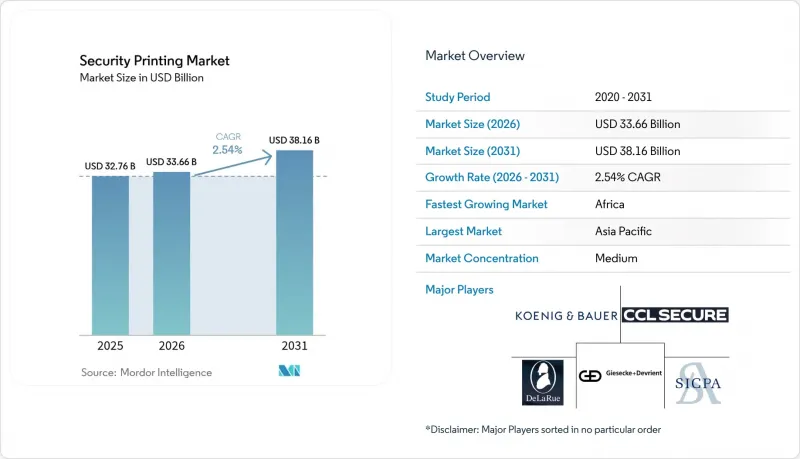
보안 인쇄 시장 규모는 2025년에 327억 6,000만 달러로 평가되었고 2026년 336억 6,000만 달러에서 2031년까지 381억 6,000만 달러에 이를 것으로 예측되며, 예측 기간(2026-2031년) CAGR은 2.54%를 나타낼 전망입니다.
지폐, 여권, 세금 인지에 대한 위조 위협이 끊이지 않기 때문에 발행 기관은 여러 가지 명백한, 잠재적인, 그리고 감식적 보안 기능을 다층적으로 통합해야 합니다. 생체 인식 여권 도입과 국가 차원의 디지털 ID 프로그램 추진으로 개인 식별 서류의 진화가 현금보다 더 빠르게 진행되고 있습니다. 폴리머 기판은 면지 대비 2.5-4배의 긴 수명으로 30-40%의 가격 프리미엄을 감안하더라도 라이프사이클 비용을 절감할 수 있어 채택이 확대되고 있습니다. RFID 및 NFC 태그를 통한 비접촉식 인증은 현재 여권 및 보안 ID 카드의 주류 요구 사항으로, 인라인 디지털 잉크젯을 통한 개인화에 대한 새로운 수요를 창출하고 있습니다. 한편, 중앙은행의 '녹색 지폐' 정책은 공급업체들에게 재생 면화, 저배출 잉크, 무용제 바니시 채택을 장려하고 있으며, 보안 인쇄 시장 내에서 지속가능성 관련 제품의 틈새 시장을 개척하고 있습니다.
세계 보안 인쇄 시장 동향과 인사이트
위조 및 모조품 발생률 증가
위조지폐 압수 건수가 증가하고 있으며, 광학 변조 잉크, 3D 보안 리본, 마이크로 광학 실의 채택이 가속화되고 있습니다. 유럽중앙은행은 2024년 55만 4,000장의 위조 유로화 지폐를 회수했습니다. 이는 진짜 지폐 100만장당 위조지폐 18장에 해당합니다. 독일연방은행에서 위조지폐가 전년 대비 28% 증가한 반면, 미국 100달러 지폐는 여전히 세계에서 가장 많이 위조된 지폐 시리즈입니다. ICAO 호환 RFID 칩이 도입된 이후에도 여권 사기는 계속되고 있으며, 홀로그램 오버레이와 레이저 조각에 대한 수요는 계속 증가하고 있습니다. 신흥 시장에서의 고액권 유통은 위조업체들의 이익을 증가시키고, 보안 기능의 경쟁을 심화시키고 있습니다.
보안 신분증 및 전자 여권 관련 정부 의무화 법안 발의
각국 정부의 프로그램으로 인해 보안 폴리카보네이트 데이터 페이지, 레이저 조각, 비접촉식 스마트카드 인레이에 대한 대량 수요가 증가하고 있습니다. 인도는 2025년 11월부터 생체 인식 칩이 탑재된 여권 발급을 시작했으며, 2027년까지 연간 1,000만 장 생산을 목표로 하고 있습니다. 유럽연합(EU)의 eIDAS 2.0 프레임워크는 회원국들에게 보안 요소 칩에 연결된 디지털 ID 지갑 도입을 의무화하고 있으며, 27개국 당국의 장비 업그레이드를 촉진하고 있습니다. 인도네시아 내무부는 대량 발급되는 NIK카드 계약의 파트너로 아이데미아를 선정했습니다. 한편, 미국에서는 2025년 5월 REAL ID 도입 시한을 앞두고 각 주 운전면허국은 지속적인 조달 주기를 유지하고 있습니다. 필수 기능은 소득 계층에 따라 다르며, 공급업체 시장은 프리미엄 생체인증 솔루션과 비용 최적화된 부정사용 방지 솔루션의 두 가지로 나뉩니다.
현금 없는 결제와 CBDC로의 전환
고소득 시장에서는 디지털 결제 수단의 부상으로 지폐에 대한 장기적인 수요가 감소하고 있습니다. BIS(국제결제은행)의 조사에 따르면, 2024년 현재 조사 대상 중앙은행의 94%가 CBDC를 조사했으며, 6년 이내에 일반인 대상 도입이 시작될 것으로 예상하고 있습니다. 스웨덴의 e-krona 시범운영과 유럽중앙은행의 디지털 유로 프로젝트는 2035년까지 지폐 발행량이 두 자릿수 감소할 것으로 예상하고 있습니다. 중국의 e-CNY는 2억 6천만 개의 지갑을 확보했지만, 농촌 지역의 현금 의존도가 그 영향을 완화시키고 있습니다. 비접촉식 결제가 정착된 지역에서는 종이 티켓과 수표가 사라지고, 인쇄업체들은 신분증과 브랜드 보호 라벨로 사업을 전환할 수밖에 없습니다.
부문 분석
2025년 현재, 지폐가 보안 인쇄 시장에서 가장 큰 점유율을 차지하고 있지만, 개인 신분증에 대한 수요가 더 빠르게 증가하고 있으며, 설비 투자 우선순위를 재구성하고 있습니다. 인도, 프랑스, 영국의 대규모 여권 입찰은 칩 임베디드 조립 라인, 레이저 조각, 폴리카보네이트 라미네이트 가공에 대한 다년간 수요를 확정했습니다. 신분증 보안 인쇄 시장 규모는 유럽의 eIDAS 2.0과 아시아의 강화된 KYC 요건의 혜택을 받고 있으며, 공급업체들이 지역별로 카드 개인화 기반을 확대하는 데 힘을 실어주고 있습니다. 한편, 수표 인쇄는 구조적으로 감소하는 추세입니다. 영국 내 발행량은 1990년 39억 장에서 2023년 2억 1,900만 장으로 감소했습니다. 교통카드가 NFC 지원 스마트폰으로 전환되고 있는 가운데, 규제 당국의 일련번호 의무화에 따라 담배와 주류의 브랜드 보호용 밴더롤은 확대되고 있습니다. EU 담배 제품 지침에 따른 세금 인감 입찰은 전통적인 현금 결제 수단이 침체된 상황에서도 보안 인쇄에 대한 수요가 어떻게 확대될 수 있는지를 보여줍니다.
현금 중심 지역에서는 고액권 지폐 수요로 인해 오목 인쇄 라인이 거의 풀가동 상태를 유지하고 있으며, 이로 인해 기존 장비 공급업체들의 보안 인쇄 시장 점유율을 지키고 있습니다. 나이지리아, 인도, 서아프리카 중앙은행(BEAC) 회원국은 2025년에 총 2,500억 장 이상의 지폐를 발행할 것으로 예상되며, OECD 역외 지폐의 견조한 성장세를 다시 한 번 강조했습니다. 그러나 중앙은행이 향후 CBDC(중앙은행 디지털화폐)로의 전환을 예상하고 있기 때문에 재발행 주기가 길어지고, 발주 규모도 변동성이 커질 가능성이 높습니다. 이에 따라 공급업체들은 신분증, 추적 및 이력추적용 라벨로 사업 다각화를 추진하고 있습니다. 이들은 유사한 은폐 기능을 필요로 하지만, 기판 1평방미터당 수익률이 높다는 특징이 있습니다.
보안 잉크는 여전히 기능별 매출의 3분의 1 이상을 차지하고 있지만, 전자 부품의 가치는 상승세를 보이고 있습니다. 여권 1권당 2-4달러의 RFID 및 NFC 태그는 현재 전자 여권의 부품 원가표를 지배하고 있으며, 홀로그램은 약 0.30달러로 전자 여권의 부품 원가표를 지배하고 있습니다. 2024년 칩 부족은 가치사슬의 취약성을 드러냈고, 발행기관은 NXP, Infineon, 그리고 인도와 중국의 국내 팹과 이중 조달을 해야 하는 상황에 처했습니다. Surys의 키네그램과 같은 광학 변조 장치는 여전히 1차 검증에 필수적이지만, 은폐된 태그와 기계 판독이 가능한 요소가 수익의 대부분을 차지합니다. 2025년 쾨닉앤바우어가 도입한 스테가노 바니시는 육안으로는 보이지 않지만 특정 파장에서 감지할 수 있는 은폐 스펙트럼이 내장되어 있어 별도의 마무리 공정 없이도 인쇄 공정에 적용할 수 있습니다. 이러한 명시적, 은폐적, 감식적 특징의 융합은 중앙은행이 위조범을 막기 위해 각 액면당 10-15개의 서로 다른 요소를 겹겹이 쌓아가는 과정에서 표준적인 방법으로 자리 잡았습니다.
GS1 및 EU 담배 제품 지침의 기준을 충족하는 직렬화 시스템은 가장 빠르게 성장하는 마이크로 부문입니다. 현재 유럽연합(EU)의 모든 담배 팩에는 고유 식별자가 부여되어 있으며, 분당 120미터의 속도로 600dpi의 마이크로 텍스트를 인쇄할 수 있는 인라인 디지털 프린트 헤드에 대한 수요가 발생하고 있습니다. 도미노(Domino)와 비디오젯(Videojet)은 이 틈새 시장에서 일찌감치 점유율을 확보했으며, 멤젯(Memjet)과 자르(Xaar)는 고급 세금 표시 및 의약품을 위한 고해상도 대체 솔루션을 제안하고 있습니다. 이러한 추세로 인해 아날로그 보안 잉크의 우위는 점차 사라지고 있으며, 향후 성장은 하이브리드 전자 인쇄 기능 세트로 이동하고 있습니다.
지역별 분석
아시아태평양은 보안 인쇄 시장 수익의 중심이 되고 있으며, 이는 중국의 연간 900억 장 이상의 지폐 발행량과 인도의 1,400억 장의 지폐 유통량을 반영하고 있습니다. 성장을 견인하는 것은 2030년까지 지폐 발행량을 매년 3%씩 늘리겠다는 인도네시아의 계획과 2024년에 도입된 일본의 새로운 시리즈가 2025년 중반까지 30%가 유통되었다는 점입니다. 공급업체는 기판 제조업체, 오목 인쇄기 조립 공장, 반도체 제조 공장으로 구성된 밀집된 생태계의 혜택을 누리고 있으며, RFID 칩과 광학 가변 안료를 지역 내에서 조달할 가능성이 있습니다.
아프리카는 2031년까지 연평균 복합 성장률(CAGR) 3.46%로 다른 모든 지역을 능가할 것으로 예측됩니다. 케냐의 기제케 데브리엔트(Gizecke Devrient)와의 5년 계약과 에티오피아의 토판(Toppan)과의 전자 여권 합작 사업은 통화 및 신분증 제조에 있어 국가의 자율성을 보장하기 위한 노력을 보여줍니다. 나이지리아의 새로운 지폐 디자인, 소말리아의 새로운 1,000실링 지폐, 서아프리카 중앙은행(BEAC) 지역의 'Type 2020' 시리즈가 지역 내 인쇄기 가동률을 높이고 있습니다. 초기 설비투자는 여전히 장벽으로 남아 있지만, 다자간 금융기관과 수출신용기관이 여러 턴키 공장에 대한 자금조달을 지원하고 있어 아프리카 대륙으로의 기술 이전이 가속화되고 있습니다.
유럽은 디지털 전환의 좋은 예입니다. 12개국 유로화 지폐 인쇄업체라는 탄탄한 기반이 있음에도 불구하고 스웨덴과 노르웨이의 현금 사용률은 한 자릿수에 육박하고 있으며, 유럽중앙은행(ECB)의 디지털 유로화 실증 실험으로 인해 2028년 이후에는 현금 유통이 억제될 가능성이 있습니다. 그럼에도 불구하고, 이 지역에서는 생체 인식 여권, 담배 제품 지침에 따른 세금 스탬프, 일련번호가 있는 의약품 라벨에 대한 수요가 지속될 것이며, 보안 인쇄 시장은 현금에서 안전한 공문서로 전환될 것입니다. 북미 역시 이러한 양면성을 반영하고 있습니다. 미국 조폐국(BEP)은 여전히 연간 76억 장의 지폐를 생산하고 있지만, 브랜드 보호 라벨과 고도의 보안을 갖춘 운전면허증에 대한 수요가 가장 빠르게 증가하고 있습니다.
남미는 통화 변동이 심해 수요 예측이 어려운 상황입니다. 브라질의 카사 다 모에다는 국내 하이퍼인플레이션 억제를 우선시하기 위해 일부 수출 계약을 중단한 반면, 아르헨티나에서는 페소화 폭락으로 인해 폴리머 지폐의 시범 도입을 위한 자금 조달 격차가 확대되고 있습니다. 중동에서는 각국의 인쇄 공장들의 설비 업데이트가 진행되고 있습니다. UAE의 재활용 가능한 폴리머로 만든 500디르함 지폐와 사우디의 생산 능력 확대는 유럽 공급업체에 대한 의존도를 줄이기 위한 것입니다. 이처럼 각 지역마다 고유한 성장 요인과 구조적 억제요인을 함께 가지고 있어 보안 인쇄 시장에서 다양한 제품 포트폴리오의 필요성이 강화되고 있습니다.
기타 특전:
- 엑셀 형식 시장 예측(ME) 시트
- 3개월간 애널리스트 지원
자주 묻는 질문
목차
제1장 서론
제2장 조사 방법
제3장 주요 요약
제4장 시장 구도
제5장 시장 규모와 성장 예측
제6장 경쟁 구도
제7장 시장 기회와 향후 전망
JHS 26.06.11The security printing market size was valued at USD 32.76 billion in 2025 and estimated to grow from USD 33.66 billion in 2026 to reach USD 38.16 billion by 2031, at a CAGR of 2.54% during the forecast period (2026-2031).
Persistent counterfeiting pressure on banknotes, passports and tax banderoles is compelling issuers to layer multiple overt, covert and forensic features. Personal identification documents are advancing more quickly than cash, helped by biometric-passport rollouts and national digital-ID programs. Polymer substrates are gaining traction because they last 2.5-4 times longer than cotton paper, trimming lifecycle costs even after factoring in their 30-40% price premium. Contactless authentication via RFID and NFC tags is now a mainstream requirement in passports and secure ID cards, creating fresh demand for inline digital-inkjet personalization. Meanwhile, central-bank "green banknote" policies are nudging suppliers toward recycled cotton, lower-emission inks and solvent-free varnishes, opening a sustainability-linked product niche within the security printing market.
Global Security Printing Market Trends and Insights
Rising Incidence of Forgery and Counterfeiting
Counterfeit seizures are climbing, spurring faster adoption of optically variable inks, 3D security ribbons and micro-optic threads. The European Central Bank withdrew 554,000 fake euro notes in 2024, equivalent to 18 counterfeits per million genuine notes.Germany's Bundesbank registered a 28% annual rise in counterfeits, while the U.S. USD 100 note remains the world's most forged series. Passport fraud is also persistent, even after the introduction of ICAO-compliant RFID chips, driving continued demand for holographic overlays and laser engraving. Higher-value notes in emerging markets enlarge the payoff for counterfeiters, reinforcing the security-feature arms race.
Government Mandates for Secure IDs and E-Passports
National programs are boosting volume demand for secure polycarbonate data pages, laser engraving and contactless smart-card inlays. India began issuing biometric chip passports in November 2025 with the goal of producing 10 million units per year by 2027. The European Union's eIDAS 2.0 framework obliges member states to deploy digital-ID wallets tied to secure element chips, catalyzing equipment upgrades across 27 authorities. Indonesia's Home Affairs Ministry selected IDEMIA for a high-volume NIK card contract, while the United States REAL ID deadline of May 2025 kept state driver-license bureaus on a sustained procurement cycle. Mandatory features differ by income tier, splitting the supplier landscape between premium biometric offerings and cost-optimized fraud deterrence.
Shift Toward Cashless Payments and CBDCs
Digital alternatives are eroding long-run demand for physical currency in high-income markets. Ninety-four percent of central banks surveyed by the BIS were researching CBDCs in 2024, with retail launches expected within six years. Sweden's e-krona tests and the European Central Bank's digital euro project foreshadow double-digit contractions in banknote volumes by 2035. China's e-CNY has amassed 260 million wallets, although rural cash reliance tempers the impact. Everywhere that contactless payments take hold, paper tickets and cheques disappear, forcing printers to pivot toward identity documents and brand-protection labels.
Other drivers and restraints analyzed in the detailed report include:
- Adoption of Polymer Banknote Substrates for Durability and Security
- Growing Circulation of High-Denomination Banknotes in Emerging Markets
- High Capex for Next-Gen Security Presses
For complete list of drivers and restraints, kindly check the Table Of Contents.
Segment Analysis
Banknotes generated the largest slice of the security printing market in 2025, yet personal identification documents are growing faster and reshaping capital investment priorities. Large passport tenders in India, France and the United Kingdom locked in multi-year demand for chip-inlay assembly lines, laser engraving and polycarbonate lamination. The security printing market size for ID documents is benefiting from eIDAS 2.0 in Europe and rising KYC requirements in Asia, encouraging suppliers to expand regional card-personalization hubs. Meanwhile, cheque printing is in structural decline after volumes in the United Kingdom dropped from 3.9 billion in 1990 to 219 million in 2023. Transit ticketing is migrating to NFC-enabled smartphones, but brand-protection banderoles for tobacco and alcohol are expanding as regulators impose serialization. Tax-stamp tenders under the EU Tobacco Products Directive illustrate how secure print volumes can grow even as traditional cash instruments stagnate.
In cash-centric regions, high-denomination banknotes keep intaglio press lines running near capacity, preserving the security printing market share of legacy equipment suppliers. Nigeria, India and the BEAC bloc collectively issued more than 250 billion notes in 2025, underlining the resilience of physical currency outside the OECD. However, retender cycles are getting longer and order sizes more variable because central banks anticipate eventual CBDC substitution. Suppliers are therefore diversifying into ID documents and track-and-trace labels, which require similar covert features but carry higher margins per square meter of substrate.
Security inks still anchor more than one-third of feature revenues, but electronic components are climbing the value stack. RFID and NFC tags, each costing USD 2-4 in a passport versus about USD 0.30 for a hologram, now dominate the bill of materials for e-passports. Chip shortages in 2024 exposed supply-chain fragility, pushing issuers to dual-source between NXP, Infineon and domestic fabs in India and China. Optically variable devices such as Surys kinegrams remain critical for first-line verification, yet covert taggants and machine-readable elements drive bulk profitability. Stegano varnish, introduced by Koenig and Bauer in 2025, embeds covert spectra that are invisible to the naked eye but detectable under defined wavelengths, enabling press-side application without an extra finishing step. This convergence of overt, covert and forensic features is standard practice as central banks layer 10-15 distinct elements on each denomination to frustrate counterfeiters.
Serialisation systems meeting GS1 and EU Tobacco Products Directive standards are the fastest-growing micro-segment. Each cigarette pack in the European Union now carries a unique identifier, generating demand for inline digital printheads capable of 600-dpi microtext at 120 meters per minute. Domino and Videojet have captured early share in this niche, while Memjet and Xaar pitch higher-resolution alternatives for premium tax stamps and pharmaceuticals. These trends are gradually eroding the dominance of analog security inks and tilting future growth toward hybrid electronic-print feature sets.
The Security Printing Market Report is Segmented by Application (Banknotes, Payment Cards, Cheques, and More), Security Feature (Security Inks (UV, OVI, Optically Variable), Holograms and DOVIDs, and More), Printing Technology (Intaglio, Offset/Lithography, and More), Substrate (Cotton-Based Paper, Polymer, and More), and Geography. The Market Forecasts are Provided in Terms of Value (USD).
Geography Analysis
Asia-Pacific remains the revenue anchor for the security printing market, reflecting China's output above 90 billion banknotes per year and India's 140 billion notes in circulation. Growth is helped by Indonesia's plan to raise banknote volumes 3% annually through 2030 and by Japan's new series introduced in 2024, which were 30% distributed by mid-2025. Suppliers benefit from a dense ecosystem of substrate mills, intaglio press assembly plants and semiconductor fabs, allowing regional sourcing of RFID chips and optically variable pigments.
Africa is predicted to outpace every other region at a 3.46% CAGR to 2031. Kenya's five-year contract with Giesecke+Devrient and Ethiopia's e-passport joint venture with Toppan show a push for sovereign autonomy in currency and ID document manufacture. Nigeria's redesign, Somalia's new 1,000-shilling notes and the BEAC bloc's "type 2020" series bolster regional press utilization rates. Upfront capex remains a hurdle, but multilateral lenders and export-credit agencies are underwriting several turnkey plants, accelerating technology transfer into the continent.
Europe illustrates the digital transition. Despite a robust base of 12 national euro printers, cash usage in Sweden and Norway is near single digits, and the ECB's digital euro pilot may curb circulation after 2028. Nevertheless, the region will sustain demand for biometric passports, tax stamps compliant with the Tobacco Products Directive and serialized pharmaceutical labels, allowing the security printing market to pivot from cash to secure civil documents. North America mirrors this dual track: the United States Bureau of Engraving and Printing still turns out 7.6 billion notes annually, but brand-protection labels and high-security driving licenses are rising fastest.
South America faces currency volatility that complicates forecast volumes. Brazil's Casa da Moeda has halted some export contracts to prioritize domestic hyperinflation mitigation, while Argentina's peso collapse widened tender gaps for polymer note trials. The Middle East is upgrading its own plants; the UAE's recyclable polymer Dh500 note and Saudi Arabia's capacity expansion aim to cut dependence on European suppliers. Each geography thus exhibits a unique mix of growth drivers and structural drag, reinforcing the need for diversified product portfolios within the security printing market.
- Giesecke+Devrient GmbH
- De La Rue plc
- SICPA Holding SA
- Koenig and Bauer AG
- CCL Secure Pty Ltd
- Oberthur Fiduciaire SAS
- Crane Currency (Crane NXT Co.)
- Toppan Inc.
- IDEMIA Group S.A.S.
- Komori Corporation
- Note Printing Australia Ltd
- Canadian Bank Note Company, Limited
- Landqart AG
- Orell Fussli Holding Ltd (Orell Fussli Security Printing Ltd)
- China Banknote Printing and Minting Corporation
- Security Printing and Minting Corporation of India Ltd (SPMCIL)
- Korea Minting, Security Printing and ID Card Operating Corp. (KOMSCO)
- HID Global Corp. (Citizen Identity Solutions)
Additional Benefits:
- The market estimate (ME) sheet in Excel format
- 3 months of analyst support
TABLE OF CONTENTS
1 INTRODUCTION
- 1.1 Study Assumptions and Market Definition
- 1.2 Scope of the Study
2 RESEARCH METHODOLOGY
3 EXECUTIVE SUMMARY
4 MARKET LANDSCAPE
- 4.1 Market Overview
- 4.2 Market Drivers
- 4.2.1 Rising Incidence of Forgery and Counterfeiting
- 4.2.2 Growing Circulation of High-Denomination Banknotes in Emerging Markets
- 4.2.3 Adoption of Polymer Banknote Substrates for Durability and Security
- 4.2.4 Government Mandates for Secure IDs and E-Passports
- 4.2.5 AI-Enabled Inline Inspection Reduces Spoilage
- 4.2.6 Central-Bank "Green Banknote" Sustainability Programs
- 4.3 Market Restraints
- 4.3.1 Shift Toward Cashless Payments and CBDCs
- 4.3.2 High Capex for Next-Gen Security Presses
- 4.3.3 Shortages of Specialty Security Inks and Substrates
- 4.3.4 Carbon-Footprint Scrutiny of Currency Production
- 4.4 Industry Value/Supply-Chain Analysis
- 4.5 Regulatory Landscape
- 4.6 Technological Outlook
- 4.7 Porter's Five Forces Analysis
- 4.7.1 Bargaining Power of Suppliers
- 4.7.2 Bargaining Power of Buyers
- 4.7.3 Threat of New Entrants
- 4.7.4 Threat of Substitutes
- 4.7.5 Intensity of Competitive Rivalry
- 4.8 Impact of Macroeconomic Factors on the Market
5 MARKET SIZE AND GROWTH FORECASTS (VALUE)
- 5.1 By Application
- 5.1.1 Banknotes
- 5.1.2 Payment Cards
- 5.1.3 Cheques
- 5.1.4 Personal Identification Documents
- 5.1.5 Ticketing and Transit Passes
- 5.1.6 Postage and Fiscal Stamps
- 5.1.7 Brand-Protection and Tax Banderoles
- 5.2 By Security Feature
- 5.2.1 Security Inks (UV, OVI, Optically Variable)
- 5.2.2 Holograms and DOVIDs
- 5.2.3 Watermarks and Security Threads
- 5.2.4 RFID and NFC Tags
- 5.2.5 Track-and-Trace Serialisation
- 5.3 By Printing Technology
- 5.3.1 Intaglio
- 5.3.2 Offset/Lithography
- 5.3.3 Screen and Flexo
- 5.3.4 Digital Inkjet
- 5.3.5 Gravure
- 5.4 By Substrate
- 5.4.1 Cotton-Based Paper
- 5.4.2 Polymer
- 5.4.3 Hybrid Paper-Polymer
- 5.4.4 Synthetic and Composite Films
- 5.5 By Geography
- 5.5.1 North America
- 5.5.1.1 United States
- 5.5.1.2 Canada
- 5.5.1.3 Mexico
- 5.5.2 South America
- 5.5.2.1 Brazil
- 5.5.2.2 Argentina
- 5.5.2.3 Rest of South America
- 5.5.3 Europe
- 5.5.3.1 United Kingdom
- 5.5.3.2 Germany
- 5.5.3.3 France
- 5.5.3.4 Italy
- 5.5.3.5 Russia
- 5.5.3.6 Spain
- 5.5.3.7 Rest of Europe
- 5.5.4 Asia-Pacific
- 5.5.4.1 China
- 5.5.4.2 Japan
- 5.5.4.3 India
- 5.5.4.4 Australia and New Zealand
- 5.5.4.5 Indonesia
- 5.5.4.6 Thailand
- 5.5.4.7 Rest of Asia-Pacific
- 5.5.5 Middle East
- 5.5.5.1 United Arab Emirates
- 5.5.5.2 Saudi Arabia
- 5.5.5.3 Rest of Middle East
- 5.5.6 Africa
- 5.5.6.1 South Africa
- 5.5.6.2 Nigeria
- 5.5.6.3 Rest of Africa
- 5.5.1 North America
6 COMPETITIVE LANDSCAPE
- 6.1 Market Concentration
- 6.2 Strategic Moves
- 6.3 Market Share Analysis
- 6.4 Company Profiles (includes Global Level Overview, Market Level Overview, Core Segments, Financials as available, Strategic Information, Market Rank/Share, Products and Services, Recent Developments)
- 6.4.1 Giesecke+Devrient GmbH
- 6.4.2 De La Rue plc
- 6.4.3 SICPA Holding SA
- 6.4.4 Koenig and Bauer AG
- 6.4.5 CCL Secure Pty Ltd
- 6.4.6 Oberthur Fiduciaire SAS
- 6.4.7 Crane Currency (Crane NXT Co.)
- 6.4.8 Toppan Inc.
- 6.4.9 IDEMIA Group S.A.S.
- 6.4.10 Komori Corporation
- 6.4.11 Note Printing Australia Ltd
- 6.4.12 Canadian Bank Note Company, Limited
- 6.4.13 Landqart AG
- 6.4.14 Orell Fussli Holding Ltd (Orell Fussli Security Printing Ltd)
- 6.4.15 China Banknote Printing and Minting Corporation
- 6.4.16 Security Printing and Minting Corporation of India Ltd (SPMCIL)
- 6.4.17 Korea Minting, Security Printing and ID Card Operating Corp. (KOMSCO)
- 6.4.18 HID Global Corp. (Citizen Identity Solutions)
7 MARKET OPPORTUNITIES AND FUTURE OUTLOOK
- 7.1 White-Space and Unmet-Need Assessment


