

|
시장보고서
상품코드
2044215
대화형 시스템 시장 : 점유율 분석, 산업 동향 및 통계, 성장 예측(2026-2031년)Conversational Systems - Market Share Analysis, Industry Trends & Statistics, Growth Forecasts (2026 - 2031) |
||||||
 Mordor Intelligence
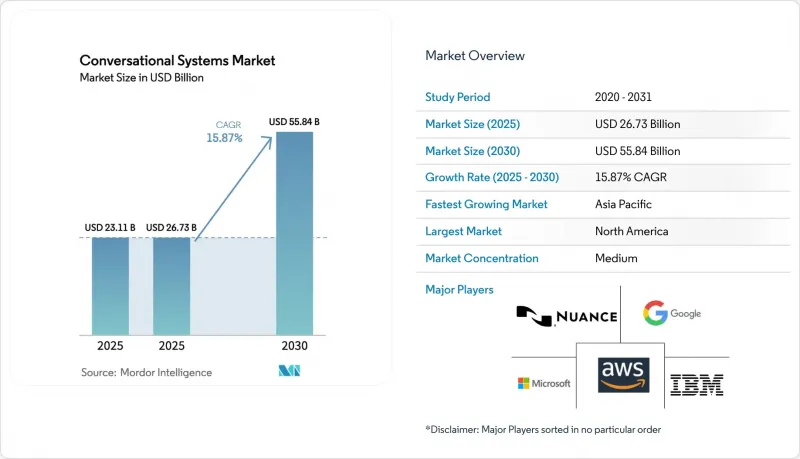
대화형 시스템 시장 규모는 2025년에 231억 1,000만 달러, 2026년에 267억 3,000만 달러되어, 2031년까지 558억 4,000만 달러에 이를 것으로 예측되며, 2026년부터 2031년까지 CAGR 15.87%로 성장할 전망입니다.
생성형 AI의 추론 비용이 중견기업이 감당할 수 있는 경제적 한계치를 밑돌면서 수요가 증가하기 시작했고, 얼리 어답터인 하이퍼스케일러가 아닌 일반 기업도 자동화가 가능해졌습니다. 기업들은 규칙 기반 챗봇에서 대규모 자연어를 이해하고, 취약한 의사결정 트리를 피하고, 문제 해결 속도를 가속화할 수 있는 대규모 언어 모델을 통한 오케스트레이션으로 전환하고 있습니다. 클라우드 호스트형 도입이 여전히 주류를 이루고 있지만, 유럽연합(EU), 인도, 중국의 데이터 주권 관련 법안이 민감한 고객 데이터를 로컬에서 처리하는 엣지 및 하이브리드 토폴로지로의 전환을 촉진하고 있습니다. 하이퍼스케일러가 광범위한 클라우드 계약에 대화 기능을 통합하는 한편, 오픈소스 에이전트 프레임워크를 통해 사내 개발팀이 벤더에 종속되지 않고 자체 워크플로우를 구축할 수 있게 됨에 따라 경쟁은 더욱 치열해지고 있습니다.
세계 대화형 시스템 시장 동향 및 인사이트
CX 기술 스택 전반에 걸쳐 급증하고 있는 API 기반 통합
API 우선 아키텍처를 통해 대화형 AI는 단일 채널에서 고객 경험 플랫폼의 '결합 조직'으로 변모하여 음성, 채팅, 이메일, 소셜 미디어의 워크플로우를 통합하고 있습니다. MuleSoft의 조사에 따르면, 2025년에는 대화형 시스템 도입 1건당 평균 47건의 API 통합이 이루어질 것으로 예상되며, 이는 2023년 대비 2배 이상 증가한 수치입니다. 이를 통해 상담원은 화면 전환 없이 CRM(고객관계관리), 주문관리, 청구 시스템에서 컨텍스트 정보를 얻을 수 있게 되었습니다. 통합 밀도가 높아짐에 따라 평균 처리 시간이 최대 40% 단축되어, 최초 대응 해결률이 고객 이탈률과 직결되는 은행 및 통신 업계에서 NPS(Net Promoter Score)가 향상되었습니다. Contentstack의 조사에 따르면, 기업의 68%가 GraphQL을 통해 데이터를 공개하는 헤드리스형 컨텐츠 관리 시스템을 채택하고 있으며, 이를 통해 대화형 에이전트는 정적인 FAQ를 참조하는 것이 아니라 동적으로 응답을 구성할 수 있게 되었다고 합니다. 현재 구매자들은 개별 기능의 다양성보다는 바로 사용할 수 있는 커넥터를 중요시하고 있으며, 다양한 CX 스택을 통합할 수 있는 플랫폼으로의 전환이 가속화되고 있습니다.
생성형 AI의 비용 곡선 급락으로 중소기업에 도입 가능
2024년 1월부터 2025년 12월까지 엔비디아의 H200 GPU, 트랜스포머의 양자화, 하이퍼스케일러 간의 가격 경쟁으로 인해 비용이 0.0004달러까지 하락했고, GPT-4급 모델의 토큰 단가는 78% 하락했습니다. 이 새로운 가격 수준은월5만 건 미만의 인터랙션이 있는 기업도 도입할 수 있도록 수익성을 높였습니다. 지금까지는 인프라 오버헤드로 인해 이 정도 규모의 기업은 도입이 어려웠습니다. AWS Bedrock은 서버리스 추론으로 인해 전용 클러스터가 필요 없어짐에 따라 2025년 중소기업의 채택률이 전년 대비 340% 증가했다고 보고했습니다. Microsoft Phi-3와 같은 Distilled 모델은 GPT-3.5 수준의 품질을 추론 비용의 10분의 1 수준으로 제공하며, 4GB 엣지 디바이스에서 작동하기 때문에 지역 통합업체는 가격에 민감한 고객을 위해 턴키 방식의 수직 통합 솔루션을 번들로 제공할 수 있습니다. 이러한 민주화로 인해 아시아태평양 및 남미 지역의 로컬 제공업체들이 현지 언어 모델과 컴플라이언스 템플릿을 구독 번들에 포함시킴으로써 경쟁 구도가 재편되고 있습니다.
대규모 LLM 추론 비용 상승
단위당 경제성은 개선되었으나, 매일 수백만 건을 처리하는 기업의 경우월추론 비용이 280만 달러가 넘는 경우도 있어 인건비 절감에 따른 이익을 상쇄하고 있습니다. 상태 유지형, 메모리 집약적인 대화는 단일 턴 쿼리의 4-7배의 GPU 사이클을 소모하며, 프롬프트 캐싱이나 양자화 등의 최적화 기법은 음성 채널의 포기 임계치를 위협하는 지연을 유발합니다. 가격 민감도가 높은 숙박업과 같은 분야에서는 예측할 수 없는 쿼리 급증으로 인해 자동화가 인력 대응보다 더 높은 비용이 발생할 수 있어 단기적으로 도입을 억제하는 요인으로 작용하고 있습니다.
부문 분석
단일 모드의 텍스트 챗봇은 2025년 매출 비중에서 51.74%로 가장 큰 비중을 차지했습니다. 이는 메시징 앱과 이메일 대기열에 최적화된 초기 도입의 유산입니다. 그러나 기업이 복잡한 지원 및 원격 의료 이용 사례를 동일한 세션 내에서 음성, 텍스트 및 이미지를 해석할 수 있는 에이전트로 전환함에 따라 멀티모달 플랫폼은 CAGR 15.92%로 성장하고 있습니다. 마이크로소프트가 Dynamics 365 Customer Service에 GPT-4 Vision을 추가한 결과, 가전제품 소매 업계의 시범 운영에서 에스컬레이션 비율이 38% 감소했습니다. 엣지 프로세싱과 규제적 프라이버시 요구사항은 디바이스에서 멀티모달 추론을 촉진하고 있으며, 퀄컴의 AI 최적화 칩셋은 대기시간을 800밀리초에서 120밀리초로 줄였습니다.
비용에 민감한 워크플로우에서는 대역폭, 컴퓨팅 성능, 컴플라이언스 요구 사항을 최소화하는 단일 모드 텍스트가 계속 선호되고 있습니다. 그러나 아시아태평양과 아프리카에서 스마트폰 카메라와 5G 네트워크가 보급되면서 시각적 컨텍스트의 가치가 높아져 멀티모달 솔루션의 대상이 되는 시장이 확대되고 있습니다. 비전 인코더, 음성 인식, 언어 모델을 추상화하는 통합 API를 우선시하는 벤더는 단순히 각 양식을 조합한 단일 기능의 제품을 능가할 것입니다. 인터랙티브 시스템 시장에서는 예측 기간 후반까지 멀티모달 아키텍처가 설계의 기본이 될 것으로 예측됩니다.
2025년에는 텍스트 지원 인터페이스가 수익의 55.92%를 차지했습니다. 이는 전화 응대를 대체하는 웹 채팅과 메시징 봇이 자리를 잡아가고 있음을 반영합니다. 음성지원형 시스템은 중위권에 위치하며, 콜센터와 스마트 스피커의 대화를 자동화하고 있습니다. 생성형 멀티모달 에이전트는 아직 개발 중이지만, 기업이 스크립트화된 의사결정 트리를 포기하고 인간의 개입 없이 주문 변경, 클레임 분쟁 또는 보험금 청구를 관리하기 위해 자유형 추론을 채택함에 따라 CAGR 15.98%로 발전하고 있습니다. Salesforce의 파일럿 프로그램에서는 Service Cloud에 생성형 에이전트를 도입한 결과, 복잡한 주문 변경 건에 대한 평균 처리 시간이 52% 단축되었습니다.
음성 채널은 딥페이크에 대한 우려로 컴플라이언스 역풍에 직면해 있으며, 이에 따라 미국 연방통신위원회(FCC)는 2026년 본인확인 의무화 방안을 마련하고 있어 도입 비용이 상승할 수 있습니다. 텍스트는 로그가 명확한 증거의 흔적을 제공하기 때문에 여전히 저렴한 비용으로 감사에 적합한 선택입니다. 생성형 멀티모달 에이전트는 접근성을 위한 음성, 명확성을 위한 텍스트, 확인을 위한 이미지를 하나의 대화에서 모두 수용함으로써 이 간극을 메웁니다. 인터랙션별 과금 모델이 비용과 성과에 연동되면서 대화형 시스템 시장은 모달리티별 사일로화가 아닌 인터페이스의 유연성으로 전환될 것입니다.
지역별 분석
아시아태평양은 2031년까지 연평균 복합 성장률(CAGR) 16.17%로 성장 궤도를 주도하고 있습니다. 이는 인도의 '디지털 인디아' 크레딧, 일본의 노인요양 보조금, 그리고 중국의 바이두(Baidu) 주도의 언어 모델 확대가 맞물리면서 지역 내 보급이 확대되고 있기 때문입니다. 스마트폰의 보급으로 기존에 SMS로 대응하던 지방 지역에도 멀티모달 접근이 가능해짐에 따라 아시아태평양의 대화형 시스템 시장 규모는 빠르게 확대되고 있습니다. 힌디어, 중국어, 중국어, 인도네시아어, 베트남어 등 현지어 모델이 영어 중심의 장벽을 허물고 있으며, 정부의 의무화로 인해 시민을 위한 기관은 서비스 데스크의 디지털화를 요구받고 있습니다.
북미는 금융, 보험, 증권(BFSI) 및 통신 분야에서의 조기 도입과 기반 모델 연구센터와의 근접성에 힘입어 2025년 대화형 시스템 시장 점유율 38.51%를 유지하며 수익의 중심이 될 것으로 예측됩니다. 의료용 챗봇에 대한 FDA의 승인 절차, CFPB의 명확한 고객 서비스 규정과 같은 규제의 구체성은 도입에 대한 명확성을 제공하고, 기업의 지속적인 투자를 뒷받침합니다. 미국에 본사를 둔 하이퍼스케일러는 통합 클라우드 서비스를 활용하여 현지 기업의 조달 주기를 단축하고 있습니다.
유럽에서는 AI법 투명성 확보 규제로 인해 문서화 비용이 15-25% 증가하는 가운데, 꾸준한 확대가 이어지고 있습니다. 그러나 이 지역은 고급 기술 인력과 국경을 초월한 고객층을 위한 다국어 인터페이스에 대한 공공 부문의 강력한 수요의 혜택을 누리고 있습니다. 중동, 아프리카 및 남미에서는 사우디아라비아의 '비전 2030'이 AI 인프라에 200억 달러를 할당하고, 브라질과 멕시코가 은행 계좌가 없는 계층에 도달하기 위해 대화형 뱅킹을 도입하는 등 새로운 기회가 창출되고 있습니다. 현지 법규에 맞게 컴플라이언스 체계를 조정하고 현지 언어 지원을 통합한 벤더는 범용 솔루션보다 더 나은 성과를 거둘 수 있습니다.
기타 특전:
- 엑셀 형식 시장 예측(ME) 시트
- 3개월간 애널리스트 지원
자주 묻는 질문
목차
제1장 서론
제2장 조사 방법
제3장 주요 요약
제4장 시장 구도
제5장 시장 규모와 성장 예측
제6장 경쟁 구도
제7장 시장 기회와 향후 전망
JHS 26.06.11The conversational systems market size is projected to be USD 23.11 billion in 2025, USD 26.73 billion in 2026, and reach USD 55.84 billion by 2031, growing at a CAGR of 15.87% from 2026 to 2031.
Demand inflects upward as generative AI inference costs fall below the economic threshold for mid-market enterprises, making automation viable outside the early-adopter hyperscalers. Enterprises are replacing rule-based chatbots with large-language-model orchestration that understands natural language at scale, avoids brittle decision trees, and accelerates resolution speed. Cloud-hosted deployments continue to dominate but data-sovereignty laws in the European Union, India, and China are catalyzing a pivot to edge and hybrid topologies that process sensitive customer data locally. Competitive intensity is rising as hyperscalers embed conversational capabilities inside wider cloud agreements, while open-source agent frameworks empower internal developer teams to build proprietary workflows without vendor lock-in.
Global Conversational Systems Market Trends and Insights
Soaring API-Based Integrations Across CX Tech Stacks
API-first architectures convert conversational AI from a single channel into the connective tissue of customer-experience platforms, unifying voice, chat, email, and social media workflows. MuleSoft recorded an average of 47 application-programming-interface integrations per conversational deployment in 2025, more than double the 2023 figure, which enabled agents to pull context from customer-relationship-management, order-management, and billing systems without screen toggling. Denser integration trimmed average handle times by up to 40% and improved net promoter scores in banking and telecom where churn closely tracks first-contact resolution. Contentstack found 68% of enterprises adopting headless content-management systems that expose data via GraphQL, letting conversational agents dynamically compose responses rather than referencing static FAQs. Buyers now rank out-of-the-box connectors above individual feature breadth, accelerating consolidation toward platforms able to orchestrate heterogeneous CX stacks.
Generative-AI Cost Curve Collapse Enabling SME Adoption
Between January 2024 and December 2025, per-token prices for GPT-4-class models fell 78% as NVIDIA's H200 GPUs, transformer quantization, and hyperscaler price wars pushed costs to USD 0.0004. The new threshold makes deployments profitable for firms handling fewer than 50,000 monthly interactions, a tier previously locked out by infrastructure overhead. AWS Bedrock reported 340% year-on-year SME uptake in 2025 after serverless inference removed the need for dedicated clusters. Distilled models such as Microsoft Phi-3 deliver GPT-3.5-level quality at one-tenth the inference cost and run on 4 GB edge devices, letting regional integrators bundle turnkey vertical solutions for price-sensitive clients. This democratization is redrawing competitive lines as local providers in Asia Pacific and South America embed local-language models and compliance templates into subscription bundles.
Rising LLM Inference Costs at Scale
Although unit economics have improved, enterprises processing millions of daily interactions face monthly inference bills that can exceed USD 2.8 million, eroding labor-savings gains. Stateful, memory-rich conversations consume four to seven times the GPU cycles of single-turn queries, and optimization tactics such as prompt caching or quantization introduce latency that jeopardizes voice-channel abandonment thresholds. For price-sensitive sectors like hospitality, unpredictable query spikes can make automation more expensive than human handling, tempering near-term uptake.
Other drivers and restraints analyzed in the detailed report include:
- Contact-Center Automation Mandates in BFSI and Telecom
- Shift From Uni-Modal to Multimodal (Voice-Text-Vision)
- Accuracy and Hallucination Risk in Regulated Verticals
For complete list of drivers and restraints, kindly check the Table Of Contents.
Segment Analysis
Uni-modal text chatbots retained the largest 2025 revenue slice at 51.74%, a legacy of early deployments tuned for messaging apps and email queues. However, multimodal platforms are scaling at 15.92% CAGR as enterprises move complex support and telehealth use cases to agents that interpret speech, text, and images in the same session. Microsoft's addition of GPT-4 Vision to Dynamics 365 Customer Service lowered escalation rates by 38% during electronics-retail pilots. Edge processing and regulatory privacy mandates encourage multimodal inference on-device, reducing latency from 800 ms to 120 ms on Qualcomm's AI-optimized chipsets.
Cost-sensitive workflows continue to favor uni-modal text where bandwidth, compute, and compliance requirements stay minimal. Yet as smartphone cameras and 5G networks proliferate in Asia Pacific and Africa, the value of visual context climbs, widening the addressable base for multimodal solutions. Vendors prioritizing unified application-programming-interfaces that abstract vision encoders, speech-to-text, and language models will outpace point products that bolt modalities together. The conversational systems market will see multimodal architectures become the design default by the late forecast horizon.
Text-assisted interfaces accounted for 55.92% revenue in 2025, reflecting entrenched web-chat and messaging bots that deflect phone calls. Voice-assisted systems sit mid-pack, automating call centers and smart-speaker dialogs. Generative multimodal agents, though nascent, are advancing at 15.98% CAGR as enterprises abandon scripted decision trees for open-ended reasoning that manages order changes, billing disputes, or insurance claims without human takeover. Salesforce pilots logged a 52% cut in average handle time on complex order-modification cases after embedding generative agents inside Service Cloud.
Voice channels face compliance headwinds from deep-fake concerns, prompting the Federal Communications Commission to draft 2026 authentication mandates that could raise implementation costs. Text remains a lower-cost, audit-friendly option because logs furnish clear evidence trails. Generative multimodal agents bridge the divide, accepting voice for accessibility, text for clarity, and images for confirmation, all within a single engagement. As pay-per-interaction pricing aligns costs with outcomes, the conversational systems market will migrate toward interface flexibility rather than modality silos.
The Conversational Systems Market Report is Segmented by Modality Type (Uni-Modal and Multi-Modal), Interface Type (Voice-Assisted, Text-Assisted, and More), Deployment (On-Premises, Cloud-Hosted, and More), Enterprise Size (Small and Medium Enterprises and Large Enterprises), End-User Vertical (BFSI, Healthcare, IT and Telecommunications, and More), and Geography. The Market Forecasts are Provided in Terms of Value (USD).
Geography Analysis
Asia Pacific leads the growth trajectory with a 16.17% CAGR to 2031 as India's Digital India credits, Japan's elder-care subsidies, and China's Baidu-led language-model expansion converge to scale local adoption. The conversational systems market size for Asia Pacific is rapidly climbing as smartphone penetration brings multimodal access to rural regions previously served by SMS. Local-language models in Hindi, Mandarin, Bahasa Indonesia, and Vietnamese remove the English-centric barrier, while government mandates require citizen-facing agencies to digitize service desks.
North America remains the revenue anchor at a 38.51% conversational systems market share in 2025, buoyed by early BFSI and telecom rollouts and proximity to foundation-model research centers. Regulatory specificity, such as the FDA pathway for medical chatbots and clear CFPB customer-service rules, provides adoption clarity that supports steady enterprise investment. Hyperscalers headquartered in the United States leverage integrated cloud offerings, compressing procurement cycles for indigenous enterprises.
Europe sustains measured expansion amid the AI Act's transparency rules that raise documentation costs 15-25%. Yet the region benefits from deep technical talent and strong public-sector demand for multilingual interfaces serving cross-border constituencies. Middle East and Africa plus South America present emerging opportunities as Saudi Arabia's Vision 2030 earmarks USD 20 billion for AI infrastructure and Brazil and Mexico deploy conversational banking to reach unbanked populations. Vendors tailoring compliance frameworks to regional statutes and embedding local-language support will outperform generic solutions.
- Microsoft
- Google LLC (Alphabet)
- Amazon Web Services
- IBM Corporation
- Anthropic
- Cohere
- OpenAI
- Salesforce Inc.
- Meta Platforms
- Baidu
- Nuance Communications
- Kore.ai
- LivePerson
- ServiceNow
- Zendesk
- Twilio
- NICE
- Ada Support
- Yellow.ai
- Rasa Technologies
Additional Benefits:
- The market estimate (ME) sheet in Excel format
- 3 months of analyst support
TABLE OF CONTENTS
1 INTRODUCTION
- 1.1 Study Assumptions and Market Definition
- 1.2 Scope of the Study
2 RESEARCH METHODOLOGY
3 EXECUTIVE SUMMARY
4 MARKET LANDSCAPE
- 4.1 Market Overview
- 4.2 Market Drivers
- 4.2.1 Soaring API-Based Integrations Across CX Tech Stacks
- 4.2.2 Generative-AI Cost Curve Collapse Enabling SME Adoption
- 4.2.3 Contact-Center Automation Mandates In BFSI and Telecom
- 4.2.4 Shift From Uni-Modal To Multimodal (Voice-Text-Vision)
- 4.2.5 Edge-Deployed Private LLMs To Meet Data-Sovereignty Laws
- 4.2.6 Exploding Open-Source LLM Agent Frameworks (Autogen, Langchain)
- 4.3 Market Restraints
- 4.3.1 Rising LLM Inference Costs at Scale
- 4.3.2 Accuracy and Hallucination Risk In Regulated Verticals
- 4.3.3 Synthetic-Voice Deep-Fake Compliance Pressure
- 4.3.4 AI-Carbon-Footprint Disclosure Rules (EU CSRD)
- 4.4 Value Chain Analysis
- 4.5 Regulatory Landscape
- 4.6 Porter's Five Forces
- 4.6.1 Threat of New Entrants
- 4.6.2 Bargaining Power of Buyers
- 4.6.3 Bargaining Power of Suppliers
- 4.6.4 Threat of Substitutes
- 4.6.5 Competitive Rivalry
5 MARKET SIZE and GROWTH FORECASTS (VALUE)
- 5.1 By Modality Type
- 5.1.1 Uni-modal
- 5.1.2 Multimodal
- 5.2 By Interface Type
- 5.2.1 Voice-assisted
- 5.2.2 Text-assisted
- 5.2.3 Generative multimodal agents
- 5.3 By Deployment
- 5.3.1 On-premise
- 5.3.2 Cloud-hosted
- 5.3.3 Edge / Device-level
- 5.4 By Enterprise Size
- 5.4.1 Small and Medium Enterprises (SMEs)
- 5.4.2 Large Enterprises
- 5.5 By End-User Vertical
- 5.5.1 IT and Telecommunication
- 5.5.2 BFSI
- 5.5.3 Government and Public Sector
- 5.5.4 Retail and E-commerce
- 5.5.5 Healthcare
- 5.5.6 Energy and Utilities
- 5.5.7 Travel and Hospitality
- 5.5.8 Other End-User Verticals
- 5.6 By Geography
- 5.6.1 North America
- 5.6.1.1 United States
- 5.6.1.2 Canada
- 5.6.1.3 Mexico
- 5.6.2 South America
- 5.6.2.1 Brazil
- 5.6.2.2 Argentina
- 5.6.2.3 Rest of South America
- 5.6.3 Europe
- 5.6.3.1 Germany
- 5.6.3.2 United Kingdom
- 5.6.3.3 France
- 5.6.3.4 Italy
- 5.6.3.5 Spain
- 5.6.3.6 Rest of Europe
- 5.6.4 Asia Pacific
- 5.6.4.1 China
- 5.6.4.2 Japan
- 5.6.4.3 India
- 5.6.4.4 South Korea
- 5.6.4.5 Rest of Asia Pacific
- 5.6.5 Middle East
- 5.6.5.1 Saudi Arabia
- 5.6.5.2 United Arab Emirates
- 5.6.5.3 Rest of Middle East
- 5.6.6 Africa
- 5.6.6.1 South Africa
- 5.6.6.2 Nigeria
- 5.6.6.3 Egypt
- 5.6.6.4 Rest of Africa
- 5.6.1 North America
6 COMPETITIVE LANDSCAPE
- 6.1 Market Concentration
- 6.2 Strategic Moves
- 6.3 Market Share Analysis
- 6.4 Company Profiles (includes Global level Overview, Market level overview, Core Segments, Financials as available, Strategic Information, Market Rank/Share for key companies, Products and Services, and Recent Developments)
- 6.4.1 Microsoft
- 6.4.2 Google LLC (Alphabet)
- 6.4.3 Amazon Web Services
- 6.4.4 IBM Corporation
- 6.4.5 Anthropic
- 6.4.6 Cohere
- 6.4.7 OpenAI
- 6.4.8 Salesforce Inc.
- 6.4.9 Meta Platforms
- 6.4.10 Baidu
- 6.4.11 Nuance Communications
- 6.4.12 Kore.ai
- 6.4.13 LivePerson
- 6.4.14 ServiceNow
- 6.4.15 Zendesk
- 6.4.16 Twilio
- 6.4.17 NICE
- 6.4.18 Ada Support
- 6.4.19 Yellow.ai
- 6.4.20 Rasa Technologies
7 MARKET OPPORTUNITIES AND FUTURE OUTLOOK
- 7.1 White-space and Unmet-need Assessment


