|
시장보고서
상품코드
2044271
인도의 엔지니어링 플라스틱 시장 : 점유율 분석, 산업 동향 및 통계, 성장 예측(2026-2031년)India Engineering Plastics - Market Share Analysis, Industry Trends & Statistics, Growth Forecasts (2026 - 2031) |
||||||
 Mordor Intelligence
인도의 엔지니어링 플라스틱 시장 규모는 2025년 251만 톤에서 2026년에는 264만 톤으로 확대되어 2026-2031년까지 CAGR 5.33%로 성장을 지속하여, 2031년에는 343만 톤에 이를 것으로 예측됩니다.
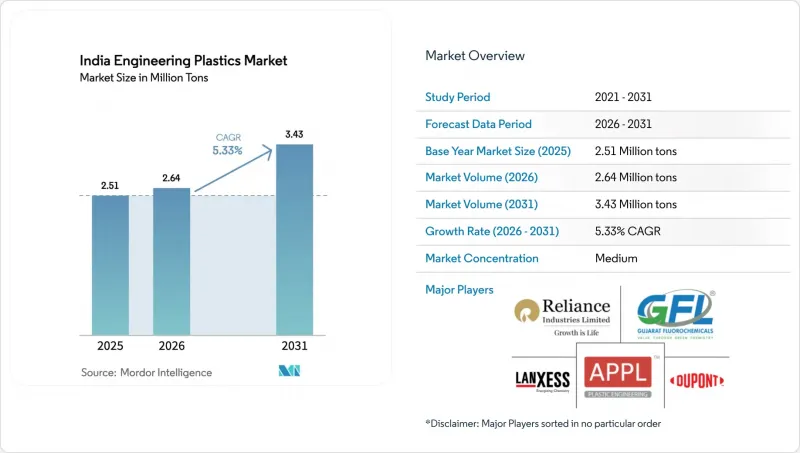
음료, 식품, 전자상거래 분야에서 경질 및 연질 포장재에 대한 수요는 계속 강세를 보이고 있습니다. 그러나 전기 및 전자 및 모빌리티 부문에서는 프리미엄 부품으로의 전환이 두드러지게 나타나고 있습니다. 생산 연동형 인센티브(PLI)와 같은 정부의 이니셔티브와 더불어 전기차(EV)의 생산 기반 확대, 재활용 소재 함유량에 대한 엄격한 규제로 인해 수지의 채택 주기는 극적으로 가속화되고 있습니다. 이전에는 10년 가까이 걸리던 것이 현재는 약 5년으로 단축되었습니다. 이러한 급속한 전환은 난연성 폴리아미드, 폴리카보네이트-ABS 혼합, 불소수지의 등급 확대로 두드러지게 나타나고 있습니다. 2026-2031년까지 국내 생산능력 확대는 PET, ABS, 표준 폴리아미드6에 중점을 두고 있습니다. 그러나 인도는 여전히 특수 폴리머의 상당 부분을 수입에 의존하고 있습니다. 이러한 높은 의존성으로 인해 컨버터는 환율 변동 및 운송 지연의 위험에 노출되어 있습니다.
인도 엔지니어링 플라스틱 시장 동향과 인사이트
자동차 경량화와 전기자동차(EV) 보급의 급격한 확대
2024년부터 2033년까지 인도의 전기차 판매량은 급증할 것으로 예상되며, 이는 자동차 폴리머 수요를 증가시킬 것으로 예측됩니다. OEM 업체들은 기존 금속 하우징 대신 유리섬유 강화 폴리아미드66, 폴리프탈라미드, 난연성 폴리카보네이트-ABS 등의 소재를 점점 더 많이 채택하고 있습니다. 이러한 전환은 차량 중량 감소뿐만 아니라 EV의 항속거리를 늘리기 위해 배터리 인클로저, 파워 일렉트로닉스 모듈, 열 관리 매니폴드에서 매우 중요한 선택이 되고 있습니다. 타타모터스와 마힌드라는 새로운 EV 플랫폼에서 엔지니어링 플라스틱의 사용 비율을 높이고 있으며, 그 사용량은 동급 내연기관 모델 대비 두 배에 달할 전망입니다. PA 66의 국내 생산은 생산 능력의 제약에 직면하고 있으며, 밸류체인의 각 참여 기업은 카프로락탐과 아디프산과 같은 중간체 수입에 의존하고 있습니다. 이러한 수입 의존도는 반스리엔지니어링폴리머스가 2028년 완공 예정인 증설 계획에도 불구하고 잠재적인 비용 절감을 억제하는 요인으로 작용하고 있습니다. 2027년부터 에너지 효율국(Bureau of Energy Efficiency)이 기업 평균 연비(CAFE) 기준을 강화합니다. 이번 조치로 도어 모듈, 계기판, 시트 구조 등의 부품에서 플라스틱에서 금속으로의 전환이 더욱 가속화될 것으로 예측됩니다.
특수 폴리머에 대한 정부의 PLI 인센티브
2025년 12월까지 PLI 제도의 지출은 상당한 수준에 이르렀고, 전자, 배터리, 특수 화학에 중점을 둔 산업 회랑에서 여러 개의 그린필드 프로젝트가 시작되었습니다. 폭스콘, 삼성, 타타 일렉트로닉스 등 주요 기업들은 폴리카보네이트 하우징, 액정 폴리머 커넥터, PVDF 바인더 등의 부품을 국내 시장에서 조달하기로 약속했습니다. 이는 이전의 수입 의존도에서 크게 전환된 것을 보여줍니다. 막대한 자금이 투입된 '첨단 화학전지 PLI'는 음극 바인더, 분리막 코팅 등의 용도로 PVDF와 PTFE에 대한 연간 상당한 수요를 창출했습니다. 구자라트 주 다헤지 바드다라 지역과 카르나타카 주 방갈로르 클러스터에서 가장 큰 성장세를 보였습니다. 이들 지역에서는 토지 보조금과 유리한 전력 요금으로 인해 수지 제조업체는 운영 비용을 절감할 수 있었습니다. 특히 2020-2021년 이후 휴대폰 수입량이 크게 감소하고 있어, 단일 투자 사이클 내에서 무역수지를 재구성하는 현지화 노력의 가능성이 부각되고 있습니다.
원료 가격 변동(PX, 벤젠, HF)
파라자일렌 가격은 큰 변동을 보이고 있으며, 벤젠 가격도 단기간에 큰 변동을 경험했습니다. 이러한 가격 변동으로 인해 폴리에스테르와 폴리아미드 생산업체들의 수익률이 압박을 받고 있습니다. 스프레드를 확보하기 위해 Reliance Industries와 구자라트 주 비료 및 화학 산업은 가격 조정 빈도를 분기별에서 월별로 전환했습니다. 그러나 이러한 변화는 운전자금에 부담을 주며 하류 사업에 악영향을 미치고 있습니다. 한편, PTFE와 PVDF 생산의 중요한 원료인 불화수소산은 중국에서 도입된 새로운 환경 규제로 인해 공급이 타이트한 상황입니다. 그 결과, 구자라트 플루오로케미컬은 기존 평균 가격보다 높은 프리미엄 가격으로 다년간공급 계약을 체결했습니다. 또한, 일반적으로 헤지를 하지 않는 중소 컴파운더들은 새로운 압출 라인의 도입을 몇 달간 연기했습니다. 이 연기로 인해 5G 안테나, EV용 배터리 씰 등 신흥 응용 분야용 수지 등급의 상용화가 지연되고 있습니다.
부문 분석
2025년 인도 엔지니어링 플라스틱 시장에서 포장 부문은 57.12%의 압도적인 점유율을 차지하며 시장을 주도했습니다. 이러한 상승 추세는 급속한 도시화, 음식 배달 서비스, 조직화된 소매업의 요구에 능숙하게 대응하는 활기찬 국내 포장 부문에 의해 주도되었습니다. 청량음료, 물, 유제품 분야의 기업들이 rPET 의무화에 대비하면서 PET 병 생산량은 꾸준히 증가했습니다. 현재 포장 총톤수에서 중요한 부분을 차지하고 있는 연질 다층 필름은 EVOH와 폴리아미드 배리어 층을 결합하여 스낵 식품의 유통기한을 연장하고 있습니다. 2025년 생산량에서 차지하는 비중은 작지만, 전자제품 제조 부문은 2026-2031년의 예측 기간 동안 CAGR 8.55%로 확대될 것으로 예측됩니다. 이러한 예상 성장은 스마트폰, 백색가전, 웨어러블 기기의 국내 조립을 촉진하는 PLI(생산연계형 인센티브) 제도가 견인하고 있습니다. 인쇄 회로 기판(PCB)이나 인쇄 안테나가 추가될 때마다 내열성 LCP와 PBT에 대한 수요가 크게 증가합니다. 자동차 산업에서는 전기자동차(EV)용 폴리머 사용량을 늘리고 있으며, 배터리 팩, 전기 커넥터, 외장 유리 등의 부품에 광학 등급의 폴리카보네이트를 채택하여 기존 소재에서 벗어나고 있습니다. 건설 부문은 CPVC 파이프, PMMA 유리, 폴리카보네이트 지붕재 등을 활용하고 있으며, '스마트시티 미션'과 'PM Awas Yojana' 주택 프로젝트 등의 노력에 힘입어 주요 수요처가 되고 있습니다.
전자상거래 트렌드가 진화함에 따라 포장 부문에서는 가볍고 재활용 가능한 형태로의 전환이 두드러지게 나타나고 있습니다. 이러한 추세에 따라 단일 소재의 글리콜 변성 PET와 폴리올레핀계 배리어 필름의 틈새 시장이 주목받고 있습니다. 브랜드 소유주들의 변조 방지 병과 레이저 조각 캡에 대한 수요가 증가함에 따라 특수 폴리아세탈과 열가소성 엘라스토머에 대한 수요가 급증하고 있습니다. 애플, 삼성 등 주요 기업들과 밀접한 관계를 맺고 있는 전자 부문에서는 수입 난연 ABS에 대한 의존도가 현저히 낮아지고 있습니다. 자동차 산업의 경량화 노력으로 유리섬유 강화 PA 66과 폴리프탈아미드 소재의 엔진 커버에 대한 수요가 급증하고 있습니다. 또한, 내충격성 폴리카보네이트는 이륜차 배터리 케이스의 기본 소재가 되고 있습니다. 특히 지방정부의 상수도 프로젝트를 중심으로 건설 붐이 일어나면서 CPVC와 UPVC 파이프에 대한 수요가 크게 증가하고 있습니다. 베어링에서 컨베이어 시스템에 이르는 산업기계 부문에서는 내마모성을 높이기 위해 저마찰성 POM과 아라미드 강화 PA 6의 채택이 진행되고 있지만, 고기능성 등급은 여전히 수입에 대한 의존도가 높은 상황입니다.
"인도 엔지니어링 플라스틱 시장 보고서는 최종 사용자 산업별(자동차, 전기/전자, 건축/건설, 포장, 산업/기계, 항공우주, 기타 최종 사용자 산업)과 수지 유형별(불소수지, 액정 폴리머, 폴리아미드, 폴리부틸렌 테레프탈레이트, 폴리카보네이트, 폴리카보네이트, 폴리테르 에테르 케톤, 기타)로 구분하여 분석했습니다. 폴리카보네이트, 폴리에테르에테르케톤, 기타)로 분류됩니다. 시장 예측은 수량(톤) 기준으로 제공됩니다.
기타 혜택
- 엑셀 형태 시장 예측(ME) 시트
- 3개월간 애널리스트 지원
자주 묻는 질문
목차
제1장 서론
제2장 조사 방법
제3장 주요 요약
제4장 시장 구도
제5장 시장 규모와 성장 예측
제6장 경쟁 구도
제7장 시장 기회와 향후 전망
제8장 CEO용 중요 전략적 과제 :
JHS 26.06.02The Indian Engineering Plastics Market size is expected to grow from 2.51 million tons in 2025 to 2.64 million tons in 2026 and is forecast to reach 3.43 million tons by 2031 at 5.33% CAGR over 2026-2031.
Demand for rigid and flexible packaging remains robust across the beverage, food, and e-commerce sectors. However, there is a notable pivot towards premium components in the electrical, electronics, and mobility domains. Government initiatives, such as the Production Linked Incentive (PLI) outlays, alongside a growing electric vehicle (EV) production base and stringent recycled content mandates, have drastically accelerated resin-adoption cycles. What previously required nearly a decade has now been reduced to approximately five years. This swift transition is highlighted by the expanding grades in flame-retardant polyamides, polycarbonate-ABS blends, and fluoropolymers. Between 2026 and 2031, domestic capacity expansions have focused on PET, ABS, and standard polyamide 6. However, India continues to depend on imports for a considerable portion of its specialty polymers. This reliance makes converters vulnerable to foreign exchange fluctuations and potential shipping delays.
India Engineering Plastics Market Trends and Insights
Automotive Light-Weighting and Electric-Vehicle Adoption Boom
From 2024 to 2033, India's EV sales are projected to surge, driving up the demand for polymers in vehicles. OEMs are increasingly opting for materials such as glass-fiber-reinforced polyamide 66, polyphthalamide, and flame-retardant polycarbonate-ABS, replacing traditional metal housings. This shift not only reduces curb weight but also enhances the EV driving range, making it a pivotal choice for battery enclosures, power-electronics modules, and thermal-management manifolds. Tata Motors and Mahindra are leading the charge, specifying a higher content of engineering plastics in their new EV platforms, which doubles the content used in comparable internal-combustion models. While domestic production of PA 66 faces capacity constraints, the value-chain players are turning to imports for intermediates such as caprolactam and adipic acid. This reliance on imports tempers potential cost reductions, even with Bhansali Engineering Polymers planning an expansion set to conclude in 2028. Starting in 2027, the Bureau of Energy Efficiency is tightening Corporate Average Fuel Economy (CAFE) norms. This policy is expected to further accelerate the shift from plastic to metal in components such as door modules, instrument clusters, and seat structures.
Government PLI Incentives for Specialty Polymers
By December 2025, disbursements under the PLI scheme reached significant levels, leading to the establishment of multiple greenfield projects in corridors focused on electronics, batteries, and specialty chemicals. Major players such as Foxconn, Samsung, and Tata Electronics are committed to sourcing components, including polycarbonate housings, liquid-crystal-polymer connectors, and PVDF binders, from domestic markets. This marked a significant shift from their earlier reliance on imports. The Advanced Chemistry Cell PLI, with substantial funding, created a considerable demand for PVDF and PTFE annually for applications such as cathode binders and separator coatings. The Dahej-Vadodara belt in Gujarat and the Bengaluru cluster in Karnataka experienced the most momentum. In these regions, land subsidies and favorable power tariffs enabled resin manufacturers to reduce operating costs. Notably, mobile-phone import volumes had significantly declined since FY 2020-21, underscoring the potential of localization efforts to reshape trade balances within a single investment cycle.
Feedstock Price Volatility (PX, Benzene, HF)
Paraxylene prices have exhibited significant fluctuations, and benzene prices have also experienced notable swings in a short timeframe. These price movements have compressed margins for polyester and polyamide producers. In a bid to safeguard their spreads, Reliance Industries and Gujarat State Fertilizers & Chemicals transitioned from quarterly to monthly price adjustments. However, this shift has strained their working capital, adversely affecting downstream operations. Meanwhile, hydrofluoric acid, a critical feedstock for PTFE and PVDF production, has experienced a tightening supply due to new environmental restrictions implemented in China. As a result, Gujarat Fluorochemicals has entered into multi-year supply contracts at a premium over previous averages. Furthermore, smaller compounders, who typically do not hedge, postponed their new extrusion lines by several months. This postponement has hindered the commercialization of resin grades for emerging applications, including 5G antennas and EV battery seals.
Other drivers and restraints analyzed in the detailed report include:
- Surge in Electronics Manufacturing
- Food-Grade rPET Mandate for Beverage Bottles
- Compliance Costs from EPR and Recycled-Content Rules
For complete list of drivers and restraints, kindly check the Table Of Contents.
Segment Analysis
In 2025, packaging took the lead in India's engineering plastics market, securing a commanding 57.12% share. This upswing was fueled by a dynamic domestic packaging sector, skillfully addressing the needs of swift urbanization, food delivery services, and organized retail. As companies in the soft drink, water, and dairy sectors geared up for the rPET mandate, production of PET bottles saw a consistent rise. Flexible multi-layer films, now a significant segment of total packaging tonnage, are enhanced with EVOH and polyamide barriers to extend the shelf life of snack foods. Although electronics manufacturing represented a smaller slice of the 2025 volume, it is set to expand at an 8.55% CAGR through the 2026-2031 forecast period. This anticipated growth is driven by PLI incentives that bolster the domestic assembly of smartphones, white goods, and wearables. Each addition of a PCB or printed antenna notably heightens the demand for high-temperature LCP and PBT. The automotive sector is ramping up its polymer usage for electric vehicles (EVs), favoring optical-grade polycarbonate for components like battery packs, electrical connectors, and exterior glazing, moving away from traditional materials. The construction sector, leveraging CPVC pipes, PMMA glazing, and polycarbonate roofing, is a major consumer, spurred by initiatives like the Smart Cities Mission and PM Awas Yojana housing projects.
As e-commerce trends evolve, there is a noticeable shift in packaging towards lighter, recyclable formats. This evolution has spotlighted niches for monomaterial glycol-modified PET and polyolefin-based barrier films. Brand owners' push for tamper-evident bottles and laser-engraved closures has spiked the demand for specialty polyacetal and thermoplastic elastomers. The electronics sector, closely tied to major players like Apple and Samsung, has seen a marked decrease in the country's dependence on imported flame-retardant ABS. The automotive industry's drive for lightweight components has led to a surge in demand for glass-fiber-reinforced PA 66 and polyphthalamide engine covers. Additionally, impact-modified polycarbonate is becoming the go-to for two-wheeler battery casings. With a construction boom underway, especially in municipal water projects, there has been a notable uptick in the demand for CPVC and UPVC pipes. Industrial machinery, from bearings to conveyor systems, is increasingly opting for low-friction POM and aramid-reinforced PA 6 to boost wear resistance, though there is still a significant dependence on imports for advanced grades.
The India Engineering Plastics Market Report is Segmented by End-User Industry (Automotive, Electrical and Electronics, Building and Construction, Packaging, Industrial and Machinery, Aerospace, and Other End-User Industries), Resin Type (Fluoropolymers, Liquid Crystal Polymer, Polyamide, Polybutylene Terephthalate, Polycarbonate, Polyether Ether Ketone, and More). Market Forecasts are Provided in Terms of Volume (Tons).
List of Companies Covered in this Report:
- APPL Industries Limited
- Bhansali Engineering Polymers Ltd.
- DuPont
- Gujarat Fluorochemicals Limited (GFL)
- Gujarat State Fertilizers & Chemicals Limited (GSFC)
- INEOS
- IVL Dhunseri Petrochem Industries Private Limited (IDPIPL)
- Kingfa Science & Technology (India) Limited
- LANXESS
- Mitsubishi Chemical Group
- Polyplex Corporation Ltd.
- Reliance Industries Ltd
- Styrenix Performance Materials Limited
- JBF Industries Ltd
- CHIRIPAL POLY FILM
Additional Benefits:
- The market estimate (ME) sheet in Excel format
- 3 months of analyst support
TABLE OF CONTENTS
1 Introduction
- 1.1 Study Assumptions and Market Definition
- 1.2 Scope of the Study
2 Research Methodology
3 Executive Summary
4 Market Landscape
- 4.1 Market Overview
- 4.2 Market Drivers
- 4.2.1 Automotive Light-weighting and Electric Vehicle Adoption Boom
- 4.2.2 Government PLI Incentives for Specialty Polymers
- 4.2.3 Surge in Electronics Manufacturing
- 4.2.4 Food-grade rPET Mandate for Beverage Bottles
- 4.2.5 Rapid Growth of Technical-textile and Fiber Exports
- 4.3 Market Restraints
- 4.3.1 Feedstock Price Volatility (PX, Benzene, HF)
- 4.3.2 Compliance Costs from EPR and Recycled-content Rules
- 4.3.3 Under-investment in Certified Recycling Infrastructure
- 4.4 Value Chain Analysis
- 4.5 Regulatory Landscape
- 4.6 Porter's Five Forces
- 4.6.1 Bargaining Power of Suppliers
- 4.6.2 Bargaining Power of Buyers
- 4.6.3 Threat of Substitutes
- 4.6.4 Competitive Rivalry
- 4.6.5 Threat of New Entrants
- 4.7 Import and Export Trends
- 4.7.1 Fluoropolymer Trade
- 4.7.2 Polyamide (PA) Trade
- 4.7.3 Polyethylene Terephthalate (PET) Trade
- 4.7.4 Polymethyl Methacrylate (PMMA) Trade
- 4.7.5 Polyoxymethylene (POM) Trade
- 4.7.6 Styrene Copolymers (ABS and SAN) Trade
- 4.8 Price Trends
- 4.8.1 Fluoropolymer
- 4.8.2 Polycarbonate (PC)
- 4.8.3 Polyethylene Terephthalate (PET)
- 4.8.4 Polyoxymethylene (POM)
- 4.8.5 Polymethyl Methacrylate (PMMA)
- 4.8.6 Styrene Copolymers (ABS and SAN)
- 4.8.7 Polyamide (PA)
- 4.9 Recycling Overview
- 4.9.1 Polyamide (PA) Recycling Trends
- 4.9.2 Polycarbonate (PC) Recycling Trends
- 4.9.3 Polyethylene Terephthalate (PET) Recycling Trends
- 4.9.4 Styrene Copolymers (ABS and SAN) Recycling Trends
- 4.10 Licensors Overview
- 4.11 Production Overview
- 4.12 End-use Sector Trends
- 4.12.1 Aerospace (Aerospace Component Production Revenue)
- 4.12.2 Automotive (Automobile Production)
- 4.12.3 Building and Construction (New Construction Floor Area)
- 4.12.4 Electrical and Electronics (Electrical and Electronics Production Revenue)
- 4.12.5 Packaging (Plastic Packaging Volume)
5 Market Size and Growth Forecasts (Volume)
- 5.1 By End-User Industry
- 5.1.1 Automotive
- 5.1.2 Electrical and Electronics
- 5.1.3 Building and Construction
- 5.1.4 Packaging
- 5.1.5 Industrial and Machinery
- 5.1.6 Aerospace
- 5.1.7 Other End-User Industries
- 5.2 By Resin Type
- 5.2.1 Fluoropolymers
- 5.2.1.1 Ethylenetetrafluoroethylene (ETFE)
- 5.2.1.2 Fluorinated Ethylene-propylene (FEP)
- 5.2.1.3 Polytetrafluoroethylene (PTFE)
- 5.2.1.4 Polyvinylfluoride (PVF)
- 5.2.1.5 Polyvinylidene Fluoride (PVDF)
- 5.2.1.6 Other Sub Resin Types
- 5.2.2 Liquid Crystal Polymer
- 5.2.3 Polyamide
- 5.2.3.1 Aramid
- 5.2.3.2 Polyamide (PA) 6
- 5.2.3.3 Polyamide (PA) 66
- 5.2.3.4 Polyphthalamide
- 5.2.4 Polybutylene Terephthalate
- 5.2.5 Polycarbonate
- 5.2.6 Polyether Ether Ketone
- 5.2.7 Polyethylene Terephthalate
- 5.2.8 Polyimide
- 5.2.9 Polymethyl Methacrylate
- 5.2.10 Polyoxymethylene
- 5.2.11 Styrene Copolymers (ABS and SAN)
- 5.2.1 Fluoropolymers
6 Competitive Landscape
- 6.1 Market Concentration
- 6.2 Strategic Moves
- 6.3 Market Share(%)/Ranking Analysis
- 6.4 Company Profiles (includes Global Overview, Market Overview, Core Segments, Financials, Strategic Information, Products and Services, Recent Developments)
- 6.4.1 APPL Industries Limited
- 6.4.2 Bhansali Engineering Polymers Ltd.
- 6.4.3 DuPont
- 6.4.4 Gujarat Fluorochemicals Limited (GFL)
- 6.4.5 Gujarat State Fertilizers & Chemicals Limited (GSFC)
- 6.4.6 INEOS
- 6.4.7 IVL Dhunseri Petrochem Industries Private Limited (IDPIPL)
- 6.4.8 Kingfa Science & Technology (India) Limited
- 6.4.9 LANXESS
- 6.4.10 Mitsubishi Chemical Group
- 6.4.11 Polyplex Corporation Ltd.
- 6.4.12 Reliance Industries Ltd
- 6.4.13 Styrenix Performance Materials Limited
- 6.4.14 JBF Industries Ltd
- 6.4.15 CHIRIPAL POLY FILM
7 Market Opportunities and Future Outlook
- 7.1 White-Space and Unmet-Need Assessment