

|
시장보고서
상품코드
2044293
재활용 플라스틱 시장 : 점유율 분석, 산업 동향 및 통계, 성장 예측(2026-2031년)Recycled Plastics - Market Share Analysis, Industry Trends & Statistics, Growth Forecasts (2026 - 2031) |
||||||
 Mordor Intelligence
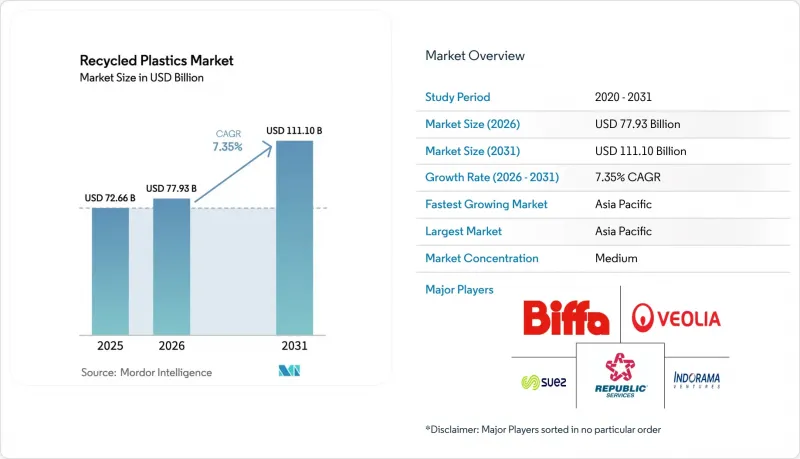
재활용 플라스틱(rPET) 시장 규모는 2025년에 726억 6,000만 달러, 2026년에 779억 3,000만 달러가 되어, 2031년까지 1,111억 달러에 이를 것으로 예측되며, 2026-2031년까지 CAGR 7.35%로 성장할 전망입니다.
현재 공급망을 형성하는 주요 원동력은 규제 압력이며, 그 선두에는 2026년부터 플라스틱 포장의 각 카테고리에서 재활용 재료의 최소 함량 기준을 설정하는 유럽 연합(EU)의 "포장 및 포장 폐기물 규정"이 있습니다. 아시아태평양에서는 중국 전역의 폐기물 분리수거 프로그램 확대와 함께 주요 동남아시아 시장에서 확대되는 생산자책임재활용(EPR) 프레임워크가 수요와 생산능력 확대를 견인하고 있습니다. 기술의 성숙은 Carbios가 주도하는 시설에서 효소에 의한 PET 분해가 상용화 단계에 이르렀다는 점과 재활용 업체의 수익 안정화와 자금 조달을 가능하게 하는 장기 오프테이크 계약의 활용에서 찾아볼 수 있습니다. 북미에서는 미국 환경보호청(EPA)의 보조금 지원을 받아 인프라 구축이 진행되고 있지만, 회수 상황과 오염의 편차로 인해 현재 식품 등급 제품의 점유율은 제한적일 수밖에 없습니다. 자동차 및 기타 엔지니어링 응용 분야는 OEM의 프로그램이 순환 경제 목표 및 사용 후 제품에 대한 요구 사항과 일치함에 따라 빠르게 성장하고 있지만, 내용물 규제 및 브랜드 목표에 따라 포장은 여전히 주요 응용 분야로 남아있습니다.
세계 재활용 플라스틱 시장 동향과 인사이트
EU의 PPWR(플라스틱 포장 및 폐기물 규정)의 30% 재활용 재료 함유 의무화, 폐쇄 루프 투자 촉진
유럽 연합(EU)의 '포장 및 포장 폐기물 규정(PPWR)은 2025년 2월에 발효되어 2026년 8월부터 적용될 예정입니다. 이 규정은 플라스틱 포장재에 대한 재생재 함량 최소 기준을 정하고 있으며, 식품접촉용 PET는 30%, 기타 식품접촉용 플라스틱은 10%, 일회용 식수병은 30%, 기타 카테고리는 35%로 설정되어 있으며, 2040년까지 추가적으로 상향 조정될 예정입니다. 이러한 명확성을 통해 고도의 폐쇄형 루프 생산 능력에 대한 새로운 프로젝트 자금 조달이 가능해졌습니다. 여기에는 베올리아가 Shrewsbury에 건설 예정인 트레이 투 트레이 방식의 PET 시설에 대한 노력도 포함되어 있으며, 연간 8만 톤의 처리 능력을 계획하고 7,000만 파운드(8,890만 달러)의 투자로 뒷받침되고 있습니다. 또한, 루프인더스트리즈는 BASF의 슈바르츠하이데 공장에서 유럽 최초의 '인피니트 루프' 라이선스 계약을 체결하였습니다. 초기 라이선스 비용은 1,000만 유로(1,080만 달러)이며, 2030년까지 연간 7만 톤 처리를 목표로 하고 있습니다. 프랑스와 같은 시장에서는 재활용 적합성 등급에 따라 생산자책임부담금을 조정하고 있으며, 이는 다층 구조보다 단일 재료를 우선시하는 가격 시그널을 더욱 강화시키고 있습니다. 재활용 재료의 수입은 EU의 식품 접촉 규정에 따라 엄격한 동등성 및 규정 준수 요건에 직면하고 있으며, 이는 국내 감사 가능한 공급원에 대한 투자를 촉진하고 있습니다.
버진 HDPE 가격이 1,600달러/톤을 넘어서면서 rPE의 경제성이 향상되었습니다.
버진 고밀도 폴리에틸렌(HDPE) 가격이 고공행진을 하고 있는 상황에서 컨버터 업체들은 PCR(Post-Consumer Recycled) 소재의 함유에 내성이 있거나 그 혜택을 누릴 수 있는 포장 및 산업 응용 분야에서 재생 HDPE와 LDPE를 재검토하고 있습니다. 또한, 규제 및 함량 목표도 음료 및 생활용품 분야에서 천연 재생 HDPE에 대한 안정적인 수요를 뒷받침하고 있습니다. 플라스틱재활용협회(Association of Plastic Recyclers)의 보고서에 따르면, 원료의 품질과 최종 시장 수요가 유지된다면, 미국과 캐나다 전역의 재활용업체들은 연간 약 20억 파운드의 추가 처리가 가능할 것으로 예상했습니다. 이러한 잉여 처리 능력은 버진 소재 가격의 차익거래를 통해 PCR(Post-Consumer Recycling)의 경제성이 향상될 때 재활용 플라스틱 시장이 보다 신속하게 대응할 수 있도록 도와줍니다. 버진 소재 가격의 고공행진과 정책적 압박이 결합되어 내구소비재 및 반내구 소비재 분야에서 재활용 플라스틱 함량을 더욱 향상시킬 수 있는 동력이 되고 있습니다.
유럽의 rPET 플레이크 공급과잉으로 재활용업체들의 수익률 압박
유럽 rPET 시장공급과잉 기간은 플레이크 가격을 하락시켜 재활용 업체의 이익률을 압박합니다. 특히, 식수 병에 대한 '일회용 플라스틱 지침'의 최소 기준에 따라 브랜드 수요가 증가하는 경우 더욱 그렇습니다. 재고 누적과 계절적 요인이 압박을 가중시킬 수 있으며, 이로 인해 품질 향상을 위한 투자가 미뤄지고 가동률이 하락할 수 있습니다. 회수비용과 에너지 가격도 버진 PET와의 비용 경쟁에 영향을 미치고 있으며, EPR(확대생산자책임재활용) 요금 도입과 일관성 있는 시행의 필요성이 강화되고 있습니다. EU 식품 접촉 규정의 명확화는 높은 품질 기준을 유지하지만, 추가적인 문서화 및 공정 검증이 필요합니다. 보증금 반환 제도의 운영 개선과 규격 통일은 재활용 플라스틱 시장에서 더 높은 재생재 함량으로 수요를 안정화시키는 데 도움이 될 것입니다.
부문 분석
2025년 폴리에틸렌이 29.18%를 차지했으며, 경질 포장용 고밀도 폴리에틸렌과 필름용 LDPE(LDPE) 및 선형 LDPE(LLDPE)가 주도했습니다. 이는 성숙한 회수 및 재활용 인프라가 뒷받침된 결과입니다. 또한 미국과 캐나다의 기계 재생 업체는 베일의 품질과 다운스트림 수요가 안정적이라면 더 많은 폴리올레핀을 처리할 수 있는 여지가 있다는 전망을 제시했습니다.
'기타 플라스틱' 부문은 주로 자동차 및 전자제품 부문에 힘입어 9.15%의 가장 높은 CAGR로 성장할 것으로 예측됩니다. 제조업체들이 엄격한 지속가능성 목표를 달성하기 위해 노력하는 가운데, 이러한 재생 엔지니어링 폴리머에 대한 수요가 급증하고 있습니다. 고성능 재생 ABS, PC, PA는 우수한 기계적 특성을 가지고 있어 복잡하고 내구성이 요구되는 제조 응용 분야에서 버진 수지를 대체할 수 있는 매우 실용적이고 친환경적인 대안이 될 뿐만 아니라 전 세계 순환 경제의 노력을 촉진하고 있습니다.
2025년에는 기계적 재활용이 시장의 70.8%를 차지했습니다. 이는 포장, 건설, 자동차 용도에 공급하는 세척, 압출, 펠릿화 라인의 도입 실적을 반영한 것입니다. 화학적 경로를 통한 재활용 플라스틱 시장 규모는 2031년까지 연평균 8.71%의 연평균 복합 성장률(CAGR)로 확대될 것으로 예측됩니다. 이는 각 브랜드가 혼합 또는 오염된 원료 스트림에서 식품 접촉용 또는 고사양의 폴리머를 요구하기 때문입니다. 플라스틱재활용협회(Association of Plastic Recyclers)는 원료 공급의 개선과 안정적인 수요의 조짐을 조건으로 PET, HDPE, PP, 필름 부문에서 미활용 생산능력에 큰 잠재력이 있다고 보고했습니다. 유럽 연합(EU)의 식품 접촉 규정이 변경됨에 따라 오염 제거 공정 인증에 대한 중요성이 더욱 강조되고 품질과 추적성에 대한 요구사항이 증가하고 있습니다. 이를 통해 검증된 기술에 대한 투자를 촉진하고 있습니다.
탈중합과 같은 고도의 가공법은 재활용이 어려운 원료를 고부가가치 용도에 즉시 사용 가능한 단량체 및 정제된 폴리머로 전환함으로써 기계적 가공법을 보완합니다. 도입 패턴은 분야마다 다르며, 포장 브랜드는 식품 등급의 안정성을 우선시하는 반면, 자동차 및 전자 산업은 기능적 성능 표준에 중점을 둡니다. 표준, 인증, 생산 이력에 대한 문서화는 비용과 마찬가지로 구매자의 신뢰에 영향을 미치며, 계약량의 꾸준한 성장을 뒷받침하고 있습니다. 신뢰할 수 있는 생산 실적을 보여주는 상업용 플랜트가 늘어남에 따라, 화학적 재활용의 역할은 기계적 재활용의 큰 기반을 대체하지 않고 재활용 플라스틱 시장 내에서 확대될 것으로 예측됩니다.
지역별 분석
아시아태평양은 2025년 48.7%의 점유율로 1위를 차지했으며, 급성장하는 소비 시장에서 EPR(확대된 생산자책임재활용(EPR) 프로그램이 확대되고 대규모 도시 지역에서 폐기물 분리배출이 표준화됨에 따라 2031년까지 연평균 복합 성장률(CAGR) 8.32%로 성장할 것으로 전망됩니다. 중국의 '제로 웨이스트 도시 2.0'은 2026-2030년까지 약 200개 도시로 확대되고, 2027년까지 60%의 참여율, 2035년까지 전면적인 커버리지를 목표로 하고 있으며, 이를 통해 원료공급량과 품질을 향상시킬 수 있습니다. 상하이의 규제는 가정에서의 분리배출 준수율을 높이고, 상하이의 전체 재활용률을 향상시켰으며, 이는 모두 고품질의 rPET 및 폴리올레핀 스트림을 확보하는 데 도움이 됩니다. 또한, 이 지역에서는 오염된 필름과 혼합 플라스틱을 처리할 수 있도록 설계된 신규 설비의 검사 운영 등 화학적 재생 프로젝트가 부상하고 있습니다. 이러한 정책, 인프라, 기술의 조합은 아시아태평양 재활용 플라스틱 시장의 지속적인 성장을 시사하고 있습니다.
유럽도 이에 이어 2025년에는 큰 시장 점유율을 차지했습니다. 이는 PPWR(플라스틱 포장 및 용기 규정)의 재활용 재료의 최소 함량 및 재활용 가능성에 대한 요구사항이 회원국 전체에서 폐쇄형 투자를 촉진하고 있기 때문입니다. '일회용 플라스틱 지침'이 정한 식수 병의 rPET 함량 목표(2025년까지 25%, 2030년까지 30%)는 고품질 병용 PCR(Post-Consumer Recycled Plastic, 소비 후 재활용 플라스틱)에 대한 수요를 지속적으로 뒷받침하고 있습니다. 새로운 프로젝트로는 영국의 트레이-투-트레이(Tray-to-tray) PET 라인과 국가 보조금 및 혁신 펀드의 지원을 받아 고도의 탈중합에 대한 투자를 들 수 있습니다. 가격 조정과 브랜드 목표의 조합은 단일 재료 설계와 명확한 표시를 촉진하고 재활용성을 향상시키고 있습니다. 식품 접촉 용도에 대한 수입 규제가 강화되는 가운데, 추적성이 필수적인 분야에서는 현지 공급이 우위를 점하고 있습니다.
북미에서는 연방정부 프로그램 자금 지원과 주정부의 EPR법 확대를 통해 인프라 부족을 해결하고 있지만, 재활용 업체들은 원료 품질 향상과 안정적인 수요만 있다면 가동 가능한 상당한 양의 미사용 생산 능력이 있다고 보고하고 있습니다. PET, HDPE, PP, 필름을 취급하는 기계식 재활용업체는 브랜드 규격이 통일되고 베일의 혼입물이 감소함에 따라 생산량을 확대할 수 있는 처리 여력이 있습니다. 주요 수지 제조업체 및 컨버터는 대량 균형 제품군을 공급하고, 식품 접촉 용도 및 고사양 용도를 가능하게 하는 고도로 재활용 및 정제된 PCR 원료에 대한 장기 계약을 체결하고 있습니다. 이러한 계약이 확대됨에 따라 재생업체들의 가격 변동 위험을 줄이고 재활용 플라스틱 시장용 생산 라인에 대한 신규 투자를 촉진할 수 있습니다.
기타 혜택
- 엑셀 형태 시장 예측(ME) 시트
- 3개월간 애널리스트 지원
자주 묻는 질문
목차
제1장 서론
제2장 조사 방법
제3장 주요 요약
제4장 시장 구도
제5장 시장 규모와 성장 예측(금액, 10억 달러)
제6장 경쟁 구도
제7장 시장 기회와 향후 전망
JHS 26.06.02The Recycled Plastics Market size is projected to be USD 72.66 billion in 2025, USD 77.93 billion in 2026, and reach USD 111.10 billion by 2031, growing at a CAGR of 7.35% from 2026 to 2031.
Regulatory pressure is now the primary force shaping supply chains, led by the European Union's Packaging and Packaging Waste Regulation that establishes minimum recycled content thresholds across plastic packaging categories beginning in 2026. Asia-Pacific leads demand and capacity build-out as Extended Producer Responsibility frameworks spread across major Southeast Asian markets alongside China's nationwide expansion of waste-sorting programs. Technology maturation is visible in enzymatic PET depolymerization reaching commercial timelines at Carbios-led facilities and in the use of long-term offtake contracts that stabilize recycler revenue and unlock financing. North America continues to add infrastructure with support from U.S. Environmental Protection Agency grants, though collection and contamination variability limit the share of food-grade output today.Automotive and other engineering uses are fast-growing as OEM programs align with circularity goals and end-of-life requirements, while packaging remains the anchor application under content mandates and brand targets.
Global Recycled Plastics Market Trends and Insights
EU PPWR 30% Recycled-Content Mandate Drives Closed Loop Investment
The European Union's Packaging and Packaging Waste Regulation entered into force on February, 2025, and applies from August, 2026, setting minimum recycled content thresholds for plastic packaging, including 30% for contact-sensitive PET, 10% for other contact-sensitive plastics, 30% for single-use beverage bottles, and 35% for the remaining categories, with further increases through 2040. This clarity has enabled new project financing for advanced closed-loop capacity, including Veolia's commitment to a tray-to-tray PET facility in Shrewsbury with planned throughput of 80,000 tonnes per year, supported by a GBP 70 million investment (USD 88.9 million). Loop Industries also advanced its first European Infinite Loop license at BASF's Schwarzheide site, with an initial license payment of EUR 10 million (USD 10.8 million) and a target of 70,000 metric tons per year by 2030. Producer-responsibility fee modulation based on recyclability grades in markets like France adds further price signals that favor mono-material over multi-layer designs. Imports of recyclate face rigorous equivalence and compliance requirements under EU food-contact regulations, reinforcing investment in domestic, auditable supply.
Sustained Virgin HDPE Prices Above USD 1,600/t Improve rPE Economics
When virgin high-density polyethylene prices remain elevated, converters reconsider recycled HDPE and LDPE for packaging and industrial uses that can tolerate or benefit from PCR content. Mandates and content targets also underpin stable demand for natural rHDPE in beverage and household applications. The Association of Plastic Recyclers reported that reclaimers across the United States and Canada could process nearly 2 billion additional pounds annually if feedstock quality and end-market demand are sustained. This available capacity allows the recycled plastics market to respond faster when virgin price arbitrage improves PCR economics. The combination of sustained virgin price premiums and incremental policy pressure supports higher recycled-content utilization in durable and semi-durable applications.
rPET Flake Oversupply in Europe Compresses Recycler Margins
Periods of oversupply in European rPET markets reduce pricing for flakes and compress margins for recyclers, especially when brand demand tracks the minimum thresholds under the Single-Use Plastics Directive for beverage bottles. Inventory build-ups and seasonality can intensify pressure, which in turn defers investments in quality upgrades and reduces run rates. Collection costs and energy prices also influence cost parity against virgin PET, reinforcing the need for EPR fee signals and consistent enforcement. Clarifications under EU food-contact rules sustain high-quality standards, yet they require additional documentation and process validation. Improved deposit-return performance and harmonized specifications can help stabilize demand at higher recycled-content levels within the recycled plastics market.
Other drivers and restraints analyzed in the detailed report include:
- China Zero-Waste Cities 2.0 Expands Household Plastics Collection Infrastructure
- U.S. EPA USD 375 Million Recycling-Infrastructure Grants Unlock Regional Capacity
- Escalating Marine Insurance & Asia-EU Freight Costs Pressure Feedstock Routes
For complete list of drivers and restraints, kindly check the Table Of Contents.
Segment Analysis
Polyethylene accounted for 29.18% in 2025, led by high-density polyethylene in rigid packaging and low-density or linear low-density polyethylene in film applications, supported by a mature collection and recycling infrastructure. Mechanical reclaimers in the United States and Canada also indicated material headroom to process more polyolefins if bale quality and downstream demand hold steady.
The "Other Plastics" segment is expected to grow at the fastest CAGR at 9.15%, driven primarily by the automotive and electronics sectors. Demand for these recycled engineering polymers is surging as manufacturers strive to meet stringent sustainability targets. High-performance recycled ABS, PC, and PA offer excellent mechanical properties, making them highly viable, eco-friendly substitutes for virgin resins in complex, durable manufacturing applications while advancing global circular economy initiatives.
Mechanical recycling accounted for 70.8% of activity in 2025, reflecting the installed base of washing, extrusion, and pelletizing lines that feed packaging, construction, and automotive applications. The recycled plastics market size for chemical routes is projected to expand at 8.71% CAGR through 2031 as brands seek food-contact and high-spec polymers from mixed or contaminated streams. The Association of Plastic Recyclers has documented significant unused capacity potential across PET, HDPE, PP, and film, contingent on better feedstock supply and consistent demand signals. Food-contact regulation shifts in the European Union place more emphasis on certifying decontamination processes, which raises both quality and traceability requirements that favor investment in proven technologies.
Advanced routes such as depolymerization complement mechanical methods by converting hard-to-recycle streams into monomers or purified polymers ready for high-value applications. Adoption patterns vary by sector, with packaging brands prioritizing food-grade consistency while automotive and electronics focus on functional performance benchmarks. Standards, certifications, and chain-of-custody documentation influence buyer confidence alongside cost, which supports steady growth in contracted volumes. As more commercial plants demonstrate reliable output, chemical recycling's role is expected to grow within the recycled plastics market without displacing mechanical recycling's large base.
The Recycled Plastics Market is Segmented by Polymer Type (Polyethylene, Polyethylene Terephthalate, and Others), by Recycling Process (Mechanical, Chemical/Advanced, and Others), by Product Form (Flakes, Powder, and Others), by End-Use Application (Packaging, Building & Construction, and Others), and by Geography (North America, Europe, Asia-Pacific and More). The Market Forecasts are Provided in Terms of Value (USD).
Geography Analysis
Asia-Pacific led with 48.7% share in 2025 and is projected to grow at 8.32% CAGR through 2031 as EPR programs expand across fast-growing consumer markets and large urban clusters standardize waste sorting. China's Zero-Waste Cities 2.0 is scaling to about 200 cities from 2026 to 2030, targeting 60% participation by 2027 and aiming for comprehensive coverage by 2035, which expands feedstock availability and quality. Shanghai's regulation raised household sorting compliance and improved the city's overall recycling rate, both of which support higher quality rPET and polyolefin streams. Chemical recycling projects are also emerging in the region, including trial operations of new units designed to handle contaminated films and mixed plastics. This mix of policy, infrastructure, and technology signals durable growth for the recycled plastics market in Asia-Pacific.
Europe followed with a significant market share in 2025 as PPWR requirements for minimum recycled content and recyclability stimulate closed-loop investments across Member States. The Single-Use Plastics Directive's 25% rPET target for beverage bottles in 2025 and 30% by 2030 continues to anchor demand for high-quality bottle-grade PCR. New projects include tray-to-tray PET lines in the United Kingdom alongside advanced depolymerization investments supported by state aid and innovation funding. The combination of fee modulation and brand targets encourages mono-material designs and clear labeling that improve recyclability outcomes. As import compliance tightens for food-contact applications, local supply gains an advantage where traceability is critical.
North America is addressing infrastructure gaps through federal program funding and growing state EPR laws while reclaimers report sizable unused capacity that could be activated with better feedstock quality and steady demand. Mechanical recyclers across PET, HDPE, PP, and film have the processing headroom to add output as brand specifications align and bale contamination falls. Large resin producers and converters are signing long-term agreements for advanced recycled and purified PCR feedstocks that supply mass-balance portfolios and enable food-contact or high-spec uses. As these agreements scale, they help reduce the volatility faced by reclaimers and catalyze new investments in lines that serve the recycled plastics market.
- Veolia
- Indorama Ventures
- Biffa
- Republic Services
- Suez
- KW Plastics
- Plastipak Holdings
- Loop Industries
- MBA Polymers
- Brightmark
- Agilyx
- Waste Management Inc.
- Clean Harbors
- CarbonLite
- Eastman Chemical
- BASF SE
- SABIC
- LyondellBasell
- Covestro
- REMondis
- Custom Polymers
- Green Line Polymers
- Berry Global
- PureCycle Technologies
Additional Benefits:
- The market estimate (ME) sheet in Excel format
- 3 months of analyst support
TABLE OF CONTENTS
1 Introduction
- 1.1 Study Assumptions & Market Definition
- 1.2 Scope of the Study
2 Research Methodology
3 Executive Summary
4 Market Landscape
- 4.1 Market Overview
- 4.2 Market Drivers
- 4.2.1 EU Packaging & Packaging-Waste Regulation (PPWR) 30 % recycled-content mandate
- 4.2.2 China's "Zero-Waste Cities 2.0" rollout boosting household plastics collection
- 4.2.3 U.S. EPA USD 375 million Recycling-Infrastructure Grants unlocking new capacity
- 4.2.4 Commercial start-up of enzymatic PET depolymerisation technology
- 4.2.5 Corporate ?recycled-plastic PPAs? providing price floors for recyclers
- 4.2.6 Sustained high virgin-polymer prices (less than USD 1 600/ton HDPE), improving recycled polyethylene (rPE) economics
- 4.3 Market Restraints
- 4.3.1 rPET flake oversupply in Europe compressing recycler margins
- 4.3.2 Escalating marine-insurance & freight costs on Asia-EU feedstock routes
- 4.3.3 EU legal ambiguity on chemical-recycling mass-balance claims cooling investment
- 4.3.4 Skilled-labour shortage for robotics-enabled MRFs delaying yield gains
- 4.4 Value / Supply-Chain Analysis
- 4.5 Regulatory Outlook
- 4.6 Technological Outlook
- 4.7 Industry Attractiveness - Porter?s Five Forces
- 4.7.1 Threat of New Entrants
- 4.7.2 Bargaining Power of Buyers
- 4.7.3 Bargaining Power of Suppliers
- 4.7.4 Threat of Substitutes
- 4.7.5 Intensity of Competitive Rivalry
- 4.8 Impact of Geopolitical Events & Inflationary Pressures
5 Market Size & Growth Forecasts (Value, In USD Billion)
- 5.1 By Polymer Type
- 5.1.1 Polyethylene
- 5.1.1.1 High-Density Polyethylene (HDPE)
- 5.1.1.2 Low/Linear-Low Density Polyethylene (LD/LLDPE)
- 5.1.2 Polyethylene Terephthalate (PET)
- 5.1.3 Polypropylene (PP)
- 5.1.4 Polyvinyl Chloride (PVC)
- 5.1.5 Polystyrene (PS)
- 5.1.6 Other Plastics (ABS, PC, PA, etc.)
- 5.1.1 Polyethylene
- 5.2 By Recycling Process
- 5.2.1 Mechanical Recycling
- 5.2.2 Chemical / Advanced Recycling (Pyrolysis, Depolymerisation, Dissolution)
- 5.2.3 Energy Recovery (Plastic-to-Fuel)
- 5.2.4 Others (Biological - enzymatic/ microbial)
- 5.3 By Product Form
- 5.3.1 Flakes
- 5.3.2 Pellets/ Granules
- 5.3.3 Powder
- 5.3.4 Others (Chips, Regrind, Sheets, etc.)
- 5.4 By End-Use Application
- 5.4.1 Packaging
- 5.4.1.1 Food-Grade
- 5.4.1.2 Non-Food Grade
- 5.4.2 Building & Construction
- 5.4.3 Automotive
- 5.4.4 Electrical & Electronics
- 5.4.5 Textiles & Apparel
- 5.4.6 Consumer Products
- 5.4.7 Agriculture & Horticulture
- 5.4.8 Other Applications (General Manufacturing, Medical Devices, etc.)
- 5.4.1 Packaging
- 5.5 By Geography
- 5.5.1 North America
- 5.5.1.1 United States
- 5.5.1.2 Canada
- 5.5.1.3 Rest of North America
- 5.5.2 South America
- 5.5.2.1 Brazil
- 5.5.2.2 Argentina
- 5.5.2.3 Rest of South America
- 5.5.3 Europe
- 5.5.3.1 Germany
- 5.5.3.2 United Kingdom
- 5.5.3.3 France
- 5.5.3.4 Italy
- 5.5.3.5 Spain
- 5.5.3.6 BENELUX (Belgium, Netherlands, and Luxembourg)
- 5.5.3.7 NORDICS (Denmark, Finland, Iceland, Norway, and Sweden)
- 5.5.3.8 Rest of Europe
- 5.5.4 Middle East and Africa
- 5.5.4.1 Saudi Arabia
- 5.5.4.2 United Arab Emirates
- 5.5.4.3 Turkey
- 5.5.4.4 South Africa
- 5.5.4.5 Nigeria
- 5.5.4.6 Egypt
- 5.5.4.7 Rest of Middle East and Africa
- 5.5.5 Asia-Pacific
- 5.5.5.1 China
- 5.5.5.2 India
- 5.5.5.3 Japan
- 5.5.5.4 South Korea
- 5.5.5.5 ASEAN (Indonesia, Thailand, Philippines, Malaysia, Vietnam)
- 5.5.5.6 Rest of Asia-Pacific
- 5.5.1 North America
6 Competitive Landscape
- 6.1 Market Concentration
- 6.2 Strategic Moves (M&A, Capacity, JVs)
- 6.3 Market Share Analysis
- 6.4 Company Profiles {(includes Global level Overview, Market level overview, Core Segments, Financials as available, Strategic Information, Products & Services, and Recent Developments)}
- 6.4.1 Veolia
- 6.4.2 Indorama Ventures
- 6.4.3 Biffa
- 6.4.4 Republic Services
- 6.4.5 Suez
- 6.4.6 KW Plastics
- 6.4.7 Plastipak Holdings
- 6.4.8 Loop Industries
- 6.4.9 MBA Polymers
- 6.4.10 Brightmark
- 6.4.11 Agilyx
- 6.4.12 Waste Management Inc.
- 6.4.13 Clean Harbors
- 6.4.14 CarbonLite
- 6.4.15 Eastman Chemical
- 6.4.16 BASF SE
- 6.4.17 SABIC
- 6.4.18 LyondellBasell
- 6.4.19 Covestro
- 6.4.20 REMondis
- 6.4.21 Custom Polymers
- 6.4.22 Green Line Polymers
- 6.4.23 Berry Global
- 6.4.24 PureCycle Technologies
7 Market Opportunities & Future Outlook
- 7.1 White-Space & Unmet-Need Assessment


