

|
시장보고서
상품코드
2061499
핵의학 영상 시장 : 시장 점유율 분석, 산업 동향 및 통계 데이터, 성장 예측(2026-2031년)Nuclear Imaging - Market Share Analysis, Industry Trends & Statistics, Growth Forecasts (2026 - 2031) |
||||||
 Mordor Intelligence
Mordor Intelligence에 의하면, 핵의학 영상(핵영상) 시장 규모는 2025년 178억 1,000만 달러로 평가되었습니다. 2026년 191억 5,000만 달러로 확대되어 2031년까지 275억 7,000만 달러에 이를 것으로 예측되며, 2026년부터 2031년에 걸쳐 CAGR은 7.55%를 나타낼 전망입니다.
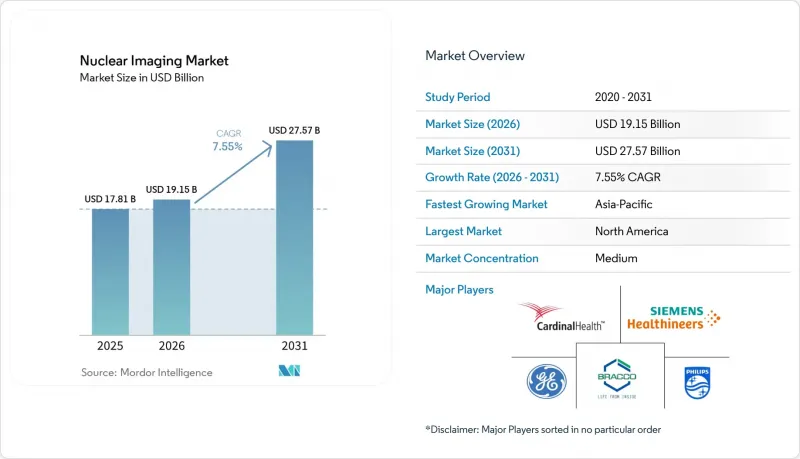
본 보고서는 제품별(PET 스캐너·SPECT 스캐너), 용도별(SPECT·ET 용도), 최종 사용자별(병원, 영상진단센터, 학술기관 및 연구기관), 지역별(북미, 유럽, 아시아태평양, 중동 및 아프리카 등)로 분류되어 있습니다. 시장 전망은 금액(달러) 기준으로 제시되어 있습니다.
세계의 핵의학 영상 시장 동향 및 인사이트
암 및 심혈관 질환의 발병률 증가
세계 종양학 및 순환기학 분야의 환자 수는 꾸준히 증가하고 있으며, 이는 진단용 영상 진단 및 치료용 방사성 의약품 모두에 대해 지속적인 수요를 창출하고 있습니다. Lu-177 PSMA-617의 FDA 승인으로 인해 2024년 9개월 동안 10억 4,000만 달러의 매출을 기록하며, 정밀 종양학의 상업적 규모가 입증되었습니다. 한편, 순환기 분야에서는 기존의 SPECT 관류 스캔보다 뛰어난 감도를 발휘하며, 운동 부하 검사 프로토콜을 가능하게 하는 풀피리다즈 F-18이 기여하고 있습니다. 신흥국들이 3차 의료기관에 핵의학 영상 부서를 도입함에 따라, 검사 건수 증가세가 성숙 시장을 넘어 확산되고 있습니다. 두 질환 분야에 동일한 방사성 동위원소 인프라가 활용되므로, 검사 건수 증가는 영업 레버리지 효과를 창출하여 공급업체의 수익성을 강화합니다. 평균 수명의 지속적인 연장과 생활 습관에 기인한 위험 요인 증가는 예측 기간 동안 검사 건수가 높은 수준을 유지할 것임을 시사합니다.
하이브리드 PET/CT 및 SPECT/CT 시스템의 급속한 보급
하이브리드 이미징은 단일 검사에서 기능성 추적자 데이터와 고해상도의 해부학적 세부 정보를 통합하여 병변 식별 정확도를 높이는 동시에 위음성률을 낮춥니다. 2024년 PET 검사 건수는 전년 대비 12.2% 증가했으며, PET/CT 시스템 1대당 평균 스캔 횟수는 8.2% 증가했습니다. 이는 도입 대수의 확대와 가동률 향상이라는 두 가지 측면을 모두 보여줍니다. 차세대 전신 PET 플랫폼은 촬영 시간을 1분 미만으로 단축하고, 추적자 투여량을 줄이는 동시에 환자 처리 능력을 향상시킵니다. SPECT/CT는 카드뮴·아연·텔루르화물 결정 덕분에 검출기 효율이 향상되어, 약제 비용을 절감하는 저방사능 프로토콜을 지원합니다. 재구성 소프트웨어에 내장된 AI 엔진은 장기 분할 및 감쇠 보정을 자동화하여, 기술자가 부가가치가 더 높은 업무에 전념할 수 있도록 합니다. 따라서 병원 측은 플랫폼 업그레이드를 진단 정확도 향상과 투자 회수 기간 단축을 위한 방안으로 보고 있으며, 이로 인해 장비 교체 주기가 빨라지고 있습니다.
불안정한 Mo-99 및 기타 동위원소공급망
2024년 10월, 유럽의 페텐 및 마리아 원자로에서 유지보수 작업이 지연됨에 따라 Mo-99공급량이 최대 100% 감소했습니다. 이로 인해 의료기관들은 검사를 연기하고, 발생 장치의 가동을 제한할 수밖에 없게 되었습니다. 미국 의회 청문회에서는 수입 테크네튬에 대한 의존이 계속되고 있다는 점을 감안할 때, 미국 역시 유사한 공급 차질의 영향을 받기 쉬운 상태에 놓여 있다고 경고했습니다. 가속기를 이용한 생산 시범 사업은 유망한 것으로 평가되고 있지만, 현재로서는 다큐리급 원자로 생산량을 대체할 수는 없습니다. 이러한 공급의 취약성은 조달 비용을 상승시키고, 검사 일정 조정을 복잡하게 만들며, 단기적인 핵의학 영상 시장의 성장을 제약하고 있습니다.
부문별 분석
2025년 기준으로 SPECT는 핵의학 영상 시장의 55.78%를 차지했습니다. PET 시장은 2031년까지 연평균 성장률(CAGR) 8.03%를 나타낼 것으로 전망됩니다. 장비 판매는 하이브리드 장비로의 업그레이드 주기와 AI를 활용한 워크플로우 기능의 혜택을 누리고 있습니다. 시스템 가격이 고가인 전신 PET 플랫폼은 몇 분 이내에 눈에서 허벅지까지의 부위를 촬영할 수 있게 하여, 해당 부서의 처리 능력을 대폭 향상시킵니다. SPECT/CT는 검출기의 감도 향상으로 인해, 방사선 피폭량을 줄인 소아 및 신장 검사 프로토콜을 적용할 수 있게 되었습니다. PET/MRI는 도입 비용이 높고 통합이 복잡하기 때문에 신경종양학 연구 분야에서 틈새 분야로만 남아 있습니다. 병원에서는 추적자 공급을 확보하기 위해 사이클로트론 공동 구매가 증가하고 있으며, 장비, 동위원소 계약, 소프트웨어 유지보수에 걸쳐 자본 상환을 분산시키는 금융 패키지를 조합하고 있습니다. 이러한 추세들이 복합적으로 작용함에 따라, 하드웨어의 가치가 꾸준히 상승하고 있음에도 불구하고, 핵의학 영상 시장 규모는 방사성 동위원소 공급량 증가에 힘입어 성장하고 있습니다.
지역별 분석
2025년, 북미는 핵의학 영상 시장에서 41.85%의 점유율을 차지하며 시장을 주도했습니다. 이는 세계 최대 규모의 PET/CT 스캐너 도입 대수, 폭넓은 보험 적용, 그리고 FDA 승인을 받은 추적자의 풍부한 파이프라인에 힘입은 결과입니다. CMS(미국 의료보험서비스센터)가 2025년부터 방사성 의약품 지급 상한액(630달러 이상과)을 폐지함에 따라, 고가 의약품에 대한 주요 장벽이 제거되어 병원들이 종양학, 심장학, 감염병 영상 진단에 F-18, Ga-68, Cu-64 추적자를 도입하도록 뒷받침하고 있습니다. 또한 미국에는 여러 사이클로트론 집적지가 있으며, Mo-99 생산을 위한 새로운 가속기 시험도 진행되고 있어 수입 의존도를 낮추는 것을 목표로 하고 있습니다. 캐나다는 맥마스터 대학교와 TRIUMF 시설을 통해 특수 동위원소 생산에 기여하고 있지만, 초크 리버 원자로가 폐쇄된 후에도 국경을 넘어 공급되는 발생 장치에 계속 의존하고 있습니다.
유럽은 2위를 차지하고 있으며, 체계적으로 정비된 의료 시스템과 동위원소 인프라에 대한 지속적인 공공 투자의 균형을 유지하고 있습니다. 22억 유로 규모의 파라스 원자로 프로젝트는 장기적인 테크네튬 공급을 확보하고, 치료용 동위원소의 다양화를 지원합니다. 프랑스는 오라노 메드(Orano Med)사의 트륨-228 공장을 통해 알파선 치료제 생산의 최전선에 서 있으며, 2034년 이후에는 연간 10만 회 분량의 납-212를 공급할 전망입니다. 영국 의약품 및 의료기기 규제청(MHRA)이 테크네튬-PSMA 제품을 최초로 승인한 것은 규제 측면에서의 유연성을 보여주는 동시에, PET가 주류를 이루는 경계를 넘어 추적자 혁신을 확대하려는 의지를 반영하고 있습니다. 그러나 원자로의 정기 가동 중단 및 국가별 상환 요금의 차이로 인해 EU 내에서는 시장 상황에 편차가 발생하고 있습니다.
아시아태평양은 충족되지 않은 진단 수요의 규모, 암 유병률의 상승, 그리고 동위원소 자급자족을 위한 정부의 적극적인 지원에 힘입어, 2031년까지 연평균 성장률(CAGR) 9.05%를 기록하며 지역별 가장 빠른 성장세를 보이고 있습니다. 중국에는 약 1,200개의 핵의학 영상 부서가 운영 중이며, 의료용 동위원소 개발 계획에 따라 2035년까지 서비스 제공 능력을 두 배로 늘리는 것을 목표로 하고 있습니다. 일본은 GE 헬스케어의 일본 메디피직스 인수를 계기로, 첨단 장비 기술과 확대되는 방사성 의약품 수출 플랫폼을 융합하고 있습니다. 인도와 한국은 급증하는 PET 활동과 의료 관광 수요를 뒷받침하기 위해 사이클로트론 도입을 우선시하고 있습니다. 호주는 ANSTO의 OPAL 원자로를 통해 Mo-99 공급에 대한 이중화 체계를 확보하고 있습니다. 이 지역 전체적으로 볼 때, 규제 조화를 위한 노력과 인재 양성 노력이 급속한 장비 도입 속도를 따라잡기 위해 노력하고 있으며, 이를 통해 아시아태평양을 핵의학 영상 시장의 차기 수요 동력으로 자리매김하고 있습니다.
기타 혜택 :
- 엑셀 형식 시장 예측(ME) 시트
- 3개월간의 애널리스트 지원
자주 묻는 질문
목차
제1장 서론
제2장 분석 방법
제3장 주요 요약
제4장 시장 구도
제5장 시장 규모 및 성장률 예측
제6장 경쟁 구도
제7장 시장 기회 및 향후 전망
KTH 26.06.22According to Mordor Intelligence, the nuclear imaging market size is expected to increase from USD 17.81 billion in 2025 to USD 19.15 billion in 2026 and reach USD 27.57 billion by 2031, growing at a CAGR of 7.55% over 2026-2031.
This report is Segmented by Product (PET Scanners and SPECT Scanners), Application (SPECT and PET Applications), End User (Hospitals, Diagnostic Imaging Centres, Academic & Research Institutes), and Geography (North America, Europe, Asia-Pacific, Middle East and Africa, and More). The Market Forecasts are Provided in Terms of Value (USD).
Global Nuclear Imaging Market Trends and Insights
Rising Cancer and Cardiovascular Disease Incidence
Global oncology and cardiology case loads continue to climb, creating durable demand for both diagnostic imaging and therapeutic radiopharmaceuticals. FDA approval of Lu-177 PSMA-617 generated USD 1.04 billion in nine-month 2024 sales, validating precision oncology's commercial scale. Cardiology meanwhile benefits from flurpiridaz F-18, which delivers superior sensitivity over legacy SPECT perfusion scans and enables exercise-stress protocols. Procedure growth spreads beyond mature markets as emerging economies integrate nuclear imaging units into tertiary hospitals. Because the same radioisotope infrastructure serves both disease areas, volume expansion produces operating-leverage benefits that reinforce supplier profitability. Ongoing increases in life expectancy and lifestyle-driven risk factors point to sustained high procedure counts through the forecast horizon.
Rapid Adoption of Hybrid PET/CT and SPECT/CT Systems
Hybrid imaging unites functional tracer data with high-resolution anatomical detail in a single exam, improving lesion localization while lowering false-negative rates. PET procedure volumes jumped 12.2% year-on-year in 2024 and average scans per PET/CT system rose 8.2%, signaling both installed-base expansion and higher utilization. Next-generation total-body PET platforms shorten acquisition times to under one minute, cutting tracer dose and boosting patient throughput. SPECT/CT gains detector efficiency from cadmium-zinc-telluride crystals, supporting low-activity protocols that lower pharmacy costs. AI engines embedded in reconstruction software automate organ segmentation and attenuation correction, freeing technologists for higher-value tasks. Hospitals thus view platform upgrades as a route to superior diagnostic accuracy and faster return on capital, accelerating the replacement cycle.
Fragile Mo-99 and Other Isotope Supply Chains
October 2024 maintenance delays at Europe's Petten and Maria reactors cut Mo-99 deliveries by up to 100%, forcing clinics to postpone scans and ration generator activity. U.S. congressional hearings warned the nation remains vulnerable to similar disruptions, given its continuing reliance on imported technetium. While accelerator-based production pilots show promise, they cannot yet replace multi-curie reactor output. Such supply fragility raises procurement costs and complicates scan scheduling, constraining near-term nuclear imaging market growth.
Other drivers and restraints analyzed in the detailed report include:
- Regulatory Approvals of Novel PSMA- and FAPI-Based Tracers
- Government Investments in Isotope-Production Reactors
- High Capital Cost and Patchy Reimbursement
For complete list of drivers and restraints, kindly check the Table Of Contents.
Segment Analysis
SPECT captured 55.78% of the nuclear imaging market share in 2025; PET are forecast to expand at an 8.03% CAGR through 2031. Equipment sales benefit from hybrid upgrade cycles and AI-driven workflow features. Total-body PET platforms, priced at the system premium, enable eyes-to-thigh coverage within minutes, significantly raising department capacity. SPECT/CT gains detector sensitivity improvements that permit pediatric and renal protocols with reduced radiation burden. PET/MRI remains a niche for neuro-oncology research owing to high acquisition costs and integration complexity. Hospitals increasingly co-purchase cyclotrons to secure tracer supply, bundling financing packages that spread capital repayment across equipment, isotope contracts, and software maintenance. Together, these dynamics keep the nuclear imaging market size anchored by radioisotope volume growth even as hardware values advance steadily.
Geography Analysis
North America led the nuclear imaging market with 41.85% share in 2025, supported by the world's largest fleet of PET/CT scanners, robust payor coverage, and a deep pipeline of FDA-cleared tracers. CMS's 2025 radiopharmaceutical payment carve-out above USD 630 removes a key deterrent to high-cost agents, encouraging hospitals to adopt F-18, Ga-68, and Cu-64 tracers for oncology, cardiology, and infection imaging. The U.S. also houses multiple cyclotron clusters and emerging accelerator production trials for Mo-99, aiming to reduce import dependence. Canada contributes specialized isotope production through the McMaster and TRIUMF facilities yet continues to rely on cross-border generator flows after the Chalk River reactor retirement.
Europe ranks second, balancing coordinated health systems with sustained public investment in isotope infrastructure. The EUR 2.2 billion Pallas reactor project secures long-term technetium supply and supports therapeutic isotope diversification. France positions itself at the forefront of alpha-therapy manufacturing via Orano Med's thorium-228 plant, projected to supply 100,000 lead-212 doses annually post-2034. Regulatory agility is on display with U.K. MHRA approval of the first technetium-PSMA product, illustrating a willingness to extend tracer innovation beyond PET-dominant pathways. However, periodic reactor outages and varying national reimbursement tariffs produce patchwork market conditions across the bloc.
Asia-Pacific delivers the fastest regional growth at a 9.05% CAGR through 2031, spurred by large unmet diagnostic needs, rising oncology prevalence, and aggressive government backing for isotope self-sufficiency. China operates nearly 1,200 nuclear imaging departments and aims to double service capacity by 2035 under its medical-isotope development blueprint. Japan blends advanced device engineering with a growing radiopharmaceutical export platform, bolstered by GE HealthCare's takeover of Nihon Medi-Physics. India and South Korea prioritize cyclotron deployments to support burgeoning PET activity and medical-tourism demand. Australia builds redundancy into Mo-99 supply through the ANSTO OPAL reactor. Across the region, regulatory harmonization efforts and workforce-training initiatives seek to keep pace with rapid equipment installation, shaping Asia-Pacific into the next demand engine for the nuclear imaging market.
List of Companies Covered in this Report:
- GE HealthCare Technologies Inc.
- Siemens Healthineers
- Koninklijke Philips
- Canon
- United Imaging Healthcare Co., Ltd.
- Cardinal Health
- Curium Pharma
- Bracco Imaging S.p.A.
- Bayer
- Novartis
- Lantheus
- BWX Technologies Inc. (Nordion)
- Eckert & Ziegler SE
- Jubilant Pharmova Ltd.
- Telix Pharmaceuticals Ltd.
- Clarity Pharmaceuticals Ltd.
- Spectrum Dynamics Medical Inc.
- MiE Medical Imaging Electronics GmbH
- Digirad Corp.
- SOFIE Biosciences Inc.
- Isotope Technologies Garching GmbH
- NTP Radioisotopes
- CMR Naviscan
Additional Benefits:
- The market estimate (ME) sheet in Excel format
- 3 months of analyst support
TABLE OF CONTENTS
1 Introduction
- 1.1 Study Assumptions & Market Definition
- 1.2 Scope of the Study
2 Research Methodology
3 Executive Summary
4 Market Landscape
- 4.1 Market Overview
- 4.2 Market Drivers
- 4.2.1 Rising cancer & CVD incidence
- 4.2.2 Rapid adoption of hybrid PET/CT & SPECT/CT systems
- 4.2.3 Regulatory approvals of novel PSMA- & FAPI-based tracers
- 4.2.4 Government investments in isotope-production reactors
- 4.2.5 Decentralized hospital cyclotrons
- 4.2.6 AI-driven dose- and workflow optimisation
- 4.3 Market Restraints
- 4.3.1 Fragile Mo-99 and other isotope supply chains
- 4.3.2 High capital cost & patchy reimbursement
- 4.3.3 Shortage of certified nuclear-imaging technologists
- 4.3.4 Slow regulatory path for alpha-emitting therapeutics
- 4.4 Value / Supply-Chain Analysis
- 4.5 Regulatory Landscape
- 4.6 Technological Outlook
- 4.7 Porter's Five Forces
- 4.7.1 Threat of New Entrants
- 4.7.2 Bargaining Power of Suppliers
- 4.7.3 Bargaining Power of Buyers
- 4.7.4 Threat of Substitutes
- 4.7.5 Competitive Rivalry
5 Market Size & Growth Forecasts (Value in USD)
- 5.1 By Product
- 5.1.1 Equipment
- 5.1.1.1 PET Scanners
- 5.1.1.2 SPECT Scanners
- 5.1.1 Equipment
- 5.2 By Application
- 5.2.1 SPECT Applications
- 5.2.1.1 Cardiology
- 5.2.1.2 Neurology
- 5.2.1.3 Thyroid
- 5.2.1.4 Other SPECT Applications
- 5.2.2 PET Applications
- 5.2.2.1 Oncology
- 5.2.2.2 Cardiology
- 5.2.2.3 Neurology
- 5.2.2.4 Other PET Applications
- 5.2.1 SPECT Applications
- 5.3 By End User
- 5.3.1 Hospitals
- 5.3.2 Diagnostic Imaging Centres
- 5.3.3 Academic & Research Institutes
- 5.4 By Geography
- 5.4.1 North America
- 5.4.1.1 United States
- 5.4.1.2 Canada
- 5.4.1.3 Mexico
- 5.4.2 Europe
- 5.4.2.1 Germany
- 5.4.2.2 United Kingdom
- 5.4.2.3 France
- 5.4.2.4 Italy
- 5.4.2.5 Spain
- 5.4.2.6 Rest of Europe
- 5.4.3 Asia-Pacific
- 5.4.3.1 China
- 5.4.3.2 India
- 5.4.3.3 Japan
- 5.4.3.4 South Korea
- 5.4.3.5 Australia
- 5.4.3.6 Rest of Asia-Pacific
- 5.4.4 South America
- 5.4.4.1 Brazil
- 5.4.4.2 Argentina
- 5.4.4.3 Rest of South America
- 5.4.5 Middle East and Africa
- 5.4.5.1 GCC
- 5.4.5.2 South Africa
- 5.4.5.3 Rest of Middle East and Africa
- 5.4.1 North America
6 Competitive Landscape
- 6.1 Market Concentration
- 6.2 Market Share Analysis
- 6.3 Company Profiles (includes Global-level Overview, Market-level Overview, Core Segments, Financials as available, Strategic Information, Market Rank/Share for key companies, Products & Services, Recent Developments)
- 6.3.1 GE HealthCare Technologies Inc.
- 6.3.2 Siemens Healthineers AG
- 6.3.3 Koninklijke Philips N.V.
- 6.3.4 Canon Medical Systems Corp.
- 6.3.5 United Imaging Healthcare Co., Ltd.
- 6.3.6 Cardinal Health Inc.
- 6.3.7 Curium Pharma
- 6.3.8 Bracco Imaging S.p.A.
- 6.3.9 Bayer AG
- 6.3.10 Novartis AG (Advanced Accelerator Applications)
- 6.3.11 Lantheus Holdings Inc.
- 6.3.12 BWX Technologies Inc. (Nordion)
- 6.3.13 Eckert & Ziegler SE
- 6.3.14 Jubilant Pharmova Ltd.
- 6.3.15 Telix Pharmaceuticals Ltd.
- 6.3.16 Clarity Pharmaceuticals Ltd.
- 6.3.17 Spectrum Dynamics Medical Inc.
- 6.3.18 MiE Medical Imaging Electronics GmbH
- 6.3.19 Digirad Corp.
- 6.3.20 SOFIE Biosciences Inc.
- 6.3.21 Isotope Technologies Garching GmbH
- 6.3.22 NTP Radioisotopes SOC
- 6.3.23 CMR Naviscan (Gamma Medica Inc.)
7 Market Opportunities & Future Outlook
- 7.1 White-space & Unmet-Need Assessment


