|
시장보고서
상품코드
2061519
북미의 절제 기술 : 시장 점유율 분석, 업계 동향 및 통계, 성장 예측(2026-2031년)North America Ablation Technologies - Market Share Analysis, Industry Trends & Statistics, Growth Forecasts (2026 - 2031) |
||||||
 Mordor Intelligence
Mordor Intelligence에 의하면, 북미의 절제 기술 시장 규모는 2025년 36억 5,000만 달러로 평가되었습니다. 2026년에는 40억 1,000만 달러로 확대되어 2031년까지 66억 3,000만 달러에 이를 것으로 예측됩니다. 2026년부터 2031년에 걸쳐 CAGR은 10.58%를 나타낼 전망입니다.
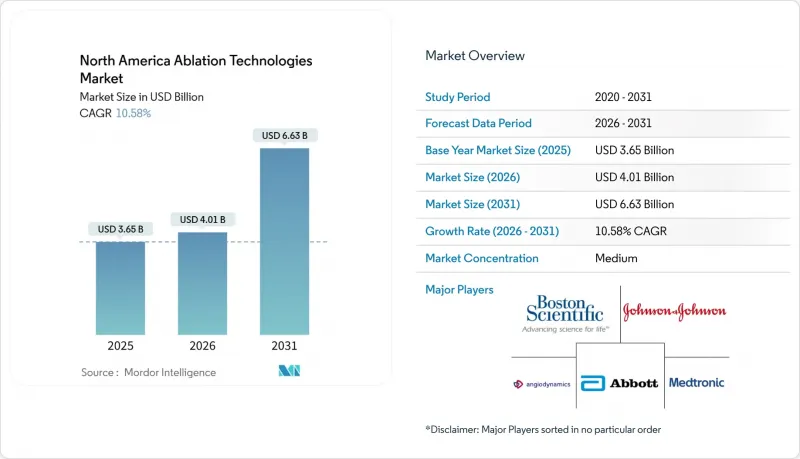
본 보고서는 기술별(고주파 절제술, 마이크로파 절제술, 냉동 절제술, 레이저 절제술, HIFU 및 히스토트리프시), 용도별(종양학, 심장학, 통증 관리, 산부인과, 기타 용도), 최종 사용자별(병원, 외래수술센터(ASC), 전문 클리닉), 국가별(미국, 캐나다, 멕시코)로 분류되어 있습니다. 시장 전망은 금액(달러) 기준으로 제시되어 있습니다.
북미의 절제 기술 시장 동향 및 인사이트
암 및 심장 질환 유병률 증가
암 발병률과 심방세동의 유병률이 모두 증가하고 있으며, 이에 따라 절제술에 대한 수요도 함께 높아지고 있습니다. 미국암협회는 2026년 미국에서 200만 건의 신규 암 진단이 있을 것으로 전망하고 있으며, 한편 심방세동은 670만 명의 성인에게 영향을 미치고 있어 2019년 대비 33% 증가했습니다. 고주파를 이용한 간 종양 절제술 후 5년 전체 생존율은 3cm 미만의 간세포암에서 75.3%에 달하여, 외과적 수술이 적합하지 않은 환자에게 있어 절제술의 근치적 잠재력이 입증되었습니다. 75세 이상 인구의 18%가 종양성 질환과 심장 질환을 모두 앓고 있는 만큼, 합병증이 적은 절제술은 허약한 환자에게 있어 첫 번째 선택 치료법으로 자리 잡고 있습니다.
저침습 의료에 대한 수요 증가
환자들은 당일 퇴원과 빠른 회복을 바라고 있습니다. PFA는 시술 시간을 30% 단축하고, 하나의 검사실에서 하루 5건의 사례를 처리할 수 있게 함으로써 병원에 연간 약 22만 달러의 추가 수익을 창출합니다. 경피적 마이크로파 폐 절제술 후, 고령자는 3일 이내에 일상생활로 복귀할 수 있지만, 외과적 쐐기형 절제술 후에는 21일이 소요됩니다. 이러한 효율성과 삶의 질 향상은 북미의 절제술 기술 시장 내 수요 증가의 주요 요인으로 작용하고 있습니다.
막대한 설비 투자 및 소모품 비용
발전기의 가격은 3만-300만 달러, 일회용 카테터는 3,000-8,000달러입니다. 병상 200개 규모의 병원에서 연간 150건의 심장 절제술을 시행할 경우, 연간 최대 120만 달러의 소모품 비용이 발생하며, 손익분기점에 도달하려면 180건 이상의 시술이 필요합니다. 캐나다의 지방 의료시설과 멕시코의 공립 병원에서는 예산 상한선이 더욱 엄격해져 장비 구입이 주춤하고 있습니다.
부문별 분석
고주파 절제술은 2025년 매출의 42.78%를 차지했으나, PFA가 심장 절제술 시장 점유율을 잠식하고 있으며, HIFU와 히스토트리프시(histotripsy)의 결합은 2031년까지 연평균 성장률(CAGR) 14.06%를 나타낼 것으로 전망됩니다. PFA는 식도 손상을 방지하고 당일 퇴원을 가능하게 할 뿐만 아니라, 모니터링 비용을 절감합니다. 마이크로파 절제술은 3cm를 초과하는 종양의 경우, 시술 시간을 30% 단축하고 절제 범위를 확대함으로써 고주파 절제술보다 뛰어난 성능을 발휘합니다. 한편, 냉동 절제술은 소형 신장 종양에서 97.1%의 국소 통제율을 달성하고 있습니다.
지역 병원에서는 기존의 고주파 콘솔이 교체되고 있으며, 미국 전기생리학 검사실의 40%가 2027년까지 PFA로 전환할 계획입니다. 존슨앤드존슨의 VARIPULSE는 CARTO 매핑 시스템과의 폐쇄형 루프 통합 기능을 갖추고 있어 고객 유지율을 높이고 있습니다. PFA 카테터의 평균 판매 가격은 7,000달러로, 열치료용 기기보다 60% 비싸지만, NTAP(국가 열치료 지원 프로그램)의 보조금 덕분에 투자 회수 기간이 단축되어 북미 절제 기술 시장의 기술 전환을 촉진하고 있습니다.
기타 혜택 :
- 엑셀 형식 시장 예측(ME) 시트
- 3개월간의 애널리스트 지원
자주 묻는 질문
목차
제1장 서론
제2장 조사 방법
제3장 주요 요약
제4장 시장 구도
제5장 시장 규모 및 성장 예측
제6장 경쟁 구도
제7장 시장 기회 및 향후 전망
KTH 26.06.19According to Mordor Intelligence, the north america ablation technologies market size is expected to increase from USD 3.65 billion in 2025 to USD 4.01 billion in 2026 and reach USD 6.63 billion by 2031, growing at a CAGR of 10.58% over 2026-2031.
This report is Segmented by Technology (Radiofrequency Ablation, Microwave Ablation, Cryoablation, Laser Ablation, HIFU & Histotripsy), Application (Oncology, Cardiology, Pain Management, Gynecology, Other Applications), End User (Hospitals, Ambulatory Surgery Centers, Specialty Clinics), and Country (United States, Canada, Mexico). The Market Forecasts are Provided in Terms of Value (USD).
North America Ablation Technologies Market Trends and Insights
Rising Cancer & Cardiac Disease Prevalence
Cancer incidence and atrial fibrillation prevalence are climbing together, generating parallel demand for ablative therapies. The American Cancer Society projects 2 million new U.S. cancer diagnoses in 2026, while atrial fibrillation affects 6.7 million adults, up 33% from 2019. Five-year overall survival after microwave liver-tumor ablation reached 75.3% for hepatocellular carcinoma <3 cm, proving ablation's curative potential in non-surgical candidates. Because 18% of people aged >= 75 carry both oncologic and cardiac diagnoses, low-morbidity ablation is becoming the treatment of choice in frail patients.
Growing Demand for Minimally-Invasive Care
Patients favor same-day discharge and quick recovery. PFA shortens procedure time by 30%, allowing five cases per lab per day and adding roughly USD 220,000 incremental yearly revenue for hospitals. After percutaneous microwave lung ablation, seniors resume normal activity within 3 days, compared with 21 days after surgical wedge resection. These efficiency and quality-of-life gains are key demand accelerants for the North America ablation technologies market.
High Capital & Disposable Costs
Generators cost USD 30,000-3 million; single-use catheters run USD 3,000-8,000. A 200-bed hospital performing 150 cardiac ablations accrues up to USD 1.2 million in annual disposables, requiring 180+ cases to break even. Rural Canadian facilities and Mexican public hospitals face even tougher budget ceilings, stalling equipment purchases.
Other drivers and restraints analyzed in the detailed report include:
- Advances in Image-Guided & Robotic Systems
- Favorable U.S. CMS Reimbursement Policies
- Stringent FDA Regulatory Pathway
For complete list of drivers and restraints, kindly check the Table Of Contents.
Segment Analysis
Radiofrequency ablation retained 42.78% of 2025 revenue, but PFA is siphoning cardiac volume, and HIFU plus histotripsy are set to post 14.06% CAGR through 2031. PFA eliminates esophageal damage, enabling same-day discharge and lowering monitoring costs. Microwave ablation outperforms radiofrequency for tumors >3 cm by shortening procedure time by 30% and expanding ablation zones, while cryoablation achieves 97.1% local control in small renal masses.
Across community hospitals, legacy radiofrequency consoles are being replaced, and 40% of U.S. electrophysiology labs plan to convert to PFA by 2027. Johnson & Johnson's VARIPULSE adds closed-loop integration with the CARTO mapping system, cementing customer stickiness. PFA catheter ASPs average USD 7,000, 60% above thermal tools, but NTAP subsidies shrink payback periods, underpinning technology migration in the North America ablation technologies market.
List of Companies Covered in this Report:
- Abbott Laboratories
- Accuray
- AngioDynamics
- AtriCure
- Avanos Medical
- BIOTRONIK
- Boston Scientific
- CardioFocus Inc.
- CONMED Corp.
- Hologic
- Insightec Ltd.
- Integra LifeSciences
- Johnson & Johnson
- Medtronic
- Merit Medical Systems
- Olympus Corp.
- Koninklijke Philips
- Smiths Group
- Stryker
- Varian Medical Systems (Siemens Health.)
Additional Benefits:
- The market estimate (ME) sheet in Excel format
- 3 months of analyst support
TABLE OF CONTENTS
1 Introduction
- 1.1 Study Assumptions & Market Definition
- 1.2 Scope of the Study
2 Research Methodology
3 Executive Summary
4 Market Landscape
- 4.1 Market Overview
- 4.2 Market Drivers
- 4.2.1 Rising Cancer & Cardiac Disease Prevalence
- 4.2.2 Growing Demand for Minimally-Invasive Procedures
- 4.2.3 Advances in Image-Guided & Robotic Ablation Systems
- 4.2.4 Favorable U.S. CMS Reimbursement Policies
- 4.2.5 Geriatric Demographic Expansion
- 4.2.6 ASC-Led Microwave System Adoption
- 4.3 Market Restraints
- 4.3.1 High Capital & Disposable Costs
- 4.3.2 Stringent FDA Regulatory Pathway
- 4.3.3 Shortage of Electrophysiologists & IR Operators
- 4.3.4 Reimbursement Uncertainty for Emerging Histotripsy
- 4.4 Regulatory Landscape
- 4.5 Technological Outlook
- 4.6 Porter's Five Forces Analysis
- 4.6.1 Threat of New Entrants
- 4.6.2 Bargaining Power of Buyers
- 4.6.3 Bargaining Power of Suppliers
- 4.6.4 Threat of Substitute Products
- 4.6.5 Intensity of Competitive Rivalry
5 Market Size & Growth Forecasts
- 5.1 By Technology
- 5.1.1 Radiofrequency Ablation
- 5.1.2 Microwave Ablation
- 5.1.3 Cryoablation
- 5.1.4 Laser Ablation
- 5.1.5 HIFU & Histotripsy
- 5.2 By Application
- 5.2.1 Oncology
- 5.2.2 Cardiology
- 5.2.3 Pain Management
- 5.2.4 Gynecology
- 5.2.5 Other Applications
- 5.3 By End User
- 5.3.1 Hospitals
- 5.3.2 Ambulatory Surgery Centers
- 5.3.3 Specialty Clinics
- 5.4 By Country
- 5.4.1 United States
- 5.4.2 Canada
- 5.4.3 Mexico
6 Competitive Landscape
- 6.1 Market Concentration
- 6.2 Market Share Analysis
- 6.3 Company Profiles (includes Global Level Overview, Market Level Overview, Core Segments, Financials as Available, Strategic Information, Market Rank/Share for Key Companies, Products & Services, and Recent Developments)
- 6.3.1 Abbott Laboratories
- 6.3.2 Accuray Inc.
- 6.3.3 AngioDynamics Inc.
- 6.3.4 AtriCure Inc.
- 6.3.5 Avanos Medical Inc.
- 6.3.6 Biotronik SE & Co. KG
- 6.3.7 Boston Scientific Corporation
- 6.3.8 CardioFocus Inc.
- 6.3.9 CONMED Corp.
- 6.3.10 Hologic Inc.
- 6.3.11 Insightec Ltd.
- 6.3.12 Integra LifeSciences
- 6.3.13 Johnson and Johnson (Biosense Webster, Inc)
- 6.3.14 Medtronic
- 6.3.15 Merit Medical Systems
- 6.3.16 Olympus Corp.
- 6.3.17 Philips Healthcare
- 6.3.18 Smith & Nephew plc
- 6.3.19 Stryker Corp.
- 6.3.20 Varian Medical Systems (Siemens Health.)
7 Market Opportunities & Future Outlook
- 7.1 White-space & Unmet-Need Assessment