|
시장보고서
상품코드
2061524
인도의 사료 첨가물 : 시장 점유율 분석, 업계 동향 및 통계, 성장 예측(2026-2031년)India Feed Additives - Market Share Analysis, Industry Trends & Statistics, Growth Forecasts (2026 - 2031) |
||||||
 Mordor Intelligence
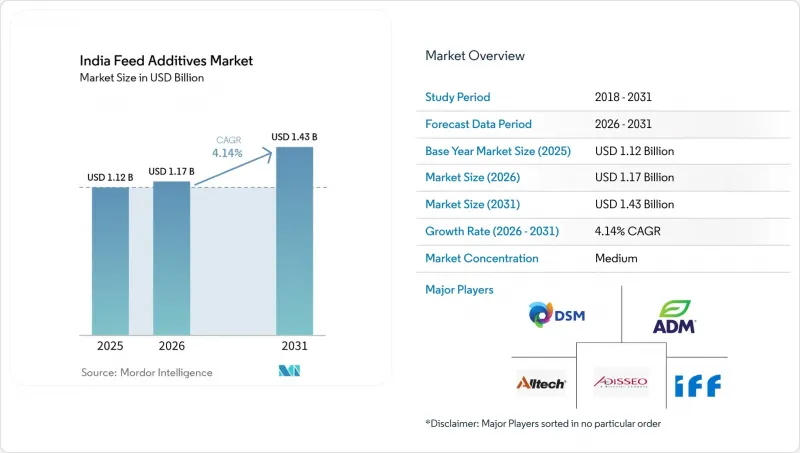
Mordor Intelligence에 의하면, 2026년 인도의 사료 첨가물 시장 규모는 11억 7,000만 달러에 달할 것으로 추정됩니다. 2025년 11억 2,000만 달러에서 성장하여 2031년에는 14억 3,000만 달러에 이를 것으로 예측됩니다.
2026년부터 2031년까지 연평균 성장률(CAGR) 4.14%를 나타낼 것으로 전망됩니다.
본 보고서는 첨가물(산미료, 아미노산, 항생제, 항산화제, 결합제, 효소, 향료·감미료, 미네랄, 미코톡신 해독제, 식물성 성분, 착색료, 프리바이오틱스, 프로바이오틱스, 비타민, 효모) 및 대상 동물(수산물 양식, 가금류, 반추동물, 돼지, 기타 동물)별로 분류되어 있습니다. 시장 전망은 금액(달러) 및 수량(톤) 단위로 제시되어 있습니다.
인도의 사료 첨가물 시장 동향과 인사이트
가금류 생산량 증가
2024년, 상업용 육계 및 산란계 농장에서는 450만 톤 이상의 닭고기와 1,400억 개 이상의 달걀이 생산되었습니다. 통합률은 80%를 넘어섰으며, 효소, 아미노산, 유기산에 기반한 통일된 영양 프로토콜이 확립되었습니다. 주요 통합 기업들은 성과 보너스를 사료 요구율과 연계했기 때문에 영양사들은 측정 가능한 성과를 가져온다는 것이 입증된 솔루션을 적극적으로 도입하고 있습니다. 표준화된 사육 시설과 자동 급이기를 통해 열안정성이 뛰어난 식물 유래 성분 및 차세대 피타제의 배합 비율을 정확하게 관리할 수 있게 되었습니다. 초기 도입자들로부터 피타제와 프로바이오틱스를 병용함으로써 사료 효율이 4% 향상되었습니다는 보고가 있었으며, 이에 따라 프리미엄 기능성 첨가제에 대한 수요가 더욱 확고해지고 있습니다. 이러한 노력은 인도의 사료 첨가물 시장의 장기적인 성장 추세를 뒷받침하고 있습니다.
항생제 계열 성장 촉진제의 사용 금지
인도 식품안전기준청(FSSAI)은 2024년에 콜리스틴, 클로람페니콜, 니트로프란의 사용을 금지했습니다. 이러한 성장 촉진제를 배제함에 따라, 통합형 양계업자들은 항균제 잔류물 없이 장내 환경을 보호하는 프로바이오틱스, 프리바이오틱스, 효소 및 식물성 첨가제로 전환했습니다. 가금 통합형 양계업체가 개정된 잔류 기준치를 준수하기 위해 사료 배합을 재설계한 결과, 2025년 프로바이오틱스 매출은 전년 대비 23% 증가했습니다. 사료 배합 업체 역시 사료에 포함된 항생제를, 장내 pH를 낮춰 병원균을 억제하는 유기산으로 대체했습니다. 국제적인 공급업체는 이 전환기를 기회로 삼아, 최대 90℃의 펠릿화 온도를 견딜 수 있도록 설계된 내열성 바실러스균 포자를 출시했습니다. 금지 대상이 더 많은 화합물로 확대됨에 따라, 인도의 사료 첨가물 시장에서는 천연 유래의 성능 향상제가 점점 더 많은 지지를 받게 될 것입니다.
원자재 가격 변동
2025년 초, 에탄올 생산으로 용도가 전환됨에 따라 옥수수 가격은 1 퀸탈당 2,425 루피(1톤당 293 달러)까지 상승한 반면, 대두박은 1톤당 5만 2,000루피(1톤당 630달러) 수준을 유지했습니다. 사료는 가금류 생산 비용의 65%를 차지하기 때문에 가격의 급등은 즉시 이익률을 압박합니다. 이에 대해 사료 제조업체는 60일 분량의 재고를 확보하는 한편, 비전분 다당류를 분해하는 효소를 재조제하여 옥수수 배합 비율을 3-5포인트 줄였습니다. 그러나 환율 변동과 운임 급등으로 인해 가격 책정에는 여전히 불확실성이 남아 있습니다. 소규모 낙농 및 양돈 농가에서는 우선 첨가물 예산을 삭감했기 때문에 인도의 사료 첨가물 시장의 총 판매량이 일시적으로 부진했습니다.
부문별 분석
2025년 기준으로, 아미노산은 인도의 사료 첨가물 시장에서 19.05%의 점유율을 유지했습니다. 한편, 항산화제는 규모는 작지만 원료 가격 변동으로 인해 사료의 보관 기간이 길어지면서 산화 위험이 높아지고 있어, 연평균 성장률(CAGR) 4.65%로 가장 빠르게 성장하고 있습니다. 또한, 사료 배합 업체들이 이익률 개선을 위해 단백질 함량을 미세 조정하고 있기 때문에 2031년까지 연평균 성장률(CAGR) 3.74%로 증가할 것으로 예측됩니다. 이 부문은 2025년 인도의 사료 첨가물 시장 규모에서 2억 1,340만 달러를 차지했으며, 국내 라이신 및 메티오닌 생산 능력 확대를 촉진하는 ‘생산 연계형 인센티브(PLI) 제도’의 혜택을 받았습니다. 현지에서 발효 과정을 거침으로써 운송 비용의 추가 부담을 줄일 수 있고, 중국으로부터공급 리스크도 완화되므로, 통합형 기업은 안정적인 가격으로 계약을 체결할 수 있게 되었습니다. 트립토판의 사용량은 2023년 이후 두 배로 증가했으며, 이는 스트레스 완화를 목적으로 한 특수 산란계용 배합 사료에 트립토판이 포함된 것을 반영한 것입니다. 효소 제품군은 섬유질 함량이 높은 지역 특유의 사료에 맞추어 조정된 자일라나아제 및 프로테아제를 통해 지속적으로 다양화되고 있습니다. 프로바이오틱스와 피토제닉스의 도입 현황은 콜드체인 접근 여부에 따라 편차가 나타나고 있지만, 내열성 바실러스균의 포자와 강황 유래 에센셜 오일은 시장 평균을 상회하는 성장세를 보이고 있습니다. BIS의 품질 기준에 따라 소규모 블렌딩 업체들이 시장에서 철수함에 따라, ISO 인증을 획득한 프리믹스 생산 라인을 운영하는 DSM-Firmenich나 Trouw Nutrition과 같은 확고한 입지를 가진 브랜드로 시장 점유율이 집중되고 있습니다.
비타민 및 미네랄 프리믹스에 대한 수요는 가축의 유형에 관계없이 안정적입니다. 옥수수 운송 중 발생한 아플라톡신 오염 사건으로 인해 낙농협동조합의 인식이 높아진 것을 계기로, 미코톡신 해독제 수요가 확대되고 있습니다. 면역 조절제로 사용되는 효모 세포벽 유래 성분은 항생제의 대체재로 가금용 스타터 사료에 점차 도입되고 있습니다. 전반적으로 이러한 동향은 과학적으로 입증된 제품과 탄탄한 현지 유통망을 갖춘 사료 첨가물 공급업체의 꾸준한 성장을 뒷받침하고 있으며, 인도의 사료 첨가물 시장의 수익 성장세를 더욱 강화하고 있습니다.
기타 혜택 :
- 엑셀 형식 시장 예측(ME) 시트
- 3개월간의 애널리스트 지원
자주 묻는 질문
목차
제1장 서론
제2장 개 보고서의 내용
제3장 주요 요약 및 주요 조사 결과
제4장 주요 업계 동향
제5장 시장 규모 및 성장 예측
제6장 경쟁 구도
제7장 CEO에 대한 주요 전략적 질문
KTH 26.06.22According to Mordor Intelligence, india feed additives market size in 2026 is estimated at USD 1.17 billion, growing from 2025 value of USD 1.12 billion with 2031 projections showing USD 1.43 billion, growing at 4.14% CAGR over 2026-2031.
This report is Segmented by Additive (Acidifiers, Amino Acids, Antibiotics, Antioxidants, Binders, Enzymes, Flavors and Sweeteners, Minerals, Mycotoxin Detoxifiers, Phytogenics, Pigments, Prebiotics, Probiotics, Vitamins, and Yeast), Animal (Aquaculture, Poultry, Ruminant, Swine, and Other Animals). The Market Forecasts are Provided in Terms of Value (USD) and Volume (Metric Tons).
India Feed Additives Market Trends and Insights
Rising Industrial Poultry Production
Commercial broiler and layer farms produced more than 4.5 million tons of chicken meat and over 140 billion eggs in 2024. Integration levels crossed 80%, creating uniform nutritional protocols that rely on enzymes, amino acids, and organic acids. Major integrators linked performance bonuses to feed conversion ratios, so nutritionists aggressively adopt solutions demonstrated to deliver a measurable return. Standardized housing and automated feeders enable precise inclusion rates for heat-stable phytogenics and next-generation phytases. Early adopters report a 4% improvement in feed efficiency when phytase is combined with probiotics, further entrenching demand for premium functional additives. These practices reinforce the long-term expansion path of the India feed additives market.
Ban on Antibiotic Growth Promoters
The Food Safety and Standards Authority of India banned colistin, chloramphenicol, and nitrofurans in 2024. Eliminating these growth promoters pushed integrators toward probiotics, prebiotics, enzymes, and phytogenics that safeguard gut health without antimicrobial residues. Probiotic sales rose 23% year over year in 2025 as poultry integrators reformulated rations to comply with updated maximum-residue thresholds. Feed compounders also replaced in-feed antibiotics with organic acids that lower gut pH and suppress pathogens. International suppliers capitalized on this inflection by launching heat-stable Bacillus spores engineered to survive pelleting temperatures up to 90 °C. As the ban expands to cover additional molecules, the India feed additives market will increasingly favor natural performance enhancers.
Raw-Material Price Volatility
Maize prices climbed to INR 2,425 per quintal (USD 293 per metric ton) in early 2025 due to ethanol diversion, while soybean meal hovered at INR 52,000 per ton (USD 630 per metric ton). Feed accounts for 65% of poultry production cost, so any spike immediately erodes margins. Feed mills responded by stockpiling 60-day inventory and reformulating with enzymes that unlock non-starch polysaccharides, reducing corn inclusion by 3-5 percentage points. However, currency swings and freight charges still feed uncertainty into pricing. Small dairy and swine farms cut additive budgets first, temporarily damping overall volumes in the India feed additives market.
Other drivers and restraints analyzed in the detailed report include:
- Growing Aquaculture Output and Export Incentives
- Expansion of Integrated Feed Mills
- Cold-Chain Gaps Restraining Probiotic Viability
For complete list of drivers and restraints, kindly check the Table Of Contents.
Segment Analysis
Amino acids retained a 19.05% share of the India feed additives market in 2025, while antioxidants, though smaller, are growing fastest at a 4.65% CAGR because volatile ingredient prices lengthen feed storage cycles and raise rancidity risk. are forecast to rise at a 3.74% CAGR through 2031 as feed formulators fine-tune protein levels for margin relief. The category commanded USD 213.4 million of the India feed additives market size in 2025 and benefits from the Production Linked Incentive scheme that encourages domestic lysine and methionine capacity. Local fermentation reduces freight premiums and mitigates Chinese supply risk, allowing integrators to lock in contracts at steady prices. Tryptophan usage doubled since 2023, reflecting adoption in specialty layer rations aimed at stress reduction. Enzyme portfolios continue to diversify with xylanases and proteases tailored to high-fiber regional diets. Probiotics and phytogenics see variable uptake depending on cold chain access, but heat-stable Bacillus spores and turmeric-derived essential oils post above-market growth. BIS quality mandates are pushing out sub-scale blenders and consolidating share toward established brands, including DSM-Firmenich and Trouw Nutrition, which both operate ISO-certified premix lines.
Demand for vitamin and mineral premixes remains stable across livestock species. Mycotoxin detoxifiers are gaining traction after aflatoxin outbreaks in maize shipments heightened awareness in dairy cooperatives. Yeast cell-wall derivatives used as immune modulators are entering poultry starter diets as antibiotic replacements. Collectively, these trends underpin steady gains for additive suppliers that offer scientifically validated products and robust local distribution, reinforcing revenue momentum in the India feed additives market.
List of Companies Covered in this Report:
- Adisseo
- Archer Daniel Midland Co.
- BASF SE
- Alltech, Inc.
- Cargill Inc.
- DSM Nutritional Products AG
- Solvay S.A.
- IFF(Danisco Animal Nutrition)
- Kerry Group Plc
- SHV (Nutreco NV)
- Evonik Industries AG
- Elanco Animal Health Inc.
- Novus International, Inc.
Additional Benefits:
- The market estimate (ME) sheet in Excel format
- 3 months of analyst support
TABLE OF CONTENTS
1 INTRODUCTION
- 1.1 Study Assumptions & Market Definition
- 1.2 Scope of the Study
- 1.3 Research Methodology
2 REPORT OFFERS
3 EXECUTIVE SUMMARY & KEY FINDINGS
4 KEY INDUSTRY TRENDS
- 4.1 Animal Headcount
- 4.1.1 Poultry
- 4.1.2 Ruminants
- 4.1.3 Swine
- 4.2 Feed Production
- 4.2.1 Aquaculture
- 4.2.2 Poultry
- 4.2.3 Ruminants
- 4.2.4 Swine
- 4.3 Regulatory Framework
- 4.3.1 India
- 4.4 Value Chain & Distribution Channel Analysis
- 4.5 Market Drivers
- 4.5.1 Rising Industrial Poultry Production Drives Feed Additive Uptake
- 4.5.2 Antibiotic Growth-Promoter Ban Reshapes Additive Mix
- 4.5.3 Aquaculture Incentives Spur Specialty Additives
- 4.5.4 Integrated Feed Mill Expansion Boosts Distribution Efficiency
- 4.5.5 PLI scheme lowering domestic amino-acid costs
- 4.5.6 Precision livestock farming enabling micro-dosing
- 4.6 Market Restraints
- 4.6.1 Volatile Raw-Material Prices Inflate Production Costs
- 4.6.2 Lengthy and Complex Regulatory Approvals
- 4.6.3 Cold-chain gaps Restraining probiotic viability
- 4.6.4 Backyard desi poultry limiting additive uptake
5 MARKET SIZE AND GROWTH FORECASTS (VALUE AND VOLUME)
- 5.1 Additive
- 5.1.1 Acidifiers
- 5.1.1.1 By Sub Additive
- 5.1.1.1.1 Fumaric Acid
- 5.1.1.1.2 Lactic Acid
- 5.1.1.1.3 Propionic Acid
- 5.1.1.1.4 Other Acidifiers
- 5.1.1.1 By Sub Additive
- 5.1.2 Amino Acids
- 5.1.2.1 By Sub Additive
- 5.1.2.1.1 Lysine
- 5.1.2.1.2 Methionine
- 5.1.2.1.3 Threonine
- 5.1.2.1.4 Tryptophan
- 5.1.2.1.5 Other Amino Acids
- 5.1.2.1 By Sub Additive
- 5.1.3 Antibiotics
- 5.1.3.1 By Sub Additive
- 5.1.3.1.1 Bacitracin
- 5.1.3.1.2 Penicillins
- 5.1.3.1.3 Tetracyclines
- 5.1.3.1.4 Tylosin
- 5.1.3.1.5 Other Antibiotics
- 5.1.3.1 By Sub Additive
- 5.1.4 Antioxidants
- 5.1.4.1 By Sub Additive
- 5.1.4.1.1 Butylated Hydroxyanisole (BHA)
- 5.1.4.1.2 Butylated Hydroxytoluene (BHT)
- 5.1.4.1.3 Citric Acid
- 5.1.4.1.4 Ethoxyquin
- 5.1.4.1.5 Propyl Gallate
- 5.1.4.1.6 Tocopherols
- 5.1.4.1.7 Other Antioxidants
- 5.1.4.1 By Sub Additive
- 5.1.5 Binders
- 5.1.5.1 By Sub Additive
- 5.1.5.1.1 Natural Binders
- 5.1.5.1.2 Synthetic Binders
- 5.1.5.1 By Sub Additive
- 5.1.6 Enzymes
- 5.1.6.1 By Sub Additive
- 5.1.6.1.1 Carbohydrases
- 5.1.6.1.2 Phytases
- 5.1.6.1.3 Other Enzymes
- 5.1.6.1 By Sub Additive
- 5.1.7 Flavors & Sweeteners
- 5.1.7.1 By Sub Additive
- 5.1.7.1.1 Flavors
- 5.1.7.1.2 Sweeteners
- 5.1.7.1 By Sub Additive
- 5.1.8 Minerals
- 5.1.8.1 By Sub Additive
- 5.1.8.1.1 Macrominerals
- 5.1.8.1.2 Microminerals
- 5.1.8.1 By Sub Additive
- 5.1.9 Mycotoxin Detoxifiers
- 5.1.9.1 By Sub Additive
- 5.1.9.1.1 Binders
- 5.1.9.1.2 Biotransformers
- 5.1.9.1 By Sub Additive
- 5.1.10 Phytogenics
- 5.1.10.1 By Sub Additive
- 5.1.10.1.1 Essential Oil
- 5.1.10.1.2 Herbs & Spices
- 5.1.10.1.3 Other Phytogenics
- 5.1.10.1 By Sub Additive
- 5.1.11 Pigments
- 5.1.11.1 By Sub Additive
- 5.1.11.1.1 Carotenoids
- 5.1.11.1.2 Curcumin & Spirulina
- 5.1.11.1 By Sub Additive
- 5.1.12 Prebiotics
- 5.1.12.1 By Sub Additive
- 5.1.12.1.1 Fructo Oligosaccharides
- 5.1.12.1.2 Galacto Oligosaccharides
- 5.1.12.1.3 Inulin
- 5.1.12.1.4 Lactulose
- 5.1.12.1.5 Mannan Oligosaccharides
- 5.1.12.1.6 Xylo Oligosaccharides
- 5.1.12.1.7 Other Prebiotics
- 5.1.12.1 By Sub Additive
- 5.1.13 Probiotics
- 5.1.13.1 By Sub Additive
- 5.1.13.1.1 Bifidobacteria
- 5.1.13.1.2 Enterococcus
- 5.1.13.1.3 Lactobacilli
- 5.1.13.1.4 Pediococcus
- 5.1.13.1.5 Streptococcus
- 5.1.13.1.6 Other Probiotics
- 5.1.13.1 By Sub Additive
- 5.1.14 Vitamins
- 5.1.14.1 By Sub Additive
- 5.1.14.1.1 Vitamin A
- 5.1.14.1.2 Vitamin B
- 5.1.14.1.3 Vitamin C
- 5.1.14.1.4 Vitamin E
- 5.1.14.1.5 Other Vitamins
- 5.1.14.1 By Sub Additive
- 5.1.15 Yeast
- 5.1.15.1 By Sub Additive
- 5.1.15.1.1 Live Yeast
- 5.1.15.1.2 Selenium Yeast
- 5.1.15.1.3 Spent Yeast
- 5.1.15.1.4 Torula Dried Yeast
- 5.1.15.1.5 Whey Yeast
- 5.1.15.1.6 Yeast Derivatives
- 5.1.15.1 By Sub Additive
- 5.1.1 Acidifiers
- 5.2 By Animal
- 5.2.1 Aquaculture
- 5.2.1.1 By Sub Animal
- 5.2.1.1.1 Fish
- 5.2.1.1.2 Shrimp
- 5.2.1.1.3 Other Aquaculture Species
- 5.2.1.1 By Sub Animal
- 5.2.2 Poultry
- 5.2.2.1 By Sub Animal
- 5.2.2.1.1 Broiler
- 5.2.2.1.2 Layer
- 5.2.2.1.3 Other Poultry Birds
- 5.2.2.1 By Sub Animal
- 5.2.3 Ruminants
- 5.2.3.1 By Sub Animal
- 5.2.3.1.1 Beef Cattle
- 5.2.3.1.2 Dairy Cattle
- 5.2.3.1.3 Other Ruminants
- 5.2.3.1 By Sub Animal
- 5.2.4 Swine
- 5.2.5 Other Animals
- 5.2.1 Aquaculture
6 COMPETITIVE LANDSCAPE
- 6.1 Key Strategic Moves
- 6.2 Market Share Analysis
- 6.3 Company Landscape
- 6.4 Company Profiles (includes Global Level Overview, Market Level Overview, Core Business Segments, Financials, Headcount, Key Information, Market Rank, Market Share, Products and Services, and Analysis of Recent Developments)
- 6.4.1 Adisseo
- 6.4.2 Archer Daniel Midland Co.
- 6.4.3 BASF SE
- 6.4.4 Alltech, Inc.
- 6.4.5 Cargill Inc.
- 6.4.6 DSM Nutritional Products AG
- 6.4.7 Solvay S.A.
- 6.4.8 IFF(Danisco Animal Nutrition)
- 6.4.9 Kerry Group Plc
- 6.4.10 SHV (Nutreco NV)
- 6.4.11 Evonik Industries AG
- 6.4.12 Elanco Animal Health Inc.
- 6.4.13 Novus International, Inc.