
|
시장보고서
상품코드
2061525
인도의 환자 모니터링 시장 : 시장 점유율 분석, 업계 동향 및 통계, 성장 예측(2026-2031년)India Patient Monitoring - Market Share Analysis, Industry Trends & Statistics, Growth Forecasts (2026 - 2031) |
||||||
 Mordor Intelligence
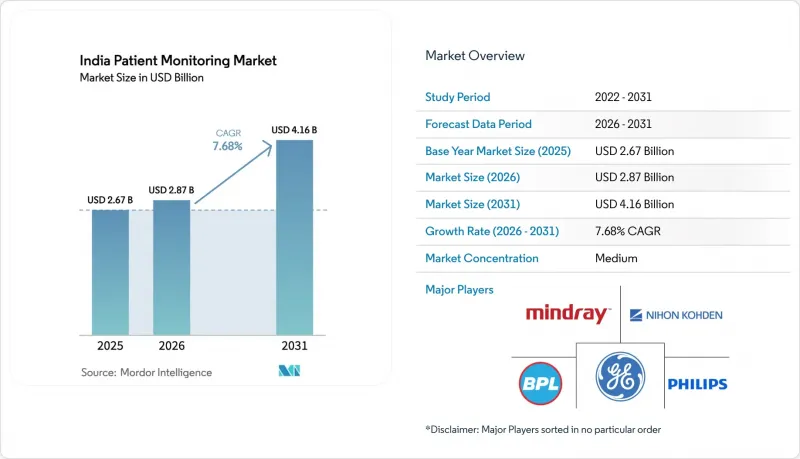
인도의 환자 모니터링 시장 규모는 2025년 26억 7,000만 달러로 평가되었고, 2026년에는 28억 7,000만 달러로 추정되고, 2031년까지 41억 6,000만 달러에 이를 것으로 예측되며, 2026-2031년 CAGR 7.68%로 성장할 전망입니다.
본 보고서는 유형별(기기, 서비스), 최종 사용자별(공립 3차 병원, 민간 기업 병원, 전문 및 단일 전문 클리닉, 재택 치료 사업자, 외래수술센터(ASC)), 용도별(순환기, 호흡기, 신경, 중환자실(ICU/CCU), 당뇨병 및 대사, 산부인과 및 신생아)로 분류되어 있습니다. 시장 전망은 금액(달러) 기준으로 제시되어 있습니다.
인도의 환자 모니터링 시장 동향 및 인사이트
증가하는 만성 질환의 부담
인도에서 당뇨병 및 고혈압 유병률이 증가함에 따라, 일시적인 치료에서 가정이나 병원을 통한 지속적인 모니터링으로 전환되고 있습니다. 1억 명 이상의 성인이 당뇨병을 앓고 있으며, 수많은 고혈압 환자가 충분한 치료를 받지 못하는 상황이 지속되고 있어, 이로 인해 가정용 혈압계와 센서를 활용한 혈당 모니터링에 대한 수요가 증가하고 있습니다. 심혈관 질환은 국내 사망 원인 중 큰 비중을 차지하고 있으며, 이에 따라 3차 의료기관들은 수동 회진을 넘어선 모니터링이 가능한 다기능 모니터로 교체하는 작업을 진행하고 있습니다. 민간 병원에서는 심전도, 맥박 산소 포화도 측정기, 체중계를 대시보드에 통합한 커넥티드 침대를 도입하여 의료진이 조기에 개입할 수 있도록 지원하고 있습니다. 퇴원 후 심장병이나 당뇨병 관리 과정에서 부정맥이나 혈당 수치 이상을 실시간으로 감지하기 위해 원격 환자 모니터링 키트에 대한 의존도가 높아지고 있습니다. 이러한 추세는 도시 및 도시 주변 지역 주민들의 만성 질환이 심화됨에 따라, 인도의 환자 모니터링 시장을 뒷받침하는 '상시 모니터링' 접근 방식을 강화하고 있습니다.
원격의료 프로그램 및 보험급여 시범사업의 확대
'아유슈만 바라트 디지털 미션'은 전국적으로 디지털 신분증 및 동의 획득 절차를 구축하고 있으며, 여러 주에서는 공적 보험을 통한 RPM(원격 환자 모니터링) 비용 보상을 시범적으로 시행하고 있습니다. 카르나타카주, 텔랑가나주, 마하라슈트라주에서는 기기에서 전송된 생체 신호와 연동된 온라인 진료에 대해 보험 급여를 지급하는 시범 사업을 전개하고 있으며, 2024년 이전에는 존재하지 않았던 자금 조달 경로를 확립하고 있습니다. 국가보건청은 1차 진료 클리닉을 대상으로 블루투스 지원 혈압계 및 혈당 측정기를 포함한 만성 질환 관리에 대한 종합적 지급 방안을 검토하고 있습니다. 의료기기 통합 플랫폼 기업들은 치료 순응도와 지속성을 높이기 위해 구독형 RPM 패키지를 제공합니다. 주마다 요금 체계는 다르지만, 새로운 지불 모델은 보다 광범위한 일상적 모니터링의 길을 열어줄 것이며, 중기적으로는 인도의 환자 모니터링 시장을 활성화시킬 것입니다.
전자기기 및 부품 분야의 높은 수입 의존도와 환율 변동 위험
정책적 지원이 있음에도 불구하고, 대부분의 모니터는 여전히 수입된 반도체, 센서 모듈, 디스플레이에 의존하고 있으며, 이로 인해 환율 변동 및 공급 리스크에 대한 노출이 커지고 있습니다. 2025년에 1달러당 83루피 전후가 된 것으로 평가되었으며, 주요 부품의 수입 비용이 상승하여 헤지나 장기 가격 확보가 어려운 중소 제조업체의 이익률이 압박을 받게 될 것입니다. 특수한 아날로그 프런트엔드나 고해상도 TFT 부품은 여전히 동아시아 공급망에 집중되어 있어, 국내 제조업체들은 외부 공급업체에 의존할 수밖에 없는 실정입니다. 최저가를 우선시하는 공공 조달로 인해, 특히 가격 변동을 흡수할 만한 규모를 갖추지 못한 공급업체의 경우 비용 상승분을 전가하기가 어려워지고 있습니다. 국내 반도체 생산 능력 확대 계획은 순조롭게 진행되고 있지만, 환자 모니터링용 업스트림 공급을 안정화하기 위해서는 상업적 규모의 생산이 본격화되기까지 시간이 걸릴 것입니다.
부문별 분석
2025년에는 기기가 매출의 84.92%를 차지한 것으로 평가되었으며, 서비스 부문은 2031년까지 연평균 성장률(CAGR) 9.21%로 확대될 전망으로, 운영 관리 및 분석 분야로의 전환이 두드러지고 있습니다. 다중 생체 신호 모니터는 여전히 중환자실(ICU)과 수술실에서 주력 제품으로 자리 잡고 있으며, 교체 주기에서는 연결성과 통합 경보 관리 기능이 중요하게 여겨지고 있습니다. 홀터 심전도 및 이벤트 레코더를 포함한 심장 모니터링은 신속한 분석에 기반한 외래 부정맥 검사 분야에서 도시 지역의 순환기 전문의들 사이에서 점차 확대되고 있습니다. 맥박 산소 포화도 측정기, 이산화탄소 포화도 측정기, 폐활량계 등의 호흡기 관련 기기는 COPD나 천식으로 인한 부담이 여전히 존재하고, 수술 전후 안전에 대한 중요성이 강조됨에 따라 높은 사용률을 유지하고 있습니다. 미야지 산과 센터에서는 태아 및 신생아 모니터링이 지속적으로 확대되고 있는 한편, 2급 도시의 신생아 중환자실 수용 능력 증대에 따라 도입 대수도 증가하고 있습니다. 외상 및 중환자 치료 분야에서는 신경 모니터링 및 혈역학 센서가 점차 보급되고 있으며, 임상 등급의 소비자용 웨어러블 기기가 의료 서비스와 융합되는 가운데, 웨어러블 패치와 비접촉식 센서가 가장 빠르게 성장하고 있는 폼 팩터로 부상하고 있습니다.
병원들이 현장 인력을 증원하지 않고도 지속적인 모니터링을 추구하며, 의료 서비스 제공업체들이 상호 운용성, 분석, 가동 시간을 우선시함에 따라 이 서비스 시장 점유율이 확대되고 있습니다. 원격 모니터링 및 원격 의료 서비스는 기기 사용 및 임상의의 검토를 회원 1인당 지불액에 반영한 보상 시범 사업의 혜택을 받고 있습니다. 데이터 통합 및 상호운용성 서비스는 기기의 프로토콜과 ABDM 준수 데이터 교환 시스템, 그리고 병원의 HIMS(병원 정보 관리 시스템)를 연동하는 데 필수적이며, 이를 위해서는 맞춤형 미들웨어 개발이 필요합니다. 간호사나 호흡기 치료사가 담당하는 관리형 모니터링 업무에서는 거점 간에 경보의 우선순위를 정하여 대응 시간을 단축하고 업무 흐름을 표준화하고 있습니다. 훈련 서비스의 보급률은 여전히 낮은 수준이며, 경보 관리 및 아티팩트 인식을 위한 체계적인 프로그램을 도입함으로써 오경보를 줄이고, 인도 환자 모니터링 업계 전반에 걸쳐 현장 직원의 자신감을 높일 수 있을 것입니다.
기타 혜택 :
- 엑셀 형식 시장 예측(ME) 시트
- 3개월간의 애널리스트 지원
자주 묻는 질문
목차
제1장 서론
제2장 조사 방법
제3장 주요 요약
제4장 시장 구도
제5장 시장 규모 및 성장 예측
제6장 경쟁 구도
제7장 시장 기회 및 향후 전망
AJY 26.06.22According to Mordor Intelligence, the india patient monitoring market size is expected to increase from USD 2.67 billion in 2025 to USD 2.87 billion in 2026 and reach USD 4.16 billion by 2031, growing at a CAGR of 7.68% over 2026-2031.
This report is Segmented by Type (Devices, Services), End-User (Public Tertiary Hospitals, Private Corporate Hospitals, Specialty & Single-Specialty Clinics, Home-Healthcare Providers, Ambulatory Surgical Centers), and Application (Cardiology, Respiratory, Neurology, Critical Care (ICU/CCU), Diabetes & Metabolic, Maternal & Neonatal). The Market Forecasts are Provided in Terms of Value (USD).
India Patient Monitoring Market Trends and Insights
Rising Chronic Disease Burden
India's diabetes and hypertension prevalence is shifting episodic care toward continuous monitoring at home and in hospitals. Over 100 million adults live with diabetes and a very large hypertensive population remains undertreated, which sustains demand for home BP monitors and sensor-based glucose tracking. Cardiovascular disease contributes a significant share of national mortality, prompting tertiary hospitals to upgrade with multiparameter monitors that extend surveillance beyond manual rounds. Private corporate hospitals are deploying connected beds that integrate ECG, pulse oximetry, and scales into dashboards that help teams intervene earlier. Post-discharge cardiology and diabetes pathways increasingly rely on remote patient monitoring kits to flag arrhythmias and glucose excursions in real time. These patterns reinforce an always-on approach that supports the India patient monitoring market as chronic conditions intensify in urban and peri-urban populations.
Expansion of Telehealth Programs and Reimbursement Pilots
The Ayushman Bharat Digital Mission has created digital identities and consent rails at national scale, and several states are piloting RPM reimbursement under public insurance. Karnataka, Telangana, and Maharashtra operate pilots that reimburse virtual visits linked to device-submitted vitals, creating a funding path that did not exist before 2024. The National Health Authority is evaluating bundled chronic-care payments that include Bluetooth-enabled BP cuffs and glucometers for primary-care clinics. Platform companies integrating devices with teleconsultation workflows are offering subscription RPM packages to improve adherence and continuity of care. Although state-by-state fee schedules differ, new payment models are paving the way for wider routine monitoring and boosting the India patient monitoring market over the medium term.
High Import Dependency and Forex Volatility for Electronics/Components
Despite policy support, most monitors still depend on imported semiconductors, sensor modules, and displays, which raises exposure to currency swings and supply risk. The rupee near INR 83 per USD in 2025 raises landed costs of critical components and narrows margins for smaller manufacturers that cannot hedge or secure long-term pricing. Specialty analog front-ends and high-resolution TFT components remain concentrated in East Asian supply chains, keeping domestic makers reliant on external suppliers. Public procurement that prioritizes lowest price complicates pass-through of cost increases, especially for vendors lacking scale to absorb volatility. Plans for local semiconductor capacity are advancing, yet commercial-scale output will take time to stabilize upstream supply for patient monitoring.
Other drivers and restraints analyzed in the detailed report include:
- Government PLI and Med-Tech Clusters Accelerate Local Manufacturing
- Shift to Hospital-At-Home, Virtual ICUs, and Connected Beds in Private Chains
- Fragmented State Procurement and Tendering Complexity
For complete list of drivers and restraints, kindly check the Table Of Contents.
Segment Analysis
Devices captured 84.92% of revenue in 2025, and services are expanding at 9.21% CAGR through 2031, underscoring a shift toward managed operations and analytics. Multiparameter vital-signs monitors remain the workhorse across ICUs and operating rooms, with replacement cycles favoring connectivity and centralized alarm management. Cardiac monitoring, including Holter and event recorders, is expanding among urban cardiologists for outpatient arrhythmia workups supported by rapid interpretation. Respiratory devices such as pulse oximeters, capnographs, and spirometers maintain elevated use given persistent COPD and asthma burdens and the emphasis on perioperative safety. Fetal and neonatal monitoring continues to build in tertiary maternity centers while neonatal ICU capacity in tier-2 cities increases the installed base. Neuro-monitoring and hemodynamic sensors gain traction in trauma and critical care, while wearable patches and contactless sensors are the fastest-growing form factors as clinical-grade consumer wearables converge with care delivery.
Services are gaining share as hospitals pursue continuous oversight without expanding onsite headcount, and as providers prioritize interoperability, analytics, and uptime. Remote monitoring and telehealth services benefit from reimbursement pilots that package devices and clinician review into per-member payments. Data-integration and interoperability services are critical for bridging device protocols with ABDM-aligned exchanges and hospital HIMS, which requires custom middleware development. Managed-monitoring operations staffed by nurses and respiratory therapists triage alarms across sites to improve response times and standardize workflows. Training services remain underpenetrated, and structured programs for alarm management and artifact recognition could reduce false alerts and improve frontline confidence across the India patient monitoring industry.
List of Companies Covered in this Report:
- Abbott Laboratories
- Baxter International Inc. (Hillrom/Welch Allyn)
- Beckton Dickinson
- BPL
- Dexcom
- Dozee (TurtleShell Technologies)
- Dragerwerk
- Edward Lifesciences
- F. Hoffmann La Roche AG
- GE HealthCare Technologies Inc.
- HealthCube India
- ICU Medical
- Koninklijke Philips
- LifeSigns (Re'bu Health)
- Masimo
- Medtronic
- Mindray Bio Medical Electronics Co., Ltd.
- Nihon Kohden
- Omron Healthcare Co., Ltd. (India)
- Schiller
- Siemens Healthineers
- Skanray Technologies Ltd.
- Spacelabs Healthcare (OSI Systems)
- Stasis Health
- Ten3T Healthcare Pvt. Ltd.
- Tracky (DrStore Healthcare)
Additional Benefits:
- The market estimate (ME) sheet in Excel format
- 3 months of analyst support
TABLE OF CONTENTS
1 Introduction
- 1.1 Study Assumptions & Market Definition
- 1.2 Scope of the Study
2 Research Methodology
3 Executive Summary
4 Market Landscape
- 4.1 Market Overview
- 4.2 Market Drivers
- 4.2.1 Rising Chronic Disease Burden
- 4.2.2 Expansion of Telehealth Programs and Reimbursement Pilots
- 4.2.3 Government PLI And Med-Tech Clusters Accelerate Local Manufacturing
- 4.2.4 Shift to Hospital-At-Home, Virtual ICUs, and Connected Beds in Private Chains
- 4.2.5 Growing Adoption of AI-Powered Analytics in Monitoring Workflows
- 4.2.6 Rapid Penetration of Low-Cost Wearables/India-First Sensors Enabling RPM at Scale
- 4.3 Market Restraints
- 4.3.1 High Import Dependency and Forex Volatility For Electronics/Components
- 4.3.2 Fragmented State Procurement and Tendering Complexity
- 4.3.3 Low Physician Adoption of Home BP/RPM Protocols in Primary Care
- 4.3.4 Data-Privacy and Device-EHR/HIMS Integration Gaps vs ABDM Consent Rails
- 4.4 Value / Supply-Chain Analysis
- 4.5 Regulatory Landscape
- 4.6 Technological Outlook
- 4.7 Porter's Five Forces
- 4.7.1 Bargaining Power of Suppliers
- 4.7.2 Bargaining Power of Buyers
- 4.7.3 Threat of New Entrants
- 4.7.4 Threat of Substitutes
- 4.7.5 Competitive Rivalry
5 Market Size & Growth Forecasts (Value, in USD)
- 5.1 By Type
- 5.1.1 Device Type
- 5.1.1.1 Multiparameter Vital-Signs Monitors
- 5.1.1.2 Cardiac Monitoring Devices
- 5.1.1.3 Respiratory Monitoring Devices
- 5.1.1.4 Fetal & Neonatal Monitoring Devices
- 5.1.1.5 Neuro-Monitoring Devices
- 5.1.1.6 Hemodynamic & Pressure Monitoring Devices
- 5.1.1.7 Remote Patient Monitoring Kits
- 5.1.1.8 Wearable Sensors & Patches
- 5.1.2 By Service/Offering
- 5.1.2.1 Installation & Maintenance Services
- 5.1.2.2 Training & Education Services
- 5.1.2.3 Remote Monitoring & Telehealth Services
- 5.1.2.4 Data Integration & Interoperability Services
- 5.1.2.5 Analytics & Reporting Services
- 5.1.2.6 Managed Monitoring Operations & Triage Services
- 5.1.1 Device Type
- 5.2 By End-User
- 5.2.1 Public Tertiary Hospitals
- 5.2.2 Private Corporate Hospitals
- 5.2.3 Specialty & Single-Specialty Clinics
- 5.2.4 Home-Healthcare Providers
- 5.2.5 Ambulatory Surgical Centers
- 5.3 By Application
- 5.3.1 Cardiology
- 5.3.2 Respiratory
- 5.3.3 Neurology
- 5.3.4 Critical Care (ICU/CCU)
- 5.3.5 Diabetes & Metabolic
- 5.3.6 Maternal & Neonatal
6 Competitive Landscape
- 6.1 Market Concentration
- 6.2 Market Share Analysis
- 6.3 Company Profiles (includes Global level Overview, Market level overview, Core Segments, Financials as available, Strategic Information, Market Rank/Share for key companies, Products & Services, and Recent Developments)
- 6.3.1 Abbott Laboratories
- 6.3.2 Baxter International Inc. (Hillrom/Welch Allyn)
- 6.3.3 BeatO
- 6.3.4 BPL Medical Technologies
- 6.3.5 Dexcom, Inc.
- 6.3.6 Dozee (TurtleShell Technologies)
- 6.3.7 Dragerwerk AG & Co. KGaA
- 6.3.8 Edwards Lifesciences
- 6.3.9 F. Hoffmann La Roche AG
- 6.3.10 GE HealthCare Technologies Inc.
- 6.3.11 HealthCube India
- 6.3.12 ICU Medical Inc.
- 6.3.13 Koninklijke Philips N.V.
- 6.3.14 LifeSigns (Re'bu Health)
- 6.3.15 Masimo Corporation
- 6.3.16 Medtronic plc
- 6.3.17 Mindray Bio Medical Electronics Co., Ltd.
- 6.3.18 Nihon Kohden Corporation
- 6.3.19 Omron Healthcare Co., Ltd. (India)
- 6.3.20 Schiller AG
- 6.3.21 Siemens Healthineers AG
- 6.3.22 Skanray Technologies Ltd.
- 6.3.23 Spacelabs Healthcare (OSI Systems)
- 6.3.24 Stasis Health
- 6.3.25 Ten3T Healthcare Pvt. Ltd.
- 6.3.26 Tracky (DrStore Healthcare)
7 Market Opportunities & Future Outlook
- 7.1 White?space & Unmet?Need Assessment