

|
시장보고서
상품코드
2097375
환자 모니터링 기기 시장 : 시장 점유율 분석, 산업 동향 및 통계 데이터, 성장 예측(2026-2031년)Patient Monitoring Devices - Market Share Analysis, Industry Trends & Statistics, Growth Forecasts (2026 - 2031) |
||||||
 Mordor Intelligence
Mordor Intelligence에 의하면, 환자 모니터링 시스템 시장 규모는 2025년에 505억 3,000만 달러로 평가되었고, 2030년까지 775억 달러에 이를 것으로 예측됩니다.
이는 해당 기간 동안 연평균 성장률(CAGR)이 7.39%에 달할 전망임을 나타냅니다.
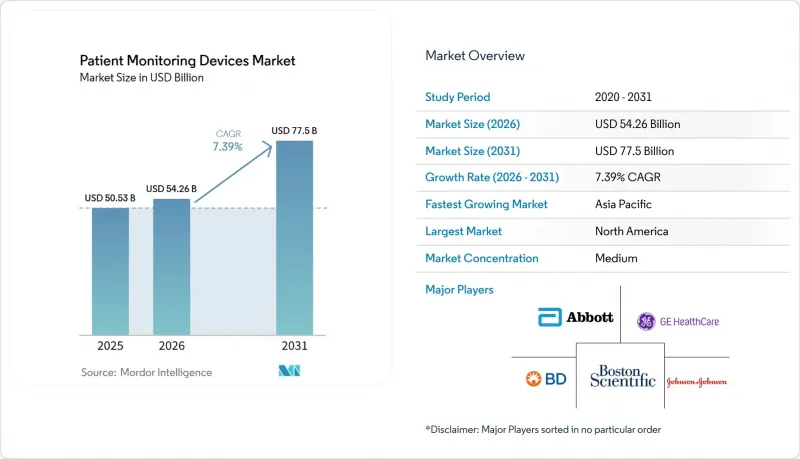
본 보고서에서는 시장을 기기 유형별(혈역학 모니터링 장치, 신경 모니터링 장치, 심장 모니터링 장치, 다중 항목 모니터 등), 용도별(순환기, 신경, 호흡기 등), 최종 사용자별(재택 치료, 병원 및 진료소 등), 지역별(북미 등)로 분류하고 있습니다.
세계의 환자 모니터링 기기 시장 동향 및 인사이트
고령화와 재택 치료로의 전환
장기적인 인구 동향의 변화로 인해 65세 이상 성인의 비율이 증가하고 있으며, 임상적 모니터링을 저해하지 않으면서 고령자가 자택에서 생활할 수 있는 시스템에 대한 수요가 지속되고 있습니다. 메이요 클리닉은 ‘Advanced Care at Home’ 이니셔티브를 통해 2,000명 이상의 환자를 치료하고 있으며, 연중무휴 24시간 모니터링을 통해 주거 환경에서도 병원 수준의 감시를 재현할 수 있음을 입증하고 있습니다. 현재, 사용하기 쉬운 인터페이스와 간소화된 장비 유지보수는 ‘가정 내 급성기 병원 치료(Acute Hospital Care at Home)’ 프로그램과 같은 메디케어 보상 체계와 결합되어 지속적인 성장을 위한 경제적 기반을 마련하고 있습니다. 이러한 변화에 따라 제조업체들은 센서의 정확도를 높이는 동시에, 고령 사용자가 스스로 기기를 관리할 수 있도록 설정의 복잡성을 줄여야 할 필요가 있습니다. 그 결과, 환자 모니터링 시스템 시장에서는 음성 가이드를 통한 초기 설정, 자동 소프트웨어 업데이트, 그리고 치료의 연속성을 보장하는 오류 방지 연결 기능에 대한 수요가 증가하고 있습니다.
증가하는 만성 질환의 부담
심혈관 질환, 당뇨병, 만성 호흡기 질환은 합쳐서 의료비의 90% 가까이를 차지하고 있으며, 이는 단발성 치료에 비해 지속적인 모니터링이 비용 면에서 우월함을 여실히 보여주고 있습니다. 프레더릭 헬스(Frederick Health)는 원격 환자 모니터링을 도입한 후 재입원율을 38% 감소시키는 데 성공하며, 정량화 가능한 비용 절감과 치료 성과 향상을 입증했습니다. AI가 탑재된 모니터는 병세의 조기 악화를 감지합니다. 이는 마시모(Masimo)가 UC헬스(UCHealth)와 제휴하여 가상 진료 네트워크 전반에 예측 분석을 적용한 사례에서도 확인할 수 있습니다. 연속 혈당 모니터와 자동 인슐린 펌프의 통합 역시 센싱과 치료가 폐쇄 루프 솔루션으로 융합되고 있음을 보여주며, 모니터링이 만성 질환 관리 과정에 더욱 깊이 통합되고 있습니다.
데이터 개인정보 보호 및 사이버 보안 취약점
연결된 기기는 공격 표면을 확대시킵니다. 이는 Contec 및 Epsimed사의 모니터에 무단 원격 조작을 가능하게 하는 취약점이 있다고 지적한 FDA의 안전성 관련 공지에도 반영되어 있습니다. '식품의약품 옴니버스 개혁법'에 따라 제조업체는 패치 적용 능력과 시판 후 조사 계획을 문서화해야 할 의무가 부과되어, 규정 준수 관련 지출이 증가하고 있습니다. 사이버 위험은 이미 랜섬웨어 문제에 직면해 있는 의료 서비스 제공업체들의 구매를 주저하게 만들고 있으며, 종단 간암호화 및 제로 트러스트 아키텍처를 제공하는 벤더에 대한 선호도를 높이고 있습니다.
부문 분석
2025년 매출의 34.78%를 다중 매개변수 생체 신호 모니터가 차지한 것으로 평가되었으며, 심전도(ECG), SpO2, 비침습적 혈압(NIBP), 체온 측정값을 통합된 대시보드에 집계하는 단일 콘솔에 대한 의료 기관 수요가 높다는 점이 부각되고 있습니다. 병원들이 분석 기능을 중첩할 수 있는 클라우드 지원 모델로 구형 장비를 교체함에 따라, 다중 매개변수형 환자 모니터링 시스템 시장 규모는 꾸준한 확장을 유지할 것으로 예측됩니다. 신경 모니터링 장비는 신경학적 사건을 더 조기에 감지하는 AI 강화형 뇌파(EEG) 및 뇌 산소 포화도 측정의 부양에 힘입어 2031년까지 7.65%라는 가장 높은 연평균 성장률(CAGR)을 보일 것으로 전망됩니다.
심전도 모니터, 호흡 모니터, 태아 및 신생아용 시스템은 여전히 중요한 역할을 담당하고 있지만, 단독 장치로 작동하기보다는 모듈형 플랫폼 내에서 통합되는 경향이 강해지고 있습니다. BD사의 ‘HemoSphere Alta’ 출시에서 볼 수 있듯이, 첨단 혈역학 모듈은 현재 저혈압 발생 몇 분 전에 예측을 수행하는 알고리즘을 통한 동향 분석과 결합되어 있습니다. 이러한 통합을 통해 경보 피로를 최소화하고 간호 업무의 워크플로우를 간소화할 수 있기 때문에 병원들은 단일 목적의 도구보다 설정 가능한 매개변수 세트를 제공하는 공급업체를 선호하는 추세입니다. 그 결과, 환자 모니터링 시스템 시장은 플랫폼 기반의 조달 전략으로 계속 전환되고 있습니다.
중환자실(ICU)에서는 유선 연결을 통한 신뢰성과 EHR 미들웨어와의 호환성이 요구되기 때문에 병상용 모니터는 여전히 46.98%의 점유율을 차지하고 있습니다. 그러나 연평균 성장률(CAGR) 7.92%로 확대되고 있는 웨어러블 및 패치형 모니터는 부정맥 감지부터 수면 단계 판정에 이르기까지, 손목이나 가슴에 착용하는 기기가 널리 받아들여짐에 따라 가장 빠르게 성장하는 부문의 중심이 되고 있습니다. 각 기업은 스마트폰 연동 및 클라우드 대시보드를 활용하여 임상의에게 상세한 인사이트를 제공하는 동시에, 환자에게 완전한 이동의 자유를 보장하고 있습니다.
VitalPatch나 Philips BioTel Heart와 같은 일회용 패치는 소독의 필요성을 없애줌으로써 물류를 간소화합니다. 배터리 수명 향상과 저전력 블루투스 덕분에 연속 작동 시간이 7일 이상으로 연장되어 치료 순응도가 향상되고 있습니다. 휴대용 이송 모니터는 구급차, 영상 진단실, 스텝다운 병동 등 시설 내 데이터 수집의 공백을 메우며, 환자 이송 중에도 지속적인 데이터 스트림을 유지합니다. 이러한 변화들이 맞물리면서, 환자 모니터링 시스템 시장은 정확성을 저해하지 않으면서 의료용과 소비자용 하드웨어의 경계를 모호하게 만드는 폼 팩터로 나아가고 있습니다.
지역별 분석
북미는 42.23%의 점유율로 1위를 차지하고 있으며, 원격 생체 신호 측정에 대한 보험 급여의 균등화, FDA의 신속 승인 절차, 그리고 모니터링 장비 업그레이드에 예산의 41%를 할당하는 기업 IT 자금에 힘입고 있습니다. 메이요 클리닉의 프로그램은 ‘재택 병원’의 임상적 동등성을 입증하고 있으며, 이는 지역 보험사들이 보다 광범위한 도입을 승인하는 계기가 되고 있습니다.
아시아태평양은 연평균 성장률(CAGR) 7.56%를 나타낼 것으로 예측되며, 중국의 원격의료 시범 사업이 이를 뒷받침하고 있습니다. 중국 정부는 농촌 지역의 의료 접근성 격차 해소와 환자 모니터링 시스템 시장의 성장을 가속화하기 위한 정책을 추진하고 있습니다. 인도의 디지털 헬스 로드맵은 2025년까지 250억 달러를 목표로 했으며, 이는 1차 의료 기관에서의 센서 광범위한 도입을 뒷받침하고 있습니다. 2015-2030년 고령자 의료 지출이 20조 달러를 넘어설 것으로 전망되는 점은 장기적인 수요를 뒷받침하고 있습니다.
유럽에서는 EU 차원의 사이버 보안 표준화 및 예측 분석 실적을 보유한 공급업체를 엄선하는 가치 기반 조달을 통해 꾸준한 도입이 진행되고 있습니다. 남미, 중동 및 아프리카는 여전히 발전 단계에 있지만 매력적인 시장입니다. 거시경제의 안정성이 향상됨에 따라 민관 파트너십을 통해 3차 의료 기관에서의 첫 번째 도입이 진행되고 있습니다.
기타 혜택 :
- Excel 형식 시장 예측(ME) 시트
- 3개월간의 애널리스트 지원
자주 묻는 질문
목차
제1장 서론
제2장 분석 방법
제3장 주요 요약
제4장 시장 구도
제5장 시장 규모 및 성장률 예측
제6장 경쟁 구도
제7장 시장 기회 및 향후 전망
AJY 26.08.07According to Mordor Intelligence, the patient monitoring systems market size is valued at USD 50.53 billion in 2025 and is forecast to reach USD 77.50 billion by 2030, reflecting a 7.39% CAGR throughout the period.
This report Segments the Industry Into by Type of Device (Hemodynamic Monitoring Devices, Neuromonitoring Devices, Cardiac Monitoring Devices, Multi-Parameter Monitors, and More), by Application (Cardiology, Neurology, Respiratory, and More), by End-User (Home Healthcare, Hospitals and Clinics, and More), and Geography (North America, and More).
Global Patient Monitoring Devices Market Trends and Insights
Aging Population & Home-Care Shift
Long-term demographic changes increase the proportion of adults aged 65 years and older, sustaining demand for systems that allow seniors to remain at home without compromising clinical oversight. Mayo Clinic has treated more than 2,000 patients through its Advanced Care at Home initiative, proving that 24/7 monitoring can replicate hospital-level supervision in residential settings. User-friendly interfaces and simplified device maintenance now accompany Medicare reimbursement frameworks, such as the Acute Hospital Care at Home program, which lay the economic foundation for durable growth. These shifts oblige manufacturers to refine sensor accuracy while reducing setup complexity so elderly users can manage devices independently. As a result, the patient monitoring systems market sees stronger demand for voice-guided onboarding, automatic software updates, and fail-safe connectivity that safeguard continuity of care.
Rising Chronic Disease Burden
Cardiovascular illness, diabetes, and chronic respiratory disorders collectively account for nearly 90% of health-care expenditure, spotlighting the cost advantage of continuous surveillance over episodic treatment. Frederick Health achieved a 38% reduction in hospital readmissions after adopting remote patient monitoring, illustrating quantifiable savings and better outcomes. AI-equipped monitors spot early decompensation, as seen in Masimo's partnership with UCHealth to apply predictive analytics across virtual care networks. Integration of continuous glucose monitors with automated insulin pumps also showcases how sensing and therapy are converging into closed-loop solutions, further embedding monitoring into chronic-care pathways.
Data-Privacy & Cybersecurity Vulnerabilities
Connected devices widen attack surfaces, as reflected in FDA safety communications on vulnerabilities in Contec and Epsimed monitors that permit unauthorized remote control. The Food and Drug Omnibus Reform Act now obliges manufacturers to document patching capabilities and post-market surveillance plans, elevating compliance expenditure. Cyber risks heighten purchasing hesitancy among providers already contending with ransomware, driving preference for vendors offering end-to-end encryption and zero-trust architectures.
Other drivers and restraints analyzed in the detailed report include:
- Telehealth and Remote Monitoring Uptake
- Tech Advances in Multi-Parameter & Wearables
- High Capital & Operating Costs
For complete list of drivers and restraints, kindly check the Table Of Contents.
Segment Analysis
Multi-parameter vital-signs monitors generated 34.78% of 2025 revenue, underscoring provider demand for single consoles that consolidate ECG, SpO2, NIBP, and temperature readings in unified dashboards. The patient monitoring systems market size for multi-parameter devices is projected to maintain steady expansion as hospitals replace legacy units with cloud-ready models that enable analytics overlays. Neuro-monitoring devices show the highest 7.65% CAGR through 2031, propelled by AI-enhanced EEG and cerebral oximetry that detect neurological events earlier.
Cardiac monitors, respiratory monitors, and fetal-neonatal systems retain critical roles yet increasingly converge within modular platforms rather than operating as stand-alone units. Advanced hemodynamic modules now pair with algorithmic trend analysis that forecasts hypotension minutes before onset, as seen in BD's HemoSphere Alta launch. This integration minimizes alarm fatigue and simplifies nursing workflows, driving hospitals to favor vendors offering configurable parameter suites over single-purpose tools. As a result, the patient monitoring systems market continues to transition toward platform-based procurement strategies.
Bedside monitors still control 46.98% share because ICUs require hard-wired reliability and compatibility with EHR middleware. However, wearable and patch monitors, expanding at 7.92% CAGR, anchor the fastest-growing segment as consumers accept wrist- and chest-based devices for everything from arrhythmia detection to sleep staging. Companies capitalize on smartphone pairing and cloud dashboards to give clinicians granular insights while allowing patients full mobility.
Disposable patches like VitalPatch or Philips BioTel Heart simplify logistics by negating disinfection needs. Battery life improvements and low-power Bluetooth extend continuous operation to seven days or more, boosting adherence. Portable transport monitors fill intra-facility gaps-ambulances, imaging suites, step-down units-maintaining continuous data streams during patient transfers. Collectively, these shifts steer the patient monitoring systems market toward form factors that blur lines between medical-grade and consumer-grade hardware without sacrificing accuracy.
Complete Report Scope:
- By Product Type
- Multi-parameter vital-signs monitors
- Cardiac monitoring devices
- Hemodynamic monitors
- Respiratory monitors
- Fetal & neonatal monitors
- Neuro-monitoring devices
- Temperature & weight monitors
- By Portability
- Bedside / fixed monitors
- Portable / transport monitors
- Wearable / patch monitors
- By End User
- Hospitals
- Ambulatory Surgical Centers
- Home-care Settings
- Long-term Care Facilities
- By Application
- Cardiology
- Respiratory
- Neurology
- Critical Care
- Diabetes & Metabolic
- Other Applications
- By Geography
- North America
- United States
- Canada
- Mexico
- Europe
- Germany
- United Kingdom
- France
- Italy
- Spain
- Rest of Europe
- Asia-Pacific
- China
- India
- Japan
- South Korea
- Australia
- Rest of Asia-Pacific
- South America
- Brazil
- Argentina
- Rest of South America
- Middle East and Africa
- GCC
- South Africa
- Rest of Middle East and Africa
- North America
Geography Analysis
North America leads with 42.23% share, supported by reimbursement parity for remote vitals, FDA fast lanes, and enterprise IT funding that earmarks 41% of budgets for monitoring upgrades. Mayo Clinic's program proves clinical equivalence for hospital-at-home, influencing regional insurers to authorize wider deployments.
Asia-Pacific, forecast at 7.56% CAGR, benefits from telehealth pilots in China where government mandates aim to address rural access gaps and accelerate the patient monitoring systems market. India's digital-health roadmap targets USD 25 billion by 2025, underpinning broad sensor rollouts in primary-care outposts. Geriatric health spending topping USD 20 trillion between 2015-2030 underscores long-run demand.
Europe experiences steady adoption through EU cybersecurity harmonization and value-based procurement short-listing vendors with predictive-analytics proof. South America and the Middle East & Africa remain nascent but attractive; as macroeconomic stability improves, public-private partnerships seed first-wave installations in tertiary hospitals.
- Koninklijke Philips
- GE HealthCare Technologies Inc.
- Medtronic
- Nihon Kohden
- Mindray
- Masimo
- Dragerwerk
- Baxter International Inc. (Hillrom)
- Abbott Laboratories
- Dexcom
- OMRON
- Zoll Medical Corporation (Asahi Kasei Group)
- Schiller
- Honeywell International Inc. (Life Care Solutions)
- BIOTRONIK
- Contec Medical Systems
- AliveCor
- Welch Allyn (Baxter)
- Garmin
- Capsule Technologies (Philips)
Additional Benefits:
- The market estimate (ME) sheet in Excel format
- 3 months of analyst support
TABLE OF CONTENTS
1 Introduction
- 1.1 Study Assumptions & Market Definition
- 1.2 Scope of the Study
2 Research Methodology
3 Executive Summary
4 Market Landscape
- 4.1 Market Overview
- 4.2 Market Drivers
- 4.2.1 Ageing Population & Home-care Shift
- 4.2.2 Rising Chronic Disease Burden
- 4.2.3 Tele-health and Remote Monitoring Uptake
- 4.2.4 Tech Advances in Multi-parameter & Wearables
- 4.2.5 AI-driven Predictive Analytics Cuts Alarm Fatigue
- 4.2.6 Hospital-at-home Pilots & Disposable Biosensor Patches
- 4.3 Market Restraints
- 4.3.1 Data-privacy & Cybersecurity Vulnerabilities
- 4.3.2 High Capital & Operating Costs
- 4.3.3 Interoperability Gaps with EHR Ecosystems
- 4.3.4 Semiconductor-sensor Supply-chain Volatility
- 4.4 Value / Supply-Chain Analysis
- 4.5 Regulatory Landscape
- 4.6 Technological Outlook
- 4.7 Porter's Five Forces
- 4.7.1 Threat of New Entrants
- 4.7.2 Bargaining Power of Suppliers
- 4.7.3 Bargaining Power of Buyers
- 4.7.4 Threat of Substitutes
- 4.7.5 Competitive Rivalry
5 Market Size & Growth Forecasts (Value, in USD)
- 5.1 By Product Type
- 5.1.1 Multi-parameter vital-signs monitors
- 5.1.2 Cardiac monitoring devices
- 5.1.3 Hemodynamic monitors
- 5.1.4 Respiratory monitors
- 5.1.5 Fetal & neonatal monitors
- 5.1.6 Neuro-monitoring devices
- 5.1.7 Temperature & weight monitors
- 5.2 By Portability
- 5.2.1 Bedside / fixed monitors
- 5.2.2 Portable / transport monitors
- 5.2.3 Wearable / patch monitors
- 5.3 By End User
- 5.3.1 Hospitals
- 5.3.2 Ambulatory Surgical Centers
- 5.3.3 Home-care Settings
- 5.3.4 Long-term Care Facilities
- 5.4 By Application
- 5.4.1 Cardiology
- 5.4.2 Respiratory
- 5.4.3 Neurology
- 5.4.4 Critical Care
- 5.4.5 Diabetes & Metabolic
- 5.4.6 Other Applications
- 5.5 By Geography
- 5.5.1 North America
- 5.5.1.1 United States
- 5.5.1.2 Canada
- 5.5.1.3 Mexico
- 5.5.2 Europe
- 5.5.2.1 Germany
- 5.5.2.2 United Kingdom
- 5.5.2.3 France
- 5.5.2.4 Italy
- 5.5.2.5 Spain
- 5.5.2.6 Rest of Europe
- 5.5.3 Asia-Pacific
- 5.5.3.1 China
- 5.5.3.2 India
- 5.5.3.3 Japan
- 5.5.3.4 South Korea
- 5.5.3.5 Australia
- 5.5.3.6 Rest of Asia-Pacific
- 5.5.4 South America
- 5.5.4.1 Brazil
- 5.5.4.2 Argentina
- 5.5.4.3 Rest of South America
- 5.5.5 Middle East and Africa
- 5.5.5.1 GCC
- 5.5.5.2 South Africa
- 5.5.5.3 Rest of Middle East and Africa
- 5.5.1 North America
6 Competitive Landscape
- 6.1 Market Concentration
- 6.2 Market Share Analysis
- 6.3 Company Profiles (includes Global level Overview, Market level overview, Core Segments, Financials as available, Strategic Information, Market Rank/Share for key companies, Products & Services, and Recent Developments)
- 6.3.1 Koninklijke Philips N.V.
- 6.3.2 GE HealthCare Technologies Inc.
- 6.3.3 Medtronic plc
- 6.3.4 Nihon Kohden Corporation
- 6.3.5 Shenzhen Mindray Bio-Medical Electronics Co., Ltd.
- 6.3.6 Masimo Corporation
- 6.3.7 Dragerwerk AG & Co. KGaA
- 6.3.8 Baxter International Inc. (Hillrom)
- 6.3.9 Abbott Laboratories
- 6.3.10 Dexcom, Inc.
- 6.3.11 OMRON Corporation
- 6.3.12 Zoll Medical Corporation (Asahi Kasei Group)
- 6.3.13 Schiller AG
- 6.3.14 Honeywell International Inc. (Life Care Solutions)
- 6.3.15 Biotronik SE & Co. KG
- 6.3.16 Contec Medical Systems Co., Ltd.
- 6.3.17 AliveCor, Inc.
- 6.3.18 Welch Allyn (Baxter)
- 6.3.19 Garmin Ltd.
- 6.3.20 Capsule Technologies (Philips)
7 Market Opportunities & Future Outlook
- 7.1 White-space & unmet-need assessment


