

|
시장보고서
상품코드
2061527
헬스케어용 UCaaS(Unified Communications As A Service) 시장 : 시장 점유율 분석, 업계 동향 및 통계, 성장 예측(2026-2031년)Unified Communications-as-a-Service In Healthcare - Market Share Analysis, Industry Trends & Statistics, Growth Forecasts (2026 - 2031) |
||||||
 Mordor Intelligence
헬스케어용 UCaaS(Unified Communications As A Service)(UCaaS) 시장 규모는 2026년에 58억 3,000만 달러에 이를 것으로 추정되고 있습니다.
이는 2025년 52억 2,000만 달러에서 확대되는 것으로, 2031년에는 101억 1,000만 달러에 달할 것으로 예상되며, 2026-2031년 연평균 성장률(CAGR) 11.62%로 성장할 것으로 전망됩니다.
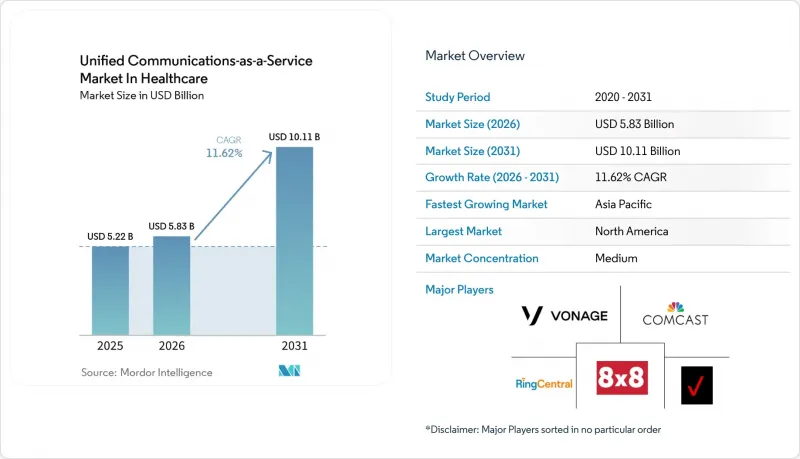
본 보고서는 도입 모델별(퍼블릭 클라우드, 프라이빗 클라우드, 하이브리드 클라우드), 구성 요소별(전화 및 음성, 통합 메시징 등), 용도별(임상 커뮤니케이션 및 협업 등), 조직 규모별(대기업 등), 최종 사용자별(병원 등) 및 지역별로 분류되어 있습니다. 시장 전망은 금액(달러) 기준으로 제시되어 있습니다.
헬스케어용 UCaaS 시장 동향
코로나19 이후 원격의료의 확대
원격의료 이용량은 꾸준히 증가하고 있으며, 서비스 제공업체들은 음성, 영상, 원격 모니터링 트래픽을 단일 플랫폼으로 통합해야 하는 압박을 받고 있습니다. 보고에 따르면, 가상 진료의 1회당 평균 비용은 최대 17% 감소했으며, 업무 흐름이 하나의 안전한 환경 내에서 이루어짐에 따라 의료진의 업무 만족도도 높아지고 있다고 합니다. 현재 이 의료 서비스 제공업체는 온라인으로만 진료를 수행하는 '버추얼리스트' 의사와 계약을 맺고 있으며, 진료 이관 및 상급 진료 의뢰를 위해 HIPAA 규정을 준수하는 지속적인 연결성이 요구되고 있습니다. 예측 분석과 AI 기반 트리아지의 통합을 통해 원격 진료는 일회성 이벤트에서 장기적인 치료 경로로 진화하고 있습니다. 전자건강기록(EHR) 내에서 상황에 맞는 메시징에 대한 수요도 동시에 증가하고 있어, 상호 운용성을 보장할 수 있는 UCaaS 공급업체에게는 새로운 비즈니스 기회가 열리고 있습니다.
UCaaS의 비용 절감형 OPEX 모델
자본 집약적인 PBX 하드웨어에서 구독형 UCaaS로 전환함으로써, 환자 중심의 투자에 사용할 자금을 확보할 수 있습니다. 40개 거점으로 구성된 지역 의료 네트워크에서는 2,000명의 직원을 RingCentral로 전환한 결과, 연간 35만 달러의 비용 절감을 달성했습니다. 이는 지원 관련 제반 비용을 절감하려는 다시설 시스템 전반에서 나타나는 경향입니다. 이 운영비(OPEX) 모델을 통해 대규모 업데이트 주기가 필요 없어지며, 변동하는 환자 수에 맞추어 비용을 조정할 수 있게 됩니다. 가치 기반 보상 제도의 압박을 받고 있는 CFO들은 불규칙한 자본 지출보다 예측 가능한 월별 요금을 선호하는 경향이 있습니다. 소규모 의료기관은 클라우드 제공업체가 유지보수, 보안 패치 적용, 재해 복구를 담당하기 때문에 엔터프라이즈급 통신 시스템 도입에 따른 인적 장벽이 낮아져 가장 큰 혜택을 보고 있습니다.
데이터 보안 및 HIPAA와 관련된 우려가 도입의 걸림돌이 됩니다.
저장된 데이터 및 전송 중인 데이터의 암호화, 세밀한 접근 제어의 시행, 그리고 비즈니스 제휴 계약의 체결은 비용과 지연을 초래합니다. 소규모 진료소의 경우, 보안 팀이 클라우드 아키텍처를 검증하고 데이터 흐름을 매핑하는 동안 프로젝트가 6-12개월 지연되고 있는 것으로 보고되고 있습니다. 정보 유출로 인한 벌금은 건당 150만 달러를 초과하는 경우도 있어, 이에 대한 위험 인식이 높아지면서 오랜 기간 규정 준수 실적을 쌓아온 기존 공급업체를 선호하는 경향이 있습니다. 멀티테넌트형 클라우드에서는 환자 기록이 혼재될 수 있다는 우려가 커지고 있어, 비용이 더 비싸짐에도 불구하고 하이브리드형이나 전용 인스턴스에 대한 관심이 높아지고 있습니다.
부문별 분석
퍼블릭 클라우드는 온디맨드 확장성과 자동 소프트웨어 업데이트에 대한 수요를 반영하여, 2025년에는 의료 분야의 통합 커뮤니케이션 서비스(UCaaS) 시장에서 45.10%의 점유율을 차지하며 시장을 주도했습니다. 대규모 통합 의료 네트워크는 지리적으로 분산된 의료 팀을 지원하기 위해 전 세계의 데이터센터를 활용하는 반면, 스타트업 기업들은 초기 투자 비용을 절감하기 위해 종량제 요금제를 활용하고 있습니다. 개인정보 보호 정책 및 데이터 주권 관련 법률에 따라, 서비스 제공업체는 임상 데이터베이스를 현지 저장소에 보관해야 할 의무가 있으므로, 하이브리드 클라우드의 연평균 성장률(CAGR)은 16.70%로, 도입 형태 중 가장 높은 성장률을 보일 것으로 전망됩니다. 헬스케어용 UCaaS 하이브리드 클라우드 시장 규모는 2031년까지 66억 2,000만 달러에 달할 것으로 예측됩니다. 통신사는 일반적으로 통화 상세 기록이나 녹음 데이터를 온프레미스에서 호스팅하면서, 실시간 워크로드는 클라우드로 오프로드하고 있습니다. 이러한 구성으로 인해 현장에서 비상 상황이 발생했을 때의 지연이 줄어들며, 병원 방화벽 내에 있는 엘리베이터, 경보 장치, 의료기기 게이트웨이와의 통합이 가능해집니다.
프라이빗 클라우드에 대한 수요는 여전히 틈새 시장에 머물러 있으며, 고위험 임상시험을 수행하거나 국방상의 제약 하에 운영되는 대학 병원 등에 집중되어 있습니다. 이러한 도입 방식은 전용 하드웨어나 통신사 회선이 필요하기 때문에 총 비용이 높아집니다. 그렇긴 하지만, 보안 어플라이언스나 연중무휴 24시간 모니터링이 포함된 관리형 서비스가 진입 장벽을 낮추고 있습니다. 일부 공급업체는 단계적 접근 방식을 채택하여, 먼저 인사나 청구 등 비임상 부서를 퍼블릭 클라우드로 이전한 뒤, 거버넌스 모델이 성숙한 단계에서 환자 대응 워크로드를 이전하고 있습니다.
2025년 시점에서 전화 및 음성 분야는 26.60%의 점유율을 유지했으며, 코드 콜, 상담, 교접객 업무에서 음성이 차지하는 중요한 역할이 다시금 부각되었습니다. 그러나 성장의 주역은 협업 도구이며, 연평균 성장률(CAGR)은 17.90%에 달할 전망입니다. 다직종 팀 회의에서 임상의들은 현재 EHR 콕핏 내에 통합되어 상시 이용 가능한 채팅방, 파일 공유 공간, 화상 회의 포털을 선호하여 사용하고 있습니다. 헬스케어용 UCaaS 시장에서 협업 도구의 점유율은 2031년까지 31.80%를 넘어설 것으로 예측됩니다. 각 업체들은 메모 작성 AI, 자동 언어 번역, 환자 기록과 직접 연동되는 가상 화이트보드를 도입하여 차별화를 꾀하고 있습니다.
통합 메시징은 음성 메일, 이메일, SMS를 하나의 대기열로 통합하여 정보의 분산을 해소합니다. 회의 솔루션은 고해상도 카메라 카트와 청진기 주변 기기를 통합하여 가상 회진을 실현합니다. 컨택 센터의 통합은 옴니채널을 통한 환자 참여에 있어 여전히 매우 중요하며, 검사 결과, 예약 알림, 약국 문의 등을 통합된 대기열을 통해 처리합니다. 가치 기반 보상 제도 하에서 환자를 유지하기 위해 의료 제공업체들이 소비자 수준의 경험을 중시함에 따라, 이 분야의 성장세는 더욱 가속화되고 있습니다.
지역별 분석
북미는 확고히 자리 잡은 HIPAA 규정, EHR의 보급, 그리고 적극적인 AI 시범 프로젝트에 힘입어 2025년 매출의 35.90%를 차지했습니다. 마이크로소프트의 DAX Copilot은 400개 이상의 의료 기관 네트워크에서 운영되고 있으며, 950만 건의 진료 기록을 생성함과 동시에 임상 수준의 음성 인식 기술을 대규모로 입증하고 있습니다. 의료기관은 성숙한 광대역 및 5G 통신망을 활용하여 병실에서의 원격 진료와 시설 간 자원 공유를 실시했습니다. 2026년까지 연장된 원격의료 보험급여에 대한 연방 정부의 유연한 대응은 클라우드에 대한 의존도를 더욱 공고히 하고 있습니다.
아시아태평양은 연평균 성장률(CAGR) 13.40%로 성장세를 주도하고 있습니다. 태국, 한국, 중국에서 진행된 공공 부문 스마트 병원 실증 실험은 5G를 활용한 구급차 원격 모니터링과, 영상 진단 소요 시간을 15분에서 25초로 단축하는 AI 기반 분류 시스템의 대표적인 사례로 꼽히고 있습니다. 지역마다 다른 개인정보 보호법으로 인해, UCaaS 스택 내 데이터 저장 위치 설정 변경이나 통신사 자유 선택(BYOC)에 대한 수요가 증가하고 있습니다. 현지 시스템 통합 업체가 규정 준수 컨설팅을 패키지화함으로써, 중규모 클리닉의 도입 장벽이 낮아졌습니다.
유럽에서는 e-헬스 이니셔티브와 '유럽 건강 데이터 공간(European Health Data Space)'을 통한 국경을 초월한 데이터 공유 목표에 힘입어, 한 자릿수 중반대의 견조한 성장세를 유지하고 있습니다. 프랑스의 원격 진료 관련 법률에 따라 의료 종사자의 원격 근무 대상이 확대됨에 따라, 보안이 강화된 화상 통신 채널에 대한 수요가 증가하고 있습니다. GDPR(EU 개인정보보호규정)의 의무 사항에 따라, 통신 데이터가 해당 지역 내 데이터센터에 머무르는 하이브리드 방식에 대한 관심이 높아지고 있습니다. 벤더들의 로드맵에서는 공공병원 수주를 목표로 'Schrems II 대응' 아키텍처에 대한 언급이 늘고 있습니다.
기타 혜택 :
- 엑셀 형식 시장 예측(ME) 시트
- 3개월간의 애널리스트 지원
자주 묻는 질문
목차
제1장 서론
제2장 조사 방법
제3장 주요 요약
제4장 시장 구도
제5장 시장 세분화
제6장 경쟁 구도
제7장 시장 기회 및 향후 전망
AJY 26.06.22According to Mordor Intelligence, unified communications-as-a-Service in Healthcare market size in 2026 is estimated at USD 5.83 billion, growing from 2025 value of USD 5.22 billion with 2031 projections showing USD 10.11 billion, growing at 11.62% CAGR over 2026-2031.
This report is Segmented by Deployment Model (Public Cloud, Private, Cloud, and Hybrid Cloud), Component (Telephony / Voice, Unified Messaging, and More), Application (Clinical Communications and Collaboration, and More), Organization Size (Large Enterprises, and More), End-User (Hospitals, and More), and Geography. The Market Forecasts are Provided in Terms of Value (USD).
Insights and Trends of Unified Communications-as-a-Service Market In Healthcare
Tele-health Expansion Post-COVID-19
Elevated telehealth volumes have stabilized, pushing providers to consolidate voice, video, and remote-monitoring traffic onto single platforms. Average cost per encounter in virtual care is falling by up to 17%, and caregivers report higher job satisfaction when workflows remain inside one secure environment. Providers now contract "virtualist" physicians who practice exclusively online, requiring continuous, HIPAA-grade connectivity for hand-offs and escalations. Integration of predictive analytics and AI-driven triage elevates tele-consultations from episodic events to longitudinal care pathways. Demand for contextual messaging within electronic health records (EHRs) grows in parallel, underpinning fresh opportunities for UCaaS vendors that can certify interoperability.
Cost-Saving OPEX Model of UCaaS
Switching from capital-intensive PBX hardware to subscription-based UCaaS frees cash for patient-centric investments. A 40-site community health network saved USD 350,000 annually after migrating 2,000 employees to RingCentral, an outcome echoed across multi-facility systems looking to trim support overhead. The operating-expense structure removes large refresh cycles, aligning expenses with fluctuating patient volumes. CFOs under pressure from value-based reimbursement find predictable monthly fees preferable to lumpy capital outlays. Smaller practices benefit most because cloud providers assume maintenance, security patching, and disaster recovery, lowering the personnel barrier to enterprise-class communications.
Data Security and HIPAA Concerns Create Adoption Barriers
Encrypting data at rest and in transit, enforcing granular access controls, and signing business-associate agreements add cost and delay. Smaller clinics report six-to-twelve-month project slippage while security teams validate cloud architectures and map data flows. Breach penalties can exceed USD 1.5 million per incident, elevating risk perception and driving preference for incumbents with long compliance track records. Multi-tenant clouds intensify worries about co-mingling patient records, spurring interest in hybrid and dedicated instances despite higher price points.
Other drivers and restraints analyzed in the detailed report include:
- Integration with EHR & Clinical Workflows
- 5G Edge-Enabled AR Surgical Collaboration
- Legacy PBX and Low Digital Readiness Constrain Migration
For complete list of drivers and restraints, kindly check the Table Of Contents.
Segment Analysis
Public Cloud dominated 2025 with 45.10% share of the Unified Communications-as-a-Service in Healthcare market, reflecting preference for on-demand scalability and automatic software updates. Large integrated-delivery networks tap global data centers to support geographically dispersed care teams, while start-ups exploit pay-as-you-go pricing to sidestep capital outlays. Hybrid Cloud trajectories are set to compound at 16.70% CAGR, the fastest within the deployment category, as privacy policies and data-sovereignty laws force providers to retain clinical databases in local vaults. The Unified Communications-as-a-Service in Healthcare market size for Hybrid Cloud is projected to reach USD 6.62 billion by 2031. Providers typically host call-detail records and recordings on-premises while offloading real-time workloads to the cloud. The arrangement mitigates latency for on-site emergency codes and integrates with elevators, alarms, and medical-device gateways that remain behind hospital firewalls.
Demand for Private Cloud remains niche, concentrated in academic medical centers conducting high-risk clinical trials or operating under national defense constraints. These deployments attract higher total cost due to dedicated hardware and carrier circuits. Nonetheless, managed-service options that bundle security appliances and 24X7 monitoring are lowering entry barriers. Some providers adopt a phased approach: migrate non-clinical departments such as HR and billing to Public Cloud first, then shift patient-facing workloads once governance models mature.
Telephony/Voice retained 26.60% share in 2025, underlining voice's enduring role for code calls, consults, and switchboard operations. However, Collaboration Tools hold the growth spotlight with an 17.90% CAGR. Across multidisciplinary team huddles, clinicians now prefer persistent chat rooms, file-share spaces, and video huddle portals embedded inside their EHR cockpit. The Unified Communications-as-a-Service in Healthcare market share for Collaboration Tools is forecast to exceed 31.80% by 2031. Vendors differentiate by embedding note-taking AI, automatic language translation, and virtual whiteboards that map directly to patient records.
Unified Messaging converges voicemail, email, and SMS into one queue, easing information scatter. Conferencing solutions integrate high-definition camera carts and stethoscope peripherals for virtual rounding. Contact-Center Integration remains pivotal to omni-channel patient engagement, routing lab results, appointment reminders, and pharmacy queries through a unified queue. Momentum here climbs as providers emphasize consumer-grade experience to retain patients under value-based reimbursement.
Geography Analysis
North America contributed 35.90% of 2025 revenue, driven by entrenched HIPAA mandates, EHR ubiquity, and aggressive AI pilots. Microsoft's DAX Copilot is live in 400+ provider networks, generating 9.5 million encounter notes and validating clinical-grade speech recognition at scale. Providers leverage mature broadband and 5G coverage for in-unit teleconsults and cross-facility resource pooling. Federal flexibilities for telehealth reimbursement, extended through 2026, further entrench cloud reliance.
Asia-Pacific leads in growth momentum at 13.40% CAGR. Public-sector smart-hospital pilots in Thailand, South Korea, and China exemplify 5G-enabled ambulance telemetry and AI-based triage that slash imaging turnaround from 15 minutes to 25 seconds. Regionally diverse privacy laws cultivate demand for configurable data-residency settings and bring-your-own-carrier options inside UCaaS stacks. Local system integrators bundle compliance consultancy, making adoption less daunting for mid-tier clinics.
Europe holds steady mid-single-digit growth underpinned by eHealth initiatives and cross-border data-sharing goals in the European Health Data Space. France's tele-consult legislation expanded remote-work eligibility for clinicians, fueling demand for secure video channels. GDPR obligations push interest in hybrid deployments, where communication payloads remain inside regional data centers. Vendor roadmaps increasingly reference "Schrems-II ready" architectures to court public hospitals.
- RingCentral, Inc.
- 8x8, Inc.
- Verizon Communications Inc.
- Comcast Corporation
- Vonage Holdings Corp. (Telefonaktiebolaget LM Ericsson)
- Intrado Corporation
- Star2Star Communications, LLC
- International Business Machines Corporation
- ALE International SAS (Alcatel-Lucent Enterprise)
- Cisco Systems, Inc.
- Microsoft Corporation
- Google LLC (Google Cloud)
- Zoom Video Communications, Inc.
- Avaya LLC
- Mitel Networks Corporation
- Fuze, Inc.
- Dialpad, Inc.
- NEC Corporation
- Twilio Inc.
- Genesys Telecommunications Laboratories, Inc.
Additional Benefits:
- The market estimate (ME) sheet in Excel format
- 3 months of analyst support
TABLE OF CONTENTS
1 INTRODUCTION
- 1.1 Study Assumptions and Market Definition
- 1.2 Scope of the Study
2 RESEARCH METHODOLOGY
3 EXECUTIVE SUMMARY
4 MARKET LANDSCAPE
- 4.1 Market Overview
- 4.2 Market Drivers
- 4.2.1 Tele-health expansion post-COVID-19
- 4.2.2 Cost-saving OPEX model of UCaaS
- 4.2.3 Integration with EHR and clinical workflows
- 4.2.4 5G edge-enabled AR surgical collaboration
- 4.2.5 Compliance-as-a-Service bundles for HIPAA
- 4.2.6 AI-driven clinical documentation and workflow automation
- 4.3 Market Restraints
- 4.3.1 Data security and HIPAA concerns
- 4.3.2 Legacy PBX and low digital readiness
- 4.3.3 Budget squeeze from value-based care
- 4.3.4 Vendor lock-in with vertical UC stacks
- 4.4 Evaluation of Critical Regulatory Framework
- 4.5 Industry Value Chain Analysis
- 4.6 Technological Outlook
- 4.7 Porter's Five Forces
- 4.7.1 Bargaining Power of Suppliers
- 4.7.2 Bargaining Power of Buyers
- 4.7.3 Threat of New Entrants
- 4.7.4 Threat of Substitutes
- 4.7.5 Competitive Rivalry
- 4.8 Key Use Cases and Case Studies
- 4.9 Impact on Macroeconomic Factors of the Market
- 4.10 Investment Analysis
5 MARKET SEGMENTATION
- 5.1 By Deployment Model
- 5.1.1 Public Cloud
- 5.1.2 Private Cloud
- 5.1.3 Hybrid Cloud
- 5.2 By Component
- 5.2.1 Telephony / Voice
- 5.2.2 Unified Messaging
- 5.2.3 Conferencing
- 5.2.4 Collaboration Tools
- 5.2.5 Contact-Center Integration
- 5.3 By Application
- 5.3.1 Clinical Communications and Collaboration
- 5.3.2 Tele-health and Virtual Care
- 5.3.3 Administrative and Billing
- 5.3.4 Emergency Response Coordination
- 5.3.5 Patient Outreach and Engagement
- 5.4 By Organization Size
- 5.4.1 Large Enterprises
- 5.4.2 Small and Medium Enterprises
- 5.5 By End-User
- 5.5.1 Hospitals
- 5.5.2 Clinics and Physician Offices
- 5.5.3 Ambulatory Surgical Centers
- 5.5.4 Long-Term Care Facilities
- 5.5.5 Diagnostic and Imaging Centers
- 5.5.6 Home Healthcare Agencies
- 5.6 By Geography
- 5.6.1 North America
- 5.6.1.1 United States
- 5.6.1.2 Canada
- 5.6.1.3 Mexico
- 5.6.2 South America
- 5.6.2.1 Brazil
- 5.6.2.2 Argentina
- 5.6.2.3 Rest of South America
- 5.6.3 Europe
- 5.6.3.1 Germany
- 5.6.3.2 United Kingdom
- 5.6.3.3 France
- 5.6.3.4 Italy
- 5.6.3.5 Spain
- 5.6.3.6 Russia
- 5.6.3.7 Rest of Europe
- 5.6.4 Asia-Pacific
- 5.6.4.1 China
- 5.6.4.2 Japan
- 5.6.4.3 India
- 5.6.4.4 South Korea
- 5.6.4.5 Australia and New Zealand
- 5.6.4.6 Rest of Asia-Pacific
- 5.6.5 Middle East and Africa
- 5.6.5.1 Middle East
- 5.6.5.1.1 Saudi Arabia
- 5.6.5.1.2 United Arab Emirates
- 5.6.5.1.3 Turkey
- 5.6.5.1.4 Rest of Middle East
- 5.6.5.2 Africa
- 5.6.5.2.1 South Africa
- 5.6.5.2.2 Nigeria
- 5.6.5.2.3 Egypt
- 5.6.5.2.4 Rest of Africa
- 5.6.5.1 Middle East
- 5.6.1 North America
6 COMPETITIVE LANDSCAPE
- 6.1 Market Concentration
- 6.2 Strategic Moves
- 6.3 Market Share Analysis
- 6.4 Company Profiles {(includes Global level Overview, Market level overview, Core Segments, Financials as available, Strategic Information, Market Rank/Share for key companies, Products and Services, and Recent Developments)}
- 6.4.1 RingCentral, Inc.
- 6.4.2 8x8, Inc.
- 6.4.3 Verizon Communications Inc.
- 6.4.4 Comcast Corporation
- 6.4.5 Vonage Holdings Corp. (Telefonaktiebolaget LM Ericsson)
- 6.4.6 Intrado Corporation
- 6.4.7 Star2Star Communications, LLC
- 6.4.8 International Business Machines Corporation
- 6.4.9 ALE International SAS (Alcatel-Lucent Enterprise)
- 6.4.10 Cisco Systems, Inc.
- 6.4.11 Microsoft Corporation
- 6.4.12 Google LLC (Google Cloud)
- 6.4.13 Zoom Video Communications, Inc.
- 6.4.14 Avaya LLC
- 6.4.15 Mitel Networks Corporation
- 6.4.16 Fuze, Inc.
- 6.4.17 Dialpad, Inc.
- 6.4.18 NEC Corporation
- 6.4.19 Twilio Inc.
- 6.4.20 Genesys Telecommunications Laboratories, Inc.
7 MARKET OPPORTUNITIES AND FUTURE OUTLOOK
- 7.1 White-space and Unmet-Need Assessment


