

|
시장보고서
상품코드
2061563
환자 모니터링 : 시장 점유율 분석, 업계 동향 및 통계, 성장 예측(2026-2031년)Patient Monitoring - Market Share Analysis, Industry Trends & Statistics, Growth Forecasts (2026 - 2031) |
||||||
 Mordor Intelligence
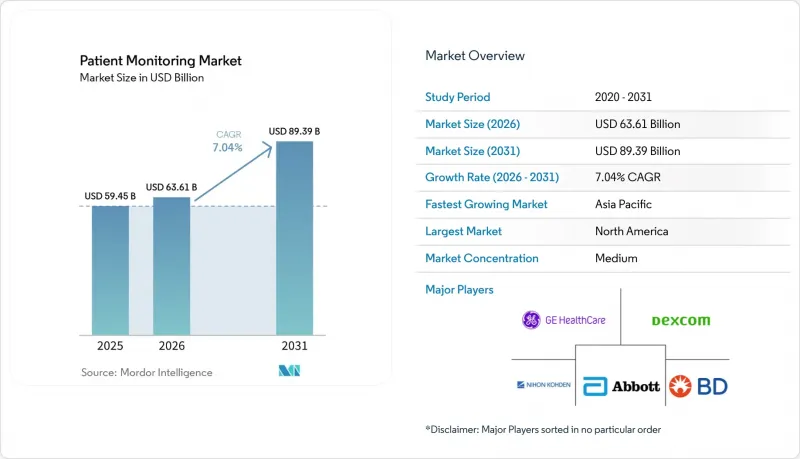
Mordor Intelligence에 의하면, 환자 모니터링 시장 규모는 2025년에 594억 5,000만 달러로 평가되었습니다. 2026년 636억 1,000만 달러에서 2031년까지 893억 9,000만 달러에 이를 것으로 예상되며, 예측 기간(2026-2031년) CAGR은 7.04%를 나타낼 전망입니다.
본 보고서는 유형(기기(심장 모니터링 기기 등), 서비스(교육·훈련 등)), 용도(순환기, 호흡기, 신경과 등), 최종 사용자(병원, 전문·단일 전문 클리닉, 외래수술센터(ASC), 재택치료 제공업체 등) 및 지역(북미 등)별로 분류되어 있습니다. 시장 전망은 금액(달러) 기준으로 제시되어 있습니다.
세계의 환자 모니터링 시장 동향 및 인사이트
만성 질환의 유병률 및 동반 질환 증가
2021년에는 심혈관 질환으로 인한 사망자 수가 1,790만 명에 달했으며, 국제당뇨병연맹(IDF)은 2045년까지 7억 8,300만 명의 성인이 당뇨병을 앓게 될 것으로 예측했습니다. 이는 46%의 급증으로, 간헐적인 진료소 진료만으로는 감당하기 어려운 상황이 될 것입니다. 따라서 혈당, 혈압, 체중을 동시에 모니터링하는 다중 매개변수 허브가 단일 매개변수 기기보다 더 많은 지지를 얻고 있습니다. 미국 질병통제예방센터(CDC)는 2024년 미국 성인의 10명 중 6명이 적어도 하나의 만성 질환을 앓았으며, 10명 중 4명은 두 가지 이상의 만성 질환을 앓았다고 보고하여, 병원 밖에서의 지속적인 모니터링에 대한 수요가 증가하고 있음을 보여주었습니다. 재입원을 불이익으로 규정하는 가치 기반 계약에 따라, 의료 제공업체들은 상태 악화를 조기에 감지하기 위한 퇴원 후 모니터링 시스템 도입을 요구받고 있습니다. 상호 운용성이 향상됨에 따라, 환자 모니터링 시장에서 통합 플랫폼이 기존의 독립형 모니터를 대체할 것으로 예측됩니다.
‘재택 병원’ 및 ‘가상 병동’으로의 전환 가속화
CMS(미국 의료보험 및 의료서비스 센터)는 2025년에 ‘재택 급성기 병원 치료(Acute Hospital Care at Home)’ 면제 조치를 영구적인 제도로 전환할 예정이며, 37개 주에 걸쳐 있는 290개 병원을 대상으로 하고 있습니다. 영국에서는 2024년 중반까지 가상 병동을 1만 병상 이상으로 확대하여 급성기 의료의 수용 능력을 확보했습니다. 재택 병원 모델에는 현장의 의료진이 없더라도 휴대전화 회선이나 위성 게이트웨이를 통해 생체 신호를 전송할 수 있는 내구성이 뛰어나고 환자 스스로 조작할 수 있는 기기가 필요합니다. Philips와 GE 헬스케어는 현재 모니터, 연결 기능 및 관리형 트리아지를 환자별 구독 서비스에 통합하여, 자본 지출을 운영 비용으로 전환하고 있습니다. 보험자 간 상환 제도가 통일됨에 따라 중규모 지역 병원에 도입이 확산되고 있으며, 이에 따라 환자 모니터링 시장 규모도 확대되고 있습니다.
연결 기기에 대한 사이버 보안 보험료의 급등
2025년 6월 시행될 FDA 섹션 524B 규정에 따라, 네트워크에 연결된 모든 기기에 대해 소프트웨어 부품 명세서(BOM) 및 위협 모델링이 의무화됨에 따라 규정 준수 비용이 증가하여, 보험사들은 의료 사이버 보험료를 15-25% 인상할 수밖에 없는 상황입니다. 500병상 규모의 병원의 경우, 연간 보험료가 30만 달러에 달할 수 있으며, 이는 7년 주기로 계산한 하드웨어 감가상각비를 초과합니다. 전담 보안 담당자가 없는 소규모 병원은 구매를 연기하거나 더 높은 위험을 감수하는 것 중 하나를 선택할 수밖에 없으며, 그 결과 시장의 단기 발주가 위축되면서 환자 모니터링 시장 규모 확대가 주춤하고 있습니다.
부문별 분석
2025년 기준으로, 기기 부문은 환자 모니터링 시장 점유율의 83.1%를 차지했으며, 이는 대규모 중환자실(ICU) 및 스텝다운 병동에서의 도입 실적이 뒷받침하고 있습니다. 그러나 설치, 데이터 통합, 분석 및 관리형 트리아지에 이르는 서비스 매출은 2026년부터 2031년까지 연평균 9.53% 성장할 것으로 예상되며, 이는 환자 모니터링 시장 전체의 성장률을 2.5%p 상회할 전망입니다. 병원 경영진은 설비 투자를 예측 가능한 운영 비용으로 전환할 수 있는 구독형 번들 상품을 선호하고 있으며, GE 헬스케어나 Philips 같은 공급업체들은 현재월이용료를 하드웨어 대수가 아닌 활성 환자 수에 연동하여 책정하고 있습니다.
하드웨어 분야에서는 웨어러블 및 패치형 모니터가 가장 빠르게 성장하고 있으며, 웰니스 및 당뇨 전단계 시장을 겨냥한 Dexcom Stelo나 Abbott Libre Rio와 같은 시판용 CGM(지속 혈당 측정기)이 성장을 주도하고 있습니다. 스마트폰에 블루투스와 LTE가 내장되면서, 리모트 허브는 일반화되는 추세이며, 그 가치는 클라우드 분석으로 옮겨가고 있습니다. 그 결과, 기기 단독 계약을 통한 환자 모니터링 시장 규모는 정체될 것으로 예상되는 반면, 서비스형 모델이 추가 지출을 확보해 나갈 것으로 전망됩니다.
지역별 분석
북미는 CMS의 RPM 개혁, 섹션 524B의 사이버 보안 의무, 그리고 잘 갖춰진 재택치료 인프라에 힘입어 2025년 매출의 41.2%를 차지했습니다. 해당 지역의 높은 평균 판매 가격과 관리형 서비스에 대한 지불자의 비용 회수 의지가 환자 모니터링 시장 규모에 대한 해당 지역의 과도한 기여를 뒷받침하고 있습니다.
유럽은 독일의 DiGA 보상 제도와 영국의 가상 병동 확대에 힘입어 상당한 시장 점유율을 차지하고 있습니다. EU 의료기기 규정의 시행으로 인해 규정 준수 비용은 증가했으나, 시판 후 조사가 개선되어 임상의들 간의 신뢰가 높아졌습니다. 거시경제적 압박이 있음에도 불구하고, 법정 보험자는 커넥티드 케어 시범 사업에 대한 자금 지원을 지속하며 수요를 안정시키고 있습니다.
아시아태평양은 성장의 원동력이며, 2026년부터 2031년까지 연평균 성장률(CAGR) 10.99%를 나타낼 것으로 전망됩니다. 중국 국가약품감독관리국(NMPA)은 2024년부터 2025년에 걸쳐 50종 이상의 AI 탑재 모니터를 승인했으며, 한편 인도는 원격의료를 자유화했고, 일본은 만성폐쇄성폐질환(COPD) 및 심부전의 원격 모니터링 대상 범위를 확대했습니다. 이러한 정책 전환에 더해 고령화가 진행됨에 따라, 인구가 많은 경제권에서 환자 모니터링 시장은 확대되고 있습니다. 중동 및 아프리카은 여전히 초기 단계에 있지만, 걸프협력회의(GCC) 회원국들의 스마트 병원 투자가 향후 수요의 씨앗이 될 것으로 기대됩니다. 남미에서는 브라질의 민간 보험사를 중심으로 선택적인 도입이 진행되고 있습니다.
기타 혜택 :
- 엑셀 형식 시장 예측(ME) 시트
- 3개월간의 애널리스트 지원
자주 묻는 질문
목차
제1장 서론
제2장 조사 방법
제3장 주요 요약
제4장 시장 구도
제5장 시장 규모 및 성장 예측
제6장 경쟁 구도
제7장 시장 기회 및 향후 전망
KTH 26.06.19According to Mordor Intelligence, the patient monitoring market size was valued at USD 59.45 billion in 2025 and is estimated to grow from USD 63.61 billion in 2026 to reach USD 89.39 billion by 2031, at a CAGR of 7.04% during the forecast period (2026-2031).
This report is Segmented by Type (Device [Cardiac Monitoring Devices, and More], Services [Training & Education, and More]), Application (Cardiology, Respiratory, Neurology, and More), End-User (Hospitals, Specialty & Single-Specialty Clinics, Ambulatory Surgical Centers, Home-Healthcare Providers, and More), and Geography (North America and More). The Market Forecasts are Provided in Terms of Value (USD).
Global Patient Monitoring Market Trends and Insights
Rise in Chronic-Disease Prevalence & Comorbidity Clusters
Cardiovascular diseases caused 17.9 million deaths in 2021, and the International Diabetes Federation projects 783 million adults living with diabetes by 2045, a 46% surge that will overwhelm episodic clinic care . Multiparameter hubs that simultaneously track glucose, blood pressure, and weight are therefore gaining favor over single-parameter devices. The CDC reported in 2024 that 6 in 10 U.S. adults have at least one chronic condition and 4 in 10 have two or more, underscoring demand for continuous surveillance outside hospitals. Value-based contracts penalizing readmissions are pushing providers to deploy post-discharge monitoring that flags decompensation early. As interoperability improves, integrated platforms are expected to crowd out legacy stand-alone monitors within the patient monitoring market.
Accelerating Shift to Hospital-at-Home & Virtual Wards
CMS transitioned its Acute Hospital Care at Home waiver into a permanent pathway in 2025, covering 290 hospitals across 37 states. The United Kingdom scaled virtual wards to more than 10,000 beds by mid-2024, freeing acute-care capacity. Hospital-at-home models require rugged, patient-operated devices that can transmit vitals via cellular or satellite gateways without onsite clinicians. Philips and GE HealthCare now bundle monitors, connectivity, and managed triage into per-patient subscriptions, converting capital expenditure to operating expense. As reimbursement converges across payers, adoption is widening among mid-size community hospitals, thereby broadening the patient monitoring market footprint
Escalating Cybersecurity Insurance Premiums for Connected Devices
FDA Section 524B rules, effective June 2025, now demand software bills of materials and threat-modeling for every networked device, increasing compliance spend and driving insurance carriers to hike healthcare cyber-premiums 15-25%. For a 500-bed hospital, annual coverage can reach USD 300,000, exceeding amortized hardware costs over a seven-year cycle. Smaller hospitals, lacking full-time security staff, either delay purchases or accept higher risk, curbing near-term orders in the market and slowing patient monitoring market size expansion.
Other drivers and restraints analyzed in the detailed report include:
- AI-Enabled Early-Warning Systems Lowering Adverse-Event Costs
- Reimbursement Expansion for Remote Physiologic Monitoring (RPM)
- High Total-Cost-of-Ownership in Low-Resource Settings
For complete list of drivers and restraints, kindly check the Table Of Contents.
Segment Analysis
Devices retained 83.1% of the patient monitoring market share in 2025, supported by large ICU and step-down installed bases. However, services revenue spanning installation, data integration, analytics, and managed triage is forecast to grow 9.53% from 2026 to 2031, outpacing the overall patient monitoring market by 2.5 percentage points. Hospital executives prefer subscription bundles that convert capital outlays into predictable operating costs, and vendors such as GE HealthCare and Philips now tie monthly fees to active-patient counts rather than hardware units.
Wearable and patch-based monitors are expanding fastest within hardware, propelled by over-the-counter CGMs like Dexcom Stelo and Abbott Libre Rio that address wellness and prediabetes segments. Remote hubs face commoditization as smartphones offer built-in Bluetooth and LTE, pushing value toward cloud analytics. Consequently, the patient monitoring market size for device-only contracts is expected to plateau, while as-a-service models capture incremental spend.
Geography Analysis
North America generated 41.2% of 2025 revenue, buoyed by CMS RPM reforms, Section 524B cybersecurity mandates, and a robust hospital-at-home infrastructure. The region's high average selling prices and payer willingness to reimburse managed services underpin its outsized contribution to the patient monitoring market size.
Europe holds significant share, supported by Germany's DiGA reimbursement pathway and the United Kingdom's virtual-ward expansion. EU Medical Device Regulation enforcement raised compliance costs but improved post-market surveillance, reinforcing trust among clinicians. Despite macroeconomic pressures, statutory insurers continue to fund connected-care pilots, stabilizing demand.
Asia-Pacific is the growth engine, forecast to post a 10.99% CAGR from 2026 to 2031. China's NMPA approved more than 50 AI-enabled monitors in 2024-2025, while India liberalized telemedicine and Japan expanded coverage for remote COPD and heart-failure monitoring. These policy shifts, coupled with aging demographics, enlarge the patient monitoring market across populous economies. Middle East and Africa remain early-stage, yet Gulf Cooperation Council investments in smart hospitals are expected to seed future demand. South America shows selective uptake, led by private payers in Brazil.
- Abbott Laboratories
- Baxter
- Beckton Dickinson
- BIOTRONIK
- Contec Medical Systems
- Dexcom
- Dragerwerk
- Garmin
- GE HealthCare Technologies Inc.
- Honeywell International
- iRhythm Technologies
- Koninklijke Philips
- Masimo
- Medtronic
- Nihon Kohden
- OMRON
- Resmed
- Schiller
- Mindray
- Spire Health
- VitalConnect Inc.
- Zoll Medical Corporation (Asahi Kasei Group)
Additional Benefits:
- The market estimate (ME) sheet in Excel format
- 3 months of analyst support
TABLE OF CONTENTS
1 Introduction
- 1.1 Study Assumptions & Market Definition
- 1.2 Scope of the Study
2 Research Methodology
3 Executive Summary
4 Market Landscape
- 4.1 Market Overview
- 4.2 Market Drivers
- 4.2.1 Rise In Chronic-Disease Prevalence & Comorbidity Clusters
- 4.2.2 Accelerating Shift to Hospital-At-Home & Virtual Wards
- 4.2.3 AI-Enabled Early-Warning Systems Lowering Adverse-Event Costs
- 4.2.4 Reimbursement Expansion for Remote Physiologic Monitoring (RPM)
- 4.2.5 Edge-Computing Wearables Reducing Data-Latency Below 20 Ms
- 4.2.6 Satellite-IoT Backhaul Unlocking Monitoring In Connectivity Blackspots
- 4.3 Market Restraints
- 4.3.1 Escalating Cybersecurity Insurance Premiums for Connected Devices
- 4.3.2 High Total-Cost-Of-Ownership in Low-Resource Settings
- 4.3.3 Fragmented Device-Data Standards Hindering Interoperability
- 4.3.4 Lithium-Supply Volatility Inflating Wearable-Battery Costs
- 4.4 Regulatory Landscape
- 4.5 Technological Outlook
- 4.6 Porter's Five Forces
- 4.6.1 Bargaining Power of Suppliers
- 4.6.2 Bargaining Power of Buyers
- 4.6.3 Threat of New Entrants
- 4.6.4 Threat of Substitutes
- 4.6.5 Competitive Rivalry
5 Market Size & Growth Forecasts (Value, in USD)
- 5.1 By Type
- 5.1.1 Device
- 5.1.1.1 Multiparameter Vital-Signs Monitors
- 5.1.1.2 Cardiac Monitoring Devices
- 5.1.1.3 Respiratory Monitoring Devices
- 5.1.1.4 Neuro-Monitoring Devices
- 5.1.1.5 Fetal & Neonatal Monitoring Devices
- 5.1.1.6 Hemodynamic & Pressure Monitors
- 5.1.1.7 Wearable & Patch-Based Monitors
- 5.1.1.8 Remote Patient Monitoring Hubs & Gateways
- 5.1.1.9 AI-Driven Predictive Analytics Modules
- 5.1.2 Services
- 5.1.2.1 Installation & Maintenance
- 5.1.2.2 Training & Education
- 5.1.2.3 RPM & Telehealth Services
- 5.1.2.4 Data Integration & Interoperability
- 5.1.2.5 Analytics & Reporting
- 5.1.2.6 Managed Monitoring & Triage Operations
- 5.1.1 Device
- 5.2 By Application
- 5.2.1 Cardiology
- 5.2.2 Respiratory
- 5.2.3 Neurology
- 5.2.4 Diabetes & Metabolic
- 5.2.5 Maternal & Neonatal
- 5.2.6 Critical Care Surveillance
- 5.2.7 Others
- 5.3 By End-User
- 5.3.1 Hospitals
- 5.3.2 Specialty & Single-Specialty Clinics
- 5.3.3 Ambulatory Surgical Centers
- 5.3.4 Home-Healthcare Providers
- 5.3.5 Long-Term Care & Assisted-Living Facilities
- 5.4 Geography
- 5.4.1 North America
- 5.4.1.1 United States
- 5.4.1.2 Canada
- 5.4.1.3 Mexico
- 5.4.2 Europe
- 5.4.2.1 Germany
- 5.4.2.2 United Kingdom
- 5.4.2.3 France
- 5.4.2.4 Italy
- 5.4.2.5 Spain
- 5.4.2.6 Rest of Europe
- 5.4.3 Asia-Pacific
- 5.4.3.1 China
- 5.4.3.2 India
- 5.4.3.3 Japan
- 5.4.3.4 South Korea
- 5.4.3.5 Australia
- 5.4.3.6 Rest of Asia-Pacific
- 5.4.4 Middle East and Africa
- 5.4.4.1 GCC
- 5.4.4.2 South Africa
- 5.4.4.3 Rest of Middle East and Africa
- 5.4.5 South America
- 5.4.5.1 Brazil
- 5.4.5.2 Argentina
- 5.4.5.3 Rest of South America
- 5.4.1 North America
6 Competitive Landscape
- 6.1 Market Concentration
- 6.2 Market Share Analysis
- 6.3 Company Profiles (includes Global level Overview, Market level overview, Core Segments, Financials as available, Strategic Information, Market Rank/Share for key companies, Products & Services, and Recent Developments)
- 6.3.1 Abbott Laboratories
- 6.3.2 Baxter International Inc.
- 6.3.3 Becton Dickinson & Company
- 6.3.4 Biotronik SE & Co. KG
- 6.3.5 Contec Medical Systems Co., Ltd.
- 6.3.6 Dexcom, Inc.
- 6.3.7 Dragerwerk AG & Co. KGaA
- 6.3.8 Garmin Ltd.
- 6.3.9 GE HealthCare Technologies Inc.
- 6.3.10 Honeywell International Inc.
- 6.3.11 iRhythm Technologies, Inc.
- 6.3.12 Koninklijke Philips N.V.
- 6.3.13 Masimo Corporation
- 6.3.14 Medtronic plc
- 6.3.15 Nihon Kohden Corporation
- 6.3.16 OMRON Corporation
- 6.3.17 ResMed Inc.
- 6.3.18 Schiller AG
- 6.3.19 Shenzhen Mindray Bio-Medical Electronics Co., Ltd.
- 6.3.20 Spire Health
- 6.3.21 VitalConnect Inc.
- 6.3.22 Zoll Medical Corporation (Asahi Kasei Group)
7 Market Opportunities & Future Outlook
- 7.1 White-space & Unmet-Need Assessment


