

|
시장보고서
상품코드
2061610
수륙양용 항공기 시장 : 시장 점유율 분석, 업계 동향 및 통계, 성장 예측(2026-2031년)Amphibious Aircraft - Market Share Analysis, Industry Trends & Statistics, Growth Forecasts (2026 - 2031) |
||||||
 Mordor Intelligence
Mordor Intelligence에 의하면, 수륙양용 항공기 시장 규모는 2025년 2억 4,875만 달러로 평가되었고, 2026년에는 2억 7,934만 달러로 추정되고, 2026-2031년 CAGR 11.84%로 성장을 지속할 전망이며, 2031년까지 4억 8,870만 달러에 이를 것으로 예측됩니다.
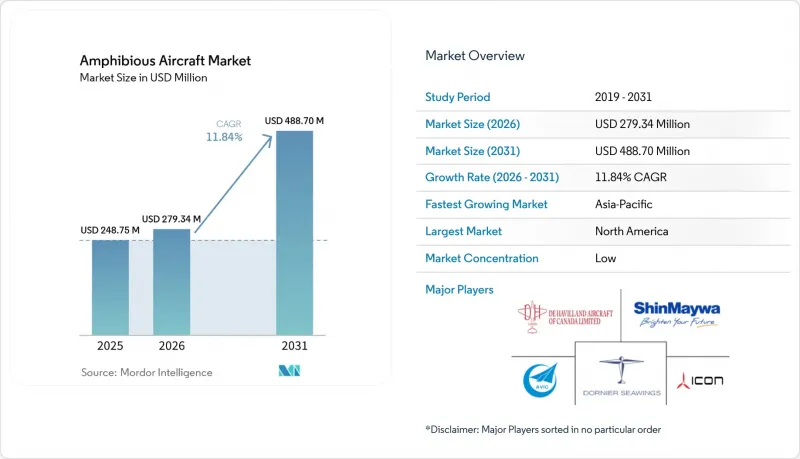
본 보고서는 엔진 유형별(피스톤, 터보프롭, 터빈, 하이브리드 및 전기), 좌석 수별(10석 미만, 10-20석, 20석 이상), 용도별(여객 수송, 화물 및 물류, 소방 및 수색구조, 해상 순찰 및 감시, 기타), 지역별(북미, 유럽, 기타)로 분류되어 있습니다. 시장 전망은 금액(달러) 기준으로 제시되어 있습니다.
세계의 수륙양용 항공기 시장 동향과 인사이트
신속 대응형 항공 소방 플랫폼에 대한 수요 증가
유럽에서는 rescEU 메커니즘에 따라 2025년까지 22대의 항공기를 사전 배치하는 계획이 추진되었으며, 계절성 산불에 대응하기 위한 유럽의 협력이 강화되고 있습니다. 이는 항공 소방 역량에 대한 공공 예산의 지속적인 지원이 보장되었음을 의미합니다. 캐나다 DHC-515의 생산 일정에 따르면, 유럽 고객에 대한 납품은 2028년부터 시작될 예정이며, 이는 향후 수년간 견조한 수요가 예상을 보여주는 한편, 단기적인 공급 부족 가능성도 시사하고 있어, 이용 가능한 플랫폼의 가격 결정력을 강화하는 요인이 되고 있습니다. 중국의 AG600은 2025년 6월에 생산 인증을 획득했습니다. 이는 대용량 수륙양용 소방 임무 및 해상 대응을 위한 국내 공급망을 구축하는 획기적인 사건으로, 공공 안전 기관의 수입 의존도를 낮출 것입니다. 이러한 요소들은 수륙양용 항공기 시장이 공공 안전 성과로 이어지는 강력한 다년 계약 및 조달 전망의 혜택을 받고 있다는 견해를 뒷받침합니다.
확대되는 관광 및 섬 간 여객 운송 서비스
아시아태평양의 수상 비행기 관광은 호황을 누리고 있으며, 시장에 진출한 기업들은 수익과 노선 밀도가 증가하고 있다고 보고하고 있습니다. 몰디브는 빈번한 운항과 리조트 픽업 서비스 분야에서 중요한 기준이 되고 있습니다. 말레이시아 최초의 수륙양용 운항 상업적 인가와 세스나 그랜드 캐러밴 EX 수륙양용 항공기의 도입은 도심과 휴양지 섬을 연결하는 관광 노선의 규제 및 운항 방안을 확고히 했습니다. 동남아시아 항공사들의 투자는 다수의 항공기 도입 계약 및 신규 노선 개설을 통해 수상 비행기 기단이 확대되고 있는 것으로 보아, 군도 간 연결성에 대한 확신을 보여주고 있습니다. 신규 하이브리드 전기 플랫폼은 연료 소비와 소음 저감에 주력하는 운항 사업자들 사이에서 지지를 얻고 있으며, 이는 ESG 요건 및 수변 운항에 대한 지역사회의 수용과도 부합합니다. 이러한 요인들이 복합적으로 작용하여, 여가 및 필수 운송 분야 모두에서 수륙양용 항공기 시장의 꾸준한 노선 개발과 항공기 도입 계약을 뒷받침하고 있습니다.
높은 도입 비용과 부식으로 인한 유지보수 문제
신규 수륙양용 항공기의 도입 비용은 육상 전용기에 비해 여전히 높은 수준을 유지하고 있어, 운항 사업자가 다년 계약이나 안정적인 가동률을 확보하지 못하는 한 투자 회수 기간이 길어질 수밖에 없습니다. DHC-515와 같은 프로그램에서는 염수 환경에서의 운용에 견딜 수 있도록 부식 방지 대책과 복합재 구조에 중점을 두고 있어, 이익률을 압박하는 유지보수 비용 절감에 기여하고 있습니다. 대용량 소방용 항공기에 대해 보고된 단가는 기체 군 확충이 자본 집약적이라는 점을 여실히 보여주고 있으며, 많은 기관이 여러 예산 주기에 걸쳐 단계적으로 조달을 진행할 수밖에 없는 실정입니다. 운항사는 가동률 목표와 계절적 수요 급증에 대한 대응 방안을 포함한 장기 계약을 통해 비용 리스크를 줄이고 있으며, 이를 통해 산불이 빈번히 발생하는 시장에서 항공기 편대의 경제성을 높이고 있습니다. OEM을 통한 유지보수 용이성, 부품의 표준화, 그리고 디지털 지원에 대한 지속적인 노력은 수륙양용 항공기 시장에서 운영 비용을 절감하기 위한 중요한 수단으로 자리 잡고 있습니다.
부문별 분석
2025년에는 터보프롭 엔진이 46.26%의 점유율을 차지한 것으로 평가되었으며, 운항 사업자들이 운영 비용 절감과 소음 저감을 추구하는 가운데, 하이브리드 및 전기 추진 시스템은 2031년까지 연평균 성장률(CAGR) 15.45%로 성장할 것으로 전망됩니다. DHC-515 및 널리 도입된 PT6A 엔진을 탑재한 수륙양용 항공기는 견고성, 연비 효율, 부품의 호환성 덕분에 소방 활동 및 지역 수송 서비스 분야에서 주력 기체로서의 위상을 유지하고 있습니다. 중국의 AG600 프로그램은 임무 범위가 넓은 대형 항공기 부문에서 규모를 확대하고 있으며, 이에 따라 대규모 급수 및 순찰 임무에 있어 국가와 지방자치단체의 선택지가 넓어지고 있습니다. 하이브리드 전기 항공기 시장에 새로 진입한 기업들은 ESG 규정 준수와 노선 수익성을 연계하여, 관광 및 섬 간 노선을 타겟으로 하는 운항 사업자들과 수주 파이프라인을 구축하고 있습니다. 이번 전환 과정에서 터보프롭 항공기가 현재의 수송 능력 기반을 유지하는 한편, 수륙양용 항공기 업계는 특정 노선을 대상으로 하이브리드 시스템을 검토하고 있으며, 운영 효율을 높이기 위해 소음 저감과 연료 소비량 감축을 최우선 과제로 삼고 있습니다.
예측 기간 동안 터보프롭 항공기의 성장세는 완만해질 것입니다. 이는 신규 제조 기종이 계획된 교체 수요를 충족시키고, 공공 항공기 편대가 임무의 항속 거리 및 운용 주기에 적합한 복합 추진 방식을 채택하기 위함입니다. 검증된 터보프롭 항공기의 기체를 전동화하는 개조 프로그램은 기존의 인증 체계와 정비 네트워크를 활용함으로써, 운항 개시까지의 기간을 단축할 수 있습니다. 수소 및 전기식 19인승 실증기는 에너지 저장 기술의 발전과 인증 획득을 전제로, 장기적인 지역 항공 솔루션을 제공할 것입니다. 이러한 단계적인 진화를 통해 터보프롭 항공기의 단기적인 신뢰성을 유지하면서, 수륙양용 항공기 시장에서 하이브리드 항공기 및 수소 항공기를 활용한 미래 노선과 운항의 가능성을 열어갈 것입니다.
지역별 분석
2025년, 북미는 수륙양용 항공기 시장의 36.78%를 차지했으며, 이는 캐나다 주 정부의 수폭탄 투하 기단과 미국의 계약 물량에 힘입은 결과입니다. 2028년부터 시작되는 유럽용 DHC-515 기종의 납품 일정은 활발한 생산 계획을 보여주고 있으며, 이는 북미공급 상황과 가격에도 영향을 미치고 있습니다. 지역 항공 운항사들은 임무의 신뢰성과 유지보수 용이성을 중시하여 실적이 검증된 터보프롭 기체를 선호하고 있으며, 이는 소방 및 다목적 임무에 있어 일관된 배치 체계를 뒷받침하고 있습니다. 새로운 개조 및 개량 옵션은 기존 항공기 제품군과 공통된 지원 네트워크를 활용함으로써, 해당 지역의 항공기 운용 계획에 향후 수용 능력을 추가합니다.
아시아태평양은 수상 비행기 서비스를 뒷받침하는 섬 간 네트워크의 확대와 관광 수요 증가에 힘입어, 2031년까지 연평균 성장률(CAGR) 14.56%를 기록하며 성장할 것으로 전망됩니다. 말레이시아에서 수륙양용형 '그랜드 캐러밴 EX'에 대한 규제 승인 및 도입은 수상 여객 노선 통합을 위한 지역적 참고 사례가 되었습니다. 중국 내 AG600 프로그램의 양산 개시는 소방 및 해상 임무용 국내 대형 수륙양용 능력을 강화하고, 국영 사업자에 대한 공급을 가속화하고 있습니다. 동남아시아에서의 다대수 항공기 구매 계약은 군도 간 연결성에 대한 신뢰를 보여주는 동시에, 수륙양용 항공기 시장의 기체 규모 확대를 뒷받침하고 있습니다. 지역 전체의 공항 투자 계획은 여건이 허락하는 한 수상 운항을 포함한 수용 능력 확대와 복합 운송 연결성을 시사하고 있습니다.
EU의 2025년 항공기 및 지상 요원 준비 계획은 강력한 국경 간 협력을 뒷받침하며, 항공 소방 활동에 대한 지속적인 예산 지원을 강조했습니다. 중동 및 아프리카를 합쳐도 세계 수요에서 차지하는 비중은 여전히 미미한 수준입니다. 그러나 이러한 지역에서는 수로를 통한 접근 방식이 현지 인프라와 가장 잘 부합하는 관광 및 인도적 지원 서비스 분야에서 특별한 기회를 제공합니다.
기타 혜택 :
- 엑셀 형식 시장 예측(ME) 시트
- 3개월간의 애널리스트 지원
자주 묻는 질문
목차
제1장 서론
제2장 조사 방법
제3장 주요 요약
제4장 시장 구도
제5장 시장 규모 및 성장 예측
제6장 경쟁 구도
제7장 시장 기회 및 향후 전망
AJY 26.06.22According to Mordor Intelligence, the amphibious aircraft market size is expected to grow from USD 248.75 million in 2025 to USD 279.34 million in 2026 and is forecasted to reach USD 488.70 million by 2031 at 11.84% CAGR over 2026-2031.
This report is Segmented by Engine Type (Piston, Turboprop, Turbine, and Hybrid/Electric), Seating Capacity (Less Than 10 Seats, 10 To 20 Seats, and More Than 20 Seats), End Use (Passenger Transport, Cargo and Logistics, Firefighting/Search and Rescue, Maritime Patrol and Surveillance, and More), and Geography (North America, Europe, and More). The Market Forecasts are Provided in Terms of Value (USD).
Global Amphibious Aircraft Market Trends and Insights
Rising Demand for Rapid-Response Aerial Firefighting Platforms
European coordination for seasonal wildfire response advanced with a 2025 pre-positioned fleet of 22 aircraft under the rescEU mechanism, which confirms sustained public budget support for aerial suppression capacity. Canada's DHC-515 production schedule signals a planned delivery window beginning in 2028 for European customers, which indicates firm multi-year demand but also a near-term shortfall, supporting stronger pricing power for available platforms. China's AG600 received production certification in June 2025, a milestone that creates domestic supply for large-capacity amphibious firefighting missions and maritime response, reducing reliance on imports for public safety agencies. These elements reinforce the view that the amphibious aircraft market benefits from strong multi-year commitments and procurement visibility tied to public safety outcomes.
Growing Tourism and Inter-Island Passenger Connectivity Services
Asia-Pacific seaplane tourism showed rising engagement with market participants reporting growing revenue and route density, with the Maldives serving as a scaled benchmark for high-frequency operations and resort transfers. Malaysia's first commercial approvals for amphibious operations and delivery of a Cessna Grand Caravan EX Amphibian validated the regulatory and operational pathway for tourism links between urban centers and resort islands. Operator investments in Southeast Asia signaled confidence in archipelagic connectivity as seaplane fleets expand through multi-aircraft commitments and route launches. Emerging hybrid-electric platforms are gaining traction with operators focused on reducing fuel burn and noise, which align with ESG mandates and local community acceptance of waterfront operations. These factors, together, support steady route development and aircraft commitments in the amphibious aircraft market across both leisure and essential transport profiles.
High Acquisition Costs and Corrosion-Driven Maintenance Challenges
Acquisition costs for new-build amphibious aircraft remain high relative to land-only platforms, which extends payback periods unless operators secure multi-year service contracts and steady utilization. Programs such as the DHC-515 emphasize corrosion protection and composite structures to better handle saltwater operations, helping reduce maintenance overheads that erode margins. Unit pricing reported for large-capacity firefighters underscores the capital-intensive nature of fleet expansion, compelling many agencies to stage procurement over multiple budget cycles. Operators mitigate cost risk through long-term contracts that allocate availability targets and seasonal surge provisions, thereby improving fleet economics in markets prone to wildfire seasons. Sustained OEM focus on maintainability, parts commonality, and digital support remains a key lever for reducing operating costs in the amphibious aircraft market.
Other drivers and restraints analyzed in the detailed report include:
- Expansion of Coastal Surveillance and Maritime Patrol Investments
- Technological Advancements Improving Operational Efficiency and Lifecycle Costs
- Stringent Certification Processes and Specialized Pilot Training Requirements
For complete list of drivers and restraints, kindly check the Table Of Contents.
Segment Analysis
Turboprop engines commanded a 46.26% share in 2025, and hybrid/electric propulsion is forecast to grow at a 15.45% CAGR through 2031 as operators pursue lower operating costs and reduced noise. The DHC-515 and widely deployed PT6A-powered amphibious aircraft remain the workhorses for firefighting and regional services due to ruggedness, fuel efficiency, and parts commonality. China's AG600 program adds scale at the heavy end of the mission spectrum, which broadens state and provincial options for large water-delivery and patrol roles. Hybrid-electric entrants are building order pipelines with operators targeting tourism and inter-island routes, linking ESG compliance to route economics. The transition involves turboprops anchoring current capacity, while the amphibious aircraft industry assesses hybrid systems for specific routes, prioritizing reduced noise and fuel consumption to enhance operational efficiency.
Over the forecast period, turboprop growth moderates as new-build supply fills planned replacements and public fleets adopt mixed propulsion types that fit mission range and cycle profiles. Retrofit programs that electrify proven turboprop airframes can shorten the path to operations by leveraging existing certification foundations and maintenance networks. Hydrogen-electric 19-seat demonstrators offer a long-term regional solution, contingent on advancements in energy storage and successful certification. This staged evolution keeps near-term reliability with turboprops while unlocking future routes and operations for hybrid and hydrogen variants within the amphibious aircraft market.
Geography Analysis
North America retained 36.78% of the amphibious aircraft market in 2025, supported by provincial water-bomber fleets in Canada and contracted capacity in the US. Delivery schedules for European DHC-515 units starting in 2028 show an active production pipeline that also influences North American availability and pricing. Regional operators favor proven turboprop airframes for mission reliability and maintainability, which supports consistent deployment across firefighting and utility roles. New conversion and retrofit options add future capacity to the region's fleet plan by leveraging existing aircraft families and common support networks.
Asia-Pacific is projected to grow at a 14.56% CAGR through 2031, driven by expanding inter-island networks and tourism flows that support seaplane services. Malaysia's regulatory approval and delivery of an amphibious Grand Caravan EX established a regional reference case for integration of water-based passenger links. China's AG600 program's launch into mass production has added domestic heavy amphibious capability for firefighting and maritime missions, accelerating supply for state operators. Operator orders for multi-aircraft commitments in Southeast Asia signal confidence in archipelagic connectivity and support fleet scaling in the amphibious aircraft market. Airport investment plans across the region indicate capacity and multimodal connectivity, including water-based operations where conditions permit.
The EU's 2025 readiness plan for aircraft and ground personnel underpins strong cross-border cooperation and highlights sustained budget support for aerial firefighting. The Middle East and Africa together remain a smaller share of global demand. Yet, they offer targeted opportunities in tourism and humanitarian services where water-access operations best align with local infrastructure.
- Airtime Aircraft Inc.
- Scandinavian Seaplanes Oy Ltd.
- Aviation Industry Corporation of China, Ltd.
- United Aircraft Company
- Dornier Seawings GmbH
- Equator Aircraft AS
- ICON Aircraft Inc. (Precision Aviation Group)
- ShinMaywa Industries, Ltd.
- De Havilland Aircraft of Canada Limited
- Vickers Aircraft Company Limited
- Amphibian Aerospace Industries, Pty Ltd
- Textron Inc.
- NPO AeroVolga
- Seamax LLC
- Wipaire Inc.
- G1 Aviation SAS
Additional Benefits:
- The market estimate (ME) sheet in Excel format
- 3 months of analyst support
TABLE OF CONTENTS
1 INTRODUCTION
- 1.1 Study Assumptions and Market Definition
- 1.2 Scope of the Study
2 RESEARCH METHODOLOGY
3 EXECUTIVE SUMMARY
4 MARKET LANDSCAPE
- 4.1 Market Overview
- 4.2 Market Drivers
- 4.2.1 Rising demand for rapid-response aerial firefighting platforms
- 4.2.2 Growing tourism and inter-island passenger connectivity services
- 4.2.3 Technological advancements improving operational efficiency and lifecycle costs
- 4.2.4 Development of hybrid-electric amphibious aircraft for sustainable operations
- 4.2.5 Expansion of coastal surveillance and maritime patrol investments
- 4.2.6 Government-backed development of seaplane corridors and water-based aviation infrastructure
- 4.3 Market Restraints
- 4.3.1 High acquisition costs and corrosion-driven maintenance challenges
- 4.3.2 Stringent certification processes and specialized pilot training requirements
- 4.3.3 Operational limitations due to adverse sea and weather conditions
- 4.3.4 Increasing adoption of unmanned systems reducing certain military applications
- 4.4 Value Chain Analysis
- 4.5 Regulatory Landscape
- 4.6 Technological Outlook
- 4.7 Porter's Five Forces Analysis
- 4.7.1 Bargaining Power of Suppliers
- 4.7.2 Bargaining Power of Buyers
- 4.7.3 Threat of New Entrants
- 4.7.4 Threat of Substitutes
- 4.7.5 Intensity of Competitive Rivalry
5 MARKET SIZE AND GROWTH FORECASTS (VALUE)
- 5.1 By Engine Type
- 5.1.1 Piston
- 5.1.2 Turboprop
- 5.1.3 Turbine
- 5.1.4 Hybrid/Electric
- 5.2 By Seating Capacity
- 5.2.1 Less than 10 seats
- 5.2.2 10 to 20 seats
- 5.2.3 More than 20 seats
- 5.3 By End Use
- 5.3.1 Passenger Transport
- 5.3.2 Cargo and Logistics
- 5.3.3 Firefighting/Search and Rescue (SAR)
- 5.3.4 Maritime Patrol and Surveillance
- 5.3.5 Military Operations
- 5.4 By Geography
- 5.4.1 North America
- 5.4.1.1 United States
- 5.4.1.2 Canada
- 5.4.1.3 Mexico
- 5.4.2 Europe
- 5.4.2.1 United Kingdom
- 5.4.2.2 France
- 5.4.2.3 Germany
- 5.4.2.4 Italy
- 5.4.2.5 Rest of Europe
- 5.4.3 Asia-Pacific
- 5.4.3.1 China
- 5.4.3.2 India
- 5.4.3.3 Japan
- 5.4.3.4 South Korea
- 5.4.3.5 Australia
- 5.4.3.6 Rest of Asia-Pacific
- 5.4.4 South America
- 5.4.4.1 Brazil
- 5.4.4.2 Rest of South America
- 5.4.5 Middle East and Africa
- 5.4.5.1 Middle East
- 5.4.5.1.1 Saudi Arabia
- 5.4.5.1.2 United Arab Emirates
- 5.4.5.1.3 Rest of Middle East
- 5.4.5.2 Africa
- 5.4.5.2.1 South Africa
- 5.4.5.2.2 Rest of Africa
- 5.4.5.1 Middle East
- 5.4.1 North America
6 COMPETITIVE LANDSCAPE
- 6.1 Market Concentration
- 6.2 Strategic Moves
- 6.3 Market Share Analysis
- 6.4 Company Profiles (includes Global level Overview, Market level overview, Core Segments, Financials as available, Strategic Information, Market Rank/Share for key companies, Products and Services, and Recent Developments)
- 6.4.1 Airtime Aircraft Inc.
- 6.4.2 Scandinavian Seaplanes Oy Ltd.
- 6.4.3 Aviation Industry Corporation of China, Ltd.
- 6.4.4 United Aircraft Company
- 6.4.5 Dornier Seawings GmbH
- 6.4.6 Equator Aircraft AS
- 6.4.7 ICON Aircraft Inc. (Precision Aviation Group)
- 6.4.8 ShinMaywa Industries, Ltd.
- 6.4.9 De Havilland Aircraft of Canada Limited
- 6.4.10 Vickers Aircraft Company Limited
- 6.4.11 Amphibian Aerospace Industries, Pty Ltd
- 6.4.12 Textron Inc.
- 6.4.13 NPO AeroVolga
- 6.4.14 Seamax LLC
- 6.4.15 Wipaire Inc.
- 6.4.16 G1 Aviation SAS
7 MARKET OPPORTUNITIES AND FUTURE OUTLOOK
- 7.1 White-space and Unmet-Need Assessment


