|
시장보고서
상품코드
2061629
전기자동차 레인지 익스텐더 : 시장 점유율 분석, 업계 동향 및 통계, 성장 예측(2026-2031년)Electric Vehicle Range Extender - Market Share Analysis, Industry Trends & Statistics, Growth Forecasts (2026 - 2031) |
||||||
 Mordor Intelligence
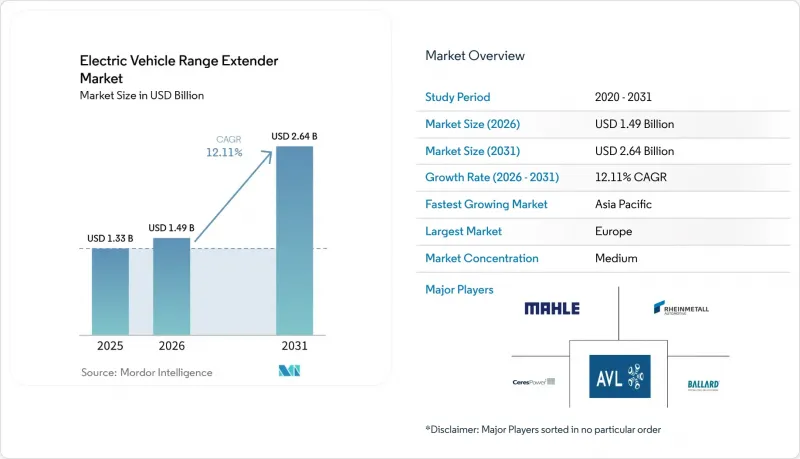
Mordor Intelligence에 의하면, 전기자동차 레인지 익스텐더 시장 규모는 2025년 13억 3,000만 달러로 평가되었습니다. 2026년에는 14억 9,000만 달러로 확대되어 2026년부터 2031년에 걸쳐 CAGR은 12.11%를 나타내, 2031년까지 26억 4,000만 달러에 이를 것으로 예측됩니다.
본 보고서는 유형별(내연기관 및 연료전지 레인지 익스텐더, 고체산화물 연료전지 레인지 익스텐더 등), 구성 요소별(배터리 팩 및 전기 모터, 발전기 등), 차량 등급별(승용차 및 소형 상용차 등), 출력별(30kW 미만 및 30-60kW 등), 지역별로 분류되어 있습니다. 시장 전망은 금액(달러) 및 수량(대수)으로 제시되어 있습니다.
세계의 전기자동차 레인지 익스텐더 시장 동향 및 분석
정부의 제로 배출 규제가 OEM 수요를 촉진
규제 압력으로 인해 파워트레인 로드맵이 재검토되면서, 전기자동차 레인지 익스텐더 시장의 성장이 가속화되고 있습니다. 2024년에 발효된 유로 7 규제는 대형 트럭의 NOx 배출량을 50% 감축하도록 의무화하고 있어, 제조업체들에게 신속한 하이브리드화를 촉구하고 있습니다. 캘리포니아주의 ‘Advanced Clean Cars II’는 2035년까지 판매 대수의 100%를 무공해 차량으로할 것을 의무화하고 있으며, 워싱턴주도 유사한 기준을 채택하여 OEM이 레인지 익스텐더 탑재 모델로부터 컴플라이언스 크레딧을 획득할 수 있도록 하고 있습니다. 2027년부터 2032년까지를 대상으로 한 미국 환경보호청(EPA)의 규제안에서는 차량군의 평균 배출량을 마일당 82g의 CO2로 줄이는 것이 의무화되어 있으며, 공공 충전 인프라가 확충됨에 따라 레인지 익스텐더가 현실적인 대안으로 떠오르고 있습니다. 자동차 제조업체들은 현재 세계 시장에서 유연성을 확보하기 위해, 배터리 전용 모델과 레인지 익스텐더 모델 모두를 지원할 수 있는 확장 가능한 아키텍처를 우선시하고 있습니다.
배터리 가격 하락이 비용 효율이 높은 하이브리드 아키텍처를 가능하게 합니다.
리튬 이온 배터리의 비용이 1kWh당 139달러까지 하락함에 따라 시스템 전체의 비용이 절감되었고, 자동차 제조업체들은 비용 목표를 초과하지 않으면서도 소형 배터리 팩과 보조 발전기를 결합할 수 있게 되었습니다. 리튬 철 인산염 화학으로의 전환은 특히 주행 거리보다 사이클 수명이 더 중요시되는 상용차 차량군에서 추가적인 비용 절감 효과를 가져오고 있습니다. 전기자동차 레인지 익스텐더 시장도 미국의 ‘인플레이션 억제법’과 EU의 투자 프로그램의 혜택을 받고 있습니다. 이는 배터리 생산의 현지화를 촉진하고 물류 비용을 절감하는 동시에, 통합형 레인지 익스텐더 라인의 도입을 뒷받침하고 있습니다. EUROBAT는 2035년까지 유럽의 리튬 배터리 수요가 8배로 급증할 것으로 전망하고 있으며, 이에 따라 하이브리드 구성이 갖는 규모의 경제 효과가 더욱 강화될 것으로 보입니다.
급속 충전 네트워크 확충으로 인해 레인지 익스텐더의 필요성이 줄어들고 있습니다.
일렉트라이파이 아메리카는 2024년까지 네트워크를 25% 확장했고, 평균 충전 시간을 단축할 수 있는 5,000기의 고출력 충전소를 설치했습니다. 미국의 NEVI 프로그램은 2028년까지 50억 달러를 투자해 50만 개의 공공 충전소를 구축할 계획이며, 캘리포니아주만 해도 2030년까지 3만 9,000개의 DC 급속 충전기를 설치할 계획입니다. 충전망이 점차 확충됨에 따라 순수 전기차(BEV)의 실용성이 높아지고 보조 발전기에 대한 수요는 일부 감소하고 있지만, 지방의 화물 운송 분야에서는 여전히 충전 인프라 부족 문제에 직면해 있습니다.
부문별 분석
2025년, 내연기관(ICE) 방식의 레인지 익스텐더는 전기자동차 레인지 익스텐더 시장 점유율의 66.72%를 유지했습니다. 이는 OEM 각사가 소형 가솔린 엔진이나 가스 연료 엔진용으로 이미 구축된 공급망을 재사용할 수 있기 때문입니다. 이 플랫폼은 기존의 배기가스 후처리 시스템, 진단 도구 및 생산 라인과 호환되어 개발 주기를 단축합니다. 그러나 연료전지 방식의 레인지 익스텐더는 연평균 성장률(CAGR) 22.05%로 성장하고 있으며, 지역 내 배출 제로 목표를 달성해야 하는 고효율 상용차의 제품 로드맵에서 핵심적인 역할을 하고 있습니다. Ceres Power사와 Weichai Power사의 고체 산화물 스택은 정상 부하 시 높은 전기 효율을 달성하여, 시내버스나 배송 트럭에 적용할 수 있게 되었습니다.
고체산화물 연료전지 시스템은 수소, 메탄, 암모니아 등 다양한 연료를 사용할 수 있어, 수소 공급망이 확대됨에 따라 사업자는 향후 가격 변동에 대한 리스크 헤지가 가능해집니다. 마이크로터빈 방식의 레인지 익스텐더는 고성능 차량이나 항공우주 프로토타입 등 높은 출력 밀도가 요구되는 프로젝트에서 틈새 시장을 차지하고 있습니다. 예를 들어, 델타 모터스포츠의 시연용 기기는 35kW 마이크로 가스 터빈이 동급 피스톤 엔진보다 가벼우면서도 미세먼지 배출량도 적다는 것을 보여주고 있습니다. 자유 피스톤식 리니어 발전기나 아연-공기 전지 기술은 아직 쇼룸이 아닌 연구실에 머물러 있지만, 장기적인 혁신 잠재력 덕분에 벤처 자금의 유입은 여전히 활발합니다.
2025년 전기자동차 레인지 익스텐더 시장에서 배터리 팩은 전체 가치의 43.02%를 차지했으며, 이는 모든 아키텍처에서 에너지 저장 장치가 핵심적인 역할을 하고 있음을 여실히 보여주었습니다. 적절한 용량 선정에는 여전히 설계상의 균형 조정이 필요합니다. 이 차량은 적재 용량을 저해할 정도로 차량 중량을 늘리지 않으면서도 도심 진입 규제를 충족하기 위해 약 80-100km의 전기 주행 거리를 확보해야 합니다. 단가는 높은 편이지만, 상용차 차량군에는 장시간 공회전 없는 주행과 저온 성능이 요구되기 때문에 파워 컨버터는 연평균 성장률(CAGR) 18.45%로 가장 빠르게 성장하는 부품이 되고 있습니다. 고성능 전력 변환기는 배터리 팩, 발전기, 구동 모터 간에 에너지를 분배하며, 차세대 실리콘 카바이드 소자는 손실을 최대 30%까지 줄여줍니다.
열 관리 시스템은 특히 연료전지 및 고체산화물 연료전지 분야에서 작동 온도의 제어가 시스템의 효율과 내구성에 직접적인 영향을 미치기 때문에 중요한 부품 범주로 부상하고 있습니다. 고체산화물형 연료전지 시스템에 대한 조사에 따르면, 열 사이클 신뢰성과 연료 개질 기술은 첨단 열 관리 솔루션이 필요한 주요 기술적 과제로 대두되고 있습니다. 첨단 배터리 관리 시스템과 레인지 익스텐더 제어 전략의 통합을 통해, 여러 에너지원을 관리하면서 시스템 전체의 효율을 최적화할 수 있는 고도의 전력 전자 장치에 대한 수요가 증가하고 있습니다. 부품 공급업체들은 서로 다른 레인지 익스텐더 아키텍처 간에 유연한 통합을 가능하게 하는 모듈식 설계에 주력하고 있으며, ZF와 같은 기업들은 발전기, 인버터, 기어 세트를 단일 패키지로 통합한 시스템을 개발하여 복잡성을 줄이고 신뢰성을 높이고 있습니다.
지역별 분석
유럽은 엄격한 차량 평균 CO2 배출 기준과 다가오는 유로 7 규제로 인해, 2025년 매출 점유율 33.95%를 기록하며 전기자동차 레인지 익스텐더 시장을 주도했습니다. 이 지역의 각 OEM 업체들은 E10 연료에 대응하도록 개조된 기존 가솔린 엔진 라인을 활용하여, 국내 기가팩토리에서 조립된 인산철 리튬 배터리 팩과 결합하고 있습니다. 프랑스, 독일, 네덜란드의 각 지자체는 이미 도심 내 전기 구동을 의무화하고 있으며, 지역 배송 차량을 시리즈 하이브리드 차량으로 전환하고 있습니다.
아시아태평양은 연평균 성장률(CAGR) 18.90%로 성장하고 있습니다. 이는 순수 BEV(배터리 전기차)에 대한 보조금이 단계적으로 축소되는 상황에서도, 2024년 전기 SUV 판매의 25%를 차지한 중국의 레인지 익스텐더 전기차(EREV) 부문이 계속해서 성장하고 있기 때문입니다. 고속도로에서의 충전과 관련된 소비자들의 우려를 배경으로, 대형 SUV 등록 대수 중 EREV 설계 모델이 60%의 점유율을 차지하고 있습니다. 일본에서는 정부의 로드맵이 2035년까지 판매 대수의 100%를 xEV로 만드는 것을 목표로 하고 있으며, 배터리 공급망이 확대될 때까지의 10년 동안 레인지 익스텐더 플랫폼이 기존 제조업체들의 정책 대응을 뒷받침하게 될 것입니다. 인도에서는 야간에는 차고에서 충전이 필요한 반면, 전력망이 제대로 갖춰지지 않은 지방 노선에서는 여전히 주간에 발전기 사용이 요구되기 때문에 도시 간 버스 사업자들의 관심이 높아지고 있습니다.
북미는 제3의 성장 축이 될 것입니다. 환경보호청(EPA)이 중형 트럭의 온실가스 배출 기준을 강화했고, 여러 주가 캘리포니아주의 ‘Advanced Clean Cars II’ 기준을 따르고 있기 때문입니다. Harbinger와 같은 스타트업 기업들은 모듈식 가솔린 또는 수소 연료전지 방식의 레인지 익스텐더를 선택 사양인 주행 거리 모듈로 탑재한 스케이트보드형 섀시를 개발하여, 유틸리티체나 지방자치단체의 서비스 차량용으로 판매하고 있습니다. 캐나다에서는 청정 연료 구매 인센티브가 도입된 반면, 멕시코에서는 미국·멕시코·캐나다 협정(USMCA)을 활용하여 주행 거리 연장형 배송 밴을 관세 없이 수출할 수 있는 계약 제조업체를 유치하고 있습니다.
기타 혜택 :
- 엑셀 형식 시장 예측(ME) 시트
- 3개월간의 애널리스트 지원
자주 묻는 질문
목차
제1장 서론
제2장 조사 방법
제3장 주요 요약
제4장 시장 구도
제5장 시장 규모 및 성장 예측
제6장 경쟁 구도
제7장 시장 기회 및 향후 전망
KTH 26.06.19According to Mordor Intelligence, the electric vehicle range extender market size is expected to grow from USD 1.33 billion in 2025 to USD 1.49 billion in 2026 and is forecast to reach USD 2.64 billion by 2031 at 12.11% CAGR over 2026-2031.
This report is Segmented by Type (ICE and Fuel Cell Range Extender, Solid-Oxide Fuel Cell Range Extender and More), Component (Battery Pack and Electric Motor, Generator and More), Vehicle Class (Passenger Cars and Light Commercial Vehicles, and More), Power Output (Less Than 30 KW and 30-60 KW, and More), and Geography. The Market Forecasts are Provided in Terms of Value (USD) and Volume (Units).
Global Electric Vehicle Range Extender Market Trends and Insights
Government Zero-Emission Mandates Accelerating OEM Demand
Regulatory pressure is reshaping powertrain roadmaps and accelerating growth in the Electric Vehicle Range Extender Market. Euro 7 limits that took effect in 2024 slash NOx for heavy-duty trucks by 50%, pushing manufacturers to hybridize quickly. California's Advanced Clean Cars II requires 100% zero-emission sales by 2035, and Washington State mirrors those standards, letting OEMs earn compliance credits from range-extended models. Proposed U.S. EPA rules for 2027-2032 would force average fleet emissions down to 82 g CO2/mile, making range extenders an attainable option while public charging rolls out. Automakers now prioritize scalable architectures that accept both battery-only and range-extended variants for flexibility across world markets.
Falling Battery Prices Enabling Cost-Efficient Hybrid Architectures
Lithium-ion cost declines to USD 139 per kWh lowered total system outlays, letting OEMs pair compact packs with auxiliary gensets without breaching cost targets. Shifts toward lithium-iron-phosphate chemistry add further margin, especially for commercial fleets where cycle life outweighs range. The Electric Vehicle Range Extender Market is also benefiting from the U.S. Inflation Reduction Act and EU investment programs that are localizing cell production, trimming logistics expenses, and favoring integrated range extender lines. EUROBAT forecasts an eightfold jump in European lithium battery demand by 2035, reinforcing economies of scale that benefit hybrid layouts.
Fast-Charging Network Build-Out Reducing Need for Extenders
Electrify America expanded its network 25% in 2024, targeting 5,000 high-power stalls that shrink average charge times. The U.S. NEVI program funnels USD 5 billion through 2028 to create 500,000 public ports, while California alone plans for 39,000 DC fast chargers by 2030. As coverage improves, pure BEVs become more practical, eroding some demand for auxiliary gensets, though rural freight still faces gaps.
Other drivers and restraints analyzed in the detailed report include:
- Urban Ultra-Low-Emission Zones Spurring Adoption
- Rapid Growth of Last-Mile E-Commerce Fleets
- High Drivetrain Complexity vs BEV Alternatives
For complete list of drivers and restraints, kindly check the Table Of Contents.
Segment Analysis
ICE range extenders maintained 66.72% of the Electric Vehicle Range Extender Market share in 2025 because OEMs can reuse mature supply chains for small gasoline or gaseous-fuel engines. The platform accommodates existing emission after-treatment, diagnostic tools, and manufacturing lines, shortening development cycles. However, Fuel-cell range extenders are advancing at a 22.05% CAGR and anchor product roadmaps for high-efficiency commercial vehicles that must achieve zero local emissions. Solid-oxide stacks from Ceres Power and Weichai Power achieve high electrical efficiency at steady-state loads, making them viable for urban buses and distribution trucks.
Solid-oxide fuel-cell systems also tolerate multiple fuels - hydrogen, methane, and ammonia, allowing operators to hedge against future price swings as the hydrogen supply chain expands. Micro-turbine range extenders hold a niche for high-power-density projects such as performance cars and aerospace prototypes. Delta Motorsport's demonstrator, for example, shows how a 35-kW micro gas turbine can weigh less than a comparable piston engine while emitting fewer particulates. Although free-piston linear generators and zinc-air chemistries sit in laboratories rather than showrooms, their long-term disruption potential keeps venture funding active.
Battery packs accounted for 43.02% of total value in the Electric Vehicle Range Extender Market in 2025, underscoring the central role of energy storage in every architecture. Right-sizing remains a design balancing act: packs must deliver roughly 80-100 km of electric range to satisfy urban-access rules without inflating curb weight to the point of eroding payload. Despite higher unit cost, power converter exhibit the fastest component growth at a 18.45% CAGR because commercial fleets need long idle-free periods and low-temperature performance. Sophisticated power converters channel energy between the pack, generator, and traction motor, and next-generation silicon-carbide devices cut losses by up to 30%.
Thermal management systems are emerging as a critical component category, particularly for fuel cell and solid oxide fuel cell applications where operating temperature control directly impacts system efficiency and durability. Research on solid oxide fuel cell systems indicates that thermal cycling reliability and fuel reforming technologies represent key technical challenges requiring advanced thermal management solutions.The integration of advanced battery management systems with range extender control strategies is driving demand for sophisticated power electronics that can manage multiple energy sources while optimizing overall system efficiency. Component suppliers are focusing on modular designs that enable flexible integration across different range extender architectures, with companies like ZF developing integrated systems that combine generators, inverters, and gearsets in unified packages to reduce complexity and improve reliability.
Geography Analysis
Europe led the electric vehicle range extender market with 33.95% 2025 revenue share due to stringent fleet-average CO2 norms and the impending Euro 7 regime. OEMs there leverage existing gasoline engine lines converted for E10 fuel and pair them with lithium-iron-phosphate packs assembled in domestic gigafactories. City councils in France, Germany, and the Netherlands already require electric operation inside urban cores, pushing local delivery fleets toward series hybrids.
Asia-Pacific advances at a 18.90% CAGR because China's extended-range electric vehicle segment - accounting for 25% of 2024 electric SUV sales - continues scaling even as pure BEV subsidies taper. EREV designs dominate large-SUV registrations at 60% share thanks to consumer anxiety over highway charging. In Japan, the government roadmap targets 100% xEV sales by 2035, leaving a decade-long window where range-extender platforms help legacy manufacturers satisfy policy while battery supply chains ramp. India sees emerging interest from intercity bus operators that need overnight depot charging but still require daytime generator use for rural routes with weak grid access.
North America makes up the third growth pillar as the Environmental Protection Agency tightens greenhouse-gas standards for medium-duty trucks and several states align with California's Advanced Clean Cars II. Start-ups such as Harbinger develop skateboard chassis with modular gasoline or hydrogen fuel-cell extenders as optional range modules, marketing them to utilities and municipal service fleets. Canada follows with clean-fuel purchase incentives, while Mexico attracts contract manufacturers leveraging the United States-Mexico-Canada Agreement to export range-extended delivery vans tariff-free.
- MAHLE International GmbH
- Rheinmetall Automotive AG
- Ceres Power Holdings plc
- Ballard Power Systems Inc.
- AVL List GmbH
- Magna International Inc.
- Horizon Fuel Cell Technologies
- Plug Power Inc.
- Nissan Motor Co., Ltd.
- BMW AG
- General Motors Co.
- Lotus Engineering
- Nikola Corporation
- REE Automotive
- Wrightspeed
- Tata Motors Ltd.
- Toyota Motor Corporation
- Ashok Leyland Ltd.
- Hyundai Motor Company
- Weichai Power Co., Ltd.
- Cummins Inc.
- Jiangling Motors Co., Ltd.
Additional Benefits:
- The market estimate (ME) sheet in Excel format
- 3 months of analyst support
TABLE OF CONTENTS
1 Introduction
- 1.1 Study Assumptions & Market Definition
- 1.2 Scope of the Study
2 Research Methodology
3 Executive Summary
4 Market Landscape
- 4.1 Market Overview
- 4.2 Market Drivers
- 4.2.1 Government zero-emission mandates accelerating OEM demand
- 4.2.2 Falling battery prices enabling cost-efficient hybrid architectures
- 4.2.3 Urban ultra-low-emission zones spurring range-extender adoption
- 4.2.4 Rapid growth of last-mile e-commerce fleets
- 4.2.5 Defense procurement of silent-watch hybrid powertrains (under-the-radar)
- 4.2.6 Mining industry shift to battery-diesel hybrid haul trucks (under-the-radar)
- 4.3 Market Restraints
- 4.3.1 Fast-charging network build-out reducing need for extenders
- 4.3.2 High drivetrain complexity vs. BEV alternatives
- 4.3.3 Upcoming Euro 8 and CARB rules limiting onboard combustion (under-the-radar)
- 4.3.4 Limited residual-value data hindering fleet financing (under-the-radar)
- 4.4 Value-Chain Analysis
- 4.5 Regulatory Landscape
- 4.6 Technological Outlook
- 4.7 Porter's Five Forces
- 4.7.1 Threat of New Entrants
- 4.7.2 Bargaining Power of Buyers/Consumers
- 4.7.3 Bargaining Power of Suppliers
- 4.7.4 Threat of Substitute Products
- 4.7.5 Intensity of Competitive Rivalry
5 Market Size & Growth Forecasts (Value (USD) and Volume (Units))
- 5.1 By Type
- 5.1.1 ICE Range Extender
- 5.1.2 Fuel Cell Range Extender
- 5.1.3 Solid-Oxide Fuel Cell Range Extender
- 5.1.4 Micro-Turbine Range Extender
- 5.1.5 Other Emerging Technologies
- 5.2 By Component
- 5.2.1 Battery Pack
- 5.2.2 Electric Motor
- 5.2.3 Generator
- 5.2.4 Power Converter
- 5.2.5 Control Unit
- 5.2.6 Thermal Management System
- 5.3 By Vehicle Class
- 5.3.1 Passenger Cars
- 5.3.2 Light Commercial Vehicles
- 5.3.3 Heavy Commercial Vehicles
- 5.3.4 Off-Highway Vehicles
- 5.4 By Power Output
- 5.4.1 Less than 30 kW
- 5.4.2 30 - 60 kW
- 5.4.3 60 - 100 kW
- 5.4.4 More than 100 kW
- 5.5 By Geography
- 5.5.1 North America
- 5.5.1.1 United States
- 5.5.1.2 Canada
- 5.5.1.3 Rest of North America
- 5.5.2 Europe
- 5.5.2.1 Germany
- 5.5.2.2 United Kingdom
- 5.5.2.3 France
- 5.5.2.4 Italy
- 5.5.2.5 Spain
- 5.5.2.6 Netherlands
- 5.5.2.7 Norway
- 5.5.2.8 Russia
- 5.5.2.9 Rest of Europe
- 5.5.3 Asia-Pacific
- 5.5.3.1 China
- 5.5.3.2 Japan
- 5.5.3.3 India
- 5.5.3.4 South Korea
- 5.5.3.5 Australia
- 5.5.3.6 Rest of Asia-Pacific
- 5.5.4 Middle East and Africa
- 5.5.4.1 Saudi Arabia
- 5.5.4.2 United Arab Emirates
- 5.5.4.3 Turkey
- 5.5.4.4 Egypt
- 5.5.4.5 South Africa
- 5.5.4.6 Rest of Middle East and Africa
- 5.5.1 North America
6 Competitive Landscape
- 6.1 Market Concentration
- 6.2 Strategic Moves
- 6.3 Market Share Analysis
- 6.4 Company Profiles (Includes Global Level Overview, Market Level Overview, Core Segments, Financials as Available, Strategic Information, Market Rank/Share for Key Companies, Products & Services, and Recent Developments)
- 6.4.1 MAHLE International GmbH
- 6.4.2 Rheinmetall Automotive AG
- 6.4.3 Ceres Power Holdings plc
- 6.4.4 Ballard Power Systems Inc.
- 6.4.5 AVL List GmbH
- 6.4.6 Magna International Inc.
- 6.4.7 Horizon Fuel Cell Technologies
- 6.4.8 Plug Power Inc.
- 6.4.9 Nissan Motor Co., Ltd.
- 6.4.10 BMW AG
- 6.4.11 General Motors Co.
- 6.4.12 Lotus Engineering
- 6.4.13 Nikola Corporation
- 6.4.14 REE Automotive
- 6.4.15 Wrightspeed
- 6.4.16 Tata Motors Ltd.
- 6.4.17 Toyota Motor Corporation
- 6.4.18 Ashok Leyland Ltd.
- 6.4.19 Hyundai Motor Company
- 6.4.20 Weichai Power Co., Ltd.
- 6.4.21 Cummins Inc.
- 6.4.22 Jiangling Motors Co., Ltd.
7 Market Opportunities & Future Outlook
- 7.1 White-space & Unmet-Need Assessment