|
시장보고서
상품코드
2061654
분무 건조 장비 : 시장 점유율 분석, 업계 동향 및 통계, 성장 예측(2026-2031년)Spray Drying Equipment - Market Share Analysis, Industry Trends & Statistics, Growth Forecasts (2026 - 2031) |
||||||
 Mordor Intelligence
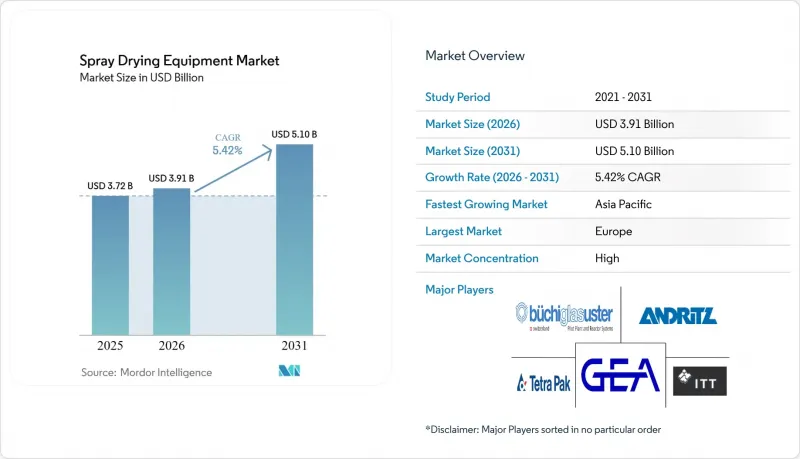
Mordor Intelligence에 의하면, 분무 건조 장비 시장 규모는 2025년 37억 2,000만 달러로 평가되었습니다. 2026년에는 39억 1,000만 달러로 확대되어 2026년부터 2031년에 걸쳐 CAGR은 5.42%를 나타내, 2031년까지 51억 달러에 이를 것으로 예측됩니다.
본 보고서는 건조 단계(단단식, 2단식, 다단식), 공정(로터리 휠, 원심식/스핀 디스크 등), 용도(유제품, 유아용 조제분유, 의약품 등), 지역(북미, 유럽, 아시아태평양, 남미, 중동 및 아프리카)별로 분류되어 있습니다. 시장 전망은 금액(달러) 기준으로 제시되어 있습니다.
세계의 분무 건조 장비 시장 동향 및 분석
가공식품 및 인스턴트 식품에 대한 수요 증가
세계적으로 편의식 문화로 전환되면서 분무 건조기 수요에 큰 변화를 가져오고 있습니다. 각 제조업체는 이 기술에 막대한 투자를 하고 있으며, 특히 인스턴트 커피나 분유 제품은 소비자 수요가 광범위하게 분포되어 있어 그 선두에 서 있습니다. 식품 제조업체들은 제품의 유통기한을 연장할 뿐만 아니라, 제품 품질 유지에 필수적인 열에 약한 비타민이나 단백질 등의 영양소를 보존하기 위해서도 분무 건조를 더욱 적극적으로 도입하고 있습니다. 이 기술은 입자 크기 분포를 조절하여 유동성이 높은 분말을 제조하는 데 있어 매우 중요한 역할을 하며, 이는 인스턴트 음료나 즉석 식품의 성분에서 일관성과 품질을 확보하는 데 필수적입니다. 게다가 클린 라벨 제품에 대한 선호도가 높아지면서 분무 건조 방식의 도입이 가속화되고 있습니다. 이 방법을 통해 첨가물을 사용하지 않은 분말을 제조할 수 있게 되었으며, 보다 건강하고 자연스러운 식품을 원하는 소비자의 요구에 부응함으로써 다른 보존 기술에 비해 뚜렷한 우위를 점하고 있습니다.
고용해성 유아용 분유에 대한 수요 증가
유아용 분유 제조 과정에서 분무 건조 기술은 매우 중요한 역할을 수행하며, 분말이 영양학적으로 완벽하고 WHO 및 FDA가 정한 엄격한 안전 기준을 준수함을 보장합니다. FDA의 21 CFR Part 106 규정에 따라, 유아용 분유 제조에는 엄격한 품질 관리 조치가 적용됩니다. 여기에는 설비 및 열처리 검증도 포함되어 있으며, 이 모든 요소가 첨단 분무 건조 시스템의 도입을 더욱 촉진하고 있습니다. 이에 대응하여 제조업체들은 전용 분무 건조기를 도입하고 있습니다. 이러한 첨단 시스템은 단백질의 기능성을 유지할 뿐만 아니라, 현대의 유아용 영양제에 요구되는 높은 용해율도 충족시키고 있습니다. 게다가 DHA나 프로바이오틱스 같은 민감한 영양소를 열분해시키지 않고 봉입할 수 있다는 이 기술의 장점이 고급 기기 판매의 급증에 박차를 가하고 있습니다. 이러한 추세는 출산율 상승과 가처분 소득 증가로 인해 분유 소비가 확대되고 있는 아시아태평양 시장에서 특히 두드러집니다.
비용 효율적인 건조 기술에 대한 수요 증가
경제적 압박으로 인해 각 제조업체는 기존의 분무 건조 시스템에 비해 설비 투자 및 운영 비용이 낮은 대체 건조 기술에 대한 평가를 진행하고 있습니다. 동결건조나 유동층 건조와 같은 기술은 특히 제품 품질을 현저히 저하시키지 않으면서도 단시간 내 처리에 비해 에너지 효율을 우선시할 수 있는 용도에서 유력한 대안으로 주목받고 있습니다. 신흥 시장에서는 중소규모 제조업체들이 하이브리드 건조 시스템을 적극적으로 도입하고 있습니다. 이러한 시스템은 분무 건조와 비용 효율이 더 높은 농축 전 공정을 통합하고 있어, 제조업체는 원하는 제품 품질을 유지하면서 총 설비 투자 비용을 절감할 수 있습니다. 이러한 재정적 제약은 치열한 이익률 압박으로 인해 신규 설비에 대한 투자 능력이 제한되고 있는 일반 식품 분야에서 특히 두드러집니다. 그 결과, 이 분야의 제조업체들은 비용을 효과적으로 관리하기 위해 기존 설비의 가동 수명을 연장하고 첨단 기술 도입을 미루고 있습니다.
부문별 분석
2025년, 단단식 건조기는 분무 건조 장치 시장을 독점하며 51.44%라는 높은 시장 점유율을 차지했습니다. 이 건조기들은 비용 효율성이 뛰어나고 설계가 간단하여 널리 사용되고 있으며, 기본적인 건조 조건만 충족하면 되는 용도에 적합합니다. 식품 및 음료, 의약품, 화학제품 등의 업계에서는 비교적 낮은 운영 복잡성으로 대량의 원료를 처리할 수 있는 효율성 덕분에 단단식 건조기가 자주 사용되고 있습니다. 또한, 다단식 시스템에 비해 유지보수 부담이 적기 때문에 운영 비용 최적화를 목표로 하는 제조업체에게 바람직한 선택지가 되고 있습니다.
다단식 기술은 2031년까지 연평균 성장률(CAGR) 6.43%를 기록하며 가장 높은 성장률을 달성할 것으로 전망됩니다. 이러한 성장은 더 높은 제품 품질과 에너지 효율을 보장하는 첨단 건조 솔루션에 대한 수요 증가에 힘입어 이루어지고 있습니다. 다단식 건조기는 특수 화학제품이나 고부가가치 식품 등 수분 함량이나 입자 크기의 정밀한 제어가 요구되는 업계에서 특히 선호되고 있습니다. 또한, 다단식 건조기에 첨단 자동화 및 제어 시스템을 통합함으로써 운영 효율이 향상되었으며, 이는 최종 사용자 산업의 변화하는 요구를 충족하는 데 있어 필수적인 요소가 되었습니다.
지역별 분석
2025년, 유럽은 32.96%의 세계 점유율로 분무 건조기 시장을 주도했습니다. 이는 확립된 의약품 제조거점과 FDA 기준을 준수하는 첨단 분무 건조 기술의 도입을 촉진하는 엄격한 규제 기준에 의해 뒷받침되고 있습니다. 독일은 특히 유제품 분야에서 이러한 지역적 우위를 바탕으로 매우 중요한 역할을 수행하고 있습니다. 이 나라에서는 탈지분유, 전지분유, 기타 유제품 베이스 분말 등 다양한 유제품이 생산되고 있습니다. 유로스타트(2024년)에 따르면, 독일은 유럽 유제품 총생산량의 약 18.8%를 차지하고 있으며, 이는 독일의 강력한 생산 능력과 선진적인 가공 인프라를 입증하고 있습니다. 이처럼 견조한 유제품 산업이 지역 전체의 분무 건조기 수요를 크게 견인하고 있습니다.
아시아태평양은 2031년까지 연평균 성장률(CAGR) 6.87%를 기록하며 가장 빠르게 성장하는 지역이 될 것으로 예측됩니다. 이러한 성장은 주로 중국 제약 산업의 현대화와 ICH 지침 준수에 힘입어 이루어지고 있으며, 이에 따라 세계 제조 기준의 도입이 가속화되고 있습니다. 첨단 API(유효 성분) 생산 시설에 대한 투자가 분무 건조기 수요를 크게 끌어올리고 있습니다. 동시에 인도 등 여러 국가에서는 증가하는 소비자 수요에 부응하기 위해 영양 보조 식품 및 식품 가공 분야에서 분무 건조 기술의 활용을 확대되고 있습니다.
북미는 특히 특수 화학제품이나 고부가가치 식품 원료와 같은 전문적이고 고부가가치 용도 분야에서 계속해서 확고한 입지를 유지하고 있습니다. 미국은 여전히 주요 기여국이며, 의약품 및 식품 가공 분야의 연구 개발에 대한 지속적인 투자를 바탕으로 흡입제나 서방형 제제 등의 분야에서 눈에 띄는 도입이 진행되고 있습니다. 남미와 중동 및 아프리카를 포함한 신흥 지역도 주로 식품 가공 부문의 확장에 힘입어 성장세를 보이고 있습니다. 남미에서는 브라질의 식품 및 음료 산업, 특히 유제품 가공 분야의 성장이 분무 건조 기술의 도입을 가속화하고 있습니다. 마찬가지로 중동 및 아프리카에서도 분유와 커피 생산 증가에 따라 수요가 높아지고 있어, 이들 시장에서 새로운 성장 기회가 부각되고 있습니다.
기타 혜택 :
- 엑셀 형식 시장 예측(ME) 시트
- 3개월간의 애널리스트 지원
자주 묻는 질문
목차
제1장 서론
제2장 조사 방법
제3장 주요 요약
제4장 시장 구도
제5장 시장 규모 및 성장 예측
제6장 경쟁 구도
제7장 시장 기회 및 향후 전망
KTH 26.06.19According to Mordor Intelligence, the spray drying equipment market size is expected to grow from USD 3.72 billion in 2025 to USD 3.91 billion in 2026 and is forecast to reach USD 5.1 billion by 2031 at 5.42% CAGR over 2026-2031.
This report is Segmented by Drying Stage (Single-Stage, Two-Stage and Multi-Stage), Process (Rotary Wheel, Centrifugal/Spin Disc and More), Application (Dairy Products, Infant Formula, Pharmaceuticals and More), and Geography (North America, Europe, Asia-Pacific, South America, and Middle East and Africa). The Market Forecasts are Provided in Terms of Value (USD).
Global Spray Drying Equipment Market Trends and Insights
Rising demand for processed and instant foods
The global shift toward convenience foods is actively driving a significant transformation in the demand for spray drying equipment. Manufacturers are heavily investing in this technology, with instant coffee and powdered dairy products leading the way due to their widespread consumer demand. Food producers are increasingly adopting spray drying not only to extend the shelf life of their products but also to preserve their nutritional value, particularly for heat-sensitive vitamins and proteins that are essential for maintaining product quality. This technology plays a crucial role in creating free-flowing powders with controlled particle size distribution, which is critical for ensuring consistency and quality in instant beverages and ready-to-eat meal components. Furthermore, the growing preference for clean-label products is accelerating the adoption of spray drying. This method enables the production of additive-free powders, offering a distinct advantage over alternative preservation techniques by meeting consumer demands for healthier and more natural food options.
Mounting demand for high-soluble infant formula powders
Spray drying technology plays a pivotal role in the production of infant formula, ensuring the powders are nutritionally complete and adhere to stringent safety standards set by the WHO and FDA. Under the FDA's 21 CFR Part 106 regulations, infant formula production is subject to rigorous quality control measures . These include validating equipment and thermal processing, both of which increasingly favor advanced spray drying systems. In response, manufacturers are turning to specialized spray dryers. These advanced systems not only uphold protein functionality but also meet the high solubility rates sought after in contemporary infant nutrition formulations. Furthermore, the technology's prowess in encapsulating delicate nutrients, such as DHA and probiotics, without subjecting them to thermal degradation, is propelling a surge in premium equipment sales. This trend is especially pronounced in the Asia-Pacific markets, buoyed by rising birth rates and increasing disposable incomes that bolster formula consumption.
Growing demand for cost effective drying technologies
Economic pressures are driving manufacturers to evaluate alternative drying technologies that offer lower capital and operating costs compared to traditional spray drying systems. Technologies such as freeze-drying and fluidized bed drying are gaining traction as viable alternatives, particularly in applications where manufacturers can prioritize energy efficiency over shorter processing times without significantly compromising product quality. In emerging markets, small and medium-sized manufacturers are actively adopting hybrid drying systems. These systems integrate spray drying with more cost-effective pre-concentration steps, enabling manufacturers to reduce overall equipment investment while still maintaining the desired product quality. The financial constraints are especially pronounced in commodity food applications, where intense margin pressures limit the ability to invest in new equipment. As a result, manufacturers in this segment are extending the operational lifecycles of their existing equipment and delaying the adoption of advanced technologies to manage costs effectively.
Other drivers and restraints analyzed in the detailed report include:
- Growth of plant-based and alternative protein ingredients
- Strong growth in dairy industry
- Stringent Volatile Organic Compound (VOC) and particulate emission norms
For complete list of drivers and restraints, kindly check the Table Of Contents.
Segment Analysis
In 2025, single-stage dryers dominated the spray drying equipment market, accounting for a significant 51.44% market share. These dryers are widely used due to their cost-effectiveness and simpler design, making them suitable for applications where basic drying requirements are sufficient. Industries such as food and beverages, pharmaceuticals, and chemicals frequently utilize single-stage dryers for their efficiency in handling large volumes of material with relatively low operational complexity. Additionally, their lower maintenance requirements compared to multi-stage systems make them a preferred choice for manufacturers aiming to optimize operational costs.
Multi-stage technology is projected to achieve the fastest growth rate, with a CAGR of 6.43% by 2031. This growth is driven by the increasing demand for advanced drying solutions that ensure higher product quality and energy efficiency. Multi-stage dryers are particularly favored in industries requiring precise control over moisture content and particle size, such as specialty chemicals and high-value food products. Furthermore, the integration of advanced automation and control systems in multi-stage dryers enhances their operational efficiency, making them a critical component in meeting the evolving demands of end-user industries.
Geography Analysis
In 2025, Europe leads the spray drying equipment market with a 32.96% global share, supported by a well-established pharmaceutical manufacturing base and stringent regulatory standards that promote the adoption of advanced, FDA-aligned spray drying technologies. Germany plays a pivotal role in this regional dominance, particularly in the dairy sector. The country produces a wide range of dairy products, including skim milk powders, whole milk powders, and other dairy-based powders. According to Eurostat (2024), Germany accounts for approximately 18.8% of Europe's total dairy output, underscoring its strong production capacity and advanced processing infrastructure. This robust dairy industry significantly drives demand for spray drying equipment across the region.
Asia-Pacific is expected to be the fastest-growing region, registering a CAGR of 6.87% through 2031. Growth is largely fueled by the modernization of China's pharmaceutical industry and its alignment with ICH guidelines, which is accelerating the adoption of global manufacturing standards. Investments in advanced API production facilities are significantly boosting demand for spray drying equipment. At the same time, countries like India are expanding the use of spray drying technologies in nutraceuticals and food processing to meet increasing consumer demand.
North America continues to hold a strong position, particularly in specialized and high-value applications such as specialty chemicals and advanced food ingredients. The United States remains a key contributor, with notable adoption in areas like inhalable drugs and controlled-release formulations, supported by ongoing investments in pharmaceutical and food processing research and development. Emerging regions, including South America and the Middle East and Africa, are also gaining momentum, primarily driven by the expansion of their food processing sectors. In South America, Brazil's growing food and beverage industry, especially in dairy processing, is accelerating the uptake of spray drying technologies. Similarly, the Middle East and Africa are experiencing increased demand due to rising production of powdered milk and coffee, highlighting new growth opportunities in these markets.
- GEA Group AG
- ITT Inc (SPX FLOW)
- Antolab Group Co., Ltd.
- ANDRITZ GROUP
- SiccaDania Group
- The Tetra Laval Group
- Changzhou Jinqiao Spray Drying and Engineering Co., Ltd.
- Pulse Drying Systems
- Buchiglas (Buchi AG)
- Moret Industries
- SSP Pvt Limited
- Yamato Scientific Co Ltd
- G. Larsson Starch Technology AB
- THORNICO A/S
- Col-Int Tech
- AKSH Engineering Systems (P) Limited
- DORST Technologies GmbH & Co. KG
- Sinitech Industries d.o.o.
- Mojj Engineering Systems ltd.
- Kerone Engineering Solutions LTD.
Additional Benefits:
- The market estimate (ME) sheet in Excel format
- 3 months of analyst support
TABLE OF CONTENTS
1 INTRODUCTION
- 1.1 Study Assumptions and Market Definition
- 1.2 Scope of the Study
2 RESEARCH METHODOLOGY
3 EXECUTIVE SUMMARY
4 MARKET LANDSCAPE
- 4.1 Market Overview
- 4.2 Market Drivers
- 4.2.1 Rising demand for processed and instant foods
- 4.2.2 Mounting demand for high-soluble infant-formula powders
- 4.2.3 Growth of Plant-Based and Alternative Protein Ingredients
- 4.2.4 Rise in the adoption of nano-spray drying for nutraceutical micro-encapsulation
- 4.2.5 Strong Growth in the Dairy Industry
- 4.2.6 Advancements in multi-stage dryers
- 4.3 Market Restraints
- 4.3.1 Growing demand for cost-effective drying technologies
- 4.3.2 Stringent Volatile Organic Compound (VOC) and particulate emission norms
- 4.3.3 Risk of degradation in heat-sensitive ingredients during drying
- 4.3.4 Skill-gap in operating advanced multi-stage dryers in developing markets
- 4.4 Supply Chain Analysis
- 4.5 Regulatory Outlook
- 4.6 Porter's Five Forces
- 4.6.1 Threat of New Entrants
- 4.6.2 Bargaining Power of Buyers/Consumers
- 4.6.3 Bargaining Power of Suppliers
- 4.6.4 Threat of Substitute Products
- 4.6.5 Intensity of Competitive Rivalry
5 MARKET SIZE AND GROWTH FORECASTS (VALUE)
- 5.1 By Drying Stage
- 5.1.1 Single-Stage
- 5.1.2 Two-Stage
- 5.1.3 Multi-Stage
- 5.2 By Process
- 5.2.1 Rotary Wheel (Pressure Nozzle)
- 5.2.2 Pneumatic Two-Fluid Nozzle
- 5.2.3 Centrifugal/Spin-Disc
- 5.2.4 Fluidized Spray Dryer
- 5.2.5 Closed-Loop (Inert Gas)
- 5.3 By Application
- 5.3.1 Dairy Products
- 5.3.2 Infant Formula
- 5.3.3 Functional and Plant-based Foods
- 5.3.4 Pharmaceuticals
- 5.3.5 Dietary Supplements
- 5.3.6 Others
- 5.4 By Geography
- 5.4.1 North America
- 5.4.1.1 United States
- 5.4.1.2 Canada
- 5.4.1.3 Mexico
- 5.4.1.4 Rest of North America
- 5.4.2 Europe
- 5.4.2.1 United Kingdom
- 5.4.2.2 Germany
- 5.4.2.3 Spain
- 5.4.2.4 France
- 5.4.2.5 Italy
- 5.4.2.6 Netherlands
- 5.4.2.7 Sweden
- 5.4.2.8 Poland
- 5.4.2.9 Belgium
- 5.4.2.10 Rest of Europe
- 5.4.3 Asia-Pacific
- 5.4.3.1 China
- 5.4.3.2 India
- 5.4.3.3 Japan
- 5.4.3.4 Australia
- 5.4.3.5 South Korea
- 5.4.3.6 Indonesia
- 5.4.3.7 Thailand
- 5.4.3.8 Singapore
- 5.4.3.9 Rest of Asia-Pacific
- 5.4.4 South America
- 5.4.4.1 Brazil
- 5.4.4.2 Argentina
- 5.4.4.3 Chile
- 5.4.4.4 Colombia
- 5.4.4.5 Peru
- 5.4.4.6 Rest of South America
- 5.4.5 Middle East and Africa
- 5.4.5.1 Saudi Arabia
- 5.4.5.2 South Africa
- 5.4.5.3 United Arab Emirates
- 5.4.5.4 Nigeria
- 5.4.5.5 Morocco
- 5.4.5.6 Egypt
- 5.4.5.7 Turkey
- 5.4.5.8 Rest of Middle East and Africa
- 5.4.1 North America
6 COMPETITIVE LANDSCAPE
- 6.1 Market Concentration
- 6.2 Strategic Moves
- 6.3 Market Ranking Analysis
- 6.4 Company Profiles (includes Global-level Overview, Market-level Overview, Core Segments, Financials (if available), Strategic Information, Market Rank/Share, Products and Services, Recent Developments)
- 6.4.1 GEA Group AG
- 6.4.2 ITT Inc (SPX FLOW)
- 6.4.3 Antolab Group Co., Ltd.
- 6.4.4 ANDRITZ GROUP
- 6.4.5 SiccaDania Group
- 6.4.6 The Tetra Laval Group
- 6.4.7 Changzhou Jinqiao Spray Drying and Engineering Co., Ltd.
- 6.4.8 Pulse Drying Systems
- 6.4.9 Buchiglas (Buchi AG)
- 6.4.10 Moret Industries
- 6.4.11 SSP Pvt Limited
- 6.4.12 Yamato Scientific Co Ltd
- 6.4.13 G. Larsson Starch Technology AB
- 6.4.14 THORNICO A/S
- 6.4.15 Col-Int Tech
- 6.4.16 AKSH Engineering Systems (P) Limited
- 6.4.17 DORST Technologies GmbH & Co. KG
- 6.4.18 Sinitech Industries d.o.o.
- 6.4.19 Mojj Engineering Systems ltd.
- 6.4.20 Kerone Engineering Solutions LTD.