|
시장보고서
상품코드
2061683
소형 가스 엔진 : 시장 점유율 분석, 업계 동향 및 통계, 성장 예측(2026-2031년)Small Gas Engines - Market Share Analysis, Industry Trends & Statistics, Growth Forecasts (2026 - 2031) |
||||||
 Mordor Intelligence
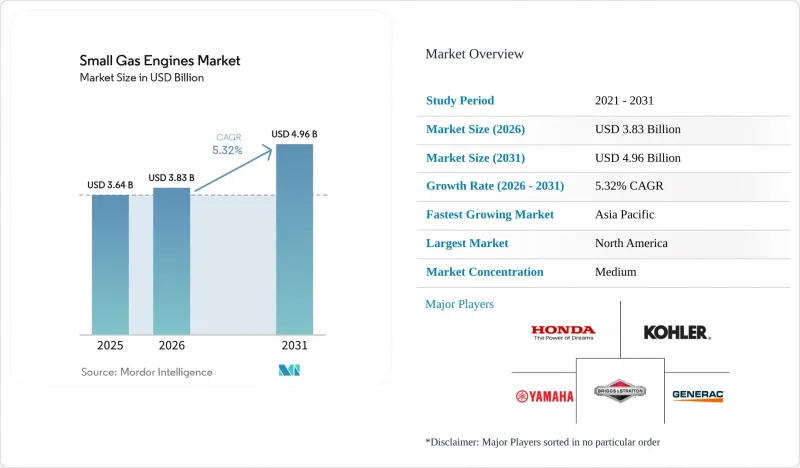
Mordor Intelligence에 의하면, 2026년 소형 가스 엔진 시장 규모는 38억 3,000만 달러에 달할 것으로 추정됩니다. 2025년 36억 4,000만 달러에서 성장하여 2031년에는 49억 6,000만 달러에 이를 것으로 예측됩니다.
2026년부터 2031년까지의 연평균 성장률(CAGR)은 5.32%를 나타낼 것으로 전망됩니다.
본 보고서는 배기량(20-100cc, 101-400cc, 401-650cc), 기기 유형(잔디깎이, 전기톱/트리머/블로어, 휴대용 발전기, 고압 세척기/펌프/스크리드), 용도별(주거용 원예·야외 작업 기기, 산업용, 건설 기계), 지역별(북미, 유럽, 아시아태평양, 남미, 중동 및 아프리카)로 분류되어 있습니다.
세계의 소형 가스 엔진 시장 동향과 인사이트
팬데믹 이후의 DIY 및 잔디 관리 붐이 OPE 엔진 수요를 견인하고 있습니다.
2024년에 시작된 주택 개조에 대한 열의는 주택 소유자들이 잔디 관리를 지속적인 취미이자 자산 가치 향상의 수단으로 여기게 됨에 따라 여전히 이어지고 있습니다. 교외 지역 소비자들이 노후된 기기를 기존 기준보다 빨리 교체함에 따라, 중출력(101-400cc) 엔진을 탑재한 손수레식 및 승용형 잔디깎기의 판매는 계속해서 높은 수준을 유지하고 있습니다. 판매점을 대상으로 한 조사에 따르면, 주요 잔디깎이 모델의 경우 초봄에 14-21일 분량의 재고 부족이 발생했으며, 이는 공급망이 정상화되었음에도 불구하고 누적된 수요가 계속되고 있음을 시사합니다. 한편, 전문 조경 업체 측에서는 노동 시장 부족으로 인해 장비의 신뢰성이 매우 중요해짐에 따라 장비 교체 빈도가 높아지고 있다는 보고도 접수되고 있습니다. 브릭스 앤 스트래튼사가 V-트윈 밴가드의 생산 거점을 일본에서 조지아주 및 앨라배마주로 이전한 것은 중기적으로 북미 수요가 구조적으로 높은 수준을 유지할 것이라는 해당 회사의 확신을 뒷받침하는 것입니다.
기상 이변으로 인한 휴대용 발전기 구매 증가
2024년 첫 9개월 동안 전력망 장애로 인한 정전 시간은 총 12억 시간에 달했으며, 이로 인해 휴대용 발전기의 도입이 기존의 허리케인 및 산불 시즌을 넘어 확대되었습니다. 현재 소비자들은 연중 내내 소형 가솔린 발전기를 구매하고 있으며, 이로 인해 유통업체의 재고 보충 주기가 단축되고 있습니다. 제네락사는 2024년 4분기 가정용 발전기 매출이 28% 급증함에 따라, 연간 출하 전망치를 3차례 상향 조정했습니다. NOAA가 발표한 2024-2025년 겨울 라니냐 현상 전망은 기상 조건으로 인한 수요가 더욱 급증할 것임을 시사하고 있으며, 가정과 중소기업이 배터리 사용 시간 제한보다 즉각적인 연료 보급의 편의성을 우선시함에 따라 소형 가스 엔진 시장을 강화하고 있습니다.
5단계/CARB Tier-5 배기가스 규제에 따른 대응 비용
2029년부터 시행되는 Tier-5 규정에 따르면, 소형 엔진의 경우 NOx를 90%, 미세먼지 배출량을 최대 75%까지 감축해야 하며, 이로 인해 인증 비용이 증가하고 코팅 기판이나 전자 진단 장치 등 고가의 자재 사용이 요구되고 있습니다. 사내 시험 시설이나 소프트웨어 보정 팀을 갖추지 못한 소규모 브랜드는 단위당 적합 비용이 과도하게 높아져, 시장에서 철수하거나 전략적인 라이선스 계약을 체결해야 하는 상황에 직면하고 있습니다. 2020년 콜라(Kolla)사가 부정 장치 혐의로 CARB와 600만 달러의 합의에 도달한 것은 규제 당국의 감시가 강화되고 있음을 보여주며, 규제 미준수로 인한 재무적 위험을 여실히 드러내고 있습니다. 이러한 요인들로 인해, 다연료 포트폴리오 전체에 걸쳐 연구개발비를 상각할 수 있는 주요 제조업체를 중심으로 시장 점유율이 집중되는 경향이 있습니다.
부문별 분석
101-400cc급은 2025년 매출의 46.30%를 차지했습니다. 이 카테고리는 여전히 균형 잡힌 출력 대 중량 비율이 필수적인 수동식 잔디깎기, 휴대용 발전기 및 소형 현장용 장비를 뒷받침하고 있습니다. 소형 가스 엔진 시장에서 이 부문은 전자식 스로틀 바디와 산소 센서를 추가한 후에도 단위당 비용을 낮게 유지할 수 있는 성숙한 공급망의 혜택을 누리고 있습니다. 각 OEM 업체들은 5시간 이상의 연속 주행에 이르는 고부하 조건에서 전동화 기술의 발전만으로는 아직 동등한 토크나 연료 공급 속도를 실현하지 못하고 있기 때문에 이 배기량 대역을 연구 개발의 우선 대상으로 삼고 있습니다. 혼다의 iGX 시리즈 연료 분사 시스템의 도입은 규제가 강화되는 가운데, 연소 기술의 개선이 어떻게 엔진의 유용성을 유지하고 있는지를 보여주고 있습니다.
20-100cc급의 경우, 시장 점유율은 비교적 낮은 편이지만 2031년까지 연평균 성장률(CAGR) 6.12%로 확대될 것으로 예측되며, 소형 가스 엔진 시장 내에서 가장 높은 성장률을 보일 것으로 전망됩니다. 이러한 성장은 가볍고 휴대하기 편한 인버터 발전기에 대한 수요 증가와 신흥 시장에서 마이크로 경운기 및 백팩식 분무기의 보급 확대에 따라 좌우됩니다. 또한, 이 부문은 배터리 제품에 의한 시장 잠식을 가장 크게 받고 있으며, 이에 따라 각 엔진 제조업체들은 퀵 스타트 시스템, 에탄올 대응 기화기, 그리고 비용 효율이 높은 촉매 패키지의 개발에 주력하고 있습니다. 반면, 401-650cc급의 경우, 업무용 제로턴 모어나 비상용 발전기가 주요 용도로 사용되며, 고가 제품군이기 때문에 배기가스 규제 대응 시스템의 비용을 상쇄하여, 더욱 엄격한 규제 하에서도 양호한 이익률을 유지할 수 있습니다.
지역별 분석
북미 수요는 부지 면적, 비상시 대비, 그리고 즉시 연료를 보급할 수 있는 편의성에 대한 소비자들의 뿌리 깊은 선호에 계속해서 좌우되고 있습니다. 보행형 부문에서는 무선 제품의 채택이 증가하고 있음에도 불구하고, 소형 가스 엔진은 여전히 신규 판매되는 승용 잔디깎이의 70%에서 주요 동력원으로 사용되고 있습니다. 2024년 첫 9개월 동안 누적 12억 시간의 정전 시간이 기록된 것에서도 알 수 있듯이, 전력망의 불안정성으로 인해 휴대용 발전기 재고는 연중 내내 부족해졌으며, 소매업체들은 추가적인 선적 재고를 확보해야 하는 상황에 몰리고 있습니다. OEM 각사가 EPA 3단계 휘발성 배출 가스 기준을 준수한 결과, 부품 비용은 상승했으나 품질은 향상되었으며, 국내 브랜드에 대한 충성도가 높아지고 있습니다. CARB Tier 5 제안이 최종 확정될 경우, 증발성 배기가스 캐니스터의 용량 확대 및 내구성 보증이 의무화될 가능성이 높으며, 이는 여러 출력 등급에 걸쳐 규정 준수 비용을 분산할 수 있는 대형 기존 제조업체들에게 유리하게 작용할 것입니다.
건설성이 수년에 걸친 도시 철도, 도로, 공항 현대화 계획에 주력하는 가운데, 아시아태평양은 가장 빠르게 성장하는 지역으로서의 역할을 더욱 공고히 하고 있습니다. 후처리 장치에 부과되는 수입 관세가 디젤의 총 소유 비용을 상승시키고 있기 때문에 미니 굴삭기나 현장용 발전기 분야에서 가스 엔진이 소형 디젤 엔진 시장 점유율을 빼앗고 있습니다. 중국, 인도, 태국의 도시 외곽 지역에서는 중산층 정원 소유자가 늘어나고 있으며, 125-160cc 엔진을 탑재한 로터리 잔디깎이 및 트리머의 출하 대수가 증가하고 있습니다. 인도의 기계 산업을 위한 생산 연계형 인센티브 제도 등 국내 부품 현지화 프로그램은 크랭크샤프트 단조 및 실린더 블록 주조 능력을 향상시켜 지역 공급망을 구축하는 동시에 리드타임을 90일에서 45일로 단축하고 있습니다. 제너랙(Generac)의 인도 합작회사는 2027년까지 조립 생산량이 연평균 35% 증가할 것으로 전망하고 있으며, 이는 현지 사업 확장의 전략적 중요성을 여실히 보여주고 있습니다.
유럽에서는 절대적인 판매 대수가 감소하고 있지만, 스테이지 V 규제의 기준이 다른 지역의 향후 규제 모델이 되고 있기 때문에 규제 측면에서의 영향력은 매우 크다고 할 수 있습니다. STIHL(슈틸)은 독일 내 배터리 셀 생산을 확대하여 2027년까지 휴대용 공구 생산의 4분의 1을 무선 방식으로 전환하는 것을 목표로 하고 있지만, 고출력 제로턴 잔디깎기나 등반용 임업용 윈치는 여전히 가스 엔진에 의존하고 있습니다. 제로 에미션 조경에 대한 정부의 보조금은 지자체의 소음 규제와 맞물려 도심 지역의 내연기관 대체를 가속화하고 있습니다. 그러나 배터리 에너지 밀도가 여전히 부족한 지역에서는 지방 자치단체나 고지대 지역에서 가솔린식 제설기나 그루터기 분쇄기 구매가 계속되고 있습니다. 유로와 달러의 환율 변동으로 인해, EU 역외에서 알루미늄 주물을 조달할 때 유럽 OEM 업체들의 이익률이 압박을 받고 있어, EU 역내 제련소와의 계약이 증가하고 있습니다.
기타 혜택 :
- 엑셀 형식 시장 예측(ME) 시트
- 3개월간의 애널리스트 지원
자주 묻는 질문
목차
제1장 서론
제2장 조사 방법
제3장 주요 요약
제4장 시장 구도
제5장 시장 규모 및 성장 예측
제6장 경쟁 구도
제7장 시장 기회 및 향후 전망
KTH 26.06.22According to Mordor Intelligence, small gas engines market size in 2026 is estimated at USD 3.83 billion, growing from 2025 value of USD 3.64 billion with 2031 projections showing USD 4.96 billion, growing at 5.32% CAGR over 2026-2031.
This report is Segmented by Engine Displacement (20 To 100cc, 101 To 400cc, and 401 To 650cc), Equipment Type (Lawnmower, Chainsaw/Trimmer/Blower, Portable Generator, and Pressure Washer/Pump/Screed), End-Use Sector (Residential Gardening and OPE, Industrial, and Construction Equipment), and Geography (North America, Europe, Asia-Pacific, South America, and Middle East and Africa).
Global Small Gas Engines Market Trends and Insights
Post-pandemic DIY & Lawn-Care Boom Fuels OPE Engine Demand
The home-improvement enthusiasm that began in 2024 endures as homeowners position lawn maintenance as a recurring hobby and a property value enhancer. Sales of push and ride-on mowers with mid-range 101-400 cc engines remain elevated as suburban consumers replace their ageing fleets sooner than historical norms. Dealer surveys indicate spring stockouts of 14-21 days for key mower models, suggesting a persistent backlog despite the normalization of supply chains. Professional landscaping firms simultaneously report higher equipment turnover because tighter labor markets make reliability critical. Briggs & Stratton's relocation of V-Twin Vanguard production from Japan to Georgia and Alabama underscores confidence that North American demand will remain structurally higher over the medium term.
Extreme-Weather-Driven Rise in Portable-Generator Purchases
Grid disruptions totaled 1.2 billion outage hours during the first nine months of 2024, driving the adoption of portable generators beyond traditional hurricane and wildfire seasons. Consumers now purchase small gas generator sets throughout the calendar year, compressing replenishment cycles for distributors. Generac posted a 28% surge in Q4 2024 residential generator revenue and lifted shipment guidance three times over the year. NOAA's La Nina outlook for the 2024-2025 winter signals further weather-linked demand spikes, strengthening the small gas engine market as households and small businesses prioritize immediate refueling ease over battery runtime limits.
Stage V / CARB Tier-5 Emission Compliance Costs
Upcoming Tier-5 regulations mandate 90% NOx and up to 75% particulate cuts for compact engines beginning in 2029, raising certification expenses and compelling costlier materials such as coated substrates and electronic diagnostics. Smaller brands lacking in-house test cells and software calibration teams confront disproportionate per-unit compliance costs, prompting either exit or strategic licensing. Kohler's USD 6 million settlement with CARB in 2020 over defeat-device allegations signals increasing enforcement scrutiny and underscores the financial exposure associated with non-compliance. These factors consolidate volume around players able to amortize R&D across multi-fuel portfolios.
Other drivers and restraints analyzed in the detailed report include:
- Emerging-Market Construction Rebound (2025-2028)
- Gas Powertrains Replacing Small Diesels in UTV/Compact Equipment
- Rapid Shift to Battery-Powered OPE in Mature Economies
For complete list of drivers and restraints, kindly check the Table Of Contents.
Segment Analysis
The 101-400 cc bracket retained 46.30% of 2025 revenue as the category underpins walk-behind mowers, portable generators, and compact site equipment where balanced power-to-weight remains essential. This slice of the small gas engine market benefits from mature supply chains that keep per-unit costs low even after adding electronic throttle bodies and oxygen sensors. OEMs prioritize this range for R&D because electrification advances have yet to deliver equivalent torque and refill speed under heavy load profiles spanning five or more hours of continuous operation. Honda's iGX-series fuel-injection roll-out illustrates how combustion refinement extends engine relevance amid tightening standards.
The 20-100 cc tier, while contributing a more modest share, is projected to compound at 6.12% through 2031, the fastest inside the small gas engine market. Growth hinges on heightened demand for light portable inverter generators and emerging-market uptake of micro-tillers and backpack sprayers. This category also feels the strongest battery encroachment, which prompts engine makers to emphasize quick-start systems, ethanol-compatible carburetors, and cost-effective catalyst packages. In contrast, the 401-650 cc range caters to commercial zero-turn mowers and standby generators, where higher ticket prices help offset compliance-system costs, preserving positive margins even under stricter standards.
Geography Analysis
North American demand continues to hinge on property size, emergency preparedness, and entrenched consumer preference for immediate refueling convenience. Small gas engines remain the power source of choice for 70% of new riding-mower sales despite rising cordless adoption in walk-behind categories. Grid instability, evidenced by a cumulative 1.2 billion outage hours logged during the first nine months of 2024, keeps portable-generator shelves thin year-round, prompting retailers to secure additional forward inventory. OEM adherence to EPA Phase III evaporative standards raises component cost but tightens quality, reinforcing domestic brand loyalty. CARB Tier-5 proposals, when finalized, will likely compel additional evaporative-emission canister capacity and durability warranties, favoring larger incumbents that can amortize compliance engineering across multiple power classes.
Asia-Pacific's role as the fastest-growing region intensifies as construction ministries commit to multi-year urban rail, road, and airport modernization plans. Gasoline engines claim share from small diesels in mini excavators and site generators because import duties on after-treatment hardware inflate diesel total cost of ownership. Middle-class yard ownership expands in peri-urban China, India, and Thailand, raising shipments of rotary mowers and trimmers fitted with 125-160 cc engines. Domestic component localization programs, such as India's Production-Linked Incentive scheme for machinery, catalyze crankshaft forging and cylinder-block casting capacity, anchoring regional supply chains and reducing lead times from 90 to 45 days. Generac's Indian joint venture expects to grow assembly output by 35% annually through 2027, underscoring the strategic importance of local presence.
Europe records lower absolute unit volumes yet exerts outsized regulatory influence because Stage V limits have become the template for forthcoming rules elsewhere. STIHL's German battery cell expansion aims to shift one-quarter of handheld tool production to cordless formats by 2027, but high-powered zero-turn mowers and hill-climb forestry winches still rely on gasoline engines. Government subsidies for zero-emission landscaping converge with municipality noise bylaws, accelerating combustion displacement in urban cores. However, rural municipalities and alpine regions continue purchasing gas-powered snowblowers and stump grinders where battery energy density remains inadequate. Currency fluctuations between EUR and USD tighten European OEM margins when sourcing aluminum castings from outside the bloc, prompting more in-region smelter contracts.
- Briggs & Stratton Corp.
- Kohler Co.
- Honda Motor Co. Ltd.
- Yamaha Motor Corp.
- Kawasaki Heavy Industries
- Kubota Corp.
- Generac Holdings Inc.
- Husqvarna Group
- Deere & Company
- Champion Power Equipment
- Cummins Inc. (Onan)
- Loncin Motor Co.
- LCT (Liquid Combustion Technology)
- STIHL Group
- Toro Company
- Atlas Copco AB
- Caterpillar Inc.
- Wacker Neuson SE
- Subaru Industrial Power (Robin)
- MTD Products (Stanley Black & Decker)
Additional Benefits:
- The market estimate (ME) sheet in Excel format
- 3 months of analyst support
TABLE OF CONTENTS
1 Introduction
- 1.1 Study Assumptions & Market Definition
- 1.2 Scope of the Study
2 Research Methodology
3 Executive Summary
4 Market Landscape
- 4.1 Market Overview
- 4.2 Market Drivers
- 4.2.1 Post-pandemic DIY & lawn-care boom fuels OPE engine demand
- 4.2.2 Extreme-weather-driven rise in portable-generator purchases
- 4.2.3 Emerging-market construction rebound (2025-2028)
- 4.2.4 DIY "repower" kits lengthen equipment life cycles
- 4.2.5 Gas powertrains replacing small diesels in UTV/compact equipment
- 4.2.6 Off-grid recreational power surge (RV & camping)
- 4.3 Market Restraints
- 4.3.1 Stage V / CARB Tier-5 emission compliance costs
- 4.3.2 Rapid shift to battery-powered OPE in mature economies
- 4.3.3 Tariffs on Chinese lawn & garden equipment inflate prices
- 4.3.4 Shortage of certified small-engine technicians globally
- 4.4 Supply-Chain Analysis
- 4.5 Regulatory Landscape
- 4.6 Technological Outlook
- 4.7 Porter's Five Forces
- 4.7.1 Threat of New Entrants
- 4.7.2 Bargaining Power of Suppliers
- 4.7.3 Bargaining Power of Consumers
- 4.7.4 Threat of Substitute Products
- 4.7.5 Intensity of Competitive Rivalry
5 Market Size & Growth Forecasts
- 5.1 By Engine Displacement
- 5.1.1 20 to 100 cc
- 5.1.2 101 to 400 cc
- 5.1.3 401 to 650 cc
- 5.2 By Equipment Type
- 5.2.1 Lawnmower
- 5.2.2 Chainsaw/Trimmer/Blower
- 5.2.3 Portable Generator
- 5.2.4 Pressure Washer/Pump/Screed
- 5.3 By End-Use Sector
- 5.3.1 Residential Gardening and OPE
- 5.3.2 Industrial (Portable Power, Pumps, Welding)
- 5.3.3 Construction Equipment
- 5.4 By Geography
- 5.4.1 North America
- 5.4.1.1 United States
- 5.4.1.2 Canada
- 5.4.1.3 Mexico
- 5.4.2 Europe
- 5.4.2.1 Germany
- 5.4.2.2 United Kingdom
- 5.4.2.3 France
- 5.4.2.4 Italy
- 5.4.2.5 NORDIC Countries
- 5.4.2.6 Russia
- 5.4.2.7 Rest of Europe
- 5.4.3 Asia-Pacific
- 5.4.3.1 China
- 5.4.3.2 India
- 5.4.3.3 Japan
- 5.4.3.4 South Korea
- 5.4.3.5 ASEAN Countries
- 5.4.3.6 Rest of Asia-Pacific
- 5.4.4 South America
- 5.4.4.1 Brazil
- 5.4.4.2 Argentina
- 5.4.4.3 Rest of South America
- 5.4.5 Middle East and Africa
- 5.4.5.1 Saudi Arabia
- 5.4.5.2 United Arab Emirates
- 5.4.5.3 South Africa
- 5.4.5.4 Egypt
- 5.4.5.5 Rest of Middle East and Africa
- 5.4.1 North America
6 Competitive Landscape
- 6.1 Market Concentration
- 6.2 Strategic Moves (M&A, Partnerships, PPAs)
- 6.3 Market Share Analysis (Market Rank/Share for key companies)
- 6.4 Company Profiles (includes Global level Overview, Market level overview, Core Segments, Financials as available, Strategic Information, Products & Services, and Recent Developments)
- 6.4.1 Briggs & Stratton Corp.
- 6.4.2 Kohler Co.
- 6.4.3 Honda Motor Co. Ltd.
- 6.4.4 Yamaha Motor Corp.
- 6.4.5 Kawasaki Heavy Industries
- 6.4.6 Kubota Corp.
- 6.4.7 Generac Holdings Inc.
- 6.4.8 Husqvarna Group
- 6.4.9 Deere & Company
- 6.4.10 Champion Power Equipment
- 6.4.11 Cummins Inc. (Onan)
- 6.4.12 Loncin Motor Co.
- 6.4.13 LCT (Liquid Combustion Technology)
- 6.4.14 STIHL Group
- 6.4.15 Toro Company
- 6.4.16 Atlas Copco AB
- 6.4.17 Caterpillar Inc.
- 6.4.18 Wacker Neuson SE
- 6.4.19 Subaru Industrial Power (Robin)
- 6.4.20 MTD Products (Stanley Black & Decker)
7 Market Opportunities & Future Outlook
- 7.1 White-space & Unmet-Need Assessment