

|
시장보고서
상품코드
2061700
인플루엔자 백신 : 시장 점유율 분석, 업계 동향 및 통계, 성장 예측(2026-2031년)Influenza Vaccine - Market Share Analysis, Industry Trends & Statistics, Growth Forecasts (2026 - 2031) |
||||||
 Mordor Intelligence
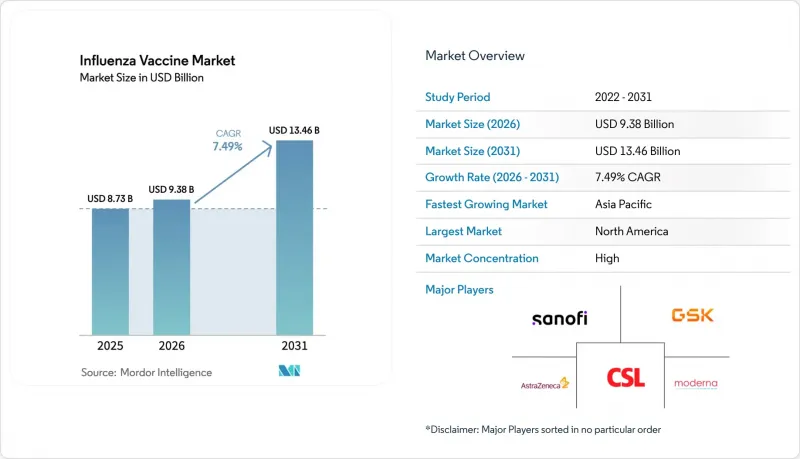
Mordor Intelligence에 의하면, 인플루엔자 백신 시장 규모는 2025년에 87억 3,000만 달러로 평가되었습니다. 2026년 93억 8,000만 달러에서 2031년까지 134억 6,000만 달러에 이를 것으로 예상되며, 예측 기간(2026-2031년) CAGR은 7.49%를 나타낼 전망입니다.
본 보고서는 백신의 유형(4가, 3가 등), 제형(불활성화, 약독화 생백신 등), 연령대(소아, 성인), 투여 경로(주사, 비강 스프레이), 유통 채널(병원 및 진료소, 약국 등), 지역(북미, 유럽, 아시아태평양 등)별로 분류되어 있습니다. 시장 전망은 금액(달러) 기준으로 제시되어 있습니다.
세계의 인플루엔자 백신 시장 동향과 인사이트
정부 주도의 예방접종 목표와 조달 확대
인플루엔자 백신 시장에서 각국의 조달 프로그램은 일반적인 계절별 발주에서 팬데믹에 대비하기 위한 전략적 비축으로 전환되고 있습니다. 미국 정부가 모더나(Moderna)사에 mRNA 팬데믹 인플루엔자 후보 백신 개발을 위해 1억 7,600만 달러를 지원한 것은 이러한 변화를 여실히 보여주고 있습니다. 또한, 영국 정부가 CSL Seqirus사로부터 500만 회분 이상의 H5N1 백신을 구매한 것은 영국에서도 이와 같은 입장을 보였음을 의미합니다. 오타와도 이에 발맞추어 GSK사의 Arepanrix H5N1 백신 50만 회분을 확보하며, 북미의 팬데믹 대응 전략을 통일했습니다. 현재 각국 정부는 인플루엔자 백신을 단순한 공중보건 필수품이 아닌 안보상의 자산으로 간주하고 있습니다. 세계보건기구(WHO)의 ‘세계 행동 계획’은 2016년까지 팬데믹 대응 능력을 연간 13억 회분으로 확대함으로써, 오늘날의 더 대규모 조달 계획의 토대를 마련했습니다.
세포 배양 및 재조합 기술을 기반으로 한 생산 플랫폼의 급속한 확산
각 제조업체는 인플루엔자 백신 시장 전체공급 안정성과 백신의 성능을 향상시키기 위해, 계란 기반 방식에서 벗어나 생산 방식의 다양화를 추진하고 있습니다. CSL Seqirus의 데이터에 따르면, 2022-23년 시즌에 세포 배양 유래 제품은 여러 연령대에서 난자 유래 비교 대상 제품보다 우수한 성능을 보였습니다(SEQIRUS.COM). 모더나(Moderna)의 호주 신규 공장은 남반구 유일의 호흡기 백신 전용 mRNA 제조 시설로, 연간 1억 회분을 공급할 수 있게 됨으로써 첨단 플랫폼의 지리적 보급 범위를 확대할 것입니다. WHO의 mRNA 기술 이전 프로그램은 기존 방식과는 다른 제조 방법에 대한 제도적 지원을 더욱 시사하고 있습니다. 그럼에도 불구하고 전 세계 생산량의 80% 이상은 여전히 계란에서 비롯되며, 이는 현재 진행 중인 변화의 규모를 여실히 보여주고 있습니다.
차세대 백신을 위한 대규모 임상 및 제조 투자
선진적인 플랫폼으로의 전환에는 자본 집약적인 임상시험과 시설 업그레이드가 필요합니다. 노바백스의 코로나19와 독감 병용 요법에 대한 3상 임상시험만으로도 2025 회계연도에 5억 달러의 임상시험 비용이 소요되었습니다. 난자 기반 공장을 세포 배양 또는 mRNA 시스템으로 전환하는 데는 수십억 달러의 비용이 소요될 수 있는 반면, CSL의 117억 달러 규모 Vifor 인수는 기존 모델을 넘어 다각화를 추구하는 기업의 투자 규모를 여실히 보여주고 있습니다. 복잡한 규제 절차로 인해 개발 일정이 지연되고 있어, mRNA 기술을 활용한 인플루엔자 후보 백신은 코로나19 백신 개발의 성공에도 불구하고 여전히 3상 임상시험 단계에 머물러 있습니다. 중소기업은 이러한 거액의 자금 조달에 어려움을 겪는 경우가 많으며, 그 결과 자금력이 있는 기존 기업 간의 통합이 가속화될 가능성이 있습니다.
부문별 분석
3가 백신은 2025년 매출의 28.32%를 차지했으나, 규제 조정에 따라 B/야마가타 균주가 제외된 이후 현재는 연평균 성장률(CAGR) 7.81%를 기록하며 해당 부문에서 가장 빠른 성장세를 보이고 있습니다. 4가 백신은 여전히 매출의 대부분을 차지하고 있지만, 보험사 등이 불활성화 백신의 필요성에 의문을 제기함에 따라 그 점유율은 서서히 줄어들고 있습니다. 각 제조업체는 2024-25년 시즌에 맞추어 공급을 준비하기 위해 검증 시험을 가속화하고, 공급의 지속성을 확보하기 위한 유연한 원액 생산 능력을 보여주었습니다. 신흥국에서는 공공 조달 시 저비용의 3가 백신을 선호하는 경향이 있어, 3가 인플루엔자 백신 시장 규모는 확대될 것으로 예측됩니다. 고령자를 대상으로 한 고용량 및 보조제 함유 3가 백신은 시장 규모를 더욱 확대할 것입니다. 반면, 4가 백신은 프리미엄 위치를 유지하기 위해 호흡기 세포융합 바이러스(RSV) 및 코로나19 항원을 결합한 복합형으로 전환될 전망입니다.
생산량의 변동은 특히 수정란과 같은 원자재 조달에 영향을 미치지만, 3가 백신 제조에는 필요한 달걀의 수가 적기 때문에 가격 안정으로 이어질 가능성이 있습니다. 또한, 이러한 전환을 통해 충전 및 마무리 공정의 복잡성이 줄어들어, 비수기에는 해당 라인을 다른 생물학적 제제 생산에 활용할 수 있게 됩니다. 공급업체에는 단기적인 혼란이 발생할 수 있지만, CDC(미국 질병통제예방센터)의 명확한 지침 덕분에 대체품의 오용은 최소화되고 있습니다. 세계보건기구는 변이 바이러스에 대한 백신 효과율이 향상될 것으로 전망하고 있으며, 이에 따라 백신 접종 후 감염 위험이 감소하고 백신 접종에 대한 신뢰가 강화될 것으로 보입니다. 이러한 장점이 구체화됨에 따라, 인플루엔자 백신 시장에서는 조성의 단순화 및 유효성의 차이를 입증하는 근거를 반영하여 가격대가 재조정될 가능성이 높다고 볼 수 있습니다.
불활성화 백신은 2025년 매출의 90.95%를 차지했으며, 독자적인 세포 배양형 및 재조합형 백신이 조달 목록에 포함됨에 따라 연평균 성장률(CAGR) 7.71%로 성장을 지속하고 있습니다. 규제 측면에서 높은 인지도와 콜드체인 적합성이 병원 내 발주 추세를 뒷받침하고 있습니다. 이 카테고리에서는 세포 유래 항원이 난자 적응 변이를 회피함으로써 효능을 높여, 높은 가격의 입찰을 뒷받침하고 있습니다. Flublok과 같은 재조합 HA 제제는 리드 타임을 단축하고 오염 위험을 줄여주므로, 팬데믹 대응에 있어 전략적 가치를 제공합니다.
생백신 제제는 금기 사항으로 인해 성인 접종률은 낮은 편이지만, 가정용 비강 스프레이를 통해 새로운 활로를 모색하고 있습니다. 한편, 개발 중인 mRNA 후보 약물은 2026년 이후 승인을 목표로 하고 있습니다. 초기 시험 결과에 따르면, A형 균주에 대해서는 이미 승인된 비교 대상 제품과 동등한 효과를 보였으나, B형 계통에 대해서는 반응이 미약하여 제제의 미세 조정이 필요한 것으로 나타났습니다. 성공할 경우, mRNA 백신은 제조 기간을 몇 주로 단축하고, 전환 비용을 대폭 절감하며, 지역별 수요에 맞춘 구성 조정이 가능해질 수 있습니다. 따라서 이해관계자들은 향후 기술 노후화를 방지하기 위해 현재 설비 투자를 검토하고 있으며, 이러한 결정이 인플루엔자 백신 시장 전체의 자본 배분에 영향을 미치고 있습니다.
지역별 분석
북미는 CDC의 보편적 권고, 보험 적용 의무화, 그리고 기업 내 진료소 덕분에 2025년 매출의 47.10%를 차지했습니다. 미국은 대규모 구매와 신속한 유통을 병행하고 있습니다. 캐나다는 GSK와의 계약을 통해 국내 생산을 보완하고, 50만 회분의 팬데믹용 백신을 확보하는 한편, 캐나다-미국 규제협력협의회를 통해 규제 심사의 일관성을 도모하고 있습니다. 멕시코는 USMCA를 활용하여 국경을 넘는 항원 수송을 효율화하고, 북미 전역의 공동 대비를 지원하고 있습니다.
아시아태평양은 연평균 성장률(CAGR) 7.92%로 성장하고 있습니다. WHO 동남아시아 지역의 총 11개국은 현재 국가 인플루엔자 센터를 설치하여 감시 체계와 바이러스 균주 선별이 개선되었습니다. 2024년 하반기 중국의 이례적인 시즌 동안 시기적 차가 뚜렷이 드러났으나, 제조업체들은 로트별 단계적 출하를 통해 이에 대응함으로써 적응력 있는 공급망의 중요성을 부각시켰습니다. 일본은 수십 년에 걸친 피하 투여 우선 정책을 거쳐, 근육 내 투여를 권장하게 되었으며, 이를 통해 투여의 유효성을 높이는 동시에 전 세계 프로토콜의 표준화를 도모했습니다. 호주의 mRNA 공장은 전 지구적 공급 위험을 완화하고 동남아시아로의 수출도 가능하게 함으로써, 해당 지역이 북반구의 생산에 대한 의존도를 낮출 수 있을 것으로 기대됩니다.
유럽은 높은 백신 접종률을 보이고 있지만, 인구 증가의 정체에 직면해 있습니다. EMA(유럽의약품청)의 승인 일원화는 국경을 초월한 거래를 촉진하고 있으며, 영국은 브렉시트 이후에도 500만 회분 H5N1 백신의 조기 입찰을 통해 계속해서 대규모 비축을 이어가고 있습니다. 중동 및 아프리카은 다소 뒤처져 있지만, Gavi의 생산 촉진 프로그램의 혜택을 받고 있어, 이를 통해 계절성 및 팬데믹 상황 모두에 대응할 수 있는 생산 능력을 확보할 수 있을 것으로 보입니다. 남미에서는 호흡기계 팬데믹 대응 계획을 검증하는 PAHO(범미보건기구)의 시뮬레이션 훈련을 통해 대비 태세를 구축하고 있습니다. 이러한 추세가 맞물려 수요가 다양화됨에 따라, 인플루엔자 백신 시장은 특정 지역에 대한 의존도를 낮추고 있습니다.
기타 혜택 :
- 엑셀 형식 시장 예측(ME) 시트
- 3개월간의 애널리스트 지원
자주 묻는 질문
목차
제1장 서론
제2장 조사 방법
제3장 주요 요약
제4장 시장 구도
제5장 시장 규모 및 성장 예측
제6장 경쟁 구도
제7장 시장 기회 및 향후 전망
KTH 26.06.19According to Mordor Intelligence, the influenza vaccine market size was valued at USD 8.73 billion in 2025 and is estimated to grow from USD 9.38 billion in 2026 to reach USD 13.46 billion by 2031, at a CAGR of 7.49% during the forecast period (2026-2031).
This report is Segmented by Vaccine Type (Quadrivalent, Trivalent, and More), Form (Inactivated, Live Attenuated, and More), Age Group (Pediatric, Adults), Route of Administration (Injection, Nasal Spray), Distribution Channel (Hospitals & Clinics, Pharmacies, and More), and Geography (North America, Europe, Asia Pacific, and More). The Market Forecasts are Provided in Terms of Value (USD).
Global Influenza Vaccine Market Trends and Insights
Escalating Government-Funded Immunization Targets & Procurement
National procurement programs have moved beyond routine seasonal ordering toward strategic stockpiling for pandemic readiness in the influenza vaccine market. Washington's USD 176 million award to Moderna for an mRNA pandemic-influenza candidate underscores this shift, while London's purchase of more than 5 million H5N1 doses from CSL Seqirus signals a similar stance in the United Kingdom. Ottawa followed suit by securing 500,000 doses of GSK's Arepanrix H5N1, aligning North American preparedness strategies. Governments now frame influenza vaccines as security assets rather than basic public-health inputs. The World Health Organization's Global Action Plan expanded collective pandemic capacity to 1.3 billion doses a year by 2016, laying the groundwork for today's larger procurement ambitions.
Rapid Adoption of Cell- and Recombinant-Based Production Platforms
Manufacturers are diversifying beyond egg-based methods to improve supply security and vaccine performance across the influenza vaccine market. Data from CSL Seqirus show cell-based products outperformed egg-derived comparators across several age groups during the 2022-23 season [SEQIRUS.COM]. Moderna's new Australian plant, the Southern Hemisphere's only dedicated mRNA facility for respiratory vaccines, will be able to supply 100 million doses annually, broadening geographic reach for advanced platforms. The WHO's mRNA Technology Transfer Program further signals institutional support for non-traditional production. Even so, more than 80% of global output still originates from chicken eggs, underscoring the scale of change now under way.
High Clinical & Manufacturing Investment for Next-Gen Vaccines
Switching to advanced platforms demands capital-intensive trials and facility upgrades influenza vaccines market. Novavax's Phase 3 COVID-influ combo study alone carries a USD 500 million clinical bill for fiscal 2025. Converting egg-based plants to cell-based or mRNA systems can cost multiple billions, while CSL's USD 11.7 billion Vifor deal illustrates the scale of corporate outlays aimed at diversifying beyond legacy models. Complex regulatory pathways stretch timelines; mRNA flu candidates remain in Phase 3 despite the technology's COVID-19 success. Smaller firms often struggle to raise such sums, which may accelerate consolidation among cash-rich incumbents.
Other drivers and restraints analyzed in the detailed report include:
- Expanding Geriatric High-Risk Population Base
- Heightened Pandemic-Preparedness Stockpiling Budgets
- Persistent Vaccine Hesitancy & Misinformation
For complete list of drivers and restraints, kindly check the Table Of Contents.
Segment Analysis
Trivalent products captured 28.32% of sales in 2025 but now post the segment's quickest expansion at 7.81% CAGR after regulatory alignment removed B/Yamagata. Quadrivalents still dominate revenue yet face gradual erosion as payers question the necessity of an inactive lineage. Manufacturers accelerated validation runs to meet the 2024-25 season, demonstrating flexible bulk-antigen capacities that safeguard supply continuity. The influenza vaccines market size for trivalent doses is expected to widen as emerging economies prefer lower-cost three-strain presentations for public tenders. High-dose and adjuvanted trivalent versions aimed at seniors will further boost value. In contrast, quadrivalent offerings will pivot to combination formats, bundling respiratory syncytial virus or COVID-19 antigens to maintain premium positioning.
Volume swings affect raw-material procurement, notably embryonated eggs, potentially stabilizing prices as trivalent output requires fewer eggs. The transition also reduces fill-finish complexity, freeing line time for other biologics during off-peak months. While providers may face short-term confusion, clear CDC guidance has minimized substitution errors. Global health agencies anticipate improved strain match rates, lowering breakthrough infection risk and reinforcing trust in vaccination. As these benefits materialize, the influenza vaccines market will likely recalibrate pricing tiers to reflect simplified compositions and differential effectiveness evidence.
Inactivated vaccines represented 90.95% of 2025 sales yet also record a 7.71% CAGR as proprietary cell-based and recombinant versions enter tender lists. Their broad regulatory familiarity and cold-chain compatibility sustain hospital ordering preferences. Within this class, cell-derived antigens circumvent egg-adaptation mutations, lifting effectiveness and supporting premium bids. Recombinant HA constructs, such as Flublok, shorten lead times and reduce contamination risk, offering strategic value for pandemic pivoting.
Live attenuated solutions lag in adult uptake due to contraindications but gain new life via at-home nasal sprays. Meanwhile, pipeline mRNA candidates target licensure from 2026 onward. Early readouts show parity with licensed comparators on A-strains but weaker responses against B lineages, prompting formulation fine-tuning. If successful, mRNA could compress manufacturing to weeks, slash changeover costs, and enable bespoke regional compositions. Stakeholders therefore weigh capex now to avoid obsolescence later, a calculus that influences capital allocation across the influenza vaccines market.
Geography Analysis
North America held 47.10% of revenue in 2025 owing to universal CDC recommendations, insurance mandates, and corporate clinics. The U.S. couples large-scale purchasing with rapid distribution; Canada supplements domestic output with GSK contracts, securing 500,000 pandemic doses while aligning regulatory reviews through the Canada-U.S. Regulatory Cooperation Council. Mexico leverages USMCA to streamline cross-border antigen shipments, supporting joint North American preparedness.
Asia-Pacific is expanding at 7.92% CAGR. All 11 WHO South-East Asia Region countries now maintain National Influenza Centers, improving surveillance and strain selection. China's atypical late 2024 season revealed timing gaps that manufacturers addressed by staggering release lots, highlighting adaptive supply chains. Japan, after decades of subcutaneous preference, endorsed intramuscular administration, improving dose efficacy and standardizing global protocols. Australia's mRNA factory de-risks hemispheric supply and could export to Southeast Asia, making the region less reliant on Northern Hemisphere production.
Europe possesses mature coverage yet faces demographic stagnation. EMA centralized approvals facilitate cross-border trade, and the U.K. continues deep stockpiling despite Brexit through early tenders for 5 million H5N1 doses. Middle East and Africa trail but benefit from Gavi's manufacturing accelerator, which will underwrite capacity for both seasonal and pandemic needs. South America builds readiness via PAHO simulation drills that test deployment plans for respiratory pandemics. Collectively, these dynamics diversify demand, making the influenza vaccines market less dependent on any single geography.
- Sanofi
- GlaxoSmithKline
- CSL Seqirus
- AstraZeneca
- Pfizer
- Merck
- Moderna
- Novavax
- Bharat Biotech
- Sinovac Biotech
- Serum Institute of India
- Daiichi Sankyo Co. Ltd.
- Emergent Bio Solutions
- BIKEN
- Abbott Laboratories
- Viatris
- SK bioscience
- Green Cross Corp. (GC Flu)
- Valneva
- Mitsubishi Tanabe Pharma
Additional Benefits:
- The market estimate (ME) sheet in Excel format
- 3 months of analyst support
TABLE OF CONTENTS
1 Introduction
- 1.1 Study Assumptions & Market Definition
- 1.2 Scope of the Study
2 Research Methodology
3 Executive Summary
4 Market Landscape
- 4.1 Market Overview
- 4.2 Market Drivers
- 4.2.1 Escalating Government-funded Immunization Targets & Procurement
- 4.2.2 Rapid Adoption of Cell- and Recombinant-based Production Platforms
- 4.2.3 Expanding Geriatric High-risk Population Base
- 4.2.4 Heightened Pandemic-preparedness Stockpiling Budgets
- 4.2.5 Regulatory Shift Back to Trivalent Formulations Lowers Mismatch Risk
- 4.2.6 Approval of at-home Nasal Spray Vaccines Unlocks D2C Channel
- 4.3 Market Restraints
- 4.3.1 High Clinical & Manufacturing Investment for Next-gen Vaccines
- 4.3.2 Persistent Vaccine Hesitancy & Misinformation
- 4.3.3 Fragile Global Egg Supply Chain Vulnerable to Avian-flu Shocks
- 4.3.4 Capital Burden of Re-tooling to mRNA/cell Facilities
- 4.4 Supply-Chain Analysis
- 4.5 Regulatory Landscape
- 4.6 Technological Outlook
- 4.7 Porter's Five Forces Analysis
- 4.7.1 Threat of New Entrants
- 4.7.2 Bargaining Power of Buyers
- 4.7.3 Bargaining Power of Suppliers
- 4.7.4 Threat of Substitutes
- 4.7.5 Intensity of Competitive Rivalry
5 Market Size & Growth Forecasts (Value-USD)
- 5.1 By Vaccine Type
- 5.1.1 Quadrivalent
- 5.1.2 Trivalent
- 5.1.3 High-dose / Adjuvanted
- 5.2 By Form
- 5.2.1 Inactivated
- 5.2.2 Live Attenuated
- 5.2.3 mRNA / Recombinant
- 5.3 By Age Group
- 5.3.1 Pediatric
- 5.3.2 Adults
- 5.4 By Route of Administration
- 5.4.1 Injection
- 5.4.2 Nasal Spray
- 5.5 By Distribution Channel
- 5.5.1 Hospitals & Clinics
- 5.5.2 Pharmacies & Retail Chains
- 5.5.3 Government & NGO Procurement
- 5.6 Geography
- 5.6.1 North America
- 5.6.1.1 United States
- 5.6.1.2 Canada
- 5.6.1.3 Mexico
- 5.6.2 Europe
- 5.6.2.1 Germany
- 5.6.2.2 United Kingdom
- 5.6.2.3 France
- 5.6.2.4 Italy
- 5.6.2.5 Spain
- 5.6.2.6 Rest of Europe
- 5.6.3 Asia Pacific
- 5.6.3.1 China
- 5.6.3.2 Japan
- 5.6.3.3 India
- 5.6.3.4 South Korea
- 5.6.3.5 Australia
- 5.6.3.6 Rest of Asia Pacific
- 5.6.4 Middle East and Africa
- 5.6.4.1 GCC
- 5.6.4.2 South Africa
- 5.6.4.3 Rest of Middle East
- 5.6.5 South America
- 5.6.5.1 Brazil
- 5.6.5.2 Argentina
- 5.6.5.3 Rest of South America
- 5.6.1 North America
6 Competitive Landscape
- 6.1 Market Concentration
- 6.2 Market Share Analysis
- 6.3 Company Profiles (includes Global level Overview, Market level overview, Core Segments, Financials as available, Strategic Information, Products & Services, and Recent Developments)
- 6.3.1 Sanofi SA
- 6.3.2 GlaxoSmithKline plc
- 6.3.3 CSL Seqirus
- 6.3.4 AstraZeneca plc
- 6.3.5 Pfizer Inc.
- 6.3.6 Merck & Co. Inc.
- 6.3.7 Moderna Inc.
- 6.3.8 Novavax Inc.
- 6.3.9 Bharat Biotech
- 6.3.10 Sinovac Biotech Ltd.
- 6.3.11 Serum Institute of India
- 6.3.12 Daiichi Sankyo Co. Ltd.
- 6.3.13 Emergent BioSolutions
- 6.3.14 BIKEN
- 6.3.15 Abbott Laboratories
- 6.3.16 Viatris Inc.
- 6.3.17 SK bioscience
- 6.3.18 Green Cross Corp. (GC Flu)
- 6.3.19 Valneva SE
- 6.3.20 Mitsubishi Tanabe Pharma
7 Market Opportunities & Future Outlook
- 7.1 White-space & Unmet-need Assessment


