
|
시장보고서
상품코드
2061744
방위 분야 인공지능(AI) 및 애널리틱스 시장 : 시장 점유율 분석, 업계 동향 및 통계, 성장 예측(2026-2031년)Artificial Intelligence And Analytics In Defense - Market Share Analysis, Industry Trends & Statistics, Growth Forecasts (2026 - 2031) |
||||||
 Mordor Intelligence
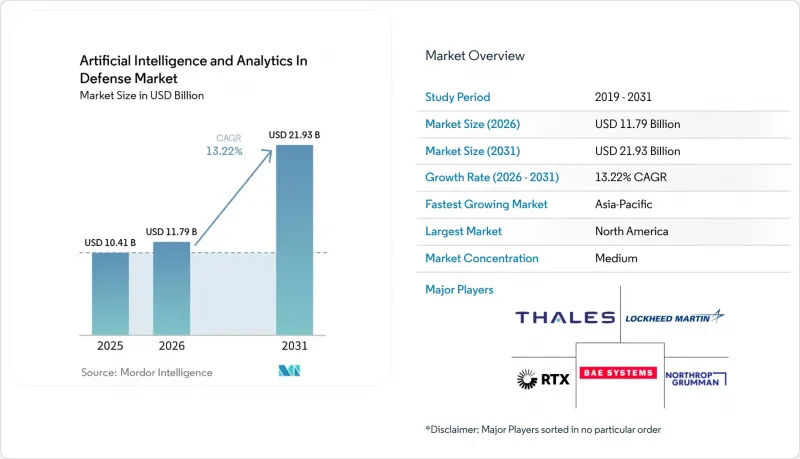
Mordor Intelligence에 의하면, 방위 분야 인공지능(AI) 및 애널리틱스 시장 규모는 2025년 104억 1,000만 달러로 평가되었고, 2026년에는 117억 9,000만 달러로 추정되고, 2026-2031년 CAGR 13.22%로 성장을 지속할 전망이며, 2031년까지 219억 3,000만 달러에 이를 것으로 예측됩니다.
본 보고서는 구성 요소별(하드웨어, 소프트웨어, 서비스), 플랫폼별(항공, 육상, 해상), 용도별(사이버 보안, 전장 의료, 전투 플랫폼, 물류 관리 등), 기술별(AI, 빅데이터 분석, 기타 기술) 및 지역별(북미, 유럽 등)로 분류되어 있습니다. 시장 전망은 금액(달러) 기준으로 제시되어 있습니다.
세계의 방위 분야 인공지능(AI) 및 애널리틱스 시장 동향과 인사이트
AI 기반 자율 시스템에 대한 국방비 증가
방위 분야 조달 담당자들은 항공, 육상, 해상 영역 전반에 걸쳐 자율성을 대규모로 실현하기 위한 자금을 지원하는 계약을 통해 실증 실험을 본격적인 프로그램으로 전환하고 있습니다. 미 해군이 Saronic사에 수여한 모듈식 무인수상정에 관한 다년 계약은 소모성 시스템의 조달 도입을 시사하는 동시에, 자율적인 해상 감시 및 경비 임무에 대한 수요를 뒷받침하는 것입니다. 소프트웨어 지출은 각 군종과 기밀 등급을 아우르며 데이터 통합과 AI 기반 의사결정 지원을 포함하는 엔터프라이즈급 계약을 통해 확대되고 있으며, 미 육군의 Palantir 플랫폼에 대한 사상 최대 규모의 계약이 그 대표적인 사례입니다. 동맹국 정부들도 AI를 활용한 의사결정 지원의 표준화를 추진하고 있으며, 영국은 워크플로우를 통합하고 국방 조직 전체에서 성과 창출을 가속화할 데이터 통합 및 AI 플랫폼에 대해 대규모 계약을 체결했습니다. 비행 시험 활동도 자율성의 성숙도를 높여가고 있으며, 비행 중 소프트웨어 인계 및 경쟁 관계에 있는 제어 스택 간의 상호 운용성을 검증하는 협업 전투기 실증 시험이 진행되고 있습니다. 이는 자율 소프트웨어가 실용적인 규모에서 다중 벤더 간 상호 운용 가능성에 가까워지고 있음을 보여주는 지표입니다. 기밀 처리가 가능한 컴퓨팅 클러스터에 대한 새로운 입찰은 안전한 환경 내에서 고급 모델의 훈련 및 호스팅에 대한 지속적인 투자를 보여주는 것으로, 견고한 엣지 및 배포 가능한 클라우드 인프라에 대한 수요를 더욱 높이고 있습니다.
실시간 전장 데이터의 급격한 증가
작전 중 촬영된 영상과 텔레메트리 데이터의 생성량이 급증하고 있으며, 우크라이나 전쟁의 경험을 바탕으로 감지 및 표적 지정 모델 훈련에 사용되는 수백만 시간 분량의 영상이 생성되었습니다. 이 데이터 기반을 통해 현장 분류 주기를 단축하고 정확도를 높일 수 있게 됩니다. 인도군의 현장 실증 결과, 머신러닝을 활용해 위성, 드론, 레이더 데이터를 융합함으로써 은폐된 발사 장치에 대한 감지 정확도가 향상되었으며, 분쟁 지역에서의 다중 센서 분석의 유효성이 입증되었습니다. Maven의 배포 등, 각 군종을 아우르며 확장 가능한 정보 플랫폼은 영상 및 신호 데이터 처리를 가속화하여, 분석 담당자가 더 가치 있는 업무에 시간을 할애할 수 있도록 하고 있습니다. 이는 자동화된 분류 및 인간에 의한 루프 내 검토(Human-on-the-Loop)로의 운영 전환과 부합하는 것입니다. 소프트웨어 정의 킬 체인은 정확하고 시의적절한 데이터에 의존하기 때문에 각 기관은 수집부터 의사 결정까지의 시간을 단축하기 위해 인증된 환경 내에서 모델 제공 플랫폼과 공통 데이터 레이어를 구축하고 있습니다. 센서 증가, 탑재된 컴퓨팅 성능의 향상, 그리고 안전한 AI 파이프라인의 결합을 통해, 전자기 환경이 상충하는 상황에서도 기계 수준의 속도로 상관 분석을 수행함으로써 현재 임무를 성공적으로 수행하고 있습니다.
높은 초기 통합 비용
AI를 기존 네트워크나 플랫폼에 통합하려면 인증, 사이버 보안 및 인터페이스 조정이 필요하며, 이로 인해 일정이 지연되고 비용이 증가합니다. 사이버 보안 성숙도 모델 인증(CMMC) 레벨 2와 같은 인증 절차는 국방 네트워크 전반에서 관리 대상인 비기밀 정보를 취급하는 것을 목표로 하는 소프트웨어 공급업체에게 더 이상 필수 요건이 되었습니다. 또한 프로그램 사무국은 함정 및 플랫폼 간 소프트웨어 스택을 표준화하고, 분산 현상을 해소하기 위한 노력을 추진하고 있습니다. 이를 통해 통합 비용을 절감할 수 있을 가능성이 있지만, 표준 운영 환경에 대한 초기 투자가 필요합니다. 치명적인 결과에 대한 인간의 감독을 보장하면서 자동화를 촉진하는 부처 차원의 지침에 따라, 시스템은 감사 가능성과 제어 기능을 갖추도록 설계되어야 하며, 이로 인해 안전 및 거버넌스를 위한 비반복적인 엔지니어링 업무 부담이 증가합니다. 방위 분야 인공지능(AI) 및 애널리틱스 기술은 서비스 성장률 측면에서 이러한 현실을 반영하고 있으며, 시스템 통합사업자들은 진화하는 규정 준수 기준에 부합하는 지속적인 인증 및 유지 관리 활동을 통해 수익을 창출하고 있습니다. 사전 인증을 획득하고 보안 승인을 받은 인력을 보유한 공급업체는 선점 우위를 누리고 있지만, 많은 프로그램에서는 여전히 고객 간에 재사용할 수 없는 맞춤형 통합이 요구되고 있습니다.
부문별 분석
하드웨어는 2025년 매출의 45.70%를 차지했으며, 컴퓨팅, 센서, 자율 플랫폼의 기반을 확립했습니다. 한편, 통합과 유지 관리가 핵심적인 가치 창출 요인으로 부상함에 따라, 해당 서비스 시장은 2031년까지 연평균 성장률(CAGR) 17.10%라는 가장 높은 성장률을 보일 것으로 전망됩니다. 당국은 대규모 언어 처리 및 비전 아키텍처를 포함한 현행 및 차세대 모델을 지원하기 위해 보안 인증을 완료한 컴퓨팅 클러스터를 도입하고 있으며, 이에 따라 러기드 서버와 가속기에 대한 수요가 증가하고 있습니다. 동시에, 엔터프라이즈 데이터 플랫폼과 지휘통제 소프트웨어가 계속해서 소프트웨어 지출의 기반을 이루고 있으며, 분석, 작전 계획, 정보 워크플로우에 공통된 도구 세트를 제공하는 다중 서비스 계약이 체결되고 있습니다. 이러한 동향은 구매자들이 기밀 수준이나 연합을 초월하여 운영이 가능하고, 데이터 접근을 허용하며, 고립된 단일 도구가 아닌 모듈식 용도 생태계를 지원할 수 있는 확장 가능한 플랫폼을 선호하고 있음을 보여줍니다. 그 결과, 국방 분야의 인공지능(AI) 및 분석 시장에서는 컴퓨팅 및 센서에 대한 초기 투자와 도입, 인증, 갱신 관리를 위한 지속적인 서비스 계약 간의 균형이 이루어지고 있습니다.
방위 분야에서의 서비스 확대는 운영 허가(AO), 사이버 보안 기준 준수, 기존 레거시 네트워크와의 통합과 같은 인증 요건 및 유지 관리상의 과제의 영향을 받고 있으며, 이러한 요인들이 복합적으로 작용하여 지속적인 범위 조정을 초래하고 있습니다. 또한, 부처의 방침에 따라 물류 및 유지보수 분야의 자동화가 장려되고 있으며, 이에 따라 대규모 조직 전체 차원의 모델 운영, 데이터 엔지니어링 및 사용자 교육의 필요성이 높아지고 있습니다. 예측 기간 동안, 주요 계약업체와 IT 통합업체는 자율형 소프트웨어 기업과의 파트너십을 심화하여 실제 도입을 가속화하는 동시에 규정 준수 부담을 분담할 것으로 예측됩니다. 이는 AI가 임무의 모든 측면에 적용됨에 따라, 장기 유지보수 계약에 적합한 체계가 될 것입니다. 방위 산업 분야의 인공지능과 분석 기술은 기밀 환경에 적합한 DevSecOps를 도입하고 있으며, 이를 통해 보안을 저해하지 않으면서도 배포 파이프라인의 표준화와 패치 적용을 신속하게 진행하고 있습니다. 이러한 상황에서 데이터 양이 증가하고, 임무 책임자들이 적의 적응에 대응하기 위해 지속적인 모델 재훈련을 요구함에 따라, 각 군은 통합을 통해 부가가치를 창출하고 있습니다.
2025년 시장 점유율에서는 지상 시스템이 43.55%로 1위를 차지했으나, 공동 전투기 프로그램에서 자율 기술의 성숙도와 소모형 드론의 실전 배치 확대에 따라 항공 플랫폼은 2031년까지 연평균 성장률(CAGR) 15.85%라는 가장 높은 성장세를 보일 것으로 전망됩니다. 플랫폼에 구애받지 않는 자율성과, 서로 다른 제어 아키텍처 간 비행 중 소프트웨어 인계 실증을 통해 소프트웨어의 이식성이 향상되었음이 입증되었습니다. 이로 인해 벤더 종속성이 완화되어, 여러 벤더의 기체 군 도입이 촉진되고 있습니다. 해상 자율화도 진전되고 있으며, 모듈식 페이로드와 지속적인 감시를 중시하는 무인수상정(USV)에 대해 수억 달러 규모의 계약이 잇따르고 있습니다. 이는 해군이 유인 자산과 무인 자산을 결합한 상호 보완적인 함대를 구축하고 있음을 보여주는 징후입니다. 이러한 플랫폼의 동향은 자율화가 고립된 시범 단계에서 개방형 인터페이스와 임무 소프트웨어의 민첩성이 중요한 평가 요소가 되는 지속 가능한 프로그램으로 전환되고 있음을 뒷받침합니다.
항공 분야의 성장세는 신속한 전개, 모듈식 페이로드 교체, 구조적 개조 없이 현장에서 수행 가능한 소프트웨어 업데이트 등 운영상의 이점을 반영하고 있습니다. 육상 시스템은 그 규모와 임무의 다양성 덕분에 여전히 중심적인 위치를 차지하고 있습니다. 그 임무는 후방 지원에서 전자전(EW)은 물론, 여단 규모로 전개되는 대기뢰 임무에 이르기까지 다양합니다. 해군의 프로그램은 대기뢰전(MCM), 대잠수함전(ASuW), 연안 방어 분야에서 무인 시스템의 지속성과 위험 허용도를 활용하는 유인 및 무인 혼합 아키텍처의 기반을 마련하고 있습니다. 프로그램이 양산 단계로 접어들면서, 시장은 지휘관 및 정비 담당자를 위해 패키지화된 견고한 안전 사례, 텔레메트리 수집, 그리고 임무 후 분석을 통해 최전선에서 높은 신뢰성을 갖춘 자율성을 입증한 공급업체를 높이 평가할 가능성이 높습니다. 예측 기간 동안 플랫폼 예산은 계속해서 소프트웨어 정의 기능을 우선시할 것이므로, 지속적인 통합 및 테스트 역량이 경쟁 우위가 될 것입니다.
지역별 분석
북미는 지속 가능한 조달, 기업 소프트웨어 통합, 그리고 각 군을 아우르는 인증된 클라우드 환경 구축을 통해 2025년에는 시장 점유율의 41.80%를 차지했습니다. 생성형 AI에 관한 조직적 지침과 인증 환경은 운영, 훈련 및 유지보수와 관련된 실험 및 도입 절차를 강화하고 있습니다. 이 공급업체는 각 사령부 및 군종 간 데이터 기반을 표준화하는 다년 계약을 수주했으며, 이를 통해 신규 용도 도입 기간이 단축되고 중복 업무가 줄어들고 있습니다. 해상 자율화 및 공통 운영 체제와 관련된 노력 또한 미 해군의 소프트웨어 표준화를 추진하고 있으며, 이를 통해 해상에서의 크로스 플랫폼 배포가 간소화될 전망입니다. 이러한 구조적인 선택은 해당 지역 전체에 걸쳐 향후 AI 투자를 위한 견고한 기반을 마련하고 있습니다.
아시아태평양은 현대화와 지능화를 중시하는 정부 예산 및 감시 및 국경 경비에 대한 국내 투자의 뒷받침을 받아, 2031년까지 연평균 성장률(CAGR) 15.30%를 기록하며 성장할 것으로 전망됩니다. 인도의 2026년도 국방 예산 및 프로젝트 계획에는 수십 건의 AI 이니셔티브와 분쟁 지역에서의 대규모 도입이 포함되어 있으며, 이는 운영상 수요와 산업 역량이 점차 융합되고 있음을 보여줍니다. 중국의 2025년도 공식 국방 예산은 해당 지역의 현대화 규모에 대한 추가적인 배경을 제공하며, 이는 영역을 초월한 자율성과 다중 센서 분석의 필요성을 뒷받침하고 있습니다. 이러한 요인들이 복합적으로 작용하여, 엄격한 주권 규칙 하에서도 에지 자율성과 안전한 분석을 제공할 수 있는 통합 업체에 대한 지역적 수요가 증가하고 있음을 보여줍니다.
유럽은 각국의 독자적인 프로그램과 EU 차원의 노력을 결합하여 역량 격차를 해소하는 한편, 데이터 공유 및 AI 도입에 영향을 미치는 거버넌스 체계도 추진하고 있습니다. 유럽연합 집행위원회의 ‘데이터법’은 특히 연합 및 대서양 횡단 협력 체제 내에서 방위용 소프트웨어의 아키텍처를 형성하는 데이터 권리와 공유 조건을 규정하고 있습니다. 일부 국가에서는 신설되거나 규모가 확대된 기관 및 산업 간 협력을 포함하여, 국방 AI를 위한 전문 기관 및 파트너십 구축이 진행되고 있습니다. 분석 및 의사결정 지원을 포함한 국방용 데이터 플랫폼을 표준화하는 대규모 국가 계약은 해당 지역이 대규모 주권 역량 구축을 추진하고 있음을 다시 한번 보여주고 있습니다.
기타 혜택 :
- 엑셀 형식 시장 예측(ME) 시트
- 3개월간의 애널리스트 지원
자주 묻는 질문
목차
제1장 서론
제2장 조사 방법
제3장 주요 요약
제4장 시장 구도
제5장 시장 규모 및 성장 예측
제6장 경쟁 구도
제7장 시장 기회 및 향후 전망
AJY 26.06.26According to Mordor Intelligence, the artificial intelligence and analytics in defense market size is expected to grow from USD 10.41 billion in 2025 to USD 11.79 billion in 2026 and is forecasted to reach USD 21.93 billion by 2031 at a 13.22% CAGR during 2026-2031.
This report is Segmented by Component (Hardware, Software, and Services), Platform (Airborne, Land, and Naval), Application (Cybersecurity, Battlefield Healthcare, Warfare Platform, Logistics Management, and More), Technology (AI, Big Data Analytics, and Others Technologies), and Geography (North America, Europe, and More). The Market Forecasts are Provided in Terms of Value (USD).
Global Artificial Intelligence And Analytics In Defense Market Trends and Insights
Rising Defense Expenditure on AI-Enabled Autonomous Systems
Defense buyers are converting pilots into programs with contracts that fund autonomy at scale across air, ground, and maritime domains. The US Navy's multiyear award to Saronic for modular unmanned surface vessels signals procurement acceptance of attritable systems and validates mission demand for autonomous maritime surveillance and security roles. Software spending is expanding through enterprise-level agreements that embed data integration and AI decision support across services and classification levels, demonstrated by the US Army's maximum-value agreement for Palantir platforms. Allied governments are standardizing on AI-enabled decision support as well, with the UK awarding a large contract for a data integration and AI platform that consolidates workflows and accelerates delivery across defense organizations. Flight test activity has also advanced autonomy maturity with collaborative combat aircraft demonstrations that validate mid-flight software handoffs and interoperability between competing control stacks, an indicator that autonomy software is approaching multi-vendor operability at a relevant scale. New solicitations for classified-ready compute clusters indicate continued investment in training and hosting advanced models within secure environments, strengthening demand for hardened edge and deployable cloud infrastructure.
Exponential Growth of Real-Time Battlefield Data
Operational video and telemetry generation has surged, with Ukraine's war experience producing millions of hours of video used to train detection and targeting models. This data foundation enables faster classification cycles and improved accuracy rates in the field. Field demonstrations by the Indian military showed that fusing satellite, drone, and radar feeds using machine learning improved detection accuracy against concealed launchers, supporting the case for multi-sensor analytics on contested borders. Intelligence platforms that scale across services, such as Maven deployments, are helping process imagery and signals data at speeds that reallocate analyst time to higher-value tasks, aligning with the operational shift toward automated triage and human-on-the-loop review. As software-defined kill chains depend on accurate, timely data, institutions are establishing model-serving platforms and common data layers in accredited environments to shorten the collection-to-decision timelines. The combination of more sensors, better onboard compute, and secure AI pipelines now underwrites mission threads where machine-speed correlation becomes decisive in contested electromagnetic conditions.
High Upfront Integration Costs
Integrating AI into legacy networks and platforms involves accreditation, cybersecurity, and interface mediation, which extend timelines and add costs. Accreditation pathways, such as the Cybersecurity Maturity Model Certification Level 2, have become table stakes for software vendors that want to handle controlled unclassified information across defense networks. Program offices are also working to standardize software stacks across vessels and platforms to reduce fragmentation, which can lower integration cost but requires upfront investment in typical operating environments. Department-level guidance that promotes automation while ensuring human oversight of lethal outcomes means systems must be designed with auditability and controls, which adds non-recurring engineering workload for safety and governance. The artificial intelligence and analytics in the defense market reflect this reality in services growth rates, as integrators monetize ongoing accreditation and sustainment activities aligned with evolving compliance baselines. Vendors with prior accreditations and cleared personnel enjoy a head start, but many programs still require tailored integration that cannot be reused across customers.
Other drivers and restraints analyzed in the detailed report include:
- Government AI R&D Funding Initiatives
- Need for Faster, Data-Driven Decision-Making
- Scarcity of Defense-Qualified AI Talent
For complete list of drivers and restraints, kindly check the Table Of Contents.
Segment Analysis
Hardware accounted for 45.70% of 2025 revenue, setting the baseline for compute, sensors, and autonomous platforms, while services posted the fastest projected growth at a 17.10% CAGR through 2031 as integration and sustainment became core value drivers. Authorities are procuring classified-ready compute clusters to support current and next-generation models, including large language and vision architectures, which reinforces demand for ruggedized servers and accelerators. At the same time, enterprise data platforms and command-and-control software continue to anchor software spending, with multi-service agreements that bring common tooling to analysis, operations planning, and intelligence workflows. These developments indicate that buyers prefer scalable platforms capable of operating across classification levels and coalitions, enabling data access and supporting modular application ecosystems instead of isolated point tools. Consequently, the artificial intelligence and analytics in defense market is balancing initial investments in computing and sensors with recurring service contracts for deployment, accreditation, and updates management.
Service expansion in the defense sector is influenced by accreditation requirements and sustainment challenges, including Authority to Operate, adherence to cybersecurity standards, and integration with existing legacy networks, which collectively contribute to recurring scope adjustments. Department policy also encourages automation in logistics and maintenance, which increases the need for model operations, data engineering, and user training across large organizations. Over the forecast, primes and IT integrators are expected to deepen partnerships with autonomy software firms to accelerate fielding and share compliance burdens, an arrangement that fits long-term sustainment contracts as AI permeates mission threads. The artificial intelligence and analytics in defense industry is also adding DevSecOps practices adapted for classified environments, which standardize delivery pipelines and speed patching without undermining security. In this context, services capture the integration premium as data volumes grow and as mission owners demand continuous model retraining that responds to adversary adaptation.
Land systems held the leading 2025 share at 43.55%, while airborne platforms recorded the highest projected growth at 15.85% CAGR through 2031 as autonomy matured in collaborative combat aircraft programs and attritable drones scaled into operational use. Demonstrations of platform-agnostic autonomy and mid-flight software handoff across different control architectures showed that software portability is improving, reducing vendor lock-in and encouraging multi-vendor fleets. Maritime autonomy is also advancing with multi-hundred-million-dollar awards for unmanned surface vessels (USVs) that emphasize modular payloads and persistent surveillance, a sign that navies are building complementary fleets of crewed and uncrewed assets. These platform trends confirm that autonomy is moving beyond isolated pilots into sustained programs where open interfaces and mission software agility are key evaluation factors.
Airborne momentum reflects operational advantages, including rapid deployment, modular payload swaps, and software updates that can be fielded without structural retrofits. Land systems remain central because of volume and mission diversity, from logistics to electronic warfare (EW) and counter-mine roles that scale across brigades. Naval programs are setting the stage for mixed-crewed architectures that exploit uncrewed endurance and risk tolerance in mine countermeasures (MCM), anti-submarine warfare (ASuW), and coastal defense. As programs move into production, the market is likely to reward suppliers that prove reliable autonomy at the edge with robust safety cases, telemetry capture, and post-mission analytics packaged for commanders and maintainers. Over the forecast, platform budgets will continue to favor software-defined capabilities, which makes sustained integration and test capacity a competitive advantage.
Geography Analysis
North America held 41.80% of the market share in 2025 due to sustained procurement, enterprise software consolidation, and accredited cloud build-outs across services. Institutional guidance and accredited environments for generative AI are strengthening experimentation and deployment pathways that touch operations, training, and maintenance. Suppliers have secured multi-year awards that standardize data foundations across commands and services, shortening onboarding for new applications and reducing duplication. Maritime autonomy and common operating system initiatives are also driving US naval software standardization, which should simplify cross-platform deployments at sea. These structural choices produce a durable base for further AI investments across the region.
Asia-Pacific is projected to grow at a 15.30% CAGR through 2031, supported by official budgets that emphasize modernization and intelligentization as well as domestic investment in surveillance and border security. India's 2026 defense budget and project pipeline include dozens of AI initiatives and significant deployments along contested borders, a sign that operational demand and industrial capability are converging. China's official 2025 defense budget provides further context on the scale of regional modernization, which reinforces the need for autonomy and multi-sensor analytics across domains. These factors, together, point to increased regional demand for integrators that can deliver edge autonomy and secure analytics within strict sovereignty rules.
Europe is closing its capability gap through a mix of national programs and union-level initiatives, while also advancing governance frameworks that influence data sharing and AI deployment. The European Commission's Data Act establishes data rights and sharing conditions that shape defense software architectures, especially in coalition or transatlantic settings. Several countries are seeding specialized institutions and partnerships for defense AI, including newly created or expanded agencies and cross-industry collaborations. Large national awards that standardize data platforms for defense use, including analytics and decision support, further demonstrate the region's push for sovereign capabilities at scale.
- Lockheed Martin Corporation
- Northrop Grumman Corporation
- RTX Corporation
- BAE Systems plc
- THALES Group
- IBM Corporation
- General Dynamics Information Technology (General Dynamics Corporation)
- L3Harris Technologies, Inc.
- Palantir Technologies Inc.
- Shield AI
- Avathon, Inc.
- Elbit Systems Ltd.
- Anduril Industries, Inc.
- Airbus SE
- Rheinmetall AG
- QinetiQ Group
- Atos SE
- HENSOLDT AG
- Systematic A/S
- Dassault Systemes S.E.
Additional Benefits:
- The market estimate (ME) sheet in Excel format
- 3 months of analyst support
TABLE OF CONTENTS
1 INTRODUCTION
- 1.1 Study Assumptions and Market Definition
- 1.2 Scope of the Study
2 RESEARCH METHODOLOGY
3 EXECUTIVE SUMMARY
4 MARKET LANDSCAPE
- 4.1 Market Overview
- 4.2 Market Drivers
- 4.2.1 Rising defense expenditure on AI-enabled autonomous systems
- 4.2.2 Exponential growth of real-time battlefield data
- 4.2.3 Government AI R&D funding initiatives
- 4.2.4 Need for faster, data-driven decision-making
- 4.2.5 AI-based predictive maintenance for extended platform life
- 4.2.6 Growth of synthetic training environments
- 4.3 Market Restraints
- 4.3.1 High upfront integration costs
- 4.3.2 Scarcity of defense-qualified AI talent
- 4.3.3 Ethical and regulatory concerns over lethal autonomy
- 4.3.4 Data-sovereignty limits on multi-nation model training
- 4.4 Value Chain Analysis
- 4.5 Regulatory Landscape
- 4.6 Technological Outlook
- 4.7 Porter's Five Forces Analysis
- 4.7.1 Bargaining Power of Suppliers
- 4.7.2 Bargaining Power of Buyers
- 4.7.3 Threat of New Entrants
- 4.7.4 Threat of Substitutes
- 4.7.5 Intensity of Competitive Rivalry
5 MARKET SIZE AND GROWTH FORECASTS (VALUE)
- 5.1 By Component
- 5.1.1 Hardware
- 5.1.2 Software
- 5.1.3 Services
- 5.2 By Platform
- 5.2.1 Airborne
- 5.2.1.1 Combat Aircraft
- 5.2.1.2 Unmanned Aerial Vehicles (UAVs)
- 5.2.2 Land
- 5.2.2.1 Military Fighthing Vehicles
- 5.2.2.2 Unmanned Ground Vehicles (UGVs)
- 5.2.3 Naval
- 5.2.3.1 Ships
- 5.2.3.2 Submarines
- 5.2.3.3 Unmanned Marine Vehicles (UMVs)
- 5.2.1 Airborne
- 5.3 By Application
- 5.3.1 Cybersecurity
- 5.3.2 Battlefield Healthcare
- 5.3.3 Warfare Platform
- 5.3.4 Logistics Management
- 5.3.5 Training and Simulation
- 5.3.6 Surveillance and Situational Awareness
- 5.3.7 Others
- 5.4 By Technology
- 5.4.1 Artificial Intelligence (AI)
- 5.4.2 Big Data Analytics
- 5.4.3 Other Technologies
- 5.5 By Geography
- 5.5.1 North America
- 5.5.1.1 United States
- 5.5.1.2 Canada
- 5.5.1.3 Mexico
- 5.5.2 Europe
- 5.5.2.1 United Kingdom
- 5.5.2.2 France
- 5.5.2.3 Germany
- 5.5.2.4 Russia
- 5.5.2.5 Rest of Europe
- 5.5.3 Asia-Pacific
- 5.5.3.1 China
- 5.5.3.2 India
- 5.5.3.3 Japan
- 5.5.3.4 South Korea
- 5.5.3.5 Rest of Asia-Pacific
- 5.5.4 South America
- 5.5.4.1 Brazil
- 5.5.4.2 Rest of South America
- 5.5.5 Middle East and Africa
- 5.5.5.1 Middle East
- 5.5.5.1.1 Saudi Arabia
- 5.5.5.1.2 United Arab Emirates
- 5.5.5.1.3 Israel
- 5.5.5.1.4 Rest of Middle East
- 5.5.5.2 Africa
- 5.5.5.2.1 South Africa
- 5.5.5.2.2 Rest of Africa
- 5.5.5.1 Middle East
- 5.5.1 North America
6 COMPETITIVE LANDSCAPE
- 6.1 Strategic Moves
- 6.2 Market Share Analysis
- 6.3 Company Profiles (includes Global Level Overview, Market Level Overview, Core Segments, Financials as aAvailable, Strategic Information, Market Rank/Share for Key Companies, Products and Services, and Recent Developments)
- 6.3.1 Lockheed Martin Corporation
- 6.3.2 Northrop Grumman Corporation
- 6.3.3 RTX Corporation
- 6.3.4 BAE Systems plc
- 6.3.5 THALES Group
- 6.3.6 IBM Corporation
- 6.3.7 General Dynamics Information Technology (General Dynamics Corporation)
- 6.3.8 L3Harris Technologies, Inc.
- 6.3.9 Palantir Technologies Inc.
- 6.3.10 Shield AI
- 6.3.11 Avathon, Inc.
- 6.3.12 Elbit Systems Ltd.
- 6.3.13 Anduril Industries, Inc.
- 6.3.14 Airbus SE
- 6.3.15 Rheinmetall AG
- 6.3.16 QinetiQ Group
- 6.3.17 Atos SE
- 6.3.18 HENSOLDT AG
- 6.3.19 Systematic A/S
- 6.3.20 Dassault Systemes S.E.
7 MARKET OPPORTUNITIES AND FUTURE OUTLOOK
- 7.1 White-space and Unmet-Need Assessment