

|
시장보고서
상품코드
2061778
스페인의 히트펌프 시장 : 시장 점유율 분석, 업계 동향 및 통계, 성장 예측(2026-2031년)Spain Heat Pump - Market Share Analysis, Industry Trends & Statistics, Growth Forecasts (2026 - 2031) |
||||||
 Mordor Intelligence
Mordor Intelligence에 의하면, 스페인의 히트펌프 시장 규모는 2025년 7억 538만 달러로 평가되었고, 2026년에는 7억 4,484만 달러로 추정되고, 2031년까지 9억 5,641만 달러에 이를 것으로 예측되며, 2026-2031년 CAGR 5.13%로 성장할 전망입니다.
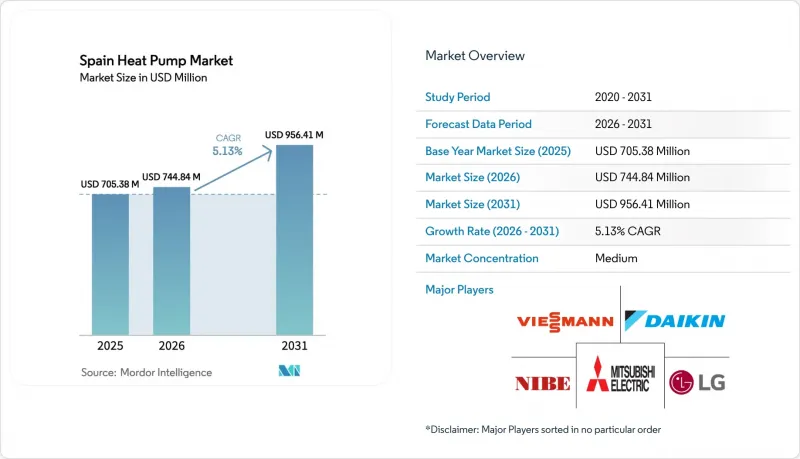
본 보고서는 열원 유형별(공기원, 수원 등), 기술별(공기-공기, 공기-물 등), 용량별(10kW 미만, 10-50kW 등), 용도별(공간 난방, 공간 냉방 등), 최종 사용자별(주거, 상업, 산업), 설치 형태별(신규 설치, 개보수), 지역별로 분류되어 있습니다. 시장 전망은 금액(달러) 기준으로 제시되어 있습니다.
스페인의 히트펌프 시장 동향 및 인사이트
정부의 인센티브 및 환경 보조금
스페인의 단계적 자금 지원 체계는 국가 차원의 재건 보조금과 자치주 차원의 추가 지원을 결합한 것으로, 일반 가구에는 3,000-5,000유로(3,390-5,650달러)의 환급금이 지급되며, 바르셀로나에서는 최대 1만 8,800유로(2만 1,240달러)의 프로젝트 지원이 제공되고 있습니다. 카탈루냐 주의 40% 자본 보조금과 안달루시아 주의 6,190만 유로(6,995만 달러) 규모의 새로운 축열 라인 덕분에, 설치 업체들의 역량은 인센티브가 높은 지역에 집중되고 있으며, 보조금이 적은 주에서는 수요가 충족되지 못하고 있는 상황입니다. 2026년 RENORED 프로그램에 따라 공공기관에 제공되는 최대 75%에 달하는 보조금 지원률은 지역 열공급 시스템의 전기화를 촉진하고 있습니다. 인센티브 덕분에 투자 회수 기간은 최단 5년까지 단축되지만, 한편으로는 지역 간 노동력 불균형을 초래하고, 설치 업체의 기술 향상이 더욱 시급해지고 있습니다.
EU 그린 딜 및 EPBD 준수 기한
2026년 5월에 시행될 개정판 ‘건축물 에너지 성능 지침(EPBD)’에 따라, 개발업자와 소유주는 지역별 건축 기준에 따라 화석 연료 보일러 사용 금지가 잇따르기 전에 제로 배출 솔루션을 확정해야 합니다. D등급 미만의 평가를 받은 건물은 2033년까지 개보수가 필요하게 되며, 단열재나 저온 라디에이터가 설치되지 않은 1980년 이전의 스페인 주택 재고에서 개보수 공사가 집중될 것입니다. 상업용 부동산 소유주들은 그린 파이낸스 자격 요건을 유지하기 위해 공기-물 방식 및 하이브리드 시스템으로 전환하고 있으며, 이러한 추세는 마드리드와 바르셀로나의 설치 업체들이 보유한 대규모 수주 잔고에 반영되어 있습니다.
설치 작업에 필요한 숙련된 인력의 부족
스페인은 2030년까지 EU 전체에서 50만 명의 설치 전문가를 양성하겠다는 목표 중 자국의 할당량을 달성하기 위해 수천 명의 기술자를 추가로 양성해야 합니다. 현재의 인증 제도 하에서는 연간 8,000명 미만의 전문가만 배출되고 있으며, 주요 도시에서는 공사 기간이 4주에서 12주로 늘어났습니다. 온수식 개보수 공사에는 수력 균형 조정이나 저온 라디에이터 선정과 같은 전문 기술이 필요하지만, 이러한 기술은 냉방용 스플릿 에어컨을 전문으로 하는 작업자에게는 드문 기술이기 때문에 복잡한 공사의 경우 인건비가 15-25% 상승하고 있습니다. 기업 인수자들은 부족한 시공 역량을 확보하기 위해 설치 업체 팀을 통째로 인수하는 움직임을 보이고 있습니다.
부문별 분석
하이브리드 유닛은 현재 도입 대수가 적음에도 불구하고 연평균 성장률(CAGR) 5.49%로 성장을 지속하고 있으며, 스페인의 500만 대에 달하는 냉방 설비를 활용함으로써 추가 투자를 최소화할 것으로 예측됩니다. 이를 통해 사업자는 피크 부하가 드문 시간대에 가스 보일러를 가동하면서도, 겨울철 전력망 용량에 부담을 주지 않고 배출량을 60% 감축할 수 있게 됩니다. 반면, 스페인의 히트펌프 시장에서는 겨울철 온화한 기후 덕분에 계절별 COP가 3.5 이상을 유지할 수 있어, 공기원식 기기가 2025년에는 84.73%의 점유율을 차지했으며, 시장을 주도하고 있습니다.
하이브리드 방식의 성장세는 파워-투-가스(Power-to-Gas)의 가격 차이와 단기적인 송전망 업그레이드에 관한 정책의 불확실성과 일치하고 있습니다. 각 제조업체는 연료를 동적으로 전환하는 예측 제어 기능을 탑재하고 있으며, 송전망 강화가 실현되면 완전한 전기화로 나아가는 비용 최적화된 경로를 마련하고 있습니다. 따라서 스페인의 히트펌프 시장은 양극화된 양상을 보이고 있는데, 해안 지역에서는 순수 전기 방식이 주도하는 반면, 한파 시의 신뢰성에 여전히 우려를 표하는 북부 지역에서는 하이브리드 방식이 자리 잡고 있습니다.
공기-물형 플랫폼은 탄소중립 건축 기준에서 의무화된 바닥 난방 및 온수 순환 시스템과의 호환성 덕분에 시장 점유율을 확대되고 있습니다. 2025년에 38.31%의 시장 점유율을 차지한 것으로 평가되는 이 부문은 연평균 성장률(CAGR) 5.69%로 성장하며, 공기 대 공기 방식의 설치 기반을 서서히 잠식해 나갈 것으로 전망됩니다. 학교, 호텔, 병원에서는 택소노미에 부합하는 자금 조달을 확보하기 위해 수열식 시스템이 표준화되어 있으며, 이러한 추세는 스페인 히트펌프 시장이 냉방 전용 솔루션에서 전환되는 움직임을 뒷받침하고 있습니다.
이러한 전환은 공급망에도 영향을 미치고 있으며, 55-60℃의 토출 온도에 대응하는 압축기 및 순환 펌프에 대한 수요가 증가하고 있고, 설치 업체들은 수력 균형 조정에 관한 재교육을 받고 있습니다. 디지털 시운전 도구를 통해 유량 최적화 과정이 효율화되어 시운전 시간이 3분의 1로 단축되었습니다. 이러한 상황에서 스페인 히트펌프 시장에서 온수식 개조에 할당되는 시장 규모는 2031년까지 연간 3억 유로(3억 4,000만 달러)를 넘어설 것으로 예측됩니다.
기타 혜택 :
- 엑셀 형식 시장 예측(ME) 시트
- 3개월간의 애널리스트 지원
자주 묻는 질문
목차
제1장 서론
제2장 조사 방법
제3장 주요 요약
제4장 시장 구도
제5장 시장 규모 및 성장 예측
제6장 경쟁 구도
제7장 시장 기회 및 향후 전망
AJY 26.06.26According to Mordor Intelligence, the spain heat pump market size is expected to increase from USD 705.38 million in 2025 to USD 744.84 million in 2026 and reach USD 956.41 million by 2031, growing at a CAGR of 5.13% over 2026-2031.
This report is Segmented by Source Type (Air Source, Water Source, and More), Technology (Air-To-Air, Air-To-Water, and More), Capacity (Below 10 KW, 10-50 KW, and More), Application (Space Heating, Space Cooling, and More), End User (Residential, Commercial, and Industrial), Installation (New Installation, and Retrofit), and Geography. The Market Forecasts are Provided in Terms of Value (USD).
Spain Heat Pump Market Trends and Insights
Government Incentives and Environmental Subsidies
Spain's tiered funding stack blends national recovery grants with autonomous-community top-ups, delivering household rebates of EUR 3,000-5,000 (USD 3.39-5.65 thousand) and, in Barcelona, project support worth up to EUR 18,800 (USD 21.24 thousand). Catalonia's 40% capital grants and Andalusia's new EUR 61.9 million (USD 69.95 million) thermal-storage line have pulled installer capacity toward high-incentive regions, leaving lower-subsidy provinces underserved. Grant intensity that reaches 75% for public entities under the 2026 RENORED program extends electrification into district energy schemes. While incentives shorten payback periods to as little as five years, they also create regional labor imbalances and accelerate the need for installer upskilling.
EU Green Deal and EPBD Compliance Deadlines
The May 2026 transposition of the recast Energy Performance of Buildings Directive forces developers and owners to lock in zero-emission solutions before fossil boiler bans cascade through regional codes. Buildings rated below class D must be upgraded by 2033, concentrating retrofit activity in Spain's pre-1980 housing stock that lacks insulation or low-temperature radiators. Commercial property owners are pivoting toward air-to-water and hybrid systems to retain eligibility for green finance, a trend reflected in large pre-order backlogs with installers in Madrid and Barcelona.
Skilled Labor Shortage for Installations
Spain must train thousands more technicians to reach its proportional share of the EU-wide 500,000-installer goal by 2030. Current certification pipelines graduate fewer than 8,000 specialists yearly, inflating lead times from four to 12 weeks in major cities. Hydronic retrofits require hydraulic balancing and low-temperature radiator sizing skills rare among crews focused on cooling splits, pushing labor premiums 15-25% higher for complex jobs. Corporate buyers are acquiring installer teams outright to lock in scarce capacity.
Other drivers and restraints analyzed in the detailed report include:
- Rising Electricity-to-Gas Price Ratio Boosting TCO
- Advancements in Low-GWP Propane-Based Heat Pumps
- High Up-Front Equipment and Retrofit Costs
For complete list of drivers and restraints, kindly check the Table Of Contents.
Segment Analysis
Hybrid units, though a small base today, are projected to post a 5.49% CAGR and draw on Spain's five-million-unit cooling fleet to minimize incremental investment. They allow operators to retain gas boilers for sparse peak-load hours, delivering 60% emissions cuts without straining winter grid capacity. In contrast, air source equipment dominates the Spain heat pump market with an 84.73% 2025 share, buoyed by benign winter temperatures that support seasonal COP above 3.5.
Hybrid momentum aligns with power-to-gas price spreads and policy uncertainty over near-term grid upgrades. Manufacturers bundle predictive controls that switch fuels dynamically, creating a cost-optimized pathway into full electrification once network reinforcement arrives. The Spain heat pump market therefore shows a bifurcated profile in which pure electrification leads coastal regions, while hybrids anchor northern provinces still wary of cold-spell reliability.
Air-to-water platforms are winning share thanks to their compatibility with underfloor heating and domestic hot water loops required by zero-carbon building codes. Holding 38.31% share in 2025, this cohort is projected to grow at 5.69% CAGR, gradually eroding the air-to-air installed base. Schools, hotels, and hospitals are standardizing on hydronics to secure taxonomy-aligned finance, a trend reinforcing the Spain heat pump market pivot away from cooling-only solutions.
The transition also affects supply chains; compressors and circulators rated for 55-60 °C delivery temperatures face rising demand, and installers retrain on hydraulic balancing. Digital commissioning tools now streamline flow-rate optimization, cutting start-up time by one-third. As such, the Spain heat pump market size allocated to hydronic retrofits is expected to eclipse EUR 300 million (USD 340 million) annually by 2031.
List of Companies Covered in this Report:
- Daikin Industries Ltd.
- Mitsubishi Electric Corporation
- Panasonic Corporation
- Fujitsu General Ltd.
- Midea Group Co., Ltd.
- LG Electronics Inc.
- NIBE Industrier AB
- Viessmann Werke GmbH & Co. KG
- Vaillant Group
- Bosch Thermotechnology (Robert Bosch GmbH)
- Stiebel Eltron GmbH & Co. KG
- Carrier Global Corporation
- Trane Technologies plc
- Johnson Controls International plc (York)
- Lennox International Inc.
- Aermec S.p.A.
- Ariston Group
- Clivet S.p.A.
- Hitachi Air Conditioning Europe SAS
- Danfoss A/S
Additional Benefits:
- The market estimate (ME) sheet in Excel format
- 3 months of analyst support
TABLE OF CONTENTS
1 INTRODUCTION
- 1.1 Study Assumptions and Market Definition
- 1.2 Scope of the Study
2 RESEARCH METHODOLOGY
3 EXECUTIVE SUMMARY
4 MARKET LANDSCAPE
- 4.1 Market Overview
- 4.2 Market Drivers
- 4.2.1 Government Incentives and Environmental Subsidies
- 4.2.2 EU Green Deal and EPBD Compliance Deadlines
- 4.2.3 Rising Electricity?to?Gas Price Ratio Boosting TCO
- 4.2.4 Advancements in Low-GWP Propane-Based Heat Pumps
- 4.2.5 Uptake of Hybrid Heat Pumps Leveraging Cooling Base
- 4.2.6 Hospitality Decarbonization Driven by Tourism Boom
- 4.3 Market Restraints
- 4.3.1 Skilled Labor Shortage for Installations
- 4.3.2 High Up-Front Equipment and Retrofit Costs
- 4.3.3 Grid Capacity Limits in Urban Districts
- 4.3.4 Limited Roof/Riser Space in Multi-Family Buildings
- 4.4 Regulatory Landscape
- 4.5 Technological Outlook
- 4.6 Industry Value Chain Analysis
- 4.7 Porter's Five Forces Analysis
- 4.7.1 Bargaining Power of Suppliers
- 4.7.2 Bargaining Power of Buyers
- 4.7.3 Threat of New Entrants
- 4.7.4 Threat of Substitutes
- 4.7.5 Intensity of Competitive Rivalry
- 4.8 Impact of Macroeconomic Factors on the Market
5 MARKET SIZE AND GROWTH FORECASTS (VALUE)
- 5.1 By Source Type
- 5.1.1 Air Source
- 5.1.2 Water Source
- 5.1.3 Ground Source
- 5.1.4 Hybrid
- 5.2 By Technology
- 5.2.1 Air-to-Air
- 5.2.2 Air-to-Water
- 5.2.3 Water-to-Water
- 5.2.4 Ground-to-Water
- 5.3 By Capacity
- 5.3.1 Below 10 kW
- 5.3.2 10-50 kW
- 5.3.3 50-200 kW
- 5.3.4 Above 200 kW
- 5.4 By Application
- 5.4.1 Space Heating
- 5.4.2 Space Cooling
- 5.4.3 Domestic and Sanitary Hot Water
- 5.4.4 Industrial and Process Heating
- 5.4.5 Other Applications
- 5.5 By End User
- 5.5.1 Residential
- 5.5.2 Commercial
- 5.5.3 Industrial
- 5.6 By Installation
- 5.6.1 New Installation
- 5.6.2 Retrofit
6 COMPETITIVE LANDSCAPE
- 6.1 Market Concentration
- 6.2 Strategic Moves
- 6.3 Vendor Positioning Analysis
- 6.4 Company Profiles (includes Global Level Overview, Market Level Overview, Core Segments, Financials as available, Strategic Information, Market Rank/Share, Products and Services, Recent Developments)
- 6.4.1 Daikin Industries Ltd.
- 6.4.2 Mitsubishi Electric Corporation
- 6.4.3 Panasonic Corporation
- 6.4.4 Fujitsu General Ltd.
- 6.4.5 Midea Group Co., Ltd.
- 6.4.6 LG Electronics Inc.
- 6.4.7 NIBE Industrier AB
- 6.4.8 Viessmann Werke GmbH & Co. KG
- 6.4.9 Vaillant Group
- 6.4.10 Bosch Thermotechnology (Robert Bosch GmbH)
- 6.4.11 Stiebel Eltron GmbH & Co. KG
- 6.4.12 Carrier Global Corporation
- 6.4.13 Trane Technologies plc
- 6.4.14 Johnson Controls International plc (York)
- 6.4.15 Lennox International Inc.
- 6.4.16 Aermec S.p.A.
- 6.4.17 Ariston Group
- 6.4.18 Clivet S.p.A.
- 6.4.19 Hitachi Air Conditioning Europe SAS
- 6.4.20 Danfoss A/S
7 MARKET OPPORTUNITIES AND FUTURE OUTLOOK
- 7.1 White-Space and Unmet-Need Assessment


